Karen Beasley Sea Turtle Rescue & Rehabilitation Center
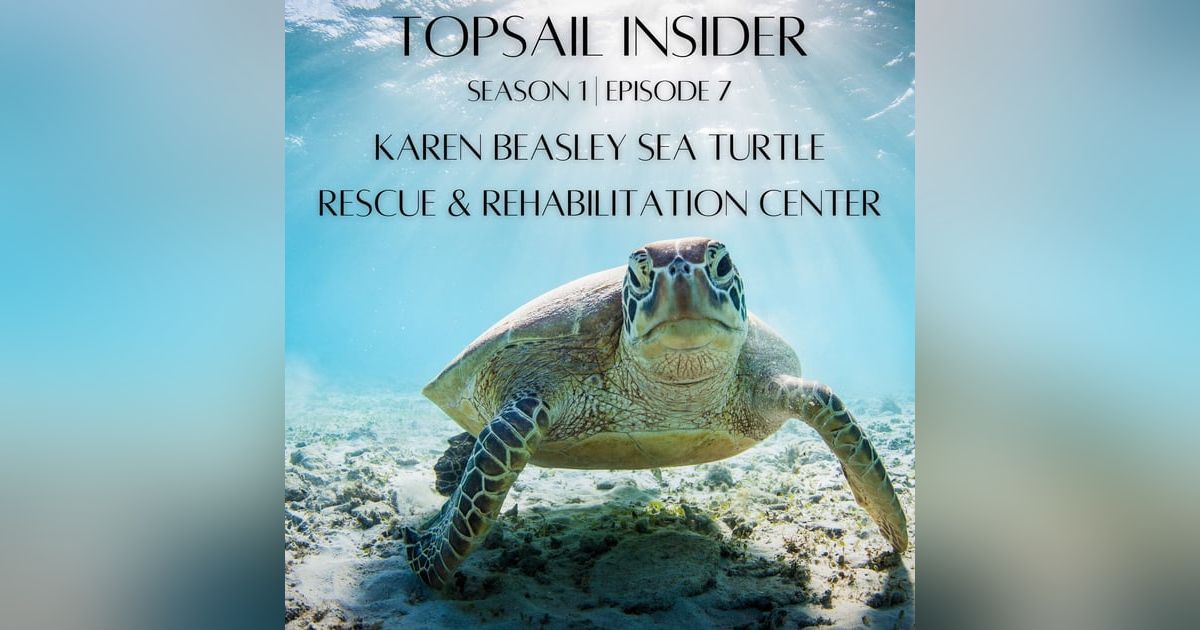


Ever wondered about the work carried out by the Karen Beasley Sea Turtle Rescue and Rehabilitation Center? Today's Topsail Insider podcast episode shines a light on the tireless efforts of this wonderful organization in Surf City, North Carolina. We're joined by the center's Executive Director, Kathy Zagzebski, who takes us on a journey through the center's mission to protect nesting females, their nests, and hatchlings, and rescue, rehabilitate and release injured sea turtles.
Topsail Insider is Sponsored by:
Saltwater Suites - Topsail Island’s premier luxury hospitality experience!
Book your beach getaway today at SaltwaterTopsail.com or call (910) 886-4818!
_________________________________________________
Audio Editor: Jim Mendes-Pouget | jimpouget@gmail.com
Please Follow/Subscribe to Topsail Insider so you don’t miss a single episode!
Also find and Follow Topsail Insider on Facebook, Instagram, Twitter and now, YouTube!
If you are a Greater Topsail or Wilmington business owner and wish to be interviewed or wish to sponsor or advertise with Topsail Insider, please email Christa at topsailinsider@gmail.com.
You may also call or text Christa at 910-800-0111.
Welcome to the Topsail Insider podcast, where locals, vacationers and those looking to relocate to the greater Topsail area can hear all about the wonderful businesses and events in our beautiful coastal Carolina towns, including Hampstead, Topsail Beach, Surf City, North Topsail, Holly Ridge and Sneads Ferry. Coming up, we all know and love the wonderful Sea Turtle Hospital in Surf City. We see the pictures and watch the videos of the amazing Sea Turtle rescues and releases and we count the nest all through the summer. But here is your chance to hear a wonderful conversation with the executive director of this incredible organization, Miss Kathy Zagzebski. Enjoy, Hello everyone and welcome to the Topsoil Insider podcast. My name is Krista and I am your host Today. I am so excited to be interviewing Miss Kathy Zagzebski. Did I say it right? You did, Kathy Zagzebski? she is the Executive Director of the Karen Beasley Sea Turtle Rescue and Rehabilitation Center in Surf City, North Carolina. Can you see how excited I am? I am so excited.
Kathy:I am so excited to be speaking with you today. Thank you, thank you for doing this.
Christa:Okay, everybody knows about the Sea Turtle Hospital here. If you are a local, you know about it. You are also very proud of it. I think it is the pride of the entire Topsail area. Everyone loves what you are doing. We love that we are able to see the Sea Turtle releases. It is very exciting. The locals are on an actual wait list to become a volunteer. Is that right?
Kathy:Yeah, we have a brand new system, so I am hoping it will make it a little bit easier. We are just in the process of implementing the public side of it. We have been working on it with our volunteers for a while. I know that in the past people have had a hard time sometimes getting a hold of us if they want to volunteer. I am just asking you all to be patient.
Christa:Be patient everybody. I love seeing the announcement on Facebook, in particular when you find a nest. I actually work with one of the volunteers that walks the mile on the beach before the sunrise and looks for those nests. It is so exciting.
Kathy:It is.
Christa:The vacationers when they come here. I have seen posts from vacationers. Someone called it their bucket list item. They got to see when the nest hatched and all those little sea turtles went out to the ocean. I am like I haven't even gotten to do that yet. I have goals.
Kathy:It was a bucket list item for me too.
Christa:Was it really I have?
Kathy:been lucky enough to see it a few times now. Every single time it feels like a new bucket list item. It is so amazing. These turtles have been doing these for thousands and thousands of years, just to see them scurry to the ocean.
Christa:It really is a big deal for so many of us here in this area. We really appreciate what you do and what your team does and what the volunteers do. Can you explain a little bit about the mission of the Karen Beasley Sea Turtle Rescue for anyone that hasn't heard of you yet Or maybe they are thinking about relocating here or thinking about vacationing here and they don't know yet? Tell us just the nutshell version about what your organization does.
Kathy:Yes, The mission of the Karen Beasley Sea Turtle Center is to conserve and protect sea turtles. We do that through a variety of different programs and efforts. One is that beach program where we protect nesting females, their nests and the hatchlings. The second is through our sea turtle hospital. That is where we rescue, rehabilitate and release second-injured sea turtles from all over the state, primarily the southern half of North Carolina, but all over North Carolina and sometimes even turtles from outside the state. How do they get to you? Usually flown Really. There is a volunteer group called Turtles Fly 2 and they have started up to help when there are these huge stranding events in New England. They will help take turtles and transport them from New England out to other places, like us here in North Carolina.
Christa:That is such a cool job. You guys have really cool jobs. You get paid to do the coolest things. I am so jealous.
Kathy:I love it. I love it.
Christa:When I went by to do a sound check at your facility and you gave me a tour, which I loved. You mentioned three endangered sea turtle species that you see here on Topsaw Island. Am I right? There are three primarily that you see, or are there more?
Kathy:There are three that are primarily seen here in North Carolina. We have documented five in the state. The Hawksbill Turtle is very endangered. It has only been seen a few times. The Leatherback Turtle is very endangered and we usually see them offshore. Sometimes you can see them off the end of the pier. I have yet to see one here, one in your facility. There was one before I came, apparently, but it was just a hatchling, thankfully, because leatherbacks can get to be up to a ton and wait. Really, yeah, that would be pretty tough to handle. It's so amazing that The three most common species that we treat in our sea turtle hospital are the Longerhead Turtle, the Green Turtle and the Kemp's Ridley Turtle.
Christa:Tell me about the type of injuries you see most often of these turtles that are coming into your facility.
Kathy:We see a lot of different injuries and illnesses faced by the turtles at Strand and come into our sea turtle hospital. Numerically the highest number come in due to a condition called cold stunning. That is a form of severe hypothermia that reptiles face In the case of the sea turtles. sea turtles are cold-blooded or ectothermic is the scientific word. Their temperature depends on the environment around them. If, as the water gets colder, they need to either migrate south to warmer waters or offshore to warmer waters. Offshore, yeah, they migrate toward the Gulf Stream, where the water is a lot warmer, gotcha, and some of them don't. We've got this great near shore habitat, all these wonderful estuaries and things like that, so they're like I don't want to leave. I can only imagine, Just like all of our wonderful guests in the summer Yes, a lot of vacation.
Christa:We don't want to leave, not leaving. I'm moving here. Yeah, Exactly.
Kathy:We understand turtles. Yes, we do, yes, we do.
Christa:Okay, so cold, stunning. That's the majority of your patients.
Kathy:Yeah, they come in, they basically get hypothermic shock. So the water gets colder and they go into severe hypothermic shock and They come ashore or they get blown ashore. They usually get blown ashore and it tends to kind of aggregate at two hot spots within the state. One is Cape Lookout and the other is up at Cape Hatteras. Okay, so a lot of our turtles in the wintertime come from that Cape Lookout area, okay, and sometimes they get dozens, sometimes they get hundreds of turtles. Really Yeah, so.
Christa:Are there other facilities like this one along the coast of North Carolina?
Kathy:In North Carolina, so we're the only 100% dedicated to sea turtles as serving only as a sea turtle hospital. There is a sea turtle hospital associated with the North Carolina Aquarium at Roanoke Islands called the Star Center, and also the North Carolina Aquarium at Pineal Shores has a portion of their facility dedicated to sea turtle rehab. I didn't know that. Yeah, so the North Carolina Aquarium at Fort Fisher and in the big years the Aquarium at Fort Fisher, they'll accept some turtles for rehabilitation. That's cool. So really, when it's a big year, all of us step in.
Christa:Just roll up your sleeves. We can't help.
Kathy:It's cold. Stunning human interaction. We see boat strikes. We see ingestion of hooks, so turtles will accidentally get hooked. We see entanglement. We see ingestion of plastic. We also see dredge turtles that come in because they were sucked in through a dredge.
Christa:Really.
Kathy:Yeah, sometimes when the dredges are offshore, how damaging is that? It can be really damaging It's. They're basically sucked through. There are a lot of technical terms for it, i'm sure I imagine a dredge has a big vacuum cleaner.
Christa:That's what it looks like. Yeah, yeah.
Kathy:They have protection, so they'll have grates over the end of the tubes and they have observers on board. So they really try to take precautions. The dredge turtles that we've gotten have been smaller, so somehow they fit between the grates. But when they come in they have two main issues. One, they're basically scoured by the sand as they're sucked along the tube, And the second is they're coming up really quickly from depth. So just like a diver a human diver you can't come up too quickly once you're diving at depth. So there are a lot of challenges with those turtles, Okay, But thankfully there aren't very many of those. We see a lot of boat strikes and those tend to be heartbreaking.
Christa:I'm sure this is based on their injuries, but on an average, how long do the turtles stay with you before you release them back into the ocean?
Kathy:We'll have turtles that stay with us. Some turtles are really quick turnarounds. If a turtle just swallowed a hook but is otherwise healthy, they may stay with us for only a couple of days, Basically fast enough for us to do the blood-wrapped turtle.
Christa:Those are the stealth releases.
Kathy:Exactly.
Christa:Those are the stealth releases Listeners. So if it's a quick turnaround, you do go through great lengths to set up these turtle releases And it could be upwards of 1,500 people attending these things. But there's a lot that goes into those with the city and all of that. But if it's a quick turnaround, you will go into stealth mode and put these turtles back in the ocean.
Kathy:Good, Yes, Our goal is to do the right thing for the turtles as quickly as we can And of course we want to share with the public as much as possible. But I will say, on our last release we had two turtles that had been hooked and they had just stranded a few days prior. So we just added those turtles to the release.
Christa:You had two recently.
Kathy:We had one in surf city two weeks ago and we had one in North Topsle Beach last week And we are hoping to schedule one in Topsle Beach, all in celebration of our 25th anniversary, which we are going to talk about What happens when one of the turtles cannot be released.
Christa:The injuries are so severe. Perhaps Right?
Kathy:Sometimes we do have a turtle that can't be released. It tends to happen when they're healed but they're not going to be fit to go out to the wild. We've had two turtles that were suffering from a positive buoyancy disorder, so one we thankfully placed last year and the other we're looking for a home. So sometimes a turtle comes in and they have severe internal injuries or even illnesses a positive buoyancy disorder where they basically float and they can't dive. They can't dive for food. That's really common and sometimes it can be from traumatic injury, sometimes it can be from a variety of different illnesses And sometimes we really don't know what happens. But we do have one turtle right now. Her name is Snooki. She's stranded in New Jersey. She's a Jersey girl. The Marine Mailman Strading Center up in New Jersey had performed the rescue and stabilized her and she just needed an ongoing place to complete her rehabilitation. So we accepted her in 2016 and then, a little while later, it started to become obvious that she developed those buoyancy issues. And sometimes you don't see them right away. They develop over time as the turtle grows and we were able to get a CT on her to drive her to South Carolina to find a CT scan.
Christa:Oh wow, Big enough for it.
Kathy:I did, but found that she had two fractured vertebrae at the top of her spinal cord and that was probably contributing to the buoyancy issue. So at that point our veterinarian, dr Craig Harms, did try some surgical procedures.
Christa:Okay, I was going to ask, yeah.
Kathy:But it's difficult. It was difficult on Snooki. It helped it a little bit but it didn't actually correct the problem. So when a turtle is obviously not going to be able to dive, it wouldn't be fair to that turtle to release it. So there's a process Our veterinarian certifies that she's not releasable and then we start looking for a home for her.
Christa:It could just be an aquarium. Is that what you're looking for?
Kathy:Yes, a zoo or an aquarium. We work with the state North Carolina Wildlife Resources Commission. There are permitting agency. They have to prove everything. We also work with the US Fish and Wildlife Service and any zoo or aquarium that is accredited that has the facilities that meet the standards. We don't want to send her to a bathtub somewhere or somebody's backyard swimming pool then they can accept it and we won't go through a transfer process. So if anybody knows a zoo or an aquarium with a nice big 5,000 plus gallon pool that wants to take a beautiful 305 pound girl named Snooki, she's got some personality, you won't Snooki.
Christa:It would be wonderful if we could find a home for Snooki It would be.
Kathy:That would be so great It would be.
Christa:I saw on that tour as well the kitchen that you use to make the food for your turtles. Can you tell us a little bit about their diet?
Kathy:Yes, so we feed the turtles various types of protein, various types of fish. The normal fish that we give them are Kaplan, that's a five or six inch small fish, and we also will feed them Northern mackerel. They like that. We'll feed them shrimp sometimes and squid, but Kaplan and squid form the bulk of their diet. Okay, we are lucky enough to work with a wonderful bait dealer up in Moorhead City And they will deliver the fish to us.
Christa:Oh cool.
Kathy:Cape Point Bait and shout out to them Really helpful, And we're grateful for anybody who's fishing and has extra fish that maybe they don't want to eat. They'll drop it off at the hospital. Love that Our founder, Jean Beasley. She's amazing And the very first turtle hospital. We're obviously in our 25th year. We're reflecting a lot on our history And we used to be located in a 900 square foot building at the south end of the island at Topsell Beach, And Jean used to fish off the end of the dock to catch fish for turtles.
Christa:Really Yes Okay 900 square feet is not very large, no, so the facility that you're in now, how big is that? Our facility now is 13,000 square feet. That's a big jump. That's amazing. Yes, it is Okay.
Kathy:But for us back then, 900 square feet versus 24, somebody's backyard was great.
Christa:How many volunteers do you have working for you right now? We?
Kathy:have approximately 500 volunteers. Wow, yes.
Christa:Okay, it's a really big effort And you still have a wait list, and we still have a wait list.
Kathy:Oh my gosh, it's the turtles. I tell you, it's why I'm here, it's why everybody's here.
Christa:And you had told me previously that 99% of the people that work with you or for you 99% plus are volunteers. Yes, that's amazing.
Kathy:We've been. we were founded by volunteers. We've been volunteer for most of our history And it's only now that we're basically growing and to the point where we're hiring a small dedicated professional staff that really our job is to supplement what the volunteers do and do well, you were doing that right now, actively sticking Yes, okay, and you also have some very lucky interns, as well as thinking about what a great place to intern. We are so lucky to have our interns, we've got this amazing summer intern program and we actually have an onsite house, so we're able to provide housing, which is a big bonus, especially in a town like here, because there's no way you'd be able to find an affordable summer rental. They come in from all over the country, sometimes even out of the country, and they form a team and they take over all of the turtle care from our regular volunteers for the 12 weeks that they're here and they do all the food prep, cleaning, husbandry, feeding cleaning, more cleaning, more cleaning.
Christa:I did have a chance to chat briefly with a couple of girls that were there and she was excited that it didn't take long to ramp up. You get in there and you learn really fast and you get busy really fast, and she seemed very happy about that.
Kathy:Yeah, And they meet the challenge. They definitely meet the challenge. It's pretty great to see day one. They're like okay, what do you want me to do What with? the turtle, and then we trust them with a lot and we have a very selective process and a very competitive process.
Christa:And how many do you have per summer 11.?
Kathy:We're adding fall and spring internships so people can apply. It's a different experience because you're integrated with our regular volunteers. We also have a special arrangement with UNC Wilmington where in the fall and the spring semester we have Saturday interns who apply and it's a competitive internship for UNCW students, i bet, i bet And then also in the summer we have a junior internship. So this is a two week experience for high school students.
Christa:That would be an amazing experience.
Kathy:It is one thing I'd like to get the word out more, because I'd love to see more people, both local and farther afield, but especially local to top school coming in. We have one student now who goes to top school high school. We have a lot of students that come in from the triangle area. We have students that come in from out of state, people who have relatives in the area that they can stay with for two weeks.
Christa:When do you make the announcement that you're taking applications for the interns at the high school in?
Kathy:particular About December, december, december. So yeah, look on our website about.
Christa:December at seeperlhospitalorg. Okay, let's go ahead and move to the history and talk about that 25th anniversary a little bit. I know that it started out a long time ago as the Topsell Turtle Project, correct? Yes, how that evolved over time.
Kathy:Absolutely. 2023 is our 25th anniversary of our legal incorporation as a nonprofit, but our volunteer effort actually started many years before that. We're basically we're born in the 70s, when our founder, Jean Beasley- Oh, in the 70s, yeah, our founder Jean Beasley and her family, including her then eight-year-old daughter. Karen were staying in a little beach cottage on Topsell Beach and a mama sea turtle nested behind their beach cottage Oh my gosh, yeah, and they were all went out to watch and Jean and Karen were especially inspired and watched the whole process And the next day they weren't sure what to do to protect that nest because they didn't want anybody digging it up So they just erased the tracks so nobody could find it. And then they started trying to report it. Talk to the Wildlife Resources Commission and different people and we're told there aren't any sea turtles at nest on Topsell Island. And over the next few years they started becoming known as the mother-daughter turtle team. When the family came back they would start looking for nests. Karen grew up, they kept coming back and eventually started more of a formal survey process similar to what we do today. We're looking for tracks every morning and protecting the nest. And they organized that and called it the Topsell Turtle Project. Gosh. That was started in 1990. Okay, then unfortunately Karen passed away of leukemia.
Christa:I read that online. I didn't know it was leukemia, but I knew she passed away at an early age.
Kathy:Yeah, And she had a life insurance policy from her work and she asked her family to do something for the turtles. It was the Topsell Turtle Project was her baby. She was out in the community educating people and talking to groups and very active in the couple of years before she passed. And then, a few years later, jean Beasley really took up the mantle of her daughter. She loved turtles too, but then it became a calling for her, and a turtle a loggerhead turtle that they called Lucky came into Jean's care and the Topsell Turtle Project And Jean realized there wasn't really any place to take this injured turtle, and that inspired her and the volunteers to start building a hospital. They got a piece of property donated to them for a dollar a year from the town of Topsell Beach and nice. They raised the money using the life insurance policy and donations and memory of care. And then just the community came out for it and they built this little garage size facility 900 square feet but it was something that hadn't ever existed before in the state. Just 100% dedicated to rehabilitating and getting those injured turtles back to the wild. I'm so grateful for what we have now and I'm so grateful for our amazing roots and everything that Jean and Karen and the Beasley family did and the community to get this project off the ground.
Christa:And Miss Jean is still very active, she's still active.
Kathy:She serves as a director of Marathon on our board. She spends most of the year with her family out of state, but she does come back in the summer. So with that first hospital, they started building it and then realized that even though the organization was quite a few years old, it was time for them to actually incorporate as a nonprofit and that would allow them to get more donations and to build the next phase, and so that's what we're celebrating this year The incorporation. So in 1998, jean filed the papers with the North Carolina Secretary of State and it meant forming a board, it meant putting together bylaws, all those legal things that are required for a nonprofit organization, and she filed the papers on June 5th and we were accepted on July 21st and we were named in memory of Karen. So then we became the Karen Beasley Sea Turtle Rescue and Rehabilitation Center and it was to incorporate both the Topsoil Turtle Project side, which continues today, and the new Sea Turtle Hospital side.
Christa:Okay. So you got incorporated and now you're celebrating 25 years And you guys have been really going strong with this celebration and I feel like I've missed most of it, but I'm glad to have a little piece of it right now. So tell me about all the wonderful things that you're doing for the celebration. The celebration.
Kathy:I love it. Yes, there are a lot of things that we'll have even through the summer partnerships with local businesses and things like that But through August we have our turtle talks and this year We've been growing them and this year we added a third turtle talk for surf city. So we have a turtle talk in every town on the island. Monday mornings at nine o'clock We are at behind the assembly building in Topso Beach. Monday afternoons at five o'clock We are in Soundside Park and in surf city, and then Tuesday mornings at nine o'clock we are at the town hall in North Topso Beach and all the various towns have been really accommodating and welcoming for us, and also the partnership with the historical society, and so for about an hour our Topso Turtle Project volunteers will talk to you for free about nesting and the turtles and everything that they might see when they're walking on the beach, and they're also giving away these special anniversary stickers at those talks. So that's something you can definitely do every week.
Christa:You talked about some local stores that you're collaborating with or they're offering a celebration special. I can't get enough of that.
Kathy:Celebration.
Christa:Yeah, what stores are you working with locally? I want to give a shout out to them.
Kathy:Absolutely, absolutely. Sundial Coffee and Tea has a special anniversary coffee drink and a portion is donated to us. Blakely Suites is co-located at Sundial and they have a adorable, yummy little sea turtle cookie and a portion of those proceeds come to us. Pelican Snowball in Surf City has these awesome sea turtle gummies. No other snowball store has them, they're only here at the. Snowball Surf City and they have these special sea turtle flavors.
Christa:I'll have to take my kids there, yeah.
Kathy:And those benefit us. The Salty Turtle Beer Company. That's an ongoing partnership. Those are some of the local places.
Christa:Okay, and let's talk about the Gala.
Kathy:Yes, the Gala. So we're having our very first actual Gala that I'm aware of. We've had a number of events over the years, but we're having our first, one and only 25th anniversary celebratory Gala and it'll be held on the grounds of the Sea Turtle Hospital and in Surf City. We're renting a tents, we've got tables, we've got food by Fusion Blue Zone. We've got beverages provided by Salty Turtle. We've got sundials providing after dinner coffee. Blakely Suites is helping to provide the cookies. We've got other local stores. We've got a DJ. We've got the auction items. Yes, Each of our teams, the teams at the Turtle Hospital, the volunteer teams, and then each of the sections of beach. they're all competing to put together these baskets that will go in our silent auction.
Christa:Okay, yeah, that'll be fun to see what they come up with. Yeah, it's all very touch. You can buy the tickets online. I saw that You can buy the tickets online.
Kathy:They are going quickly, don't wait until the last minute. It's at seaturtlehospitalorg.
Christa:Okay, let's talk about you. Kathy, oh Tara, let's talk about turtles. I just want to hear a little bit about where you're from originally and where you studied, and what led you to Topso and what led you to the sea turtle rescue.
Kathy:Yes, absolutely So. I'm originally from Madison, Wisconsin. There's no sea turtles there.
Christa:You're right.
Kathy:Went to undergraduate school at Augusta La College in Rock Island, illinois. Still no sea turtles No. After college I went and worked for Johns Hopkins University, a branch of their university that's located in Washington DC, and I was there for four years and no sea turtles exactly, but getting closer. One of the benefits of working for a university was taking classes, so I got to have my first job and also explore different classes. I really got excited about environmental studies classes, so when I decided to go on to grad school, i wanted to pursue environmental studies. I looked at programs all over. My parents were advocating for UW Madison, but Duke University had this amazing program. They had a summer class studying marine mammals. I'm like, yes, and I always loved dolphins too. I applied and I was fortunate to get in and spent two years a year in Durham and a year at their campus on the coast in Beaufort Yeah. And who wouldn't fall in love with the North Carolina coast?
Christa:after that, no kidding.
Kathy:So I started volunteering at that point with the Stranding Network, so responding to stranded marine mammals on shore, also with the local dolphin sightings group ran out of the National History Museum up there on Beaufort looking at dolphins in the wild and decided that was it. So I got an internship in Hawaii studying dolphins.
Christa:I saw your little stint in Hawaii.
Kathy:I was very jealous, it was pretty neat And then moved to Georgia. I was working for the state and California, so a lot of cross country moves need to be by the ocean.
Christa:Yeah, you travel a lot.
Kathy:Moved to California and worked for a stranding organization called the Marine Mammal Center, and then, most recently, i was in Massachusetts for 16 years working for the National Marine Life Center, which is a marine animal hospital. That's where I really got my first exposure to turtles.
Christa:And how did you get here to Topsville Island?
Kathy:It was the pandemic. How many of our stories now say it was the pandemic, i know. I loved what I was doing for the.
Christa:National Marine Life.
Kathy:Center. I loved the work and the people, but in that first year of the pandemic I was still going to work. I did not have the same pandemic experience as everybody, because seals and turtles continued to strand. We continued to have to take care of it, so we just had to take extra precautions. But, the whole world was locked down And I saw this job come across my email on one of the listservs I belonged to And I was like huh And my sister and brother-in-law and family these are the nephew live in the Triangle area And just the appeal of being physically closer to family. Sure During that time in particular During that time Exactly So I thought I'd throw my hat in the ring. I was very familiar with the organization. I knew it by reputation.
Christa:You did.
Kathy:I had visited before.
Christa:Oh, you had Okay.
Kathy:I had matching Beasley and I knew what a great reputation it had And I knew I loved the North Carolina coast from being here in grad school. I applied and I You got the job.
Christa:And what year was that? When did you come to Care and Beasley I?
Kathy:started in February 1st of 2021. 2021. Okay So verge on two and a half years now Doesn't seem like it's been that long.
Christa:What do you love most about your work here at Care and Beasley?
Kathy:I should say the turtles, but it's And it is the turtles, but I think it's also the turtle people, both the folks that I work with, and just the dedication, the variety and how, through turtles, so many different people come together, all walks of life, all everything We all love. The turtles Beautiful. And whether it's visitors, volunteers, supporters, interns, everybody.
Christa:You share the same passion, exactly. Yeah, that's, i'm going to go work for you. Make room slide over.
Kathy:I'm in the closet. I'm in the process of cleaning out another closet so we have more room for people. Our priority in building this place, which, in 2014, we went from that 900 square foot garage to a 13,000 square foot facility that we are in now. In that process, we definitely were concentrating on turtle space.
Christa:So people's space to distance? Yeah, That's funny. What would you say is the most challenging thing that you've come up against while working here?
Kathy:I think one of the most challenging things for me has been seeing the boat strike turtles. They come in and they're. It's heartbreaking. They're still alive, but they're suffering from these just awful injuries And often it's just we can't help them all. We can't fix them. What we can do is help ease their suffering, but those just are heartbreaking.
Christa:So that could be very heartbreaking. I don't know that I could do that part. That part's hard. Okay, let's see. Let's talk about the nesting season and how we can help, and we're going to get the word out to vacationers and even locals who are not doing the right thing, and the vacationers who come here and just simply don't know, and for folks that might be relocating here, this is stuff that they need to know what to do on a beach.
Kathy:So turtles nest in a season in North Carolina. Our season is May 1st through August 31st. Okay, that's not to say that they could nest before May 1st and they have nested after August 31st, but that May 1st through August 31st is the bulk of the nests. And that's when we, our Topso Turtle Project volunteers and all the volunteer groups up and down North Carolina, are actively patrolling the beach looking for those turtle tracks, finding the nest and roping it off to protect it and undergoing the other conservation efforts that we do to help protect and conserve those nests.
Christa:Let's talk about what can we do to make this process easier on the turtles.
Kathy:There are a lot of things that we can do, And even if you're not staying on the beach, if you go to the beach you probably like digging holes. We all do. I do, Philbin, when you leave. It's that simple.
Christa:It's a big one. That's it. I see these posts online several times a week where people who left giant holes in the beach. Yeah, And so I guess turtles come up at night. they don't see the hole. They're going to fall in and they can't get out. They're going to fall in and they can't get out. Okay.
Kathy:And it's not only turtles. People have fallen in those holes. They've gotten injured. Beach patrol safety vehicles can get stuck in them. So it's fun to dig a hole fill it in.
Christa:People will leave their beach chairs and blankets and such on the beach overnight.
Kathy:Yeah, I don't get it, but. I hope they're spot for the next day, those tents are hard to put up and stuff, but any kind of structure, your tent, your beach chairs, your blankets, if mom and turtle goes there and any kind of obstacle can cause her to go back to the ocean.
Christa:Okay.
Kathy:And if she doesn't find that good nesting spot, she may drop her eggs at sea and the whole clutch is lost.
Christa:Okay.
Kathy:So that's a big one And other things that you can do if you're staying in a beach house or a beach hotel, or you own a beach house or live on the beach, turn off the lights on the ocean side of your house, or.
Christa:This is a big one too right Lights. This is huge Okay.
Kathy:Yeah, or get turtle friendly lights, and I'm pleased to announce that we now offer turtle friendly lights in our gift shop. What is the difference? So turtles can't really see in the longer wavelengths You've probably seen if you've been on the beach. We all have these red flashlights. We have to limit those too, because those can be Oh really, but they can't see red. It doesn't disturb them as much. But the bright lights are very disturbing For a mama turtle. They can cause her to turn around and go back in. Oh really, for baby turtles, the bright light actually causes them to go away from the ocean instead of toward the ocean, which can be devastating. They go towards the light.
Christa:They go towards the brightest light.
Kathy:Okay, and if that brightest light is a street light or somebody's porch light, they're going to keep going towards that porch light.
Christa:Okay And I saw Has that happened in the past? Have you seen that Often, really Often?
Kathy:Yeah, i saw that firsthand for myself. I got to witness that last year and it just made this profound impression on me. I was out with volunteers and the folks on the beach had all turned their lights off. Our volunteers will work with the electric company and they're very gracious about turning off street lights.
Christa:We just have to, oh, really.
Kathy:It takes them time to go through that, so we have to get our request in time, and we just didn't do that in this case. So there's a street light. It was across the street, it was raining, it was lightning. We probably shouldn't have been out there. The folks staying at the beach are like come on, you can call, come up onto our porch. But then the nest started hatching. Oh, really So there was no way we're going to leave when that nest is hatching. Yeah, it's pouring down rain. The lightning flashes, i thought the lightning might attract the turtles, but they ignored it. And when a turtle boil he mentioned earlier boils the word Boil- Yeah, they scream. Quite a great word for that And it's amazing because they're just like nothing. You might see a beak or a flipper Really, and then also that's like they boil up out of the nest and they scurry towards the ocean. So they were doing this and this. The volunteers had the top part of the nest shaded off, but at one point on the path to the beach we smooth out a path to the beach so that it makes it easier for them, and the light became visible And it was just so obvious that the turtles just made a U-turn.
Christa:U-turned. Incredible, incredible, point Wow A.
Kathy:U-turn And what do you do? There are some things that we can do. We'll play the moon, we'll shine a white light towards the ocean to make the waves more prominent, and that worked for the bulk of the turtles. So I was following just two little stragglers and they just kept turning. So I've got my towel and I'm kind of like stretching it across the ramp as shading them, and as soon as I put my towel there, they turned right around and they went to the ocean.
Christa:That is amazing.
Kathy:But then I took my towel back and they did another U-wee.
Christa:Wow.
Kathy:And I had to keep. I couldn't stretch far enough and actually step in the middle of this ramp that we try to leave clear for them in order to stay behind the turtle. And another volunteer came up with her jacket, so we're shading them the whole way so that they continue to go to the ocean And it was for me. I'd heard it, I knew it intellectually, But just to see that U-turn Like it was so dramatic. And as soon as I took away the shading, immediately they turned away.
Christa:Crazy, so incredible, but you're not allowed to pick them up and deliver them through the ocean.
Kathy:We try to be as hands-off as possible. Well, our job there, that we see, is we're trying to mitigate our presence, basically trying to mitigate human presence. So the turtles know what to do. They've done it for thousands of years, so they actually have to walk on the sand in order to imprint, and they imprint on the micro-magnetic fields of our beaches And that's how they know.
Christa:To come back here, Oh my gosh, I just learned something so amazing.
Kathy:So cool Turtles are so cool, that is really cool.
Christa:You mentioned even cell phones can provide too much light. that would make these little turtles U-turn. That's crazy.
Kathy:So after Nest is laid, after we've protected it, when it's about to hatch, we might be talking and but everybody's on their phone. But the instant it starts to hatch, all phones go away, because even the light from a screen, not even using your flashlight, it can be bright enough.
Christa:Let's talk about the plastics too, because you told me something that I found extremely fascinating, and sad actually, that even in the hatchlings you're finding bits of plastic. Yeah microplastic.
Kathy:This is a study that colleagues at Moat Marine Lab did And I heard about it a number of years ago and it just again heartbreaking. They were looking at washback turtles. So these were hatchlings that had been released, but there was a storm or something and a certain amount of them were washed back and didn't make it. So they did an e-cropsee So that's like an animal autopsy on these turtles, and they found microplastic in some huge percent 80% or something of the digestive tract. And these turtles are daisal. They're barely even eating anything yet, because when they're first hatched they try to get out to the deep ocean to the. Sargassum sea, so they might pause for a snack, but they're not stopping to forage on the way And somehow there was enough plastic in the ocean that it made it in. And plastic looks like food to a sea turtle, to a fish. Think about that. We're fishing. We're also eating plastic, because that fish probably eats some plastic.
Christa:So let's talk about how to become a volunteer, because I know a lot of people are interested in that. Can you tell us the process?
Kathy:Yeah, so to become a volunteer, if you go on our website at wwwseeturtlehospitalorg, we have a how you can help tab and volunteers on there And right now we have a form that you fill out and that goes to our volunteer coordinator. We have required volunteer orientation and we try to have it every couple of months so that you can come in, learn more and see if this is really what you want to do. Some people come and they realize that our whole facility kind of smells like fish and maybe that gets to them.
Christa:It's just not glamorous.
Kathy:But you can at least learn a little bit more about turtles. And then right now, our only openings are for tour guides. We are fortunate that a lot of people like turtles, so we open our facility for tours and we have a lot of need for tour guides. So that's our main need right now. But you fill out a form, we'll get you in for an orientation, talk to you about what we have going on, and then you'll be on our list to contact for additional opportunities, like the beach walkers or hospital teams Yeah. You want to know the inside scoop Yeah.
Christa:I do.
Kathy:I do Sign up to be a tour volunteer and then get to be buddies with, because our hospital teams are also required to do our tours, and this is the education part of what they do. They spend the morning taking care of turtles, in the afternoon talking to people about taking care of turtles. Okay, so sign up to be a tour volunteer or a gift shop volunteer and get to know our hospital volunteers.
Christa:And work your way in that way.
Kathy:And work your way in that way. Gotcha, all right.
Christa:You heard it here first.
Kathy:Yeah, the year first.
Christa:I did want to mention that the island is 26 miles, yes, and each volunteer covers a mile, yes, morning.
Kathy:Every morning.
Christa:In the dark.
Kathy:Is that right? It's sunrise. It's sunrise. We don't want you to go out in the pitch black. Some volunteers are very eager and they will go out, but we don't want you missing the tracks, basically.
Christa:Okay, oh, yeah It has.
Kathy:We have those stories of people who are just chat, chat, chatting and maybe missed a turtle track. Oh no, Or you see something and you're not sure if it's a track, but we always suggest that you call and our beach walker volunteers. Then we have the beach tops of the island organized within five sections. Okay, So every morning one or more volunteers walks every single mile. So there are at least 26 miles 26 volunteers seven days a week, four months of the year, walking that mile and reporting to their beach coordinator before 7am.
Christa:That would. That's early, but what? that would be a really thrilling thing to do.
Kathy:I think it was. So I've been lucky. I'm not a morning person.
Christa:You are not a morning person.
Kathy:Everybody I work with knows I'm not a morning person, but I like being up in the morning. I just don't like getting up in the morning. But every summer I'm fortunate that some of the volunteers have invited me to go with them on a beach walk And I haven't found one yet when I've been walking with somebody. But occasionally I've gotten to go out and see and it's pretty magical And even if you don't find anything, it's a beautiful time to be on the beach.
Christa:Let's talk about the tours also, because I know everything is up on the website, but if we can just go through that briefly for anyone who's listening, you can book your tour online. You don't have to call in, you can do everything online.
Kathy:That's what we ask you to do?
Christa:I don't know if you ever visited us before? I haven't for a tour. No, that was my first little tour that you gave me the other day.
Kathy:We used to have people lined up and waiting in the sun for hours and hours to try to get in, and so, like a lot of things, we had to rethink what we did, and so we implemented this online ticketing system. That's great, and we limit the entry.
Christa:Now you can see if it's available or not. There's no waiting in line, Gotcha. So Monday through Fridays, you're doing the tours in July.
Kathy:Monday through Friday, 12 to four.
Christa:Last tour for Saturday, 11 to three and then Sunday 11 to two And admission.
Kathy:Admission is seven for adults, plus tax and a ticketing fee, six for seniors and six for our military and five for kids. Two and under are free, but we do ask that you reserve a free ticket for them so that we can make sure that we don't have 15 people all carrying.
Christa:All carrying their littles. Yeah, okay, and the adopt and donate.
Kathy:Right now, through July 21st, we're offering retro adoption. So these are four turtles that have been significant throughout our history And they represent some of the hundreds of turtles that we have released over our 25 plus years. So that information is on our website. You can click adopt. Also, if you don't have tour tickets but you just want to come shop, we all spend way too much money there. We have the most amazing gift shop with anything you can ever think of that has a turtle on it. We have a lot of fair trade items also and locally produced. a lot of our either local artisans or some of our volunteers are making things and donating them. So we've got a really fun gift shop. I will say and you can shop anytime that we're open Okay, We are an independent nonprofit organization, So all of your donations go to help the turtles, whether or not you're buying a ticket or buying something in the gift shop or making a straight donation, adopting anything or buying a coffee at sundial, and you can make a monthly donation as well.
Christa:You can make a monthly donation. So let's just do. let's go to those final thoughts. What is it that you really just want the listeners to know about the Karen Beasley Turtle Hospital, or just about you, kathy?
Kathy:I've been really amazed of. A friend once told me everyone has a turtle story And that's true. We all do, and I think that the Karen Beasley Sea Turtle Center helps inspire turtle stories And maybe you found your turtle story at our organization or by meeting one of our volunteers on the beach And I think it there's so much that we can do to help sea turtles. Keep plastic out of the ocean, reduce, reuse, recycle all those things And anything that we do to help sea turtles will also help us. So I think it's also save sea turtles, save the planet. That's my trite little saying, but I really believe it.
Christa:I have loved this interview And I really can't thank you enough. Thank you.
Kathy:It's been such a pleasure talking with you. I love your questions. You made it easy, nice, thank you, it's easy, it's so much easier than people think.
Christa:It's just girls chit-chatting. You make it so. You make it so I appreciate that, thank you, thank you. So let's talk about the contact and location information. Really fast, you can find and follow the Karen Beasley Sea Turtle Rescue and Rehabilitation Center on Facebook. Are you also on Instagram? We are.
Kathy:Okay, on Facebook we are at Sea Turtle Hospital And on Instagram we're at Sea Turtle Hospital. Okay, On Facebook we're also at Topsoil Turtle Project.
Christa:Okay.
Kathy:And we even have a group on Facebook. So we have three presences on Facebook. We do have a Twitter at Sea Turtle Hosp Okay, it wouldn't take hospital. We have a YouTube account. I will say we're most active on Facebook and Instagram.
Christa:Okay, alrighty, the website is sea turtle hospitalorg. Yes, you can go to the website to book your tour. You can donate. The email address is info at sea turtle hospitalorg And the phone number there is 910-329-0222. Did I get all that right?
Kathy:You absolutely did. Okay, you can call that number. Actually, if you see a sick or injured sea turtle, or if you see a sea turtle nesting, or if you see a sea turtle nest hatching, that is the number. That's the number There's an option to press and get our 24-hour highlight.
Christa:Let me just say it one more time 910-329-0222. Alright, so thank you, listeners, for joining us today, and thank you again, Kathy. It's been such a pleasure getting to know you and getting to learn about the Sea Turtle Rescue. Thank you, Christa. Hey, thank you for joining me today on Topsail Insider. If you liked today's episode, please hit the follow or subscribe button so that you can get the Topsoil Insider podcast delivered automatically to whichever podcast platform you're listening on. And if you're a business owner and you wish to set up a pre interview or you want to advertise, please email me at TopsailInsider@ gmail. com. Please also find and like the Topsail Insider Facebook page. I provide links to the new podcast there each week, as well as providing photos of the businesses that I'm highlighting, along with any of their upcoming events. So, hey, let's do this again next week. I'll see you around Topsoil.


