Don't Walk Past The Broken Data
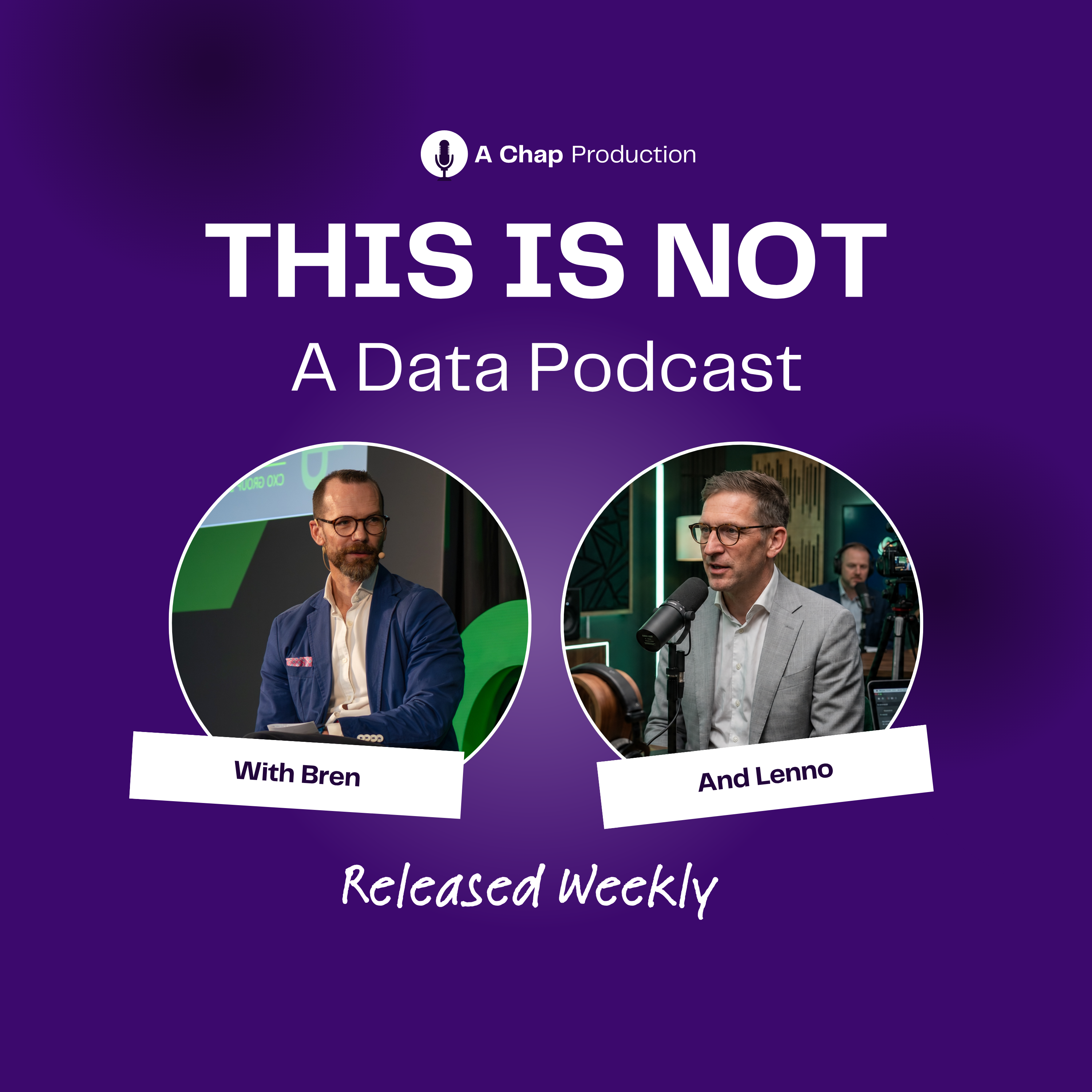


Brendan and Lenno are back for another unfiltered conversation on This Is Definitely Not a Data Podcast.
This episode tackles a question the data community has been circling for a decade without answering, "Who is actually accountable for data quality, and why does it never seem to stick with any one role?"
Lenno shares a story from the world of a highly regulated chemicals business, asking when the data is wrong, whose responsibility is it to fix it?
Both mull over data accountability and workplace safety culture, arguing that most people notice when something's broken and just expect someone else to deal with it. Finally, asking why the technical side of a data leader's job is often the easiest part.
Honest, unpolished, and packed with real examples from the front line of enterprise data.
Bren: Hello. This is â I guess a return visit for This Is Not A Data Podcast and again I've got my very good friend Leno with me. You've been you've been â a away for a few days, Leno. You're looking very relaxed. What's what's going on? Welcome back to This Is Definitely Not a Data Podcast. I'm Brendan, joined again by Leno, a chief data officer with twenty-five years experience, fresh back from the Alps and straight into today's subject. All about accountability. Everyone in the data world has been talking about who owns data for a decade, and somehow nobody's actually solved it. We've got a story about hazardous chemical companies and exactly why it matters when things go wrong. We also get into the slightly technical side of a CDO's job and
Lenno: I've had a little holiday in the Austrian Alps and that indeed is getting me into a much more relaxed state than I was before.
Bren: Yeah. Amazing, amazing. So what we're actually saying is that the the level of conversation which was amazing before, is gonna go up another level. Is that right? What the easy part is. But the real work is getting people to care. So, with all that in mind, let's get into it.
Lenno: Yeah, we need to up it a notch. I think what we've done last time was very exciting and appealing and now we need to evolve this into something even better.
Bren: I I would agree. I I joke to you after the after the first one, you know, the the the difficult second album is always quite hard when â everybody loves the first one. And to be fair, I'd like to say that we've been inundated with fan mail, with messages, we've had a shout out from like royalty. That's not been true. But it I mean it's only a matter of time.
Lenno: it isn't because my phone was ringing non-stop over the last couple of weeks.
Bren: Well that means that you're that means you're the star. Because I ha I haven't had any.
Lenno: No, no, no, these were merely suppliers that wanted to engage on establishing new contracts and so on. no, no sponsorships, no, not at all. So there's no star dust in this area just yet. No, not yet.
Bren: Or or or sponsorship, is that what we're saying? Not yet. Not yet. Not yet. But it the the world the world of AI never never really stops. And and I know you've you've had some lovely time away and I've I've been I've been busy with work. But is there anything that that I mean, I know we've talked about accountability in in the past. Is is that is that us worth touching on on this week?
Lenno: That's great segue into indeed a subject that is close to my heart as well. Talking about accountability and taking responsibility on data.
Bren: Mm. Yeah.
Lenno: which I believe is an underestimated or undervalued area as well. Where over the course of previous years, there's many data functions that have been created, data executives, and I think if you look up â Gartner researches, et cetera,
Bren: Yeah.
Lenno: Over the last 15, 20 years maybe, the number of data related jobs have effectively exploded.
Bren: Mm.
Lenno: In our previous podcast, we already said something about data being â the new IT, everything with a wall plug is IT, everything that has the data subjects associated to it. Then all of a sudden becomes a responsibility of a CDO, CDAO, et cetera. Personally, I believe that we need to have the attitudes across any... function, any core function within the company that takes care and pride in nourishing the data and the insights that are either used or being generated within that function.
Bren: So kind of along those lines and and I don't I don't disagree, I think you're I think you're right. We've we've probably as a data community been having the conversation around chief data officers and accountability f for a decade, maybe. Ha I I how how d wh why do you think we haven't kind of solved that one? Because it w what you're saying is right, is â ultimately who's accountable?
Lenno: Okay. Why didn't we solve this? Well, if we take a very close look at the communities where we're talking about these subjects, it's basically the same group of people. It's data-focused, analytics-focused communities that are coming together and sharing these experiences as well.
Bren: Yeah.
Lenno: Why not having that conversation with â your sales executive, your purchasing executive, your finance executives in the room? Now, I do realize by saying that, then equally I'm also expecting that everyone is open to have that dialogue and open to engage in that particular area as well. If you really take a close look at role descriptions in an organization, these are being described. are not necessarily having the care around nourishing your data that you're generating or using within your functional area articulated as well. Hence the data, quote unquote, is considered to be an afterthought or something that you can bring to someone else. Now, would it help to specifically articulate the data elements in a role description? Maybe that's a good starting point. Maybe it isn't. Maybe it's just a paper tiger. But at least there's something that you can reference back to that as part of your core role. You are not only accountable for generating 10 % additional sales every year, but in there you're also accountable or responsible for making sure that in your sales domain, your pricing is correct, the customer information that you're generating or using is effectively reflecting your accounts that you're responsible and accountable for also. or the other way around. A company realizes that there's a high degree of administrations in there, but then indeed also giving the care and the decision making ability. And that's also something that we touched upon in our last conversation to a specific department. But then you are getting the mandates.
Bren: Mm.
Lenno: â which is connected also with the attitude and the drive for that domain. Does that make sense anyway?
Bren: So Yeah. No, it it it it does, 'cause I was gonna say as you in either in a current or previous role as as a chief data officer, when it comes to accountability, when you think about the the top layer of management and is generally typified by chief something, everybody else seems to have it quite clearly defined as to what the accountability in the remit is. But I think in the data space we've often struggled that we don't have a defined budget
Lenno: Yeah.
Bren: necessarily. You know, we rely on influence rather than direct â sort of a accountability across certain parts of the firm. And it seems to be that everybody can have an opinion on our world, yet the moment we say, well, you know, what about ops or finance or whatever? Everybody gets very touchy and v â kind of a bit a bit upset. Is that is that still true?
Lenno: Yeah. From all of the roles that I've had in different companies, â I can indeed agree that that holds true. There's a very high degree of indirect engagements, â indirect influencing â rather than direct decision-making authority.
Bren: Okay. Mm.
Lenno: and at the one hand side and now I'm going to contradict myself at the one hand side that makes the role I think even more complex and interesting on the other hand side it makes the role very difficult to be successful
Bren: Yeah. Mm. Yes.
Lenno: the moment that you really break through. it has maybe a high degree of managing politics. Also that takes either a skill set, an attitude type of thing.
Bren: But but less less a technical skill.
Lenno: it's definitely not a technical skill.
Bren: Yeah.
Lenno: That's a great point to touch upon, Brandon. The technicality in this role, although we are delivering platforms, we're delivering solutions a lot, et cetera, the majority of everything that I do on a day-to-day basis is speaking with people, bringing people together. And alongside it is delivering platforms, it's delivering the solutions, it's delivering the insights and so on. The challenge there is that I cannot deliver without getting the conversations right. And getting the conversations right is the most difficult part â in an international and widely spread geographical setup.
Bren: Hmm. And and I think the the point you make is is so so pertinent because if we if we cast our mind back, you know, when when the data space kind of boomed, or at least I got exposed to it, there was a real emphasis on big data and data lakes and warehouses and so forth. I was way out of my depth because I'm I'm not technical, I don't I don't code. But actually the the part that
Lenno: Thank
Bren: I've found most interesting and again a bit of a â kind of a challenge was actually it's not about whether you can write good code, it's about can you get somebody to buy into what you're doing? And I think this is â what you're saying that if you want to build a platform or deliver a data initiative, do the exec really care how it's done? I would argue probably not. But they want to presumably they'll turn around to to you and say, Lano, is this the right thing to are you confident we could do this? And you'll say, Yes, no, or
Lenno: Yeah.
Bren: keep your fingers crossed and hope hope that it goes goes well. Is i the the technical part, ironically, for quite a de technical role is almost secondary.
Lenno: It is, but the measurement on the success of the role is primarily on that part. However,
Bren: â so you're saying that the actual success is measured by the the delivery of the platform?
Lenno: But look at the, that's part of the quantifiable objectives that one would get on an annual basis. Deliver the platform, you know, that can be measured in time, in the budget and you know, that's all measurable. Everything that needs to happen around it to make it happen, it's very hard to quantify it. Now that's where I must say 80 % of the time effectively goes into that. It doesn't go into delivering the platform in itself. And I will also argue that there is no CEO, no CFO around that wakes up in the morning and then says, you know what? I want to establish a master data management platform in my company, or I want to...
Bren: Mm. You just killed all the fairies, I know. Like this peop people's dreams have been shattered now.
Lenno: No, come on. Come on. There's no CEO, no CFO that wakes up and says, you know what? I want to establish a data platform across my company so that I can run AI. No, why would they? Come on.
Bren: â
Lenno: At the end of the day, I believe that it is highly dependent or much more focused around. I want to improve margin. I want to improve revenue. I want to reduce my costs and I want to work much more efficient. These are the company objectives. There's no company that says I want to do a transformation right now because I want to do transformations. No. there's something behind it.
Bren: Yeah. I think
Lenno: And then there's the burst out into all of the initiatives that need to underpin or support realizing these benefits. What do you think?
Bren: Yeah. I I mean th the slight hesitation is that I'm I'm just thinking of all the times that you know that the it's easier for a project or a program team to say we've been successful because we've gone from nothing to an implemented system. And and let's let's call let's call it a lake house, because you what that sounds sounds cool and funky, doesn't it? But d does the lake house actually do what we need it to do? Can
Lenno: Okay.
Bren: Can we get the data when we want it? I I still firmly believe, and I had a conversation last week, ironically, the the question around AI is obviously very pertinent, but we're still talking about data being like good quality data. And my argument is companies are really still struggling to do the basics. And I view that as put good quality data in the hands of the end users as and when they need it. But But when when we when we first met and started this conversation, we were having the same conversation. So d to why why I mean, have we all been smoking our socks and just not doing anything? Or like why why why are we still having this conversation, do you think?
Lenno: I think it's a lot of work, it is difficult and it's getting through it. You need to get through it and you need to not shy away to step into the mud, take a shovel and start shoveling. and That's a lot of work. Maybe it's fair also to say that not a lot of companies realize that there is a lot of work associated to it and then also allowing the runway to get the groundwork. literally done. And the runway can be explained in a whole lot of facets. This can be time, this can be capacity, this can be budgets, this cover a whole lot of areas. I think we're working in an era where a lot of things are short cycled. We need to commence an initiative and get that initiative behind us in relatively short period of time because of the nature of maybe our human behavior right now and that's also something that we touched upon last time is that it's so high-speed and quick All the information is available. I want to have everything on a mouse click. I need to have a UI that does everything for me. â Now with AI coming into the mix, I generally have a sort of a capability that can do quote unquote everything for me. I just need to prompt write and then everything goes automatically.
Bren: Yes. Just just just prompt it and away it goes.
Lenno: or yeah exactly or doesn't it.
Bren: Well, I and th and therein lies the the the the problem because the the question that comes to mind then, in in your experience, if the proverbial or something goes wrong, something hits the fan, who who who gets the phone call from a an angry chief executive?
Lenno: That's a great one. So today, for instance, I'm working in a, for part of our business, a highly, highly regulated area. These are chemicals that are â in very specific categories. You can talk about substances â that can be used in manufacturing narcotics.
Bren: Mm.
Lenno: we can work on substances that are highly explosive, for instance. So there's a high degree of regulation in place for these items. Now, when the data is incorrect and a truckload â of an explosive substance drives through tunnels and something goes wrong because the manifest was not set up correctly.
Bren: Okay. â gosh.
Lenno: Where does that responsibility lie? Is that an operation thing? Is that a purchasing? Is that a â data topic? Is that a chief financial officer? Is that a â chief executive officer â area? know, and that's why in my mind it needs to evolve around taking ownership, taking care and pride. end to end. For me it doesn't, ultimately it doesn't really matter who is doing the work. The work needs to be done and we all need to be able to â call anyone to the responsibility of making sure that that is done. Now the moment that you make... sorry go ahead yeah
Bren: Hmm. But but in in no no I was gonna say but in in that example, let let's say the manifest is wrong. Some would argue it's a data like if the data was wrong, it why but then if they came knocking on your door, but you don't have line management responsibility over that that person, so sh it shouldn't be you, should it?
Lenno: it That is the right question. I do have difficulty answering that with a point blank yes or no.
Bren: Yeah. Okay.
Lenno: And that to me comes back to the care, the care area. You know, there's, I personally have a vein in my body that says, you know what? I'm hired as a chief data officer. And because of the role or because I'm working for this company, irrespective of the role title in itself. I work for this company and as a company we are all having an accountability and a responsibility to make sure that no accidents happen, that we're delivering good quality products to our customers, products and services and so on, that we procure from suppliers that are actually â good also in a sustainability space. That's... I may be wrong, but in my mind that's an attitude thing. It doesn't say anything about skills. It doesn't say anything about a role title. It is an attitude thing that I value greatly in a person. We need to get it right. You know, and of course there are specialties across a company. At the end of the day, I cannot go toe to toe with a chief financial officer when it comes down to supplying quarterly reports on the public market. You know, that's the core role that the chief financial officer would have with his or her team. You know, my forte is in the data space. You know, that's where a lot of my experiences, a lot of my brain is focused towards. So I would make an appeal to indeed then also allow me to work in the space that I value most, know a lot about, â am capable of driving that as well because I care about it.
Bren: Yeah. Do And and because you care about it, do you think that part of the problem with this like with the CFO example, the people that input the data or where that data kind of starts from aren't the same ones that feel the pain when it goes wrong? So I I I mean I think back to to my days and you know, i if if a sales team couldn't put a name and a date a name and a name column, a date and a date column and a number and a number column in the CRM
Lenno: â 100 % yes.
Bren: If they got it wrong, the data engineering team were expected to code round it. I like, hang on, whoa, whoa, whoa, sweet child of mine. That that's not how it works. But because the sales team didn't f feel under the pain of having to correct it. And I think we need to close that gap or at least if the if the sales team or whoever inputs the data incorrectly, they need to deal with res or feeling the pain of resolving it, not just being like an MP, not my problem.
Lenno: Exactly. Okay. No, exactly. I genuinely agree to that statement. And that has everything to do in my mind with accountability, responsibility and caring about what you're generating, what you're using and what you're bringing forward in that â chain.
Bren: Yeah.
Lenno: end to end as well.
Bren: Because the a accountability and I guess and you'll be able to sort of say whether this is right or not, certainly the more senior levels, you are accountable for the running of the firm as a whole. And a a a a chief executive I used to work for a long time ago used to have the phrase, don't walk past a broken window i. e. if you see something wrong, do something about it.
Lenno: Yeah. Do something about it.
Bren: And it might not necessarily be in your area, but if if let's let's say I'm the CFO and I see something that's wrong with data, I'd Leno, actually, you know, I've noticed that I don't know, the the you know, the the the teams are not putting the data in correctly or, you know, there's a there's a real issue. I think it's too easy for people just to ignore it and go, NNP not my problem, that's a data problem. And then even if it's not a data problem, everybody points a finger at you and goes, What are you gonna do to fix it? And I'm like, Well what what pfft
Lenno: Yeah, precisely.
Bren: What do you want me to do?
Lenno: So taking a sidestep â just a little bit. Have you worked in any of the companies that have a safety program? Okay, so when you're in manufacturing, there is a whole lot of physical and mental â safety programs happening.
Bren: Not not specifically.
Lenno: No, you cannot walk around a warehouse or a manufacturing plant just wandering off. There's strict guidelines because of fatal injuries that can happen. In order for everyone to recognize these safety rules, there is annual or a couple of times a year trainings that are happening.
Bren: Okay.
Lenno: to get everybody aware of the regulations in that space to drive down the lost time injury, for instance. You know, these are awareness type programs.
Bren: Okay.
Lenno: data could be one of these as well. There's of course also programs around regulatory affairs, doing honest business and so on and so forth. These are well-established programs that a lot of companies around the globe have in place on a day to day. which I believe the main objective is to elevate the awareness of everything that is happening. So would you for instance walk up the stairs with a hot cup of tea or coffee in your hands and your laptop in the other?
Bren: I will can neither confirm nor deny that I might have done that today.
Lenno: Very good. So, that's one of these safety things. You shouldn't. Walking up or down the stairs, hold a handrail. Make sure that you have that hand free. Otherwise you can injure yourself. You will likely injure anyone else.
Bren: Let's let's go with no. Let's go with no.
Lenno: When you're carrying too much, you need to leave something behind. If you see a power cord that is broken, you see sparkles coming off it, just like your example. If you see the broken window, don't just walk past it. You need to take measures. You need to do something about it. You need to care.
Bren: Mm. Do you think an not enough people care?
Lenno: I think a lot, most people... see that something is off but then expect someone else to fix it.
Bren: â okay.
Lenno: expect that to be fixed.
Bren: Somebody it's somebody else's problem.
Lenno: It's somebody else's problem. Why? I don't know. It's a lot of work. You need to be able to strap on your boots, get into the dirt and shovel through it until it's really good.
Bren: I I think the the other the other part that kind of aligns to that is ev ev people want credit, but they don't want to take responsibility when it goes wrong. And I think that the the accountability element to it, why do and I've seen this in in previous lives, is i it kind of gets thrown up the chain until somebody goes, I'll make that decision because I'm brave enough, bold enough, you know, that that's my role.
Lenno: Ahem.
Bren: I think it's also too easy for people not to take accountability for it. Because I think as you've just said, it it almost just flows on to somebody else and actually as long as you you touched it last you deal with it scenario, then y you can you can kinda move on. I the the accountability part really worries me actually just I guess across the board, really.
Lenno: And also maybe there's two sides of that equation as well, Brandon. I've stepped into roles, we've stepped into projects frequently â with an ambition. and feeling responsible, feeling accountable to get that done. And from time to time also came out of that with bruises, black eye and clothing being torn. You get where I'm going to. A very good friend of mine years ago, had a...
Bren: Yeah.
Lenno: very successful in going through the ranks in companies as well. He's much more taking it slow paced and by that taking less risk therefore potentially also less painful. Now I think that that's probably different characters acting differently, you know, and there's no right or wrong. Absolutely not. â I think while we're working with people there's different styles, there's different mentalities. And we need to be one aware of that to also allow different characters to act differently.
Bren: Mm.
Lenno: And still we then will get into very successful spaces, growth of companies, regardless of the route, how we are getting there. Yeah, so long story short, I believe that everything that we do is still a people game and it's not a technical thing.
Bren: this is this is absolute music to my ears, let her I think th for for for the millions listening around the world, â that's really where the where the where the genesis of this started is people buying to people and you know, I I I I still think in the data space especially, not losing sight of it's a people based business is is is really im really important. Now I I I can't believe we have whistled through this episode and our time our time is up. I mean it listen I I I'd like to say that the telephones are going mental and everybody wants us to keep going, but unfortunately we need to bring this one to a close. Leno, as as ever, thank you so much for for your thoughts. Your honesty, because I think what what makes this so so so beneficial is these are not hypothetical situations that you know you you kind of get for the bull and the bluster in the in some of the conversations. It's actually this is happening.
Lenno: Thank
Bren: This is this is what what what what we're going through. So â to to anybody listening, please do send us some questions. â it would be remiss of me not to say I think you need to like and subscribe and follow and leave reviews and all that sort of stuff. â obviously we're making it up as we go along. but Leno, absolute pleasure. I mean how how cool is that? That's absolutely flown by.
Lenno: Thank you. Thank you very much for guiding us through this conversation again. You are absolutely fabulous in that space.
Bren: Here we go. So with that with that wonderful piece of flattery, we're gonna say thank you very much. â listen in â and and join us for the next episode. Bye for now.
Lenno: Okay. See you guys.