How to Use Piano Meditation to Calm Overthinking in 15 Minutes

When your mind is racing with endless loops of worry, traditional meditation methods that demand complete silence often backfire. This comprehensive guide explores a structured 15-minute piano meditation for overthinking techniques using slow, spacious acoustic notes to anchor an overactive nervous system, quiet mental chatter, and restore inner peace without forcing your thoughts to stop.
Key Takeaways
- Piano meditation uses the physical cadence of notes as an external anchor for an overactive mind.
- Slow, spacious instrumental tracks prevent cognitive overload compared to guided voice meditations.
- A structured 15-minute practice moves the nervous system from stress response to parasympathetic relaxation.
- Naming thoughts with a simple mental label prevents emotional entanglement during listening.
- Habitual daily listening trains the brain to associate piano melodies with an automatic safety cue.
The Science of Acoustic Anchors for Overactive Minds
When anxiety peaks, the default mode network in the human brain goes into overdrive. We ruminate on the past, project catastrophic futures, and replay awkward conversations on an endless loop. Trying to force this mental machinery to simply turn off is like trying to stop a speeding train by slamming on imaginary brakes—it only creates more internal friction and frustration.
This moment is where acoustic anchors become exceptionally powerful. Slow, spacious piano music provides a tangible, auditory focal point. Because a piano note has a definitive beginning, a resonant decay, and an eventual fade into absolute silence, it provides the conscious mind something concrete to follow. Instead of fighting your thoughts, you are simply outsourcing your attention to the rhythm of the instrument.
Why Piano Music Over Other Instruments?
While ambient pads and electronic soundscapes are wonderful for general relaxation, the piano possesses a unique percussive yet organic quality. The physical hammer striking the string creates a momentary impact that grounds the listener in the present second, while the lingering reverberation mimics the natural expansion and contraction of a calm breath. This makes it uniquely suited for breaking the cycle of rumination.
The Step-by-Step 15-Minute Piano Meditation Protocol
To effectively intercept an overthinking spiral, a haphazard listening session is rarely enough. You need a deliberate, step-by-step framework that guides your nervous system out of a fight-or-flight state and back into baseline equilibrium. Here is how to structure a 15-minute reset session using solo piano compositions.
Minutes 1 to 3: Settling and Grounding
Begin by finding a comfortable posture, either lying flat on your back with your arms resting loosely by your sides. Or, if you prefer, sit upright with your spine long and unsupported. Close your eyes immediately to cut off visual stimuli.
Take three slow, exaggerated breaths, allowing your exhales to be slightly longer than your inhales. For these opening three minutes, do not try to focus on any single element. Simply let the music wash over you as a unified mood and atmosphere. Notice the general tempo, the emotional register, and the ambient room temperature against your skin.
Minutes 4 to 10: The Single-Point Focus
Once your body has registered an initial sense of safety, narrow your scope of attention. Choose one specific anchor point related to the music:
- Follow an individual piano note from its sharp inception through its gradual decay until it merges with silence.
- Focus on the physical spaces of silence that are between the notes.
- Check your body to see where the piano's vibrations seem to be strongest. This could be in your chest, forehead, or stomach.
Your mind will likely drift back to your daily to-do lists, worries, or mental chatter. When such an event happens, do not judge yourself or curse the distraction. Simply note the occurrence by silently labeling it "thinking" and gently guide your attention back to the next piano note.
Minutes 11 to 14: Breath and Melody Synchronization
As you enter the final third of your practice, allow your breathing to naturally lock into the pacing of the piano phrases. Do not force a mechanical rhythm; instead, let the natural swell of the melody cue your inhalations, and the fading notes cue your long, slow exhalations. If difficult emotions or heavy feelings arise during this phase, place a warm hand over your center of chest and observe the feeling with compassionate curiosity rather than analytical resistance.
Minute 15: Resting in Pure Awareness
During the final sixty seconds, drop all techniques entirely. Stop tracking notes, stop monitoring your breath, and stop trying to achieve a specific mental state. Rest entirely in pure, unforced awareness where the music, your breathing, and the surrounding silence become one single, seamless experience.
Integrating Micro-Doses Into Your Day
You do not always need a full fifteen-minute block to experience the mental benefits of intentional listening. Modern life is filled with micro-moments of friction where overthinking threatens to derail your focus. You can utilize short piano segments throughout your day to reset your baseline:
- Morning Centering: Dedicate five minutes upon waking to listen to uplifting piano movements while silently setting a clear, grounded daily intention.
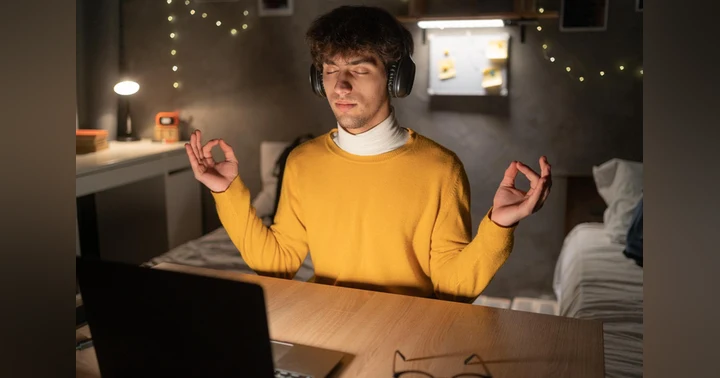
- Midday Stress Resets: Take a three-minute pause during high-stress work hours, put on headphones, and let a few simple phrases soften your clenched jaw and lowered shoulders.
- Pre-Work Transition: Listen to instrumental pieces for five minutes before tackling complex cognitive tasks to clear out mental clutter and establish deep, steady focus.
Conclusion: Reclaiming Your Mental Space
Overthinking is not a personal failure; it is simply a habituated mental loop of an active brain searching for safety in an unpredictable world. By giving your mind a beautiful, spacious acoustic landscape to wander through, you provide it with the gentle boundary it needs to finally rest, reset, and let go.
To explore immersive soundscapes specifically designed for this practice, listen to the full episode and let the gentle melodies guide you back to a state of profound inner stillness.
Frequently Asked Questions
Why is piano music better than guided meditation for overthinking?
Guided meditations require processing verbal instructions, which can cognitively fatigue an already overactive brain. Piano music provides a non-verbal, abstract anchor that allows the linguistic centers of the brain to finally rest while still giving attention a clear focus.
What if my mind keeps wandering during the piano meditation?
Mind wandering is a natural part of the process, not a failure. When you notice a thought, simply label it 'thinking' without judgment and gently bring your awareness back to the physical sound of the piano notes or the spaces between them.
How loud should the music be played to calm anxiety?
Keep the volume low and comfortable, serving as a subtle background atmosphere rather than an aggressive sensory input. The goal is for the music to guide you, not overwhelm your auditory system.
Can I practice this piano meditation while sitting at a desk?
Yes. While lying down is ideal for deep relaxation, you can practice this sitting upright with your feet planted on the floor, making it an excellent tool for midday stress resets during a busy workday.

Why Distant Thunder Makes You Feel Safe: Psychology of Rainstorm Sounds