“The Sehlat Who Ate His Tail” Makes a Bold Leap Towards a Formula We Already Know and Love
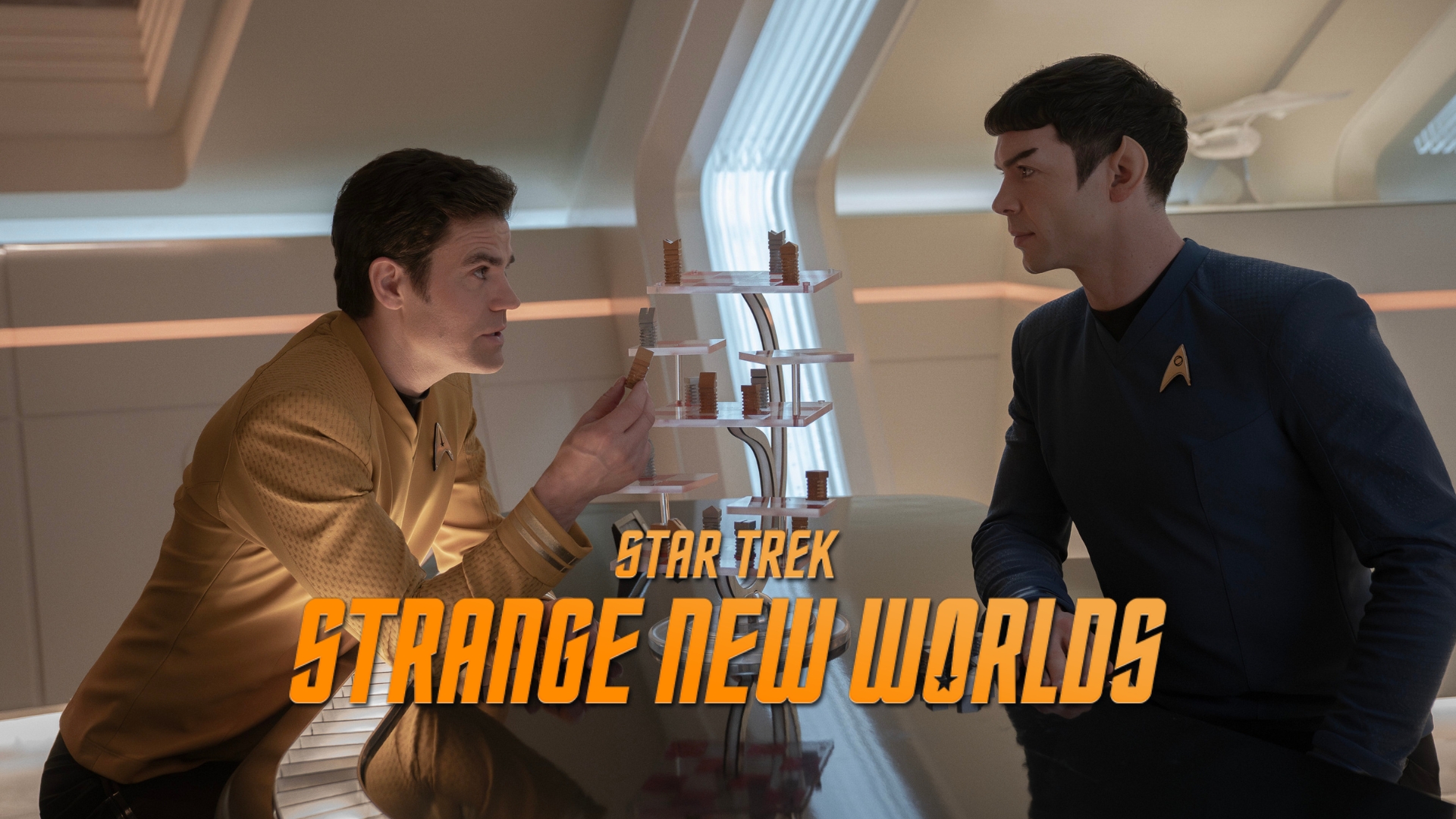
“The Sehlat Who Ate His Tail” is a backdoor pilot. It is clearly a backdoor pilot.
How else do you describe an episode where James Kirk commands a ship with Uhura, Spock, Scotty, and Chapel aboard? Is that a bad thing? Not in itself, and really, “Sehlat” stands on its own feet as a good episode. It’s good drama, it’s good character work, it’s…good Star Trek. It remains flawed: again, the final twist (and frankly, it is a really, really good twist) comes far too late to be explored properly. Yet this is definitely the highlight of this season.
This episode firmly sets it’s focus on James Kirk from the start: his perspective (and log) carries the opening stinger, as he expresses privately and openly his frustration with USS Farragut’s Captain V’Rell and her command style. He’s about to suggest something much more Kirk-like (a landing party) when the planet, and then the Farragut, are attacked by something powerful enough to wreck the ship, and leave Kirk in command for the first time. A lot of this early Kirk stuff is very…pop-culture Kirk. Yes, I enjoy the expressions of his frustrations with the situation, and his desire to take risks and be on the ground, which is something always at the heart of Kirk’s character, but I would have preferred a more by-the-book Kirk: the “stack of books with legs” that Gary Mitchell talked about.
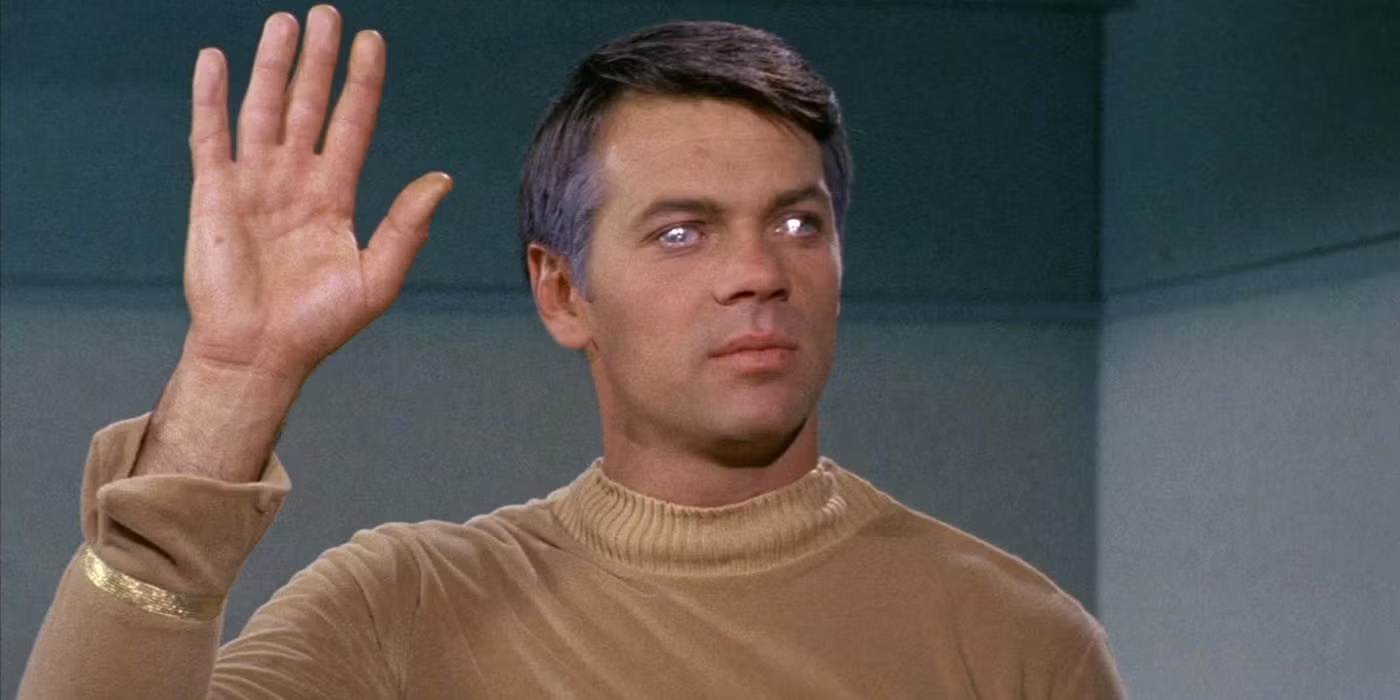
Where are you, Gary?
Speaking of. Where the hell is Gary Mitchell? Kirk’s best friend? His absence from the “Kirk story” we are telling is increasingly obvious.
With Farragut wrecked by the planet’s explosion, Enterprise arrives to render aid in the form of a boarding party of Spock, Uhura, Scotty, La'an, and Chapel. Kirk’s ship is barely holding together (second time in four years, if you know the Farragut’s unfortunate history), and so is Kirk. It is quite good to see Kirk do this “command” thing for the first time, and really, every time I see Wesley play Kirk, the character fits him better than beforehand. He is carrying himself in the right way, and talking the right way, especially when Pike orders the evacuation of the Farragut’s crew before the enemy returns: which they do, just as the mystery ship, which, in the highest Trek tradition is as camp as it is horrifying, captures and swallows Enterprise while Kirk and the gang watch in horror.
Now the mystery ship - ancient, terrifying, destroyer of worlds (the Sas’lik, Chak’ca, and Astrogore of colonial mythology), looking like a motorcycle Doomsday would drive, is intent on tearing Enterprise apart for parts and power inside its mechanical stomach. I do really like the idea that this is an ancient threat on the edge of civilization, known to almost all spacefaring powers and frightening to all. The Farragut struggles to find a plan to save the Enterprise just as Kirk struggles to exercise his command ability in the face of a broken ship and a hunt for an unknowable enemy. It’s got good moments like Scotty’s aghast horror at performing engineering miracles, and Kirk demanding that he gets the ship going at “high speed” in hours, as opposed to days. The weakest part of this is that Quinn’s Scotty is clearly being written as an older character than Quinn himself. His dressing down of Kirk for asking him to catch up with the Sas’lik would fit for the older engineer of Doohan, but it doesn’t land as well with Quinn’s twenty-something-year-old. Kirk’s self-confidence also sells well, especially when his boast over buying drinks for everyone jinxes Scotty’s miracle work and sends the Farragut careening out of Warp Seven with engines completely unusable, right in the monster ship’s path.
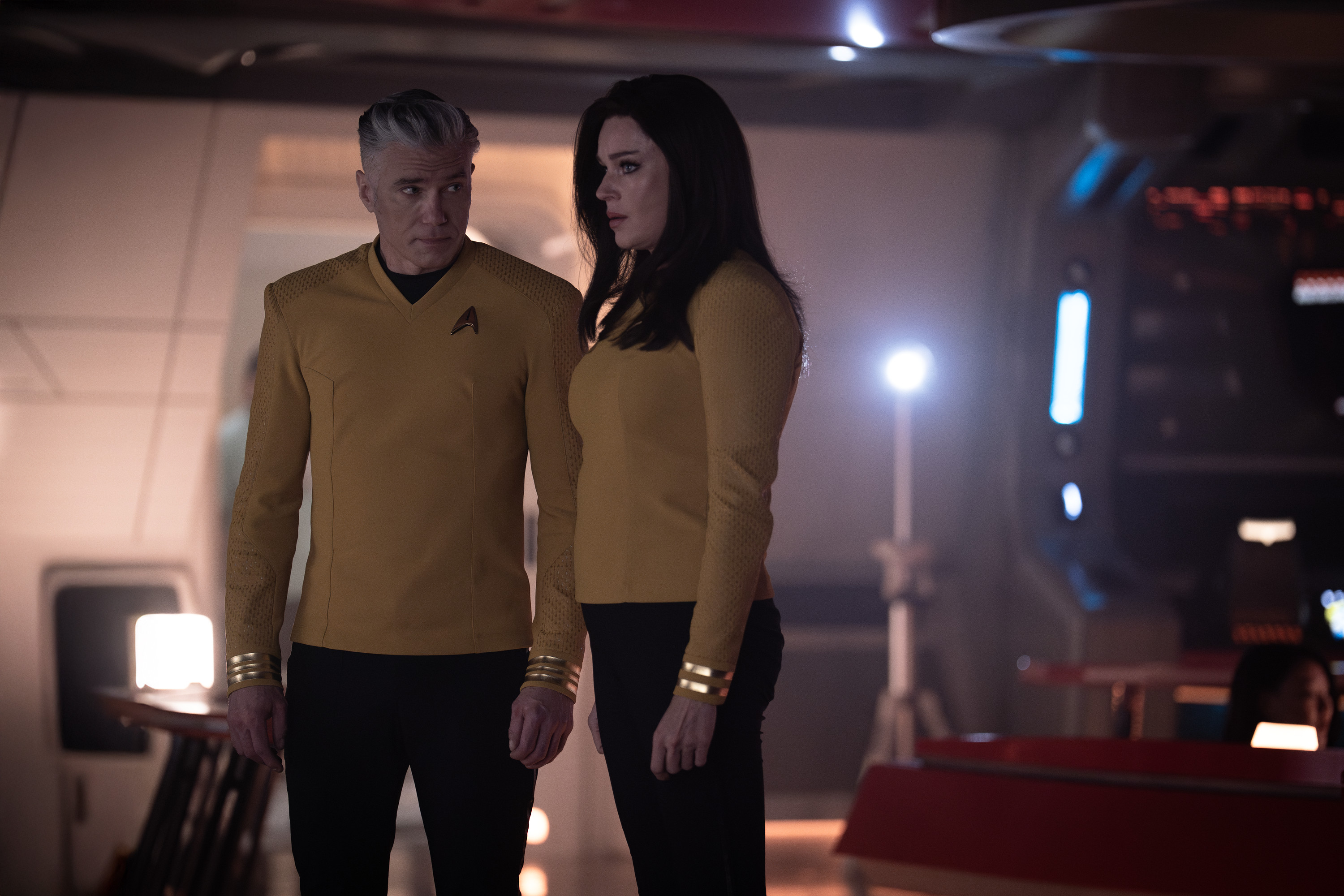
Anson Mount as Capt. Pike and Rebecca Romijn as Una in season 3, Episode 6 of Strange New Worlds streaming on Paramount+. Photo Credit: Marni Grossman Paramount+
Farragut is in a dire state: with the options stuck between playing dad and escaping by shuttle, Kirk chooses the Kirk option: a third plan, even if he doesn’t know what it is yet. No one is very happy about this, and suddenly we notice the difference between Kirk and Pike’s command style: he doesn’t want the option-bombardment that Pike expects of his crew; if anything, he’s just overwhelmed. I wish they had leaned more on his command style being different from that of Pike, as opposed to just not existing at present underneath a layer of emotional agitation.
Enterprise is in no better state. The enemy ship has attached an umbilical cord straight into the ship’s computer and power system, drawing energy at such a rate that there isn’t even residual power to put a charge through the wires. The two enemy intruders, in their massive energy-absorbing spacesuits, are also pursuing Pike and La’an (who beamed back to Enterprise right before the ship was "eaten") with menace. I do not like the emphasis on how monstrous the beings are, however. There’s been this consistent theme about unnegotiable enemies throughout this season, and it’s never really nuanced or criticized by our characters, who are meant to be officers in the “peace at any price” organization. At least this time, the enemy is interesting; both primitive and hyper-advanced, known to all but still a mystery to everyone. Less of a mystery (and more of an oddity) is Pelia’s plan to wire up the Enterprise with cable telephones, which is fun, I suppose. I guess the gag lands better in the digital age than it would have in 1966.
Back on Farragut, we get the first of many important Kirk and Spock dialogues and it’s good. Frankly, it’s probably the best moment of the episode. We see why they are different people: Kirk, distracted, lamenting about the loss of everything from the chess game to the people he could have gotten killed on Helicon Gamma. Wesley doesn’t quite have the grief that Shatner has in these moments, but he’s absolutely conveying the frustration of Kirk’s many crises of confidence in this sequence. Ethan Peck brings the proper certainty that Spock should bring in these replies. It works well, and what we get out of it is the first proper Kirk moment, as he demands answers from his people instead of letting it be brought to them. And, in typical Kirk fashion, he turns the enemy’s strength into their weaknesses. They’re going to turn Farragut into bait for the scavenger ship! I’m sure that won’t end up in a plan that goes down to the wire.
Things on Enterprise are less hopeful: a typically SNW fight in a poorly lit corridor sees La’an vaporize one of the intruders, while Pike avoids death through a single moment of hesitation. Again, I can see this twist emerging, and it’s a good twist, but why the hell is this happening in Act Four and not in Act Two? It’s the interesting bit! Much less than throwing bottles of alcohol at expensive costumes while the rest of the cast runs around the set with copper wiring (and Pelia brags about being a roadie for the Grateful Dead).
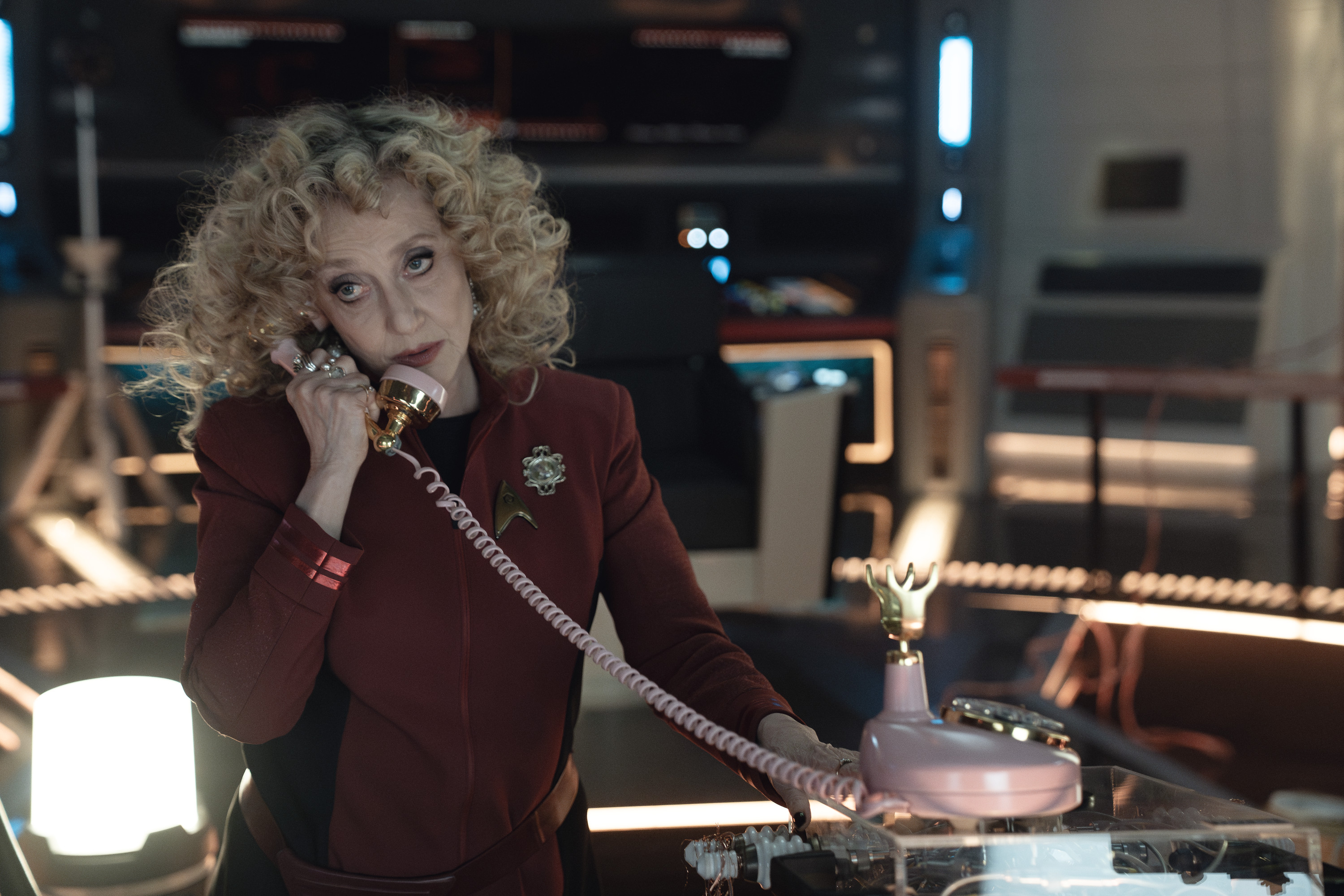
Carol Kane as Pelia in season 3, Episode 6 of Strange New Worlds streaming on Paramount+. Photo Credit: Marni Grossman Paramount+
The climax of the episode, however? Perfect. With the scavenger ship closing in on Farragut, Uhura flies the rickety cruiser up and over the monster, chased by grappling hooks that then go after the detached nacelles until they shock and disable the monster ship. It works. It’s fun! And it’s time for Enterprise to make its escape by telephone and joystick. The worst offense of this sequence is that it all takes slightly too long, especially Pike’s disconnection of the umbilical cord. The whole thing is slightly too laboured for the drama to land, even if Number One venting the airlock to re-direct the ship is great, as is the climactic detonation of a Klingon Battlecruiser’s Warp core, tearing the scavenger apart from the inside.
Now comes both the best and the worst part of the episode: the grand reveal that these monsters, aliens from beyond the edge of civilization, all 7,000 of them cast into the void, were, in fact, human. The ship is even marked with the early UESPA symbol and an American flag. It turns out that the scavenger ship had begun life as a scientific expedition from the mid-21st century. The brightest and best of post-atomic earth, lost for 200 years in deep space, turned to destruction and savagery. “What went wrong?” asks Kirk. It is the correct question to ask. And it’s clear that, despite Pike trying to comfort and reassure Jim, he remains upset by the people he has killed, and that he didn’t feel any empathy for his foe until it was too late.
I think this conversation between Pike and Kirk is, like his earlier conversations with Spock, foundational: it sets out why and how Kirk is different. It is clear that Akiva Goldsman, despite my reservations about his desire for his proposed “Star Trek: Year One” show, understands what James T Kirk is about as a character. His flaws, his weaknesses, his hopes, and what makes him a hero to be followed. And yet in making that clear, other weaknesses with the general themes of this season and the show itself become apparent: a lack of empathy for the enemy, a belief that our team is right no matter what, and that being the brightest and the best is all you have to be to be good. It is possible, in making a massive advertisement for yet another bleeding spinoff prequel, “Sehlat” proves that it hasn’t been the smartest plan as of yet.
“The Sehlat Who Ate His Tail” is a solid, four-square act of Star Trek. It could use some trimming around the corners, and yet I’m not that bothered. The Act Four twists lands here: it actually adds to the episode that the reveal comes when it’s too late for anything to happen, enough to twist a knife about what a mutual lack of empathy can do, and about how even the most optimistic of people can be twisted to savagery. I think Wesley’s Kirk works. I think he works very well next to Spock, Uhura, and the rest of the cast. In that sense, this proves that a full recast reboot of TOS would work.
And yet it’s also proof they shouldn’t do that, because this episode, that formula, works because here it is presenting something novel: that moment of Kirk unsure of himself, unfamiliar with his crew and his command style, and what it means to be Captain Kirk. I don’t want to watch Kirk in the glory days, and that is all a Year One show would be. Give me more Farragut stuff, bring in characters we barely know, like Gary Mitchell. Hell, a spiritual adaptation of Christopher L. Bennett’s The Captain’s Oath, a Trek Novel about Kirk’s time commanding the scout ship USS Sacagewea, would be brilliant: because it would be treading new ground, even if it is doing so in an old setting. As a single episode, however? I am rating this week's run highly, if just for the quality Starship beauty shots.
John is a history of the 20th and 23rd century. He knows too much about Star Trek: he's thought too much about it, both in the serious sense through THE EDGE OF MIDNIGHT, in which he treats TOS like real history, and in the less serious sense through I QUIT STAR TREK, in which he treats Voyager like cruel and unusual punishment . In both ways he has applied his passion for history to his equal love for Trek, mainly in the form of Starships, Uniforms and trying to figure out why exactly Gene was Like That.
Starfleet Academy Episode 107 "Ko'Zeine" Preview: Duty vs. Dreams