Small College America Jeff Selingo - Podcast Co-Host Future U



Welcome to Small College America, a podcast dedicated to exploring the role and value of small colleges in the higher education landscape. I'm Dean Hoke, and I’m joined by my co-host, Kent Barnds.
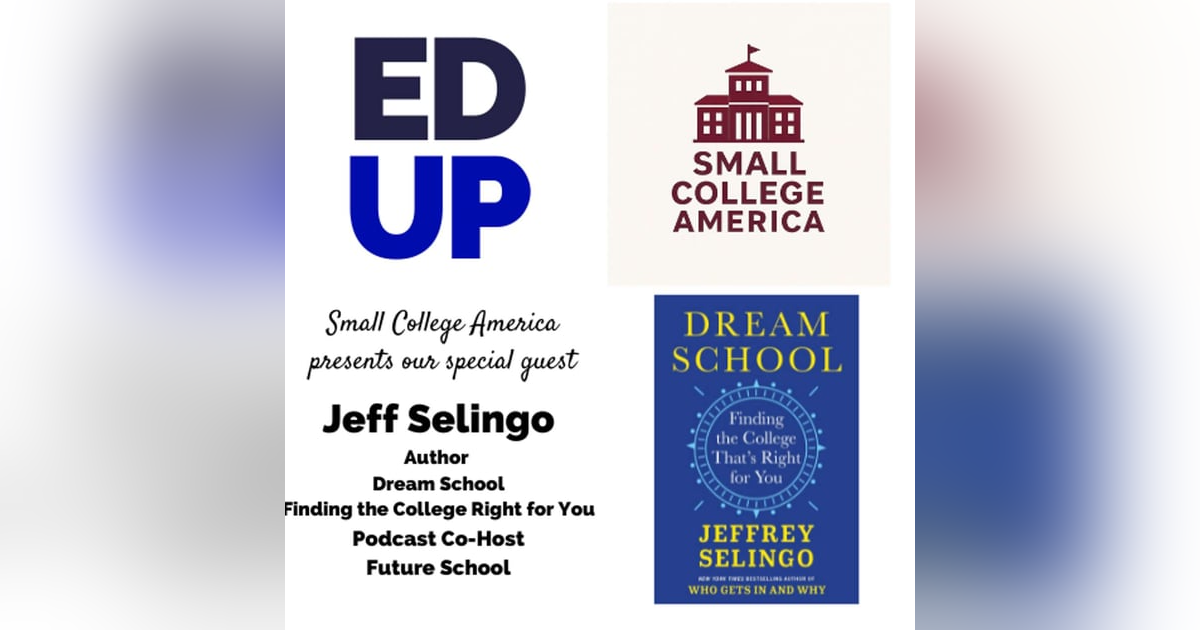
Kent Barnds: Joining us today is Jeff Selingo who has written about colleges and universities for more than 25 years and is a New York Times bestselling author of four books. His latest, New York Tines Best Seller Dream School: Finding the College That’s Right for You, draws on more than two years of research and a survey of some 3,000 parents to give families permission to think more broadly about what signals a “good” college and then the tools to discover their dream school.
I’ll just note that my alma mater, Gettysburg College, my employer, Augustana College, and, my daughter’s college, Butler University are among those the 75 New Dream Schools, each identified as “hidden values.”
He is also the author of Who Gets In & Why: A Year Inside College Admissions, named one of the New York Times’s 100 Notable Books of the Year in 2020.
A regular contributor to The Atlantic, The New York Times, and The Wall Street Journal, Jeff is a special advisor to the president and professor of practice at Arizona State University. He writes the biweekly newsletter Next and co-hosts the podcast Future U. He lives near Washington, D.C., with his family.
Jeff, as a father of two teenage daughters who will soon be navigating their own college search, you’re about to experience firsthand the very system you’ve spent decades analyzing!
Q1: Jeff, you’ve spent more than 25 years examining how higher education, the workforce, and student expectations are evolving. What trends have surprised you most recently, and how have they shaped your thinking in Dream School and your other current work?
Q2: Your new book draws on a survey of 3,000 parents about what signals a ‘good’ college. How do parents today perceive small colleges differently from large publics or well-known brands, and what misperceptions should presidents address head-on?
Q3: You’ve written extensively about admissions in Who Gets In & Why. Since that book came out in 2020, what changes have you seen, particularly in how small colleges can position themselves?
Q4: Jeff, Gen Z, Gen Alpha, and their parents seem to be very focused on ROI. How can small colleges demonstrate lifetime value without over-promising?
Q5: You’ve advised boards and presidents across the country. What blind spots do you see repeated most often at colleges, large or small? And what innovation patterns differentiate financially healthy institutions from those that are struggling?
Q6: If you were advising a board tomorrow, what’s the first move you’d tell them to make? And looking ahead, is there one innovation or shift that could dramatically improve the prospects of small colleges if widely adopted?
Closing Jeff, thank you for being with us today and for offering such thoughtful perspective on the challenges and opportunities facing small colleges at this pivotal moment in higher education
For those listening or viewing, if you'd like to learn more about Small College America, go to our web page at www.smallcollegeamerica.net, where you can find details on upcoming episodes, contact us, and suggest topics you’d like us to cover.
This episode of Small College America is made possible with underwriting support from Edu Alliance Group — a higher education consulting firm that champions small colleges and the communities they serve.
On behalf of our guest, Jeff Selingo, my co-host Kent Barnds, and myself, thank you for joining us.



