

 Apple Podcasts
 Spotify
 PocketCasts
 Amazon Music
 YouTube
 Reinventing Car Buying: CarMax’s Omnichannel Appeal
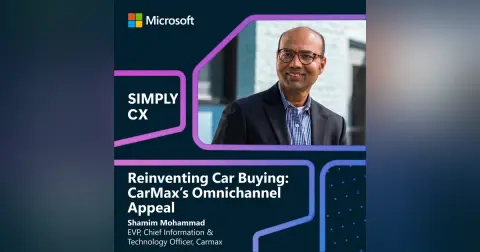
Buying a car should feel like a joyride, not a chore—and CarMax is investing to make it easy, exciting, and even fun. In this episode of Simply CX, Nicole sits down with Shamim Mohammed, EVP and Chief Information and Technology Officer at CarMax, to explore how the company is redefining the car buying experience. From omnichannel innovation to AI-powered tools like Sky 2.0, Shamim shares how CarMax puts customers at the center of every decision, creating multi-channel, personalized, and empowering journeys.
You'll walk away with:
• How CarMax’s omnichannel strategy is transforming customer experience
• The role of AI and experimentation in driving innovation
• Why startup culture and empowered teams fuel CX success
Whether you're a CX pro, team leader, or brand builder, this episode will inspire you to see customer experience through a more human—and more powerful—lens.
Mentioned in this Episode
• Sky 1.0 and Sky 2.0 AI assistants
• CarMax’s Instant Offer (IO) program
• Cross-functional product teams and startup culture
• Net Promoter Score (NPS) as a CX metric
• GenAI for customer review optimization
🎧 Produced by Larj Media
📩 For more CX insights, follow Nicole on Linkedin
If you have questions or comments about CX email us: SimplyCX@microsoft.com
Additional Resources
Guest: Shamim Mohammed, EVP & Chief Information and Technology Officer, CarMax
CarMax: https://www.carmax.com
| The omnichannel has been such a game-changing for our industry because it's giving all customers from all demographics and all age groups, option. And optionality is really, really key. The flexibility is really, really key. |
| [music] Welcome to Simply CX, where we bring you customer voices and expert insights. I'm Nicole McKinley, Leader of Global Customer Experience at Microsoft. CarMax is the largest used car retailer in the country. And it's not just known for cars. It's known for transforming how people feel about buying them. My guest today is Shamim Mohammad, EVP and Chief Information and Technology Officer at CarMax. Shamim has helped lead CarMax's digital transformation by placing the customer at the center of every decision, from online search tools to personalized pricing and delivery options. Welcome to the show, Shamim. |
| Hi, Nicole. It's great to be with you today. |
| When I think about car buying, my personal experience is it can be a pretty stressful, often mysterious experience. Definitely time-consuming, whether it's going in person to a dealership, spending long hours, negotiating for prices. I'd love to hear about how you and CarMax have approached really transforming this experience to one that's more personalized and enjoyable for your customers. |
| We brought a number of new things to our industry. Number one was haggle-free. No negotiation, fixed price, simple as that. It's like you're going to your local mall and buying a pair of jeans. You don't negotiate. You go buy it, based on the price. We use a lot of technology to enable that. And even today, after 30 years, the company has evolved. Technology is changing. Customer experiences are changing. The customer expectations are changing. We change again by bringing this omnichannel experience. And CarMax is the only company that has the omnichannel. That means you can buy online, buy in-store, or somewhere in between. This is where I love it because it's all about technology, it's all about AI, all about data. But the mission is the same: drive a simple, seamless, easy experience for the customers. The other thing we do is when somebody buys a car, let's say you went through all the process and bought a car, and you don't like it, we are the first one in the industry to say, okay, you can return it, actually, and get something different. Just a very simple return policy. So those things really makes it a lot more enjoyable and fun for our customers. |
| The trust that is inherently built through the mission and the experience that you are enabling is super evident. I actually have a good friend who recently shared with me that not only did he buy his prior car from CarMax and that it was the best experience he ever had, but he just resold that same car three years later and was raving about just how easy that whole experience was. It literally took minutes, which was pretty mind-blowing. Can you share more about how that customer trust, that transparency, that integrity, is woven into the culture? What does that look like? |
| The culture is such an important element for us. We wanted to do two things. One, we wanted to build a business where our associates really feel empowered and they love working. I'm wearing a pin right here on my jacket. It's the Fortune 100 Best Place to Work pin. And CarMax has been on that list for 21 years. And we're there on the list because we created this environment where our associates are empowered and they enjoy working here. Because we believe that when you have great environment, a great culture, where your people have to work, guess what? They will deliver great customer experience. And that's really a big part of that. And we do everything that's opposite, everything that's different than a traditional dealership model or traditional car-buying process. And we enable that by having this great set of associates. Their primary goal is to make sure the customers have a great experience in every interaction they have. This is something we were very deliberate, very intentional, in our hiring process, in our management process. Across the company, we really put a lot of emphasis on the culture. And then in terms of technology, we build the technologies. Right? Every technology piece we do is focusing on empowering our customers, at the same time, empowering our associates; and empowering our associates so they can take care of the customer. |
| And the last thing I would say about culture is, especially over the last, I would say, 10, 15 years, we transformed our business to be extremely digitally savvy and digital-oriented. So what it's allowing us to do is invent and test and experiment with the customers. As the customer expectations are changing, we're able to really work with the customers, putting the customer at the center of all the experimentation, and enable different experiences. So the culture of innovation is also now a big part of our culture today. And that's really helping us to stay ahead and bring different types of industry leading, is the industry standard, as it relates to customer experience. |
| I couldn't agree more in terms of the criticality of employee empowerment, in turn, enabling that innovation and that exceptional customer experience, in putting the customer at the center. And the example you gave of really innovating with and experimenting with customers, how do you listen to what customers really want? |
| CarMax is a big company. And one of the things we really work very hard to do is we like to maintain kind of startup culture. Our teams are really organized like a small startup in a big company. And what it allows us to do is we have very small cross-functional teams that are very mission-focused, and their mission is to drive customer experience. So there's roughly seven to nine people in those small cross-functional teams. And they're highly empowered. They are given a target in terms of what experience they need to deliver, but we don't tell them how to do it. And they figure out what experience needs to be delivered, really doing a lot of test and learn. So they use our technology to get the experiences in the hands of the customer, and the customers then really tell us whether they like it or they don't like it. They interact with the customer in real time and get the feedback. At the same time, we're also looking at all the data behind the scene to see what the customers are really doing, actually, and then we can tweak and tailor and enhance that experience. So as a result, we're finding ways that customers like to interact with us, the way they like to buy things and sell things, and all those things that we're able to do, in a very iterative way through this culture of experimentation. So that's really what's allowing us to not only just meet what the customer is really expecting, but a lot of times go ahead and exceed their expectations because we are identifying the things that customers don't even know that they want. But the data and the AI technology that we've been deploying is allowing us to get those insights so we can really pave the way before even customers get there. |
| Can you share an example of either a recent experiment or one that stands out for you that was just incredibly impactful, and what you and the team learned from that? |
| Yeah, I mean, there are many, right? You mentioned that one of your friend sold a car to us. And that's actually through a process called Instant Offer, or we call it IO. So this is something that was developed by one of this team. They really figured out that using machine learning algorithm and AI, we're able to actually price a car without looking at the car. They created this very wonderful technology or capability that we deployed to our customers through experimentation, and we learned that customers love it. And so much so that deploying within a few weeks, we became the largest online buyer of used cars in the country. So that just tells you the power of working with the customers, identifying the pain point for the customers, and then being able to deploy at scale using a lot of technology. A lot of the technology running behind the scene is really through Microsoft that's allowing us to deploy these kind of new experiences. |
| Another example I can give you is really customer reviews. Think about our website. We have thousands of thousands of cars in our inventory, and our customers are providing feedback or review on these cars. Now, what we used to do is we used to have content writers. They'll look through the reviews and organize them and structure them to make it easier for the customers to look at. Now, because there's this massive amount of data, it would be very difficult to do this on the ongoing basis. And even if we had an army of people, it would have probably taken us 10, 12 years to do it on a regular basis. |
| Sure. |
| So what we did is we used Gen AI, right? We were one of the early adopters of Gen AI, and we're able to use the new technologies to organize those customer reviews in a way that it only took us a few days to do it. And that had a huge impact because now we are able to do this on a regular basis. We're able to make it available to our customers. So when they are making this large purchase, they have great information to make the decision on. And then it also helped us on the search engine optimization. Now, on the search engines, it's like, "Oh, CarMax has this amazing, great structural information about the cars that they felt like when their customers are looking, searching for something, we were one of the first ones to show up." So just a couple of examples, but there are many like this that our teams are constantly testing, experimenting, and evolving. |
| I imagine what my 16-year-old son may be expecting or wanting as a teenager in his first car-buying experience, which probably still won't be for a while now, versus what I expect and want versus maybe what my elderly parents may expect and want are slightly different. In these examples, how are you leveraging technology? How are you and CarMax approaching really deeply understanding the unique needs and those kind of personal expectations that a given customer may have? |
| What I found is that regardless of the age or the demographics or their background, most of our customers are beginning their car-shopping journey online. So I would say over 95% of the customers will start online. They're not going to go to a store. They'll start with a search or they go to CarMax app or they'll go to the website. So what it allows us to do is really understand what they're looking for, what they're searching for, and how they're interacting with our web. And then what happens is a lot of customers will select their car online, and then they will schedule a test drive. They'll go to a store. Or sometimes some customers will just go and buy it right there. So then when your son is ready to buy the car, if he wants to just click on the app and buy a car and have it delivered to your home, he can do that. Or if he wants to do some of the work, like select a car and finance the car and then go pick it up from the store, he can do that. |
| So it's really providing the flexibility and creating this awesome experience so that the customers feel like they're in control, is really what we're focusing on. Another interesting fact is-- it was really unintuitive, but we found this through our data-- is that the older generations like me, Gen X, we like value. We like to talk to people. We like to go to the store. Whereas, let's say, your son, I would think that he would like to do 100% online. But what we're finding is that a lot of the more younger generation, they also like to go to the store because they have never bought a car. They really want to see it. |
| Touch it. |
| Drive it. So that's the thing. This is why I think the omnichannel has been such a game-changing for our industry because it's giving all customers from all demographics and all age groups, option. And optionality is really, really key. The flexibility is really, really key. One thing I'll tell you is the Alpha Generation, which is really the next generation - they're probably 0 to 15 right now - they are going to be AI-savvy. Right? The companies know them very well, and they provide hyper-personalized experience. And they don't want to redo the work. Let's say somebody's searching for a car in the middle of the night and spend five hours finding this beautiful car, they don't want to go to the store and start over, right? So they'll want to get credit for the work they do on their own, but they also want to be able to pick up the phone or use their text messaging or work with an AI tool to interact and get through the process. So that's really where we're focusing on, like let's make sure we have all the bases covered. And we're constantly testing and experimenting and providing the tools and capability for regardless of the channel the customer may be coming from. |
| Back on these tests and these experiments, you said you're running so many in parallel, right? And love the fact that there's teams empowered to do this experimentation. I imagine some of these experiments likely fail in terms of the intended outcome. And others, it sounds like, are huge, almost instant successes, and then you scale the capabilities. How are you measuring impact? How do you know, and what metrics or data are you using to really tell you what things to move forward with and scale versus which things maybe are better shelved? |
| So we measure everything through qualitative facts and also the data. So a lot of product teams, they have the analyst embedded in them because they set the experiments and they set the goals, and then they see if it's giving the desired results or not. And what happens is we expect a lot of these experiments not to yield the right outcome, which is okay. Because let's say there are 10 experiments. Out of that, even if 2 of them are successful, that's a success. Because by getting through the 8 other experiments, they got to the 2 that really worked. Because we encourage the teams to experiment. And I don't call it failure. I encourage them to really learn from it. So learn fast, learn cheap, is the way we look at it. And they go into this two-week cadence. So as a result, this experiment may not work, but it hasn't cost us anything major. And it's kind of small. It's called the minimum viable product. So as soon as they have a working minimum viable experience, they can get it in front of the customer. And if it doesn't work, at least they'll have some feedback to make the next experiment a little bit better. So this iterative process, we're able to really find those incredibly powerful and game-changing innovation that our teams are able to drive. |
| Well, I love the concept of this minimal viable experience. You talked about product teams and having analysts be a part of that. You have this kind of model that has been proven to be successful at CarMax, this kind of seven- to nine-person squad model that really breaks down silos and ensures that there's a one-team approach to innovation. What have you learned from that approach? What works? What doesn't, if anything? |
| So as I mentioned, at CarMax, we're a big company, but we operate like a startup. And the way we created that startup culture is through this-- you call it squads or product teams or cross-functional teams, however you want to define it. And it has a product manager. It has a couple of engineers. You have a user-experience person. You have an analyst. And these are mission-driven teams because they have given business outcome goals. They are accountable for delivering not just cool experiences or cool technologies or capability, but they also have to deliver the business outcome. And because they're held accountable to deliver the business outcome is why they do go through all the experiments, and they find what's going to work and what's going to help them get to the business outcome. What it really does is having this kind of startup mindset and small teams, it really speeds up the decision-making because you don't need a lot of people to make a decision. A decision doesn't have to come from me because I already have given them a big high-level guardrails and business outcome goals. The teams have a lot of authority, and they're highly empowered to figure out what they have to do to deliver that business outcome. |
| And because these small teams have real customer data and real customer insights, and they're really working with the customer directly and seeing the results or not results, magic happens. It's really magical to see how this team can work together and how they get things done. I mean, it's just been amazing. |
| I can see and feel the energy even from you as you talk about it. Can you talk a little bit about how you and CarMax are approaching what it is you actually measure and the balance between what customers value and what a customer may perceive versus what the business of CarMax obviously wants to accomplish? |
| I don't think they're mutually exclusive. As we have evolved our company, especially in the last 10-plus years, from being a market-leading brick-and-mortar kind of channel delivering exceptional customer service, to a digital-first, digitally savvy, AI-driven, very much of a technology-oriented company, one of the things we really wanted to make sure that our technology strategy, our customer experience strategy, and our business strategy, they're very much aligned. And it really started out with our leaders being aligned. So it's really the CEO, the board of directors, my colleagues in the C-suite, all of us being laser-focused and very much aligned on what is really the overall objective for the business. And then when we go down all the way to our product teams, our squad teams, we called it, which I love the term, their goals are actually supporting the overall business goal. And what they're experimenting with, what the capability they're working on to building, collectively, they're actually supporting the overall business objectives and business outcome, business strategy. |
| So it's this synchronicity and it is the cohesiveness of the strategy, to all the way the work the teams are doing, really what's allowing us to bring those kind of experiences to our customers, which has been fascinating. Because I feel like the congruency in how the team's going to work and the visibility of the work they're doing is providing us great ability to adjust and evolve and enhance the customer experiences. The product teams, they do a, we call it, product showcase or open house every two weeks. |
| Oh, wow. |
| Every two weeks, it's a hybrid. So anybody in the company can really look at what those teams are working on, what experiments they're running, what tests worked and what did not work, and how they're enhancing the next experiment to make it better, and how they're tracking to the business outcome goals. And these open houses are attended by the CEO, by me, and all the leaders. So it really creates sort of this company-wide buzz and alignment and excitement about all the things that we're doing and the type of experiences that we're bringing to our customers through technology. It's just been fascinating to see that. |
| So Shamim, one of the really incredible innovations that you and CarMax have developed is Sky 1.0, the online buying assistant. What really is Sky 1.0? How did it get started? What was the intent behind it? |
| Sky 1.0 has really been helping our customers over the past few years. It came from one of the product teams. They were looking for ways to help customers be able to get answers quickly while somebody at CarMax may not be available. So this sort of became an interactive chatbot built on AI technologies and advanced NLP to guide customers through dozens of workflows. And it was very helpful because we had a huge spike in volume the-- certain time of the year, and customers were able to get an answer quickly and it met their needs in a big way. So that was the Sky 1.0, and we're very proud of that development. It was really, really helpful for the customers. However, I'm even more excited about Sky 2.0. Sky 2.0 knows your car-buying journey. It understands your intent. It guides you forward across all the channels, whether it's online, whether it's the mobile devices, whether you're accessing some apps or you're texting, call center, you name it. Sky 2.0 is ready to help you anywhere you need help. And what's really cool is it's all built responsibly with industry-leading moderation and security. And every use case is then designed with a social responsible AI in mind, which has really been great. And then Sky 2.0 is where we believe it's a quantum leap forward compared to Sky 1.0. We're co-engineering with Microsoft. Right? We have some of the best Microsoft engineers and AI engineers working side by side with my engineers to bring Sky 2.0 to life. And the early results have been wonderful because we're noticing like 30% containment. In other words, 30% of the time, a customer is able to get the answer they are looking for and the help they needed through the new version of Sky. |
| Amazing. Do you have any early insights in terms of how Sky 2.0 is enabling customers to go from start all the way through to completion of the buying experience, or is that still to come? |
| We're measuring those, but we still don't have anything conclusive yet that we can share. What I can tell you is Sky 2.0 is a part of our overall omnichannel strategy, the type of experience we want to deliver. And it is a big part of our company's positioning as a company because that's where I think the customers are going to be or will be. So Sky 2.0 is a big part of that. And when we look at our omni experience, we measure the net promoter score for our omni experience. And we have seen the highest net promoter score since we deployed omni. And Sky is part of the tool. I'm not saying that Sky is what's causing it, but it's the comprehensive experience because it's all end-to-end. The simplest and simple experience of omni is really what's driving a higher net promoter score. And we're not stopping there. We're continuously figuring out how to make it even better. |
| Well, congratulations. That's super exciting. Obviously, with your culture of innovation and your commitment to continuously enhancing and revving the omnichannel experience, what was it, if there was one or two things, that really were the key motivator, the key driver for you to go, "You know what? We got to do more than Sky 1.0. We got to bet on new capabilities and really be all in on 2.0. And perhaps there's a 3.0 and a 4. 0 in the future as well"? |
| First thing I would say is don't worry about technology. Don't worry about AI. Don't worry about any of the stuff. But really worry about how do you drive exceptional customer experience, and drive it not once, but continuously? So that was the motivation for us. We didn't go about saying, "Okay, we're going to use Sky or we're going to use AI or not." It was like, "How do we drive, how do we deliver exceptional customer experience for our industry, and how do we maintain our market leadership?" So that was really our goal. To do that, we deployed Sky 1.0. We deployed a lot of AI tools. We were constantly innovating and testing because we believe that this has to be an iterative process. It has to be a continuous process. It's not once and done. This is why cross-functional product teams are really powerful because creating that start-up culture really keeps us on our toes, and we are always looking at how to make it better tomorrow than we are today. |
| Now, new leaders, I would say that you must start with something. At least, start now. Figure out what are the key customer pain points - start there - and how AI can help with that particular pain points. And once you do that, guess what? You're going to find another one and another one. And customers will tell you what's working and what's not working, as long as you ask them and you bring them part of the process. Companies don't need an AI strategy. And a lot of companies, okay, "What kind of AI strategy do we need?" You don't need an AI strategy. Your strategy needs an AI. So that's the way to look at it. You can need to figure out how AI helps deliver the exceptional customer experience, how AI can alleviate the pain points for the customer. When you do those, guess what's going to happen? You're going to get more customers. You're going to sell more things. You're going to get great customer NPS. That would be my advice. |
| The simplicity of your advice is fantastic. "You don't need an AI strategy. Your strategy needs AI." I couldn't agree more. So Shamim, as you look ahead, what does the future hold for you and CarMax? What's your north star, and what are you focused on going forward? |
| Our north star is very simple: do the right thing for customers, for associates, and for the community. It's very simple. And that's the north star we had from the beginning. Our goal today is really more on empowering customers with an experience designed for them through clarity, confidence, and control. This is where the tools and technology, a lot of innovation, come into place. Because through all those, we're basically giving customers the control so they can decide how, when, where they want to shop by research. Really, the customer is fully in control. And that is what we're enabling, and that's what we're focusing on. |
| [music] Well, Shamim, thank you so much for joining me today. I learned a lot. I'm inspired by everything that you and CarMax is creating and innovating. I know when my son has a job and has enough money to buy a car, I'll definitely be recommending that he check out CarMax. So again, thank you so much. |
| Thank you, Nicole. |
| Thank you for listening to Simply CX. I'm Nicole McKinley. Our show is produced by Larj Media. That's L-A-R-J Media. Special thanks to [Luya Polka?] and Elizabeth Machado, and to our video partner, PegLeg Pictures. To find out more about today's guest, check out the links in the show notes. If you have your own challenges or questions about CX, email your questions to the show at SimplyCX@microsoft.com. And please share today's episode with someone you think could learn from it, and follow me on LinkedIn to keep the conversation going. |