
 Apple Podcasts
 Spotify
 PocketCasts
 Amazon Music
 YouTube
 Human-Centered Design with Purpose: AI, EX, and CX
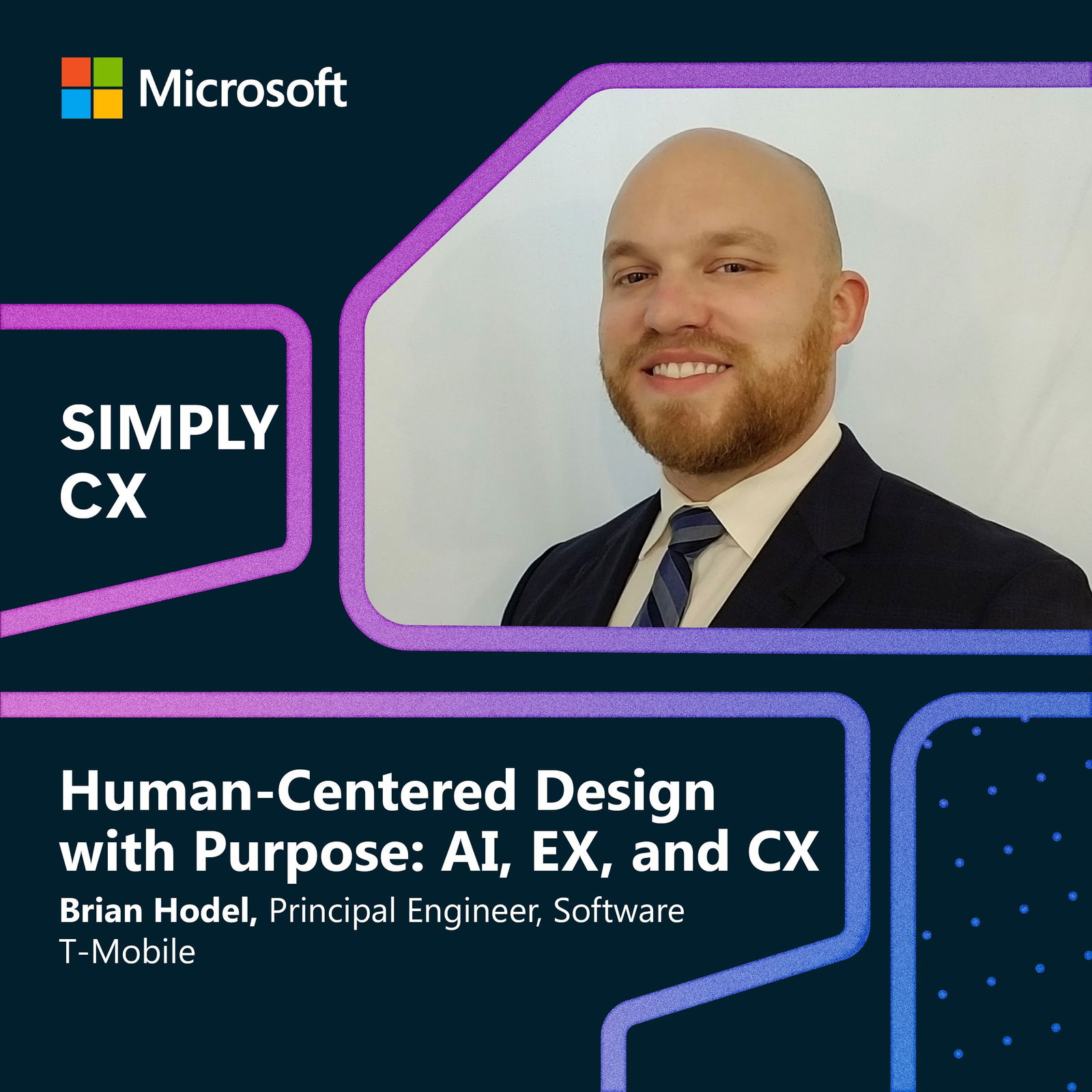
In this episode of Simply CX, Nicole talks with Brian Hodel from T-Mobile about how his team tackled a manual employee experience and transformed it into a streamlined, AI-powered solution for customers. They dive into how AI, customer feedback, and frontline employee insights shaped a tool that personalizes promotions, simplifies decision-making, and enhances both customer and employee experiences. They didn’t start with AI, they started with empathy, and how things went tell you everything about the power of human-centered design.
You'll walk away with:
• How human-centered design drives better CX outcomes
• Why simplicity and speed can matter more than flashy features
• What it takes to build scalable solutions that actually drive customer value
Mentioned in this Episode
• Promo Genius
• Microsoft Copilot
• Office 365 and Netflix promotions
🎧 Produced by Larj Media
📩 For more CX insights, follow Nicole on Linkedin
If you have questions or comments about CX email us: SimplyCX@microsoft.com
Additional Resources
Guest: Brian Hodel, Principal Engineer at T-Mobile
Role: Developer of Promo Genius and Orbit go-to-market system
Focus: AI-powered customer experience innovation
| if you have a great job and you love your job, but you have to sit there and copy a bunch of data from a spreadsheet over here, you have to do a lot of repetitive, mundane stuff that isn't really your job, maybe, but it's part of something that needs to be done, that's where AI can really help. And so you can get better job satisfaction and you can do things faster. You can focus on doing quality work because you're not so rushed because you had to spend time on a bunch of stuff that annoys you. |
| [music] Welcome to SimplyCX, where we bring you customer voices and expert insights. I'm Nicole McKinley, Leader of Global Customer Experience at Microsoft. Today, I'm joined by Brian Hodel, who is a leader and a problem solver at T-Mobile. He's known for championing human-centered AI solutions like Promo Genius, a tool used by T-Mobile employees to quickly find the most suitable promotions for customers based on their specific needs. Brian's approach emphasizes speed, collaboration, and keeping the customer's voice at the heart of every initiative. Brian's work is at the intersection of people, AI, and CX. So Brian, you're the driver behind a pretty cool innovation called Promo Genius. |
| What was the thinking and kind of the genesis behind this AI-powered CX innovation? |
| There's a lot of complexity with setting up new cell phones, new plans. There's a lot of options depending on where you're at as a customer, which region you live in, what demographics you're in, if you're military or you're 55 plus, there's a lot of different things that go into that. And that's a lot for a customer service person to understand and to think and to know off the top of their head. And they change daily. It's constant new information, not only creating new ones, but also updating existing ones. So at the time, before Promo Genius, there was literally a large piece of paper, several pieces of paper they would print out every morning. |
| They put it on the wall, they'd have it on the desk, which is kind of crazy for most companies. But from a telecommunication company that prides itself in technology and moving forward, wasn't a good look. And it was very slow and confusing. So we took that as a starting point and said, "Let's solve this problem. This is not great for a lot of reasons." So we built an app around it. We tied it in with our existing systems, brought a bunch of data together, made it very easy, quick for the reps to go through and put in a couple query terms and give that person an answer. |
| Especially the very initial part of the discussion where you say, "I'm thinking about getting a new phone. Here's what I have. What are our options? What's the best phone for me?" And you can put that in there. It gives you the different promotions that they're available for. But then we started building on things like adding an AI to it to enhance that experience to answer questions that they might have that aren't necessarily just what are the spending options, but what are the best options for me as a person, as a teacher, as a businessman, as a student, and to give those really quick answers to people. |
| To really personalizing the individual promos or discounts or whatever it may be to the uniqueness of the customer. |
| Yeah, that and the device even. You don't always necessarily want to sell somebody an iPhone 17 Pro Max, right? That's not always the device that's good for them. Maybe they want a simple device. I wouldn't give my grandmother an iPhone Pro Max and think that she's going to do well on that. She doesn't need to spend that much money. She's not going to utilize the features on it. And it's a lot of power. It's a lot of complexity. She wants something that she can make phone calls on and check some email and Facebook. |
| And so given that ability to sort of put in a profile and say, "This is the person who I'm talking to, what are the best phone options for them?" And that kind of targets you to give them the best experience as a customer during the process, the discussion, but also make sure that they're happy with what they get after they move into that plan because it is a commitment, right-- |
| Absolutely. |
| --to have that. |
| Yeah. |
| And you're going to spend a lot of time on there. Even my grandmother spends a lot of time on her cell phone. |
| Yeah, my kids spend too much time on their cell phones, which is a whole nother topic. |
| I think most people do. |
| But just to put it in perspective, when you talked about just the velocity or the volume of different changes that were being introduced to T-Mobile employees that are serving customers, what does that look like? Are we talking about juggling 20 types of new offerings a day or a lot larger than that? |
| It varies, but usually we probably have around 80 different promotions, and they're all segmented. So there's a lot of complexity in which offers you can get, as well as what they offer. You just put in this criteria and they'll still show maybe 15 different offers that are good options for them. And then you have to kind of compare those to say, "Okay, well, what are your data needs?" Like, weighing the cost of the promotion, the offer to how much data you need. Do you need to focus on business? Like some of the business plans have Office 365 included in your plan, but maybe that's not what you need, but you want Netflix free offer. |
| Sure. |
| So there's all these different things you kind of have to weigh. And so we build that into a way where they can sort through that and quickly give these answers to the customers based on what they're saying, what they think they want. And then, of course, if they're buying a new device, there's different offers available with that. And so you want to make sure that you have all of that information, put it in there, and then it says, here are five things that we recommend that you discuss with the customer. The top one is probably the best one for them, but we can only go so far without being in front of the person. So that's where that discussion comes in and that relationship with the customer. |
| I'm curious what role people actually play, both your employees and team members, as well as customers' play in helping shape the innovation and the solutions that you're developing. |
| As a developer, I sit pretty far away from the actual retail experience. But one of the important things is there's the empty chair at the table. And I've always liked that analogy because it reminds you that there's always a customer. Your customer eventually is the person that is the customer that's a subscriber and they're joining the company as a consumer. But in between that, there are a lot of other customers. I have leaders that are customers because they want to make sure that they're serving the business or a financial aspect. There are the retail reps, of course, which are also customers. |
| If you think about all of those together, then you can build really great solutions that solve a lot of problems, have big impact. That's one of the things that we've struggled with during the development of this is, okay, well, how do we get the best for the end customer? There's always a compromise. There's always trade-offs. And so some of that is how do we optimize the experience for the consumer, but how do we also optimize it for the person that has to deliver that information? |
| And so while the Promo Genius is available on the iPad, we made it specifically where the retail reps can easily sort, they can use their fingers, they don't have to use a keyboard, so it's mobile, and they can put in their information, and it's very easy, but then they can spin it around and they can show it to the customer. That's another really innovative part of this, is that we're not just, "Here, let me read you a bunch of stuff from my system," which is a bunch of data and me interpreting it. |
| I can actually show you, here are the options, I can click on it, and it shows you this nice summary of what you do or compare these two plans. That's where we've gotten now, and it's been really successful for all of that stuff to just continue innovating in a way that serves numerous people. And that way, you build the best solutions for the customer and the company. |
| You're touching on a challenge I see often as I engage with customers who are trying to innovate. How do you personalize experiences and best serve such a diverse array of people in needs and ensure that you're really tailoring the CX solutions to exceed expectations? |
| Giving people the tools to solve their own problems because accountants and account payable know what the problems are and they know what they have to do. So the people that are actually working in this area where they have expertise in different areas. For instance, when I worked at Seattle Cancer Care Alliance, I actually went through extensive training on the clinical systems so that I could build up prescription regimes and clinical orders. And obviously, I'm not licensed to do that, but I wanted to know what the process is. I wanted to know what the nursing staff had to go through, what the doctors had to go through. |
| So you immersed yourself in the lived experience to really deeply understand it so that then you could be effective in developing a solution for it. |
| And it's the same thing going into the stores and really sitting with the people. We had a lot of focus groups with key people from the retail side. We brought them in and said, "Here's what we're thinking. What do you think about this? Does this help?" And some of the stuff we implemented and we thought we were going to implement were options that they're like, "Yeah, that doesn't really help. I don't want to use that." That overcomplicates the thing. It needs to be really simple. And so the application is very simple, but it's very powerful and very quick. And so it's been very well received. |
| And so in terms of how you are continuously innovating, how do you prioritize the features, the functions, the next set of capabilities to ensure that that value is continued to be delivered? |
| We have different test environments. We have different people that we roll out sort of like a beta version to, and they can take a look at it and play with it before we reach the mass audience, which is pretty large. |
| And when you say beta audience, that includes both T-Mobile employees as well as end customers? |
| Yeah. So we got a lot of feedback that way because it needs to make sense. And just because you provide a bunch of information, we could fully pull it in and say, "How do you compare this phone to this phone?" And give a big spec sheet. So it's a real challenge of what can we offer? And a lot of times we'll give different options like, "Here's an idea," and just float it by them and say, "Is this something we should even look at?" And a lot of times that's shut down. We think it's cool. As a developer, I like all the technical. I want to see a lot of information. But as a retail reb and a customer, for sure, they don't care. They don't want to know what 32 gigs of storage is, especially my grandmother doesn't care about that. She wants to know that I'm going to be able to put my pictures of my grandkids on there and take videos, is there going to be enough storage for me? And that's where generative AI comes into play. How many videos can I put on there? There's no real metric, but you can ask AI and it's, "Okay, well, based on what you will usually do, that's 300 videos that are three minutes long or something." And that's something everybody can understand and meet and say, "Yeah, I understand that." They can also ask questions around break technical questions, but all of that's available at their fingertips with Copilot integrated in it because we have that information in there. But the goal is to meet people where they're at and to answer the questions that they have, not to give them the information and say, "Go find what you need in there." |
| Well, and I think what you're speaking to is by getting the feedback from end customers, from your frontline workers, in this case, customer service and sales employees, they keep it real, right? They ground you in what is really value-add versus what might not be. But you mentioned AI, you mentioned Copilot. And at Microsoft, we often talk about the real magic of any AI solution is the combination of people or humans and the AI. How are you using AI, whether it's in Promo Genius, you touched on this briefly, or in other solutions? How are you really using AI powered by people to deliver the real value? |
| Yeah. In the front end, there's like a little slide-out pane that has a generative app, chat agent in there. And so they can ask it questions. In the next iteration, we hope to tie that in with the data so that if they select an iPhone 16 versus an iPhone 17, it will actually pull that into there where it's very easy. But right now, they can type that in there. They can just ask it questions. Say, "I'm a teacher, and I have $1,000 to spend on a phone, and I spend a lot of time on email. What's the best phone for me?" And it can just kind of give you a regular answer, like "Here are a couple options. Here's why I chose each one," and it gives you that in a few seconds. So it doesn't rely on the retail rep knowing every phone that's out there - there's a lot of them - to know all the specs and what's going on with that because that's confusing. It also opens up opportunity for errors when you have that. So putting AI in there gives them the quick answers, and they can focus on dealing with the customer instead of looking things up. |
| I like the speed and insights that help customers make the right decision for them. How does that translate on the back end and make sure the recommendations being made are correct for that specific customer? |
| We also have backend AI that will, for instance, look and see if there's any data discrepancies because we're taking a lot of different data from different systems, and so if there's some sort of anomaly that's in there that says something didn't load right or something was formatted wrong when somebody put it in the system, they can alert us and say, "Hey, here's an anomaly. We don't think this is correct." So there's a lot of different ways you can kind of look at those things to use AI instead of having a person sitting there and just watching data. |
| Sure. Well, and applying AI at every aspect of the experience, you talked about the front end and the back end, and I think those are really great examples. I know, often, we're seeing a lot of skepticism, especially in pockets of certain industries, where there's that fear factor that AI is going to eliminate the need for my job, when in fact, those of us that are practitioners and applying AI to experience innovation are seeing how it just enables people like you and me to do our job that much better. What is the sentiment of T-Mobile employees, and how are they reacting to the introduction of AI? |
| T-Mobile is unique, a little bit forward to other companies, because we're used to changing things. We're used to new tools constantly coming in and trying new things. But there still is a lot of fear around there, and you see that with a lot of companies doing layoffs and stuff around this. But you get into the idea that people generally feel overworked. If you have a great job and you love your job, but you have to sit there and copy a bunch of data from a spreadsheet over here, you have to do a lot of repetitive, mundane stuff that isn't really your job maybe, but it's part of something that needs to be done, that's where AI can really help. And so you can get better job satisfaction, and you can do things faster. You can focus on doing quality work because you're not so rushed because you had to spend time on a bunch of stuff that annoys you. So when I go in to talk to people about opportunities for implementing AI or just process improvement in general, I start off with, "What are the things in your job that annoy you?" And those are really great ways to automate things and move people into "Let's use AI to make things faster and easier" by eliminating the stuff you don't want to do anyway. And then you can start looking at the stuff that you do want to do. How do we make that better? Because there's always opportunities for that. So you have to put PowerPoint decks together. Here's a tool that will create a lot of this stuff, the base, for you. There's still human in the loop - there's always going to be this human-in-the-loop piece of it - but if it gets you 50% of the document put together, you can spend 50% more time going through that, making sure it's worded properly, it's tailored, it's formatted - all these things are exactly how you want them - instead of feeling rushed to get out by a deadline. |
| So there's a lot of these great tools in there which just enhance your job and help you to do it better and faster. And usually, the better and faster stuff is because it's taking away the stuff that you didn't really like anyway. And so you can spend more time following your passion and the stuff that you like about your job but have more time to learn new things. There's so much to learn in AI. We have so many different learning programs available at T-Mobile, and a lot of people just don't have time for them. That's the feedback we constantly get: "I don't have time for this in my job." Well, what if we took 10% of your job, automated it you have 10% to learn a new tool to invest in your career. |
| To grow. |
| Yeah. And even if it's not something that's directly related to what you're doing, maybe it's something that you like to do. And that can also be folded into what you do or what you do next. |
| So AI as a tool, AI as an enabler, AI as a job enhancer. I really like that. How are you approaching balancing speed and urgency to innovate with quality? What does that look like for you and for T-Mobile? |
| Yeah, it's a challenge. We did run into-- some of the feedback that we got from the initial release was that-- especially the people that had been using the paper form for a long time knew where things were. And people that had just started, they loved the new tool because it was very easy. They didn't have to learn how to look through all of this stuff on a paper and find it. So having some overlapping the tools when you introduce a new tool, being very careful when you do an actual cutover. Maybe you can run them in parallel, right? Or you bring over some of the design elements from the previous tool to make it easier to adopt. In my mind, the best tools are ones that you don't have to have training for. It's intuitive, and it's responsive, and you have little help guides that are in there. And not only does that save a lot of money and training, especially when you say, "Look across the entire organization," but it makes it where people can just go in there and sort of adopt it at their own pace and say, "Look, this is convenient. I understand it. I don't have to go through a training thing to do something where I can already do it here." |
| I know that with PromoGenius, you literally rolled it out in three weeks. How did you go about balancing that crazy speed with quality and care for the end result? |
| The consumer side leadership went to our typical development team, and they said, "Well, it's going to be 9 to 12 months before we can deliver anything, the first iteration." And so they said, "That's too long. We need to solve this." So they came to my leadership and said, "Hey, can you do anything faster?" And I said, "Yeah, of course." |
| Nothing like a good challenge. |
| Yeah, yeah, exactly. And honestly, it would have taken a lot less time, but the data was very messy. And that was the majority of the development time was getting the data where it was clean and usable and reliable. And then we built the interface. And so yeah, it took about three weeks to get the initial version out of there. Wow. It's not too far off what it was, but we've continuously taken feedback from the front lines and the customers to say, "Hey, what do you like about this? What don't you like about this?" and implemented those. And every few weeks or a month, we release a new set of features that are in there. We're going through another big change right now to match our existing systems and give more information in that app without having to transfer. So right now, we still have you get the basic information in there, and then we link over to another web page. But again, that's context switching, and to compare those things is really a challenge. So that's what we're going through right now is how much can we really put in this app. And instead of just looking at it as a promotion, quick reference, how do we build this more of a sales cycle app? |
| What would you say was the biggest challenge or learning in that three-week sprint? |
| The people that supply you a sample data set of what is in the system generally give you the really best-case example. |
| So the data challenge? |
| The data challenge, yeah. Definitely. I had a lot of experience with all of the other power platform tools and everything. But especially for AI, you have to make sure that your data is really reliable, you know exactly what's in there, and then building out the agent so that it's usable and it's intuitive, giving more prompts and stuff in there. |
| Tuning the agent. |
| Yeah. And that takes more time. That's one of the things I tell people a lot. When you look into developing AI, you can develop something that works and does some things really, really quick, and that gives you a start. But when you start getting into more complex situations where you need to do a lot of testing to Make sure that every variation of how people are going to ask it questions, where their chain of thought is going to be. You really have to monitor that. And so, after you deploy the agent, you need to monitor it and see what people are doing with it to make sure that it's doing what you expect. It's doing the responsible things, and it's addressing the things that people are asking for and not just saying, "I don't know," right? So those are things that you need to constantly kind of go through and tweak. |
| Ensure it's getting smarter. There's no hallucinations? |
| Right. |
| And I think that's where the human-powered element of AI comes into play and is so critical. |
| Yeah. And it's always a balance, especially when you use generative AI. Because generative AI, by nature, is going to generate answers. It's not going to give you always the right answer. And so, you also need to train people that this is AI. And if something looks off, go ahead and check it. Don't just trust it because it gives you an answer. But as the developer, that is your responsibility to minimize the information that is incorrect. For instance, one thing we ran into was if you ask a question about the iPhone 17, it's not the same specs as the iPhone 17 Pro or the Pro Max. And so, you have to be very explicit. If somebody asks that, don't generalize across all three of those products and give me an average. That's not what I want. You have to be very specific. So investing in AI is going to take a while. You can get some stuff up pretty quick and do amazing things, but you need to continue to follow up and make sure that it's working, and monitor it, and make tweaks along the way. |
| So taking a step back then, so you created and launched Promo Genius in three weeks using some amazing technology. You are constantly tuning these capabilities using the feedback from your employees, the feedback from customers, and releasing new features and functions. What would you say has been the biggest area of impact that you've seen on the business side as a result? |
| The reliability that we have for people giving consistent advice to customers. So when you have a grid, which was before it was this giant page, like multiple pages, a lot of times what people would do is they remember some things that come top of the mind, and those are the ones that you bring people to. They don't have to do that now because they can just put in the queries, the specs around the customer, what they need, and it will give them the top five. And so, it's going to update with, "Oh, this one launched today. I didn't know about that one." Or, "This is something that I didn't know was available for this device." So it really gives you the best answers to choose from, and then it moves to the human loop where they can say, "Of these four or five, these are what I recommend out of these." And they can click on them and easily see a kind of a summary and the differences between them. That's what it's done from a business perspective, is given us the ability to know that we have consistent information coming from the rep to the customer, and we're giving them the best options that are available, not just the ones that kind of come to mind. |
| Sure. What are then the metrics or the measures that you look at to determine successful impact as a result? |
| We have a lot of sales metrics that go out there. We're not specifically splitting them up by which ones are using Promo Genius or which ones are driven. Because it's just part of the sales cycle. But our app usage is tremendous. We have massive app usage, so we can see how many people are launching it, how often they're launching it. And it is actually scaled out to other parts of the organization that we didn't intend on, like the care. So the back-end care organizations, if they have customer calls or something like that, they've started using it as well. So originally it was a retail thing, but it makes it so easy that other parts of the organization are going through and looking at this and seeing what's on the block, what is available, and answering those questions. So it's replacing other tools in the organization that people were using. That's kind of the metrics that we use, is it's being used a lot. And we can also look at the agents and see how often people are using the agents, how much information they're getting, how many turns of the conversation it is, how many times people abandon the conversation, versus give feedback. So those are all doing very well. And I think we have a lot of opportunity to do better as we put more features in there. So overall, it's been a pretty good result for the customer and the business. |
| Any customer experience-specific measures that you look at? |
| We've gotten some feedbacks from people, but we really try to keep the customer as customer. So we do have feedback sessions with them, but it's very limited. Even with the retail reps, there's a process going through and asking, "Hey, can I have some time with these people from the store because you have to schedule?" So it's a bit of a challenge. It's a lot different from where I was, like when I worked at Seattle Cancer Care Alliance, where I would just go hang out in the Huck Center or something and watch what they do all day and say, "Hey, what are the problems?" And they'll tell you. |
| Well, you talked about a lot of opportunity ahead. What does the next wave of innovation and creating unique and differentiated experience look like for you and T-Mobile? |
| The more you can automate this stuff, the better. And so things like tying in with the customer account. And so I can pull up their account with a phone number, and it's going to pull up all the devices they already have, and then automatically pull up and say, these are the opportunities for upgrades for these devices. Here are plans that they're on. Here are some plans we suggest they change to. So really getting the customer-specific information. That's a challenge because, of course, with all of the confidentiality issues with data that everybody deals with, but that's a big push that we're working on is to get that built into the tool so that we can very quickly just type in. I can type in your phone number, and it's going to give you all of your account stuff and recommendations really quick. And that's always good because not everybody knows what they have, what their device is, and not everybody knows-- I don't know what phone my mom has, and she's on my plan. So if I have to say, "Okay, well, she needs a new phone, I don't know what it is. I'm texting her to try to find out." That's not great. Yeah Be able to go through and then just pull that up in the same system. But walking through that sales cycle of, here's how we typically go through the flow and adding more features into there to, okay, well, now this is the plan they want, the next step is to go to activate that, moving that in the tool as well and say, "Okay, here's another line, pull up, activate this." And hopefully you just say, "Activate," and it does all of these six different systems and lines and troubleshooting and stuff and fix things. It does that on the back while you're having a conversation with the customer. And that's the dream, right? You don't want to have anything where you're having to go and enter information and look stuff up. So context switching is a huge waste of time and a distraction because you get a lot of errors that way, but also every time you're bouncing through there trying to find something, you're not paying attention to the customer. So optimizing those are big points. |
| So make it easy, super simple. If not, why not? One click is the opportunity that you see. |
| And focusing on the human in the loop because there's always going to be something happens. We can build a process that handles 80% of the things, but then having something pop up and say, "Okay, well, here's a mismatch. Can you choose the right one for me?" But that should be really simple. When I need you as a human, it pops up and says, "Hey, here's a decision. I don't know what it is." And then you go back to your conversation and deal with the customer. |
| Well, I love your passion for customer experience and your leadership in this space. And yet you're not a traditional CX leader by title. You're in a more technical leadership role. Advice for other leaders like you who maybe aren't yet fully focused on experience innovation and how you can really differentiate customer experience. |
| It's still a growing thing in our organization. And I think most organizations, when you get people in this role with the Power Platform and similar platforms, where do you put them? I originally was in the data side, and then I moved to IT, and now I sit in consumer. So I actually sit in the consumer and marketing side. And I'm the only principal engineer in that side because principal engineers are IT. And so that was the point. So they had to create a new position for me to be in there. But that is the main thing, right? There's different ways you can have process improvement in general. You can have it siloed, where you go and you ask them to fix something. But the best model I found is that you have people that have the skills to do the work in the teams. The growth of problem solving and addressing issues is amazing. It's like a firestorm. And you just kind of have to go through it and guide them, but it's amazing the passion people have. And the tool adoption is way easier. If you build the tool yourself, you probably are going to be using it, right? And so that's a huge win as well. |
| The one other thing that you didn't touch on that clearly you do as a leader is you immerse yourself in the end-to-end experience. You clearly understand the lived experience of the end customers you're serving, but then all of the employees and the different functions within T-Mobile that you're serving as well. And I think that often gets overlooked where leaders don't recognize the power of really putting themselves in the shoes of others and immersing themselves in the end-to-end experience. So it's great to see that you're leading in that way. And wow, amazing impact as a result of the innovation you guys are creating. |
| Yeah, and that was like Toyota Production's Taiichi Ohno said, "Go out and get your hands dirty." As a leader, your hands should be dirty once a day. Go out to the line and just do it. Just watch what people are doing, because especially when you get into higher-up positions, people sort of sugarcoat their answers. They don't want to be a complainer. But if you have to go through there and do that-- you don't have to do it all the time. But once in a while, you just go into a store and you say, "What's going on?" When you go through that, you sympathize with them, understand where their frustrations are, and where to ask the right questions. Really getting out there, that gemba, that go out and see what's going on is amazing. |
| And then using AI to automate and deploy innovation that makes material impact in rapid time. Again, three weeks. I can't believe that but fantastic. So lastly, as you look ahead next year, two years, what do you feel is going to be the next big impact that you and your team will deliver? |
| Making the interfaces more dynamic in general. So if you go in there and you're asking the question about this, the interface can change. So that's the big push around making nicer interfaces because AI can help you design them but also have them change depending on what role you're in or what you're doing to make it optimized. I mean, you only have so much screen space. And especially when you look at somebody that's on an iPad, they can't be switching stuff around. So bringing that stuff together. But really looking at tools that are end-to-end processes. If you look at a tool as a tool that does a thing, you end up with 50 different tools that one person has to use. If you look at it as a process, you could have one tool that does all those 50 things sequentially and orderly, and it walks you through that process. And that is tremendous, tremendous value. And I think that's where we're going to go. And this initial promo genius kind of shows how that works in the basic form. And so there's more interest now in building on additional features in that same tool to centralize it. |
| [music] Thanks so much, Brian, for joining today. I know you really went deep on the technology and the innovation and the specific changes that you're driving, and I value that. And it's a great reminder that no matter your job title or the department that you're a part of, you too can be a CX leader, and you really embody that. You are a technology leader that is championing customer experience, keeping the customer voice at the center of everything that you do. And I learned a lot today. Thanks so much. Thank you for listening to Simply CX. I'm Nicole McKinley. Our show is produced by Larj Media. That's L-A-R-J Media. Special thanks to Leya Puolakka and Elizabeth Machado. To find out more about today's guest, check out the links in the show notes. If you have your own challenges or questions about CX, email us at simplycx@microsoft.com. And please share today's episode with someone you think could learn from it and follow me on LinkedIn to keep the conversation going |