
 Apple Podcasts
 Spotify
 PocketCasts
 Amazon Music
 YouTube
 Emotional Intelligence and The Future of Customer Connection
In this episode of Simply CX, Nicole sits down with behavioral scientist and CX visionary Ken Hughes to explore the emotional side of customer experience. Together, they dive into why emotional loyalty and customer intimacy are the true differentia...
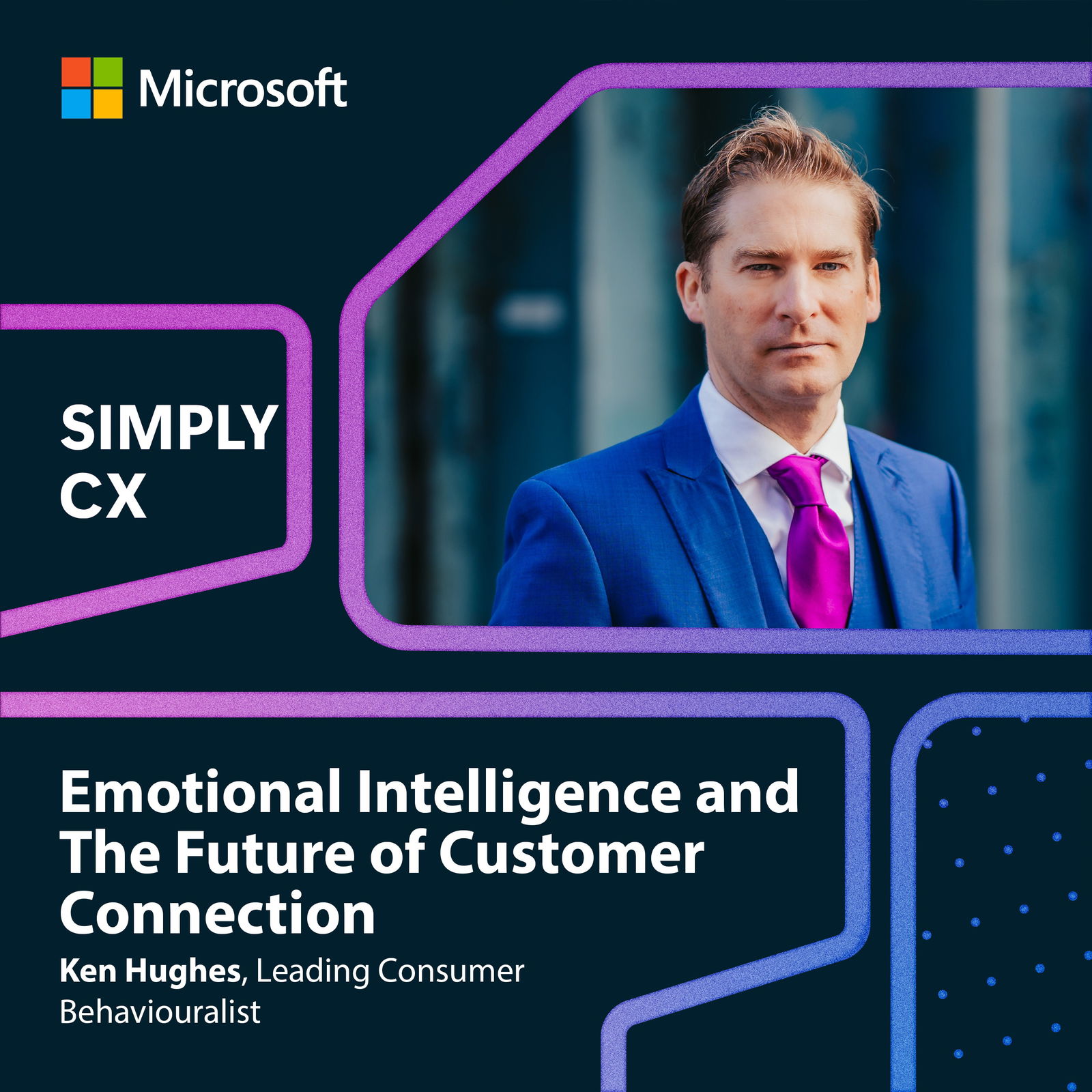
In this episode of Simply CX, Nicole sits down with behavioral scientist and CX visionary Ken Hughes to explore the emotional side of customer experience. Together, they dive into why emotional loyalty and customer intimacy are the true differentiators in an increasingly commoditized, AI-powered landscape.
Ken shares powerful stories—from how Octopus Energy uses music personalization to create emotional connection and reduce hold time frustration, to how Taylor Swift’s tribal fandom is a masterclass in long-term brand loyalty and customer engagement. They discuss the critical role of creativity, diverse teams, and employee empowerment in shaping standout experiences. Plus, why B2B brands might actually be in the best position to deliver truly personalized service.
You’ll walk away with:
- Why emotional connection outlasts product features
- How using unique human connection creates loyalty
- Understanding how to strengthen your brand through CX creativity and cultural leadership
Whether you're a CX pro, team leader, or brand builder, this episode will inspire you to see customer experience through a more human—and more powerful—lens.
🎧 Produced by Larj Media
📩 For more CX insights, follow Nicole on Linkedin
If you have questions or comments about CX email us: SimplyCX@microsoft.com
Additional Resources:
Ken Hughes – Consumer & Shopper Behavioralist | CX Strategist | Keynote Speaker
Mentioned in this episode:
- Octopus Energy – Learn more about their customer-first approach
- Taylor Swift’s The Eras Tour – A case study in emotional brand loyalty
- Brené Brown – Author and researcher on vulnerability and emotional intelligence
- Esther Perel – Psychotherapist and relationship expert
- Disney+ – Streaming home of Taylor Swift: The Eras Tour (Taylor’s Version)
- Grease Monkey – Quick-lube franchise mentioned for its customer delight strategy
| we forget that the core of CX deliveries is in the creativity of a human, at some point, to come up with a way of manipulating data, our customer touchpoint, that will make everything amazing. | |
| Welcome to Simply CX, where we bring you customer voices and expert insights. I'm Nicole McKinley, Leader of Global Customer Experience at Microsoft. My guest today is Ken Hughes, author, speaker, and customer experience expert. When I think about customer experience, I think of it in the context of the entirety of a customer's journey, all touchpoints, interactions that a customer has with a brand, whether that be through interactions with a product, product portfolio, digitally, with humans, you name it. And I'd love to get your perspective as a social scientist and a consumer behavioralist. How do you think about customer experience? | |
| Yeah, sure. I mean, very holistically would be the short answer. So as a behavioral scientist, my focus is always not so much on the brand and the product and the process, but actually on how people feel, the emotional loyalty. And emotional loyalty is heart space. And so, to me, connection is everything. What connection do I have with my customer? And does that connection go beyond product? Because product can be copied by anybody. Anyone can have better tech than you tomorrow. Anyone can have better pricing. They can have a better promotional strategy, better channels of distribution. They're so copyable, and we're in a commoditization race at this stage. As [agent?] AI bears down on us, there's going to be a leveling of the playing field for everybody. | |
| Absolutely. | |
| So really, all you're left with as a brand and business then is, well, what depth of connection do I have with my customer? That's why right now, you're seeing customer experience at the boardroom table rising in terms of its status on a daily basis because people acknowledge that actually, this is the KPI that we need to track, the depth of connection. That's the focus for the future. | |
| The term emotional loyalty, I'd love to unpack that a bit more and this whole concept of redefining customer experiences being customer intimacy. | |
| Yeah. Intimacy is in the moments when customers feel seen, where they feel listened to, where they feel truly valued. They are the moments of intimacy that root deep. And so the question is for all our frontline employees, for all our tech stack, for every interaction that we have, either digitally, physically, through AI agent, whatever the form, are we putting down roots of intimacy at some point? Intimacy can really only be formed when we truly understand the person, when we understand where they are, what they're going through, who they are beyond just names and dates of birth. And so getting our data and all the data we have on people into a form where we can start hyper-personalizing in all our customer experience work with the person as to who they are and what they're going through, as opposed to just buying brands and services. And that's really the shortcut to building ultimate customer lifetime value. | |
| The hyper-personalization. I love that term. I think hyper-personalization is something that large businesses, in particular at scale, really struggle with getting right. I know you have this great example from Octopus Energy, the UK utility company, and their approach. I'm curious if you could share more about that. | |
| Yeah. The Octopus Energy, beautiful story. I love it for its simplicity because sometimes we get so caught up in the data and the tech and using those things and AI to deliver CX, we forget that the core of CX deliveries is in the creativity of a human at some point to come up with a way of manipulating data, our customer touchpoint that will make everything amazing. And so what they did during the pandemic, they had initially the same problem that all utilities and financial services and insurance companies had. Their customer contact centers obviously all collapsed overnight. Everyone working from home had never done that model before. They had staff turnover issues. | |
| At the same time, they have huge inbound calls now. And so you've got a kind of a crisis point from a customer experience point of view. Now, Octopus would pride themselves on customer experience philosophy being at the core of everything they do for a utility company. They're selling a very commodity product. So the only differentiation for them is the way they talk with their customers. The brand is all about CX. So they didn't like this extended call waiting stuff and it was 5, 10-minute calls, and we all know what it's like to be on hold. It seems that awful music or you're hearing their campaign song over and over and over at the upsell. | |
| No. | |
| So they thought, "Well, what can we do better here?" And one of their executives have been reading an article about nostalgia. It was an article that said that the strongest powerful music that you would ever experience as a human is the summer hit when you were 14. The summer soundtrack to that summer will be very, very strong in your memories and generally give you quite positive feelings. And with that information, they built such a simple system. So you called in. Obviously, they would harvest your number immediately on the inbound call. They match it with your account number, and that would happen in any contact center today. And then they went one step further. Once they had your account number, and it's all happening in microseconds, they pull your data birth from the account, and they match that data birth with the hit song when you were 14, and that's the whole music you're going to get. | |
| Amazing. | |
| And so instead of thinking like, "Oh, God, I got a hold." You're immediately hearing heaven is a place in our Belinda Carlisle and you're going, "Oh, God, do you remember this?" And then all the memories that are associated with that, some are all. And so instead of being on hold for five or seven minutes, being grumpy, hilariously, a lot of the people when the agents called in were told, "No, I was listening to that. Go away." And so this idea of using data because it's date of birth data, but using the data in a way to make people feel special, that's the intimacy moment. | |
| It would be fun to hear a little Christina Aguilera, What a Girl Wants while I'm on hold. | |
| Yeah, exactly. And so the idea here of being able to personalize, at scale, make everybody feel special. Now multiply that out across more data points because we're only using one simple database data point there. Imagine if you take 50 or 100 data points on a customer and really know them. Imagine the level of hyper-personalization you can get to, but you're going to have to have quite creative people sitting around the table. The data science guys can make the data do whatever you want it to do. The tech people can make the tech do whatever you do. But in the middle, it's got to be someone that says, "I've got an idea. What if we did this?" And that's never going to come from AI. | |
| Absolutely. | |
| It's going to come from a creative moment of, I had this experience recently on an airline, staying in a hotel, buying something in a store, and it made me think about this, and I think, maybe, what if we did this? And what if we made our customers feel better because of this? And that's the magic. And so the creativity part of customer experience is often not spoken about a lot. So if you talk about talent and what the customer experience industry needs, it's a question I'm often asked. Where do you think the industry is going? We need the data people. We need the tech people. Of course, we do. | |
| But actually, the layer that we seem to be kind of missing is the behavioral science people, is the emotional intelligence people, is the creative people. Because people who get into customer experience are either coming from the NPS, data side or from the tech side. And what we need is a whole suite of people who are the feel people, who are the emotional people, high in EQ, and who understand that it's the purpose of customer experience to form these better connections. | |
| For larger companies, it becomes even more challenging at times to really have that hyper-personalization. | |
| Yeah, the fascination I have with B2B is that we have less customers. So unlike Coca-Cola, who have billions of customers, and so for them, hyper-personalization is difficult. B2B, we actually have a far smaller pool of customers and prospects. And so we can actually understand their needs to a granular point that only a marketeer could dream of. And so actually, I think that the B2B community need to kind of understand that they are in pole position here in terms of the scale and potential for personalization of product and service delivery. And so if they apply these principles to their market, they actually come out in front quite quickly. | |
| A number of things you shared are really on point, in particular, the simplicity. It reminded me of a recent experience that I had just last weekend. As a mom of four kids, I had to get my oil changed. I've been procrastinating for eons. I drive a minivan and I finally found 45 minutes in my Sunday to show up at Grease Monkey. I drive up and they set my expectations, first and foremost, that it's going to be about exactly 45 minutes, which is the window of time that I have. And then they fill out a couple of quick pieces of paperwork and off my car goes. | |
| And in 25 minutes, I get a notification, text message, my car is ready. And upon checkout, they let me know that not only have they changed my oil, they've updated my filter, they've renewed my washer fluid. I live in rainy Seattle, so that's very handy for me. And then in addition to that, they have placed on every seat in my minivan, which there are eight, a piece of candy. And for me, that was another example of just like a simple delight on multiple levels, right? And the data they have from me or about me is very limited. But they knew that time was critical for me. I'm a busy mom. | |
| They probably read on my face that 45 minutes in and of itself is going to be a bit longer than I would want. They delivered my car back to me not only what they committed, but they went above and beyond and added value by servicing my car in ways I wasn't even expecting but needed and appreciated. And they delighted my kids. They didn't know how many kids I had, but they ensured that I had candy on every seat within the car in order to hopefully bring a smile to their face. So I love that example as well recently, just because it is so simple, yet I will absolutely go back to Grease Monkey to get my oil changed the next time around. | |
| Yeah. The simplicity is wonderful. It doesn't have to be overly complicated. And this is how a mode of brand loyalty is so important, where when we go beyond expectations of a consumer, immediately the brand is coded into a very positive space. I'm just finishing a book at the moment on Taylor Swift and the amazing 20-year investment she's made in customer experience. And it's due to published later this year. The success you're seeing, the $2 billion global hit that the eras tour was, biggest concert of our time, biggest streamed concert on Disney+, all these huge records that she holds. You were looking at the return on investment of customer experience. | |
| Yes, the music's amazing, and she's a very talented writer and producer, but she has a Swifty army, a tribal fandom that no other brand has. Like Pink doesn't have one, and Lady Gaga doesn't have one, Madonna doesn't have one. They have fans, but they don't have the tribal belonging she has and she has that because she's invested continuously in the customer connection. If you go back to when she was 16, 17, 18, first albums, she was using social media early as even things like Tumblr and Facebook and Myspace were only forming. | |
| She was already using them to connect with customers, to talk to her fans every night, to invite them into her life, to share the intimate moments behind the curtain. She stepped into their lives. She'd turn up at their wedding and she'd send them little gifts in the post. She'd pay off their student loans as she got more and more famous. And to this day, she still does that. She still steps into their lives at any opportunity and allows them into hers. Tearing away the line between producer and consumer is so important. We call it collaborative commerce. Again, not treating the customer like an endpoint. They're at the middle. They're at the center of everything. | |
| So why shouldn't we be creating with them? And so even the word consumer kind of puts them in a place where they're just the ones consuming the product. Well, no, really, they're co-producing at this point. And so that's what Taylor Swift has because of that customer experience and customer intimacy, investment, the authenticity, the vulnerability, the excitement, delight, and particularly around that. She always looked to excite our customers and make them feel that they're as important as she is in this. That's why she uses the hard hands thing all the time. It's me, and it's you together. And those two things make us the success that we are. A lot of brands can learn from that. | |
| Yeah, it's a phenomenal example, and I am a Swiftie. I'm curious, are you? | |
| I am. Well, I've researched the phenomenon in the details of so deeply that my social media feed now looks at the feed of a 14-year-old girl every time you open my Instagram. So yes, I'm definitely now and indoctrinated Swifty everywhere I go. I end up with friendship places all up my arm. And it's quite funny because I'm fascinated by anthropology and a lot of the ritual and the consumption of the product, at the movie, at the tours, all these things, the friendship races, the concert attire. It's a huge part of ritual. What's really interesting, again, if you look at tribal behaviors, is that when we study ritual, we actually learn more about the tribe faster than we would watching regular behavior. I didn't get it. I didn't understand why she's so big. I get it now. Because if you actually open up the playbook and you look at everything she does value by value over 20 years, you understand from a customer experience point of view how she's just made this. It's like Lego. She's just made it piece by piece by piece, all very strategic. | |
| Absolutely. It's such a powerful, relevant example. And what's interesting, just to kind of tie it back to your earlier point on the emotional connection, even as you were talking about Taylor Swift and the experience of being at her concert, I actually got chills. | |
| Flashbacks. | |
| And I don't know if you could tell, but the smile on my face widened, right? And I have a daughter. We went to four of Taylor's era's tours concerts, and it's more than a concert. It's more than an amazing experience. It's really life-changing in a sense, in terms of like it brings joy and happiness and new connections and new memories, and it's lasting. So it's a really phenomenal phenomena. | |
| What I say to people is if you could just have 1% of that fear brand, if you could just have 1% of the connection those people feel to what the brand experience they're about to have, that's the game. The game is to invest beyond product. The game is to invest in experiential intimacy and to do all that consistently. And then you get that relationship. And there's 70,000 people in those arenas, but every single person feels that Taylor is their best friend. | |
| Absolutely. | |
| Every single person has that parasocial relationship with her. And yet she doesn't know you. And this is the great conversation we have again with B2B or with large scale. It's fine if you're a small local coffee shop on a corner in your local community to talk about intimacy and experience. And people get that, think, "Yeah, it's no problem. You've got 500 customers a day. You can know them all by name, and you can make, but how do you do that when you're a Heineken? How do you do that when you're a B2B company?" Well, yeah, okay, look at Taylor. And she has billions of fans all over the world, but every single one of them feels that authenticity, intimacy, connection with her. And so from a branding point of view, we often forget that, too, in customer experience. We go after the new customer all the time, acquisition, acquisition, acquisition, and we forget that the customers who we already have are maybe our most profitable assets also. And so again, it's all about relationship. And no matter what you're selling, the amount of industry you're in, that is kind of the new onus on you as a leader is to say, well, actually, can we push past product? | |
| I wanted to come back to your earlier point on human creativity. And at Microsoft, we often refer to that as human ambition. And that the real power of creating personalized experiences, creating transformational experiences for a company like Microsoft, is that combination of human ambition with AI, agents, co-pilots, you name it. And I'm often asked, though, at the same time, with this rapidly evolving AI landscape, how can we best keep that personalized human ambition at the center of the innovation and of the changes that we're making to customer experience? And I'd be curious on your point of view on that, in terms of with human ambition and human creativity, how do we ensure that that's not lost in this rapidly evolving AI world? | |
| Yeah, I think it's going to be the most important factor, I'll be honest, because everybody, no matter how small a business, is now going to be capable of delivering amazing hyper-personal messaging and customer experiences. So let's take a generative AI from imagery point of view. There was a time only, I'm going to say only five years ago, where you'd have to go to a big-scale ad agency to get some pretty amazing work done. Whereas today, if you're a mom and pop outfit, you can do that yourself. And you can have an amazing either video commercial or a piece of print media or billboard media produced in 30 seconds, and you can do it yourself. | |
| And so everybody is going to have amazing output. And in that space, then, there comes the question, well, how do we differentiate ourselves now? If everyone's got access to the same technology, if everyone's got access to the same tools, then the people that are going to rise to the top are the people that get most creative with it. And so I'm fascinated by diversity because the diversity argument is often about gender or about race. And those things are good proxies for creativity, right? Because women do think differently and different cultures think differently. And age is another one. People think differently. | |
| And so really what the diversity argument isn't about the thing, isn't about the race or the age or the gender. It's about the thought processes that we're chasing. We're chasing a collection of people around the table that have a different way of thinking. And so actually, I would always put neurodiversity on the table as another discussion. They have a way of thinking and a way of connecting two dots with a very curved line sometimes that gives us the exact new type of thinking that we need. | |
| And so I think we need to get a bit more courageous and a bit more vulnerable in how we recruit in corporate and in customer experience and find ways to truly allow people to be creative. And unfortunately, one of those ways is time. If you're going to have new ideas, you really have to be allowed the time to percolate ideas. And you need to be able to step away from desks and walk and kind of distill ideas and things. And we often don't give our teams time. We give them ridiculously tight timelines. We give them templates to fill out. They're all like passion killers when it comes to creativity. | |
| And so it's about over-resourcing teams, which again, the thing that corporate doesn't like to hear ever, allowing enough space then into that team for people to be able to percolate ideas and converse and have new stimulus and new environments. And so again, creativity in organizations, it requires us to go back and think, well, how can we build our buildings even? Remember Steve Jobs, when he built the Apple headquarters the second time around, built in little kind of off-shoots off the corridors for people to have accidental meetings because he understood that if as people were walking around, if you could just encourage cross-functional conversations and not have people living in siloed departments, that would help. And so anything that we can do to really drive the conversation around a new way of thinking and different ways of working. That's really, really important. | |
| Well, I think it also ties back to your earlier point on connection is everything. And connection fuels creativity as well. But you made some really important points I couldn't agree more with, especially on diversity and the importance of diverse perspectives, experiences, ideas, cultures, you name it. And that is something that we need to continue to really be intentional about cultivating in order to fuel that creativity. But I'm curious if there's other strategies that you would recommend businesses in particular focus on in addition to creating a diverse teaming environment. I know some of the things we've explored within my organization include co-creation sessions with customers. So ensuring that the diversity of the brainpower in the room is not just the business that you're operating within, but the customers and the partners that you're serving. | |
| I think collaboration is definitely key because you're sitting down with the customer, probably B2B customer and you're shaping product from the inside, from the customer's perspective. And that's what we need to be doing. Collaborating with competitors is the next step, and it's terrifying for most companies. But weirdly, for Gen Z coming into the workplace for the first time, they kind of are naturally collaborative. They've grown up with TikTok in their pocket, and they're used to stitching content A to Content B to Content C, and that's how you make creative stuff. And so they don't really see a problem with kind of dealing with your customers. Of course, why wouldn't you collaborate with those? And why wouldn't you collaborate with engineering and R&D and marketing internally? | |
| But also, why wouldn't you collaborate with the competitors who are having the same issues and trying to solve the same problems? And that's kind of fascinating because we were weird in the '90s to-- if you came out of university in the '80s, '90s, you didn't talk to your competitors. You tried to get ahead of them. And that is still the same today in terms of market share, maybe, but the acknowledgment that we all have the same tools now. And so why don't we all just sit down? | |
| And I'm not talking about market colluding, but I'm talking about with certain issues that we're having in the industry, maybe we can solve them together. Maybe we can bring our assets together here and again, focus on the common thread, which is the consumer. And so I think there's distance to go in that. I think it's interesting. And then back to the Gen Z recruitment piece as their next generation fueling customer experience. | |
| They come in for a lot of flak, and anyone who's managing Gen Z will tell you, "Oh my God, they all want to be a CEO in three years, and their expectations are too high, and their knowledge isn't enough." The one thing I'll say about them is that they're probably the most emotionally intelligent generation joining corporate than ever before. So everyone before, the boomers, the Gen Xers, and the millennials, came into corporate with a kind of a certain ego and a fear and leadership styles, roll around, get it done, play fast, and all that kind of stuff. Whereas Gen Z actually require meaning and purpose. That interview flip is really interesting where they sit at the table with you and they say, "Well, why should I work for you? Why should I work here?" And you're like, "Yeah, I thought we did the interview?" And so they-- | |
| I've seen this, yes. | |
| Yeah. And so they yearn for a while, like I have these values, I have my meaning and my purpose, and I want to see is that going to connect with yours? And if it does, then we're going to make some amazing work together. And so for customer experience, we're having an inbound workforce that do ask questions. They ask hard questions about connectivity and about meaning and purpose. And so if we want to retain that talent, and if we want them to stay with our organization for longer than six to twelve months, we've got to allow them to roll up their sleeves, be that empowered employee, and find ways to drive those better connections. | |
| And if they're making a difference, if they feel that they're making a difference, then they stay with you. And if they feel that their talents are being wasted, then they should get that connection elsewhere. They will leave you in a flash, and they won't even tell you they've left, which is the problem. | |
| I've seen that as well. No, it's a great point. And building off of it, when we think about generational differences, obviously, there's how to retain and grow diverse talent across generations within a company. But I'm also curious about what you're seeing in your work with regards to changing customers' expectations or changing customer values when it comes to generational differences. Because obviously, the customers of tomorrow are these new generations that are emerging as those that are going to be the users and the consumers and the buyers and then the business leaders of the future. So are you seeing shifts in what customers value or future customers value based on these generational differences? | |
| Yeah. I mean, we always study what consumers value and it changes at all times. If you look back to the traditionalists who were born just before World War II, they grew up in a world of accessibility being the problem, just queues for bread and queues for nylon stockings and all that kind of World War II behaviour. And we had a little retaste of that during the pandemic, which was kind of interesting, queuing for retail. And so back then, accessibility was a thing. | |
| And then that gave way to affordability in the '50s and '60s, where consumers valued just being able to not only get the thing, but a car for all, a washing machine for all, a TV for all. This was the kind of Mad Men peak mass consumption, mass production years. And then that gave way in the '80s to quality. I don't want a product price. I want a good product. I want Nike. I want Gucci. I want Porsche. And so we saw the birth of luxury branding and quality. And then in the 90s and 2000s we have convenience. I want it now. I want it. One click, one swipe. And you get the rise of Amazon. And so the values keep shifting. | |
| And now we're into kind of that authenticity space. There's an interesting revolution happening in the luxury market where it's all about quiet luxury. It's not about the big brand splash. A lot of the brands that are succeeding in luxury at the moment are quite soft and quite silent. And so the logos aren't even apparent, and it's all around, "I want real." And it's one of the issues that Starbucks are struggling with because Starbucks were a really authentic third space, that whole idea of when it started. But of course, it got so big. And with scale, you get the McDonaldization effect. | |
| And then people think, "Well, what does that stand for now?" And yet the street food movement is booming all over the world because people love the idea of the guy who owns the truck, left Deloitte, too. She grew a beard, and now sells falafels, [laughter] that authenticity. People love that. And so trying to connect your brand to that authenticity is really important. So as those values shift, do the generation shift yet? Yeah, they definitely have different social, and economic, and technological expectations. But what's really interesting is the common thread running through them. | |
| So Gen Beta being born right now this year, they will grow up in a world of AI agents and robotics and quantum computing, and fundamentally such a different world than Gen Z grew up in. The middle generation Gen Alfa will get a flavoring of that. And so, of course, growing up in that kind of tech-heavy reality will change their nature of expectations. But already, someone like Gen Xer who grew up waiting for a taxi for 20 minutes at an airport, that was their norm. But now when they take out their app and press their button, they expect it to be there within four minutes. Anything more than four minutes is like, "Oh, for heaven's sake." They're the same people that happily queueed 20, 30 minutes a few years ago, but they don't anymore. | |
| And so that's the point. The point is no matter who you are as a generation, the tech that comes along and the expectations that change ratchet up really fast. It's now no matter what generation they are, they expect it to work first time every time. They expect you to predict their needs. They expect you to be there ahead of them. And I can see that thread across all generations. It accelerates, obviously, more and more as you get younger. But it is pervasively there, and it's there across geographies. | |
| And that's the really exciting thing for marketing because when you can look at seven generations on a slide, and you think, "Oh my God. I have to satisfy the needs of the traditionalists, the boomers, the Gen Xers, the millennials, the Gen Z, the Alphas, the Betas. How do I do this?" Really, you might have a core target market. But actually, a lot of the human needs, the values for authenticity, for instant, for connection are all running through them all. And you might need to find a different way to connect with the traditionalist versus the Gen Z. Yeah, fair enough. Different touchpoints might need to be dialed up in physical versus digital depending on what your industry or your market. But the core underneath it all, the connection is everything rule still holds true. And so generations, while they're stacking up [laughter] in terms of numbers, the commonality of how they buy and how they interact is actually surprisingly similar. | |
| That makes great sense. And I think with that rising of expectations coupled with AI and new technologies that I feel like are launching every day, I imagine the pace of change in those expectations is now, and going forward, only going to exponentially increase as well. And when I think about companies, whether it's Microsoft or Grease Monkey or what have you, the challenge ahead is how to stay at pace or ahead of those rising expectations, and, again, not only meet those expectations, but exceed them, delight them. And I'm curious, from your vantage point, are there best practices or strategies that you recommend companies focus on or invest in that can really help future-proof? | |
| I think it's got to come from the top. When we talk strategy, we often ignore the fact that nothing can be done unless the philosophy of the organization runs like blue blood in their veins from a CX point of view. So if it doesn't come from the top, best of luck. I was talking to the CEO of a large health group company recently. And he was talking about some AI investments they had made. So one of the problems with clinician appointments is that you walk in and the doctor, he or she is charting as you're talking. So as you're sharing your most intimate vulnerabilities, "I have a rash of this of this. Oh, I'm going to die," they're kind of tapping away. No eye contact with you. They're kind of here, "Yeah, okay. Tell me. Right. Yeah, yeah. Okay, yeah," and that's not a great experience for you as a customer. And a lot of the patient satisfaction scores show that, the cold, clinical nature of the appointment. | |
| And so they installed a very simple charting system, an AI speak-to-chart system, and they took the laptop off the desk of the clinician. And now you come in, you sit in the seat, and the clinician looks you in the eyes. And for 15 minutes they ask you how you're feeling and, "Tell me more about that." And there's no charting, no pain in the hand. And when you walk out you just turn-- he or she turns to the terminal and has a quick check to make sure it's all okay, maybe a quick edit, and we're done. And the employee satisfaction scores shot up. You'd expect the patient satisfaction scores to shoot up because it's a nice, more genuine, empathetic conversation. But the surprise was the employee satisfaction scores because now they got to do what they got into medicine to do in the first place, to be there for customers and to feel that they were being in a position where the customer was excited to have the conversation as opposed to bureaucrats. And so it's a good example, again, of the simplicity of it. But investing using technology to make someone feel, it's not just there for efficiency. It's not there for cost saving. It's there to make patients feel more connected. | |
| And that same CEO talked about employee empowerment and talked about the importance of delivering customer experience in the beginning and from the top. And when he visits one of his hospitals, the first thing he does is he takes off his blazer and his tie and he puts on an apron, and he delivers meals to the beds because he tells you-- he says, "The patients, first of all, will tell you things they wouldn't tell the CEO, but they'll tell the dinner staff everything." And more importantly, he said, "It's important for my staff to see that what I expect of them I would do myself." And so this idea from the top, that the customer experience philosophy has to come from the top. You have to empower all your people. So from a strategy point of view, investing in employee experience is critical, making sure that you have employees who get it, who are motivated, who are now inspired around CX, and then also from the very top, see that every single layer in the organization is the same. You'll never get frontline workers delivering amazing customer experience if they themselves aren't having an amazing employee experience inside the organization. | |
| Absolutely. It's part of the ethos, part of the culture, part of how a company needs to operate if they want to make it real. I love that. Well, thank you. So much great insight. Whether it's the criticality and the importance of connection, customer intimacy versus customer experience, and really being hyper-personalized in how we think about delivering exceptional experiences to customers, I come away with just so many ideas and new energy that is applicable to this space. So thank you, Ken. I'm curious if there's one, two, three top things that you want to make sure every customer experience leader or aspiring leader takes forward and spends time on anything that you'd want to leave us with? | |
| I would say the first thing is dial up your emotional intelligence personally. So read books by Bernie Brown, Esther Perel, Gabor Mate, all these amazing people who are doing amazing work on relationship and emotional psychology. That's the space that we all actually need to be better at in terms of human connection. So I would say invest time there. To our point earlier about creativity, I think we need to give our teams and ourselves time to get creative. We have the data. We have the tech. But actually, we're doing very little with it. And so we need to kind of encourage ourselves to take space and time out of our days and whether that's going to more CX events or conferences or listening to podcasts like this. | |
| Congratulations to everyone who's dialed in to listen to this because again, you've made a conscious choice in your day to actually put something else in the funnel. And that's the point. If we're just doing the same thing all the time, we're looking at the NPS cores and building dashboards, you're not actually creating any space for yourself to have a think. And that's your job as a leader in CX, to have a think about how we can do better connections. So again, more of this, more of kind of putting stuff in. | |
| And then lastly, I would probably say, look outside your industry. A lot of CX people are so focused on their industry and what's happening in their reality that they forget to lift their chin and have a look at different markets in different industries and what's happening. People who work in B2B and B2B alone tend to get very solid in that industry and maybe not draw inspiration from B2C and vice versa. And so, again, looking to expand your horizons in terms of industries and markets in a way that encourages you to maybe think, "Oh, maybe that [inaudible] energy thing that he talked about, we could do that." And so the more stories you can hear and the more exposure you can give yourself to customer experiences of any sort, in any industry, in any place, I think gives yourself more ideation in your own organization. | |
| Ken, thanks again for being with us today. | |
| Yeah, sure. | |
| Hearing your stories and some of the strategies you're seeing out in the market has really fed my CX creativity. I can't wait to get your new book all about Taylor Swift. That sounds compelling personally and professionally. | |
| [music] | |
| Thank you for listening to Simply CX. I'm Nicole McKinley. Our show is produced by Larj Media. That's L-A-R-J Media. Special thanks to [Luya Polka?] and Elizabeth Machado and to our video partner Pegleg Pictures. To find out more about today's guest, Ken Hughes, check out the links in the show notes. Have your own challenges or questions about CX? Email your question to the show at simplycx@microsoft.com. | |
| Please share today's episode with someone you think could learn from it and follow me on LinkedIn to keep the conversation going |