
 Apple Podcasts
 Spotify
 PocketCasts
 Amazon Music
 YouTube
 CX as a Team Sport: Turning Customer Insights into Impact
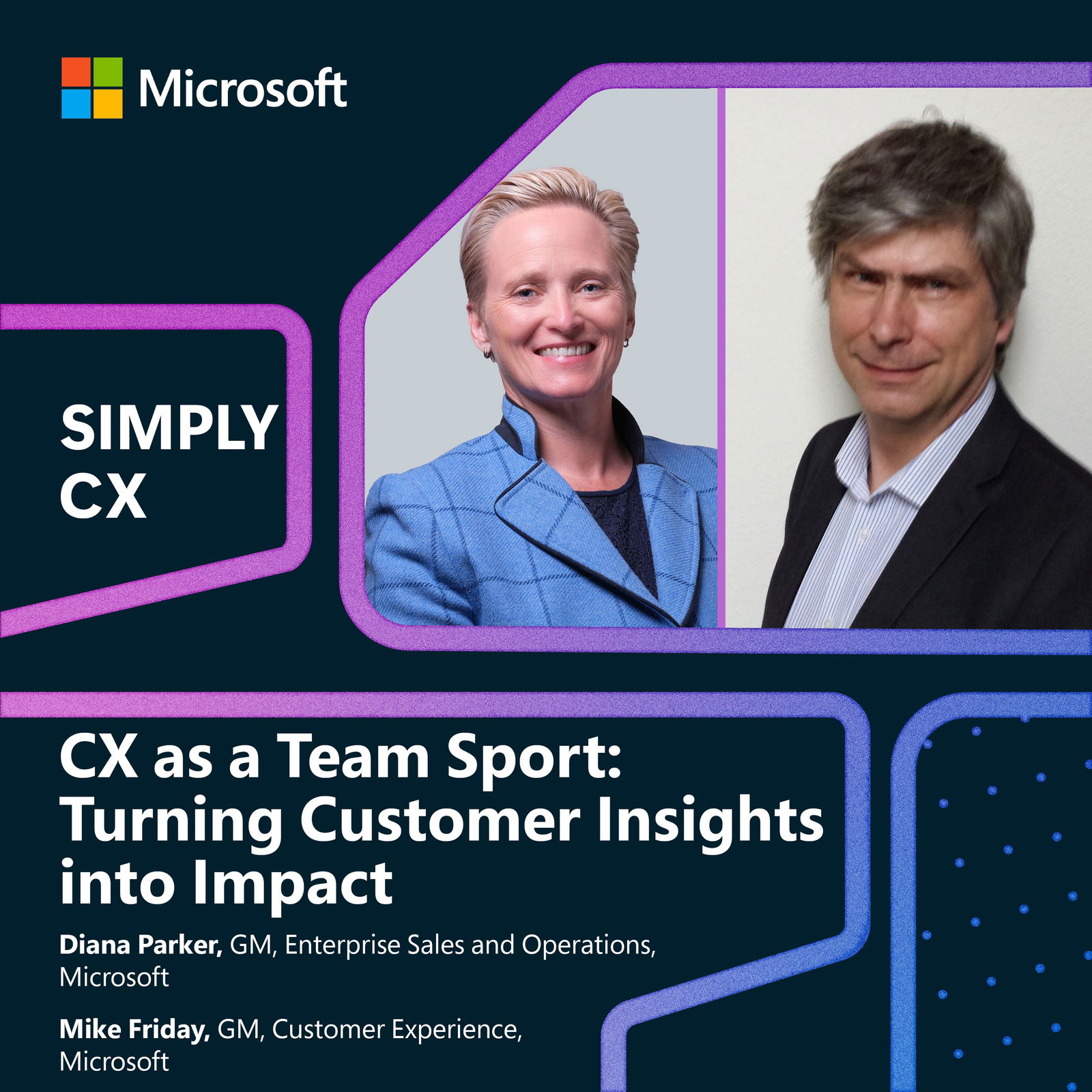
We’re breaking the mold in this episode, as Nicole sits down with two of her peers who are helping bring the CX vision for Microsoft to life. How do you embed customer experience into the DNA of a global organization? Learn from Mike Friday GM of Global Customer Experience Engagement and Diana Parker; GM of Enterprises Sales & Operations who share how Microsoft moved from reactive surveys to predictive, AI-powered insights—making CX a natural part of everyone’s day. Culture, accountability, and agility are the game changers.
You'll walk away with:
• Why culture—not tools—was the starting point for CX transformation
• How real-time feedback and AI are driving proactive customer engagement
• The power of shared accountability and personalized insights in CX strategy
Whether you're a CX pro, team leader, or brand builder, this episode will inspire you to see customer experience through a more human—and more powerful—lens.
Mentioned in this Episode
• CX Council at Microsoft
• AI-powered Sales Copilot and Sales Chat
• Champions Cup CX Awards
• Always-on listening mechanisms
🎧 Produced by Larj Media
📩 For more CX insights, follow Nicole on Linkedin
If you have questions or comments about CX email us: SimplyCX@microsoft.com
| We understand if there's a problem with customer experience, well, maybe it comes from place A, maybe it comes from B or C, maybe everywhere. But we can be much more targeted in figuring out what the underlying issues might be and how we can really respond to them. |
| [music] |
| 'Today's episode is a bit different. I'm joined by two colleagues at Microsoft who've been partnering with me over the last few years to drive true CX transformation for Microsoft. I have with me Mike Friday, General Manager, Customer Experience, and Diana Parker, General Manager, Enterprise, Sales and Operations. I'm super excited that you guys are here today. I want to go back a few years, and I recognize that when we embarked on this CX transformation, we really had to look at ourselves and really think about what it was that we were going after in terms of a bold customer experience ambition. We didn't start with tools. We didn't start with business process or metrics or some of the more traditional elements that enable large-scale change. We started with culture and our people. I'd love to hear kind of what you recall about those early days. |
| The very first customer interviews that we did to be able to bring this to life. And I remember that we went out there and got videos of the customers from different scenarios highlighting what that customer experience, what the reality was to them, what their desired outcome was, so that we could actually bring that to life to everyone within the organization. And that was the first element, if you like, was putting the customer front and center of the transformation that we wanted to drive, of the strategy that we wanted to go forward. |
| What stood out for you is we really crystallized the key things customers were expecting of a technology provider. |
| As you say, there was a huge amount of data to be coming up with the specific themes. Part of the challenge was the sheer breadth of customer base and customer types that we had. |
| Absolutely. |
| We had everything from the largest strategic global companies that you could think of, down to the smallest SMB customers that we go to every day in the corner shops, all wanting to get different levels of experiences. What that meant to them, depending on where they were with their journey into the cloud, how much of they did they have on-prem, that was different. And part of the challenge was being able to build a strategy that was flexible enough to be personalized to each of those different customer types and their individual needs. |
| And really, listening became our superpower. And I think building a capability that enables ongoing, always-on listening has really been a key accelerant to the development of our strategy. And you and your team have done some really phenomenal work in driving culture change with regards to really helping the field understand that any and all customer feedback is valuable. I'd love to learn a little bit more about what you feel like is standing out as you've started to help sellers and members of the field embrace all customer feedback. And then to tie it to your focus on how we leverage AI solutions, how we're able to do that in a very quick, easy, frictionless manner, so that it doesn't create a bunch of additional time suck in terms of immersing yourself in what our customers are saying. Feedback from our sellers on as we go more into an AI world, we're actually shifting who we have to sell to. And if you kept doing the same thing, kept polling the same people with the same questions, with the same cadence, we would have missed a lot of the shift that said, "Well, maybe we need to think about how well we're positioned with this new group of people." And this new group, so for us, a real shift into much deeper industry knowledge and understanding and business have different expectations than an IT department head who might have known Microsoft for the past 20 years, really understand the value we drive. That there are different expectations and different experiences that those different buyers essentially are having. You polled people twice a year, and you asked a rigid set of questions, and you spent months getting the data back. In today's world, if we had to do that now, by the time you got the data back, it would be useless to us because the market would have moved on so fast. So I think there's this kind of really symbiotic relationship now where the ability for the field to manage contacts in our CRM system better in such a way that you can get real feedback, then allows you very quickly, near real time, often, to be able to pick up on trends, pick up on what's changing and what needs to change. And then we can collectively address it. And I think we've also got much better at the feedback loop. And that's another thing I've really enjoyed that we've done with your team, is we've got a very clear distinction between the things that are in the control of the account teams that I specifically deal with and things that are in control of other parts of the organization. And not that that takes away from the need for this holistic accountability. Microsoft is generally a very collaborative organization, I think, that kind of one Microsoft sense. But what it means is that we're not kind of drilling down in the wrong places. We understand if there's a problem with customer experience, well, maybe it comes from place A, maybe it comes from B or C, maybe everywhere. But we can be much more targeted in figuring out what the underlying issues might be and how we can really respond to them. So I think that's a really nice way to think about it as well, is that you want this holistic accountability across the group, but you also want to be clear with people how you're helping the bits in their control get better by helping the things that aren't in their control improve too. And I think that's been a really important part of the journey for me. |
| Historically, like many companies, we did semi-annual surveys of customers to be able to listen to them. We would spend months being able to analyze, pull these things together, which was great for doing the initial themes. But if we focus on any of those approaches, it only gives us a long rear-view mirror as to what customers wanted in the past. |
| What was important was how we could move forward, modernize our processes so that we had something that was truly an always-on listening mechanism, something that we could respond to customer needs, be able to adjust on the fly, and be able to dive deep into some of those differences that I mentioned earlier with the different customer types and their needs as well. |
| We needed to not only understand the voice of our customers, the voice of our partners, but also be able to connect the data and the insights that we gleaned from those voices with voice of employee, with voice of market, with operational data, financial data, you name it. How do you feel that enabled us to move from simply serving up data and looking at what the data said to really actionable insights? |
| One of the first things that we did that was really interesting was look at all of the policies that applied and how they impacted the customer experience. We went through each of those leaders of operations, finance, planning, and identify who owned which of those policies. And we found a third of those policies weren't owned by anyone. They weren't policies. They were operational procedures to make life simpler from a Microsoft perspective. When we did that and highlighted it, we managed to significantly reduce the number of policies that applied. That resulted in a better customer experience because it was simpler for them to understand and deal with things. |
| But it also highlighted a couple of things, the fact that it's not the people necessarily on the front line that are affecting that experience. It's people in the back office. It's also the fact that people don't set out to deliver bad experiences, but unless you build that into the culture, they're just focusing on what it is that they can do to do their job easier and better without considering that impact. When we considered that impact, when we brought that to the fore, it did improvements for everyone, for customers, for partners, as well as bringing improvements for Microsoft. It was a real win-win-win situation. |
| Building off of the point around culture and driving alignment, I'd love to spend a little bit of time with you, Diana. You're kind of unique in that you've spent a bunch of time actually in the field, selling, engaging direct with customers, and now you're on the flip side, enabling sales and operations teams across the globe. |
| I know we keep coming back to culture, but anyone who knows anything about Microsoft knows it's really core to the DNA of the journey we've been on really since Satya Nadela took over back in 2014. And that notion of customer centricity, customer obsession, knowing your customer and really delivering outcomes that are meaningful to them, I think is at the core. |
| But that said, sales organizations are driven by targets. And this is something you and I have been talking about quite recently. But if I look back at the field sales roles, say, seven or eight years ago, customer experience surveys were something to be endured rather than learned from. They were something that the field would find ways to-- I mean, the field are very good at hitting targets, right? |
| Absolutely. |
| You give them a target, they'll find a way. And I think the difference is when you start to deliver meaningful outcomes - and I loved some of the examples Mike was giving there - then it starts to feel like something that has value to the seller as well as value to the customer. And I think the more you can demonstrate that linkage, the better. And then you and I have spent a bunch of time over the last kind of 12 months or so talking about how do we actually incentivize our sellers to demonstrate great customer experience and learn from not great customer experience rather than be punished for not great customer experience. And I think that's been quite a big cultural shift as well. |
| And from the information you were giving me the other day, we're seeing more and more examples of great customer experience showing up. And that lets us learn and share and be really proud of those moments. But it also gives us more opportunities in this cultural shift from kind of know-it-all to learn it all, growth mindset, to embrace opportunities to learn from the experiences that weren't as great as they could be. So I think that shift is-- and I think Mike said it really well, it is. It's that top-down cultural shift as an organization. |
| And then making sure it's been embedded in the way you listen and speak to customers, and then the way you communicate with the field, and the way we set targets, and the way we think about measuring and reacting to the outcomes as well. |
| So yes, listening to our customers just wasn't enough. We really had to broaden the aperture of the voices and perspectives that we gleaned feedback and insights from. So in addition to voice of customer, that included voice of partner, voice of market, or the competitive landscape, as well as voice of our employees. How did that combination of voices and the insights we were able to glean influence our priorities? |
| It requires that ecosystem. And so listening to the customer is the start. Listening to the partners who are going to help enable, and tailor, and personalize some of those services is important as well. How we then make the experience frictionless for them is equally important. Similarly, from our employees, look, I mean, happy employees give happy experiences. It's really a matter of sort of how do you listen to them about where their barriers are? Where are the tools that are preventing them from delivering the best services? And how can we build a roadmap to simplify things, to be able to better enable them, to free them up, to deliver the best to their customers as well? |
| And then the last element that you mentioned there, the voice of the market, I mean, the market is changing so quickly at the moment. It's changing from a technology basis, as we're seeing. But it's changing from a customer expectation perspective as well. What customers expect as being good service today will be different from what it is in the future because of those market changes that we're seeing. And that is also important that we understand not just how we're improving, but how we're improving relative to everyone else as well. |
| We focused on executing three major levers in driving change across people, process, and technology. Where did you see these three really align and come together? |
| They really come together when we start sort of building that roadmap of the customer experience changes that we want to drive. From a people process, for example, it's about making sure that we simplify the engagement for the customers in the right time. And that was part of our early learnings was the need to be able to streamline the engagement model with the customers. That was part of making sure that we didn't swarm all over customers and leave them trying to work out who they should be talking to for different components. It's making sure that they have the right tools, our customers have the right tools to enable them to do their processes as well. So all of those come together as we start building a roadmap to improve customer experiences on specific elements or specific customer journeys. |
| When you think about impact and the impact that you've seen so far - I know we're still early days - what stands out? |
| Well, it is. As you say, it's removing that friction. It's removing the friction from our own employees to be able to say, rather than spending all of the time trying to find and know an answer, it's being presented to you. We see an impact already in terms of quicker resolution times, fewer transfers, better engagement, better customer feedback as a result. And we're also seeing the feedback going back to our engineering teams to reduce the number of challenges, to reduce the number of problems in the first place. |
| So as we brought these four voices together and had this new, very rich set of data and insights, what specific impacts that we've driven as a result are you most proud of, Mike? |
| I think there's a couple. I go back to one of the first things that we addressed was the complexity of just doing business with Microsoft. If I go back five years ago, there was numerous teams, individuals from each solution area, from each product set, engaging with the customers. I think it was around 25 different groups that would but engage the customers. And it was up to the customer to navigate who they should talk to for which purpose. They couldn't rely on the fact that internally to Microsoft, somebody would be coordinating all of those different activities, making sure that everyone knew what the customer's transformational projects were, or what their strategic business needs were. So the first thing that we did, one of the first projects that I remember as well was, as a company, we streamlined the customer interaction with Microsoft and we focused it around three key roles. The customer success account manager, the account executive, and the specialist teams, to be able to then do-- they would understand the customer's strategic priorities, their business transformation projects. They would do the orchestration of all of the resources needed to pull that to life and be able to make that real. It really streamlined and made a big difference for the customers just in terms of how they engaged with Microsoft. |
| What I love about that example, and I think, to tie it back to the culture shift that we've been driving, is that as we defined clear role accountability for customer engagement, those roles work together as one to deliver value to the customer, versus operating in silos and being laser-focused on individual performance metrics or individual objectives, really working together as one team to deeply understand the customer's needs and ensure that no matter who is engaging with the customer, their needs were front and center and guiding all engagement activity. |
| Absolutely. And you talked about culture there. And the second example that I'd give around that culture shift, and the impact that we've had, has been the collaboration that we've seen across the engineering and across the support groups and the deployment groups to absolutely reduce the number of cases that are being caused by being raised by customers. It's a culture shift because, if I think about things before, each audience would take the number of cases that they were dealing with in isolation. |
| It was how many were engineering be dealing with, was a very different number to how the frontline support teams, or how our customer support engineers, or cloud solution architects were on the front line with the customer. And each one would look at the duration of the cases within their own particular environment. So we did a number of things there. First of all, we made sure that there was an understanding of one clock. How long was the cases in each different group, and what was the ultimate time to resolution for the customer? So we would manage time to engineering, time in engineering, to be able to get that resolution. |
| So really anchoring on a customer-driven view of time spent. |
| Exactly. What we also then, having built that common understanding of the customer experience, built a much greater focus on supportability. What tools could engineering put in that would enable these things to be resolved quicker at any level within that end-to-end environment? What could be done to actually help the customer resolve these themselves before having to place a support case with us in the first place? And then, building on from that, being able to set targets with engineering that they have to make their tools, their services easy enough to use, easy enough to be supportable with fewer cases coming into Microsoft support teams. And the ultimate end to that is we've now just started seeing the absolute reduction in number of Azure cases coming into Microsoft, which is obviously the best experience that you can get is never needing to raise a support case. So it's improving the customer experience, but it's also reducing the overall cost and support burden on Microsoft to continue to manage those unhappy customer situations. |
| And that example, that really treating support volume of any kind as a product defect, I think was a very significant culture shift as well. And now to see the shared accountability and the shared focus across engineering and support teams in eliminating that friction, eliminating that toil for our customers has really been remarkable. |
| Historically, the definition of an outage was managed by engineering when they saw services go down. Taking that change in culture shift to its extreme, we're now redefining that so that an outage is anything on the lived customer experience. It doesn't matter whether it was caused by an environmental issue, whether it was a networking issue, whether it was a code issue, whether it was anything else that could have affected it. |
| Caused by a customer, caused by a third party. |
| We are framing that outage in the light of a customer. And those metrics are now being viewed in that light at the very top of Microsoft at the very senior levels. |
| Those are great examples, Mike. And I talk to customers all day and often get asked the question, "Well, how? How does Microsoft achieve these pretty significant shifts in terms of culture and accountability, and then ultimately, customer value and impact. |
| Again, it comes back to where we started with culture and the need to drive culture from the tops down. That comes from the top with our senior leadership team. We also created a CX council of all of the senior leaders across engineering, the different engineering teams, business operations, finance, planning, together with the sales teams to be able to align on what those key journeys were. And we then, from that tops-down council, ensured that there were customer experience targets going down through each of the different organisations and groups. It's something that doesn't give you instant results, but over this five-year journey that we've been on so far, to be able to really start seeing some of the benefits that we've been looking forward to. |
| So starting with culture, powered by strong executive sponsorship, driving alignment tops down on the goals or the objectives and having measures in place, and then working together to really co-create the solutions and drive execution plan, and also work together to address the issues along the way. |
| And having the governance processes in place to make sure that we all hold ourselves and each other accountable to delivering those improvements as well. |
| I think managing that system of accountability and measurable progress has really been a key enabler for us. Yeah, I want to go back to your point around really demonstrating value to a seller or a person in the field. We've done a lot of work on this. We've connected experience or perception data across the four voices that Mike talked about with real business operations and performance data. |
| Being on the sales side, I think one of the things that's really interesting is it doesn't necessarily feel to me like investing in CX. It feels like investing in our customers just much more broadly. And it should be, and I think increasingly is just an integral a part of the experience of our sellers. So if I think about-- and you alluded to the fact I spent six and a bit years in the UK in the sales organization, I've now been out here in our headquarters for about five years, so I've got kind of a view from both sides of the fence is, as we think about how we use AI, for example, our primary focus is on freeing up time to spend more time with customers. And it's because we know that that drives tangible outcomes that we can justify, because even for Microsoft, there's a cost to us using AI. |
| There's compute, there's storage, there's all of those things that we could be selling to someone else. And instead, we're using it. We're giving it to our sellers. So there's always an opportunity cost. So those really tangible things that says, "Hey, if we can find 10% more time in a seller's day, then we know we're going to drive these meaningful outcomes." Both in experience, which matters because, as a seller, I then have a happy customer. Much better place for me to be than an unhappy customer. But we also know it drives ultimately higher spend, more loyalty, all of those things, higher use to your point, then it becomes a much easier case to make for why we should invest and keep investing in people and process and platform to drive those experience differences for the field. So I think ultimately, as a field seller, I will have a better experience, my customer will have a better experience, and Microsoft overall will have a better experience. |
| Yeah, I think one of our key learnings is that in order to drive CX transformation at enterprise scale, you need to have a shared accountability that customer experience matters. And at the same time, you need to have really precise, very clear, individual accountability that is in the direct control of each employee, each role. And I think we're bringing that to life for our sellers and for other roles as well, which is exciting to see. You touched on the importance of diverse customer voices, and I think that's another really important point. And I think one of our learnings has been that we can't just rely on the perception and feedback of the traditional technology buyer, but that all voices in a customer and all customer types, whether they're new and emerging startups, one-person company, all the way through to our global strategic enterprise customers, that all of their voices and the makeup of the voices within a given customer base matters. And those perceptions then can be used to better understand specific actions that a given role can take to drive incremental or deliver incremental value to the customer, both as a business, but also targeted as individuals, and creating that real personalized experience. |
| I think the thing I've really loved is how quickly you were able to pivot to looking at a completely different set of customer voices when we realized that AI fundamentally required us to make that shift to a different group. And I think you talked about-- you talked about people, process, and platform, maintaining or building in the agility to not be fixed into one way of gathering feedback. I think it's been incredibly useful for us. So your ability to do that really quickly, the ability of your team, and I mean, frankly, one of the things I've really loved is the generosity of your team in terms of their time, because it means that my team and I can sit and ask all the basic questions and try and figure out why these things matter and why A is important and why does B make sense and how do they have interplay the ability to have that really peer-based business connection between customer experience and sales that these are not separate things that we are synergistically linked and that we will be more powerful together I think has been really helpful because it's not been my experience in every organization that I've been in. And I think if you go back historically, seven, eight, ten years ago, it felt much more separated, much more siloed. So the fact that your team is always willing to sit with my team, think on the fly, "Hey, could you just look at the data this way? Could you look at it that way?" I think making sure that we've built in flexibility and agility whilst maintaining, I guess, the credibility of the data has been something that's been fantastic and a really different experience for me in terms of dealing with that. So there's that piece because we could go off and do a bunch of things on the basis that we think there's a difference. But if we can then know there's a difference and measure the reaction of those stakeholders over time, we can figure out whether the interventions we're taking from a sales standpoint are the right ones or not. So I think the speed, the synergy, the ability to work together, the real flexibility has been, I think, really powerful. |
| Yeah, definitely working as one team with one set of shared objectives, yet also having clarity of the unique accountabilities that each has in order to achieve it, I think, has been a great enabler and ignited the speed at which we can work together. Also, back to kind of your point around the precision of the data and the actionability of the insights. I think the other thing that has been a big unlock most recently is not just looking at customer experience data and insights at the thematic level, whether that's by customer type or customer industry or geography. But the ability now that we have to look at those broad thematics and let that inform our strategic priorities, but also be able to look at that customer feedback at the most granular individual level possible so that we can then equip an individual seller or an individual customer success account manager to directly take action with the human. |
| Yes. Yeah. I love the fact that we're, I mean, customer zero is how Mike referred to it before, but that kind of drinking our own champagne, as it were, the ability to say, "Hey, if you meaningfully allow us to survey your customer, then you, specific account manager of a specific account, we're going to give you insights that you can take action on." And I also love the fact that you've got a kind of kudos element to this as well. So if I'm a seller and I get really great feedback, my manager gets a message with me on copy saying, "Diana's done an amazing job. Here's some of the feedback." I think that's great. We all love a bit of kudos. And at the same time, being able to also say, "Hey, Diana, you got some feedback from your customer where there's an opportunity for you to go take action to improve their experience." And that not being sent as a, "Hey, Diana, you did a bad job." And that we're not immediately saying, "Oh, and your manager's on copy and you best do it." We're giving our sellers an opportunity to take action, to be able to drive that improved experience, and then have a really thoughtful and structured way of making sure action gets taken, that we're not just hoping that our sellers do the right thing, but driving that meaningful interaction, action, but also into their daily life, into the place that they're working. They're not having to go hunt for this. They're not having to search through thousands of emails for it, that we're using AI, we're using agents to make sure that this is surfacing in the line of their work, I think, is really important too. |
| Absolutely. I think that's the key, is really making it super easy, super simple, super personalized in providing sellers or other roles in the field with the customer experience data and insights that's meaningful for them. And the fact that we now have these AI agents, sales agents, sales co-pilot, sales chat that allows us to serve this insight up in milliseconds in those key moments that matter, I think, is a game-changer for sure. I wanted to lastly touch on this point that you've made a couple of times, around really rewarding and recognizing exceptional customer experience. And I think our whole strategy in driving culture change on this point has been to really incent and elevate customer experience as a positive enabler and accelerant to achieving business outcomes, versus to your earlier point, hand-slapping or penalizing failures or breakpoints in the customer experience. What's been most exciting for you and most impactful as you think about all the different ways we're looking to reward and recognize exceptional CX? |
| So I think it goes back to partnership. I like the fact that this is not coming from the CX organization without engagement with us as kind of the sales strategy planning go-to-market team that we're very much doing this hand-in-hand. But we have the right levels of executive sponsorship so that at, for example, our country manager level, there's buy-in that this matters, that they will be measured on this, and that it's an opportunity for them to really showcase excellence within their countries. I think that really matters. The fact that we've built and-- I mean, this happens to be a particularly Microsoft thing, but a kind of best in the World Cup, the CX Champions Cup. People care. They get to hold a piece of silverware. I've seen the pictures, and I'm sure in the coming months, we'll get to see someone lifting the cup. Those things are minimally cost-bearing, but really do allow people to celebrate in a way that matters. And it's part of the Microsoft culture is that ability to stand up and celebrate when things have been done well. So I think it's that blend of the specifics. So there'll be specific account teams that can win. To your point, that very granular level of detail we can get to. Opportunities for entire countries to win, for having moved in the right direction, made big leaps in customer experience. And all of that gives us a chance to learn. And I think that's the thing that's most crucial, is every single time we see those things, there's something new we can learn, some different way that a country is approaching it, some different approach that a specific individual has taken, or that culturally, in certain areas, we know there are differences in what works, what doesn't, but we can really understand them because people are so much more willing to share when there's a carrot out there rather than a stick. We've demonstrated over time that there is no stick. There's no hidden stick. There is no stick. This is genuinely about a learning opportunity on both ends of the spectrum and an opportunity for really, in many ways, silly, but incredibly meaningful recognition on the other end. So I think the teams love that. A bit of a challenge, a bit of healthy competition. |
| Healthy competition always is a good thing. Well, and what I would underscore that I'm most excited about in the awards, the CX awards, is that really, this is the first time ever that this top-tier award across the company is not just going to recognize an individual, but a team. Yes. And I think that kind of ties back to where we started the conversation around the importance of culture change and the importance of putting the customer at the center of everything that we do, but it's a team sport. And it's not about going it alone, but working with and in partnership with others to really deliver that exceptional customer experience. It's very exciting. |
| It is. |
| So as we look ahead, knowing that the current landscape is ever-changing, AI innovation is deploying new capabilities every day. What's next and top of mind for you in the next fiscal year? |
| Shall I start us off? Look, I think for me, it's about embedding CX so naturally and logically in the flow of our sellers' work that it just becomes not even a habit for them. It's there. Almost, could I have my own personalized CX agent sat there, and the first thing I know when I come in to start my day is what the pulse is across my customers, what the temperature is, what's happened in the market that I might need to think about or address. I think there's something about, "If there have been outages, if there have been cybersecurity incidents around the globe, can you bring all of that together to me in a way that then has an immediate action I can take so that I'm getting ahead of, in many cases, what might be a poor experience for my customer. I am able to take proactive action, but really do it from within the flow of that work." So I don't come in and think, "Hey, I best go check my CX. It's just part of the way I start my day." And it's there embedded as a natural part of the way I think about my customers and how I manage them. That's what I'd love to see. |
| I love it. |
| I think it's a great example. It doesn't become a CX insight. It just becomes an insight and the next best action. Absolutely. From the point of view, that drives it down at the granularity level down to the individual account teams, the people on the face. If I was to think about it as well, what can we do from a lighting up the programmatic changes that would drive the greatest level of improvements for the greatest number of customers? And how do we get proactive about sort of identifying those and moving forward to the future? |
| And I think building off of that, moving from current state insight, proactive, and then even predictive. And I know our capabilities that the AI will definitely enable that. |
| Imagine if you could build it in, actually, as you're designing a product, so that there are things that you'll know from your programmatic insights, your historic, that if you design a product this way or a pricing methodology this way, or evolve your contracting this way, it's going to lead to a better or a worse outcome from a customer experience standpoint, imagine if that became a decision factor, as you're building a product because I think that's the important thing is, to your point, the path you're on is building it so deeply into the culture that it's part of everything. You almost do yourselves out of a job as a CX team because CX is in every single thing. It's in the DNA. I mean, whatever, I hope, do without a CX team, but it should be in the DNA of the organization to such an extent that you're not having to-- or individual departments aren't thinking about it as a separate siloed stream. It's just built into the way that they do everything. |
| That's absolutely the vision. Yeah. Every role, every business function is accountable for customer experience, clearly understands what that accountability is. And that accountability is not just about behaviors, but measures that we look at on a recurring basis that are fully integrated into the way the business operates. So I think we're not that far off. And I'm excited about what's ahead. |
| And not just talking about sort of predictive from our own employees' perspective, but also keeping an eye on that personalized, predictive experience for the customers as they want to work with us as well. |
| Absolutely. Well, thanks, Mike. Thanks, Diana. I appreciate you guys spending time with me today. I know we've had a pretty phenomenal journey together so far. And I'm just really looking forward to what we're going after next. [music] |
| Thank you. [crosstalk]. |
| Thank you. Thank you. |
| Thank you for listening to Simply CX. I'm Nicole McKinley. Our show is produced by Larj Media. That's L-A-R-J Media. Special thanks to Luya Polka and Elizabeth Machado, and to our video partner, Peg Leg Pictures. To find out more about today's guest, check out the links in the show notes. If you have your own challenges or questions about CX, email your questions to the show at simplycx@microsoft.com. And please share today's episode with someone you think could learn from it. And follow me on LinkedIn to keep the conversation going. [music] |
| [silence] |