
 Apple Podcasts
 Spotify
 PocketCasts
 Amazon Music
 YouTube
 Creating a Culture of Customer Centric Innovation at Cummins
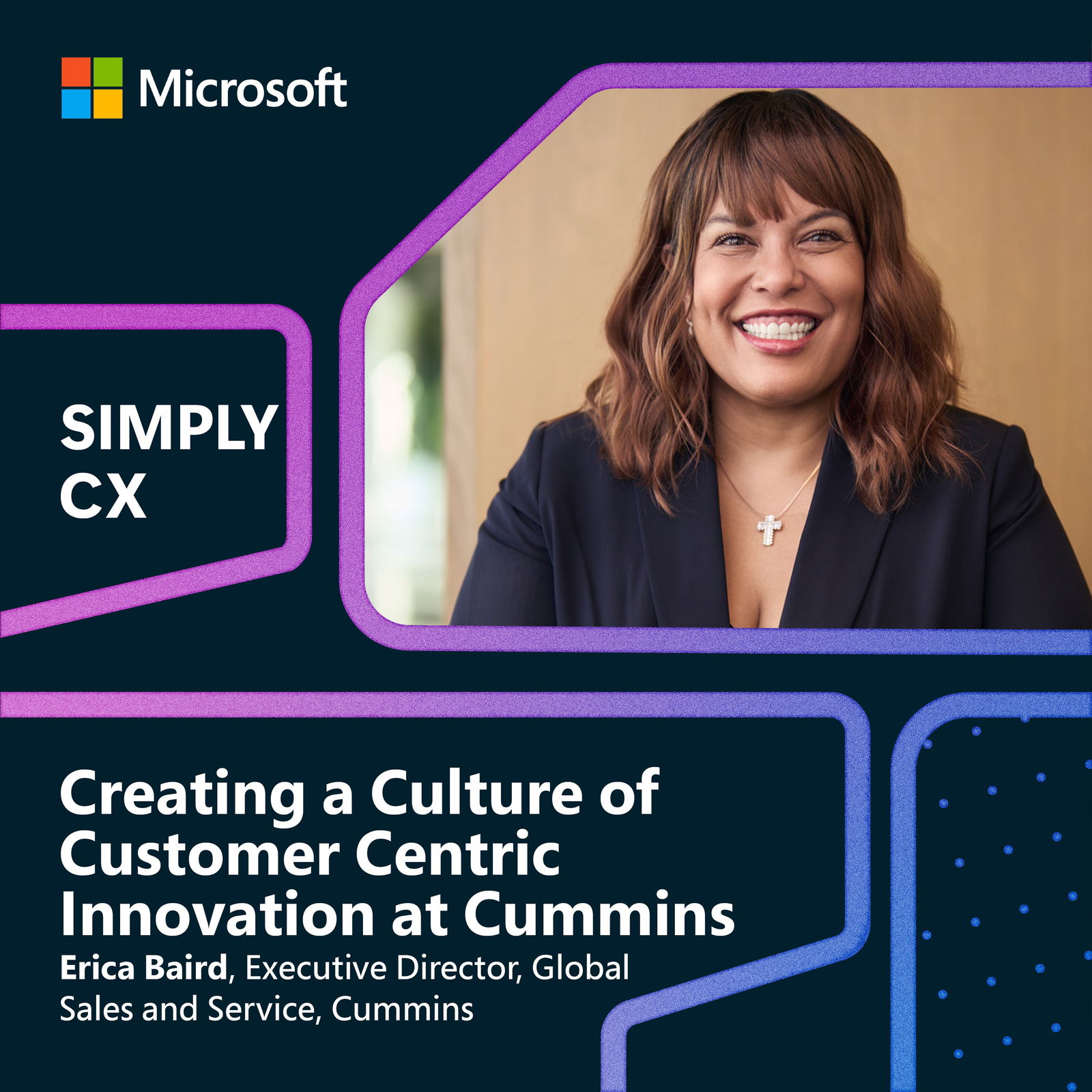
In this episode of Simply CX, Nicole McKinley talks with Erica Baird, Executive Director of Global Sales and Service at Cummins, about how customer experience is deeply embedded across every facet of the company—from engineering and field service to sales and product development.
You'll walk away with:
• How Cummins uses AI to predict and prevent mechanical issues before they happen
• Why customer empathy is more powerful than ever in delivering positive CX
• How CX data drives training, product design, and competitive intelligence
Whether you're a CX pro, team leader, or brand builder, this episode will inspire you to see customer experience through a more human—and more powerful—lens.
Produced by Larj Media
For more CX insights, follow Nicole on Linkedin
If you have questions or comments about CX email us: SimplyCX@microsoft.com
Erika Baird on LinkedIn - https://www.linkedin.com/in/erica-k-baird/
| if you're an engineer and you don't go out to the field, you don't understand how difficult it is to work on the product. And that's why it's critically important that our engineers get out, whether it's to a branch location that's nearby, so you can see what the technicians have to go through to service the product, which helps you understand when customers are trying to service it themselves, what they have to experience. And then you can take those findings back, and it helps you with how do you design it differently on the next iteration to make it more customer-friendly. [music] |
| Welcome to SimplyCX, where we bring you customer voices and expert insights. I'm Nicole McKinley, leader of Global Customer Experience at Microsoft. Today's guest is Erica Baird, Executive Director of Global Sales and Service at Cummins. With a company as wide-reaching and mission-critical as Cummins, they have $34 billion in revenue and 70,000 employees, powering everything from hospitals to hurricane rescue boats. Customer experience isn't a side strategy. It is the business. Erica and her team have been working to connect the dots between customer feedback, technician insights, and AI-powered tools to make sure that wherever you see the Cummins name, the experience is consistent, responsive, and informed by real-time on-the-ground data. Welcome, Erica. |
| Thank you. I'm really glad to be here. |
| So what is it that makes Cummins' approach to CX unique? |
| One of the things that makes Cummins uniquely special is we service all of our customers the same. I came from a world where the bigger the customer, the more attention they got. And yes, do we have big customers that we give big attention to? Of course we do. But when we get calls at the call center, there is no priority line. Whoever calls first gets the support first. And we were very intentional about that, because we wanted to make sure that the one-off mom and pop felt like they were as important as the big customers. And our CEO responds to everybody the same. |
| Wow. |
| And that's one of the things that makes her special, right, is we don't look at a small customer and say that they're different. We say if they're down, it could be their whole livelihood. It could be their whole life. Their whole business could be that one vehicle, and that's equally as important as a company who has 100, because if one of theirs is down, it may not be as impactful as the person who only owns one and it's down. |
| Wow. That's such a powerful perspective. And honestly, it gets to the heart of what great customer experience is all about. And when that mindset starts at the top from the CEO, it sets the tone for the entire organization. It says every customer matters. Every moment matters. That's how loyalty is built, not just through service, but through deep understanding. How would you describe where CX is embedded and how it guides the unique, tailored experiences that Cummins provides to the diverse customer base that you have? |
| It's embedded through every step of the process. We look at what should our service experience, whether it's in the branch or in the field, be like, and we do about 70% the same no matter what. So if you're in London versus if you're at a mine site in Africa, they still expect to be serviced the same way. But then, through surveys, through meeting with customers, through listening to our technicians, through having consultants go out and really understand the industry and then provide us with that feedback, we take all of that data, and then we say, for mining, these are the different steps that we need to follow that's unique to the mining business. And in certain parts of the mining business, it may be completely different. So we may have one model for one part of the world that works in 80% of the world, but in China, it could be uniquely different. And so we try to understand regionally the micro dynamics of each segment, and then we adapt our service model, our sales model, our training, everything to that segment. |
| There's such a wealth of information. And now with AI and new technology capabilities, you have the ability more so than ever before to aggregate and really make sense of all of this data. How do you incorporate your learnings or how do you use the data you gather from those surveys? |
| So we do multiple things. So right on my team, I have an analytics team. I have a sales team, sales enablement and operations. I have a service and customer support team. And I also have a customer experience team. The customer experience team sits right in the center of that group, and they get information, whether it's through AI of the surveys of all of the calls we get on the customer support team, whether it's surveys of our technicians, whether it's surveys of our customers after every sell, and whether it's surveys of our customers after every service experience, we use AI to pull and analyze that data. And then our customer experience team says, "Here's opportunities for improvement," and they go and they work with our sales enablement team or our service team, and they say, "This is trainings that we need. We may need more technicians in this area. It sounds like we are underservicing the customer. We could use a pricing review in the marketplace because we're hearing that our price could be a little too high or in another area, it could be a little too low." And the other thing I learned years ago, very early in my career, we always want an out-of-the-box thinker. So on all of our teams, we have people with deep expertise of the industry, of the operational excellence, so that they can drive the functional excellence. But we also bring in through our AI people who are analyzing the data, they have a fresh set of eyes that may not know all of the details because we don't want to not be able to see the forest for the trees. And we also do a think tank. So we ask our people, "Do you have ideas that we could do to change?" And then we go around, and we survey and get input from that perspective on are those things that you would be interested in seeing. |
| You're talking about the power of diversity in all aspects, diversity of experience, diversity of thought, really being able to harness all of the ideas and recommendations that come from across your business and ensure that everyone has that opportunity to make their voice known to help shape kind of the next best opportunity to go after in terms of improving the experience. It really sounds embedded in Cummins' culture of innovation and this culture of keeping the customer at the center of everything that you do. Has it always been that way? Or are there things that you are also then actively cultivating or doing as a leader to ensure that this culture remains strong? |
| Cummins has prided itself on being customer-focused. Where we lead the industry is we innovate. So in a lot of cases, we're thinking about what the customer needs before the customer needs it. So the customer just wants to get out on the job site, and they want to get the best bid and win the business and be profitable, do it in a certain time frame, and deliver a solution for their customer. But we know what regulations are coming from the government. We know where the future is headed. So we're out there thinking ahead and already developing products. So a lot of times, we're coming to our customers to say, "Hey, this is where the government is heading with regulations. Here's where we see the rest of the world going." And we say, "Do you want to partner with us as we innovate and develop?" And one of our secret weapons is we have application engineers that go and work very closely with the customer to say, "How is this piece of equipment going to be used? Where is it going to be used? What kind of ground are you digging in? Or how long do you need these pieces of equipment to run?" And then they design the engine so that it works the best in that customer's specific application, which a lot of companies, that's an additional cost, but at Cummins, it's just how we do business. |
| A customer experience secret weapon. That's fantastic. And the fact that that's through humans, through individual people that have expertise, that creates a level of personalization and human-to-human connection that's really powerful, especially in a world that is increasingly more powered by technology and AI. I'd love to hear more about how you are striking that balance between the power of your secret weapon and these technicians in the field and also leveraging AI and technology capabilities. |
| I just was on our Global Service Leaders meeting yesterday, and that was one of the topics of discussion because we are using a lot of AI. But again, I remind everyone it is artificial intelligence. The human touch is still needed, the human understanding. So they can take something very generic and they can find the ins and outs. And they'll get smarter. AI will get smarter, and we're using it, and it's making us smarter. |
| But you still need the person who understands the business to be able to say, "Okay, this is 94% right, but that 6% can make a difference in whether or not a customer is up or down." And so that's where that special touch comes in. So we use the data to say, are technicians performing the repair in the time frame that they should be? If not, we can measure that through AI data going in and searching how long it took them to do the repair. Was it slower because of a skill set? Do we need training? Was it slower because we didn't have the parts on site? Do we need inventory management training? Was it slower because we didn't order enough? So they need forecast accuracy training. So all of this data we use as input for our people on how they can get better and be more efficient. But we still need them. And I remind them of that all the time. |
| And how is that mantra of AI is really artificial, but it's supplemental? And it sounds like a big enabler for your people. How is that landing and resonating with your global employee base, everything from the product engineers all the way through to your field technicians? Are they embracing and leaning on these new capabilities, or is there resistance that you're facing? |
| They're embracing it because truthfully, the world is just going to grow. The internet is going to continue to take up massive amount of data. So there's going to be data centers. The world is not going to stop farming. The world is not going to stop mining. The world is not going to stop needing semis. We still will need hospitals. All of those things that we will continue to need, our company services those needs. And so in some cases, as the business grows, we need to be able to upskill people faster because we need deep technical expertise to keep these products up and running. We need more of them, and so we're going to need more people. And it's not easy. You can't build that skill set overnight. So that's where AI comes in and supplements. And it allows, after we do the same correction or fix multiple times, it learns it, and it automatically pulls it in. So if I'm the person answering the phone and I'm talking to a technician who's in the field who needs to solve a problem, it will pop up quicker. And now I'm solving that problem quicker, which gets my customer back up and running quicker. I had my team develop the cost of being down. And if you think about at a mine, in a day, it could be over $150,000, the cost of a truck being down. $6,000 an hour, that that truck is sitting down. And if it's in a diamond mine, it could be even more expensive. |
| I think that's a really great framework in terms of the cost of being down. It stands out as one of many really strong examples of where you're connecting tangible business outcomes, tangible business measures, with customer experience. And that is often what a lot of leaders in the customer experience space struggle with is how to quantify the impact, how to really show the dollar and cents ROI of investing in customer experience. |
| Even with warranty, we both win if we are able to catch a potential catastrophe to an engine or a major down before it happens, and it never happens, then we win. And so we don't want our engines to be down, right? And so AI and remote tools and the ability to go and have avoidance costs for our customer, not only is our customer up and making money, but we also, if that was in a warranty timeframe, we saved money too, because now we're replacing a part instead of replacing an engine, right? And so those are things we think about. And then we always talk a lot about how it impacts the customer, but happy employees with work-life balance also impact the customer. So when you think about AI and our ability to help our people get an answer quicker, we are able to provide work-life balance. Things that used to take 10, 12-hour days sometimes because of the magnitude of customers we're serving, maybe we're able to use the same person for a nine-hour day. And now we don't need less people. We just have people who are happier, and we don't lose them because they work long hours. So AI is also about employee retention. And employee retention fuels customer satisfaction because happy employees who feel safe, who feel cared about, who know that we are trying to make their lives easier, they are innovative. They have time to think. |
| I couldn't agree more. I think that the fact that you're using AI to both enable and then empower your people to really deliver value to customers, whether they're innovating or on the direct delivery side, is fantastic. I know that you guys have invested in particular in some AI-powered training capabilities for your sales teams. What are the key themes or outcomes that you're seeing being delivered as a result of that investment? |
| One of the things I love about that training, I actually took that training myself, is that you can set the persona of the customer that you're calling on. If it's going to be a tough negotiation, you can say that, and they will give you a very contentious customer. If you are going in for a negotiation, and there's a competitor, and they're using price as their secret weapon, then you come in and you tell them, "I need to be able to sell the value better." And it walks them through how they could better sell the value. If you are going into a customer who they think they know their product, but you know the engine. |
| A lot of times, customers will try to buy something because they think it has more power, but it also has more cost, and is it really what you need? And so it can train them on what applications they should be able to use to go in and talk to the customer, and sell them or get them to change their mind, and move towards a different product. So it's just a very in-depth training, and it was designed with people who had been in the field and scenarios that they had run into. So it's actually very fun. |
| It sounds like it. Yeah. I'd love to take it myself. You've talked a bit about how customer experience is brought to life through services and field technicians doing direct engagement with customers, as well as examples of how you're embedding customer experience into how you sell and how you train sellers. Can you talk a bit about customer experience being embedded in engineering and the actual product development, what that looks like at Cummins? |
| I'll give you an example. Sometimes if you're an engineer and you don't go out to the field, you don't understand how difficult it is to work on the product. And that's why it's critically important that our engineers get out, whether it's to a branch location that's nearby so you can see what the technicians have to go through to service the product, which helps you understand when customers are trying to service it themselves, what they have to experience. And then you can take those findings back, and it helps you with how do you design it differently on the next iteration to make it more customer-friendly. |
| I also think hearing the quality insights or price competitiveness needs, that helps us with how we design. Do we need to source differently? Are we sourcing from a source that is too expensive, and we could get the same quality somewhere else, so that we can be more cost-effective and deliver a more cost-competitive product to our customers? |
| So really using the ongoing richness of the customer insights and data that you have to drive continuous product improvement and innovative development that's really anchored in what customers care about. |
| Yes. And I'm at a customer meeting this week. It's myself. It's my peer who is the vice president of the engineering power system side of the business. It's their engineering team. And my engineering team for Aftermarket works directly with that engineering team. The person that I have, who's over the Customer Support Center, he's working directly with the team. So we all work together and we talk about what is the next product design? How are we going to service it? What are their needs? |
| That's a real differentiator like you're talking about there in terms of not just approaching a customer from one lens, whether it's, I'm trying to sell you a new product or I'm trying to convince you why these services are going to enhance your experience, or I'm here to address support challenges or issues, but really seeing Cummins operate as one and taking a holistic approach to how you can create incremental value for customers, help your customers achieve their goals across every dimension of what Cummins has to offer. |
| And another part of customer experience is understanding the competition. So a part of our CX team also does competitive intelligence. How are they servicing the customer? What are we hearing? What does their model look like? We have projects running right now that look at what does it mean to be industry-leading in each segment that we service. And we don't want to be tied. We want to leapfrog you when that happens or just wave at you as we pass you by, right? |
| For sure. |
| That's the goal. I'm sure that's their goal too, but we really lean in. |
| Well, and healthy competition is always a good thing. |
| Yes. |
| Just building off of that, you talked about shifting to delivering proactive and almost predictive. You didn't use those words, but that's what I got from what you were sharing. Predictive capabilities that customers don't even know that they want or need, right? That's tied to your approach in innovation. Is there an example of something along those lines from a proactive or predictive capability perspective that Cummins has already brought to market or already delivered to a customer that you could share? |
| Well, right now, we have a product that we use in the mining industry, and we call it Preventtech, basically. And it is on our mining engines. And we have a whole team that all they do is monitor those engines. And then we have a part of our team that can do remote connect. So they can, anywhere in the world, type in to the engine and evaluate what's going on and either fix it remotely. And if they can't fix it remotely, when a tech gets there, they can call the team on the phone. And if they don't have the skills to fix it, that team can fix it. Generally, they have the skills to fix it. But there are some things that you run into that are unique situations. And we have level two and level three technicians that are the best in the world technicians who can solve any problem. And worst-case scenario, they fly out. |
| And this Preventtech capability, is it a product? Is it a service? Is it something that you give to customers for free? Do they have to pay for it? Because I can imagine it was a pretty significant game-changer in terms of the customer experience. |
| We don't charge for that. We put it on the engine because our job is to keep their engines up and running. So anything that we can do that's preventative to keep their engines from being down or from having bigger failures, we monitor that. And so we catch them in advance, and it benefits us because when our customers are up and running, they buy from us. And so it is a benefit, not even to the OEM that we sell to, it's a benefit to the actual customer that's using it in the field. Because if they're not running, they're not making money. And so everything that we do is around keeping them running. |
| And I imagine the actual customer lived experience and the feedback that you're getting from this capability is quite remarkable as well. Is there anything that has surprised you in terms of the feedback that you're getting from customers or even the feedback you're getting from your technicians now that you have this Preventtech capability? |
| Just having that capability, whether it's at the mines or at the data centers, it just allows us also to better manage our technicians so we understand where our needs are. We know where our product is everywhere in the world. That allows us to make sure we have the right number of technicians to ensure that whether it's preventative maintenance, whether it's scheduled maintenance, or whether it's downtime, we have the right number of technicians to service all of our customers in a certain area. And that's a critical aspect to our business. So I would say that is the game changer for us. |
| We also know what skill sets they need so we can adapt the training plans to wherever the engines are. We need the right skill set for the right engine in the right location because it's not the same everywhere. |
| Sure. I wanted to go back to the earlier point that you were making around just the sheer diversity of customers that come and serves across the globe, across so many different industries, and how you focus on personalization and that tailoring of the experience, just given the surface area of customer needs, I imagine, is quite significant. I was fascinated to learn that you spent some time developing 40-some, maybe more customer personas to really kind of more deeply understand the unique needs of your very diverse customer base. How did journey mapping and that approach to building these customer personas really guide you and your team in helping know what to deliver that is unique and tailored to an individual customer? |
| We do the personas for each segment and each customer contact that you would call on because what the maintenance manager cares about could be completely different than what the vice president of the company cares about, could be completely different than what the purchasing manager cares about. The other thing on the personas is understanding different people have different requirements for downtime. If you are a truck company, you may have a different expectation for how many hours your people are going to work in that day. At a mine site, it's 24/7. Marine, our technicians don't work a regular schedule. They're on call. When a boat goes down, they have to show up wherever that boat is. So it could be in the middle of the night that they need to go out. And so understanding the different personas of the segments that you're covering gives you the model of how you schedule your service and how you schedule your support. And it even tells you how you should schedule your inventory management, right? Because it can be different for different segments. |
| So it sounds like with these different personas, you're really able to uncover the different expectations that your diverse customers have. |
| Yes. Actually, we look at the moments that matter for those different personas. And so when you think about customer experience, it's all about what gives them delight or what makes them a distractor. And we really want to find those moments that are critical to that customer and then delight them so that we hold the customer versus if we mess up at a particular moment, it could be the end of a relationship. |
| Well, as you look ahead, Erica, and you think about where Cummins is going and you look at your own leadership growth, I'm curious, how do you keep customer experience front and center for you, for your organization, for Cummins? And what do you envision as next when it comes to innovating customer experience? |
| How we keep it front and center is I get monthly updates on what's going on with customer experience, and not only myself, but my boss, who's a direct report to the CEO. And so when my leadership team, my boss's leadership team, meets, we're looking at what is industry-leading by segment. And so it is a constant focus for our business is what do we look like today? But we also have a vision for what do we look like in five years. And so we're right now in the middle of what does five years look like? And we have that all the way out for 30 years. We just do it in five-year increments. And then I actually have meetings with the different leaders across the organization to give updates and understand what their needs are also. I mean, if there's no customers, there's no us. And so the manufacturer who gives the best customer experience wins, and we're here to win. And we're here to help our customers win. If they win, we win. |
| So winning in customer experience is the future. |
| It is the future. If you are in any type of leadership and you service a customer and you don't care about the customer experience, you're going to be out of business. |
| I couldn't agree more. Lastly, as you think about leaders in customer experience, those that maybe are struggling to embed customer experience into their organization or to really hold others in their organization accountable for delivering exceptional CX, what advice do you have for them? Is there one, two takeaways that you would say, "If you do nothing else in prioritizing customer experience, start here." |
| Always having survey data of your customers is a good place to start. AI is a good place to start. And I think reading stories like Kodak is another good place to start because those are people who forgot about the customer experience, and they don't exist. If you really want to understand the power of a customer experience, look at companies who forgot that and where they are because they're gone. |
| Great advice. It's not just about voice of customer and customer data and insights, but it's also competitive and market data and insights, as well as the voice of your employees, your people who are day in and day out engaging with customers and using that richness of the data and insights, ideally leveraging AI to really deeply understand what customers may be challenged by. So I love it. And I really appreciate you joining me today. Thank you so much. |
| Thank you for just putting this out in the industry. I think the more people who focus on the customer experience, the better off we're all going to be because we're all customers of some kind. |
| Thank you for listening to SimplyCX. Our show is produced by Larj Media. That's LARJ Media. Special thanks to Luya Polka and Elizabeth Machado and to our video partners, Peg Leg Pictures. To find out more about today's guest, Erica Baird, check out our show notes. And to learn more about Cummins, visit their website at Cummins.com or by following the Cummins Power Onboard podcast. If you have your own challenges or questions about CX, email the show at SimplyCX@microsoft.com. And please share today's episode with someone you think could learn from it. And follow Nicole McKinley on LinkedIn to keep the conversation going. |