
 Apple Podcasts

 Spotify

 PocketCasts

 Amazon Music

 YouTube
AI, Trust, and the Human Touch: Redefining CX with Shep Hyken
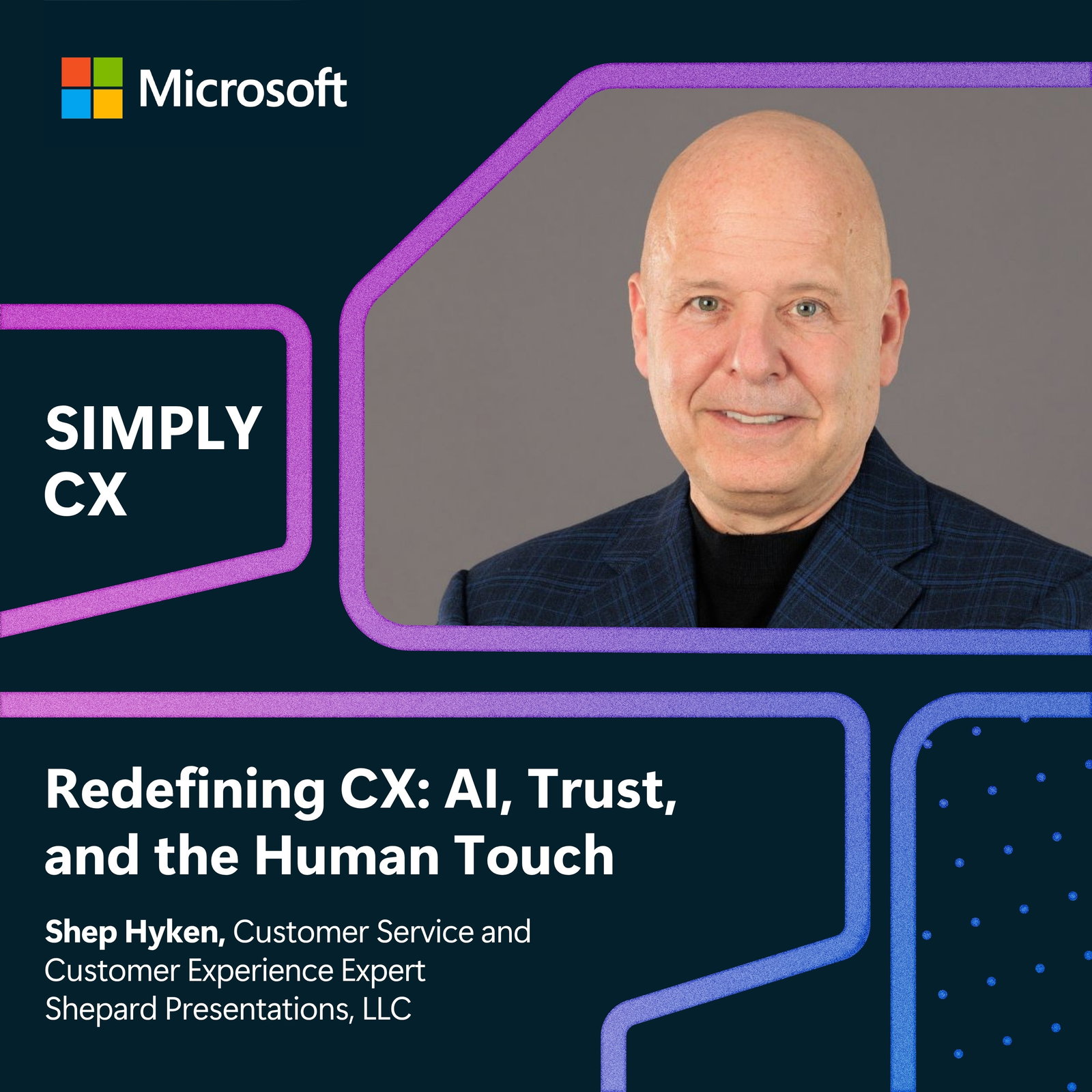
Episode Summary: In this episode, Shep Hyken joins Nicole to break down why “average” customer experience is the biggest risk companies face today. From moments of magic to the power of consistency, Shep shares research-backed insights on how trust...
Episode Summary:
In this episode, Shep Hyken joins Nicole to break down why “average” customer experience is the biggest risk companies face today. From moments of magic to the power of consistency, Shep shares research-backed insights on how trust is built—and lost—in every interaction. Together, they explore how AI is reshaping CX while reinforcing the enduring importance of human connection.
You'll walk away with:
• Why consistency—not over-the-top service—is the true driver of customer trust
• How “moments of magic,” “misery,” and “mediocrity” shape every customer interaction
• Practical ways to blend AI efficiency with human empathy to elevate experience
Whether you're a CX pro, team leader, or brand builder, this episode will inspire you to see customer experience through a more human—and more powerful—lens.
Mentioned in this Episode:
• Moments of Magic by Shep Hyken
• The concept of “Moments of Truth” by Jan Carlzon
• Malcolm Baldrige Award-winning companies like Ritz-Carlton and FedEx
• Customer trust research highlighting 88% expectation consistency
• Real-world CX examples from Amazon, Apple, and Costco rankings
🎧 Produced by Larj Media
📩 For more CX insights, follow Nicole on LinkedIn
If you have questions or comments about CX email us: SimplyCX@microsoft.com
Additional Resources
Guest: Shep Hyken — Customer experience expert, keynote speaker, and author known for pioneering research on service excellence and customer loyalty.
Shep: [00:00:00] Amazement happens when you consistently and predictably create the experience that you promise and the customer accepts that you did it, or the customer says things like, "I love doing business with them because they always are so helpful. They always get back to me quickly. They're always friendly." And it's that word always that sets that standard for a, a great company you wanna do business with.
Nicole: Hey, I'm Nicole McKinley. I lead global customer experience at Microsoft. This is Simply CX, where we bring you stories about what it really takes to deliver great customer experiences. CX isn't simple, so in each episode, I sit down with leaders who are in it every day, unpacking what they're learning, what's working, and what they're still figuring out.
My guest today is Shep Hyken.
Shep is a customer service and experience expert known for helping companies create loyalty-building interactions that keep customers coming [00:01:00] back. He's a New York Times bestselling author, keynote speaker, and advisor whose work focuses on turning exceptional service into a competitive advantage.
Welcome, Shep. I'm super excited to have you with us. I've been more than impressed with your research and extensive experience over the years. And given the decades that you've spent in the customer experience and service research, what was it that drew you into this area of focus?
Shep: I was working with companies like IBM and Anheuser-Busch and General Motors, really nice brand names, and I wrote my first book in the late 1980s titled Moments of Magic about creating a moment of magic, avoiding a moment of misery, and about moments of mediocrity, which are just average or just okay experiences.
And so I just studied companies, and there was an, a, a publication that came out that listed all the Malcolm Baldrige Award winners. These were the winners of the best experience awards, [00:02:00] Ritz-Carlton, FedEx, and what I would do is I'd see their name on a list, and then I'd dive into researching who they were and why they may have shown up on the list.
That's really, uh, how I build it and my enthusiasm for it. I believe customer service is not a department. It's a philosophy. Customer experience, again, same thing. It's not really so much a strategy. Everybody has to understand their role. I don't look at the product side of things. So the product still needs to do what it's supposed to do, and you can create a great experience.
I mean, when I open up, uh, some cool technology gadget, it's, the way it's packaged is part of the experience. But I look at the experience from how people connect with people. Even though I will talk about AI, which is a big part of people doing business with us, uh, that, that's where I really get excited is how can we create the best experience for that customer and when they need to interact with us, not just the product and the packaging and that type of thing.
Nicole: So much of what you just shared [00:03:00] really resonates now more than ever in the age of AI. So the, the concept of moments of magic versus moments of mediocracy, I'd love to dig into that and also really understand what are those differentiating moments for those companies or those brands that get it right, that are taking trust to the next level.
Yeah, yeah. There's a lot in your research. One of your findings was 88% of customers trust brands that simply do what they say they'll do.
Shep: Yep.
Nicole: Right.
Shep: They just deliver the experience that's expected.
Nicole: And then similarly, 88% trust a brand more when it admits mistakes and takes responsibility.
Shep: And it's that second part that's really important.
They take responsibility.
Nicole: So what jumps out for you in terms of what- companies can or should be doing to build more consistency and take more [00:04:00] responsibility?
Shep: Well, you just said the magic word, and that's consistency. So I'm gonna give you two background definitions. You mentioned moments of magic, moments of misery, moments of mediocrity.
Many years ago, I read an article, eventually it was turned into a book, by Jan Carlzon, who ran Scandinavian Airlines, and he talked about the moment of truth in business. Any time, in his case, a passenger, an airline passenger, or any customer, client, whatever you wanna call them, comes into contact with any aspect of your business, they form an impression, and Jan Carlzon said it's gonna go good or bad.
That's a moment of magic is good, moment of misery is bad, and it could be a complaint, a problem, something didn't work, or you're just not happy. And by the way, a moment of magic isn't about being over the top. It's just simply something that meets your expectations and you're happy. Or it could be over the top if somebody goes above and beyond, but it doesn't have to be.
The moment of mediocrity is, eh, it's okay. And in that research that you're looking at, you'll see that this [00:05:00] year, uh, the number actually changed a little bit, but it's about 20% of customers who say the experience is satisfactory, meaning it's on a scale of one to five, it's just average. Um, they will go find somewhere else.
So that means you risk losing one out of five customers even though you're not bad. You're just not that good. But amazement is another concept that I talk about, and they belong together. Amazement, like a moment of magic, it's not over the top. You used the word consistency. Amazement happens when you consistently and predictably create the experience that you promise and the customer accepts that you did it, or the customer says things like, "I love doing business with them because they always are so helpful.
They always get back to me quickly. They're always friendly." And it's that word always, hence the word consistency that you mentioned, that set, sets that standard for a, a great company you wanna do business with. And again, it doesn't mean they're always over the top. No, they're just always doing what they say they'll do.
The brand [00:06:00] promise is there, and they deliver on it.
Nicole: Absolutely.
Shep: And that's what creates amazement, and that's what we try to say to our clients. It's not, it's not a huge undertaking. It's often common sense that's not always as common as it should be. And most of the time, we learn that when we get into certain companies, the people are willing and wanting to do a great job in, in managing the interaction.
Leadership, when they decide to use AI, they believe they're going to be doing the right thing. Well, we gotta take a look at the whole process. Oftentimes, it's the process or the system that's breaking down that's frustrating the customers. The other day, I was having a great time with AI And interacting on a chatbot till it didn't seem to give me...
It, it basically repeated an answer that wasn't acceptable like four or five minutes earlier. So I had to shift over to talking to a human, and that shift was just a bad experience. Deep down, they wanted to take care of me, but guess what? [00:07:00] When it doesn't work, you've gotta be ready because at that point, customers get extremely frustrated.
But that consistency factor of getting that customer to use the word always followed by something you'd want them to say is really where you wanna be.
Nicole: Consistency is also table stakes in a sense- Yes ... with regards to delivering great experience. You mentioned that process and systems can often get in the way.
Why do you feel it's so hard for companies to be consistent? And do you think that in this age of AI, there's going to be an easier, faster path to delivering consistent experience?
Shep: Well, the consistent experience that easier and acceptable by most customers is the one for the huge volume of calls you get for the very basic simple things.
Uh, I mean, "I wanna check my balance in my bank account. Did you ship an item? I can't get my password to work." These are the types of things that are very easily [00:08:00] handled by AI, and if for some reason that customer chooses to still talk to a live support agent, we make it easy for them, but it's incumbent upon that support agent to say, "Hey, how did you get the phone number?"
"Well, it's on your website." "Okay. Well, you're on my website, so you're, like, 80% of the way there to taking care of it yourself where you didn't have to talk to me, get authenticated, which takes a few minutes. If I can show you how to do this the next time, you're gonna love it." And let them walk that customer through how to do it the right way using AI, and they will appreciate you for it.
The adoption rate becomes much higher. Think about how the airlines taught us to use online booking and online check-in. They gave us a 500-mile incentive or a point incentive when we did it. People, "Okay, I'll try it for 500 points." Sure. And then it was easy and intuitive, and they liked it. And, and today, I mean, I'll ask you, Nicole, I don't know when the last time you took a trip was, but did you call the number for reservations, or did you go online and book the trip?
Nicole: 100% online. [00:09:00]
Shep: There you go. That's the point.
Nicole: You talked about magic moments aren't necessarily above and beyond, but as customer expectations are rising, especially now with the increasing commoditization of AI and AI-driven capabilities, what's your perspective on what equates to real differentiation in the experience?
Shep: So back to consistency because this is all about I want to do business with a company that I trust, and trust comes from the consistent and predictable performance. So to your point, if I am going to use any type of system, I need to trust it's going to work. If it's great today, and the next time I'm struggling with it, or if I contact, uh, live support, and I have a great experience, but the next time it's questionable- Where am I gonna be on that third time?
I'm gonna wonder what's happening, [00:10:00] and as I start to wonder what's happening, guess what? I'm losing trust and losing confidence in the organization. And by the way, nobody is perfect. But if they can create as much consistency and predictability as possible, and to the point that we talked about before, the companies that admit when there's a problem and then step in to fix it is great.
But here's what the best companies do. They don't just fix a problem, they fix the customer, because they need to restore that confidence. So when we do a workshop on how to handle complaints, we tell them, "Acknowledge the complaint, apologize for the complaint, discuss what the resolution's going to be, or fix it right there on the spot if you can.
Take ownership as if you are in charge of taking care of this customer." So that's kind of an attitude thing. But number five is really important: act with urgency. And when you put those five things together, uh, because Everything can be perfect. You could be doing business with somebody for years, and then one day something doesn't go right, that's [00:11:00] judgment day.
Nicole: Right.
Shep: And that's when that customer decides it was worth doing business with them for the last five years, and boy, my first problem, look at how they handle it. If this is how they handle problems, I'm in. So nobody's perfect. Recognize it. You don't just fix a problem, you fix the customer.
Nicole: Absolutely.
Outside of the support domain, the traditional customer service area- Mm-hmm ... are you seeing opportunities for those moments of magic starting to pop in the sales area or pre-sales area of a business or other types of interactions a customer might have across their journey that isn't just about support?
Shep: Right. So if you're talking about, um, w- the interaction that customers have with a company, whatever that interaction is is the opportunity for them to form an impression. It doesn't have to be in customer- Right ... support. It could be the first person they talk to to ask a question. It could be a salesperson.
I [00:12:00] just read a fascinating article in the Wall Street Journal about a week ago. I think his last name is Kellingum. He is the CEO of a company called Group One Automotive, and he said something I'd never really thought about before. He realized that people come back after buying a car far more times than the actual time they purchase.
As a matter of fact, I think he said the average customer comes back 12 times. Oh,
Nicole: wow.
Shep: Well, think about it. Every year you're coming in for your annual service and maybe a few other times, so if you have the car five or six years, you're gonna probably get there eight, 10, 12 times. He says, "We're really not in the automotive sales business, we're in the after sales business."
We've gotta prove to them when they buy that car that what's gonna come down the road beyond that purchase is every interaction we have. So it's so important as people are looking around and looking at products that we can create a sense of confidence and make a promise about the experience you're gonna get [00:13:00] with us, and that has nothing to do with customer support unless something goes wrong.
So I stopped using the term, "Oh, it's the customer service department." No, it's the customer support department, which can be human or AI. It doesn't matter. That's support. But service is the philosophy that everybody must do. They must serve either directly a customer, depends on what they do, if it's sales.
If you're at an airport and you go to the gate and that gate agent is not really in sales, they're just there to take care of you and usher you onto the plane and get you where you're supposed to be. It could be someone behind the scenes. Let's stay with the airline example. If I check my bag at the curb and I get to my destination five hours later and my bag's there, great, but what if it's not there?
That person who accidentally left my bag off the plane or put it on the wrong plane, they did a huge disservice to me.
Nicole: Absolutely. And
Shep: they actually did a disservice to two people, myself as the passenger, but also [00:14:00] that poor person who's behind the counter at the baggage claim area in the office, because nobody ever goes into that little office and says, "Hey, I got my bag.
You guys are amazing." No, they only go in there to complain that they didn't get their bag. So Jan Carlson, in his book, said, when you're thinking about the whole idea of customer service, or we wanna call it customer experience, you're either dealing directly with the customer, or you're supporting somebody that is, or you're supporting the system overall.
I
Nicole: love, I love that definition. I think that's a really great clarification, 'cause oftentimes people say customer service and are thinking about customer service support representatives-
Shep: Yeah ...
Nicole: versus the capability of serving customers and that accountability really that everyone has, whether it's direct or indirect, in enabling those that do so.
And all of that accrues to every interaction a customer has with a brand, which is customer experience, that [00:15:00] holistic experience that a customer is having. So I, I really like that.
Shep: Right.
Nicole: On the trust topic, though, what companies do you feel are really getting that right and doing an exceptional job today in delivering that consistent experience to customers and really owning when mistakes are made?
Shep: Based on the research we asked, Amazon shows up as number one, Walmart, Apple, Target, Google, AT&T, Costco, Chick-fil-A, Verizon, and T-Mobile. That is the top 10. Microsoft, by the way, shows up there in the top 25. But what's interesting, if you take a look at the different age generations, you got the boomers at one end that are a little bit older, and you've got your Gen Zs.
And, uh, they overwhelmingly, the Gen Zs choose technology companies as their favorite. As a matter of fact, on their top 25 list, they have a couple of game-type companies that [00:16:00] never show up in the overall 25, and that some of the other generations probably would say, "Who are these companies?"
Nicole: Why do you think that is?
I have my own hypothesis.
Shep: It's like, who uses the phone? If you give somebody a choice, and, and in the research, we ask this every year, and it's pretty close every year. Would you rather use the phone and talk to somebody when you have a problem, or would you be willing to use digital support as your first option?
And 68% this year, they say, "I wanna use the phone." And if you take a look at the baby boomers, they wanna use the phone more than Gen Z. So baby boomers are skewing that number higher. Here's what's interesting. Last year, baby boomers 88%, that's almost nine out of 10, said, "I'd rather use the phone." This year, it's eight out of 10.
So that means there's some adoption to using online automated self-service tools. Then we take a look at the other side, Gen Z, all the way down at the other end. Gen Z, last year, I believe it was 51% or so said, "I [00:17:00] would use the phone." Basically, it's split 50/50. I'll do digital first. Well, this year, that number went up enough that it was substantial.
I think it's almost 60%. So what that tells me, I started thinking, how is it that Gen Z now would rather use the phone? Aren't they more native digital? Well, it turns out that their definition of a problem is different. Their definition of a problem is something they can't figure out how to do online by themselves.
Nicole: Well, and in all of that, I'm curious how personalization plays a role. We hear a lot about trust. We talked about that. The other big thematic that I see in the research that we do and the feedback we get from customers is the desire to be known. The simple aspect of like, I want, you know, any company to interact with me to really know me, understand my needs.
What are you seeing in your research with regards to the need to be known, and is that table stakes?
Shep: Well, the need to be known on a personal level is a [00:18:00] bonus. If you're talking to somebody or if chat is going back and forth with you and that customer mentions something that's more personal like, uh, "Oh my gosh, I gotta go.
My kid's gonna graduate, and I have to go, you know, help them, you know, pick out what they're gonna wear." Okay. Well, the next time, wouldn't it be nice to say, "Hey, I see in my notes that you had a kid that graduated. How'd that go?" Now that's building rapport And, and by the way, I get nailed on this when I talk to people who are running contact centers.
They go, "Well, we really wanna be more efficient than that." I go, "Here's the difference between efficiency and personalization at that level." Personalization at that level creates the emotional connection. Efficiency is just a, a consistent experience. It's an emotional level because you trust the company that provides consistency.
But another level of emotion is when you f- feel they truly know you. By the way, I'm not suggesting you spend a lot of time bu- [00:19:00] building rapport, but when you get that little tiny 10 seconds in there that just makes a person feel comfortable about doing business with you at a, that more personal level.
But here's what customers want. They want you to know who they are. So I talk about knowledge. There's knowledge of your product, so if you're talking about the support world, you need to have knowledge o- or at least know where to go to get the information. And today with AI, we can equip people who are manning customer support live, w- and you...
There's even systems that listen in on the conversation and put information on the screen while they're talking to the customer, so they don't even have to type it in anymore, which is a really cool technology. So it's feeding information quickly to the agent, who can then share that information in the way that the customer needs to hear it.
Is this somebody that understands technology? Do they not understand it? I'm gonna hold their hand a little bit harder and firmer than if they were really skilled. And then if I know who they are based on buying history, [00:20:00] what they called about the last time, uh, "I noticed you called the last time. Is this what this problem is about?"
When I call the airlines, and I'm flying every week to do what I do, uh, you know, booking speeches all over and, and working with clients, they go, "Are you calling about the flight you're on today?" I love that. They know what I'm calling about. "Yes, I am, as a matter of fact." Yes, I am. "I can see why you're calling.
It's delayed, and I s- I know we gave you some options. How can we help you?" And that's, that's how it works.
Nicole: I couldn't agree more. I do think that in this age of AI, because of the capabilities that you described, and we've fully AI-enabled our Microsoft support organization as well, of course, I do think that expectation of know me for customers is increasingly table stakes and increasingly more accessible to be fully enabled at scale because the technology is there.
Shep: Yeah.
Nicole: That said, are there examples you've seen [00:21:00] that have surprised you, where personalization has taken a really differentiated or unique shape in an experience either you've had or one that you've studied?
Shep: So most of the time that's gonna be in a people-to-people experience. You wanna stay away from that creepiness factor where I get too much information.
For
Nicole: sure.
Shep: Here's the TV show. The theme song is, I wanna go s- you know, to a place where everybody knows my name. The Cheers effect is just you know who the customer is, you know their background, you know why they've called before. And when you do that, again, we're trying to create a consistency that builds confidence.
It's like, what comes first, trust or confidence? I think you start to trust a company, and once you trust them, you're confident that it's going to be that way every single time. And when I call and that person who I've never talked to says, um, "And by the way, I'm looking at your record right now. Thank you so much for being a very loyal customer.
It looks like you've worked with us for the last, wow, 12 years." [00:22:00] To me, that's that rapport building that I just talked about. This is how you personalize. When you create that emotional connection at that level, that is more than just consistency. That's they know me. And by the way, re- I talked about when you have a problem, urgency is important in resolving the problem.
Any time somebody calls you, even if for, for just help or a question, it's not a complaint, urgency becomes a problem. Do you think they really wanna wait on hold for 10 minutes waiting to ask a question that may take, you know, two minutes to get an answer to? No. Are they willing to do it? Sure. And all the friendliness in the world will not make up for overall inconvenience.
There is a stat in the research that says, uh, when we take a look at convenience, 85% say it's important to them, and 52% will pay more if they knew the experience would be more convenient, and 65% say it's even more important than friendly customer [00:23:00] service. So nice is the number one reason people like you and wanna come back and do business with you.
If you are helpful and friendly, that's what customers want number one overall. But the number one reason customers will leave you is something that's not friendly or even apathetic, which means you didn't appear to even care. That means you didn't say you didn't like me, but you didn't say you liked me either, so it's right in the middle.
Nicole: Yeah, that nice factor coupled with personalization- Yeah ... delivered consistently can be a part of that secret sauce that companies can look to replicate and scale through AI in addition to their person-powered, uh, organizations.
Shep: Little things add up to be big. I'm a musician for fun, and Sweetwater is a online music company, and they send you a little pouch of candy.
Well, one day I mentioned, "I love the candy. Thanks so much. You know, my favorite is Bit-O-Honey. I hardly ever get Bit-O- ... What a special thing." [00:24:00] And every time I order from them, the only thing that's in that little pouch of candy now is Bit-O-Honey.
Nicole: Amazing.
Shep: They're listening. They
Nicole: are.
Shep: And by the way, that's rapport building at a, at a such a tiny little level, but boy, here I am talking about it to the world through Simply CX.
Nicole: No, it's wonderful. A great example for sure. Let's talk a little bit about the AI opportunity.
Shep: Mm-hmm.
Nicole: What's your perspective on some of the contradicting findings that you and your research have? Uh, there's one in particular that jumped out for me, which is customers acknowledge AI is getting better, yet at the same time are still very frustrated.
With it. And then you noted some other stats as well on the generational preferences for AI versus human. What do you feel like are the biggest opportunities as you look ahead for where AI can really create real differentiation in the experience?
Shep: Well, I think that there's great [00:25:00] brands out there that raise the bar for everybody.
There are also brands that lower the bar with a technology like AI that makes people still uncomfortable using it. Today, I, I'm really surprised as I look at it, 49% of the customers are more comfortable with AI for customer support than they were last year. Well, yeah, all these are great AI tools that we're using and we're discovering work for us.
But guess what? That's a 2% difference from last year. I, I kept thinking at some point this number is gonna really jump, and it hasn't jumped year over year. But here is what's interesting. The self-service concept is really important. While I mentioned earlier that the difference between people who want phone support and people that are willing to go digital is 68%, seven out of 10 wanna use the phone.
But there's a percentage of customers that even if they wanna use the phone, if you don't offer them the self-service solution for the basics, they go [00:26:00] work with a company or find a company that can.
Nicole: Your point earlier on the definition of the problem and what you actually want or need a human for is continuing to change.
You mentioned Gen Z fundamentally defines the problem differently as to- They do ... as to what they would want and need a human for, and that's likely something we're gonna see continue to change more broadly. And as a result, those human interactions that you do have are gonna be increasingly more critical to ensure are consistent, are personalized, and are ultimately delivering great value to you.
Shep: There's job impact with AI, but what's really interesting, and for a while everybody was saying AI is gonna kill the customer support world from the standpoint of live agents. It's not gonna kill it, but what it will do is if all you are able to do is deliver at [00:27:00] the most basic level, your job's in jeopardy because you have to be willing and able to learn enough to take care of the deeper issues.
So for example, there's a slight downturn in frontline basic customer support, but there is a major shift of taking those people on the frontline that are really good and moving them into more important roles. So we're not seeing the destruction of people yet, and I don't think we ever will at the end of the day, but I- I agree
at least not for the foreseeable future. So, uh, anyway, that's just kind of an interesting observation, and again, I read everybody's report and research every week. I-- How does it differ from mine? Is it in alignment with mine? That's how I know if I find something that's totally wrong, then I ask the question that was asked the wrong way 'cause the information's so off.
So we try to keep that in line with what is right and, and real and valid.
Nicole: Well, I couldn't agree with you more in terms of the role of people and human relationships. There is this dichotomy happening where we'll see AI continue to [00:28:00] scale and grow in terms of capability and value it can deliver. But at the same time, the importance of the human and person-to-person connection will also only increase As you look ahead, what is one prediction you have for the customer experience space?
If you look, you know, five, 10 years ahead, is there one thing that you feel will either change dramatically or be increasingly more important?
Shep: I predict everything's going to get better. But for the doomsdayers who say, "Oh, no, we're gonna lose people, it's gonna be totally automated," I predict it will not be that way.
The ATM came out in the 1960s, I believe, and they said that would be the end of tellers. There will be no more bank tellers. But the ATM machine is very proudly placed in front of the bank, and you walk in and there's plenty of tellers. MTV came out. Video did not kill the radio star. I am convinced that when it comes to people, [00:29:00] there will be people employed in this world.
Number two, we will start to see the whole concept, and I'm gonna go to the interaction that customers have with us for support and complaints and everything else. We are going to be seen as a huge sales and profit center versus just the sales and marketing departments, because our job is in the customer retention world, and when we can eliminate churn, we're building market share.
And more and more C-suite executives are recognizing the power of those lower paid people on the front line that need to be better trained, and the access that we're using for AI to support customers in a way that makes it so easy so that they don't churn out. I'm a very optimistic guy, and at the end of the day, this is what customers want.
They wanna do business with somebody. They want that experience to be predictable, so when they keep coming back, they know what they're going to get. And if they are happy, they have no reason to leave. It's going to insulate you [00:30:00] from competition. The experience that they have is gonna be more important than a tiny little price difference for many customers.
Keep that in mind. And by the way, if all you are is average, you are huge at risk when they say, "Yeah, it's satisfactory." Satisfactory, it's like saying, you know, uh, it's fine. F-I-N-E, fine. That's a four-letter word, it starts with F, and it is the F-bomb of customer experience. Boom.
Nicole: I love it. Very great advice, and your optimism and energy is contagious.
I am a forever optimist as well, so I'm excited about where customer experience will go, and hopefully we can chat again in the, in the future and we'll see if your predictions, uh, ring true.
Shep: I look forward to that
Nicole: Thank you for listening to SimplyCX. I'm Nicole McKinley. Our show is produced by Larj Media.
That's L-A-R-J Media. Special thanks to Elizabeth Machado. To find out more [00:31:00] about today's guests, check out the links in the show notes. If you have your own challenges or questions, email us at simplycx@microsoft.com, and please share today's episode with someone you think could learn from it, and follow me on LinkedIn to keep the conversation going.