Opinion Piece | Episode 1: Captain or Scapegoat: The Unfortunate Truth of Shubman Gill’s Leadership
The story of a captain learning leadership in a system that won’t let him lead
They handed him the torch but never let go of the flame. Every loss became his fault, every win someone else’s glory. This is the quiet cost of being the captain in name, but the scapegoat in story.
The Illusion of Power
The word captain sounds powerful — until you realize how little control it can actually mean.
In Indian cricket, the team that walks onto the field is rarely the one a young captain dreams of. Selection isn’t just tactics — it’s politics, seniority, reputation.
So when people say, “Gill should have played Jaiswal instead of Rohit Sharma” or “he should have changed the batting order” — they forget one thing: he can’t.
Not yet. Not when the men in question are the icons who defined an era.
Inheriting a team built by legends sounds glamorous — until you realize every decision is haunted by history.
The Weight of Legacy
Rohit Sharma and Virat Kohli aren’t just players — they’re institutions.
Replacing them isn’t a decision a new captain makes. It’s one that the board, selectors, and public have to accept.
Gill, right now, is in that no-win zone:
-
If he keeps them and India lose → “He’s too soft, can’t lead.”
-
If he drops them and India lose → “He disrespected legends.”
How do you win when both choices make you the villain?
Inherited Cracks, Borrowed Blame
He didn’t design this team; he inherited it.
In February 2025, India were whitewashed 3–0 by New Zealand at home.
Then, in the Border-Gavaskar Trophy, India’s only Test win came under Jasprit Bumrah, while the rest were losses under Rohit Sharma.
Gill inherited that aftermath — a dressing room unsure of itself and a nation clinging to nostalgia — and was told to win in Australia.
When he couldn’t, the reaction was instant: “He’s not captaincy material.”
The Silent Pressure
Every time he walks into a press conference, he’s not just speaking for himself.
He’s defending a system that may not even listen to him fully.
And yet, he still has to smile, stay calm, and say “we’ll learn from this.”
He can’t throw teammates under the bus.
He can’t admit he’s constrained.
So he stands there, taking the fall for everyone else’s decisions — the public face of internal silence.
The Double Standard of Continuity
When the legends return after seven quiet months, every boundary is hailed as destiny rediscovered.
When Gill plays non-stop cricket and stumbles, it’s labelled exhaustion, arrogance, or failure.
The same sport that celebrates rest punishes repetition — and no one sees the irony.
The Missing Space to Grow
He hasn’t been given the same opportunity to fail, to learn, to breathe.
When the torch was passed, we didn’t let him hold it — we handed it over and then blamed him for not shining as brightly.
How did we decide that someone still learning the language of leadership was unworthy of speaking it?
Maybe the real question isn’t whether he can lead India, but whether India will ever truly let him.
The Uncomfortable Truth
If this team wins, it’ll be “India’s experience.”
If this team loses, it’ll be “Gill’s captaincy.”
That’s the cruelest part — when the one trying to learn leadership is forced to wear every loss he didn’t even choose.
He didn’t dominate this series. He didn’t need to.
He steadied the bowling plans, backed his players, and carried a dressing room through noise none of us can hear.
That’s leadership — quiet, evolving, human.
India may have escaped a whitewash, but the bigger escape would be from our own short-term memory.
Shubman Gill doesn’t need a new label.
He just needs room to grow into the one he already has.
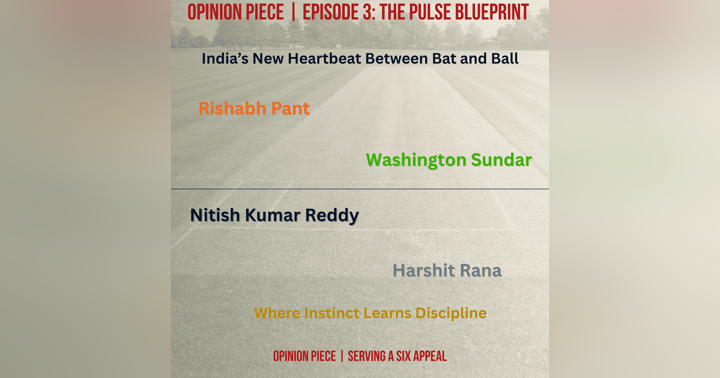
Opinion Piece | Episode 3: The Pulse Blueprint — Rishabh Pant, Washington Sundar, Nitish Kumar Reddy, and Harshit Rana