You May Also Like - Alligator Alcatraz
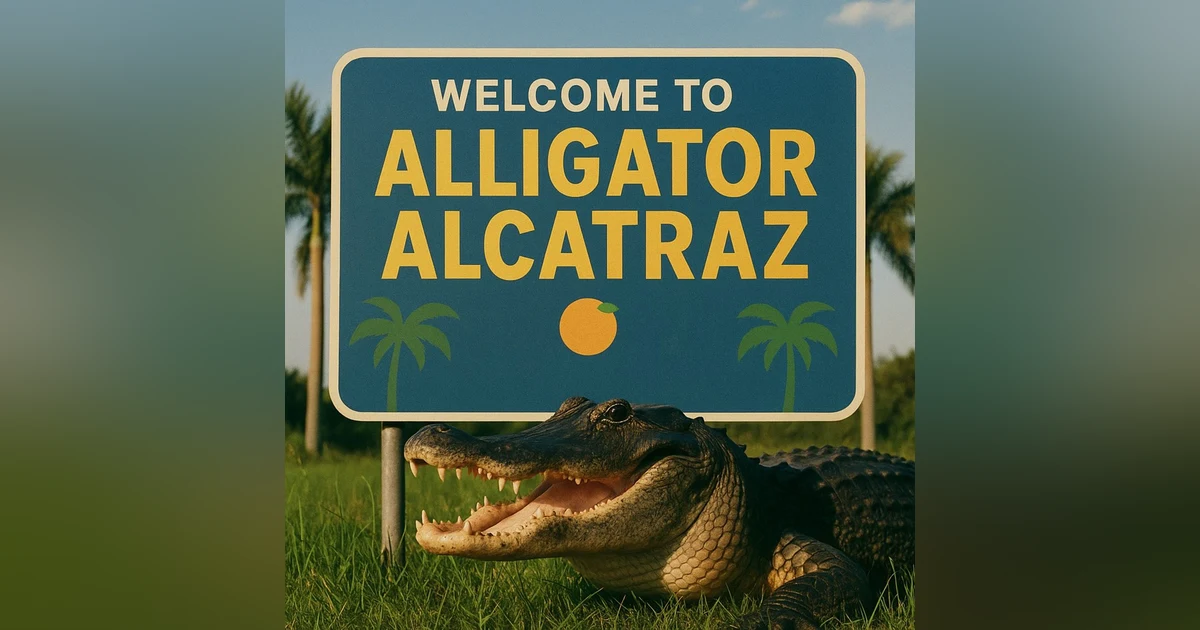
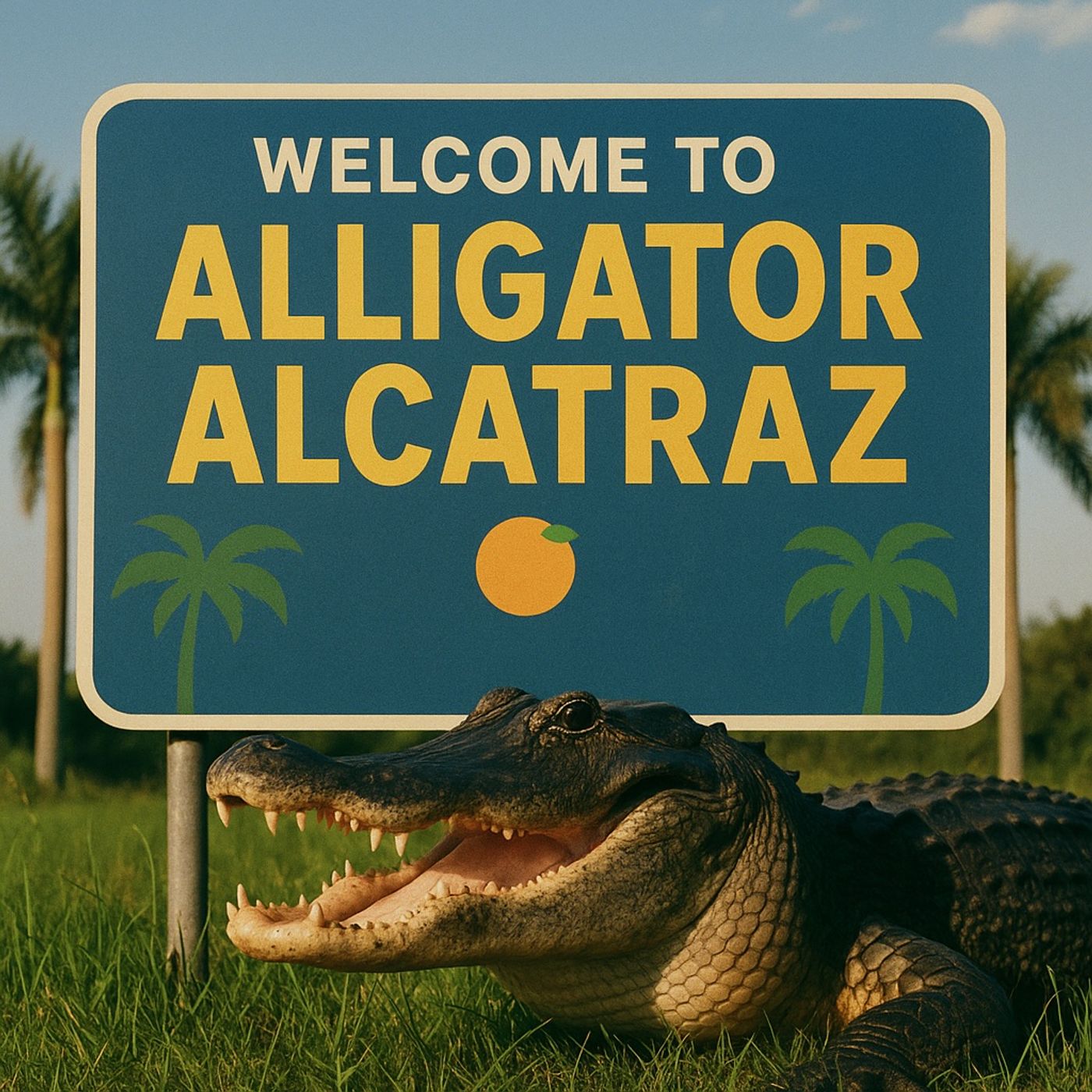


Deep in the Florida Everglades, where corruption runs as thick as the swamp, a broken immigration detention center becomes ground zero for a darkly comic uprising. When mild-mannered maintenance worker Tommy Esperanza is wrongfully detained, he teams up with a mysterious fellow inmate to turn the system upside down—using bureaucracy’s own chaos against it. With wisecracking narration from Southern legend Beau Thibodaux, Alligator Alcatraz is a sharp, satirical romp through government failure, family separation, and unlikely heroism. It’s Shawshank Redemption meets Veep, with gators.
Follow Alligator Alcatraz on Apple Podcasts or wherever you get your shows.
0:03 Calaruga Shark Media. I've been in a lot of places where people don't want to be county lock up in Baton Rouge that smelled like desperation, and Pine saw that federal facility up in Beaumont where the guards were meaner than the inmates and twice as stupid. Even did sometime in a parish jail where the cockroaches paid rent and the rats had voting rights. But I ain't never seen nothing quite like this place. They call Alligator Alcatraz course that ain't its real name. Real names something bureaucratic and forgettable. Dade call your Intensive Detention and Processing Facility or some such nonsense that sounds like it was named by a committee of lawyers who never seen the business end of a pair of handcuffs. But when you got gators swimming in the moat, they didn't mean to dig in water moccasins using the guard towers for sunbathing. Well, some names just stick, like Spanish moss on a cypress tree. The thing about this place is it was built by folks who never been anywhere more rural than a country club golf course. They figured they'd stick us out here in the middle of nowhere with some prehistoric reptiles for company, and that'd be the end of it. Problem solved, as they say in Washington.
1:37 What they didn't figure on was that some of us been living with gaiters our whole lives. Hell. My granddaddy used to wrestle them for tourist money down in Huma, back when a dollar meant something and a man's word was worth more than a politician's promise. These boys from up north, they think an alligator is like a guard dog with bigger teeth in a worse attitude. Shows you how much they know about anything that matters. See, they got this idea that if you make a place miserable enough, uncomfortable enough, dangerous enough, folks will do anything to stay away from it. And maybe that works with some people.
2:18 But what they don't understand is that some of us been miserable and uncomfortable our whole lives, and we learned something they never did, how to make the best of a bad situation. That's where this story really starts, not with the politicians making speeches or the bureaucrats cutting ribbons, but with a man named Thomas Esperanza, Tommy we called him. And if you think that name's too convenient for the story I'm telling. Well, sometimes life has a sense of humor darker than a Louisiana by you at midnight. This is episode one, Welcome to Paradise, July fifteenth, twenty twenty five.
3:16 That's the day they opened this place for business, though business might be too generous a word for what they were trying to do. I was in the first batch of what they called residence, though I ain't never lived anywhere where residents had to ask permission to use the bathroom and got their mail read by strangers. Picture this a convoy of buses rolling through the Everglades at dawn, air conditioning, struggling against the Florida heat like a one legged cat in a sandbox. We're all pressed against the windows, trying to figure out where exactly they're taking us, when suddenly the road just ends, turns into a dirt track that winds through saw grass and cypress trees, passed warning signs about alligators that somebody clearly put up in a hurry, And then you see it rising out of the swamp like some fever dream of efficiency. This collection of prefab buildings and chain link fence guard towers that looked like they were assembled by people who'd never seen a guard tower except in movies, and enough razor wire to gift wrap the state capitol. But the thing that really caught your attention wasn't the buildings or the fences. It was the water. See, when they built this place, they figured swamp land was just like any other land, except wetter.
4:43 So they brought in these drainage contractors from up north who looked at the Everglades like it was a big bathtub that just needed the plug pulled. What they created instead was something like Venice, if Venice was designed by people who flunked geography and had never seen water that didn't come out of a faucet. These drainage ditches they dug turned into canals, and the canals filled up with every creature that had ever called the Everglades home. I'm talking alligators, snakes, turtles, birds, fish, and things I ain't got names for. The first bus driver took one look at this setup and said, y'all sure this is the right place, Like maybe there was another secret government facility in the middle of the swamp that was supposed to look like something other than a scout camp designed by people who'd never been camping. Now, while we're sitting on these buses trying to figure out if this is real life or some kind of elaborate practical joke. In the administrative building, and I use that term loosely, since it looked like a double wide trailer with delusions of grandeur.
6:00 Warden Buckley Fitzpatrick the Third was having what you might call a moment of realization. Buckley Fitzpatrick the Third. That's three generations of men who never worked a day in their lives, never got their hands dirty except maybe in a garden party, and somehow got put in charge of other people's lives. Daddy Fitzpatrick was a judge. Grand Daddy Fitzpatrick was a senator, and Little Buckley got this job the way most political appointees get their jobs, by knowing the right people and writing the right checks. He was standing in his office, which had the best air conditioning in the facility, naturally, looking out his window at the circus unfolding in his front yard, and what he saw was not the smooth, military style operation he'd been promised by the contractors and consultants who'd built this place. What he saw was chaos with a government contract. Three guard boats were stuck in the mud because nobody thought to check how deep these drainage canals actually were. A maintenance crew was trying to figure out why the electronic gate system kept opening and closing by itself. Turns out a family of raccoons had made a nest in the control box, and in the middle of what was supposed to be the secure parking area, an eight foot alligator was sunbathing on the hood of a patrol car like he owned
7:31 the place, which, when you think about it, he probably did. But Buckley Fitzpatrick the Third didn't get where he was by admitting mistakes or acknowledging reality when it interfered with his plans. He got where he was by having conference calls with important people and using words like operational parameters and facility optimization. So when his phone rang and some deputy assistant under secretary from Washington wanted to as status report, Buckley straightened his tie, looked out at the disaster unfolding in front of him, and said, in his most confident voice, everything is proceeding according to plan. We're implementing dynamic security protocols and adaptive management strategies, which is political speak for I have no idea what's happening, but I'm going to act like I meant for it to happen this way. Meanwhile, down in the buses, we're getting our first look at the man who is going to change everything, though none of us knew it at the time. Tommy Esperanza was sitting about three rows back in the second bus, looking out the window at this whole mess, with the kind of expression you see on a mechanic's face when someone
9:02 brings him a car that's been fixed by their brother in law. Not angry, not surprised, just calculating, like he was already figuring out how to make things work better. Tommy was what they call a maintenance worker, though that title don't really capture what he could do. See, Tommy had one of those minds that understood how things were supposed to fit together. Give him a broken engine and he'd have it purring. Show him a leaky roof and he'd find a way to fix it with whatever was lying around hand. Him a mess of bureaucratic incompetence, and well, we were about to find out what he could do with that he'd been picked up in one of those immigration sweeps they were doing working at a hotel in Miami, where he kept the air conditioning running, the elevators working, and the guests happy. Been there fifteen years, had a work permit, paid his taxes, minded his own business. But when they need bodies for their new detention center and the headlines are screaming about border security, well, paperwork has a way of getting overlooked. Tommy didn't say much on that bus ride. Hell, Tommy didn't say much period, but he was watching everything, watching how the guards moved, how the facility was laid out, where the problems were, and brother,
10:32 there were problems. The first sign things weren't going to go smooth was when they tried to unload us. See, they had this elaborate receiving process all planned out. We were supposed to get off the buses in orderly, groups go through processing stations, get assigned to housing units, the whole nine yards. Very professional, very efficient, except they hadn't counted on the fact that their main processing building was currently under water. Turns out, when you dig drainage ditches without understanding how water actually works, sometimes the water decides to go places you didn't invite it. In this case, it decided to take a tour of the administrative complex, starting with the basement where they'd installed all their fancy computer equipment, and ending up in the main hallway where it was having a real good time splashing around. So here we are thirty seven confused prisoners on three buses, watching guards and knee high boots, waiting around what was supposed to be the most secure and efficient detention facility in the southeastern United States. And in the distance, that eight foot alligator is still sunbathing on the patrol car, occasionally opening one eye to see what all the fuss is about. The bus driver, a local boy who knew
12:02 the Everglades like most people know their own backyard, was trying not to laugh. Y'all want me to wait, he asked the garden charge, because I got a feeling this might take a while. That's when Deputy Warden chet mackenzie made his entrance. Now, chet mackenzie was one of those men who read a lot of books about leadership and strategy, but never quite figured out the difference between reading about something and actually doing it. He had a degree in criminal justice from some college you never heard of, and a head full of theories about how prisons should be run. He also had a habit of quoting Soon Sue at inappropriate moments, which should have been the first warning sign that he didn't quite understand his situation. Check came splashing through the flooded hallway, wearing rubber boots that came up to his knees and carrying a clipboard in a plastic bag like he was conducting some kind of amphibious military operation.
13:04 He'd been put in charge of intake procedures, and he was determined to follow protocol, even if protocol hadn't been designed with aquatic conditions in mind. Gentlemen, he announced to nobody, in particular, because the guards were all busy trying to figure out how to process prisoners in ankle deep water. We are implementing adaptive intake protocols. This is exactly the kind of dynamic environment that tests our operational flexibility, which was Chet's way of saying he had no idea what to do, but wasn't going to admit it. But here's where Tommy showed the first sign of what he was really made of. While the rest of us were sitting on those buses watching this comedy unfold. Tommy was looking at the problem different. He wasn't seeing chaos. He was seeing a puzzle that needed solving. He raised his hand, polite, patient, like he was in school, And when one of the guards noticed, Tommy said in English, so clear and unaccented.
14:16 It surprised everybody. Excuse me, sir, but I think I see what's happening with your water problem. Now. Most of the guards figured we were all supposed to be non English speakers, or at least not smart enough to understand what was happening, and Tommy, being Tommy, had let them think that sometimes being underestimated is the best advantage you can have. The guard looked at him like a dog that had suddenly started reciting poetry. You speak English, yes, sir, Tommy said, And I think your drainage system is backing up because you got a blockage in the main culvert.
15:01 See that water over there, how it's flowing the wrong direction. That means something stopped up downstream. Chet mackenzie came splashing over, still clutching his clipboard in its plastic bag. Are you some kind of engineer, he asked, Like the idea that a maintenance worker might understand waterflow was impossible to comprehend. No, sir, Tommy said, just worked with plumbing most of my life, and I seen this kind of backup before, which was Tommy being modest. What he'd actually seen was incompetent people trying to engineer their way out of problems they'd created by not understanding the basics of how water works. But Tommy was smart enough not to say that part out loud, Well, said Chet, trying to sound like he was still in charge.
15:58 If you have suggestions for optimizing our drainage efficiency, I suppose we could consider them as part of our adaptive problem solving protocol. Tommy nodded politely. I'd need to take a look at where your outflow connects to the main canal. Probably just need to clear whatever's blocking it. And that's how Tommy Esperanza became the first prisoner in the history of Alligator Alcatraz to be let off the bus before processing, given a pair of waiters, and asked to fix the facility before he was officially admitted to it. Now, while Tommy was out there figuring out why half the detention center was underwater, the rest of us got to witness what happens when bureaucratic confidence meets swamp reality. Warden Fitzpatrick had decided that the best way to handle this situation was to proceed as if everything was normal. In his mind, the flooding was just a minor technical difficulty, the kind of thing that happens during the startup phase of any major operation. The important thing was to maintain the appearance of control, especially since he had another conference call with Washington scheduled for that afternoon, so he ordered the intake
17:28 process to continue. Water or no water. We were going to be processed according to regulation, even if the regulations didn't quite cover aquatic detention procedures. Picture this, thirty seven men standing in a line that snaked through ankle deep water while guards in rubber boots tried to take fingerprints with equipment that wasn't exactly designed for humid conditions. Every few minutes, someone would slip on the wet floor, or a piece of electronic equipment would start sparking, or one of the many creatures that had wandered in from the swamp would make an appearance. And through it all, chet mackenzie kept insisting this was all part of the plan adaptive processing. He'd announce whenever something went wrong, dynamic intake protocols like saying the words made the chaos make sense.
18:30 The highlight came when they tried to take our id photos. The camera was set up on a tripod in the main hallway, which was now serving as a shallow indoor river. The photographer, a contractor from Miami who clearly thought he was just coming out for a quick government job, was standing knee deep in swamp water trying to get us to look presentable for our official detention portraits. Next he'd call out and someone would wade over to stand in front of the camera while various creatures swam around their ankles. It was like a very wet, very bureaucratic nature documentary.
19:13 About half way through this process, that eight foot alligator from the parking lot decided to come see what all the commotion was about. He came gliding through the front door like he owned the place, which honestly he probably did, and took up residence right next to the finger printing station. Now, most folks would consider the presence of a large predator to be a reason to stop whatever they were doing and address the situation. But Chet mackenzie was determined to maintain operational continuity minor wild life incursion. He announced like he was narrating a nature special. Continue processing. This is exact actly the kind of environmental challenge that proves our adaptive capability. The alligator, who clearly had more sense than the people running the place, just lay there in the warm water, looking bored. Every now and then he'd open one eye to watch the proceedings like he was supervising our intake process. Which, come to think of it, he probably was doing a better job of than anyone with an official title. But here's the thing about bureaucrats, they got a powerful talent for ignoring reality when it interferes with their schedules. So the processing continued, with guards stepping carefully around our new supervisor while trying to pretend that
20:45 having an apex predator in the intake area was just another day at the office. That's when we heard Tommy's voice coming from somewhere outside. Found your problem, He called out, you all got about half a cypress tree blocking your main outflow pipe. Within about ten minutes, the water level started dropping, not fast, but steady, like someone had finally found the drain plug in a very large bath tub, and as the water went down, you could see the relief on every official face in the building, except for Chet mac kenzie, who was still trying to make this look like part of his master plan. Excellent, he announced, drainage optimization complete. This demonstrates the effectiveness of our integrated problem solving approach. The alligator looked at him like he was an idiot and slid back outside to find somewhere more sensible to spend his afternoon. About an hour later, Tommy came back inside, muddy up to his chest and carrying what looked like half a tree branch. That should take care of it, he said to the guard who'd been assigned to watch him. But y'all might want to check your other outflow points. This whole system's going to back up again if you get any significant rain. Chet mackenzie came splashing over, still trying to look like he
22:16 was in charge of the situation. Excellent work, he said, like he was giving Tommy a performance review. This kind of initiative demonstrates exactly this sort of cooperative attitude we hope to foster in our resident population. Tommy just nodded politely and handed over the branch. This came from upstream, He said, y'all got trees falling across your drainage channels pretty regular, I'd guess might want to set up some kind of maintenance schedule, which was Tommy's polite way of saying they'd built their facility in a swamp without thinking about what happens in swamps when it rains. But Tommy was already learning that you catch more flies with honey than you do with pointing out people's mistakes, especially when those people have the authority to make your life difficult.
23:18 By the time they got us all processed and assigned to housing units, it was past dinner time and the sun was starting to set over what had to be the most unusual first day in the history of federal detention facilities. The housing units themselves were another adventure in optimistic engineering. They'd been designed by people who'd clearly never spend a night anywhere without central air conditioning and room service. Picture military style barracks, but built on platforms that were supposed to keep them above the water level, except nobody had figured out what the water level actually was during different seasons and weather conditions. Some of the units were sitting nice and dry on their platforms. Others were listing to one side like ships that had run aground, and a few were partially submerged, with water lapping at the door steps, like the Everglades was politely knocking to be let in. Tommy and I ended up in the same unit building sea, which was one of the dry ones. Thankfully.
24:24 There were about fifteen of us all together, a mix of folks who'd been swept up in the immigration raids and a few others who'd found themselves on the wrong side of federal law enforcement. As we were getting settled in arranging our few belongings on metal cots that looked like they'd been ordered from the cheapest supplier the government could find, Tommy was doing what Tommy always did, looking around, figuring out how things worked, thinking about how they could work better. This place got potential, he said, quietly, like he was talking to himself more than the rest of us.
25:04 Luis Morales, who'd been assigned the cot next to Tommy's, looked at him like he'd lost his mind. Louise had been a landscaper in Orlando, knew his way around outdoor work, and he could see all the problems that Tommy was apparently overlooking, potential for what Louise asked, getting eaten by alligators, drowning in our sleep, dying of mosquito bites. Tommy smiled for the first time since I'd seen him. Potential for being something better than what it is. He said, this place was built wrong, but it wasn't built stupid, just built by people who didn't understand what they were working with.
25:48 He pointed out the window toward the administrative building, where you could see lights on in the upper floors and the distant glow of computer screens. Those folks up there, they got good intentions. They just don't know how to live in a place like this, but we do. And that's when I started to understand what Tommy was really thinking. This wasn't going to be about escaping from alligator Alcatraz. This was going to be about making it into something worth staying for. That first night, lying on those government issue cots, listening to the sounds of the everglade settling in around us, I got to thinking about the difference between smart and whys. Smart is what they teach you in school, facts and figures, rules and regulations, theories about how things are supposed to work. And most of the people running this place were smart. They had degrees and certifications and training in all the right things. But why different.
27:02 Wise is understanding that just because something's supposed to work a certain way doesn't mean it actually will. Wise is knowing when to follow the rules and when to work around them. Wise is seeing that sometimes the best solution to a problem isn't the official solution, it's the one that actually works. Tommy Esperanza was wise, and over the next few weeks that wisdom was going to turn Alligator Alcatraz from a bureaucratic disaster into something none of us had expected when we stepped off those buses. But I'm getting ahead of myself. That first night, all we knew was that we were stuck in the middle of a swamp with a bunch of confused officials who thought they were running a high security detention facility but were actually running something closer to an outdoor adventure program for people who'd never asked to go camping. Outside our windows, we could hear the sounds of the everglades, alligators calling to each other across the water, birds settling in for the night, fish jumping in the canals, and somewhere in the distance the hum of generators keeping the air conditioning running. In the administrative building, Tommy was lying on his cot, hands behind his head, looking up at the ceiling like he was reading blueprints that only he could see. Y'all ever think about why they really built this place out here?
28:34 He asked the room in general. Luish, who was still convinced we were all going to die of snake bites or government and competence, grunted from his cot to make us miserable, maybe, Tommy said, Or maybe because they figured nobody would want to escape from a place like this. Too dangerous, too remote, too many things that can kill you. He paused, listening to something moving around outside in the water. But what if that's exactly what makes it perfect? And that's when I knew that Tommy Esperanza wasn't just planning to survive Alligator Alcatraz. He was planning to transform it.
29:21 Course none of us knew then just how wild that transformation was going to be, But that's a story for another day. For now, all you need to know is this, Sometimes the best escapes don't involve tunnels or rope ladders or midnight flights to freedom. Sometimes the best escape is turning your prison into your home, and your captors into your students. And sometimes, if you're very lucky and very patient and very wise, you get to watch powerful people take credit for your work while completely missing the point of what you've actually accomplished. Tommy Esperanza understood that from day one, the rest of us, well, we were about to get an education in the fine art of making the best of a bad situation. And trust me, in a place like Alligator Alcatraz, that education was going to be more valuable than any diploma you could hang on a wall, assuming you could find a wall that wasn't underwater.
30:31 Of course, next time, I'll tell you about the committee, not the official committee that the administration set up to solve their problems, but the real committee that actually did solve them, and how Tommy learned that sometimes the best way to fix a broken system is to let the people in charge think it was their idea all along. But for tonight, that's enough. The gators are calling the waters lapping at the foundations, and somewhere in the administrative building, Warden Buckley Fitzpatrick third is probably on another conference call explaining to Washington how everything is proceeding according to plan. Then, you know what, for the first time since he took this job, he might actually be telling the truth. He just doesn't know it yet