Suicide Awareness and How to Cope with the loss of a child. Special guest with Lindsay Taylor, founder of the Soul Soldier Community


Lindsay Taylor is a licensed therapist, speaker, author, and podcaster specializing in grief, suicide prevention, addiction recovery, and parent support. As the Clinical Director at a Suicide Treatment Center, she pioneers innovative approaches to mental health care, helping individuals and families navigate crisis and healing.
After tragically losing her seventeen-year-old son to fentanyl, Lindsay transformed her profound grief into a mission of hope. With over a decade of experience in the social work profession, she has guided hundreds through the heavy weight of life’s challenges. She combines professional expertise with deep empathy, offering both practical tools and unwavering support to those ready to reclaim their lives.
A mother of four and a warrior of the soul, Lindsay is also passionate about coaching parents to strengthen their connection with their children and do their own healing, which creates a ripple effect of raising confident kids and building healthier communities.
Through her work as a Soul Soldier, her podcast Soul Soldier Speaks, and her writing, Lindsay stands beside the wounded, reminding them that their life is a miracle. Because healing isn’t just an individual journey—it’s a movement. And together, we rise.
Podcast Soul Soldier Speaks
IG @_soul_soldier
Facebook community
https://www.facebook.com/share/g/1A2VgptexU/?mibextid=K35XfP
Author: The Rise of a Soul book coming out soon.
Join "Not Alone with Melissa-Sue" Podcast every week for a new episode.
Follow Melissa-Sue Methven on Social media:
@Melissa_Gratitude
Website:
Author, Speaker, registered dental hygienist and breathwork practitioner, Neurosomatic Inteligence coach.
Book available on Amazon and Audible
https://www.amazon.com/dp/1961098571
https://www.audible.com/pd/B0DG5ZZN5C?
Hope Institute in Arizona
https://www.thehopeinstitute.net
988 National Suicide Hotline
https://988lifeline.org/?utm_source=google&utm_medium=web&utm_campaign=onebox
✨ About the Host & Ways to Work Together
Melissa-Sue Methven hosts Not Alone with Melissa-Sue Methven, and is an author, speaker, and breathwork facilitator guiding emotional, nervous-system, and spiritual healing. She uses storytelling, expert conversations, and lived experience to help people reconnect with their body, release stored emotions, and return to wholeness.
Available for:
- Speaking engagements & keynotes
- Breathwork & nervous system workshops
- Podcast guest features & collaborations
- Faith-based, wellness, and integrative health events
🔗 Inquiries: Breathwork Coach & Speaker | Mélissa-Sue Methven | Phoenix, AZ
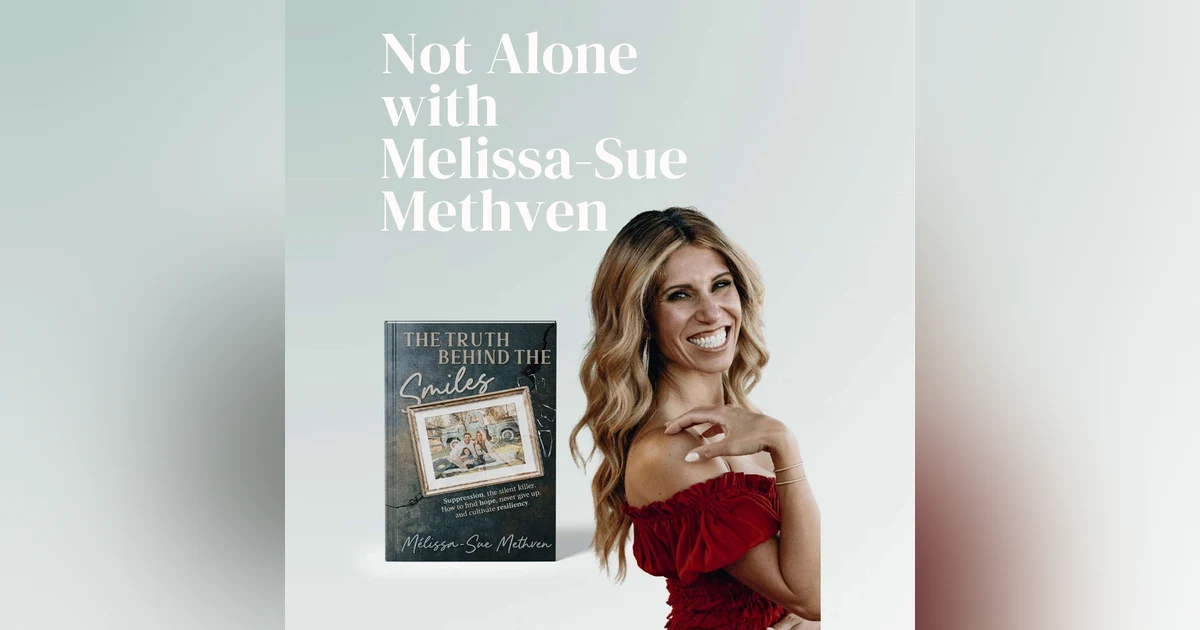
📘 The Truth Behind the Smiles explores grief, emotional suppression, faith, and the journey back to self.
📕 Amazon: https://amzn.to/4mSAcEt
🎧 Audible: https://www.audible.com/pd/B0DG5ZZN5C
🌱 Coming Soon: The Gut God Connection & Gut God Blueprint Coaching Program, focused on gut health, nervous system regulation, emotional healing, and faith-aligned living.
✨ Join the waitlist: Melissa Methven
🎧 Subscribe to Not Alone, share episodes, and leave a review.
You are not alone 🤍
Welcome to Not Alone with Melissa Methfin, a safe haven where we embrace our truth and break the silence surrounding our struggles. Here, we believe in the power of sharing our stories, fostering a loving community filled with hope, tools, and resources for healing. Together, we'll explore the journeys of those who have faced adversity, offering insights and support to ensure no one suffers alone. Join us as we shine a light on the path to healing. One authentic conversation at a time. I have a very special guest today that is so dear to my heart, Lindsay Taylor. She is a warrior in my book, and we have very much the same calling to help others from suicidal ideation. And she does work clinically with people that are suicidal, have suicidal thoughts with depression, but also she's gone through her own grief. And now she runs her own group called The Soul Soldier. And it is to, she could tell you all about it, actually, probably a lot better than me, but I feel she has a very important message. So can you share your story about losing your son and how that experience has shaped your life?
SPEAKER_00Sure. I always say the loss of a child is every parent's worst name, right? And I think one of the hardest types of losses you could face. And so really what that loss did was it broke me completely down. And I always say, literally brought me to my knees. And I think when you're brought to your knees and you're in the deepest depths of darkness at a really low point, like that's what losing my son brought me to a really difficult and dark place. And I think when you're at that point is when your soul actually is able to grow and rise and expand. And it didn't feel that way in the beginning, right? Like it was a journey of getting there, but there was only one way, and that was up, right? From my knees. And I feel like too, when you when you're on your knees in the depths of grief or deep pain or suicidal ideation, whatever it is you're struggling with, it's in that space that we're in the best position to start praying. And so, really, there was only one thing I could do, and that was surrender to God. This was so much bigger than me. And so losing my son, unfortunately, the last year of his life, he really struggled. And he ended up turning to drugs to cope, which we know a lot of people do. And in that, it ended up costing him his life. So we lost him to a fentanyl overdose at just 17 years old.
SPEAKER_01I just get full goosebumps because I could feel that. I always say, you know, the loss of a child, it'd be the unimaginable pain. So I honor you being able to speak today because I know you'll speak to so many people that are listening today that are struggling through that too. Because I feel like there's just so much that shame, the guilt, what else that you would have done? And what if, shoulda, coulda, woulda. It's so and you still had other children to take. Yeah, he was our oldest. He's our oldest. So yeah, we have three other kids. Three other kids that you needed to show up in part of their grief. So did you find yourself that you had time to grieve yourself?
SPEAKER_00Man, grieving is a lifelong journey. I think you understand this very deeply too. And so I don't think it's anything we ever um heal from or recover from. It's a lifelong journey, but I I think it's a one day at a time journey. And there was times that I would just need to go myself and grieve and cry and do whatever I needed to do and then show up for my kids and be there in their grief. And it's kind of this ebb and this flow where like when my husband's grieving, sometimes I'm there as his backbone. And when I'm grieving, he's there as my backbone. And sometimes we're grieving together, and same with my kids, sometimes we're grieving together, sometimes we're holding each other up. I think that's just how it goes. It's it's a journey. And for everybody, it's different with how they handle it and what they need. So I think it's just one day at a time and honoring that.
SPEAKER_01I think I can resonate with the ebb and flow. I've seen that with my family as well. And luckily, we're all sometimes it's not all at the same time. So I just attend to that one child or that one person, or I feel like I need to get away and have that space. So, what are some of the key moments or practices that helped you on your healing journey after such a profound loss?
SPEAKER_00So I'm a therapist, and um, at the time I was working at a high school as a social worker, and so I was literally helping kids and teens and families dealing with the very similar things that I was going through personally. So I'll be honest, there was there was a time where I don't even feel like in the beginning. I feel like the beginning is very numbing. When you first lose somebody, I personally I felt very numb. And all I knew to do was to continue to go and help others. And so it that actually became very quickly, that pain of that grief and losing my child became very quickly my purpose of like helping others to try and avoid them from having to walk this same path. And so I really just leaned into my work and continued to show up for other families. Even when I was in the middle of my deepest, darkest cave, I still showed up for others in their deep, dark caves. And in many ways, that was healing. That was healing. But probably about a year in, I think you go through these phases of grief. Somebody once said, the first year is very numbing. The second year is did this really happen? And I really felt that. Like the second year is this disbelief and this shock. And then the third year is now what? And I really have felt that to be true in my grief journey. And so then going into the second, and now we're in the third year. I feel like the third year is where I've really started to do the real healing. I started doing breath work, which has been phenomenal and such a good outlet. I've always been, always, always, always fitness has been my number one. The gym, I always say it's my therapy, it's the best therapy in the world. Um, it's my outlet. So I never stopped doing those things. So even from the very beginning, I never stopped with my normal routine, going to the gym, going to work. And then I really leaned into I will say losing a child completely changes your entire outlook on life. There was life before Alex passed away and life after. And my whole perspective changed, and it was like family first. I will never put work or anything else before my family. And so I think I leaned into those things, and those things really helped me on my healing journey. And then, yeah, getting into breath work and deeper practices like meditation has helped kind of this third year as I ventured into more that deeper healing work.
SPEAKER_01Yeah. I love that. Thank you for sharing. And then most importantly, how has your faith influenced your healing process and where there are specific beliefs or practices that provide you comfort?
SPEAKER_00Well, it's interesting. So I've I've always I grew up in church, veered away from the church in my later teen yeah, ended up turning more to just spirituality, but never really for probably over a decade, didn't ever really pray, acknowledge God in my life. Well, it just so happened literally two weeks before we lost Alex. I won't go into the whole story because it's a long story, but I I happened to stumble into a church group called Alpha. It's for people newer to Christianity, exploring religion, maybe people who are spiritual but want to get back into the church. So it's just a space to come and ask your questions. And I happened to stumble into this group and it ended up becoming everything I didn't know I would need. And in hindsight, it was God showing up in what was about to be the most difficult and painful chapter of my journey. And I believe he was really showing up to grab a hold of me. And I can say I don't think above everything else, God is the one that's gotten me through this. And I can say that's true for people I've worked with personally and professionally, people that I've been able to see kind of climb out of the deepest depths of darkness. God is in every single one of those stories. And so my faith has been huge in this. Um, it wasn't something I was even searching or seeking, but God was just relentless in his pursuit to show me that he was there. And so he is the strength. The strength. So your your faith truly was the catalyst to everything.
SPEAKER_01So for with your work, dealing with patients every day with dealing with depression and suicidal ideation, how has your personal experience with grief informed you to approach to help them?
SPEAKER_00You know what? There's something beautiful about our shared humanity. I think that the really key thing with this is no one's immune to these struggles. No one gets by this life unscathed. I think there's this common misconception. I had this mom one time in a therapy session when I shared a little bit about my journey to relate to her and the struggles that she was going through with her daughter. She goes, you know, it's really refreshing to see a therapist being authentic and really like she's I have this idea that therapists have just have these perfect homes with these perfect kids. And I'm like, no, we're human, right? Like it's life. And I think there's something beautiful about our shared humanity. And so my loss and my grief has made me relate deeper to my clients and the parents of their kids who are struggling with suicide ideation. As a parent, it's terrifying to see your kids struggling with suicide ideation or even substance use. And so I think it's just made me able to relate to my clients better on a deeper level. And that's where I think the healing comes in when we really get the heart into it and not just yes, the heal the modalities and the models that we use, the evidence-based models, those are all important, but you've got to have the heart in it. And I think that shared humanity and the ex that experience is very healing for people to know that they're not alone. I think that's the biggest thing.
SPEAKER_01I love it. So you think like that depth of that connection is there already. I always say it's like that invisible line that we have together, like for you already, knowing that you lost the deal with suicide and the overdose, and I lost my husband as suicide. It was that invisible line that truly tied us together and connect on a deeper level.
SPEAKER_00Yeah. And I just want to mention, I said I was at the high school at the time when I lost my son. Exactly seven days before I lost my son. I lost a student of mine that I was really close to that I had worked with to suicide. So I was going through that loss that week, and exactly, and I was actually at his memorial the night that we got the call about my son. So I had gone through that time was just significant grief. And it started out with losing a student to suicide and losing my son to overdose. And my son, the last year of his life, struggled with suicidal ideation because of the drugs and the position that he had got himself in, he became hopeless. And so, yeah, I understand the loss.
SPEAKER_01And then what are you telling me the numbers, which I was just couldn't believe it how it's going. You said the numbers for kids, suicide, suicide ideation are now going in elementary school.
SPEAKER_00Yeah, so the the place that I work, um, the Hope Institute, it's a suicide treatment center. So we just specifically focused on treating that. That's our whole specialty. And it was so surprising to us that the first year that we were open, we're partnered with the school district here in Arizona. And the first year we were open, the elementary referrals far exceeded our middle school referrals and far exceeded what we thought they would. The numbers were so high. So we're seeing kids younger and younger struggling with this. It's truly tragic.
SPEAKER_01And then what do you think, what do you see that the big issue might be there? Like why your children, why is there in those numbers? Yeah.
SPEAKER_00I always get asked this, and I think it's it's it's bigger than one thing, right? But I would say I think we have a real issue in our society in general of disconnection in today's world and because of social media and technology. So it's funny because this is something that actually is supposed to connect us. But I think what's happened is it's and with too much overuse of it, it's actually disconnected us. And so I think we're seeing that kids are getting phones younger and younger, and their developing brains are not able to handle this device, these addictive devices. So literally, the receptors that that drugs light up in our brain, phones are doing the same thing. So it's very addictive. And so I think that that is causing a lot of issues in our kids and their brain development and their their healthy like social functioning and resilience and coping skills that they need to develop are not being developed because they're spending too much time on devices. Um, and then social media with comparison, I think we just live in a world where we constantly feel not good enough and in the space of lack. I think not good enough is I talk about this in my book, but one of the biggest drivers and illusions that lead us to have suicidal thoughts is not feeling good enough. So I think social media feeds into that. So I think there's many factors, family dynamics, so then unhealed families, right? Like if we have parents who struggle with mental health or addiction, and then it you know gets passed on. So there's different elements, but those are a couple of the big ones.
SPEAKER_01I have to agree with those from others I've spoken to with children, and I've even seen it with my kids, you know. They, you know, of course, I had used it as the tablet as a babysitter and trying to cook or do these things, and and uh so, but I've seen like aggression behavior too, you know, when there's too much of that tablet time. So I truly can resonate with that. And is there one message you would like to share with others who are navigating their own grief? What would that be if you had one message? Someone just lost their child today.
SPEAKER_00Just gotta feel into that for a sec because it's so painful. And I think the very first thing I would say is, I see you. You're not alone. There was times I felt so alone and helpless in my journey, and so that I think would be the biggest thing. The thing that I would follow up with that that I think is really important is somebody once said grief is like a thumbprint, it's unique to every single individual. And I think that is so true that you need to honor your grief journey and what that looks like for you. If if you can't get out of bed tomorrow, that's totally okay. If you can't get out of bed two months from now, like I think that we need to honor each person's individual grief, but you got to lean on people for support. And I think just knowing that you're not alone, finding community, finding support groups, all of those things are really huge. For me, continuing with my routine was really, really important. And I do encourage people to do that as much as possible. But again, honor your unique grief journey.
SPEAKER_01I absolutely love that you shared that, Lindsay, because I felt that going through my grief as well. Is that I felt like people needed, if I wasn't not getting up and moving forward and getting things done, then they're like, oh, well, why isn't she, you know? So on the flip side, so I had to also honor like everyone grieves a bit, or people would compare. Well, my sister, she's she lost her husband and she's still this. So you don't stop comparing yourself when the grief. And and I almost tried to avoid showing that there was joy at times. You know, you can still grieve and have joy.
SPEAKER_00Oh, 100%. We call this dialectics in the therapy world, dialectical behavioral therapy. Dialectics is my favorite. It's this idea that two things that seem opposing can both be true and exist all at once. And so I always say that like pain and joy can both coexist. I was in so much pain, and it didn't mean that there wasn't joy in my life. Those are both true through that experience. I'm so glad you shared that. Yeah.
SPEAKER_01And then for someone who has recently experienced a loss, what would be the first step you would recommend to take on towards their healing journey? I think you've kind of touched base a little bit of like maybe continuing a routine, but is there something else that you'd like to say as a first step?
SPEAKER_00I think the very first step is find out who you can lean on. Because I don't think you can do this alone. I think that, well, you can, but I think it's it's very, very important to have that support system. And so I think the first step is who's your person that's gonna be able to help you navigate this journey.
SPEAKER_01Yeah, to hold space because it's a lot of times, yeah, you know, it might be hard for people to take on because they're probably struggling a lot. So it's find that person that can hold that, you know, yeah, intensity. And there are people out there, yeah, you know, waiting to hold that space, like like us, you know, like us.
SPEAKER_00100%, yeah. Sometimes it's finding an online support group and community, you know, if you don't have anybody in your close circle.
unknownYeah.
SPEAKER_01Yeah, I know. I listened to so many podcasts. I was living in Wasilla, Alaska, and there's as far as counselors, they waitlisted and there's no resources out there. So actually, podcasting and listening to breathwork things and and not feeling alone, that's what it was. And that's why I really wanted to have you on the podcast here for you to share your amazing story and what your work. I mean, tell us where you want your your vision right now with Soul Soldier, because I know this will be this is gonna be huge.
SPEAKER_00Yeah. So I just wrote a book called The Rise of a Soul Soldier. It's not out quite yet, it's in editing, but I am creating a I created a Facebook community specifically for those struggling with suicidal ideation or addiction or their loved ones who are in the battle with them or honoring those who we've lost. So also supporting those grieving somebody lost to suicide or overdose addiction. So I created the Soul Soldier community. It's actually called Soul Soldier Community on Facebook, and really my whole goal is to just create this army of support to rally around those struggling so that we can ultimately save lives. So you can find me on social media, it's underscore soul underscore soldier on Instagram, and then that community on Facebook is called Soul Soldier Community. And then I also work at the Hope Institute, which if you're local here in Arizona, it's a suicide treatment center. So if you do have anybody you know, we we treat all ages, mainly it's kids and teens at this point with the school district, but we can serve all ages. So anybody struggling with suicidal ideation, we can help too.
SPEAKER_01Oh, yeah. Beautiful work. We'll be there, you know, helping you rise as well. And I can't wait to collaborate with you more. And I know you'll have your podcast coming out soon, and that will save lives.
SPEAKER_00Yes, my I also have my podcast on Soul Soldier Speaks. Yes. So you can find that as well.
SPEAKER_01All right, fantastic. Well, thank you. Thank you so much for watching. That was wonderful. Yes. Thank you for joining me on this episode of Not Alone with Melissa Methbin. Your time and attention mean the world to me. Remember, you are never alone in your journey. There is a community filled with support and love, ready to embrace you. I see you and you matter. Until next time, may you find peace and strength in the connections we share. Take care and be kind to yourself.