How to Bridge the Gender Equity Divide with Jason Ablin
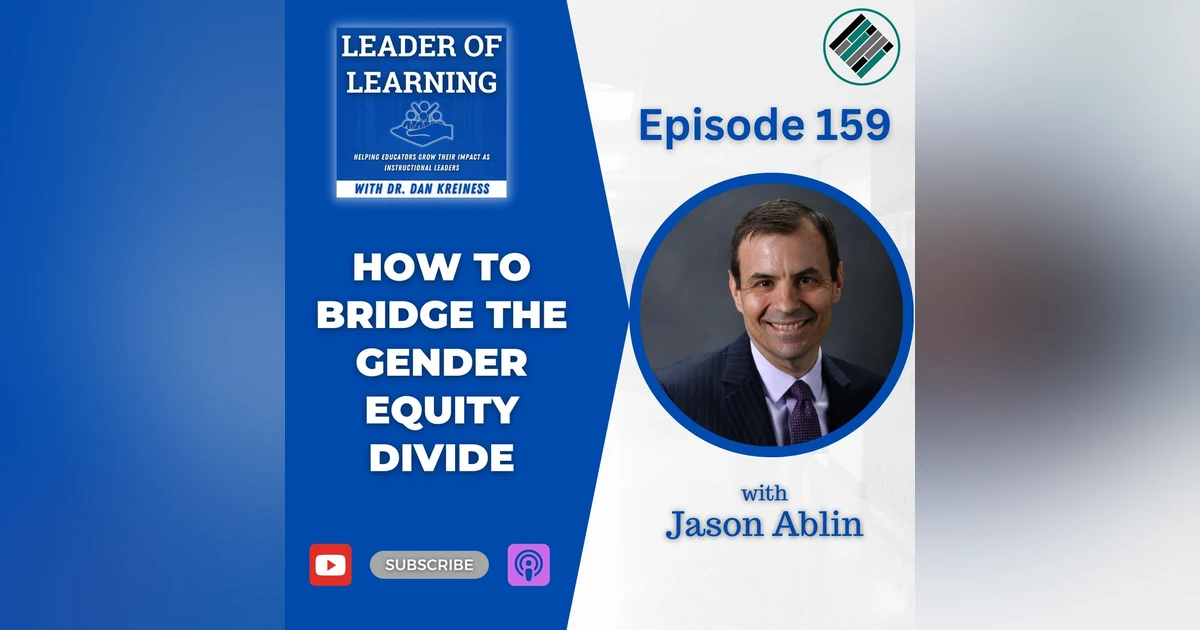

Episode 159 of the Leader of Learning Podcast features an interview with Jason Ablin (@jasonablin), an education consultant who works with schools on gender equity, positive faculty engagement, and school culture, and the author of the book, “The...

 Apple Podcasts

 Spotify

 Castro

 RSS Feed
Episode 159 of the Leader of Learning Podcast features an interview with Jason Ablin (@jasonablin), an education consultant who works with schools on gender equity, positive faculty engagement, and school culture, and the author of the book, “The Gender Equation in Schools: How to create equity and fairness for all students.” In the episode, Jason discusses gender equity in education, our current climate around gender and sexuality and what it is doing to teachers and education in general and the importance of SEL and why it's so critical, particularly for boys.
Full show notes and more information about this episode can be found at https://leaderoflearning.com/episode159.
Download my free guide “The Teacher’s Guide to Becoming a School Leader” at https://leaderoflearning.com/guide
Purchase “The Transformational Leader’s Reflection Guide” at https://leaderoflearning.com/journal
Download my FREE eBook “Lead to Inspire Growth” at https://leaderoflearning.com/ebook
Enroll in my free course “Unlock Your Leadership Potential” at https://leaderoflearning.com/freecourse
Sign up for my email newsletter at https://leaderoflearning.com/news
SUBSCRIBE ON YOUTUBE at https://youtube.com/drdankreiness to watch inspirational and educational videos about leadership and digital learning
Consider Becoming an Official Sponsor - https://leaderoflearning.com/press-kit
Melon is my recording platform of choice for video, audio, and even live streaming. For more information about Melon and to receive 20% off your first billing cycle on ANY paid plan you sign up for, visit https://leaderoflearning.com/melon
Gear that I use and love to recommend:
Mirrorless camera (Sony zv-1) - https://amzn.to/3zdxKlR
Main microphone (Shure SM7b) - https://amzn.to/3Mi5SzE
Backup microphone (Shure MV7) - https://amzn.to/38M9Vqv
Budget microphone (Samson Q2u) - https://amzn.to/38MeukB
Audio Interface (Focusrite Scarlett 2i2) - https://amzn.to/3xdocWq
Wireless lavalier microphone (AnkerWork M650) - https://amzn.to/3TUlsXN
Key lights 2pk (Sokani P25) - https://amzn.to/3mcNq0X
Ring light (Neewer 18”) - https://amzn.to/3tfnB46
Budget studio lights (Neewer Dimmable LED 2pk) - https://amzn.to/392g16i
To leave a rating and review on Apple Podcasts -
0:00 The topic of equity may have been trending now in education for the past few years, but how often do we talk about equity in terms of gender. In this episode, we are talking about the gender equation in schools. Stick around, Welcome to the Leader of Learning podcast. I'm your host, doctor Dan Crinis, and this is where I help educators grow their impact as instructional leaders because my research and leadership experiences have led me to understand that someone like you, regardless of your role or your title, can have a tremendous impact on your organization. I chat with inspiring guests who are truly making an impact as instructional leaders. Whether this is your first time listening or you've come back for more, I hope you've subscribed to this show on your preferred podcast apps so you don't miss any of the great episodes, topics, or guests.
0:54 Anyway, I'm so glad you've tuned in. Now let's get started a Leader of Learning and welcome into episode one fifty nine. I'm so glad you're here. If it's your first time tuning in, thank you so much for checking us out. If you're not new to the show, well, I hope you followed or subscribe, depending on which podcast app you use. Anyway, I have a great episode coming up with Jason Ablin, the author of the Gender Equation in Schools, how to create equity and fairness for all students, and I'm so excited to bring that to you. But before we get there, just one piece of housekeeping news real quick. I recently launched some products and services that I'm really excited about and proud of, and I know that they're going to provide value to lots of people. First, I'm now offering coaching services one on one coaching for either a half an hour or an hour at a time to help people both with their instruction if they are classroom teachers or even in school administrators, as well as content creation services. So if you or someone you know is looking for help with their instruction, or if they're looking to grow their impact and share their voice as a podcast or a blogger, a YouTuber, or any other type of content creation, then that's part of what I'm offering. I'm also expanding the offering of online courses in the Leader of Learning Academy. I now have three courses on leadership and classroom
2:30 instruction. Some are free, some are paid to find out about all of these products and services. Though, the best place to get these updates and news about what we're doing here on the podcast, as well as those products and services is to join my email newsletter. I regularly send out emails that not only provide information about new podcast episodes, but some really valuable information about what's happening in the world of educational and instructional leadership, and of course those products and services that I've already mentioned. My hope is that if you are not already subscribed, that you'll go ahead and visit Leader of Learning dot com slash news and get subscribed to that newsletter again. Leader of Learning dot com slash News. Now, let's get into this episode here in episode one fifty nine, as I mentioned, my guest is Jason Ablin. He's the author of the Gender Equation in Schools, How to Create Equity and Fairness for All Students. Jason has served in roles such as teacher, academic director, principle, and head of school and holds national certification in leadership and mentoring from some pretty prestigious school administrative associations like NASSP. We have a great conversation about the topic of gender Equity in Schools. And I really don't even want to give too much away and I want to get right to the episode. So coming up after these messages is my conversation with Jason Ablin. Welcome back, Leader
4:03 of Learning. I have a great guest, and I'm excited to dive into a topic that I've only really scratched the surface about here on this podcast, And in this episode we are going to be talking about something that may still be a little taboo to be honest, or at least in my opinion, in education. But my guest in this episode, Jason Ablin, is the author of the Gender e Equation in Schools, How to Create Equity and Fairness for All Students. With over thirty years of experience and education, Jason has served as a teacher, academic director, principal, and head of school. He holds national certification and leadership mentoring from NAESP and a SSP. He mentors new leaders throughout the country. He's the director of American Jewish University's Mentor Teacher Certification Program, and he currently consults with schools, leading training and workshops on gender equity, positive of faculty engagement, and school culture. So Jason, Welcome to the show. Like I said, I am excited to dive into this topic that we've only really dealt with kind of peripherally, I think, beforehand. So I'm really excited to tackle it more head on with you.
5:15 If there's anything I missed about you and your introduction, could you help us out a little bit more with who you are, where you are, and what you do. No, I think you got it. You got it all. And that's where I'm at right now with the work that I'm doing and obviously going around with the book, and you know, it's interesting you're in your introduction. The impulse to want to deal with this subject right now is both a highly timely one, but also we are living in incredibly divisive times in regards to these issues, and my experiences of going around this country right now and talking about the book bears witness to that, and going to places in red states and in places very conservative places in this country, where I'm speaking at conferences and I'm presenting and keynoting, and teachers are coming up to me afterwards and saying, this is all incredibly fascinating and useful, and if I bring it into my school, I'm going to get fired. And that's the kind of atmosphere we're in right now. I never expected that when I started writing this book in twenty eighteen, but that's where we are today, and so we've got a lot of work to do in terms of really carving out this issue and making sure people understand how would impacts education. Yeah.
6:42 I agree, And I didn't really know how else to put it in my introduction other than to use the word taboo. But can I just I guess based on what you just said, right, and based on your interactions, your travels, your consultant work, you said, you're you're basically seeing this issue. It's timely, but you're seeing it. I think the word that you use were divisive. Um, I guess. My My first question has to be why, like, how did we get here? Why are we in this position that we're in, and why is it that in the year twenty twenty three as we record this is this such an interesting and um difficult topic to really wrap our heads around, especially in education. Well, and it's a has a fascinating history, Dan, So I'm really glad you're framing that way. The the I think if we were to roll back to twenty and fifteen, most of us would be very shocked and surprised that we'd be here today where we are twenty and fifteen mark the you know, Supreme Court ruling that validated same sex sex marriage in the United States US the country right, and I think we're very much coupled with the hashtag me too movement.
8:07 I think we're seeing enormous backlash against a lot of the progress we've made on issues of sexuality, gender equality, understanding gender variation, and how it's playing out with a younger generation which is quite comfortable talking about these issues and having classmates to our trans and having classmates who have a variety of different whether non bondary or queer identities, and this generation is very comfortable with it. But there's an entire generation in power which really isn't comfortable with it and thinks that we're going down the wrong road. The problem with this framing, of course, as educators Dana's trying to be leaders in schools, is that it takes us away from the fundamental issue that by examining our own implicit biases in our relationship to gender and sort of ameliorating these problems, we can really make school much more successful experience for our children. They can be more successful in school, they can feel more safe in school, they can feel more joyous about walking into the classrooms and walking into their schools every day. And that should be the fundamental issue that we're focused on more than anything else. That everyone feels as if they're being validated and they're being their identity is being validated, and also that they have a freedom to express themselves in experiment with gender the way they choose. You know, a couple of months ago, I
9:39 interviewed Jed deery Berry on this show. Jed is out and an openly gay man, and he's an openly gay man and educator from a very conservative area of the country and has some strong opinions about everything from how it's dealt with in schools and to even how it's dealt with in religion. And you know, like I said, we kind of scratched the surface when I spoke to him about this, and one of the things that we talked a little bit about was, especially when it comes to this idea of sexuality, was how how different some schools and districts handle it than others. I shared a story I won't go too into it, because I've already shared it on the podcast in that interview. But where I live here in Connecticut, my kids, or at least my son who whose middle school aged at this point, has had conversations at least in health class, if not, I believe even some of his other classes too, about you know, as you were saying too, what gender identity means, you know, again not diving too deeply into it, probably, but um, you know, some kind of surface level conversation about pronouns and identification. And I know, and especially after talking to Jed, that that doesn't happen everywhere, and that can't happen everywhere right now, So I guess I'm wondering too if you can maybe go into a little
11:11 bit more of a clearer picture for me and my listeners about what are schools and districts in education doing better or best? And where are some where is it that some really need to pick up the slack in these areas? Okay, that's a really great framing down because we have a tendency in education and I think an educational leadership, and also when we get very pumped up about an issue, when we get very jazzed about an issue, and whether it's a social justice issue, an equity issue, it could be anything. Really, it can be about curricular change anything. I think we tend to we tend to jump over certain steps before that we take care of the business that we're supposed to take care of with these issues. So to give you as an example, I've gone into a lot of schools which consider themselves very woke.
12:05 You know, they consider themselves very progressive on this issue, and they ask me to come in often to deal with particular matter that they're having, or a particular issue that they're having, But they want to tell me how progressive they are. And they've got kids talking about pronouns, and they've got kids talking about identity and all of this. But when I walk into the classroom and I see certain practices going on, it's like I'm walking into a classroom that's from the nineteen fifties. So, you know, there's this tendency to want to bring it down to the kids right away. When I think the really effective programs that I've seen are the ones that start with the leadership and the faculty of the school first. Can I just ask you to sorry to cut you off. Can I just ask you to maybe get a little more specific, because I'm wondering and I really want to hear what you have to say about how to start with the staff. But let's go back for just a minute. I'm sort of envisioning, like you said, schools and districts who think, yeah, we're we're pretty progressive because we have a gender neutral bathroom, right right, you know, the buck stops there, and it's like, well, that's that's not the end all be all of really being progressive about this. So when you say that there are classroom practices that are still happening, that sort of it's like, we think we're there, but we're really not. What do you mean by that? It's yeah, And that's a lot of framing of the book, right, because my purpose and intention of writing the book was, we have an awesome amount of research
13:39 over the last fifty or sixty years. It tells us exactly what we need to be doing to bring gender equity into the classroom and fairness for all students, and we need to train our faculty members and our leadership into how to practice in these ways on a regular basis. I'm going to give you one simple example which I think is really an important It's something called bombing rate, and bombing rate has been a term which has been around again since the nineteen seventies, and basically what bombing rate is, very simply put, is the rate at which the teacher interrupts students when they're talking. Okay, and every teacher in the United States can do MAYA call bob this right, because we're all highly verbal and we love to talk. And you know, teachers realize when I'm in when I do presentations and stuff like this, they all resonate with this, with this issue, and they do it for all sorts of reasons. Rights. They're not doing it for you know, they're not doing it for issues of wanting to undermine students in a new way or to make them feel bad. They need to get the class moving, they need to get through curriculum, they need they need to keep the pace going right, and a kid is taking a long time to answer a question, so there's a tendency to interrupt. On average, students are interrupted every second when they're speaking, so a student doesn't even get a chance to speak for more than a second before they're interrupted. However, girls in classes are four times more likely to be interrupted than boys are in classes. Okay, So that's a
15:13 very simple example of how we are teaching girls in particular about the question of obedience, of asserting themselves, about what the value of their voices are in class when we are spending so much more time interrupting them than we are boys in the class when they're speaking. Okay, So immediately teachers are setting up these patterns, language patterns and behavioral patterns in class very very early. And we also know from research that boys are receiving six times the amount of attention than girls are receiving in class. Some of that is because boys learn to be more assertive, so when they have a question about something, they're more likely to really push to get an answer to a question. Uh So, a lot of it's very negative. A lot of the attention they're getting is very negative. There's a real kind of punishment culture against boys in schools, and we know we're dealing with a lot of issues with boys and trying to get them acclimated and feeling good about school. Again, uh, it's not helping when they're getting so much negative attention inside of class, they're getting punished at also three times the rate at girls are getting for doing the exact same thing, and these are just really simple practices. Now. I feel bad for interrupting you a couple of minutes ago, and I'm glad you took us down that path because I didn't want for for listeners to think that when it
16:48 comes to that this idea of gender equity, that it has to be all about um gender, you know, fluidity and pronouns and things like that. It's it's uh, And I haven't read the book yet. I apologize, I thank you for sending it to me. I'm going to dive into it at some point, maybe over the summer. But it is fascinating, UM, because I think equity in general as a broader term has become trendy in education. And I don't necessarily say that as a bad thing. I don't. I don't think saying it's trendy is that it's like a fad or anything. It's it's important. And again, I've you know, I've delved into it here on the podcast in a lot of different ways, UM, but this is really the first time I'm kind of going at this gender equity piece.
17:37 We've talked before about um equity or you know when it when it comes to UM access to technology, certainly racial equity, but it's it's fascinating and um just to hear you share some of the research and the statistics behind how often girls are interrupted and how much more attention boys get and how much more negative attention they get. It's interesting because I do think that when it comes and again this is not to downplay racial equity. I think that it has become trendy to look at discipline facts and figures based on what races and demographically speaking, who's being punished more than others and disciplined more than others. But I don't know if we're looking at the gender equity as much as we have been with the racial equity piece too. I don't know, what do you think about that? Well, I'm gonna take it even a little further than you're taking it, Dan, And I really feel like one of the ways in which diversitating equity inclusion people would do themselves so much much more of a favor in terms of people understanding what they're trying to do. And I mentioned this in the beginning. I think if if people who are listening to them speak and are listening to them engage and going to these workshops. If they don't see a direct line between the issues that are taking place and making kids
19:08 more successful in school, then I'm not exactly sure why we're having that conversation, because ultimately, as school people and school leaders, that's really why we're doing the work that we're doing, because we want to create amazing, joyful, loving educational environments for our kids so they can be successful with their learning. If you're telling me that the equity work we're doing is leading me to that path, amazing, fantastic, that's great. Show me how to get there, but it should be a means to an end. It's not something in and of itself for me, because I feel by doing the work, you're also going to be doing good equity work. By doing that work and making kids more successful and comfortable with each other, working together more collaboratively, doing all that great stuff, you're also going to be doing the equity work as well. Kids are going to be relating it's better and better relationships with each other. But it all starts with the faculty, the mission of the school, and the leadership of the school who's willing to put themselves out there for that message very very important, which kind of brings us back to what you had started to say before when I cut you off too about the I guess it's really what the what behind all this? Right? Like, what do we do about this? We know why it's a problem. You've stated some of the research. I love those statistics. I mean, it's it's sad, but it is reality. So I appreciate that. But in terms
20:40 of what do we do you mentioned before instead of schools going right to working with students on this, to really start with the faculty and staff. So how do they do that carefully? Okay? And why why I say that, Dan? It's because this is such a personal issue for so many people about how they identify their experiences with gender, their experience with sexuality. It is so deeply personal for everybody, right, I mean, there's no one who walks around. I'll give you just an example and maybe you can answer this question also as we're talking. When I begin my conversations with faculty, and I do this very strategically, the first place I begin with is can you tell me a gender story from school? Can you tell me a story which you remember either as a professional or as a student, yourself that really spoke to you and made you very aware of gender issues. And what that immediately does is when I begin the conversation that when I get the faculty talking to each other, and I get teachers talking to each other, they begin to see the universal nature of these questions. Nobody is immune to these questions.
21:56 I mean, Dan, I'll throw it out at you. Do you remember a particular moment or experience that you had which really resonated with you in terms of gender identity and a gender moment in school? That's a great question. I was trying to think a little bit as you were talking about that. Um, from my own school, you know, school career K to twelve education, I really don't. I'm trying to think now about my career as an educator. UM. I mean, of course, there have been some students that I've dealt with who are I don't want to stay confused.
22:38 That's not the right word. They're they're exploring their identity. Yeah, in terms though of anything like from the curriculum, I don't know. I think it would be a stretch, but there were As a former classroom LA teacher, they were probably some stories that I read like mentor text with my classes that I could that we probably could have explored the gender issue a little bit. Like one that jumps out at me is the book The Giver, which has all sorts of amazing themes and discussions and topics that are great for secondary students, but it certainly wasn't directly and explicitly tied to the curriculum, you know what I mean, Like it would have been a stretch. Okay, So you know, I'm gonna let you brew on that a little bit because maybe you'll be able to come up with something and think of something. I'm going to give you some examples which have come up a number of times when talking to faculty and for women, there are two stories which come up on a regular basis when we're talking about this. And and since seventy eight percent of teachers in the United States or women, much of the time I'm training, I can be training in an elementary school all an all female staff, right, and one of the memories that they have is one is the Bob cut. Right. They go they come back from summer vacation or some vacation.
24:15 You know, we just all got back from spring break, and their their mom or their parents took them out for a haircut, and they come back with this kind of bob cut, and they find themselves all of a sudden confronted with all of these people using kind of masculinized retorts back to them about their new state of being. Right, somehow, their entire identity has been now caught up in a new haircut that they have. Right. The other story I hear a lot, which is really painful on a sort of level, is one woman spoke about being on the cheerleading team. Right, So, on the cheerleading team, she would go out and you know, at a basketball game or whatever it was, and she would get comments thrown at her from the stand because of the outfits that they were wearing, very highly sexualized clothes. And then she would come in the next day an administrator would come up to her and basically castigate her for uniform violations. Okay, So, on the one hand, it's totally okay that she becomes this sexualized object when she is on you know, and the cheerleading team. But when she's at school, all of a sudden, her body is being policed by a dress code which is mainly addressed towards women's dressing right and quote unquote modesty.
25:41 Right. There are places they're supposed to be modest and there are places they can be totally you know, these are real sexual stereotypes, right. So, and a lot of the male faculty members, interestingly enough, we'll talk about their social circumstances, and they'll talk about something that really begins in high school, which is the social organization that takes place for boys after a certain age in middle school. In high school, and boys talk a lot about having to fit into what's called the boy box or a gender box, where they're expected to use certain kinds of language, talk in certain kind of ways, often derogatory, some types towards other students. They're encouraged to make fun of other students who are not fitting into that boy box, and they find that later on in life when they reflect back on it, it makes them feel bad that they had to act a certain way in order to identify as a growing young boy and a man. And those are some of the stories that come up during these sessions, and they really start to humanize the entire issue. When we start talking about gender in the classroom, it gives him a new lens to think about this podcast is a proud member of the Teach Better podcast network, Better Today, Better Tomorrow, and the podcast to get you there. You can find out more at Teach Better dot com slash
27:15 podcast. Now let's get back to the episode. You know, I want to take this opportunity, and certainly we've talked about your book and for my listeners, obviously, the link to Jason's book will be in the show notes for where you can purchase your own copy. But I also want to give a shout out to someone who I grew up with. His name is Jason Klein. He probably doesn't listen to this podcast because he's not an education But Jay wrote an amazing book called Yes Pepper, and it's basically the rest of the title is girls can play baseball too, or girls can play ball too. And when you were asking me those questions, and when you were talking about kind of those experiences that we we sort of all grow up with, I guess and and those circumstances like you mentioned. So Jay has two kids.
28:11 They're both right around the same ages as as my kids actually, and they go to camp together. And his younger daughter, Jay is a big baseball fan and he grew up playing baseball and everything. You're a Yankees fan, Jason. My friend Jay is another huge Yankee fan, so um, you know, I think when they were having kids, he probably was hoping for a boy to you know, go out and play catch and get him to play baseball, but that he has girls too. What happened was his younger daughter wanted to play baseball and questioned her dad and questioned her place really in sports, and was like, but dad, you know, I'm I'm a girl, like am I supposed to be playing baseball? And I'm going to get some of the details wrong, so I'll keep him general. But basically, my friend j put out a tweet on Twitter that went completely viral about this idea of his daughter asking him whether or not it's okay as a girl to play baseball versus obviously the more female or feminine sport, which is softball. She wanted to play baseball. Well, that whole, that whole thing turned into a lot of content that he created around it, and then within the past I don't know, six months or so, actually writing this book. So I want to, you know, like I said, I want to plug your book, Jason Ablin. But also I wanted to shout out my friend Jason Klin too, and I'll link to his book in the show notes too, as we were talking about this gender equality piece, because
29:42 that's a children's book that can be read by children and two children, and I think it's it's really important to mention here. So I just wanted to give him that that moment. Yeah. Look, I mean, you know, we're both of us are dad's dan, and we're trying to think I think frame growing up and getting older and identity with our kids as in as in as human and loving a way as possible. And at the same time, I think we want a kids to feel comfortable with pushing back on norms we don't necessarily feel or are fair or appropriate as as we do in school. We don't want school to be a place where where there's this a serious amount of respectful pushback from kids, where they are really pushing back. Uh.
30:29 You know, I take my kids out in California now, but every time to you know, the Yankees come out to play Anaheim, it's it's like a yearly tradition for me and my girls to go down and watch those games. And they certainly don't act like girls at the game. You know they are. They are vocal and loud, and they are out there and they are pure brad Yankee fans, you know, as I as I want them to be, and I want them to feel like the whole world is open to them, that there are restrictions, that they have full freedom. I think part of that is challenging these gender norms and being mentors to our kids and our students about really being who you are and having the identity that you that you that you see that you feel really glad you said that, because I want to kind of end on that note a little bit. So when you talk about being mentors to your kids, to your students, I wasn't sure if I was going to bring this up, but I probably won't talk too much about it. But we deal with some of this issue of gender equity and gender norms in my own home. I have a daughter who just turned nine, who is not as you just said about your daughters if when they attend baseball games, she is not necessarily very girly, and unfortunately it does it does still rear its ugly head among kids too. Fortunately for
32:00 us, I think a lot of her teachers throughout the years have been UM really good with her and good with the students who are around her. But I will also tell you that she idolizes her older brother, my my you know, my oldest my son. And I think in a lot of ways it's her UM just sort of living in his shadow and really wanted to, uh kind of live up to him in some ways. But anyway, I guess my question that I that I wanted to start wrapping up with is like, how then can we as educators, as as classroom teachers, but school leaders as well, you know, how can we advocate for more understanding and more empathy when it comes to differences and equality when you know, when talking about gender. And I guess just how much more work needs to be done in this area at the ground level. Right, So again, I think kids are spending eighty to ninety percent of their time in classrooms when they go to school, and I think that teachers have to really learn how to expand their lenses and thinking about how their practices are either feeding into it the implicit biases that we see, or are they really creating opening up new possibilities because they're they've really they really understand the way in which the classroom functions to either
33:30 make these things more equitable or not right. And in my book, I'm a practical guide, Dan, I mean I'm you know, I created tools. In the book, I created processes. I talked about the way that we need to go in and do evaluation of classrooms along these lines to talk about it. How do we handle math education in a particular way, How do we handle the way that classrooms are designed? Right? So, classroom design and particularly elementary schools is a big issue that I talk about in the book and which I really expand upon. The other thing that we really need to take a look at in a very deep way is our policies and practices whole school. And this is really the responsibility of leadership in the school to make sure that they're taking a look at their policies and saying, are our policies aiding and abetting certain biases that we have towards kids? Do I have time for one more example of us? Yeah? Yeah, absolutely, Okay, great, thank you. So. One of the one of the one of the pieces of research which they're bringing the book is the way we handle when when boys get gets when boys get into fights in schools, physical fights.
34:43 Okay. So a lot of research was done in Sweden in the United States around this issue, and one of the things that these researchers found when they looked at the documentation on what happens when kids get into fights is that when boys get into fights. First of all, when girls get into fight, there's like six therapists in the room. We have like you know, social emotional people coming in. It's you know, it's a national tragedy when girls get into a physical fight. When boys get into fights, the language that's often used to describe what they're doing is natural and normal forms of emotional expression. Right, So are you know, we're talking about boys and we're saying boys are being boys. This is how they express themselves, this is how they communicate their emotions, right, and we're calling it normative, we're calling it normal. Okay. So on the one hand, we're telling kids that, we're telling boys that it's totally okay to get into acts of violence, okay, and that's a normal way for you to express yourself emotionally.
35:46 Then what do we do. On the other hand, we have zero policy, zero tolerance policies in our school, So they get suspended or expelled that policy divide right there, and the way we're framing what's going on when boys get into fights versus the way we're responding is exactly reinforcing and exacerbating very misogynistic, patriarchal understanding of masculinity, very toxic and narrow understandings. So I'm a big advocate of getting rid of zero tolerance policies, particularly on this issue. If we really want to help young boys become thoughtful individuals who love and care each other and can care for other people, one thing we need to tell them is this is not normal emotional expression. Okay, if you have a problem, you talk to somebody and you talk it out. And on the other hand, we don't then exclude them from the very community that could support them and help them grow and become better people. That's one example of where a certain policy can really have an enormous impact from a gender standpoint. And I hope that the book will help leaders in particular rethink a lot of the things that they're doing along these lines. Me too, Me too. And I'm really glad that we had this conversation, And you know, I'm glad that I can we can at least play a small part in trying to um
37:19 you know better advocate and educate for these issues. And you know, again, this is one that I hadn't really tackled head on, but I'm glad to and uh and I hope it does help. So anyway, the book again is the Gender Equation in Schools, How to create equity and fairness for all students. Really appreciate your time and the conversation. Where can people go? They're they're going to be able to go to the show notes here for this episode my website Leader of Learning dot com slash episode one fifty nine and the link to the book will be there as well, or just open the show notes in whatever podcast app you're listening to this episode on right now, scroll down, click the link, and you'll be taken to the Amazon page where you can purchase the book. But if people want to reach right out to you, Jason, can they and where do they go? So then go to my website Ablin education dot com and they can email me at hello at Ablin education dot com and that's an easy way to get to me.
38:16 I'm also spending way too much time on Twitter most of the day, so they can find me on Twitter. I'm also on Instagram and Facebook and LinkedIn as well, and just reach out to me. Love to talk, love to talk about these issues and working with schools and working with faculty and working with leadership. I also do boys training groups. I work with boys groups of boys to talk about the issues that they're having in schools. So I've done that a number of times, and that's been really special work. It's exhausting work, but it's very very very satisfying work, and I just want to say shout out to you and thank you so much for having me on the show. Well, thanks a lot, and keep up the great work and congratulations on everything that you're doing. Thanks, thank you so much.
39:12 Well that's it for this episode. Thank you so much for listening. If you haven't done so yet, don't forget to subscribe to this show on your favorite podcast app. If you enjoy the content covered on this show, I want to ask you to do this one thing for me. Please share it. The biggest favor you could ever do for me is to please let others know about what I'm doing and how I'm helping educators grow their impact as instructional leaders. I hope you can share this podcast with other educators, leaders, friends, or anyone you think would love listening and learning. If you're interested in leaving a positive rating and review of this show, links to do so or always in the show notes for every episode. For more information about me or this show, and to access the great content that I share, please visit my website at Leader of Learning dot com. That's where you can find my online courses, YouTube channel, blog, how to connect with me on social media, and even ways that you can support the show like donating or purchasing Leader of Learning merchandise. Thanks again, and remember, no matter who you are or where you are, you are a Leader of Learning.