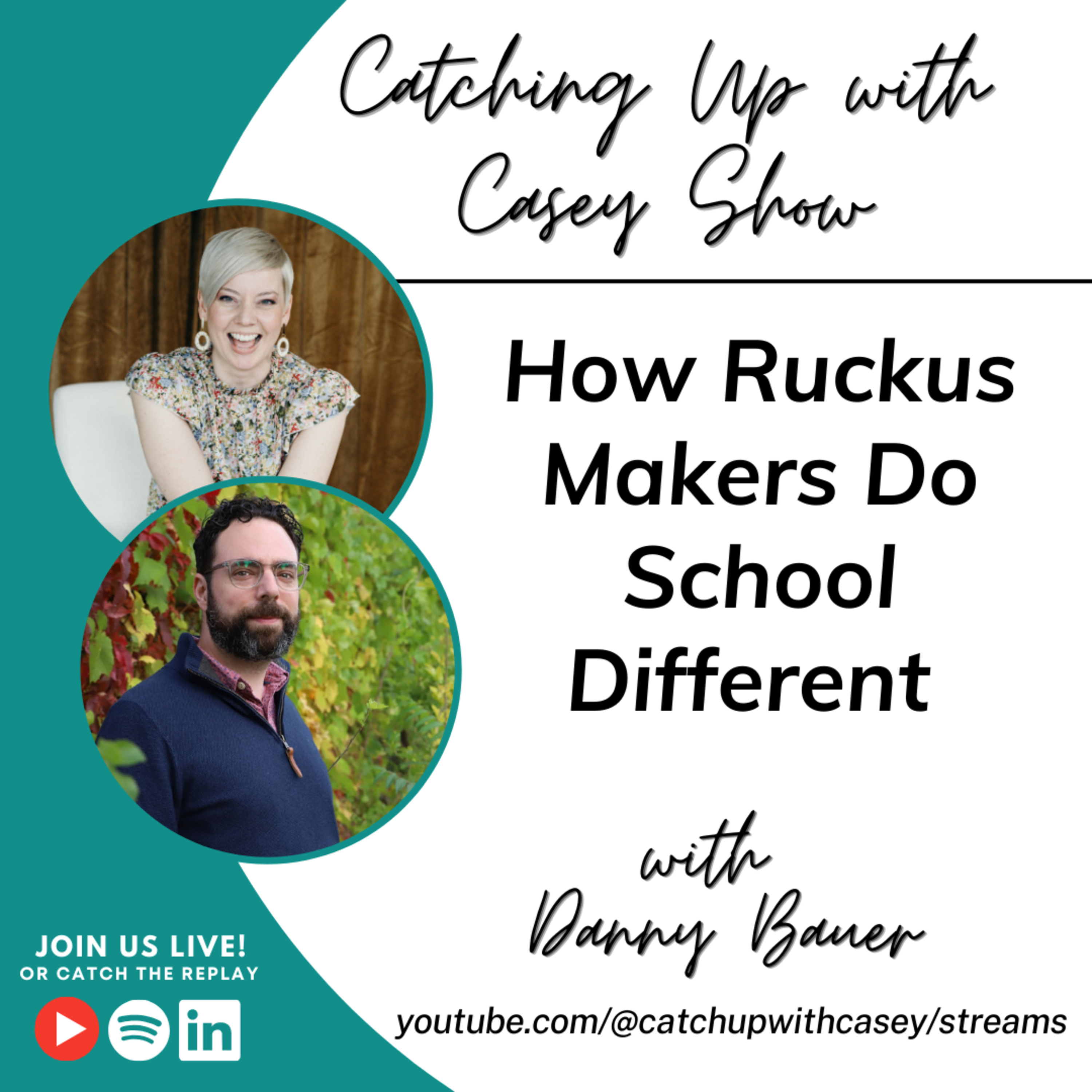
How Ruckus Makers Do School Different



 RSS Feed
Join Danny Bauer to explore how "Ruckus Makers" approach school leadership and education with a mindset of bold innovation. Discover what it means to lead differently, challenge the status quo, and implement non-traditional strategies that serve your stakeholders. Danny shares his insights on transforming school culture and points listeners toward resources for leaders looking to make a difference.
Connect with Danny:
Website: BLBS Website: https://betterleadersbetterschools.com
Newsletters:
Join 5000+ leaders who subscribe to the Ruckus Makers Newsletter: https://ruckusmakers.news/subscribe
Access our premium content: https://ruckusmakers.media
Podcast
Listen to the RuckusCast on Apple: https://itunes.apple.com/us/podcast/better-leaders-better-schools-podcast-Danny-bauer/id1036167679?mt=2
Listen to the RuckusCast on Spotify: https://open.spotify.com/show/3c1dkdobcUbAmUHfBWovuk?si=zTD5xZRTSj6rxXlucl6sUQ
Watch on YouTube: https://www.youtube.com/playlist?list=PLDheS3bA5a1eUo2ylnR_rYyQ_ct2WeXWm
Community Experiences:
Join The Ruckus Maker Club: https://ruckusmakers.club/join
Apply to the mastermind: https://www.betterleadersbetterschools.com/mastermind-application/
Resources: https://betterleadersbetterschools.com/resources
Books:
The Better Leaders Better Schools Roadmap: https://amzn.to/4lFViEv
Mastermind: Unlocking Talent Within Every School Leader: https://amzn.to/41hQJsN
Build Leadership Momentum: How to Create the Perfect Principal Entry Plan: https://amzn.to/4mAj3PK
The Remarkable Vision Formula: A Guided School Leader Retreat: https://amzn.to/4mY02Xg
Calm in the Chaos: Ancient Stoic Wisdom for Successful School Leadership: https://amzn.to/3Jqneie
Socials:
X: https://twitter.com/heydannybauer
Facebook: https://www.facebook.com/heydannybauer
LinkedIn: https://www.linkedin.com/in/heydannybauer/
Instagram: https://www.instagram.com/heydannybauer/
YouTube: https://www.youtube.com/channel/UCwVE_oB3URcg7ghv2Mn3yiQ?sub_confirmation=1
0:03 Welcome to the Catching up with Casey's show. If you are tired of chasing buy in, frustrated with teams who can't seem to get on the same page, or over the constant struggle of holding people accountable without micromanaging, this is the show for you. I'm Casey Watts, speaker, author and the creator of the Clarity Cycle Framework. I help leaders just like you take teams from frustration to alignment, so teams can work collectively toward a common purpose in a committed way instead of against each other as though they are functioning in different organizations. And we do it all through the craft of clarity. Whether you lead from the middle or you were the front facing leader of your organization.
0:45 On this show, we bring clarity to the seemingly small things in leadership that make the biggest difference because clarity precedes capacity. Now, with all of that said, let's dive into today's episode. Hey everybody, welcome to another episode. I'm glad you've joined us today. It's going to be a great conversation I have with me, Danny Bauer, and we're talking all about how Ruckus makers do school different. Danny, welcome to the show.
1:28 Hey Casey, thanks so much for having me. This is really an honor, so appreciate the invite. Yeah. So before we get started, first of all tell our listeners a little bit about who you are and the work that you do. I love to say, you know, I'm, I'm waiting in my house there in Palatine, IL, a suburb of Chicago. Actually, it's sort of like neighbor where the Bears supposedly want to move into Arlington Heights. I'm waiting for my best friend Lindsay. She always picks me up for high school, right? And drives me. And I could walk, I could ride my bike, but I'm lazy and I want to hang out with her. She's my best friend. We listen to 9 Inch Nails, Green Day, you know, all the songs back in the 90s. And so I'm waiting now.
2:12 School starts at 8:00, right? And I look and at 750 start to get worried. And this is basically every day of my life. And she's not there. So of course I sit right in the Bay window because maybe like I'll attract her to come closer, like faster. Somehow this doesn't happen. It's 755. Then I get more nervous. I go to the front door and I'm peeking my head out. I don't see her down the corner. And then it's 8:00 AM. We're officially supposed to be at school. No sign of Lindsay. So I started kind of walking towards the corner of the streets and eight O 5 I see her, you know, hightailing it down Anderson Drive and she, she picks me up.
2:54 We listen to 9 Inch Nails. We get to school, but it's probably like 810. I'm officially late. I've been late quite a bit to first period geology. And Mr. Rogers, at this point, I'm sure he's had enough. He's going to write me up. He's going to send me to the office. I'm getting suspended. I've had plenty of detentions. So I get to the door, knock on the door. Mr. Rogers answers because he locked it If you were late. And I say, Mr. Rogers, I'm so like, I'm late. But this time it's different. When I was on my way to school, Casey, I tell Mister Rogers, there was a, there was a house, it was filled with Girl Scouts and it was on fire. Now, Mr. Rogers, what would you do in this moment? Because what I did is I ran into that house and I, I saved the Girl Scout troop.
3:47 And I don't know if it was my very made-up story or the very real Dosey Doe. I love peanut butter and that peanut butter cookies so good that I gave him, but he let me off. I didn't get a detention. I didn't get suspended that day, and it taught me that learning how to tell a good story right pays, and I've been telling stories better since, so that's how I like. That's the best introduction I have ever heard and it made me rethink like anytime I've been a podcast guest, I'm like, oh, let let's change it up, Casey. Let's let's kind of go for the story, which I'm so excited to have you on today. That is one of the things, especially as a speaker, well, really just in communication in general and this I know this, we probably won't get too much into this specifically, but it's on my mind. So I'm going to talk about it.
4:36 But tell this, the art of storytelling is something that I'm fascinated with. I love listening to people who can craft a good story, and I would love to build that craft on my own. It does not come naturally to me. So do you feel like it's something that comes naturally to you? I think that I sort of, I don't know. I mean, I was an English major, so I like stories, right? For sure. And comic books. I taught middle school. I don't know what levels like you you taught at. I taught middle school.
5:17 I also taught high school. But you know, middle school kids specifically are weird and strange and just like generally terrible human beings. And so in order to get them to want to learn about what I was teaching in English language arts or reading AVID, I would have to capture their attention. So I think, you know, in some respects that was a stage, right? Like, I wasn't wearing costumes or jumping on desks, you know, that kind of thing. But I, I was thinking deeply, like, how do I get these kids interested in what we need to learn that day? And, you know, think about it like 30 kids, five classes, let's say, on average, right, that you have to convince on a daily basis to do stuff they don't want to do, right?
6:00 So storytelling is a piece of that equation in terms of a successful classroom. There's also relationships and empathy, understanding, you know where your kids are coming from. But so all that to say, I think I've been doing it for a while. People have told me like I'm kind of a good storyteller. And then I hired some work with me specifically on story to answer your question. So I'm, I'm driving, I'll make this like a 30 second story, but I'm driving to like Foxborough, Massachusetts, where my sister and brother-in-law, 22 nephews live. And I'm listening to this podcast with Shane Parrish called The Knowledge Project. And he has this guy whose name is Matthew Dicks on the show.
6:42 Matthew's telling this story that is literally incredible. So much so I forget I'm driving, right? This is dangerous. You know, I'm sober and I don't even know that I'm driving 'cause I'm so engaged in this story. He finishes the story and he says, you know, I'm an elementary teacher and I think, Oh my gosh, I'm in love, right? This is amazing. Best storyteller I've ever heard on a podcast is from the same family tree as me. He's an educator. And so I look at look at his stuff online and I ended up, you know, hiring him and working with him on story and he's brilliant. And he taught me a lot of things that I was kind of already doing, but I didn't have a name.
7:22 I didn't have a framework or like why things work or don't work. But now I do. So last thing I'll say about Matt is that like he made a lot of invisible visible for me. And now I know intentionally, like, why a story's going to work or not, how to make it funny, how to make it more dramatic, so on and so forth. And yeah, so it's a, it's a skill you can learn. Maybe I had a little bit of a natural inclination to it, but anybody can do it once you know the format. So there's this code and it's available. I can help, you know, share it with you, Casey. Yeah, I definitely would love, love that. So I want to talk about two things. First of all, my attempt at getting away with being late to school was just finding a door that, you know, like, not a secret door, but we would never go through the front door.
8:11 We would like somehow, I don't know, maybe some was. We didn't have to phones to text back then. So you had to really be clever about how you get into school without anybody counting you tardy. It almost never worked. You know why we kept doing it. But the other thing that that I can speak to is I had a speaking coach a couple of years ago when I first started getting into like really getting into speaking. And one of the practices that she did with me was we, she set a timer and she said, I want you to tell me a story from your life. You've got 5 minutes to do so, or maybe it was probably even one minute. And we backed down from 5 minutes to one minute to 30 seconds. And it was such a challenge for me because you really have to decide like what are the key things that I have to include in this and what are all of the unnecessary things that I don't need to include in it.
9:04 So it's just really interesting. For sure. And Matt, Matt likes to say that the shortest version of the story is always the best version, right? He's really about thinking about the audience and what they, you know, what they want to experience. And, you know, since working with him too, I've started doing, I don't know if you know, the Moth storytelling competition, but but I do that now, right. And I think they give you, they give you 5 or 6 minutes. It's pretty. It's under 7 for sure, you know, And that's what, that's what you need to do to make it work. Yeah. OK, this is all. This is all great, great discussion. Hopefully some of this is resonating with our listeners, but I know that the real reason they came here is to talk about this title, how Ruckus makers do school different.
9:51 So jump into that for a little bit. Talk first about what you mean when you say Ruckus makers and where that came from. Well, I'll give you like the sort of the point of view elevator pitch. And you know, one one of the things that leaders I support really resonate with is this idea of education ain't a bit disruptive. Then what are students really learning? And I also like to talk about how what we're doing is reimagining the project of education, even within a traditional setting, which school obviously operates in, so that we create campus experiences worth showing up for. And I take a lot of heat for this online when I post about it because it's often misunderstood.
10:36 You know, I say that there's a reason kids aren't showing up, right? And there's a lot of stuff out of our control, you know, like what's going on at home and access, even access right to transportation. And like is do we make a campus experience that kids are like excited to participate in? And I would argue not all the time. And so therefore, right, like, if you think of the school experience as a as a product, you know, I talked about convincing those 30 kids five classes every single day to learn, you know, what I was teaching students wanted to be there, right? And So what teachers often hear and yell at me about is like, I don't want to put on a show. I'm not Bozo the Clown, you know, I don't, I don't. I work for a circus.
11:23 And to that I respond great. Because if you were wearing a clown suit in the middle of a classroom with a type of nose, that would be weird and scary and you would traumatize your, your kids. So don't, don't do that. Nobody's saying be a clown. Nobody's saying be a performer. What I am saying is create a campus experience. That's where it's showing up for. And at the root, the foundation of that is empathy, understanding what your kids are into, what their hobbies and interests and drives and hopes, dreams and aspirations are. And then can you connect that to the content that you've been hired to teach? And often we default to what's easy, comfortable, you know, whatever for me, the adult, and we're not, we're not taking into account those human beings in front of us. And so that's a huge thing.
12:12 So Ruckus makers doing school difference that reimagine in the project education. It's about making shifts, you know, from old, traditional and broken bottles of education and new, different and creative. And I don't, I don't judge any of those shifts. Progress is progress. So it's a continuum, right? Maybe you go from traditional rose to collaborative learning centers, right? Maybe you're like Superintendent I talked to who saw an abandoned amusement park, figured out how to purchase that land and turn that literally into a learning laboratory for a school district. So there's a wide range of what you can do and everything in between. And each one of those shifts, in my view, is good because it's a shift. It's a do school different shift, making progress. Is that sort of cover, you know, what what what we're talking about?
13:01 Yeah. It does, yeah. Why do you feel like it's so challenging for because and you may have a different opinion, but and I'm curious to know, I would say my assumption is that there are fewer Ruckus makers than there are Recus makers out there in schools. Yeah. Why? Why is it so challenging to make that shift? Because nobody wants to be the first one dancing, right? That's scary and awkward and weird and saying, hey, come join me, right? There's a Ted talk that Derek Sivers did. It's over a decade old at this point, but it's legendary. And it's called How to Start a Movement, right? Maybe you've seen it, but it's a, it's a guy on a hill looking at a, you know, at a concert and he starts to dance and he's a terrible dancer.
13:47 He's awkward, weird, right? Like it doesn't, he's not a objectively like really great dancer, but he doesn't care. He's out there doing it. Time passes and finally a second person joins. And really nothing has happened at that point. But it's when the third person joins that group, it sort of becomes a critical mass and people just start running to this group. And all of a sudden it's the whole hill dancing in a weird, strange, awkward way. And so I think it's really scary to be that first dancer. It's scary to be that second. You know, the third person is that critical mass that you need, But I think it's just hard. It's hard to say I'm going to do something. I'm going to stick my head out. And you know, there's there's countless teachers I talked to that, you know, they, they explained they they're going to do something new.
14:37 There was somebody on the show, I forget their name, so I so apologize. She was all about like happiness. I know her vibe, but she did something about like adopting pets and dogs and like the kids would go to the the place where the dog store the shelter. They would like take pictures and write a little narrative and help them get adopted. And that seems like super cool. Somehow her peers were like, you're showing off, right? You're doing too much and all this stuff. And it's like the crabs in the in the bucket, right? Like pulling you down when you try to escape. And that's just wow. Principles I work with. And this is scary. There are the positive.
15:17 We'll start with the positive. So many leaders I've worked with, I've stopped counting. I've become regional or district, regional state or national principles of the year. There's more on these two hands that I can count. I stopped counting. It just happens now. There's fewer of that subset, though. This is insane. They become principal of the year, Casey. They then go on the very next year, an improvement plan. What, like all of a sudden they're a poor performer? What's going on there? The superintendent's big and very fragile ego is being outshined right by the principal inadvertently.
15:58 And because of that, they ride them up and they make it tough and they try to run them out. It's insane that this stuff happens. That's why there's, you know, fewer ruckus makers than everybody else. And it's just it's safer to blend in with the crowd, right? Literally the antithesis, the opposite of a ruckus maker. I call him a play it safe principle, right? They're playing it safe. They don't want to stand out. So it's just it's easier. Yeah. It's not fun. It's easier. No, I have I have very clear experience of this. So when I, I was a teacher at a school for two years, I'd come from a different school, but I, I was working with this one district as a classroom teacher for two years, high achiever, always was, always have been. And because of that, I was pegged as, OK, you can move in. We want you to move into a leadership capacity. And I think the idea was that I was going to become a yes woman to the CEO it, this school function in a different way. So she was a principal CEO, but I think the idea was Casey's going to be a yes woman to everything that I want to do and everything I tell her to do or not to do, which was really a wrong, a bad move on both of our parts. I should have turned it down.
17:14 She should never have offered that position because I am not a yes woman. And so my experience was I'm trying to push the boundaries, challenge the status quo and make some change happen. And middle of the year, we get together, she calls a meeting and she said we're going to change your job description. She pulled out my job description, started going through the list of things that were on my job description and crossing some things out because she felt as though I was stepping, overstepping my boundaries. And to an extent I may have been, but Oh my gosh, it was so defeating. And so I think it's moments like that where people, a lot of people probably hit their glass ceiling because they can't make change happen where they are. So they try to go somewhere else and find a way, like find the environment where you can be a ruckus maker. So yeah, definitely, definitely resonates. I'm, I'm curious, you said something about like one of the things you said was people, if someone points out you're doing too much, do you think there's an equivalent like this idea that if I'm a ruckus maker, it's going to require me to have to do more or to do too much and I don't want to do more because I already feel like I'm doing so much right now? You think that there's that idea? That there, there's some.
18:41 Are you saying there's some hesitation because it requires maybe more? Yeah. Am I hearing you right? I think it just requires different, you know? Yeah, Not necessarily more and a lot of times when we, you know, we support leaders that coach leaders one-on-one and then we have a leadership community that's a group, you know, experience that we have a team of coaches for. But I think we're we're looking for efficiencies and you know, I mean, we hear these things work smarter, not harder. And people waste their time on a lot of stuff that's meaningless, right. So we we help find that and like cut it out so that you can, you know, do the things that you're passionate about or that do school different dream that you have for your campus.
19:25 So yeah, I, I, I think, I don't think harder, I think just different. Yeah, yeah. And I, I would say probably to a lot of people probably need more direction thinking differently. Like, OK, you're telling me to think differently, but what does that even look like? How am I? How can I be sure that this isn't going to lead to failure? Because if I could, I would assume failure. There's a a fear of failure in some of that too. Being a ruckus maker, what are your thoughts on that? Schools suck at that, right, like because they they love the talk like because, you know, let's see what the business, you know, industries doing especially like, you know, tack and innovative hubs and like they're all about like experimenting and learning, learning from failure and that kind of stuff, taking risks, but. There are there are few, right?
20:21 So I want to I want to be clear, but I think the majority of school districts that love to talk that game. They like to talk about it because it gets sort of the community excited. But in reality, when you do the stuff that is innovative, you get punished, you know, at times. So you get you have to be really smart about the type of the space you're in, right, and if they are supportive or not. And I think, you know, as a younger ruckus make and that I didn't understand as much as just kind of how to get on the same page with sort of the cabinet and like leadership, your supervisor, that kind of stuff so that they're not blindsided. That's something that they hate, right? Like to find out you're doing something new and creative, but they're they have no idea. And so that's that's a recipe for trouble for sure. But you know, if you could get them their support and that kind of thing, then you have, you know, a really great green light.
21:13 So yeah, that's that's something I think about there too. When you're working with schools, what does that look like exactly? So how are you coaching the leaders and how are you coaching the teachers? Just give some examples. I haven't. Well, I've done some like back to school talks, so those have teachers in them, but I don't, I don't really work with teachers. So it's mostly administrators and either in one-on-one capacity or there's a few schools that have hired me to coach the principal and their AP team, right. So it's essentially, you know, whether that's the new school different dream or, you know, two people I'm thinking about.
21:56 I got a call about an hour after our podcast with a really fantastic principal in Delaware. She got, she got moved to a new school, high school, so adopted a new AP team. So that's like all chained and fresh and like, how do you, you know, bring your vision to life at a new campus? And then the the campus she exited or left her AP was moved up and became the principal and kept me on. So I now work with her and her team, right? So it's kind of a similar scenario, even though she's been rooted there, but it's meeting somebody, you know, it's like what we're doing right now. I mean, some podcasters send me questions that kind of stuff like ahead of time. And I just, I don't know, because I just want to be here with you in the moment. And so the same thing happens with with coaching, right? Like I don't have an agenda.
22:43 I don't, you know, there's nothing I necessarily want to teach or or share with you, get out of you. And when I'm coaching, I'm just meeting like, let's say Casey, like you, wherever you're at, you know, and I might even just open with. So what do you want? You know, what do you want to talk about today? Right, Like what's what's top of mind? We, we do have tools, you know, that, that help establish like goals and that kind of thing you want to be working on. And I have that in the back pocket in terms of, hey, how are things going on XY and Z? But usually most leaders I work with, they have a very clear sense of what what's broken, what they're working on. Yeah, that project, that big idea that they're trying to have come to life.
23:29 And then we, we create a space where you could dream about it and jam on it. And that that sort of aligns with my super powers, which is like the my mind and my creativity and ability to ask good questions. You know, here as a, as a podcast guest, I talk a lot, But you know, as a coach, I don't right. I ask a lot of questions and create a lot of space. I might, I do share some stuff here and there, but it's mostly talking with wild. I might ask two or three questions. They'll be for an hour and they'll be like such a great coaching call. And I'm like, whoa, like I barely said anything, right. But sometimes, sometimes leaders just need a place where they can download all the stuff, all the mess, right, and have someone help them sort of sort out and prioritize and figure out like I'm big on what's your intention, What's the action?
24:21 You know, we're not going to talk about the stuff like you need to be doing things too. So yeah, most of those go, well, I did, I do have, I need to figure out how do I say this in a nice way. There, there was, there was, there was 1 person that I inherited, right? So they didn't hire me themselves, you know, so it's a part of a team and I, I think it's coachable, but I'm like, do you have a pulse? Like what are, do you have no passion and drive, right? Like it was the most, it was the weirdest coaching call I've ever had. And I I exhausted all my tricks, right?
25:02 Been there, done that, friend. Oh my God. Yeah. It's those calls that I'm. I'm like, well, are are you an education because you want a job, or are you an education because you have a passion for it? But yeah, that can be really, really tricky, especially doing the work that you're doing and trying to help people to cause a ruckus. Yeah, yeah. He's not a bad guy. He's not causing harm. He's just yeah, yeah. He's just an amoeba, you know, He's just kind of like floating around like that. Like that's who he. Yeah. Here we are. I'm at work today, yeah. Let's. Go 8 to 3. Yeah, OK, awesome. So that's good to know kind of what that looks like.
25:42 And I would, I would assume that that's how you have to be in the work that you're doing of doing school different. It's going to be different for each person that you work with and every school that you work with. And the way that they do school different is going to vary on a case by case basis. 100% yeah 'cause like I said, you know, I don't judge the shift you want to make, but that's, that's part of the conversation is, you know what, what do you want to change here, you know, and so, and that change might be within themselves, right? It might. And a lot of times that's a great place to start, you know, because who do you, what kind of leader do you need to be in order to, you know, create yeah, that change that that you want to see on campus? So a lot of times leaders go to the how and all the tactics. There's a lot less inquiry into the strategy and inquiry into like who you are, like, are you capable, right? Like we need to go deep inside first. So I got a lot of tools with that and that inside game I really like to play.
26:46 Yeah. So for our listeners, people who are listening to this that are eager to be ruckus makers, or let's just imagine you're speaking to me as someone who like my past self, I was eager to make a ruckus. How would you, what would you say to them? How would you coach them through that? If they're just like, I'm not quite sure how to do this. Just start, you know, I think is, is number 1 and I think don't, don't make it too complex and don't make it too big. I love asking what's the, what's the smallest step you could take today right toward whatever sort of change that you're interested in. I've written a lot of books, 5 books, you know, I go on waves of posting a lot of content, that kind of thing. But if you don't already listen, you know, to the, to the podcast, better leaders, better schools, that that should be something you listen to if you're interested, if it makes sense, maybe we work together, right? I do exploration calls And so just to see if I'm a fit with people, you know, and if there's a vibe and chemistry there. And if not, it's super cool.
27:52 And if people want to continue, we talk about, you know, what that looks like. So, you know, I think those are all always do it, you know, within the mastermind, our our group coaching thing. One edge I chose because, you know, you're always making choices If you say, yeah, notice something is that we're not going to read books in education. That's not because there's anything wrong with content that's coming out from education. My assertion was just that the people I attract, you know, they're not, they're, they're really high achievers and and they're go getters and they want to grow even though they're winning awards and stuff.
28:32 So I assume assert that they're already reading like the books that are out there in education. So let me, how do I like create a really interesting list of content and books that, you know, they would never come across. And basically that's the feedback I always get is like, Danny, I never would have picked up that book. And it's so good. Like, thank you so much for it. And I I love hearing that now Mastermind so much more than a book club. That's a that's like 20% of what we do. But but to me, it's like turning the lights on, right? Like grabbing. Yeah. So anyways, illuminating things. Yeah. So as we close number one, I want to hear what is a favorite book that you often suggest.
29:16 Well, let me, let me give a, a book that I think we might read next year. I really made a mistake. I, I, I asked, I asked, I asked members, I just need to trust my gut, right? I asked members, hey, should we read this book? And there was one guy who kind of had a, a poor attitude and he's like, Nah, I don't want that. Let's not read that book. And I was like, and so I didn't go for it. And I always regret that we didn't. So I think we're going to read it next year. And the interesting thing about that guy is that he was in the mastermind probably about 5 or 6 years. At some point he was like on the hot seat. And he said, you know, we keep talking about the same thing.
29:59 And I'm starting to wonder if the challenge is really me, Like, am I the problem or, you know, like, my energy and how I'm showing up and, like, OK, now we can talk about it. So we started talking about that. He became principal of the year of his state. Just saying all right, so the book he said no to, but maybe today he would say yes. It's Robert Greene's 48 laws of power. I don't know if you've ever heard of that. And people think it's like this. Some critics think it's an evil book, right, because it it discusses how power works right, in a variety of ways, some ways that are not very good, but it's really well researched, well told the great stories there. And I want I want our leaders, our community to read it and everybody watching this because it even if you say, OK, I'm not going to ever try to exert power in this way, at least you understand like how it works, right? And therefore 2 you can protect yourself because those forces are at play, especially, you know, from folks above you in central office.
31:08 And if you're ignorant, right to the dead and you're just, you know, it is good to assume the best for people, but there's a lot of nasty, you know, not so nice people out there. And you need to understand what, what's going on, how the world really works. So it's Robert Greene's 48 laws of power. Yeah. Awesome, I wrote it now. OK. Any final words or things that you want to leave our listeners with before we close? I just go out there, make a ruckus. I mean, that's what I'm all about. I think you can, you can feel that energy and and we need you. We need you to to do that. And I think our kids need it, right? Our communities want it. And so it's those brave souls that are out there and and making something new for students to experience their legends in my book.
31:58 So go out there and make a rest. Yep, all it takes one small step. I love that that you mentioned earlier is just take the first tiny stop small step. It doesn't have to be doesn't have to be extravagant or grand. One small step. OK. Thank you, Danny, for coming on. This has been great listeners. We will catch you in the next episode. Bye, Danny. Bye now. Hey listener, I am so honored that you listen to today's episode and I hope you gained something valuable from it. I'd also be honored if you did ME3 solid favors. First, subscribe to this show. I've got a lot of great content coming up, and I don't want you to miss any of it. Second, be sure you're following me on social media platforms.
32:41 You can find me at. Catch up with Casey on LinkedIn or Instagram. And finally, if you were looking to book a dynamic and relatable speaker for your next event, conference, or retreat, I would love to bring a message about how the crash of clarity makes a significant impact on both leadership and life. Until next time, always remember clarity receives capacity.

