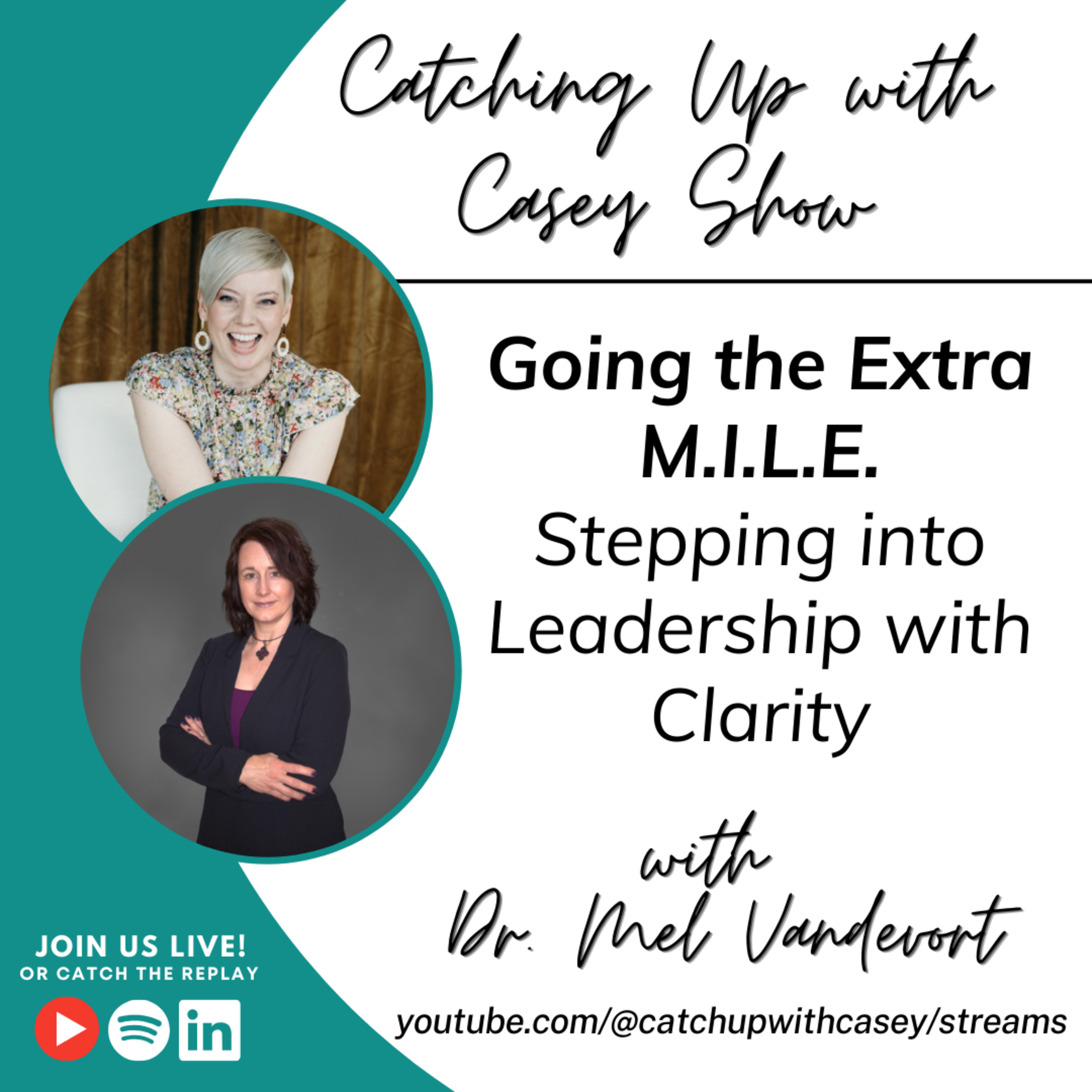
Going the Extra M.I.L.E. with Dr. Mel Vandevort



 RSS Feed
Dr. Melinda (Mel) Vandevort shares her framework for empowering new and aspiring school leaders to go the extra M.I.L.E. Discover strategies for stepping into leadership with clarity and confidence, leveraging personal gifts and strengths, and building essential systems that protect instruction and develop staff. This episode offers practical insights on prioritizing systems to avoid burnout and keep instructional mastery at the center of your work.
Where can you connect with Dr. Mel
Email melinda@empowereducator.com
Twitter/IG @melvandevort
LinkedIn @melvandevort
Podcast Empowered Educator
Website Empowered Educator
___________________________________________________________
Your teams are itching for CLARITY! That can be a complex thing to provide. But I have a framework that guides you to do just that– gain and create clarity! www.catchingupwithcasey.com/claritycycleframework
Need help getting your leaders trained in a purposeful way? https://www.catchingupwithcasey.com/identity
Ready to build the habits of a clarity-driven leader? Get The Craft of Clarity book!
Subscribe to my newsletter to get the resources mentioned in podcast episodes! www.catchingupwithcasey.com/newsletter
0:03 Welcome to the Catching Up with Casey show. If you are tired of chasing buy in, frustrated with teams who can't seem to get on the same page, or over the constant struggle of holding people accountable without micromanaging, this is the show for you. I'm Casey Watts, speaker, author, and the creator of the Clarity Cycle Framework. I help leaders just like you take teams from frustration to alignment so the teams can work collectively toward a common purpose in a committed way instead of against each other as though they are functioning in different organizations. And we do it all through the craft of clarity. Whether you lead from the middle or you were the front facing leader of your organization.
0:46 On this show, we bring clarity to the seemingly small things in leadership that make the biggest difference. Because. Clarity precedes capacity. Now with all of that said, let's dive into today's episode. Well, hello everybody. Welcome to another episode on pumps that you are here. And I am excited to have yet another wonderful conversation. We're bringing clarity to those small things in leadership that make a really big difference and impact. And today I have with me Doctor Mel Vandevoort, and hopefully I'm saying your last name correctly. That's how I'm.
1:36 Doing good. OK, awesome, awesome. So today we're talking about how to go that extra mile. But if you notice in the show title and description, it's miles spelled out m.i.el.e. So we're going to be learning a little bit more about this acronym. And so let's start by having you share a little bit about who you are and the work that you do. Yeah, absolutely. First of all, I'm Doctor Mel Vandervoort, like you said, I'm the owner of Empowered Pathways Network, and I am child of God. First. I am a mother of three very fine young men. A mother in love to two wonderful daughter in loves and I am a Nana to two great kiddos.
2:28 I am the girlfriend of Tony. I am, Oh my gosh, what else, podcaster for the Empowered Educator Show. I'm an author and currently I am the Superintendent of the most wonderful school on earth, which is North County Christian School here in the Saint Louis area. We're in Florissant, MO and I I do educational consulting on the side. Awesome. And today we're going to be talking about going the extra mile and I know you specifically are going to be talking about aspiring leaders and that's what your podcast, that's who your podcast is for, right? Can you tell a little bit more about that?
3:08 Yeah, it's new and aspiring building leaders. So it's not just aspiring, but new building leaders as well. So the things that you can do when you're prepping to move into leadership, all of those, those leadership roles you can take on without the title. So that's, that's really what it's, it's for. But it's it's also that first few years when you step into a leadership role and the things that you can do to survive and create those systems and be sustainable as a leader. Yeah, awesome. Tell us a little bit about your like just you as a person. What makes you uniquely just human?
3:48 Just another just an average person. Yeah, you know, I was listening. You, you had someone on the other day. I forget who it was and she she loves crime junkie and I love crime junkie too, but you have to have popcorn when you are what are you listening to crime junkie? Are you watching anything crime related? So I am a popcorn lover. And today, just on the day that we're actually doing this is national popcorn day. So you know, I eat popcorn almost every day and I'm wearing my popcorn socks that I got for Christmas. So I'm I'm a popcorn lover. Yeah. Is there any particular kind of popcorn that you're drawn to that you prefer?
4:32 Yes. So I do make my own here at home. I don't do that microwave stuff. That stuff will kill you. But I do make my own in a little whirly pot. But I also there we have a Schnucks here that's our our local grocery stores and they have a specific bag that I absolutely love. It is like the perfect combination of just slightly salty and it's just got this best flavor. So. But I'm not going to pass up any popcorn really. OK. I'm really curious. So when you make it at home, how do you make it? So I actually bought a whirly pot. So you stand at the kitchen stove. I, I used to do this when I was at home and young and we would just make it on top of the stove in a pan. But I put my butter and I put my oil and then I put my popcorn in and I just get it going and heat it up until it gets done popping.
5:23 And then I put it in whatever container and pretty much eat the whole thing. I'm not going to even lie about that. There's no shame. I'm, I'm. It's like, yeah. OK, so here's how I usually pop, pop pop popcorn. Well, that's hard to say. So I years ago, I got into the habit of making my own popcorn just in the pot. And I do coconut oil and then I add sugar and then I pop the popcorn in it and then I add salt to it. And so it does have a little bit of this salty, sweet flavor to it. So it's kettle corn is what that is a. Little bit yeah, it's a little bit kettle Cornish and we have just a shout out if you're ever or if you guys want to get online and go to this website, go to SU SU's popcorn. I think SU SUspopcorn.com.
6:18 I'm not positive on that. I'm going I'm going to look it up right now. SU SU's popcorn. It's here in Nacogdoches, which is where I live. Yes, it's Susus popcorn.com and it's spelled Susu, so go to it. It's the most lovely popcorn shop in our little town and doing so well that they're actually expanding into an ice cream and fudge shop. But they have all kinds of different popcorn. Like I took some to a retreat this weekend, just some little bags, and there was dill pickle popcorn and strawberry cheesecake popcorn and caramel, you know, the typical things. But yeah, absolutely check them out because you can order online and they'll send it straight to you. So it could be a great thing to try if you're interested in trying some different popcorn so. I absolutely love to pickle popcorn. That's one of my favorites, so.
7:10 That's so funny man. We it sounds like we can have an entire podcast episode about popcorn. I'm not, I'm not saying we couldn't. I mean, I think we could definitely. And it would, I think it would be really fun, but let's talk about what our actual topic is. And that is going the extra mile. So bring a little bit of clarity to that for us. What do you mean when you say going the extra mile? So it is actually my mission statement. When I decided to move into leadership several years ago, I thought, you know what, I'm going to have a personal mission statement and I just, I don't even know how it came about, but it's go the extra mile to motivate, inspire, leading, empower. And I used it when I was looking for jobs and then I kind of forgot about it. And then I started my own educational consultancy, Empowered Pathways Network.
7:59 And God's like, Hey, you remember that mission statement you made a long time ago, You're empowered Pathways network. Now you can bring that full circle and it fits perfectly going the extra mile down your pathway. And so I'm like, you know what, God, you're, you're right. So that's, that's how it was born. And so that is the mission statement of Empowered Pathways Network. Yeah, and what does Miles stand for? Motivate, Inspire. Leading. Empower. OK. You just said that. I just wanted to make sure we got that out there. Yes. So if you are thinking about that new and aspiring leader, what are the things that you feel like they struggle with when they step into leadership and how does how does your that acronym and what you do support that? So the acronym really is not.
8:52 So actually since I've talked to you and since I sent this all to you, I was really thinking about it. And so yes, the acronym is my mission statement. And it's like the overarching theme of everything. But I kind of have like 4 power surges that I have really kind of defined. And they're, they're not new. They're things that I've talked about in previous years on this podcast, on my other podcast that I used to have and also when I wrote my book. And it's, it's all about for new and aspiring leaders. It's looking for those gifts and talents that you have and your experiences and your skills and all of those things that's made you who you are now.
9:37 And we always think, OK, when I move out of being a classroom teacher, I'm going to be a principal because that's just like the mindset. I think that people think that they have to move into that specific position. But there are so many things that you can do in leadership. And when you think about all of those experiences, all of your passions, your interests, all of those things that make you who you are, what is it that you really would like to do? If it's being a principal, go for it. But if that's really not where you want to lead, then I'm sure there's something that you have in your little toolbox that you can absolutely just kill it. That could be a curriculum director or instructional coach or something to do with special education. There are so many options.
10:32 So what is it that you bring to the table that you're really passionate about? Because if you're not passionate about what you do, you're going to burn out. You're not going to be happy. Yeah. So what Why do you feel like people struggle so much with seeing what's out there that that that are potential possibilities? Because I see that same thing where we think we have to follow, like there's just a natural trajectory of roles that that lead to to one another. Why is it so hard for us to step outside of that and see what else there is? I think location is part of it.
11:12 I'm not sure if it was you that mentioned you are from a rural area, but I am from a very rural area originally, so I'm in Saint Louis now. So there are so many more opportunities for you to step into different leadership roles. But when you're rural, there aren't as many of those opportunities. So there's not a lot of instructional coaches, or at least not titled instructional coaches. Now talk to your principal because that could be an option for you. Hey, I know I need to be a classroom teacher. There's not an opportunity to be a full time instructional coach, but can I do that some way in some capacity and bring my gifts, my talents to the table or technology or something like that? So I think that's a lot of it, at least in those areas. Some of us just fear, just fear of stepping out of your comfort zone.
12:07 You're comfortable being a teacher. We have these limiting beliefs and imposter syndrome is one of those. We all deal with imposter syndrome at some point or another. And if somebody tells you they don't, they're probably lying to you because we've all felt it at some point or another. Maybe we didn't recognize it. There are just so many of those reasons as well. Yeah. And I want to point out too, we have the gift of the Internet to explore all of these different roles. But I think it's so important to identify and you, you've already mentioned this, but I just want to highlight it to identify what your gifts and strengths and talents are before thinking about what's the trajectory for me, What's the next role that I can take on? Because you may find that, yeah, it seems logical to go into a principalship.
13:05 However, maybe your gifts and talents are better utilized in a different type of leadership position and one which you will gain more fulfillment and joy. Absolutely. Absolutely. And being a building principal, it is very fulfilling. There are many joyous days, but there are are also some very hard days. And if you are not, some people are scared of parents, some people are scared of like going to board meetings and all of that. You are immersed in all of that stuff. So if that's not your your cup of tea, that probably isn't the position for you.
13:48 But I guarantee you there's something that you can excel at. Yeah. And I think it's important to note too, that sometimes you can get pegged or pinpointed as someone who may be a potential leader or principal. Like I, I know for me, there have been many times where I've been asked, oh, like let's say a principal or an assistant principal position comes open within your district. It's natural for people to start saying, oh, are you going to apply for that? Is that something do great at that position or man, if you applied for that, you would totally get it. I think for me, I have a tendency to take that and be like, well, maybe I should apply because maybe I would be really good at it.
14:35 And you're you're telling me these things that make me feel they feel good. It feels good to hear people say that and to want you in those positions. But at the same time, it's so important to really think about what do I want? Do I even want that? Is that something that I know I'm going to be able to use my talents, my strengths? Or is it not something in it? And it's OK for us to say, man, I appreciate that you think so highly of me, but this isn't really something that I think I, I want. Yeah, I just something to point out, especially if you are getting approached by people about looking into applying for those kinds of positions.
15:25 And if it's something that you're like, well, you know, maybe that kind of does sound good, but I'm not sure. Talk to your building principal and say, hey, can I do some kind of leadership internship with you? And we currently have that in our district. We have identified someone that we think is going to be fantastic coming up as a leader. She is an amazing classroom teacher and I am all about building leaders in not just the kids, but also in my staff. And so we're giving her opportunity. She's still a full time classroom teacher at the elementary level, so we can't just pull her out all the time, but we're giving her opportunities and we're making it.
16:07 We're making Subs available for her occasionally so she can spread those wings and see if this is really what she wants to do. Yeah, definitely important to think about your leadership pipeline. That's definitely true. And if your district, if you are currently a leader and your district does not already have a leadership program or some sort of leadership Academy, that's something I highly advocate that you that you pitch to your higher ups. And if you are currently not in the administrator role or in a leadership role, advocate for yourself and say, I'd really like to participate if we have something like a leadership program.
16:54 If not, is that something that we could look into? How can I support you in doing that? So I think this leads really well into what I want to talk about next. And that's just let's say that there are aspiring leaders who are wanting to prepare for leadership before they ever apply for the job so that when they are, when the time comes, they are ready. What do you feel like are some things they can do? Well, professional development is my jam. So I absolutely love it. And that's one of the things that I was always willing to do when I was trying to have things to put on my resume for one thing, and also just to get that experience. So leading professional development, seeing if there are.
17:39 So we just started RTI in our district and the teacher that I'm talking about, we work together. She and my principal and I work together one day and we got everything lined out and then we're just like, here you go. Now you, now that we've kind of gotten it laid out, we're going to give it to you and you can spread your wings and you can do what you need to do and you can flush out the rest of this program with our help, of course. But we don't. We want to give her autonomy, but we want to give her support. Yeah. OK. So really just looking for those opportunities, yeah. Absolutely.
18:20 Yeah, yeah. And can you speak to what if someone's in a district where they feel like they're not able to ask for or the culture isn't quite right and they don't feel comfortable asking for those opportunities or bringing up those opportunities? What? What would you suggest then? Yeah, that's a tough one. If it's because of your building principal and you don't have a great relationship with your building principal, I would suggest that you try to build a relationship with your building principal. I don't have a problem with that. I'm, you know, I'm, I'm an extrovert for the most part, so I can just go up to anybody and start talking. And I was always, you know, kind of in my principal space. And hey, let, let me try this.
19:07 If that's not an option, maybe if you're in a larger district, go to another building and see if there's an opportunity in another building. Do some after school stuff, do some before school stuff and see if you can do, you know, get some opportunities in that way. And maybe even, you know, in small districts, rural districts, the Superintendent is a whole lot more accessible than they are in a larger district. If it's a smaller district in a rural area, you know, talk to your Superintendent, say, hey, I, I really have this desire, what can we do? Yeah, and I great point. Just asking the question. I have this desire.
19:50 Tell me about what you think that I could do because even even if you're it's just a question they can say we don't have like if it's not the right culture or they're not eager to see you grow and change. Well, they're going to answer with we don't have anything like that or I'm not sure I'll think about it and they never get back to you. Well, you can. It's OK to ask the question and a question is a great place to start. But also again. Don't forget that you you are listening to this podcast if you're someone that we're describing right now and you are like, yeah, I want to take the opportunities. I am an aspiring leader or I'm a new leader. And it's really hard to reach out to people within my district because it's just not the culture for that. What you are doing right now is growing yourself. You're listening to this podcast, read the books. You can reach out to Doctor Mel or myself or anyone else that you've heard on this podcast.
20:47 We are more than happy to support you on your journey. Let's talk about gifts and strengths. So you step into a leadership position. You've got these gifts and strengths, but we also don't want a leader to feel like they have to do everything themselves. Can you speak to that? How can they leverage their gifts and strengths? Well, you need to know what they are. So there are so many things you can do. You can do a self-assessment, you can do a spiritual gifts assessment. That is going to give you some clarity on a lot of things there as well. And then just really, what are your interests?
21:28 What are your passions? You know, write all of this down and see where there's some overlap, where all of those things mesh. And then I would start there. That's what I recommend all the time. When I was doing career coaching, that's where we we started with all of these things, your interests, your passions, your skills, your experiences, where do they overlap? And that is going to be where you start. Yeah. Do you have a an assessment that you prefer? So I really, when I was doing career coaching with other people, I had them take, it's actually called the spiritual gifts assessment. And it get it's, even though it's spiritual gifts, it really gives you a lot more things that you can do. So then we really talked through what that looked like and all of those things that it will give you like your top three. And then you can kind of figure out what's a good area for you based on that.
22:26 But then you still, again, you have those interests because I love technology. And when I was in the classroom, I was eager, eager to help people with technology. I helped other teachers with technology. I did any kind of professional development presenting that I could, anything like that, just to get that experience and, you know, build those skills even more. Yeah, my go to I, I have several personality assessments and interest assessments that I've taken, but the one that I prefer, if I'm thinking about work specifically, I lean into the working genius because you can identify what are your working geniuses, what are your competencies and what are your frustrations and how does that help you to leverage your geniuses And then maybe offload some things that bring you great frustration to other people whose gifts that might be so you're not overloaded yourself. And everything that we're talking about is truly going the extra mile.
23:34 So when we think about going the extra mile and you are either an aspiring leader or you're a new leader, or you're just just a person who wants to take yourself to that next level, going the extra mile doesn't have to mean that you're doing more things. Yes, you're doing more things for yourself to get to know you and yourself, but it's doing more of the things that bring you fulfilment that are going to help you to level up. So it's not, it shouldn't be anything that's too taxing or a burden or something that's burning you out. So here's my question next then, are there systems that leaders should prioritize first to avoid burnout and overwhelm? Yeah.
24:24 All of them. So creating systems, I think that's where we lack we fail, we we forget to create systems. So we just jump in and we just do things and then we don't think through the process. And my favorite word is protocols. And my, my leadership team, when I first came into North County Christian School and started working with them, I'm like, OK, do we have a protocol for that? Let's create a protocol for that. And of course, at the beginning they were kind of like protocol again. But now they're just like, hey, I created a protocol. So now they're like excited to tell me because it saves them. Yes, it's work at the front end, but then on the back end you're done.
25:11 Next year when you do the back to school bash, you have everything and you don't forget things because you've written it down. You have a system, you saw what didn't work, you tweak it for next year and then your system for that back to School bash is created. And that is my recommendation for everything is to create those systems and and those protocols to go along with it. Yeah. And it's so funny because as classroom teachers, like, if you're following the trajectory of moving from classroom teacher to a different position, we have systems in our classrooms all day long like. There's a. System within the system within the system, and a protocol within the protocol within the protocol. And I think sometimes just it, because we're moving into this unknown space, you don't always know exactly what systems you need.
26:02 You don't know exactly what protocols you need until you're in the thick of it. But if you can practice that mindset of or just asking the question like what is my system or protocol for this? So I'm, I'm when I go to this planning meeting. So I'm maybe I'm an aspiring leader and I go to this planning and meeting and I'm watching everyone. Do we have a protocol or system in place? And if not, and if I was a leader, what would that system or protocol be? Just kind of starting to train your brain to think in that way is so, so, so valuable. And I and you. Do that like you, you do that like you said in your classroom, but you just call them procedures.
26:46 You don't call them systems. You call them procedures. You have systems for when your kids enter the room. I did classroom economy when I taught the last two years. I was the 6th grade teacher for ELA and social studies. I didn't do things in my classroom. My kids did my my kids ran my classroom and I didn't have kids asking me to go to the bathroom because we had a system for that. I didn't have to. You don't know while I'm actively teaching or we're actively learning, but when we go into independent time or when we have other times where we're not, I'm not working with you in whole group, then you're free and you know exactly what to do.
27:27 You're old enough to monitor going to the restroom because we have a system for that. Yeah, absolutely. Yeah. And it, you're truly just building a habit, a habit of understanding systems. I had to really shift into that when I moved into owning my own business. Is you. It's a totally different set of systems, but it's systems all the same. And the way that you think about that, it doesn't really change too much from one sector to another. OK, we, we're going to start to wrap up. I want to know a couple of things. First, though, new leaders, specifically new leaders, can get really caught up in all of the managerial things of being a a leader, right?
28:20 Like it? Just. Seems like the the management things start to pile up and so it's really hard for them to focus on instruction. What are your thoughts on keeping instructional mastery at the center while managing all of those other things? My thoughts are it's the most important thing because your kids are there to learn. We're in the business of teaching kids and so instructional mastery is how we do that. And I, my principal, he's he's great. He's been in education for a little while. He's very gung ho. He didn't and I didn't know either as a first year, even in my second year, I didn't, I went into classrooms occasionally.
29:07 I didn't know what was going on in my classrooms. I for the most part, yes, I did, but not like I should have. And so when I became a Dean of instruction, I learned you go into classrooms every week and you coach your teachers real time feedback and you do coaching cycles and all of that. I learned that as a Dean of instruction after I was the principal. So going into classrooms, protecting that time on your calendar every single week and making that a priority over everything else is so important. And that's going to close the achievement gaps.
29:48 You look at data after that and and then you adjust that. That's built into your professional development. So you have this job embedded professional development, but you also have on your TIS days, your teacher in service days. You also have that professional development that supports that weekly interaction with your teachers. Yeah, absolutely. I I think we can go back to you just have to have a system and protocol, right? Like what is your system or your protocol for keeping instructional mastery at the forefront? What's your system and protocol? What's your system and protocol call for getting into classrooms?
30:29 What's your system and protocol for engaging in the PD that your teach that you're expecting your teachers to engage in and staying on top of that? Yeah, that's so good. Are there, as we wrap up, I don't think are there any tools, strategies or resources that you would suggest to people before we close our conversation? I think the biggest one is to get a mentor even before you get a title, get a mentor because they're going to help you see things in a different way and they're going to be a support, they're going to be a thought partner, they're going to be an accountability partner, all of those things. And you don't need just one mentor. You need different mentors for different areas of your life. And so for education, for moving into leadership, you find someone who is solid.
31:24 And it doesn't have to be someone in your district. It can be, but it doesn't have to be. I have so many people that I reach out to. I'm a new Superintendent, so I have a a big system of people that I can reach out to for different things that I need to have some help with support, some support with. Yep, go the extra mile. Get the mentor now instead of waiting until you're in that position. That's. And be a mentor as well. Find somebody to mentor. Yeah, absolutely. Yeah, don't exactly. Don't wait to mentor someone. Don't. And and never assume that you don't have anything to offer. Everyone has something to offer and typically the thing that you feel like I just do this naturally. I don't know why people don't do this naturally. That's the thing that other people don't know how to do naturally and can use your mentorship in. Oh my gosh, Mel, this has been such a good conversation. Where can people find you after this podcast episode? You can find me on social media.
32:35 I'm on LinkedIn and Facebook, mostly Instagram. I'm at Mel Vandevoort at MELVANDEVORT on those. You can also find my podcast on all platforms. So you can go in there, find the Empowered Educator show and all of my links are in there. You can find me there. You can text me through there. You can e-mail me all of the things so. Awesome. And all of that will be in the show notes. Thank you so much for joining. I appreciate you. Yes, thank you so much for having me on. I really appreciate it. All right, guys, we will see you in the next episode. Bye, everybody.
33:15 Hey listener, I am so honored that you listen to today's episode and I hope you gained something valuable from it. I'd also be honored if you did ME3 solid favors. First, subscribe to this show. I've got a lot of great content coming up and I don't want you to miss any of it. Second, be sure you're following me on social media platforms. You can find me at. Catch up with Casey on LinkedIn or Instagram. And finally, if you were looking to book a dynamic and relatable speaker for your next event conference or. Retreat. I would love to bring a message about how the crash of clarity makes a significant impact on both leadership and life. Until next time, always remember clarity receives capacity.

