I Finally Got it: I Can Love my Work AND to Make Money
Send us a text I can't charge people because this isn't my real job. I can't charge because I'm new. I can't charge because they can't afford it. These are just a few of myriad reasons people give for giving things away for free and for setting very low prices. The problem is these excuses are a way to avoid the possibility of someone rejecting your offer. But the questions are, will these excuses get you where you want to be in a reasonable time frame? The simple answer is, no....


I can't charge people because this isn't my real job. I can't charge because I'm new. I can't charge because they can't afford it.
These are just a few of myriad reasons people give for giving things away for free and for setting very low prices. The problem is these excuses are a way to avoid the possibility of someone rejecting your offer. But the questions are, will these excuses get you where you want to be in a reasonable time frame?
The simple answer is, no.
None of these are the decisions of a savvy business owner. One who's making decisions in order to build a profitable business that will be there for the long term for their clients. It's true that a business without money to reinvest back into the business won't be there for long if at all.
That's what I speak about with this week's guest in this episode of Live with the Pricing Lady. She started her business while in a corporate job. And felt very conflicted about charging clients. But even after leaving the corporate world, she still found reasons not to charge. Until one day she saw the light and starting valuing what she did, and charging for it.
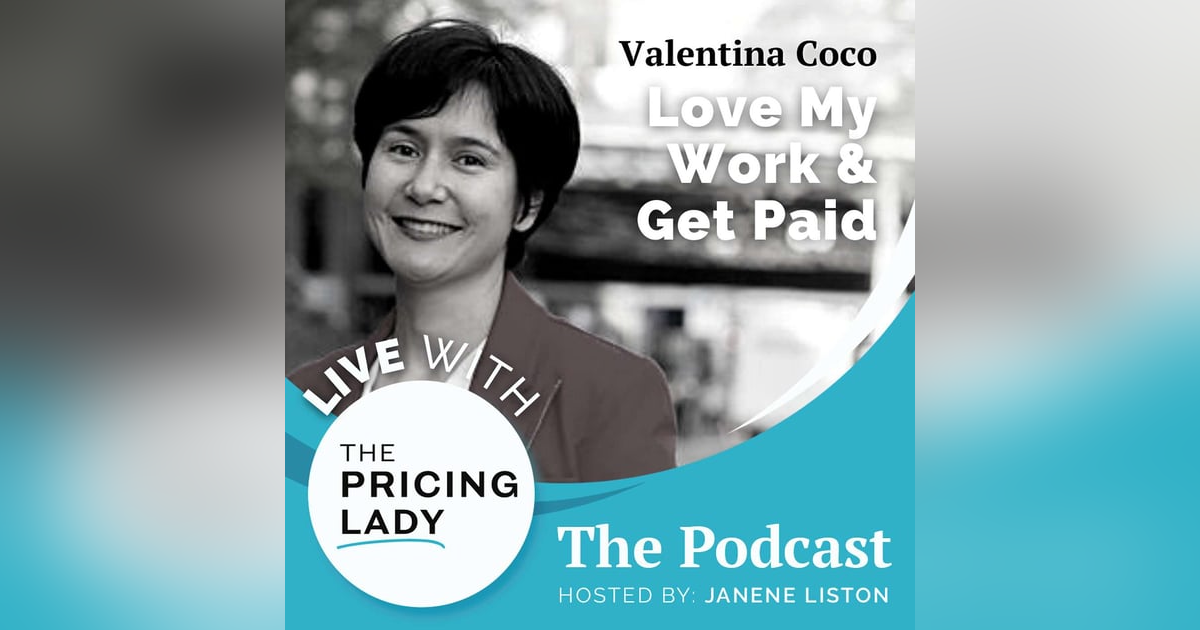
Valentina Coco, helps leaders and managers create support systems for people to perform at their best. Helping them to create strong, inclusive teams, that function - driving results and innovation. Growing up in a small town in Sicily, she dealt with bullies and marginalization as a half-Chinese “goody toe-shoes.” Which is in part why now she's dedicated to diversity and inclusion in the corporate world.
Episode Highlights:
- 1:52 Introducing Valentina
- 3:08 How she got started
- 8:21 Transitioning from the corporate world
- 10:56 Corporate clients versus individuals
- 14:47 Do you take yourself seriously?
- 18:12 Is it a business or a hobby
- 23:44 Biggest takeaway
- 25:24 The value her clients get from working with her
Connect with Valentina:
- Twitter : https://twitter.com/valejustcoco/
- Inst: https://www.instagram.com/coco_consulting/
- Linkedin: http://linkedin.com/in/cocovalentina
- Facebook: https://www.facebook.com/artofinclusiveleadership/
*****
Reach Out, Connect, or Book a Call with Janene
Get started improving your business. Sometimes it’s difficult to know where to begin. I suggest you Download the self-assessment Pricing Scorecard (https://thepricinglady.com/pricing-self-assessment-scorecard/). Get a view of what’s working and what’s not working when it comes to pricing in your business. Figure out where to start making improvements.
Get in touch with Janene. If you’ve got a question that needs answering, a challenge you’re facing or you have suggestions for future topics or guests, let me know. Contact Janene (https://thepricinglady.com/book-a-call/)
Mentioned in this episode:
The Pricing Lady is a proud member of the SwissCast Network
Discover more great podcasts for English-speaking Switzerland
00:00 - Untitled
00:01 - Untitled
01:53 - Introducing Valentina
03:09 - How she got started
08:22 - Transitioning from the corporate world
10:57 - Corporate clients versus individuals
14:48 - Do you take yourself seriously?
18:13 - Is it a business or a hobby
23:45 - Biggest takeaway
25:25 - The value her clients get from working with her
Foreign welcome to Live with the Pricing Lady.
Speaker AI'm Janine, your hostess.
Speaker AThis show is all about helping you build a sustainably profitable business while making an unbelievable impact on your world.
Speaker ALearn from my 20 plus years of experience and from my guests as we discuss their pricing challenges and failures and successes.
Speaker APricing is a way of being or behaving in your business and my mission is to help you confidently charge for the value you deliver.
Speaker APricing either hurts or helps your business.
Speaker ALet's make sure it's helping you reach your dreams.
Speaker AIf you're loving this show, be sure to rate, review and subscribe to it.
Speaker AShare it with your friends and colleagues.
Speaker AAnd of course, if you'd like to find out more about how to work with me, head on over to thepricinglady.com and book a discovery call.
Speaker AIn this episode of Live with the Pricing Lady, I sit down with Valentyna Coco.
Speaker AEquity, diversity and inclusion are more than just buzzwords to me, she says, and when it comes to pricing, she struggled.
Speaker AAt first.
Speaker AShe thought to herself, how dare I charge for something I love to do?
Speaker AI know many of you have felt this way in your businesses, so let's take a look at what she had to say and Valent Valentina's pricing journey.
Speaker ASit back, relax and enjoy the episode.
Speaker ASo hello everyone and welcome to Live with the Pricing Lady.
Speaker AI am Janine Liston, your hostess and I'd like to welcome my guest today, Valentina Coco.
Speaker AHello, Valentina.
Speaker BHello, Janine.
Speaker BNice to be here with you.
Speaker AI'm so excited to have you here.
Speaker AWe had such a great conversation on the phone previously.
Speaker AI'm quite excited about today.
Speaker BYeah, same here.
Speaker ASo, Valentina, why don't you start by telling people a little bit about yourself?
Speaker AYes.
Speaker BSo I'm Valentina.
Speaker BAs you already said, I'm originally Italian and also Chinese.
Speaker BHong Kong Chinese.
Speaker BI grew up in Italy though, and I've been in Switzerland for over 17 years.
Speaker BI left my corporate career about end of last year to now focus on coaching leaders and into diversity, inclusion and just to create more engaged, better cultures.
Speaker BIt's something that being of a mixed heritage and a woman has impacted me a lot during my corporate career and somehow I just decided to step out and try to do something about it.
Speaker BAnd again, setting up my own business with all the challenges.
Speaker BAnd that's actually how I found you, the pricing lady to help me solve quite some of them, actually.
Speaker AExcellent.
Speaker AYes.
Speaker ACertainly diversity is a hot topic in the world these days or today and I think it's wonderful that you're bringing this to businesses around the globe.
Speaker ASo fantastic.
Speaker AExcellent.
Speaker ASo of course we're here in part to also talk about pricing.
Speaker ASo I'm curious about first of all, how you started your business.
Speaker BSo I started my business as a side business, you could say side hustle, side engagement.
Speaker BAnd it was for free.
Speaker BI mean, I was working in corporate and this goes back to more than three, four, sometimes even five years ago.
Speaker BI started working on as part of employee resource group and then outside of companies, you know, mentoring people, coaching people, helping with advocacy platforms, helping with students, everything around this topic and just in general, better leadership, understanding and communication.
Speaker BAnd I was doing it for free, to help association, to help people, to support friends that had startups and, you know, social programs.
Speaker BAnd for a long time I did it for free because it felt foreign to me to start charging for something while I had a corporate job.
Speaker BIt was a big leap.
Speaker BI didn't see myself as an entrepreneur or something to this was like a service, a hobby that I had.
Speaker BAnd then I really had to shift a lot the mindset and that was really hard when I decided to go all in and stop working in corporate, to have it and actually run it as a business.
Speaker BSo, I mean, as many things that come from passion, I started for free, right?
Speaker AWhich is, I think, a path that a lot of people start on.
Speaker ANow, was it free just during sort of your training period or did you continue doing it for free even after you had your certificates and hours and.
Speaker BWhatever I done for free for a long time, even after I've done it for free, basically until I stopped having a corporate job because again, it felt so strange to say I'm charging for something while I'm getting a salary.
Speaker BAnd in a way it was like, I provide value, but I don't really need the money.
Speaker BI don't do this professionally or, you know, the startups I was helping.
Speaker BSocial program impacts don't have a budget.
Speaker BI do it for free.
Speaker BAnd in some cases I still do some of this engagement for free because I believe in the cause.
Speaker BBut for me that was just like a default, like I couldn't switch off it.
Speaker BIt was like my salary comes from the job.
Speaker BThis is passion.
Speaker ARight?
Speaker AAnd so how dare you charge for what you love to do?
Speaker BExactly.
Speaker BIt was like, you're getting paid already, why are you charging?
Speaker BAnd you love doing it and it's fun and all those things.
Speaker AIn my head, I think it's very interesting because of course a lot of people come to starting their own business from after being in the Corporate world or even while being in the corporate world, as was your case.
Speaker AAnd so I think it's not an uncommon feeling for people to have.
Speaker BYeah, I think it's quite common.
Speaker BAnd again, I am not sure if it's more women than men.
Speaker BI certainly heard this more from women than men, so I wouldn't want to generalize, but I heard it more from women than men.
Speaker BThat this view of starting to charge and seeing as a value and as a. I mean, we know it helps, but seeing it as a business and something worth being compensated, it's a hard switch to do.
Speaker BAnd then it's always the struggle of how much and what for and is it too much, too little, what's going to happen, all of that?
Speaker AYeah.
Speaker ADo you think that in part it was like, well, I don't actually have to deal with this until it becomes a necessity.
Speaker AThat is not in the corporate job anymore.
Speaker BTotally.
Speaker AI was totally.
Speaker BI was like, you know, as long as it's free, as long as it's free, I know I'm providing value and I don't need to be afraid of rejection.
Speaker BLet's be honest, that was also a big part of it.
Speaker BI don't have to deal with the how much, what is it?
Speaker BNegotiating it in a way which I learned the hard way after because again, for me, negotiating my salary with a corporate felt very different than negotiating my price with a no profit and association or even a person that was wanting to be coached.
Speaker BSo that was completely different mindset.
Speaker BBut also, yeah, there was this whole thing of I don't have to deal with it.
Speaker BAnd also there was this whole utter relief of if I don't ask for a price, they're not going to say no because it's expensive.
Speaker BSo I completely avoided that fear of rejection possibility even by not naming a price for so many years.
Speaker AYeah, I think that's really.
Speaker AThank you for being so honest because I believe that this is one reason why a lot of people offer their goods and services for free, because they don't have to face the possibility of rejection if they don't start putting a price tag on it.
Speaker ASo that's.
Speaker AThat's a very important insight.
Speaker AThank you for sharing that.
Speaker BThank you for giving me.
Speaker AI'll learn from it.
Speaker AI'm sure that I've faced and done the same thing myself over the years.
Speaker ASo that's really important.
Speaker ASo one of the things that you spoke about when we talked was that as you were transitioning out of this phase, you know, from the corporate world, and then really Stepping out of that into your business, you had some realizations around what was going on with your pricing and what you needed to change.
Speaker AI'm curious if you can share some of the, you know, that learning or that experience that you had with us.
Speaker BYeah, so initially I realized that I.
Speaker BWell, first of all I realized I had to start charging.
Speaker BYou know, this was a job now and I couldn't do it for free.
Speaker BAnd so at the beginning it was connections that were reaching out to me to put together some programs, some training, some coaching and they offer a certain rate.
Speaker BAnd I didn't negotiate it, I just took it.
Speaker ARight.
Speaker BI didn't want to negotiate it.
Speaker BI didn't feel like I could.
Speaker BIt was my first paid job.
Speaker BForgetting about the fact that I had done this for many years and whatever I was teaching was based on a 17 year corporate career accumulation.
Speaker BSo it's not like something that is just coming from yesterday, but somehow my mindset was like, that's my first paid job.
Speaker BI don't know how the mindset works sometimes it's funny that way.
Speaker BAnd I didn't negotiate it.
Speaker BSo then I went to the second client and my reference point was that first price that I was given and then I realized it was fairly low.
Speaker BSo I actually went to a client with such a low price and I was told that can't be serious.
Speaker BI mean, you can't be good, right?
Speaker BIf you charge this little, like, what is it?
Speaker BYou're not prepared?
Speaker BYou're not going to give us the follow up?
Speaker BYou are just starting now?
Speaker BAnd I'm like, no, I have experience.
Speaker BSo after that I went back out there and I started again pitching myself and discussing and talking and then the big learning again.
Speaker BThe other realization for me was that as I was pitching, I was talking to startups and people that needed coaching and bigger cooperation and my mindset somehow switched and I was able to, okay, realize that if I underprice myself as I did, I would be seen as not competent.
Speaker BSo I was able to raise it to a decent level still.
Speaker BI knew that for a corporate contract, let's say I had to raise it, let's say 200% compared to what I was charging.
Speaker BI didn't get there, I still am not there.
Speaker BIt felt just too much of a jump in my mind.
Speaker BBut I was able to increase it to a reasonable level.
Speaker BThinking it's a corporation, they have budget or they don't and they will tell me and we'll negotiate.
Speaker BWhen it comes to small business, startup or individual people, it was the hardest thing I had to do and I'm still working on tiny increment at the time because I have this feeling of, I don't know, I'm taking the money of another person or a startup which doesn't have a lot of funds and can they really pay whatever the final price that I'm gonna be charging eventually is, should I just adapt it slowly because I already done a couple of coaching programs and workshops at a low price.
Speaker BWhat if they find out that other people are paying more?
Speaker BAnd all of this chatter and it's like, can they really pay for it?
Speaker BAnd what if the other person tells them so?
Speaker BIt's been a lot of a different learning curve in dealing with different type of clients.
Speaker ASo if I understand correctly, it felt easier for the corporate clients because your assumption is they have money to spend and that if I take some of that from them, it's not such a bad thing.
Speaker AI'm paraphrasing here, right.
Speaker BI mean, you know, I've been in corporate finance, I know how it works.
Speaker BWe have a budget, it's either there or it's not right.
Speaker BIf they have it, they'll pay.
Speaker BIf they don't, they'll tell you no and you come back six months later.
Speaker BIt's a different feeling.
Speaker BIs not a personal money, it's everybody gets some budget allocated.
Speaker BSo.
Speaker ARight.
Speaker AAnd then when it came to smaller business or solo entrepreneurs, startups, it felt different because it felt more personal, is what I'm hearing on the one side.
Speaker ABut also I'd like to point out, I hear that you're making the assumption that they probably can't afford it.
Speaker ASo you're making that decision for them upfront, in a sense.
Speaker BI know, and it's the biggest thing.
Speaker BHonestly, it shocked me because I'm all about being unbiased and inclusive and diverse and I shouldn't make any assumption on my client and I should then let them decide what it's worth to them and potentially negotiate down if that's a problem.
Speaker AYes.
Speaker BStill, my mindset was so much into is it.
Speaker BCan they.
Speaker BIt's hard.
Speaker BI don't know.
Speaker BMaybe because I'm in that situation though.
Speaker BI pay for coaching and I never even question it if it's valuable, I pay for coaching.
Speaker ARight.
Speaker BSo I don't know what is it in that mindset, even when I know that I shouldn't be biased, that it makes it so.
Speaker BMaybe again, the fear of hearing the no if the price is too high, I can't tell you.
Speaker BBut I just discovered as I'm going through in this last year, adjusting the price, that there is this lot of mental chatter around it.
Speaker ARight.
Speaker AWell, I think that's really interesting.
Speaker AAnd I also believe that, you know, many people struggle with this as well, because, yeah, it sometimes it does feel different.
Speaker AAnd that's oftentimes why businesses have different prices for different types of companies as well.
Speaker ANot just because of ability to pay, but also because the value that they can get from that service or that product is often quite different as well.
Speaker ASo, you know, these are all really good points.
Speaker AI'd say that certainly we should try to let other people decide that for themselves.
Speaker AAnd it's also why it's good to have different offers at different value and price points.
Speaker ARight.
Speaker ASo.
Speaker ASo that we can navigate that with them, not for them in that context.
Speaker ASuper.
Speaker AThese are great, great questions.
Speaker AOne of the things that you spoke about that I thought was really interesting, you were talking about the offer that you made, and the company said it was too low.
Speaker AI'd like to go back to that for a minute because I think one of the things there is that when we underprice our goods or our services, we're not taking ourselves seriously.
Speaker AAnd then the question is, how can we possibly expect our clients and customers to take us seriously?
Speaker ASo maybe you have a few words to say about that.
Speaker BAgain, I didn't get to that price with that not taking myself seriously.
Speaker BIt was really more like I had an initial offer and I did not think, somehow I did not think I could increase it all of a sudden.
Speaker BBut it's different when somebody that, you know, makes you an initial offer and you might not want to negotiate it, by the way you should, but you might not want to.
Speaker BIn my case, first offer, first paid gig, whatever, it just felt a big of a leap.
Speaker BRight.
Speaker BI don't know.
Speaker BIf it had been maybe 20% below the market rate, I would have maybe adjusted and say, yes, worth this.
Speaker BBut it was a good 70% below the going market rate.
Speaker BAnd I felt, okay, I've earned this much.
Speaker BNow going 70% up, it was a mix of, again, is it too much?
Speaker BCan I do this leap?
Speaker BAll of a sudden I knew the value that I was bringing, but I felt the gap is too big to bridge in one go.
Speaker BI have to go step by step.
Speaker BI have to do this.
Speaker BAnd again, I don't know this.
Speaker BWhere does this belief come from?
Speaker BBecause when you go to the shop, they never increase peace.
Speaker BIt never increases.
Speaker BTwo euro every time.
Speaker BRight.
Speaker BOr two Swiss francs every time.
Speaker BIt's just Suddenly, another price.
Speaker BBut I had this thing in my head and then I realized actually as a pretty that wake up call, that no, it wasn't being taken seriously.
Speaker ARight.
Speaker BAnd then I had to face it and I'm like, okay, what am I doing here?
Speaker BBecause I'm afraid to ask the market price that everybody else ask.
Speaker BAnd I'm not even saying premium the market price, that it's that he's here in Switzerland.
Speaker BWell, I'm devaluing myself.
Speaker BAnd that was a big wake up call because it was like, okay, get over your fear.
Speaker BYes, it's a big number.
Speaker BYes, you're worth it.
Speaker BThat's what everybody else charges, so go with it.
Speaker AYeah.
Speaker AWow, sounds like a great transformation.
Speaker AYou're still in the journey in some areas, but you've taken that first step and once you've done it once or twice and you see that there are customers who will accept that, then it doesn't feel so difficult if you end up needing to do it again as well.
Speaker AYeah, exactly.
Speaker BTo be fair, having the first customer actually saying yes to that was the relief point where I'm like, this is working.
Speaker BI am not.
Speaker BIt's not completely out there until then.
Speaker BI knew it in my head.
Speaker BBut there was that tension behind is it really going to work?
Speaker BSo when the first customer accepted it, it was this giant, the theory is.
Speaker ARight, the yoga breath of pricing.
Speaker BI like that word saying, I'll write it down.
Speaker AAnother thing that I thought was really interesting you spoke about was that at the very beginning you kind of told yourself, well, first I have to get testimonials, so I'm going to do it in exchange and I'm going to do this.
Speaker AAnd then you got the testimonials, but you still didn't give yourself permission to char or charge properly.
Speaker ACould you share a little bit about that experience as well?
Speaker BIt was a strange situation because at the beginning it was like, okay, I've got testimonials, I need to get them, I'll exchange.
Speaker BFine, I had them.
Speaker BAnd then I was going, okay, I need to charge because I'm doing this right?
Speaker BEverybody else charges.
Speaker BWhy am I not?
Speaker BI mean, I'm using time after a corporate job, which is never 40 hours, as you know.
Speaker BSo, you know, I'm using a lot of my weekends and evening times and stuff to do this.
Speaker BAnd people get benefits, so I should ask for money.
Speaker BAnd then the whole mindset came in, which is, you have a pretty big corporate salary.
Speaker BDon't be greedy.
Speaker BYou know, do it as a karma points or you know, do it again for testimonials.
Speaker BAt some point, you're going to need them.
Speaker BWhy are you going to ask for money?
Speaker BPotentially, people are going to say no, right?
Speaker BThat whole rejection.
Speaker BDo you really need the cash?
Speaker BAnd is it a business or is it just a hobby that you do, like your passion, you know, like being paid for something you like?
Speaker BIt was like this concept of, if this is not my job, can I authorize myself in my mind to ask for money to do something I actually enjoy doing?
Speaker BBecause it was not my main job and I didn't have to make money out of it.
Speaker BIt was really a big blocker of going, but it's worth money, and then going like, yeah, but don't be greedy.
Speaker AThat.
Speaker BThat whole mindset kept going in my mind for a long time, so basically for another year.
Speaker BAnd plus, I didn't charge anything ever.
Speaker BSo I just kept.
Speaker BAnd after a while, I even.
Speaker BI mean, you won't believe it, but after a while, I even stopped.
Speaker BStop asking for testimonials because it was like, okay, I've got 10 to 15 and what for, right?
Speaker BI mean, am I ever going to charge and it's enough.
Speaker BAnd so I missed a whole good half a year of testimonials there because I just didn't bring myself to say no.
Speaker AAsk.
Speaker AJust ask.
Speaker BAt the beginning, I needed them and, you know, I was asking, and then after a while, I had a bit and I stopped asking because again, this whole thing about, is it really a business, it's a passion.
Speaker BWhat if the testimonial isn't that great?
Speaker BThat whole thing in the.
Speaker BIn my mind was excellent.
Speaker AI find it really interesting, this conflict or belief conflict that a lot of people have that we tell ourselves, if I'm passionate about it, I can't earn money from it.
Speaker ASomehow if you earn money from your passion, it kind of negates that it's really your true passion.
Speaker AAnd yet, on the other hand, you know, all the coaches and all the experts are out there are saying, find what you love and do that as your business.
Speaker ASo there's this huge divide between the way that we think about things or perceive things or a mindset towards things and what people are actually advising and telling you is the best way forward.
Speaker AI find that really fascinating.
Speaker BYeah, indeed.
Speaker BAnd it's like, I don't know, just maybe coming from the old days of work, being in a factory, and it's like, okay, if it's not painful, it's not work.
Speaker BI don't know.
Speaker BI mean, I'm working really hard to get out of that mindset.
Speaker BReally hard.
Speaker AWell, I think, you know, you're not the only one.
Speaker AI've seen this before many times.
Speaker AAnd a lot of the people that I work with, I work with a lot of sustainability startups and, you know, people in that area and I find it incredible that, you know, they say I need your help, but I don't care about the money.
Speaker AAnd you're like, wait a minute.
Speaker BYeah.
Speaker AI mean, because the reality is a lot of what I do is helping people with the money.
Speaker ASo if you don't really care about it, then why are you coming to me?
Speaker AOf course the money is important and they know that on some level, but they don't want to be perceived as being greedy or profit driven or, you know, all of these horrible associations that we have with money.
Speaker AThe reality is that just because I charge you something to work with me or you charge me something to work with you, it doesn't mean that you're taking money from people.
Speaker AIt's just energy moving around and shifting.
Speaker ARight.
Speaker BYou're 100% right.
Speaker BAnd we need to get out of that mindset.
Speaker BIt's just really hard.
Speaker BEspecially as a, as you say, when you are in a field which is openly about helping whatever it is, people, the environment, others, it's hard to say I'm here to help and to make money.
Speaker BI just make a living like there's nothing wrong to say and I want to make good money.
Speaker AActually, I think we should be saying that in a stronger way a lot of the times.
Speaker AYeah, yeah.
Speaker AAnd be and accept that.
Speaker AI have had some clients who've been told by their prospect clients that they shouldn't be charging for what they're doing.
Speaker AI always tell them, no, that's not correct.
Speaker AI understand that these people need help and want help, but that doesn't mean that you're, you know, that all of us are there and available to give that help and support for free.
Speaker AWe pick and choose when we want to do it, but we can't be there to do it if we don't have some way of living on the other side of it.
Speaker AExcellent.
Speaker ASo we're going to start wrapping this up and I'd like to ask you if there's one thing that people can take away from our conversation today.
Speaker AWhat do you think is most important?
Speaker BTake yourself and your services seriously and price.
Speaker BIt doesn't matter if you do it on the side of your job, as your job on Sunday, for fun, whatever it is, if they have value and I am sure they have value because everything we do has value for some customers.
Speaker BRight.
Speaker BSo the if it's very rhetorical.
Speaker BIf, let's say then price.
Speaker BBecause again it doesn't have anything to do with is it your main job or not.
Speaker BLike don't make my mistake of doing it for three years for free and then get in there.
Speaker BOkay.
Speaker BNow I want to make a living and I have no clue on how to price it.
Speaker BThat could have been three years of trial and error of what works and what is too much of a price point.
Speaker BLike I've missed three years of consumer research basically.
Speaker AI mean it could have, you could have been farther along with your pricing as well if you had taken that opportunity sooner.
Speaker AYeah, very true.
Speaker ANow that's a great point.
Speaker AIf I summarize it, it's take yourself seriously and the rest the of of the world will as well kind of kind of thing.
Speaker AAnd also I get questions all the time from people.
Speaker AHow can so and so charge so little?
Speaker AAnd I always tell them, well they're probably looking at it in a different context, from a different space.
Speaker AMaybe they're targeting different people, maybe this is not their primary source of income.
Speaker ABut it doesn't matter that that's what's charging.
Speaker AWhat really matters is what you are charging in the end.
Speaker AAnd so that's very important to keep in mind.
Speaker ASo Valentyna, I have two more questions for you.
Speaker AThe next one is tell us a little bit about the value that you bring your clients.
Speaker BSo I help small business owners, startup founder or new managers really to find a better way to engage and lead their team.
Speaker BYou know when you start and you don't have a team or you haven't had a team before, you go through that whole learning curve where the team gets disengaged, you don't know how to have difficult conversation.
Speaker BCan you get everybody on the same page?
Speaker BEspecially if you have a diverse team and if you don't have it, I can help you with that because you really should have it.
Speaker BIt's great for the business and there is no denying it makes things a bit trickier in terms of finding the right way of cross cultural communication and engagement.
Speaker BAnd that's basically what I do.
Speaker BI help them, I coach them through one to one group programs, workshops.
Speaker BI basically help them skip two years of painful learning curve with like two to three months of intense coaching on this because I've been to the learning curve myself over 17 years.
Speaker BSo you've got enough history of my trial and error plus the theory and everything else to help them unlock the power of their team and, you know, avoid all those bumps.
Speaker AExcellent.
Speaker ASo if someone was interested in finding out about how to speed up the curve in their business, where should they reach out to you?
Speaker BThey can reach out to me on the website.
Speaker BSo it's a usual www.
Speaker BI don't think anybody says it anymore.
Speaker BSo here I'm revealing my age.
Speaker BCoco Consulting Ch.
Speaker BOkay, or you can find me on LinkedIn Valentina Coco and you can sent me a message request and ask me.
Speaker BThere is a contact me form on the website.
Speaker BI'm there.
Speaker BI can hop on a call and see how I can help anyone.
Speaker AExcellent.
Speaker ASo I'll put those links in the show notes and in the comments below.
Speaker AThat's where you can reach Valentina Valentina Consulting Ch.
Speaker AThank you so much for joining me today, Valentyna.
Speaker AIt's been a real pleasure having you on the show.
Speaker BThank you Janine for having me.
Speaker BIt's been an enlightenment.
Speaker BAs always listening to your webinars and talking to you.
Speaker BI've learned a ton so I'm happy to share.
Speaker AExcellent.
Speaker AThank you for listening to this episode of Live with the Pricing lady, the podcast.
Speaker AIf you enjoyed the episode, rate, review and subscribe to it, then share it with your friends and colleagues.
Speaker AI love hearing back from you listeners.
Speaker AIf you've got comments, questions or topic ideas, go on over to thepricinglady.com and contact me there.
Speaker ANot sure where to start when it comes to improving pricing and profit?
Speaker AAt thepricinglady.com you can download a copy of my Self Assessment Pricing Scorecard.
Speaker AFind out where it's going well and where you can begin improving.
Speaker AOr just simply book a discovery call with me.
Speaker AThere we can discuss what's up with pricing in your business and how I might be able to help you.
Speaker AThanks once again for joining.
Speaker ARemember, pricing can hurt or help your business.
Speaker ALet's make sure it's helping you reach your dreams.
Speaker ASee you next time.
Speaker AAnd as always, enjoy pricing.

