Will Bailey: using AI in data & information businesses
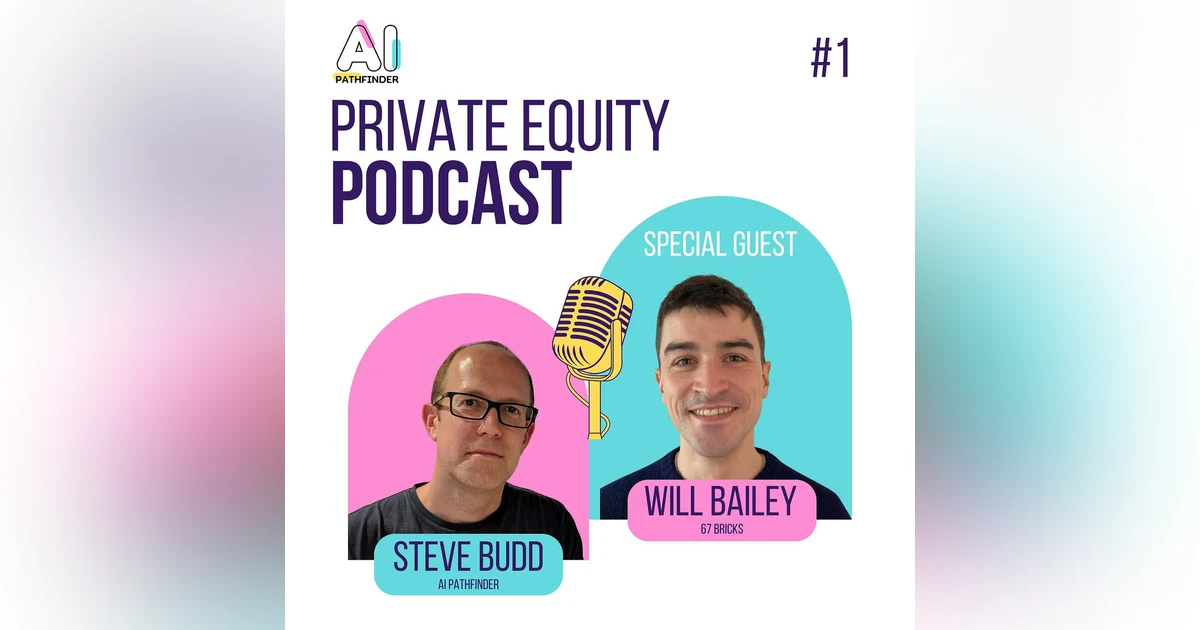


In this podcast episode, Steve Budd interviews Will Bailey from 67 Bricks about the application of AI in data & information businesses. They discuss the benefits such as improving user experiences, extracting key concepts, and expanding coverage. Will shares examples of successful AI implementations, including semantic fingerprinting. They also address the challenges of cultural adoption and the fear of obsolescence. The conversation emphasises the importance of thinking big, starting small, and continuously learning and iterating with AI.
Keywords: AI, private equity, content management, data management, user experiences, semantic fingerprinting, automated content checking, cultural adoption, fear of obsolescence
AI Pathfinder Private Equity AI Strategy Meet-ups:
https://www.aipathfinder.co/private-equity-ai-events
Have a question or would like to suggest improvements, please contact steve@aipathfinder.co
Well, hello everyone. Uh exciting day for me as I'm recording my first ever podcast. Um I'm in a process of launching a new expert network focused on AI in private equity. And with any new idea or business, one of the most important and interesting things I do is speak to um people um within the uh the the target market and poke people servicing that that market. And I've been doing a lot of that lately, and every conversation I'm I'm learning a lot. And it just dawned on me really that there's a lot of great uh nuggets of information within those that would be worth sharing. And so I had this idea of creating uh a podcast. So uh you know very excited to get moving with this today. And pleased to say that I have a friendly face here um for my first podcast, Will Bailey from uh 67 Bricks. Hi Will.
SPEAKER_00Hi Steve, nice to see you.
SPEAKER_01Yes, thank you for joining me. And um well look I know Will, I know 67 Bricks, they're not new to AI and have been working with uh PBAP businesses for for some time. They're the top of my list of people to speak with. Um but rather than me doing an introduction and probably not doing a great job of it, perhaps you could just give us a brief bit about 67 Bricks in the context of of AI and and obviously the community that that I'm uh speaking with, so investors and portfolio companies. Just a brief outline and obviously a little bit about yourself as well, Will.
SPEAKER_00Absolutely, delighted to. Um so 67 Bricks is a technology consultancy uh that works with content, data, and media businesses to enhance their value. We do that through a spectrum of consultancy services uh that range from senior technology advisory through product discovery, implementation and management, all with the broad goal of getting more value from content and data. So enabling outcomes like monetizing data, getting better attention from your data products, increasing repeat revenues through subscriptions, uh enabling new business models like licensing content, um, so building the technology and um products to enable that. Um and over the as you said, over the years, now more than ever, AI has been a critical to critical tool in doing that. I'm personally head of partnerships at Six Cembricks. I've been with the firm for approaching five years and have led client engagements designing and implementing AI-driven products in the past, mainly now though, in that role I spend my time leading our engagement with industry, which includes private equity and the investment space, um, to ensure that we're maximising our value to portfolio companies and investors and leveraging this technology in a way that really grows business value.
SPEAKER_01Great, thank you. Uh just giving us a bit of context there. Um look, uh you've mentioned it as well, uh, and I know from from experience of um of the relationships in the field of of information, data, and information businesses that you've been applying AI. You know, why why did you see this earlier than the many other um companies that there was an opportunity here? And and perhaps what what's what's changed for you and the opportunity now with we've had the advancement of general seed of AI and large language models like ChatGPT?
SPEAKER_00Yeah, um well these technologies are trained on and originally designed for written content. That's changing now with multimodal models. The textual content is the kind of the oil behind all of this, and the businesses that we work with have loads of that. That's that's what they trade in, it's what they create. But invariably it's not doing as much as it could be to provide value to the customers of those organizations. User experiences are poor, insights are locked away in long-form reports and documents, bad data about the content means that you can't find the content that you need to answer the questions that you want to answer. So AI over the years has been a great tool to get the content to work a bit harder. Um so it's really been our bread and butter at 67 Bricks for 15 years. Um, and sort of as the technologies have evolved, uh, we've evolved with them, and and generative AI is very much the cutting edge of what we're doing here. So the main things that have changed with generative AI and large language models, I think primarily it's the the time and cost and effort to getting to a point where you can make a call on whether an idea is worth pursuing or not. Um in the past, we'd spent a lot of time uh and it would require a lot of expertise and experience to have an idea, get it up and running, test it out, get things trained. Um, but that's kind of fading away now. And if you've got the kernel of an idea and some technical capability internally, not even that much. You can have something up and running and and sort of feel out the space and see if it's something worth pursuing. So lots of our clients now are coming to us with not just some nascent idea, but actually something working in a lightweight fashion, um, and where we're really adding value, maybe more than we would have been five years ago, is scaling that idea and testing it in the market and turning it into a market ready proposition. Um, so I think that's that's one of the really big changes. I think the other is just the consumer awareness of technology and how that affects expectations internally within businesses about what they should be doing and what they can be doing with their products, but externally as well about what products should be doing. Um and I think that kind of that has a really profound impact on on how product teams and technology teams are thinking about what they do.
SPEAKER_01Yeah, I'm I'm certainly finding that there's uh a bit of top-down pressure happening um that may not have been there a few years ago. There's a sense at at board level that there's an opportunity or concern about disruption, um, that the CEO's been to an event and come back and go, Oh my god, we need to do something here. So there's this sort of top-down, but that's not yeah, what you're saying is that there's a little bit more, I don't know, pragmatism around um people coming to you with it's not just oh my god, we need to do something, Will. There's a bit more better understanding, I suppose, of what's possible. Uh it's a little bit more grounded.
SPEAKER_00I think so. I mean there's plenty of oh my god, we need to do something as well. But I think because the technology is so accessible, people at any level of an organization can have some sense of what it what it can do. Um, and I think that's really quite powerful. Um, and I think actually one of the challenges for for organisations is sort of democratising the innovation process so that people who are just experimenting in the way that they do their work day to day can bring ideas to the table and um and see if those those have legs. It doesn't need to be a top-down kind of decision so much. There needs to be some sort of strategy to harness all of that.
SPEAKER_01Yeah, I think that's um that's the interesting piece of this, and and my background being sort of product development as well, is that ideas can come from anywhere. Um and I think that's really important, is that there is a way that you know innovation can come from all parts of the business and are heard. And I think that there's still um the jury's out in terms of how to do that in the best way. Um, like you talked about democratising that, but then there's others that have got a very clear centralized structure around this where they have a team thinking about AI. Um so yeah, it's it's still very much um well, a new area, but innovation and bringing a new technology isn't. Um but I suppose other companies I suppose were more um used to that environment than than others.
SPEAKER_00Yeah, I think that's right, and it still needs the kind of the guardrails and the governance, um particularly this technology does, to make sure that it's being used in the right way. But um but yeah, trying to land on the answer, how is this going to solve our a business problem and we need it all kind of firmly worked out, uh that kind of top-down approach I don't think is necessarily the right way to go about it.
SPEAKER_01Yeah, yeah. Well, let's get into, if possible, uh a specific example and and and when I'm talking to people um on the private equity side is that they want more examples of deploying and adopting AI, um, where it's not just uh an idea, it's actually delivered something, and it would be great to just get uh a view from your side, you know, an example of of something that has delivered uh ROI. Um now our audience isn't planning to be super technical, so do keep it fairly uh 54s if possible. Um but yeah, just uh if you could give us an example and just describe how you know success was measured measured and and also what comes next as well.
SPEAKER_00Can I start with a pre-generative AI example? Still AI. So business chemical watch, um, who I think you and I both know. Um so this is kind of uh seven or eight years ago when AI was natural language processing and machine learning. We built a so chemical watch is a business in the chemical regulations product safety space, and each audience really vital information that they need to do their jobs. We built a uh semantic fingerprinting system, which was effectively a series of natural language processing and uh machine learning processes that ran over all of their content and some third-party content as well, with the goal that it would uh create a consistent set of metadata for absolutely everything that they do and um and produce, but also pull in to make it much easier for their customers to find the insights that they needed, um, slice and dice, combine insights, um, and uh and yeah, actually find content based on what's in the content rather than some manual tagging process about broadly what the content's about. Um it sounds like a very foundational internal step, but actually the product improvements that something like that enables are enormous, and getting getting your customers to value more quickly is is hugely valuable to them and to the business. So rolling that out alongside the new front end that made the most of it uh led to a 40% increase in repeat revenues for that for Gemplatch as a business. Um, and ultimately the business was sold to an easer, much larger environment, health and safety uh international company uh in 2020. And that piece of technology was a key kind of strategic lever in that in that process. Um, so I think there's a lesson to pull out there, this pre-generative AI. It's something that generative AI would be great at doing now, and we're doing it more quickly and more cheaply. But this sort of foundational technology step that looks like it's an internal thing but has external benefit, I think, is something that we can all learn from as we go into the sort of large language model feature, because it because we think about summarization and conversational search and those kinds of product bolt-ons as where the product value is, but actually it's the steps I think around the content and the data behind the scenes that then enable the really impactful stuff down the line. So there's a bit of pre-genai.
SPEAKER_01Steve? Yeah, you know, I'm just focusing there as well on on the um sort of domain specific area there of a company like Chemical Watch and and how how important it is that well as ever more important that in a world that's becoming noisier with with information is that uh and trust I suppose as well, is that you've got a single source of truth that you spend a lot of time building out, and it's how you then leverage that and how you make that e uh uh accessible in a way that um somebody can can use quickly within their workflow. I think that's the aim, isn't that speed to value? Um I think that that obviously Chemical Watch knew that, you knew that. Um but just in that that particular case, and I know this is pre-sort of uh the real advancement with Gen AI, what ultimately was that user benefit? What what was the way that their experience changed?
SPEAKER_00Yeah, so so a couple of things. One is that kind of focus on extracting the key concepts from a piece of content and then treating that as a data point. So th those processes that I talked about were things like identifying chemical compounds in a in an article. Um the article might be tagged at an editorial level as being about manufacturing or about some broad kind of chemical uh family. I don't know how chemicals are managed in a taxonomy. But actually diving into it and pulling out things that look like chemical compounds to say this piece of content is about this chemical compound specifically makes it much easier for somebody who only cares about that chemical compound to find exactly what they need through a search or facets or um a scan of the latest kind of news that's being published. The front end kind of had features like uh personalised lenses that were driven by this very granular metadata that's been pulled out to the content itself, geography being another example, not just kind of high-level taxonomic regions and countries, but right down to the city or the state where some regulation takes effect. Um so it's kind of doing that hard work for the user of filtering through what might be relevant and actually just servicing the stuff that really is relevant straight away. And then the other real benefit, I think, is that because you're you're automating a process that would be really arduous for people to do manually, and you would never be able to scale it manually, it means that you can start pulling in third-party content that might be relevant, but you don't want to flood out all of your really high-quality content with stuff that's kind of neither here nor there with this process because it worked in the same way. You can make sense of that content as well and say, yes, this is going to be relevant to these users too. So it's kind of expanded coverage and also kind of dial it dialing into the specific needs of each user at scale. Okay, okay.
SPEAKER_01Uh well that's yeah, that's uh really good example. And and I think you were mentioning there that you were gonna give us something a little bit more not up to date, makes it sound like that wasn't uh last century.
SPEAKER_00The last decade. So the work that we've been doing on generated AI and large language models, I think this will probably come as no surprise that most ROI we've seen to date has been on more of the internal efficiency side. I think that's where most businesses feel comfortable kind of road testing this and where also the most kind of obvious gains are to be found. So a couple of examples of um on the kind of editorial and content management side of things, uh we built an editorial decision-making tool which effectively scans the uh external environment within a certain um within a certain domain to flag new stories, pull that in to an editorial decision-making tool, and then the the client could make decisions about what to publish on, how to talk about it, how to target it, whether it was the right thing for um for them to be publishing about. And not only that, but actually using the generative AI capability to start rewriting kind of publicly available stuff into the format that they publish in and into the structure that they publish in. So some great benefits there, kind of quicker to get content out, but also again that that idea of expanding your coverage because suddenly you could find stories that are in different languages or in markets that they're not currently operating in, it's pulling it back, it's translating it well enough to make a decision about whether or not it's the right thing, and then making that starting point on on turning it into something that they can go out and publish. So that was a nice one. Uh and I think that kind of horizon scanning piece is there's good um capability here for people to be thinking about.
SPEAKER_01That is that is really interesting, and it's obviously something that wasn't possible before unless you had a number of people properly well that could speak other languages as well. But um, it's just I can see how there's um an opportunity to um possible train of thought now. That's not good, is it? My first podcast. Um I suppose it's it's it's trying to to see where um they could they could uh write about stuff, but it was it also giving suggestions of what that stuff should be.
SPEAKER_00Yeah, well, uh based on what they'd written before, yes, but you that would be a clear kind of future improvement to say this is the stuff that you've been publishing that's been making a big impression, this is the stuff that's had impact. Depending on the data that you're collecting about your uh users and readers, you could kind of start to segment who's interacting with what and feed that back into the process. So we didn't it hasn't got to that stage yet, but that's a clear kind of next step to say this is a good or we think this is a good story, it's a good place to start, and this is a good way to um pitch it to your audience to achieve whatever the goal that you're looking to achieve is.
SPEAKER_01I think it's a really good example to allay fears that as soon as AI um starts to uh enter the world of content writing is that oh it it means that we're gonna trust it less. But actually just talking through that that use case there is that actually it's gonna make the content writing more effective um and increase the um the coverage. Um so it's telling this story and and probably being quite transparent with the audience about what AI can bring to the process rather than it being the immediately the alarm bell start ringing.
SPEAKER_00Yeah, absolutely, yeah. And I think as I think the coverage here is really interesting and just generally large language models as a tool to scale an operation, I think is really powerful because we're going to see in the content and data space as these big tech companies become players with really good user experiences, aggregation becomes more important, I think. And big tech companies that are training on really good high quality content, they become kind of 80% of what you need in lots of domains. But if you're operating in a niche, there's a real opportunity to absolute have absolute coverage within that niche and become the absolute go-to place, and that may not have been possible until some ability to scale up because you had to pull in content from another market or another language that you haven't been able to access, or um yeah, whatever it is. So I think that's that's a really interesting thing here.
SPEAKER_01Yeah, yeah. Um I've been interrupting you, but have you um have you got another example to share?
SPEAKER_00Yes, I've got one more for now.
SPEAKER_01Yes, go for it.
SPEAKER_00Yeah. So uh at the content management stage, content checking, um, an automated pipeline that uh identifies statements made in promotional content, uh, and then something that identifies that as a statement goes off to some source content to find the relevant um content to check it against, and then makes a judgment about whether that statement is validated by scientific research or guidelines, um, whatever in the context. So this is a process that this client had. Really highly qualified people running, spending lots of time and effort uh digging in, like reading through promotional content, finding these that look like statements that require validation, scouring through the corpus of scientific literature, and then marking it as yes, yeah, yes or no. But that's not an efficient use of their time by any stretch, and actually building a pipeline that automates that and then gives them a list of the statements, the content that's been checked against, and a recommendation to check through, uh not only big efficiency gains, but actually accuracy gains too, because humans fall into habits, they do things in the way that they've done it previously, they see something that looks a bit like something that they saw before, and they just they wave it through. But actually the system never gets tired, it's never gonna cut corners. If it sees something that looks like a statement that requires validation, it's gonna check it. So that was a kind of unexpected uh consequence. Um and uh there are fairly significant accuracy gains as well as efficiency gains in that process. And that sounds like a specific example within promotional material checking things to make sure that you're not saying anything you shouldn't, but it's something that could be leveraged quite widely, I think, across the content and data production, publishing um space. Regulations being used in the right way, the proceedings from case law being interpreted in the right way in in future cases. Uh obviously in scientific literature there's uh a big um convention of citation and period. Review and other ways that that could be leveraged there. So another another really interesting thing, I think.
SPEAKER_01The movement from certain activities that you're describing there is moving from human and a loop to AI and a loop, uh in the loop. Is the human completely removed from that process, or is it is it more of a copilot tool? Just describe how how that that dynamic works.
SPEAKER_00Yeah, more of a copilot. It's kind of it's giving you a start, isn't it? It's saying, here's here's my go at it, what do you think, and here's all my working as well. Um so the hum based on a kind of a a sample, I suppose the human can make a judgment call about how how deeply they then need to go in to interrogate how accurate it's been. Um so it's very much a kind of still a human-driven process, it's just tooling to do a first pass. And I think that's how people are using this in uh content generation and in all sorts of places. It's it's rare that we would say leave it, leave it to the AI and move on. Um, particularly kind of behind the scenes in places where accuracy really matters. Um but but an 80% kind of first pass is really very valuable in moving the process forward.
SPEAKER_01Yeah, I was listening to a podcast the other day that's saying that if you want to try and achieve 100% accuracy, that is gonna be super difficult. So don't choose a use case that requires that. Choose a use case where you know 80% or or you know around that figure is is good enough because it's gonna pick out things a human can't pick out. When it gets to medical, that's a very different scenario, and you're gonna spend a lot more time.
SPEAKER_00Yeah. Um you're almost certainly not achieving 100% accuracy in a process that humans are doing everything. Of course not, no. So uh I I feel sometimes like the outputs of large language models are held to a a higher um a higher standard than we are. But uh but I guess that's because they are shiny tech products with nice user interfaces that come from big companies and that sets a certain expectation about what uh what they should be doing.
SPEAKER_01Yeah, we get to self-driving cars, don't you? And and you know why that's not happened yet is you know down to you know the expectation level, even though it's a higher, you know, uh higher success rate than than humans, but we let's not go there for the minute. Um well in the first podcast. We'll do self-drive driving cars, maybe a couple podcast time. Um so you've talked through some use cases there, and and and I'm sure you've got many others. What's the recurring challenge or the biggest challenge that you're you're facing um with clients on these projects? And um and what have you found the way to navigate that through that?
SPEAKER_00Yeah, um so I think these I think the challenges generally are cultural and yeah, sort of people-based challenges more than technical ones. And one of them in particular, but this sort of links back to the com the question about ROI. People focus on the generational capability of generative AI. Um, that makes sense because it can generate text, and that's kind of people's that's most people's interaction with it. But actually they can only generate text because effectively they can understand language, and I think that's a really powerful capability that it takes a bit of education and talking to our clients about kind of opening the possibilities here. It's not just about generating text, it's that interpretive capability where I think there's really huge potential, and I think that's where we're going to start finding that the most ROI potential is as well, not around bolt-on summaries to existing products, but actually as a piece of infrastructure that can help businesses address new markets or create new products by interpreting and repurposing the content or data that they produce at a scale that they could never do just with people looking at that. Um so, yes, I think that it's that capability that has the most potential, but that takes a kind of process of developing more understanding and the consumer expectation that we all bring to large language models from messing around with the Chat GPT UI, it kind of limits our understanding, I think, of what's possible. Um, particularly as most people I think have experience really just with the free models that are not as good as the frontier models, and they come with expectations about what can be done, and they can it can be easy to write off what's possible because you've kind of tried to write an email and it wasn't that good. So that's one. I think it's that kind of really fully understanding what's possible here. Um and I think we're all still learning what is possible, but but being as ambitious and open-minded as possible is good. Um the other thing is the fear of obsolescence, I think, because the technology is moving so quickly, and I hit hear this particularly in the private equity space, people don't want to understandably sink capital expenditure into um technologies and products that in six months' time will not be anywhere near as good as the state of the art. But I think that leads to an inertia that really is the only thing that guarantees obsolescence, and the most important thing is to get started in a small way and learn and build up your capability around this, so that in six months' time, when the state of the art has moved on, you're in a position to capitalise on that, and that you're not building yourself into a box, but actually you're keeping doors open by acting now. So that's difficult just to get ideas off the ground and and commit to a course of action in a way that's not kind of frightening.
SPEAKER_01I think there's um potentially what you're talking about there as well is is readiness, a state of readiness, is that the only way you're really gonna understand what that looks like is by by leaning into this. Yeah. And and there are a number of things that a company is gonna have to be looking at to fill well to leverage this in the most uh you know um successful way, and and and a big part of that is culture and and within that perseverance as well. One piece of what advice would you give to to P firms who are looking you know to accelerate their or even get onto that their the the journey of of that?
SPEAKER_00I think so. One is don't look at this as incremental product gains. I think look at it as how can we use this as a tool to enable the biggest kind of business goals that we've been thinking about? You know, is there potential to monetize data that we're sitting on that we've never been able to get close to before, or pull insights out of a big content set that uh we can't get near. We know that there's a huge product and a market for it. Yeah, it's uh think big, I think, would be my advice. But then in in thinking big, don't get bogged down in trying to work it all out up front, and because the bigger it is, the more specking out it needs, and get started. I I saw you, I think, on LinkedIn this morning saying something similar. It doesn't need to all be worked out perfectly, just take the steps, improve the technology, learn something, learn where the opportunities are, iterate, improve, learn something about your own data and your own people as well.
SPEAKER_01Yeah, it's that consistent focus, isn't it? It's not ticking a box and moving on, it's it's you're gonna have to put some dedicated time and investment into this.
SPEAKER_00It's a hard business case to make, it's different to signing off CapEx on a thing that kind of has a finite scope and a finite period of time. It's much more fluid, I think, to get the most out of it.
SPEAKER_01Yeah, yeah, absolutely. Look, well, we have come to time and I've really enjoyed um speaking with you today and um and excited to to be seeing you again, but this time uh in in the flesh, uh, as you're partnering with us uh to launch an exciting event this September. So I'm putting on uh a first dedicated AI network, and and this is in the physical form to begin with, a breakfast briefing on the 17th of September in London. And what will be in that is actionable insights, strategies and that that companies are moving forward with tools to turn it from really a concept into a competitive advantage. So really giving a uh a good insight into what what you can be doing. So I'm really pleased that that 67 Bricks uh uh partnering with us to to put that on. So I look forward to seeing you there, Will. Um and hopefully a few of our listeners um will be there as well. And it just leaves me to say thank you very much for being my first podcast interview. And uh it's been a really super intr interesting conversation, so really appreciate it.
SPEAKER_00Thanks, Steve. It's been great fun and uh looking forward to seeing you in September.