Eleanor Hobson: The AI Liability Squeeze for Portfolio Companies
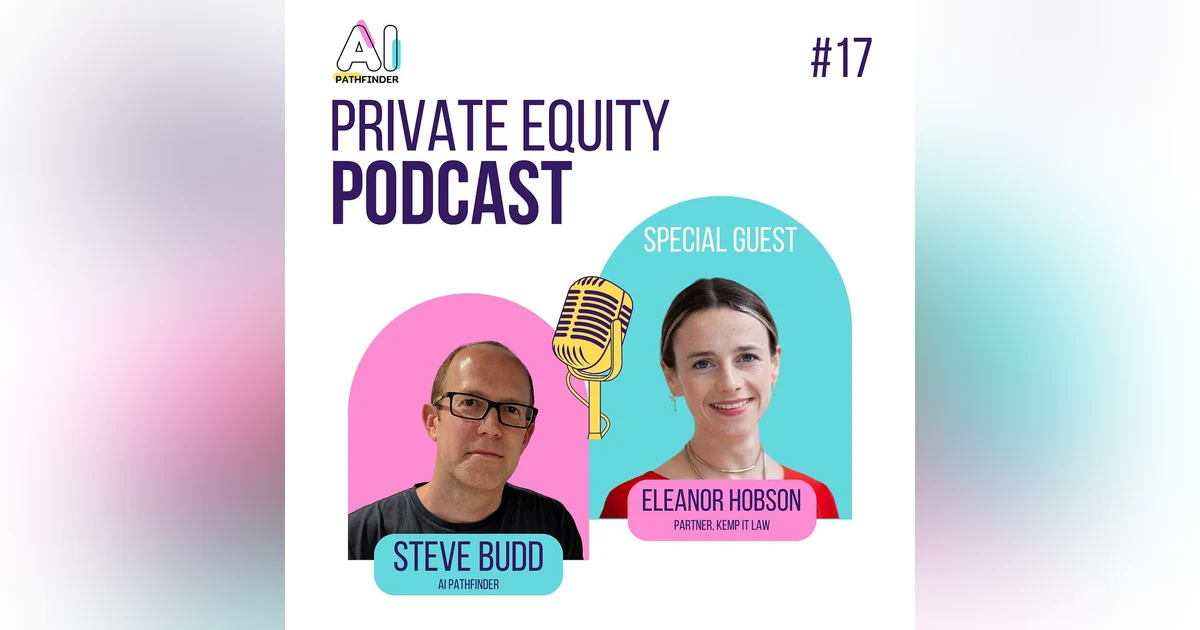

Summary In this episode of the AI Pathfinder for Private Equity podcast, Steve Budd and Eleanor Hobson discuss the growing liability concerns surrounding AI technologies, particularly for mid-market companies. They explore the risks associated with GenAI, the challenges in contractual agreements, and the implications of the EU AI Act. Eleanor provides insights on how portfolio companies can mitigate risks and emphasises the importance of AI literacy and compliance in navigating this evolving...


Summary
In this episode of the AI Pathfinder for Private Equity podcast, Steve Budd and Eleanor Hobson discuss the growing liability concerns surrounding AI technologies, particularly for mid-market companies. They explore the risks associated with GenAI, the challenges in contractual agreements, and the implications of the EU AI Act. Eleanor provides insights on how portfolio companies can mitigate risks and emphasises the importance of AI literacy and compliance in navigating this evolving landscape. The conversation highlights the need for a strategic approach to AI adoption and the potential future trends in the industry.
Takeaways
- AI is not just an opportunity; it also brings significant liability
- Mid-market companies are feeling squeezed between AI providers and customer demands
- Generative AI tools create a complex risk landscape for businesses
- Contractual obligations are shifting, placing more risk on AI users
- The EU AI Act introduces new expectations for documentation and compliance
- AI literacy is essential for both providers and customers
Links
Kemp IT Law website
Eleanor Hobson on on LinkedIn
AI Pathfinder Private Equity AI Strategy Meet-ups:
https://www.aipathfinder.co/private-equity-ai-events
Have a question or would like to suggest improvements, please contact steve@aipathfinder.co
Hello and welcome to the AI Pathfinder for a private equity podcast. AI Pathfinder helps private equity firms make sense of AI and make it work. It's an expert network built on insight, experience, connection. We bring the right people and ideas together to turn AI from something you're curious about into something that delivers real results. If you'd like to attend one of my regular AI strategy briefings in London, Manchester and soon, New York, please check out the show notes for details. Now back to today's podcast. In many of the conversations I've had in this series, we've talked about the opportunity side of AI, new products, better workflows, and value creation in portfolio companies. But there's another side to the story that's becoming hard to ignore: liability. Right now, a lot of mid-market companies, including P back businesses, are feeling squeezed. On one side, powerful infrastructure and AI providers, on the other, increasingly demanding customers, evolving regulation like the EU AI Act, and ever longer procurement and diligence questionnaires. Risk is being pushed around the table and it's not always landing in the right place. To help us unpack what's really going on and what PE firms and their port codes can do about it, I'm joined by Eleanor Hobson, a partner at Kemp IT Law. Eleanor, welcome to the podcast.
SPEAKER_00Thank you very much for having me.
SPEAKER_01I can't wait to get into this topic. It's something that uh you talked about yesterday at our breakfast briefing in Manchester and certainly got the questions flowing. But first of all, perhaps a quick introduction on yourself and Kemp IT Law.
SPEAKER_00Yeah, no, of course. So my name's Eleanor Hobson. I am a partner here at Kemp IT Law. We are a boutique tech and data practice, uh, a law firm based in the City of London. And tech law is all we do. So at the moment, that means a lot of AI, a lot of data, either the writing the contracts or negotiating the contracts, um, doing the due diligence and the procurement, or advising on the governance and compliance risks. And those could be regulatory, so exactly as you say, the EU AI Act or um local UK regulation, although we don't yet have a UK AI bill, or it could be the sex more sector-specific uh risks. So, particularly in healthcare around particular types of data.
SPEAKER_01And the topic that we're going to talk about today is obviously something that's coming across your desk more and more. But I wonder if you could just explain the pain that you're seeing of these mid-market companies and um that they're feeling around around this liability that they're they're taking on when it comes to their customers and the and the models that they're using.
SPEAKER_00Yeah, of course. So this applies across sort of all sectors, all markets, all business sizes, whether you are small, AI-first company, AI-first startup, or scale up, all the way up to the other end, you know, very large global international enterprises. Now, if you are building on any of these generative AI tools or you're using any generative AI tool, either as the center of your product or as a bolt-on, sort of an ask insert name of product, you are often building off one of the hyperscalers' infrastructure with a specific customer environment that could be a sole or multi-tenancy, plus a separate environment also controlled by the hyperscaler, in which all of these generative AI models are hosted. Insert name of whichever generative AI model you want to use. That is hosted and controlled, as well as your environment being controlled by the same hyperscaled as your AWS, Google Cloud. And where that leaves us is that those large hyperscaler providers are very reluctant to take on any of the liability risks around the use of that AI, that generative AI model. Now, that could be an IP-specific risk, or it could be other forms of infringement, privacy, terms of use, suitability for the customer's intended use case. And then when you add on the predominantly portfolio company or the enterprise that's using one of those generative AI models or that infrastructure, and they're reselling that probably with an additional software layer or data layer on top of it, the customer is expecting them to take on all of the responsibility, as for any other software business, for the um provision for the provision of the service. That very little commitment from, or what they're getting, very little commitment from the underlying infrastructure provider. And so they're ending up with this squeeze in the middle where the businesses that is actually building on the generative AI tool are having to take on the risk for everything that's gone before and everything that goes after.
SPEAKER_01And what's what's the worst case scenario coming out of the back of that if they take 100% of the risk?
SPEAKER_00So if you take 100% of the risk, you're looking at any of the copyright cases that are currently ongoing. They could lead to, let's say, mass claims or additional claims from uh the individuals or the businesses whose copyright has been infringed. That's the main IP focus at the moment. It could also be a privacy claim. So we understand that a lot of these models were trained on data scraped indiscriminately from the internet. And that will, of course, contain a lot of personal data and in some cases some more sensitive personal data. And so those individuals could also bring a claim. Now, in order to get to that claim point, you have to be somebody that somebody wants to issue a claim against you. So this isn't an automatic risk. So it's not a getty or a stability AI copyright infringement case goes against the underlying generative AI provider, and then suddenly everyone using the technology is subject to a claim. But if that does happen, you do put yourself on risk of them being subject to a claim and not being able to recover that loss to the same extent against those underlying generative AI providers or the hyperscalers.
SPEAKER_01With the the tools that are advancing, there's more um fear, I suppose, in terms of, and I suppose there's more pressure from a portfolio company that may be being pressured by the the P firm to build products beyond making their own processes more efficient, is building products. Is that that they are, you know, there is this sort of squeeze that they're they're feeling at the moment. And that um I assume in a in a contract phase is is that predominantly coming from from procurement that are looking at this?
SPEAKER_00Yeah, it it's tricky. So in in a pre-generative AI world where everyone was developing their own software or their own um their own AI tools, you where you would usually expect as the customer is for the provider of your SaaS, whichever platform or software you're working with, to take on the IP infringement risk, let's say, of any of the tools that they've developed. So if it was software, you would be expecting an IP indemnity, often on an uncapped basis reliability, that the provider owned or wrote or properly licensed everything that goes into that software. And then for the customer, if they ended up with a claim from a third party saying that your use of X provider's software infringed my copyright or my other IP rights, you can pass that back to the main provider. Or if you end up in a claim, you can recover your costs from the provider. Where we are with generative AI technologies is we're almost carving out part of what the provider is providing to its customer, which is the generative AI bit. And the customer is expecting that the IP terms or the liability terms apply to the whole tool, including that generative AI part. But the provider often has very little control, or no, let's be honest, no control over how that generative AI has been developed. They have no additional information than is already out there in the market, but they're being expected to take on the risk for the whole thing from the customer point of view. Now, where you then end up with the with in your contract negotiation is that the customer will put in all of the same terms they previously expected for software liability. The AI business or the business with an AI aspect of their technology then has to say, well, actually, this bit we can't give you the same commitments on because we didn't develop it. And we have no extra information than you already have if you just run a Google search. So we cannot give you the same commitments. And then you end up with a bit of a debate between the customer and the provider as to who is going to take on that responsibility. And ultimately that ends up with whoever has the most market power in that negotiation. That then, whoever it sits with, let's say it does sit with the provider, it's very rare to be able to then, as I said, recover that back from the underlying hyperscaler or the underlying generative AI provider, because their terms are incredibly limited on what they accept, accept responsibility for.
SPEAKER_01And when we've got um obviously in the UK it's a little bit different, but we've got the EU AI Act, is that helping at all?
SPEAKER_00I think the EU AI Act is helping to a certain extent, because there is more of an expectation around the documentation, for example, that providers or the underlying generative AI tools will provide as to how their system operates. But where it what might what we often see now is that the hyperscalers have implemented or extended what we call an acceptable use policy. So previously, in a sort of a pure software world, what you would have from a provider side is these are the things that you can use our software and our technology for. These are the acceptable uses. And there are certain acceptable uses that we don't allow, predominantly from a platform liability perspective. So you won't host anything that is defatory or images that we would be are very uncomfortable or could be subject to a lawsuit for host just for hosting. Those acceptable use policies in our new generative AI world have been wildly extended out to include any of the use cases that might be more risky, such as the prohibited use cases under the EU AI Act or some of the high-risk use cases under the EU AI Act. And in terms of the responsibility for those, because they are generally use case dependent, that liability is being pushed down to the customer. Now, to go back to our original sort of AI liability squeeze, the generative AI providers do not generally have any movement at all on what those acceptable use policies say. So there is now an unlimited liability between whoever is buying the generative AI technology and the underlying hyperscaler for any breach of those acceptable use policies. That is then being built on by an AI an AI first company or by an enterprise software business that's bolting something on, bolting an AI component on. And they are trying to pass through those acceptable use policies because it's entirely use case specific. But some of those use cases will automatically be prohibited, even though the underlying use case might be desirable for the customer. So a good example is prohibiting the upload of the defamatory or unlawful information, IP infringement information, or using, sometimes using generative AI tools to provide legal advice or to do financial advice, or in the context of dating, for example. Now, those use cases will be difficult for any law firm buyers because a law firm will automatically be hosting sometimes that kind of material, or will just be using the AI tool to provide legal services. Or a dating app, for example, might be wanting to use some of that generative AI technology in order to provide a chatbot for their customers. But the risk now has to again sit with the provider, i.e., the business that's building off this technology, because they can't get any wiggle room from the underlying infrastructure provider, but they're trying to build something for a customer that wants to use it for these specific use cases. So again, they end up sitting with the same liability or the same uncapped liability, and we end up with that liability squeeze.
SPEAKER_01Yeah, well, yeah, thank you for um for for explaining that in good detail there. So it feels like that there's not much we can do with these models other than wait for maybe other lawsuits or or um you know Smith a lot of the EU AI Act to to sort of enforce a change. So it really comes down to sort of two parties, doesn't it, really? So let let's move on to maybe then, well, how you help mitigate this for portfolio companies, mid-market firms. Yeah, what what is it that they can do then?
SPEAKER_00I think there has to be an an understanding across the business and by the businesses building on the tools in their sort of customer-facing documentation that this is a systemic risk. If you want to play in the generative AI space, you are not going to get access to these models or this underlying infrastructure on any better terms than anyone else. So there is going to be the same risk for every tool that's built on an open AI GPT model for every tool that uses Azure AI foundry, it's all going to be exactly the same. And half of that risk is your underlying hyperscaler cloud terms that you probably already have as a business because you're probably already working off Google Cloud Products, or you're probably already working off Office 365. So they're already hosting all your data anyway. Then when you add in the layer on generative AI and the additional commitments that you might get, or the additional restrictions or sort of uh disclaimers that you have, they're going to be the same for anyone using the technology. Where that sort of leaves us in a practical point of view is there are only so many providers of these technologies. There are only so many models and so many places where we can find information about the models. And yes, we will have updates, we will have GPT six or or whatever it is, but this place where you get information about them will remain the same. So having centralized documentation or a central risk acceptance, that if you use any generative AI tool, you're probably going to end up taking the IP infringement risk for at least for now. Or if you use specific AI infrastructure or hyperscaler infrastructure, you're taking the risk under those terms. So maybe you're just comfortable with anything built on Azure AI Foundry or anything that uses the Azure OpenAI infrastructure, because it's exactly the same, regardless of whether you buy it from provider A that's built on top of it, or provider B, or you deploy it internally through a copilot, for example.
SPEAKER_01Could you um it would help perhaps to talk through I'm obviously not going to ask you to name names, but uh, you know, a real case. And obviously you've talked through, you know, um what the scenario is, but but in terms of how they then um as much as they can today, and maybe that will change in the future, how they came to sort of mitigate as much of the risk as they can.
SPEAKER_00I think the the most important thing if you are a portfolio company or you have a portfolio company that is built on this technology, is having customer-facing documentation that explains the um both the technology stack that the business is built on, and I'll come to that in a second, and that uh how generative AI works in the business and which infrastructure provider they're using. Now, when I talk about the technology stack, what what I mean is that as I said at the top of the podcast, you have everything that would comprise maybe a standard software or SaaS offering, and then you have the generative AI component and explaining to customers, okay, this is we have a software layer and we will provide the standard IP indemnity and the standard software license terms that you would you would look for and liability around that. This bit of our system is the generative AI bit. It's built on this hyperscaler. It refers to these particular AI terms. And it can be helpful to say, and we have no more information about how those models were built than you are able to find if you Google. And here are some helpful links on a non-reliance basis. We're just telling you where the information is. And that can help shortcut those discussions up front. Because when I have generative AI clients, the first thing I often see is the in-house counsel or the legal advisor doesn't necessarily understand what the technology is, thinks that it's either a bespoke model that's been trained by date by the individual thinks that it's a bespoke model that's been trained by the provider with bespoke data, or they think that it's been fine-tuned, or they think that the customer can fine-tune the model. And so when you have them thinking that all of those things could apply, they will throw all terms that could apply to all of those things into the contract. So if they can understand that you haven't fine-tuned the model with your own data, or this isn't your own AI model, it's a generative AI model, and it's this model, or you can, you as the customer can pick between the publicly available versions of the models, or it's um you do have the ability to fine-tune the model, but we're not going to then take either your fine-tuned model or your data and then use that for our own purposes. Once you have that out there and bringing that really to the attention of the lawyer or asking the salesperson that you're talking to, or the procurement person to bring that to their legal counsel's front of mind, you won't end up with the kitchen sink approach on the clauses, and you can cut through some of that legal negotiation.
SPEAKER_01Imagine that I've created something and and uh and I want to sort of deploy out to my my network of private equity firms, and um, you know, I've cut I've come up against this, but I've done as much as I can around the diligence of it. Is that enough for for the lawyers to go, okay, you know, oh we will share some of the risk here, the way that you've detailed this out, or is there still pushback?
SPEAKER_00There's still pushback. But there will always be pushback. Um I think if you particularly if there's a big imbalance between the provider, so the someone who's built on generative AI tools and using them, and you've got a much bigger customer, you you just will have to accept more of the risk. And that but that would apply in in any conversation. It's not a generative AI only uh risk.
SPEAKER_01And going back to my uh my uh sort of scenario, that you know it might be only part of my offering, and it's a sort of bolt-on sort of offering, and it's it's the AI sort of piece to this, that ultimately at the end that that um a particular client doesn't want to buy that. Do you see then that there's this that that I should have something that can be switched off because it's AI? That's going to make my life easier here, rather than go through this protracted process for a customer that that the end user doesn't necessarily see see as value. Do you think that's something that we should be looking at?
SPEAKER_00I think we are there at the moment. I think having an AI component with a separate AI addendum that has specific AI terms in is what we're seeing. My longer term view is that AI just becomes like software. Just as the cloud became another part of your software as you moved from on-prem to SaaS, and now everyone just talks about SaaS as if it's one thing all together. I think AI will just become another component of your software or your SaaS. So, in terms of your your question on what to do at the moment, I think it it is helpful to segregate off which bit of the AI, which bit of your tool is AI. Partly so that you can say that our AI terms only apply to this bit, and you, customer, can tell your users don't interact with it or don't touch it, or ask the administrative settings in the background to just turn it off. But longer term, I d I don't think that's going to be an ask. from from the market.
SPEAKER_01Just um I suppose moving on to a sort of final part to this, due diligence is a core part to this, and you know, they are a risk-averse bunch. So uh in your dealings you know with with priority or certainly what you've picked up, you know, is there is there appetite changing around this? Because you know that feel it's fair to say that that you know that not only can they see that value can be taken taken away from AI and the disruption of AI, but it can also add a ton of value as well. So they can't ignore these difficult um questions.
SPEAKER_00Yeah I think there's a real push from private equity businesses to push down uh to their port codes that they have to be taking on something to do with AI, particularly in the technology sector, there's um a real pressure to adopt an AI component in the in the offering. On the due diligence side it goes back to that almost central risk assessment or acceptance process and maybe developing that into a part of the due diligence process. So saying there are all of the businesses that are built on this particular hyperscalus technology stack, these risks will always apply to those businesses and we can put that in our VDD report and that can go out up front. So we in the same way as a provider selling the actual solution to a customer, the PE compedese and and this risk will apply but it'll be the same as for anyone else you want to invest in who is using generative AI.
SPEAKER_01Yeah yeah okay I think that there's uh you know there's definite uh well lots and lots of questions uh uh around this and certainly in this session yesterday felt like um it wasn't rising to to certainly their their position in terms of a of a pain but but you know concern about what was being felt with their portfolio and that they should have a bit more oversight on this. What would you you know what what are those sort of top top tips I suppose of what should they be doing you know from a from an ownership perspective to just um explore what what the risk may may be for them?
SPEAKER_00It's in general for AI compliance or AI legal risk we're seeing a bit of a lift and shift of the GDPR compliance approach that we had seven, eight years ago now. So the first step in that is a form of mapping exercise. So understanding where AI is in the business and what type of AI it is. We've been talking about generative AI risk predominantly through this podcast but that's not the only type of AI. You know four, five years ago we wouldn't have been talking about generative AI. And there are a lot of other AI technologies that aren't generative AI. So we shouldn't tar everything with the same brush. So understanding the technology stack within the business, being able to segregate out the different types of risk that apply to generative AI mainly because of the market dominance of a few providers of the underlying models and the underlying infrastructure and then thinking about the use cases in the sectors that those portcos are operating in. So healthcare and health data will attach greater risk than other types of data. So it's just understanding the different risk profiles of those different portcos.
SPEAKER_01Yeah and I I I you know that I think there's probably a little bit more proactivity you know certain certainly around that they're going, you know they they are mapping they're trying to understand certainly the where the disruption might lie for for their for their businesses but but potentially not as much in terms of better understanding that dynamic between their product and their customer and that how much they could potentially support their their portcodes to do that. So you know I do think that that's that's something that that the potentially some form of responsibility should sit in the in the PIF Yeah and there's there's a big piece around AI literacy.
SPEAKER_00Just as when we had GDPR seven eight years ago we had to do lots of data protection training to tell people what was happening and what their individual responsibilities were it's the same thing with AI. What are the particular risks? We we talk about bias, hallucinations, standardization of mitigations we've talked about contract terms, helping helping portcods understand what is out there in the market. So they're armed with more of this information when they go into those negotiations with customers. They don't feel like they're the only ones saying we can't take on this particular type of generative AI risk.
SPEAKER_01Very final question and I think what we're talking about here is being more proactive is that happening though are we or are we very much stuck in the reactive mode at the minute?
SPEAKER_00I don't think we're seeing the same approach to AI compliance as we were to GDPR compliance. Seven, eight years ago I think I did 30 GDPR compliance projects in about six months for Port Coast. So it it is it is a very different world and maybe part of that is because of Brexit and we don't have the EUAI Act here the same way that we did the GDPR but I think that there is a an acknowledgement that this this infrastructure technical infrastructure comes with risks but it comes with huge advantages and huge opportunity. And so part of it is just that we have to adopt something because our customers are asking for it, our investors are asking for it, our private equity house is inve is asking for it. Some of the our portcos are are asking for it in some cases. So I think everyone is adopting what what what I what we've talked about before is very much felt like 2023 was the year of buy anything AI. We don't care what it is, we just need to be saying you're using AI. 24 was the year of oh actually don't actually have any ROI on a lot of these tools and we've got lots of them now and I have no idea what we've got because we just said to each employee go and buy your own thing or each department go and buy your own thing. And then they sort of I got loads of calls going we need to get out of some of these contracts or we need to terminate. And then 25 has been the year of AI strategy, AI compliance, AI governance, thinking about it more strategically, thinking about some of these risks, thinking about how can we replicate the opportunities across different business lines as well as different portcods and and how can we share that information between port cods and also sending some of that information up to the private equity house and if the private equity house is doing really well and in a particular AI adoption sending that information back down to the portcos. 2025 has been a lot more measured uh and and there's been a lot more structure to adopting AI.
SPEAKER_01Well a great way to to to finish Eleanor on that so thank you very much for your tour really of the AI liability squeeze and what it means in practice for P firms and and their portfolio companies. For those listening and would like to know more, I'll put the links to to you Eleanor and and Kent Mighty Law in the show notes. And obviously if you're interested in talking about these sorts of things in person, do take a look at the upcoming AI strategy briefings that I host in London, Manchester and soon New York. But that's it for this episode of AI Pathfinder for private equity. Thank you for listening and see you next time. Thank you Elna thanks Dave