Martian Clay Chronicles: Uncovering Life's Potential
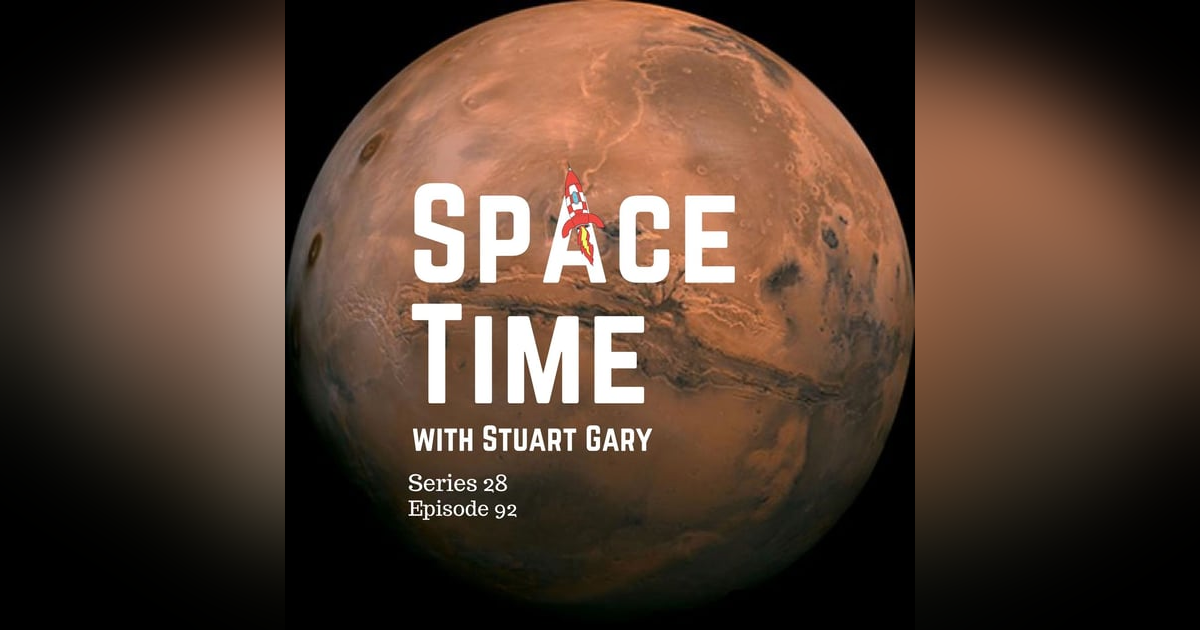


In this episode of SpaceTime, we embark on a thrilling journey through the cosmos, exploring the potential for life on Mars, a remarkable discovery in the outer solar system, and the crucial mapping of sulfur throughout our galaxy.
Searching for Life on Mars
A new study reveals that thick layers of clay on Mars could indicate stable environments conducive to life billions of years ago. Researchers have identified that these clay deposits likely formed in standing bodies of water, providing the right conditions for chemical weathering and potentially supporting ancient life. The findings suggest that the balance between water and carbon cycles on Mars may explain the planet's geological history and the absence of carbonate rocks. Lead author Rhianna Moore discusses how these stable terrains could have fostered habitable conditions for extended periods, offering insights into the Red Planet's wet past.
Discovery of 2020 VN40: A Distant Cosmic Companion
Astronomers have discovered a rare celestial body, 2020 VN40, located far beyond Neptune, moving in perfect synchronicity with the ice giant. This trans-Neptunian object orbits the sun once for every ten orbits Neptune completes, providing new insights into the dynamics of the outer solar system. The discovery, reported in the Planetary Science journal, enhances our understanding of how distant objects interact with Neptune's gravity and offers clues about the solar system's evolution.
Mapping Sulfur in the Milky Way
A groundbreaking study has mapped the distribution of sulfur across the Milky Way, an essential element for life. Utilizing the CRISM X-Ray Imaging and Spectroscopy mission, scientists have directly measured sulfur in both its gaseous and solid forms within the interstellar medium. The findings shed light on sulfur's role in the cosmos and its potential implications for understanding life's distribution throughout the galaxy. This research marks a significant step in answering fundamental questions about the building blocks of life in the universe.
www.spacetimewithstuartgary.com
✍️ Episode References
Nature Astronomy
https://www.nature.com/natureastronomy/
Planetary Science Journal
https://iopscience.iop.org/journal/2632-3338
CRISM Mission
https://www.nasa.gov/mission_pages/asteroids/overview/crism.html
Become a supporter of this podcast: https://www.spreaker.com/podcast/spacetime-space-astronomy--2458531/support.
The Astronomy, Space, Technology & Science News Podcast.


