July 20, 2016
47: SpaceTime with Stuart Gary S19E47 - Ancient Supnovae and Martian Moons
Hi...Stuart with the Show Notes for Series 19 Episode 47 *Ancient supernovae affected life on Earth Two ancient supernovae which erupted within 300 light years of Earth likely exposed biology on our planet to a long-lasting cosmic radiation. The...


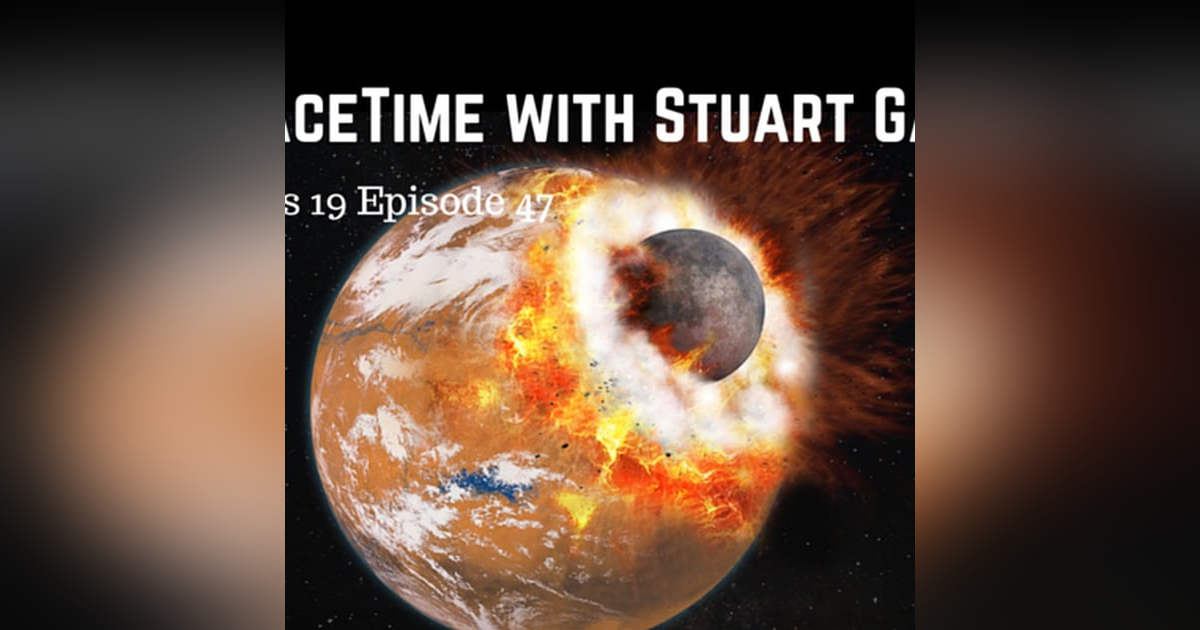
Hi...Stuart with the Show Notes for Series 19 Episode 47 *Ancient supernovae affected life on Earth Two ancient supernovae which erupted within 300 light years of Earth likely exposed biology on our planet to a long-lasting cosmic radiation. The findings are based on new computer simulations of the impact the two exploding stars had on surrounding space. *Solving the mystery of the Martian moons Astronomers may have finally solved the mystery of how the two Martian moons -- Phobos and Deimos -- were formed. Two separate and independent studies have both concluded that the moons were formed by collision events early in the red planet’s history. *Newly discovered planet has three Suns If you thought Luke Skywalker’s home planet, Tatooine, was a strange world with its two Suns in the sky, imagine a planet where you’d either experience constant daylight or enjoy triple sunrises and sunsets every day. This isn’t the opening scene for some future episode of Star Wars but rather the vista seen from the surface of the distant exoplanet, HD 131399Ab. *Flying Dragon targets International Space Station A SpaceX Falcon 9 rocket has blasted into orbit from the Cape Canaveral Air Force base -- lighting up the early morning skies of the Florida Atlantic coast – on a two day flight bound for the International Space Station. The Falcon 9 is carrying a Dragon cargo ship loaded with two tonnes of fresh supplies, scientific experiments, and space station equipment as part of a SpaceX contract with NASA to supply the orbiting outpost. *Skywatch We turn our eyes to the skies as Jonathan Nally -- the editor of Australian Sky and Telescope Magazine -- takes us on a journey through this month’s night skies with Skywatch. Learn more about your ad choices. Visit megaphone.fm/adchoices
See acast.com/privacy for privacy and opt-out information.
See acast.com/privacy for privacy and opt-out information.
The Astronomy, Space, Technology & Science News Podcast.


