Webb Makes Astronomy History | Update - NASA Rolls Artemis Back to the Hangar | Is There Life on...
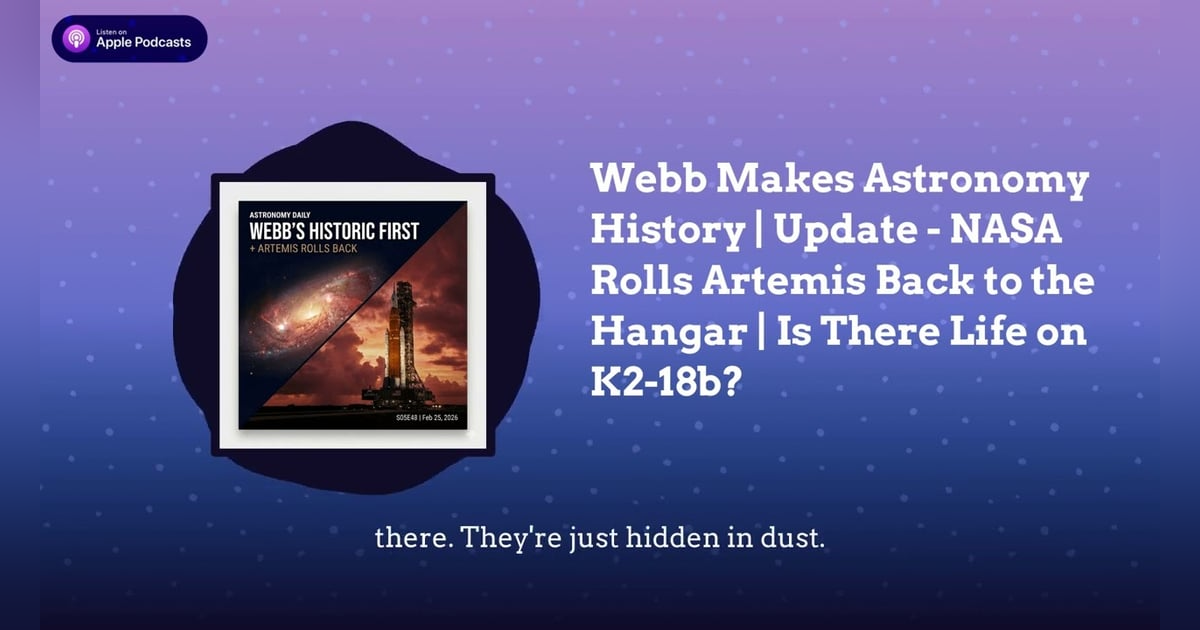


NASA's Artemis II moon rocket begins its rollback to the Vehicle Assembly Building today as a helium flow issue kills the March launch window — and the crew's unannounced presence at Trump's State of the Union adds a fascinating new dimension. Plus: James Webb achieves an astronomical first by identifying a supernova's progenitor star that was invisible to every other telescope; the case for life on exoplanet K2-18b keeps building; the sun goes spotless for the first time since 2022; China's Shenzhou-20 astronauts reveal gripping new details about last year's space debris emergency; and the U.S. Postal Service turns Webb's greatest hits into stamps. Full episode rundown at astronomydaily.io
Become a supporter of this podcast: https://www.spreaker.com/podcast/astronomy-daily-space-news-updates--5648921/support (https://www.spreaker.com/podcast/astronomy-daily-space-news-updates--5648921/support?utm_source=rss&utm_medium=rss&utm_campaign=rss) .
Sponsor Details:
Ensure your online privacy by using NordVPN . To get our special listener deal and save a lot of money, visit You'll be glad you did!
Become a supporter of Astronomy Daily by joining our Supporters Club. Commercial free episodes daily are only a click way... Click Here (https://www.spreaker.com/podcast/astronomy-daily-space-news-updates--5648921/support)
This episode includes AI-generated content.
Episode link: https://play.headliner.app/episode/31864397?utm_source=youtube
Kind: captions
Language: en
00:00:00.240 --> 00:00:03.030
Hello and welcome to Astronomy Daily.
00:00:03.040 --> 00:00:04.070
I'm Anna.
00:00:04.080 --> 00:00:06.390
>> And I'm Avery. It's Wednesday, February
00:00:06.400 --> 00:00:09.110
25th, 2026, and you are listening to
00:00:09.120 --> 00:00:11.830
season 5, episode 48.
00:00:11.840 --> 00:00:14.629
>> Big show today. NASA's moon rocket is on
00:00:14.639 --> 00:00:17.510
the move again. James Webb has achieved
00:00:17.520 --> 00:00:19.670
a genuine first in a history of
00:00:19.680 --> 00:00:21.670
astronomy, and we're going to talk about
00:00:21.680 --> 00:00:23.509
a world out there that is becoming
00:00:23.519 --> 00:00:25.670
increasingly difficult to explain
00:00:25.680 --> 00:00:29.349
without considering the word life. Plus,
00:00:29.359 --> 00:00:31.830
the sun is taking a quiet day for the
00:00:31.840 --> 00:00:33.670
first time in years. There's some
00:00:33.680 --> 00:00:35.430
gripping new detail from China's
00:00:35.440 --> 00:00:37.910
incredible space emergency last year.
00:00:37.920 --> 00:00:39.590
And we close with something that might
00:00:39.600 --> 00:00:41.590
just make you want to send a letter.
00:00:41.600 --> 00:00:43.910
>> All that coming right up. Let's get into
00:00:43.920 --> 00:00:44.470
it.
00:00:44.480 --> 00:00:46.630
>> We start with an update on a story we've
00:00:46.640 --> 00:00:48.709
been following closely all week. And
00:00:48.719 --> 00:00:50.790
today, there's a genuinely new angle
00:00:50.800 --> 00:00:53.350
that caught a lot of people off guard.
00:00:53.360 --> 00:00:55.990
>> Right. So, Artemis 2, as of this
00:00:56.000 --> 00:00:57.990
morning, the enormous space launch
00:00:58.000 --> 00:01:00.790
system rocket and the Orion spacecraft
00:01:00.800 --> 00:01:03.430
have physically begun their 4mm journey
00:01:03.440 --> 00:01:06.950
from launchpad 39B back to the vehicle
00:01:06.960 --> 00:01:08.789
assembly building at Kennedy Space
00:01:08.799 --> 00:01:10.950
Center. That roll back started around
00:01:10.960 --> 00:01:13.350
9:00 a.m. Eastern time and could take up
00:01:13.360 --> 00:01:15.109
to 12 hours.
00:01:15.119 --> 00:01:17.109
>> The reason, as we've covered, is a
00:01:17.119 --> 00:01:19.429
helium flow interruption in the rocket's
00:01:19.439 --> 00:01:22.390
upper stage. Helium is critical. It
00:01:22.400 --> 00:01:24.390
pressurizes the propellant tanks.
00:01:24.400 --> 00:01:26.550
Without that working perfectly, you
00:01:26.560 --> 00:01:29.350
cannot fly. March is now completely off
00:01:29.360 --> 00:01:31.030
the table. The next realistic
00:01:31.040 --> 00:01:33.429
opportunity opens on April 1st.
00:01:33.439 --> 00:01:35.749
>> But here's what's new today, and it's a
00:01:35.759 --> 00:01:38.149
bit of a talking point. Last night, the
00:01:38.159 --> 00:01:40.630
four Artemis 2 crew members, Reed
00:01:40.640 --> 00:01:43.270
Wisman, Victor Glover, Christina Caul,
00:01:43.280 --> 00:01:45.910
and Canadian astronaut Jeremy Hansen.
00:01:45.920 --> 00:01:47.749
They were sitting in the gallery at the
00:01:47.759 --> 00:01:49.990
US capital for President Trump's State
00:01:50.000 --> 00:01:52.230
of the Union. They were guests of House
00:01:52.240 --> 00:01:53.910
Speaker Mike Johnson
00:01:53.920 --> 00:01:56.710
>> and the speech ran for nearly two hours.
00:01:56.720 --> 00:01:58.709
The president praised the space force
00:01:58.719 --> 00:02:00.870
extensively. He called it quote his
00:02:00.880 --> 00:02:03.429
baby. But he made no mention of the four
00:02:03.439 --> 00:02:05.109
astronauts sitting right there in the
00:02:05.119 --> 00:02:07.190
room and no mention of the Aremis
00:02:07.200 --> 00:02:08.550
program at all,
00:02:08.560 --> 00:02:11.029
>> which was noticed. These are the first
00:02:11.039 --> 00:02:13.190
people who will travel beyond low Earth
00:02:13.200 --> 00:02:15.910
orbit since the Apollo era. And they
00:02:15.920 --> 00:02:18.070
were in the chamber. Some in the space
00:02:18.080 --> 00:02:19.910
community found the omission quite
00:02:19.920 --> 00:02:20.790
striking.
00:02:20.800 --> 00:02:22.470
>> The crew have now been released from
00:02:22.480 --> 00:02:24.150
their pre-launch quarantine since
00:02:24.160 --> 00:02:26.470
there's no imminent launch. NASA has
00:02:26.480 --> 00:02:28.150
said they'll hold a media briefing in
00:02:28.160 --> 00:02:29.910
the coming days to lay out the path
00:02:29.920 --> 00:02:32.790
forward. For now, April 1st is the
00:02:32.800 --> 00:02:34.710
earliest the mission could fly pending
00:02:34.720 --> 00:02:37.190
successful repairs, a likely second wet
00:02:37.200 --> 00:02:39.430
dress rehearsal, and the clean flight
00:02:39.440 --> 00:02:40.710
readiness review.
00:02:40.720 --> 00:02:43.110
>> We will absolutely keep you updated as
00:02:43.120 --> 00:02:45.350
this develops. The mission itself is
00:02:45.360 --> 00:02:47.750
still on. It's just going to take a bit
00:02:47.760 --> 00:02:48.470
longer.
00:02:48.480 --> 00:02:50.630
>> This story has still got a long way to
00:02:50.640 --> 00:02:51.910
go. Me thinks
00:02:51.920 --> 00:02:54.550
>> now. This next story is a genuine
00:02:54.560 --> 00:02:56.630
landmark in astronomy. Something
00:02:56.640 --> 00:02:59.190
researchers have been waiting years for.
00:02:59.200 --> 00:03:01.509
>> It has to do with supernova, those
00:03:01.519 --> 00:03:03.430
spectacular explosions that mark the
00:03:03.440 --> 00:03:06.070
deaths of massive stars. Astronomers
00:03:06.080 --> 00:03:07.910
have long wanted to look back at
00:03:07.920 --> 00:03:10.390
archival images after a supernova
00:03:10.400 --> 00:03:12.710
occurs, and find the star that caused
00:03:12.720 --> 00:03:15.830
it, the so-called progenitor star. But
00:03:15.840 --> 00:03:18.229
for many of the most massive stars, they
00:03:18.239 --> 00:03:20.470
just weren't there. They seemed to be
00:03:20.480 --> 00:03:21.270
missing.
00:03:21.280 --> 00:03:23.509
>> Well, now we know why, and it's thanks
00:03:23.519 --> 00:03:27.030
to James Webb. On June 29th last year,
00:03:27.040 --> 00:03:29.670
an automated sky survey detected a new
00:03:29.680 --> 00:03:34.550
supernova in a galaxy called NGC 1637,
00:03:34.560 --> 00:03:37.509
about 40 million lighty years away. The
00:03:37.519 --> 00:03:42.070
explosion was designated 2025 PHT and a
00:03:42.080 --> 00:03:44.070
team at Northwestern University
00:03:44.080 --> 00:03:46.070
immediately did something clever.
00:03:46.080 --> 00:03:47.830
Instead of pointing their telescopes at
00:03:47.840 --> 00:03:50.070
the new supernova, they went to the
00:03:50.080 --> 00:03:52.710
archives to images Webb had already
00:03:52.720 --> 00:03:55.030
taken of that same galaxy.
00:03:55.040 --> 00:03:57.670
>> And there it was, a single red super
00:03:57.680 --> 00:03:59.910
giant star sitting exactly where the
00:03:59.920 --> 00:04:02.470
supernova now shines. This is the first
00:04:02.480 --> 00:04:04.309
published detection of a supernova
00:04:04.319 --> 00:04:06.630
progenitor by the James Webb telescope
00:04:06.640 --> 00:04:07.589
ever.
00:04:07.599 --> 00:04:09.910
>> And here's the key thing. Hubble
00:04:09.920 --> 00:04:12.550
couldn't see it. The star was completely
00:04:12.560 --> 00:04:14.949
invisible in Hubble images. It was
00:04:14.959 --> 00:04:17.670
surrounded by so much dust that shorter
00:04:17.680 --> 00:04:19.430
wavelengths of light were blocked
00:04:19.440 --> 00:04:22.069
entirely. Only Web's infrared
00:04:22.079 --> 00:04:24.550
instruments could pierce that veil. Lead
00:04:24.560 --> 00:04:26.310
author Charlie Kilpatrick from
00:04:26.320 --> 00:04:29.030
Northwestern described it as quote the
00:04:29.040 --> 00:04:31.350
reddest, most dusty red super giant
00:04:31.360 --> 00:04:33.990
we've seen explode as a supernova. And
00:04:34.000 --> 00:04:36.150
there was another surprise, the dust
00:04:36.160 --> 00:04:38.790
composition. They expected silicutri
00:04:38.800 --> 00:04:41.430
dust, the kind astronomers usually find.
00:04:41.440 --> 00:04:44.070
Instead, it was carbonri. The team
00:04:44.080 --> 00:04:45.749
thinks that carbon may have been dredged
00:04:45.759 --> 00:04:47.670
up from deep inside the star in its
00:04:47.680 --> 00:04:50.230
final moments before death. This has
00:04:50.240 --> 00:04:52.390
direct implications for what's called
00:04:52.400 --> 00:04:54.710
the mystery of the missing red super
00:04:54.720 --> 00:04:57.270
giants. Theory predicts these massive
00:04:57.280 --> 00:04:59.510
stars should be easy to spot before they
00:04:59.520 --> 00:05:01.430
explode. They should be bright and
00:05:01.440 --> 00:05:04.230
luminous, but historically they've often
00:05:04.240 --> 00:05:07.749
not shown up in preupnova images at all.
00:05:07.759 --> 00:05:10.310
Now we have a compelling answer. They're
00:05:10.320 --> 00:05:12.790
there. They're just hidden in dust.
00:05:12.800 --> 00:05:14.469
>> The findings are published in the
00:05:14.479 --> 00:05:16.950
astrophysical journal letters. The team
00:05:16.960 --> 00:05:18.950
is now looking for similar dusty red
00:05:18.960 --> 00:05:21.110
super giants that might be the next to
00:05:21.120 --> 00:05:23.510
explode. And web successor missions,
00:05:23.520 --> 00:05:25.430
including the upcoming Nancy Grace
00:05:25.440 --> 00:05:27.430
Romans telescope, should help that
00:05:27.440 --> 00:05:29.110
search enormously.
00:05:29.120 --> 00:05:31.510
>> A beautiful piece of detective work.
00:05:31.520 --> 00:05:34.710
>> From stellar deaths to potential life,
00:05:34.720 --> 00:05:36.710
because our next story is one that keeps
00:05:36.720 --> 00:05:38.790
getting more interesting every time new
00:05:38.800 --> 00:05:43.029
data comes in. The exoplanet K218b.
00:05:43.039 --> 00:05:44.950
If you've been following exoplanet
00:05:44.960 --> 00:05:46.870
science over the last couple of years,
00:05:46.880 --> 00:05:49.749
you'll know this name. K218b
00:05:49.759 --> 00:05:53.029
is located 124 light years away in the
00:05:53.039 --> 00:05:55.590
constellation LEO, sitting squarely in
00:05:55.600 --> 00:05:57.830
the habitable zone of its red dwarf host
00:05:57.840 --> 00:06:00.710
star, and James Webb has been staring at
00:06:00.720 --> 00:06:01.350
it.
00:06:01.360 --> 00:06:03.670
>> What Webb found was an atmosphere rich
00:06:03.680 --> 00:06:06.790
in both carbon dioxide and methane. That
00:06:06.800 --> 00:06:09.430
chemical combination is significant. It
00:06:09.440 --> 00:06:11.430
points strongly towards what astronomers
00:06:11.440 --> 00:06:15.110
call a hyen world. The idea is a planet
00:06:15.120 --> 00:06:17.990
with a warm liquid water ocean beneath a
00:06:18.000 --> 00:06:20.790
thick hydrogen-rich atmosphere. And the
00:06:20.800 --> 00:06:23.270
intrigue doesn't stop there. Earlier
00:06:23.280 --> 00:06:26.870
analyses of K218b's atmosphere had also
00:06:26.880 --> 00:06:29.510
hinted at possible traces of dimethyl
00:06:29.520 --> 00:06:32.469
sulfide, a molecule that on Earth is
00:06:32.479 --> 00:06:34.950
produced almost exclusively by marine
00:06:34.960 --> 00:06:37.270
life. Now, that hasn't been confirmed,
00:06:37.280 --> 00:06:39.189
and scientists are appropriately
00:06:39.199 --> 00:06:41.510
cautious. There are non-biological
00:06:41.520 --> 00:06:43.670
explanations being explored, but the
00:06:43.680 --> 00:06:45.830
ongoing analysis of web data is
00:06:45.840 --> 00:06:48.230
continuing to add layers to the story.
00:06:48.240 --> 00:06:49.990
The carbon dioxide and methane
00:06:50.000 --> 00:06:51.990
combination is precisely what you'd
00:06:52.000 --> 00:06:53.670
expect if there were a liquid ocean
00:06:53.680 --> 00:06:55.749
beneath that atmosphere. The current
00:06:55.759 --> 00:06:57.430
focus is whether those chemical
00:06:57.440 --> 00:06:59.270
signatures could have a biological
00:06:59.280 --> 00:07:01.270
origin. And that's one of the most
00:07:01.280 --> 00:07:03.029
consequential questions in all of
00:07:03.039 --> 00:07:07.029
science. K28b is one of the most watched
00:07:07.039 --> 00:07:09.510
targets in astrobiology right now. And
00:07:09.520 --> 00:07:12.230
with web continuing to accumulate data,
00:07:12.240 --> 00:07:13.909
we should expect more updates in the
00:07:13.919 --> 00:07:16.390
months ahead. Avery, if it turns out
00:07:16.400 --> 00:07:19.270
there is life on K218b,
00:07:19.280 --> 00:07:22.070
>> then everything changes. That's all I'll
00:07:22.080 --> 00:07:24.390
say. Okay, something a little different
00:07:24.400 --> 00:07:27.110
now. A story about our own sun behaving
00:07:27.120 --> 00:07:30.870
unusually quietly. On February 22nd, the
00:07:30.880 --> 00:07:33.430
Sun's Earth-facing disc went completely
00:07:33.440 --> 00:07:37.350
spotless for the first time in 1,355
00:07:37.360 --> 00:07:39.749
days. That ends a streak stretching all
00:07:39.759 --> 00:07:42.870
the way back to June 8th of 2022. For
00:07:42.880 --> 00:07:44.950
nearly 4 years, you could look at the
00:07:44.960 --> 00:07:47.830
sun on any given day and find at least
00:07:47.840 --> 00:07:50.790
one active sunspot region. Not anymore,
00:07:50.800 --> 00:07:53.589
for a few days at least. Sunspots are
00:07:53.599 --> 00:07:56.150
regions of intense magnetic activity on
00:07:56.160 --> 00:07:58.309
the solar surface, and they're the
00:07:58.319 --> 00:08:00.950
source of solar flares and the coronal
00:08:00.960 --> 00:08:03.270
mass ejections that can send charged
00:08:03.280 --> 00:08:06.150
particles hurtling toward Earth. We are
00:08:06.160 --> 00:08:08.950
in solar cycle 25, which peaked in
00:08:08.960 --> 00:08:12.230
October 2024 with a sunspot count
00:08:12.240 --> 00:08:14.390
significantly higher than scientists
00:08:14.400 --> 00:08:15.830
initially predicted.
00:08:15.840 --> 00:08:18.390
>> Here's a fun wrinkle. While Earth was
00:08:18.400 --> 00:08:20.790
looking at a blank sun, NASA's
00:08:20.800 --> 00:08:23.189
Perseverance rover on Mars had a
00:08:23.199 --> 00:08:25.189
different view. From the Martian
00:08:25.199 --> 00:08:27.749
surface, Perseverance could see sunspot
00:08:27.759 --> 00:08:30.150
groups blazing away on the far side of
00:08:30.160 --> 00:08:33.269
the sun, invisible to us here on Earth,
00:08:33.279 --> 00:08:35.909
but clearly visible from Mars' position
00:08:35.919 --> 00:08:37.589
in the solar system.
00:08:37.599 --> 00:08:39.350
>> The spotless period appears to have
00:08:39.360 --> 00:08:42.070
lasted about 2 to 3 days before a new
00:08:42.080 --> 00:08:44.310
active region began emerging around
00:08:44.320 --> 00:08:47.269
February 24th. So, the sun isn't
00:08:47.279 --> 00:08:49.350
shutting down. It's just having a quiet
00:08:49.360 --> 00:08:52.230
moment. Solar activity isn't expected to
00:08:52.240 --> 00:08:54.470
reach its next minimum until around
00:08:54.480 --> 00:08:57.430
2030. But this little pause is a signal
00:08:57.440 --> 00:09:00.310
that solar cycle 25 is beginning its
00:09:00.320 --> 00:09:02.870
long, slow windown from that October
00:09:02.880 --> 00:09:06.470
2024 peak. For listeners who love aurora
00:09:06.480 --> 00:09:08.710
hunting, the good news is there's still
00:09:08.720 --> 00:09:11.509
plenty of solar activity ahead. But the
00:09:11.519 --> 00:09:13.750
best years of the cycle are behind us
00:09:13.760 --> 00:09:16.310
now. Now to a story that we've touched
00:09:16.320 --> 00:09:18.389
on before, but which has taken on
00:09:18.399 --> 00:09:20.630
fascinating new depth this week with the
00:09:20.640 --> 00:09:23.350
Shenzu 20 astronauts speaking out in
00:09:23.360 --> 00:09:25.509
remarkable detail about last year's
00:09:25.519 --> 00:09:28.630
inorbit emergency, China's first ever
00:09:28.640 --> 00:09:31.829
human spaceflight crisis. Just to recap
00:09:31.839 --> 00:09:35.430
the situation, China's Shenzhu 20 crew,
00:09:35.440 --> 00:09:37.750
Commander Chen Dong, along with Chen
00:09:37.760 --> 00:09:40.870
Shong Rui and Wing Yay launched in April
00:09:40.880 --> 00:09:43.509
2025 for what was supposed to be a
00:09:43.519 --> 00:09:45.910
standard six-month mission to the Tiang
00:09:45.920 --> 00:09:48.550
Gong space station. During pre-return
00:09:48.560 --> 00:09:50.310
checks on the day before they were
00:09:50.320 --> 00:09:52.389
supposed to come home, Commander Chen
00:09:52.399 --> 00:09:54.949
went to inspect the return capsule
00:09:54.959 --> 00:09:57.030
>> and he spotted something on the viewport
00:09:57.040 --> 00:09:59.670
window, something triangular. His first
00:09:59.680 --> 00:10:01.350
thought, and he shared this in a new
00:10:01.360 --> 00:10:03.269
interview with Chinese state broadcaster
00:10:03.279 --> 00:10:06.470
CCTV, was that a small leaf had somehow
00:10:06.480 --> 00:10:08.710
stuck to the outside of the glass.
00:10:08.720 --> 00:10:11.030
>> And then, as he told it, he quickly
00:10:11.040 --> 00:10:13.190
realized that couldn't happen because
00:10:13.200 --> 00:10:14.870
they were in space.
00:10:14.880 --> 00:10:17.269
>> What he was actually seeing was a crack,
00:10:17.279 --> 00:10:20.550
a triangular scar roughly 2 cm long in
00:10:20.560 --> 00:10:22.550
the outer layer of the three layer
00:10:22.560 --> 00:10:25.269
viewport window, most likely caused by a
00:10:25.279 --> 00:10:27.430
debris strike. The crew used a
00:10:27.440 --> 00:10:29.430
pen-shaped microscope to confirm the
00:10:29.440 --> 00:10:31.509
damage, took photos immediately, and
00:10:31.519 --> 00:10:33.910
transmitted everything to the ground.
00:10:33.920 --> 00:10:35.750
The decision that followed was
00:10:35.760 --> 00:10:38.389
extraordinary. The crew could not safely
00:10:38.399 --> 00:10:41.030
return in their own spacecraft. Instead,
00:10:41.040 --> 00:10:43.269
they transferred to the Shenzu 21
00:10:43.279 --> 00:10:45.509
vehicle that had just arrived days
00:10:45.519 --> 00:10:47.990
earlier, carrying their relief crew. An
00:10:48.000 --> 00:10:51.430
uncrrewed Shenzu 22 was then emergency
00:10:51.440 --> 00:10:53.509
launched, carrying a port hole repair
00:10:53.519 --> 00:10:56.150
device. The whole response from finding
00:10:56.160 --> 00:10:58.230
the crack to the crew's safe return to
00:10:58.240 --> 00:11:01.350
Earth took just over 20 days.
00:11:01.360 --> 00:11:04.150
>> And the damaged Senzu 20 capsule, it was
00:11:04.160 --> 00:11:05.670
eventually brought back to Earth
00:11:05.680 --> 00:11:08.550
uncrrewed on January 19th of this year
00:11:08.560 --> 00:11:12.550
after spending 270 days in orbit, 90
00:11:12.560 --> 00:11:14.949
days longer than planned. It survived
00:11:14.959 --> 00:11:17.430
re-entry, which itself was a significant
00:11:17.440 --> 00:11:19.030
engineering achievement.
00:11:19.040 --> 00:11:21.030
>> Commander Chen Dong summed it up
00:11:21.040 --> 00:11:23.350
beautifully. The unexpected window
00:11:23.360 --> 00:11:25.670
cracks ultimately became a precious
00:11:25.680 --> 00:11:27.910
testament to the concerted efforts and
00:11:27.920 --> 00:11:30.310
shared commitment for safety between our
00:11:30.320 --> 00:11:32.790
two crews and all groundbased space
00:11:32.800 --> 00:11:33.829
personnel.
00:11:33.839 --> 00:11:36.470
>> A genuinely remarkable chapter in human
00:11:36.480 --> 00:11:38.630
space flight. The space debris problem
00:11:38.640 --> 00:11:41.030
is real and this story illustrates
00:11:41.040 --> 00:11:43.030
exactly why it matters.
00:11:43.040 --> 00:11:45.509
>> And finally, something a little lighter
00:11:45.519 --> 00:11:48.150
to close the show. Avery, have you ever
00:11:48.160 --> 00:11:50.710
wanted to send a letter that was also
00:11:50.720 --> 00:11:53.670
technically a window to the cosmos?
00:11:53.680 --> 00:11:55.110
>> I feel like that's a rhetorical
00:11:55.120 --> 00:11:57.430
question, but yes, obviously.
00:11:57.440 --> 00:11:59.750
>> Well, the US Postal Service has you
00:11:59.760 --> 00:12:02.949
covered. Yesterday, February 24th, the
00:12:02.959 --> 00:12:06.389
USPS officially issued two brand new
00:12:06.399 --> 00:12:09.269
priority mail stamps, both featuring
00:12:09.279 --> 00:12:11.509
images from the James Webb Space
00:12:11.519 --> 00:12:13.910
Telescope. The first is the priority
00:12:13.920 --> 00:12:17.110
mail stamp priced at $11.95
00:12:17.120 --> 00:12:19.670
and it features the Crab Nebula, the
00:12:19.680 --> 00:12:21.590
spectacular remnant of a star that
00:12:21.600 --> 00:12:23.590
exploded in the constellation Taurus
00:12:23.600 --> 00:12:27.269
about 6,500 lighty years away. Web
00:12:27.279 --> 00:12:29.269
captured it in the infrared, revealing
00:12:29.279 --> 00:12:31.269
structural details that have never been
00:12:31.279 --> 00:12:34.310
seen before. The second is the Priority
00:12:34.320 --> 00:12:38.790
Mail Express stamp at $33.25.
00:12:38.800 --> 00:12:41.910
And this one is a real showpiece. It's a
00:12:41.920 --> 00:12:45.350
composite image called Galaxy Pair. Two
00:12:45.360 --> 00:12:50.150
interacting spiral galaxies IC263
00:12:50.160 --> 00:12:53.269
and NGC2207
00:12:53.279 --> 00:12:55.829
located about 80 million light years
00:12:55.839 --> 00:12:58.790
away. The image combines web and Hubble
00:12:58.800 --> 00:13:01.829
data across infrared, visible, and
00:13:01.839 --> 00:13:04.949
ultraviolet wavelengths. It is genuinely
00:13:04.959 --> 00:13:05.990
stunning.
00:13:06.000 --> 00:13:07.910
>> Kansas City, Missouri was the official
00:13:07.920 --> 00:13:09.910
city of issue, though there was no
00:13:09.920 --> 00:13:12.150
public ceremony. And here's a lovely
00:13:12.160 --> 00:13:14.310
detail for collectors. You have until
00:13:14.320 --> 00:13:17.190
June 24th to send your stamps in for a
00:13:17.200 --> 00:13:19.910
first day of issue postmark. The postal
00:13:19.920 --> 00:13:21.990
service will even apply the postmark for
00:13:22.000 --> 00:13:24.310
free up to 50 envelopes.
00:13:24.320 --> 00:13:26.150
>> And this is actually the fourth
00:13:26.160 --> 00:13:29.110
consecutive year the USPS has used web
00:13:29.120 --> 00:13:31.829
imagery on priority mail stamps. In
00:13:31.839 --> 00:13:35.110
2022, it was a forever stamp featuring a
00:13:35.120 --> 00:13:37.750
rendering of the telescope itself. In
00:13:37.760 --> 00:13:41.670
2024 and 2025, the Pillars of Creation
00:13:41.680 --> 00:13:44.389
featured now the Crab Nebula and a
00:13:44.399 --> 00:13:46.949
Galaxy pair. Web is becoming something
00:13:46.959 --> 00:13:48.949
of an annual tradition at the post
00:13:48.959 --> 00:13:49.829
office,
00:13:49.839 --> 00:13:51.750
>> which when you think about it is rather
00:13:51.760 --> 00:13:54.230
wonderful. A space telescope that cost
00:13:54.240 --> 00:13:57.350
$10 billion and took 30 years to build
00:13:57.360 --> 00:13:59.430
is now sitting in people's junk drawers
00:13:59.440 --> 00:14:01.590
next to the scissors and the tape.
00:14:01.600 --> 00:14:04.150
>> That is the most poetic thing you have
00:14:04.160 --> 00:14:06.710
ever said on this podcast. I have my
00:14:06.720 --> 00:14:07.509
moments.
00:14:07.519 --> 00:14:09.509
>> And that is Astronomy Daily for
00:14:09.519 --> 00:14:13.590
Wednesday, February 25th, 2026. What a
00:14:13.600 --> 00:14:16.710
show. Rollbacks, red super giants,
00:14:16.720 --> 00:14:19.829
possible ocean worlds, a quiet sun,
00:14:19.839 --> 00:14:22.150
space debris emergencies, and
00:14:22.160 --> 00:14:23.910
commemorative postage.
00:14:23.920 --> 00:14:25.750
>> If you enjoyed today's episode, please
00:14:25.760 --> 00:14:27.430
do leave us a review wherever you
00:14:27.440 --> 00:14:29.670
listen. It makes a genuine difference.
00:14:29.680 --> 00:14:32.230
And you can find us at astronomydaily.io
00:14:32.240 --> 00:14:35.110
IO and on social media at Astro Daily
00:14:35.120 --> 00:14:35.750
Pod
00:14:35.760 --> 00:14:39.030
>> for Avery. I'm Anna. Stay curious, keep
00:14:39.040 --> 00:14:41.350
looking up, and we'll see you tomorrow.
00:14:41.360 --> 00:14:53.430
>> Clear skies, everyone.
00:14:53.440 --> 00:14:57.399
The stories told.


