”We Failed Them” — Starliner Bombshell as Artemis II Gets the Green Light
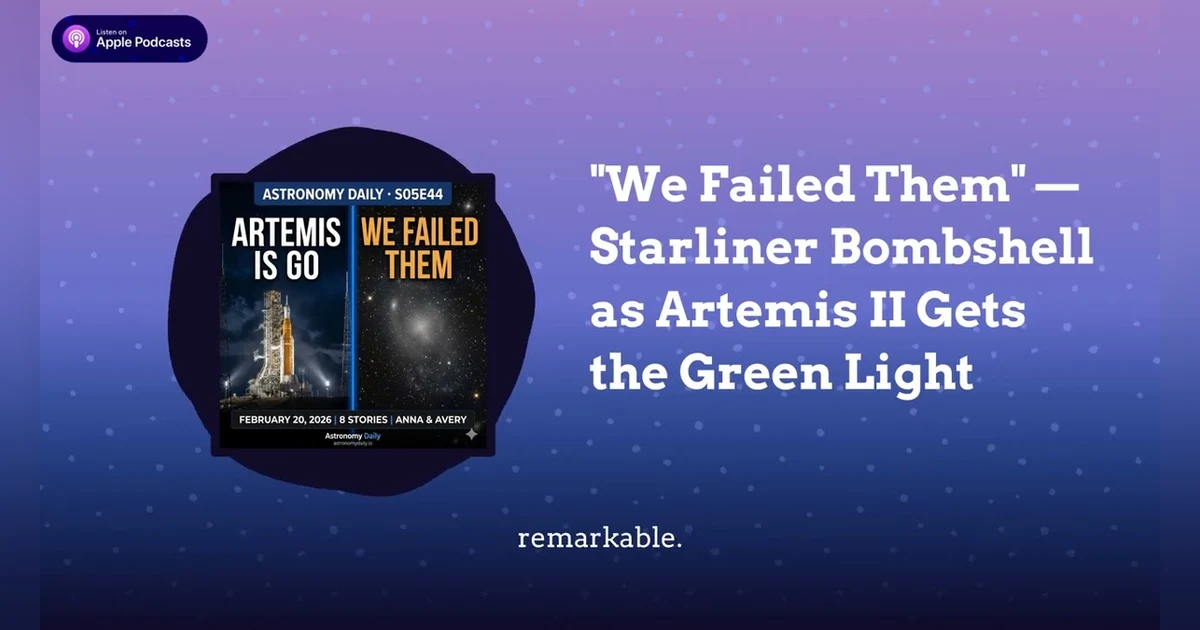


S05E44 | Friday, February 20, 2026 It's a big one today! We cover EIGHT stories including breaking news from NASA's Kennedy Space Center, a damning independent report into the Boeing Starliner crisis, two astonishing dark matter discoveries, the first ancient Jellyfish Galaxy, SpaceX rocket pollution science, and a cosmic farewell to a comet we'll never see again. Plus — yes — we briefly and responsibly address the UFO/UAP conversation. Stories in this episode: • Artemis II Wet Dress Rehearsal — Did NASA just clear the path to a March 6 launch? • Starliner Independent Report — NASA says 'we failed them' as Type A mishap is confirmed • UAP Files — Trump hints at declassification: should we get excited? • Hubble finds CDG-2: the most dark matter-dominated galaxy ever discovered • Jellyfish Galaxy spotted 5 billion years after the Big Bang — earlier than thought possible • First real-time observation of SpaceX rocket re-entry pollution cloud • First confirmed dark galaxy — a structure with no stars at all • Comet Wierzchoś at closest approach today — and it's never coming back
🌐 astronomydaily.io | 📱 @AstroDailyPod | Part of the Bitesz.com Podcast Network
Become a supporter of this podcast: https://www.spreaker.com/podcast/astronomy-daily-space-news-updates--5648921/support (https://www.spreaker.com/podcast/astronomy-daily-space-news-updates--5648921/support?utm_source=rss&utm_medium=rss&utm_campaign=rss) .
Sponsor Details:
Ensure your online privacy by using NordVPN . To get our special listener deal and save a lot of money, visit You'll be glad you did!
Become a supporter of Astronomy Daily by joining our Supporters Club. Commercial free episodes daily are only a click way... Click Here (https://www.spreaker.com/podcast/astronomy-daily-space-news-updates--5648921/support)
This episode includes AI-generated content.
Episode link: https://play.headliner.app/episode/31773666?utm_source=youtube
Kind: captions
Language: en
00:00:00.240 --> 00:00:02.629
Hello and welcome back to Astronomy
00:00:02.639 --> 00:00:04.309
Daily. I'm Anna.
00:00:04.319 --> 00:00:07.190
>> And I'm Avery. It's Friday, February the
00:00:07.200 --> 00:00:10.549
20th, 2026, and our producer has
00:00:10.559 --> 00:00:12.950
absolutely loaded us up today. We've got
00:00:12.960 --> 00:00:14.789
eight stories to get through.
00:00:14.799 --> 00:00:16.950
>> Eight. That's right. And honestly,
00:00:16.960 --> 00:00:19.269
they're all worth it. We've got huge
00:00:19.279 --> 00:00:21.029
breaking news from the Kennedy Space
00:00:21.039 --> 00:00:24.070
Center about Artemis 2. A genuinely
00:00:24.080 --> 00:00:26.630
damning report that NASA itself has
00:00:26.640 --> 00:00:29.509
described as we failed them. some
00:00:29.519 --> 00:00:31.910
absolutely mindbending deep space
00:00:31.920 --> 00:00:34.870
discoveries. And yes, we are going to
00:00:34.880 --> 00:00:37.430
briefly talk about UFOs.
00:00:37.440 --> 00:00:40.310
>> We absolutely are. Just briefly and
00:00:40.320 --> 00:00:41.590
responsibly.
00:00:41.600 --> 00:00:44.229
>> Responsibly. That is the word. Right.
00:00:44.239 --> 00:00:46.229
Let's dive in. There is a lot of ground
00:00:46.239 --> 00:00:47.110
to cover.
00:00:47.120 --> 00:00:48.549
>> I think this might be the biggest
00:00:48.559 --> 00:00:50.630
episode we've ever done, but there's
00:00:50.640 --> 00:00:52.229
plenty to cover today.
00:00:52.239 --> 00:00:54.150
>> We are going to start with the biggest
00:00:54.160 --> 00:00:56.229
space story of the week, and it's one
00:00:56.239 --> 00:00:58.790
that broke overnight. NASA has just
00:00:58.800 --> 00:01:01.189
completed its second wet dress rehearsal
00:01:01.199 --> 00:01:03.430
of the Aremis 2 space launch system
00:01:03.440 --> 00:01:05.350
rocket. And from everything we're
00:01:05.360 --> 00:01:07.109
hearing, it went well.
00:01:07.119 --> 00:01:09.910
>> Really well, actually. Teams ran the SLS
00:01:09.920 --> 00:01:11.990
through a full countdown, fueling the
00:01:12.000 --> 00:01:13.990
rocket with its super cold liquid
00:01:14.000 --> 00:01:16.710
hydrogen and liquid oxygen, simulating
00:01:16.720 --> 00:01:18.870
launch day procedures right down to
00:01:18.880 --> 00:01:21.510
closing the Orion crew codle hatch. And
00:01:21.520 --> 00:01:24.149
they got all the way to tminus 29
00:01:24.159 --> 00:01:26.469
seconds before wrapping up. That is
00:01:26.479 --> 00:01:28.710
exactly where they wanted to stop.
00:01:28.720 --> 00:01:31.590
>> And this matters enormously because the
00:01:31.600 --> 00:01:33.670
first wet dress rehearsal back on
00:01:33.680 --> 00:01:36.149
February 2nd and 3rd had to be called
00:01:36.159 --> 00:01:38.710
off early due to hydrogen fuel leaks at
00:01:38.720 --> 00:01:42.390
launchpad 39B. That was a setback. NASA
00:01:42.400 --> 00:01:44.870
had to go in and replace seals. And
00:01:44.880 --> 00:01:47.030
there was very real uncertainty about
00:01:47.040 --> 00:01:49.030
whether they'd solved the problem.
00:01:49.040 --> 00:01:51.510
>> And it looks like they have. NASA is
00:01:51.520 --> 00:01:53.350
holding a media briefing this morning,
00:01:53.360 --> 00:01:55.429
11:00 a.m. Eastern, and we'll be
00:01:55.439 --> 00:01:57.270
watching that closely, but the early
00:01:57.280 --> 00:01:58.709
word is positive.
00:01:58.719 --> 00:02:00.950
>> So, for anyone who needs a refresher on
00:02:00.960 --> 00:02:04.149
what this mission actually is, Artemis 2
00:02:04.159 --> 00:02:06.630
is the first crude flight of the Aremis
00:02:06.640 --> 00:02:09.270
program. It's not a moon landing that
00:02:09.280 --> 00:02:11.990
comes later with Artemis 3, but it is
00:02:12.000 --> 00:02:14.150
the first time humans will travel to
00:02:14.160 --> 00:02:19.190
lunar distance since Apollo 17 in 1972.
00:02:19.200 --> 00:02:22.150
We are talking more than 50 years.
00:02:22.160 --> 00:02:24.710
>> And the crew is commander Reed Weisman,
00:02:24.720 --> 00:02:27.510
pilot Victor Glover, mission specialist
00:02:27.520 --> 00:02:30.309
Christina all NASA, and mission
00:02:30.319 --> 00:02:32.229
specialist Jeremy Hansen from the
00:02:32.239 --> 00:02:34.390
Canadian Space Agency. They're going to
00:02:34.400 --> 00:02:36.390
fly around the moon in a free return
00:02:36.400 --> 00:02:39.589
trajectory and come home. 10 days, no
00:02:39.599 --> 00:02:42.150
landing, but an absolutely historic
00:02:42.160 --> 00:02:44.470
journey. And if this morning's press
00:02:44.480 --> 00:02:46.550
conference gives the all clear, the
00:02:46.560 --> 00:02:48.390
launch window we're looking at is as
00:02:48.400 --> 00:02:51.589
early as March 6th, that is just 2 weeks
00:02:51.599 --> 00:02:53.910
away. Avery, what does that feel like to
00:02:53.920 --> 00:02:54.630
you?
00:02:54.640 --> 00:02:57.589
>> Honestly, it feels surreal. We've been
00:02:57.599 --> 00:02:59.990
living in the Aremis era for years now.
00:03:00.000 --> 00:03:03.509
Artemis 1 flew in 2022, and it's been a
00:03:03.519 --> 00:03:05.910
long road to get here, but 2 weeks from
00:03:05.920 --> 00:03:08.070
now, there could be four astronauts on
00:03:08.080 --> 00:03:09.270
their way to the moon.
00:03:09.280 --> 00:03:11.190
>> We will have full coverage as things
00:03:11.200 --> 00:03:13.190
develop. And if that briefing produces
00:03:13.200 --> 00:03:15.350
any surprises, we'll update you in
00:03:15.360 --> 00:03:17.509
tomorrow's episode. For now though,
00:03:17.519 --> 00:03:19.830
looking very good for Artemis 3.
00:03:19.840 --> 00:03:21.830
>> Now, while NASA is very much in
00:03:21.840 --> 00:03:23.990
celebratory mode for this morning,
00:03:24.000 --> 00:03:26.229
yesterday they were facing a very
00:03:26.239 --> 00:03:28.149
different kind of news day, an
00:03:28.159 --> 00:03:30.070
independent review board released its
00:03:30.080 --> 00:03:32.390
full report into the Boeing Starlininer
00:03:32.400 --> 00:03:35.030
crude flight test, and it is a damning
00:03:35.040 --> 00:03:35.990
document.
00:03:36.000 --> 00:03:39.030
>> Damning is the word. The report formally
00:03:39.040 --> 00:03:41.509
classifies the Starlininer mission as a
00:03:41.519 --> 00:03:45.110
quote typea mishap, the most serious
00:03:45.120 --> 00:03:47.509
category in NASA's safety framework.
00:03:47.519 --> 00:03:49.190
That means it was an event that could
00:03:49.200 --> 00:03:51.509
have resulted in death or permanent
00:03:51.519 --> 00:03:54.470
disability. And NASA administrator Jared
00:03:54.480 --> 00:03:56.470
Isaacman stood up in front of the
00:03:56.480 --> 00:03:58.869
cameras yesterday and said, and I'm
00:03:58.879 --> 00:04:02.070
paraphrasing here, "We almost did have a
00:04:02.080 --> 00:04:05.270
really terrible day. We failed them."
00:04:05.280 --> 00:04:07.750
them being astronauts Butch Wilmore and
00:04:07.760 --> 00:04:11.190
Sunni Williams who launched in June 2024
00:04:11.200 --> 00:04:13.830
expecting to be gone for 8 to 10 days
00:04:13.840 --> 00:04:16.789
and ended up spending $286
00:04:16.799 --> 00:04:18.310
days in orbit.
00:04:18.320 --> 00:04:20.550
>> Right? So, let's just remind listeners
00:04:20.560 --> 00:04:23.590
how we got here. Boeing won a $4.2
00:04:23.600 --> 00:04:26.950
billion contract from NASA back in 2014
00:04:26.960 --> 00:04:29.030
to build the Star Liner as a second
00:04:29.040 --> 00:04:31.590
commercial crew vehicle alongside Spac
00:04:31.600 --> 00:04:34.469
X's Crew Dragon. Starlininer ran into
00:04:34.479 --> 00:04:36.790
problems on its very first uncrrewed
00:04:36.800 --> 00:04:39.670
test flight in 2019, needed a second
00:04:39.680 --> 00:04:41.670
unpiloted flight before it was deemed
00:04:41.680 --> 00:04:44.150
ready, and Butch and Sunni finally
00:04:44.160 --> 00:04:46.310
launched in June of last year.
00:04:46.320 --> 00:04:48.550
>> The trip up went okay. They docked
00:04:48.560 --> 00:04:50.150
successfully with the International
00:04:50.160 --> 00:04:52.469
Space Station. But during the rendevous
00:04:52.479 --> 00:04:54.469
approach, the capsule experienced
00:04:54.479 --> 00:04:56.550
multiple helium leaks in the propulsion
00:04:56.560 --> 00:04:58.790
system and several of the maneuvering
00:04:58.800 --> 00:05:00.870
thrusters failed. There was a moment
00:05:00.880 --> 00:05:02.629
where they temporarily lost what a
00:05:02.639 --> 00:05:04.950
report calls six degrees of freedom
00:05:04.960 --> 00:05:07.270
control. Had things gone differently in
00:05:07.280 --> 00:05:09.350
those minutes. Had the thrusters not
00:05:09.360 --> 00:05:11.350
recovered, docking might not have been
00:05:11.360 --> 00:05:13.350
possible. And what's really chilling
00:05:13.360 --> 00:05:15.590
about reading the report is discovering
00:05:15.600 --> 00:05:18.230
just how many warning signs were there.
00:05:18.240 --> 00:05:20.550
The investigation found that NASA and
00:05:20.560 --> 00:05:22.629
Boeing were aware of concerns that
00:05:22.639 --> 00:05:24.710
weren't fully understood but were
00:05:24.720 --> 00:05:26.550
considered acceptable for flight.
00:05:26.560 --> 00:05:28.390
Anyway, there was pressure,
00:05:28.400 --> 00:05:30.310
institutional pressure to make this
00:05:30.320 --> 00:05:32.550
mission succeed because the entire
00:05:32.560 --> 00:05:34.790
commercial crew program's credibility
00:05:34.800 --> 00:05:37.189
depended on having two viable crew
00:05:37.199 --> 00:05:40.230
vehicles. The report quotes unnamed NASA
00:05:40.240 --> 00:05:42.310
personnel saying things like, "There was
00:05:42.320 --> 00:05:44.550
yelling in meetings. It was emotionally
00:05:44.560 --> 00:05:47.189
charged and unproductive. And if you
00:05:47.199 --> 00:05:48.469
weren't aligned with the desired
00:05:48.479 --> 00:05:50.790
outcome, your input was filtered out or
00:05:50.800 --> 00:05:53.189
dismissed." One person said they stopped
00:05:53.199 --> 00:05:55.110
speaking up entirely because they knew
00:05:55.120 --> 00:05:56.390
they'd be dismissed.
00:05:56.400 --> 00:05:58.629
>> That is a profoundly troubling portrait
00:05:58.639 --> 00:06:01.110
of an organization under pressure. And
00:06:01.120 --> 00:06:03.830
what makes it worse is this. One NASA
00:06:03.840 --> 00:06:05.749
worker told the investigation panel
00:06:05.759 --> 00:06:08.150
roughly 11 months after the mission,
00:06:08.160 --> 00:06:10.950
"Nobody within NASA or outside of NASA
00:06:10.960 --> 00:06:13.510
has been held accountable. Nobody."
00:06:13.520 --> 00:06:15.350
>> Administrator Isaacman addressed that
00:06:15.360 --> 00:06:17.270
headon. He said there will be
00:06:17.280 --> 00:06:19.189
accountability. He said the report
00:06:19.199 --> 00:06:21.189
reveals that advocacy for the mission
00:06:21.199 --> 00:06:24.230
success quote exceeded reasonable bounds
00:06:24.240 --> 00:06:26.710
and placed the mission, the crew and
00:06:26.720 --> 00:06:29.749
America's space program at risk. He also
00:06:29.759 --> 00:06:31.670
made clear that NASA will not fly
00:06:31.680 --> 00:06:33.830
another crew on Starlininer until the
00:06:33.840 --> 00:06:35.990
technical causes are understood. The
00:06:36.000 --> 00:06:38.710
propulsion system is fully qualified and
00:06:38.720 --> 00:06:41.350
all 61 recommendations from this report
00:06:41.360 --> 00:06:44.629
are implemented. 61 recommendations
00:06:44.639 --> 00:06:47.029
spanning technical, organizational, and
00:06:47.039 --> 00:06:49.749
cultural domains. Boeing, for its part,
00:06:49.759 --> 00:06:51.670
said they've made substantial progress
00:06:51.680 --> 00:06:54.469
and driven significant cultural changes.
00:06:54.479 --> 00:06:55.350
We'll see.
00:06:55.360 --> 00:06:57.510
>> It's worth noting Butch and Sunni are
00:06:57.520 --> 00:06:59.830
safe. They got home in a SpaceX Crew
00:06:59.840 --> 00:07:02.550
Dragon in early 2025 and have since
00:07:02.560 --> 00:07:05.110
retired from NASA. But this report is a
00:07:05.120 --> 00:07:07.350
stark reminder of just how close things
00:07:07.360 --> 00:07:09.589
came to going very wrong and how
00:07:09.599 --> 00:07:11.189
important it is that the lessons are
00:07:11.199 --> 00:07:12.230
actually learned.
00:07:12.240 --> 00:07:14.150
>> One more thing before we move on.
00:07:14.160 --> 00:07:16.790
Isaacman confirmed the eventual cost of
00:07:16.800 --> 00:07:19.430
Starlininer's wos exceeded the $2
00:07:19.440 --> 00:07:23.029
million typea mishap threshold by quote
00:07:23.039 --> 00:07:25.589
a hundfold. So, not just a safety
00:07:25.599 --> 00:07:28.629
crisis, an enormous financial one, too.
00:07:28.639 --> 00:07:30.309
>> All right, we promised you this and here
00:07:30.319 --> 00:07:32.469
it is. President Trump has been making
00:07:32.479 --> 00:07:35.270
noise again about UAPs, unidentified
00:07:35.280 --> 00:07:37.749
aerial phenomena, and the possibility of
00:07:37.759 --> 00:07:40.150
releasing classified government files,
00:07:40.160 --> 00:07:42.550
including apparently what's actually
00:07:42.560 --> 00:07:44.390
going on at Area 51.
00:07:44.400 --> 00:07:46.469
>> And look, the serious astronomy
00:07:46.479 --> 00:07:48.469
community broadly keeps its distance
00:07:48.479 --> 00:07:50.790
from this territory for good reasons. We
00:07:50.800 --> 00:07:52.390
are not going to go deep on it today
00:07:52.400 --> 00:07:54.790
because there is genuinely not much new
00:07:54.800 --> 00:07:57.350
substance to report yet. It's hints and
00:07:57.360 --> 00:07:59.029
statements rather than actual
00:07:59.039 --> 00:08:00.629
declassification.
00:08:00.639 --> 00:08:03.189
But, and this is an honest butt, if
00:08:03.199 --> 00:08:05.589
genuine classified data about UAP
00:08:05.599 --> 00:08:07.830
encounters were actually released in a
00:08:07.840 --> 00:08:11.029
verifiable, scientifically usable form,
00:08:11.039 --> 00:08:13.749
that would be worth serious examination.
00:08:13.759 --> 00:08:15.589
The scientific community has actually
00:08:15.599 --> 00:08:17.589
been pushing for more transparency in
00:08:17.599 --> 00:08:20.309
this area for years. The issue has never
00:08:20.319 --> 00:08:22.390
been whether UFOs are real as a
00:08:22.400 --> 00:08:24.390
phenomenon. There are clearly things
00:08:24.400 --> 00:08:26.469
being observed that pilots and sensors
00:08:26.479 --> 00:08:29.189
can't immediately explain. The question
00:08:29.199 --> 00:08:31.430
is what they actually are.
00:08:31.440 --> 00:08:33.990
>> Right? And the history of these big
00:08:34.000 --> 00:08:36.870
reveals is, shall we say, not
00:08:36.880 --> 00:08:39.350
encouraging. You get a lot of heavily
00:08:39.360 --> 00:08:41.750
redacted documents, a lot of blurry
00:08:41.760 --> 00:08:44.710
footage, and then not much.
00:08:44.720 --> 00:08:47.829
>> Area 51, though, that is a name. If
00:08:47.839 --> 00:08:49.670
files about what's actually been going
00:08:49.680 --> 00:08:51.509
on out there in the Nevada desert come
00:08:51.519 --> 00:08:54.150
out, even if it's all just experimental
00:08:54.160 --> 00:08:56.070
aircraft, that's going to be a
00:08:56.080 --> 00:08:58.470
fascinating day. Regardless, we will
00:08:58.480 --> 00:09:01.110
watch this space. Pun intended. If
00:09:01.120 --> 00:09:03.110
something genuinely newsworthy emerges
00:09:03.120 --> 00:09:05.670
from the UAP file story, we will cover
00:09:05.680 --> 00:09:08.389
it properly. For now, back to the actual
00:09:08.399 --> 00:09:09.509
cosmos.
00:09:09.519 --> 00:09:11.829
>> Now, this is one of those stories that
00:09:11.839 --> 00:09:13.509
really makes you stop and think about
00:09:13.519 --> 00:09:16.470
how strange the universe is. NASA's
00:09:16.480 --> 00:09:18.310
Hubble Space Telescope has identified
00:09:18.320 --> 00:09:20.710
what may be the most heavily dark matter
00:09:20.720 --> 00:09:23.509
dominated galaxy ever discovered. The
00:09:23.519 --> 00:09:27.590
object is called CDG2 and CDG stands for
00:09:27.600 --> 00:09:30.550
circumgalactic diffused galaxy which is
00:09:30.560 --> 00:09:33.030
already a fascinating description. It's
00:09:33.040 --> 00:09:35.509
an extraordinarily faint low surface
00:09:35.519 --> 00:09:37.509
brightness galaxy that's basically
00:09:37.519 --> 00:09:39.829
invisible when you look at it. There are
00:09:39.839 --> 00:09:42.870
only a sparse scattering of faint stars,
00:09:42.880 --> 00:09:44.630
but according to the measurements, the
00:09:44.640 --> 00:09:47.110
vast majority of its total mass is dark
00:09:47.120 --> 00:09:49.509
matter. We should take a moment here to
00:09:49.519 --> 00:09:51.670
explain what dark matter actually is.
00:09:51.680 --> 00:09:54.150
For anyone who's new to the show, dark
00:09:54.160 --> 00:09:56.150
matter is a name we give to whatever
00:09:56.160 --> 00:09:57.829
makes up most of the mass of the
00:09:57.839 --> 00:10:00.389
universe that we can't see, can't detect
00:10:00.399 --> 00:10:03.509
directly, and don't fully understand. We
00:10:03.519 --> 00:10:05.110
know it exists because of its
00:10:05.120 --> 00:10:07.509
gravitational effects. The way galaxies
00:10:07.519 --> 00:10:09.750
rotate, the way light bends around
00:10:09.760 --> 00:10:12.389
galaxy clusters, but beyond that, it
00:10:12.399 --> 00:10:14.069
remains one of the great unsolved
00:10:14.079 --> 00:10:15.509
problems in physics.
00:10:15.519 --> 00:10:18.630
>> And CDG2 is interesting because it seems
00:10:18.640 --> 00:10:21.269
to be almost entirely dark matter. The
00:10:21.279 --> 00:10:23.670
few stars it contains are almost an
00:10:23.680 --> 00:10:25.910
afterthought. It's like finding a house
00:10:25.920 --> 00:10:27.829
that's built almost entirely of
00:10:27.839 --> 00:10:30.230
invisible walls. You can only see the
00:10:30.240 --> 00:10:32.790
wallpaper. What makes this particularly
00:10:32.800 --> 00:10:34.870
significant is that we've long theorized
00:10:34.880 --> 00:10:37.670
that galaxies like this should exist. In
00:10:37.680 --> 00:10:39.910
the standard model of cosmology, dark
00:10:39.920 --> 00:10:41.829
matter forms the scaffolding that
00:10:41.839 --> 00:10:45.509
ordinary matter, gas, stars, planets,
00:10:45.519 --> 00:10:48.389
falls into and clumps around. But most
00:10:48.399 --> 00:10:50.310
galaxies have converted a good portion
00:10:50.320 --> 00:10:53.910
of that gas into stars by now. CDG2
00:10:53.920 --> 00:10:56.069
seems to have barely bothered.
00:10:56.079 --> 00:10:59.269
>> The question is why? Why did so little
00:10:59.279 --> 00:11:01.509
star formation occur here? Was it
00:11:01.519 --> 00:11:03.750
stripped of its gas by interactions with
00:11:03.760 --> 00:11:05.910
neighboring galaxies? Is it in an
00:11:05.920 --> 00:11:08.470
unusually isolated environment? Those
00:11:08.480 --> 00:11:09.750
are the questions that will keep
00:11:09.760 --> 00:11:12.230
astronomers busy for a while, but as a
00:11:12.240 --> 00:11:14.470
window into dark matter's dominant role
00:11:14.480 --> 00:11:16.949
in shaping the cosmos. This one is
00:11:16.959 --> 00:11:18.150
remarkable.
00:11:18.160 --> 00:11:19.590
>> Amen to that.
00:11:19.600 --> 00:11:22.389
>> From one galaxy mystery to another,
00:11:22.399 --> 00:11:24.470
astronomers have spotted a candidate
00:11:24.480 --> 00:11:26.630
jellyfish galaxy. One of the most
00:11:26.640 --> 00:11:28.870
visually striking types of galaxies we
00:11:28.880 --> 00:11:31.750
know of, dating back to just 5 billion
00:11:31.760 --> 00:11:34.069
years after the Big Bang. And the reason
00:11:34.079 --> 00:11:36.310
this is extraordinary is because theory
00:11:36.320 --> 00:11:38.710
said this shouldn't be possible. Let me
00:11:38.720 --> 00:11:41.030
explain what a jellyfish galaxy is for
00:11:41.040 --> 00:11:43.190
anyone picturing an actual jellyfish
00:11:43.200 --> 00:11:45.269
floating through space, which honestly
00:11:45.279 --> 00:11:48.150
is not a bad mental image. A jellyfish
00:11:48.160 --> 00:11:50.069
galaxy gets its name from the long
00:11:50.079 --> 00:11:52.470
streamers of gas and young stars that
00:11:52.480 --> 00:11:54.949
trail behind it like tentacles. They
00:11:54.959 --> 00:11:56.949
form through a process called RAM
00:11:56.959 --> 00:11:58.230
pressure stripping.
00:11:58.240 --> 00:12:00.470
>> Ram pressure stripping is essentially
00:12:00.480 --> 00:12:02.310
what happens when a galaxy moves through
00:12:02.320 --> 00:12:05.110
the hot diffused gas that fills galaxy
00:12:05.120 --> 00:12:07.110
clusters. What astronomers call the
00:12:07.120 --> 00:12:09.590
intercluster medium. The galaxy is
00:12:09.600 --> 00:12:11.910
moving so fast through this medium that
00:12:11.920 --> 00:12:14.230
it gets the cosmic equivalent of a blast
00:12:14.240 --> 00:12:16.310
of wind from the front and the gas in
00:12:16.320 --> 00:12:18.949
its outer regions gets blown backwards
00:12:18.959 --> 00:12:21.990
forming those trailing streams. Now, the
00:12:22.000 --> 00:12:24.470
reason this discovery is so significant
00:12:24.480 --> 00:12:26.389
is that RAM pressure stripping was
00:12:26.399 --> 00:12:28.150
thought to require a dense enough
00:12:28.160 --> 00:12:30.550
cluster environment to operate. And in
00:12:30.560 --> 00:12:32.790
the early universe, 5 billion years
00:12:32.800 --> 00:12:35.110
after the Big Bang, clusters weren't
00:12:35.120 --> 00:12:37.350
expected to be dense enough yet. The
00:12:37.360 --> 00:12:39.829
universe was younger, less evolved.
00:12:39.839 --> 00:12:41.590
Clusters were less mature.
00:12:41.600 --> 00:12:44.069
>> And yet, here we have what looks like a
00:12:44.079 --> 00:12:46.790
fully formed jellyfish galaxy from that
00:12:46.800 --> 00:12:49.590
early era. It challenges our timeline of
00:12:49.600 --> 00:12:52.069
how galaxy clusters developed and how
00:12:52.079 --> 00:12:54.230
RAM pressure stripping operated in the
00:12:54.240 --> 00:12:55.509
young universe.
00:12:55.519 --> 00:12:58.310
>> There's also a bonus mystery here. The
00:12:58.320 --> 00:12:59.990
discovery may shed light on the
00:13:00.000 --> 00:13:03.190
so-called red nugget galaxies. Compact
00:13:03.200 --> 00:13:05.430
red massive galaxies from the early
00:13:05.440 --> 00:13:07.430
universe that have puzzled astronomers
00:13:07.440 --> 00:13:09.910
for years. The theory is that RAM
00:13:09.920 --> 00:13:12.150
pressure stripping in jellyfish galaxies
00:13:12.160 --> 00:13:13.829
could be one of the mechanisms that
00:13:13.839 --> 00:13:16.310
transform normal star forming galaxies
00:13:16.320 --> 00:13:19.190
into those quiescent red nuggets. If
00:13:19.200 --> 00:13:21.829
confirmed, this single galaxy could be a
00:13:21.839 --> 00:13:23.750
crucial missing link in understanding
00:13:23.760 --> 00:13:25.509
how galaxies evolve.
00:13:25.519 --> 00:13:27.910
>> It does still need to be confirmed. It's
00:13:27.920 --> 00:13:30.069
officially a candidate at this stage,
00:13:30.079 --> 00:13:32.150
but the evidence looks strong, and this
00:13:32.160 --> 00:13:33.990
is exactly the kind of thing that makes
00:13:34.000 --> 00:13:36.389
deep sky astronomy so endlessly
00:13:36.399 --> 00:13:38.629
fascinating. All right, here's a story
00:13:38.639 --> 00:13:40.470
that's a little different in flavor.
00:13:40.480 --> 00:13:44.550
It's part wow, cool science, part should
00:13:44.560 --> 00:13:45.910
we be thinking about this more
00:13:45.920 --> 00:13:49.110
carefully? Yes. For the first time ever,
00:13:49.120 --> 00:13:51.269
scientists have observed a cloud of air
00:13:51.279 --> 00:13:54.150
pollution forming in near real time as a
00:13:54.160 --> 00:13:56.550
SpaceX rocket burned up during re-entry
00:13:56.560 --> 00:13:58.870
into Earth's atmosphere. And I want to
00:13:58.880 --> 00:14:00.949
be clear about what we mean by burned up
00:14:00.959 --> 00:14:03.509
here. This isn't a failed mission. This
00:14:03.519 --> 00:14:05.670
is the normal end of life process for a
00:14:05.680 --> 00:14:07.750
rocket stage where it re-enters the
00:14:07.760 --> 00:14:09.670
atmosphere and disintegrates through the
00:14:09.680 --> 00:14:11.030
heat of re-entry.
00:14:11.040 --> 00:14:13.110
>> So these things happen routinely and
00:14:13.120 --> 00:14:15.509
what scientists have now been able to do
00:14:15.519 --> 00:14:17.910
using atmospheric monitoring instruments
00:14:17.920 --> 00:14:20.629
is actually watch in something close to
00:14:20.639 --> 00:14:23.430
real time the chemical cloud that forms
00:14:23.440 --> 00:14:25.829
as the rocket material vaporizes.
00:14:25.839 --> 00:14:28.389
Metals, aluminum oxide particles,
00:14:28.399 --> 00:14:30.870
various combustion products, all of it
00:14:30.880 --> 00:14:33.110
lighting up in the instruments. And this
00:14:33.120 --> 00:14:34.790
matters because we're launching things
00:14:34.800 --> 00:14:38.069
at an everinccreasing rate. SpaceX alone
00:14:38.079 --> 00:14:40.069
is launching dozens of missions per
00:14:40.079 --> 00:14:42.949
year. If every re-entry deposits a cloud
00:14:42.959 --> 00:14:44.790
of metallic particles and other
00:14:44.800 --> 00:14:47.030
pollutants into the upper atmosphere,
00:14:47.040 --> 00:14:49.110
and we're doing this hundreds of times a
00:14:49.120 --> 00:14:51.430
year, what does that add up to over a
00:14:51.440 --> 00:14:52.230
decade?
00:14:52.240 --> 00:14:54.790
>> The honest answer right now is we don't
00:14:54.800 --> 00:14:57.269
fully know. This is genuinely new
00:14:57.279 --> 00:14:59.509
science. Researchers have been raising
00:14:59.519 --> 00:15:01.430
concerns about the potential impact of
00:15:01.440 --> 00:15:03.590
rocket exhaust and re-entry pollution in
00:15:03.600 --> 00:15:05.670
the stratosphere for a few years now,
00:15:05.680 --> 00:15:07.670
but being able to observe it in real
00:15:07.680 --> 00:15:10.150
time to actually characterize what's
00:15:10.160 --> 00:15:12.629
happening is a significant step towards
00:15:12.639 --> 00:15:14.949
understanding the cumulative effect.
00:15:14.959 --> 00:15:16.550
>> It's one of those stories where the
00:15:16.560 --> 00:15:19.189
science itself is fascinating, but the
00:15:19.199 --> 00:15:21.189
implications quietly deserve more
00:15:21.199 --> 00:15:22.790
attention than they're getting. The
00:15:22.800 --> 00:15:24.949
space economy is booming. That's
00:15:24.959 --> 00:15:27.350
wonderful in many ways, but what are the
00:15:27.360 --> 00:15:29.509
environmental costs of a high cadence
00:15:29.519 --> 00:15:31.910
launch industry is a question that needs
00:15:31.920 --> 00:15:34.150
answering and researchers are now
00:15:34.160 --> 00:15:36.069
developing the tools to start answering
00:15:36.079 --> 00:15:38.629
it. Something to watch and full credit
00:15:38.639 --> 00:15:40.069
to the scientists making these
00:15:40.079 --> 00:15:42.550
observations. Pioneering work.
00:15:42.560 --> 00:15:44.870
>> Now we come to a story that, and I say
00:15:44.880 --> 00:15:47.829
this with genuine enthusiasm, is about
00:15:47.839 --> 00:15:50.550
as mindbending as astronomy gets.
00:15:50.560 --> 00:15:52.949
Researchers may have confirmed the very
00:15:52.959 --> 00:15:55.910
first true dark galaxy. Not just a
00:15:55.920 --> 00:15:58.310
galaxy dominated by dark matter like
00:15:58.320 --> 00:16:01.430
CDG2 we discussed earlier, but a galaxy
00:16:01.440 --> 00:16:04.310
made almost entirely of dark matter with
00:16:04.320 --> 00:16:06.710
effectively no stars at all.
00:16:06.720 --> 00:16:09.509
>> A dark galaxy in theory is a region of
00:16:09.519 --> 00:16:11.350
space where dark matter has clumped
00:16:11.360 --> 00:16:13.990
together in sufficient quantity to form
00:16:14.000 --> 00:16:16.470
a gravitationally bound structure.
00:16:16.480 --> 00:16:19.030
essentially a galaxyshaped thing, but
00:16:19.040 --> 00:16:21.350
where ordinary matter has never clumped
00:16:21.360 --> 00:16:23.829
enough to form stars or has been
00:16:23.839 --> 00:16:26.710
stripped away entirely. We've theorized
00:16:26.720 --> 00:16:28.949
they should exist for decades, and now
00:16:28.959 --> 00:16:30.949
we may finally have one.
00:16:30.959 --> 00:16:33.749
>> I want to sit with that for a second. A
00:16:33.759 --> 00:16:36.550
galaxy, a structure that has all the
00:16:36.560 --> 00:16:39.509
gravitational signatures of a galaxy
00:16:39.519 --> 00:16:42.389
with no stars in it. You literally
00:16:42.399 --> 00:16:44.389
cannot see it with any optical
00:16:44.399 --> 00:16:47.509
telescope. It's detectable only by its
00:16:47.519 --> 00:16:50.550
gravitational effects on nearby visible
00:16:50.560 --> 00:16:51.509
matter.
00:16:51.519 --> 00:16:53.829
>> It's like detecting a ghost by watching
00:16:53.839 --> 00:16:55.829
how other people react to the room it's
00:16:55.839 --> 00:16:56.870
standing in.
00:16:56.880 --> 00:16:59.110
>> That is exactly the right analogy.
00:16:59.120 --> 00:17:01.829
Actually, the way astronomers identify
00:17:01.839 --> 00:17:04.710
these objects is by looking at how their
00:17:04.720 --> 00:17:07.590
gravity warps the light and motion of
00:17:07.600 --> 00:17:10.230
surrounding galaxies. And when they do
00:17:10.240 --> 00:17:12.789
the maths on the candidate identified in
00:17:12.799 --> 00:17:15.590
this new research, the numbers point to
00:17:15.600 --> 00:17:18.789
a massive dark matter structure with
00:17:18.799 --> 00:17:21.669
essentially no luminous component.
00:17:21.679 --> 00:17:24.309
>> If confirmed, this would be a genuinely
00:17:24.319 --> 00:17:26.789
landmark moment in cosmology. We've
00:17:26.799 --> 00:17:28.630
known for decades that dark matter
00:17:28.640 --> 00:17:30.950
vastly outweighs ordinary matter in the
00:17:30.960 --> 00:17:34.470
universe, roughly 5:1. But actually
00:17:34.480 --> 00:17:36.870
finding a structure that is purely dark
00:17:36.880 --> 00:17:38.950
matter with no ordinary matter
00:17:38.960 --> 00:17:41.669
hitchhiking along inside it would be
00:17:41.679 --> 00:17:44.310
extraordinary observational proof of how
00:17:44.320 --> 00:17:46.070
dark matter can organize itself
00:17:46.080 --> 00:17:47.190
independently.
00:17:47.200 --> 00:17:49.590
>> The researchers are being appropriately
00:17:49.600 --> 00:17:52.150
cautious. This requires further
00:17:52.160 --> 00:17:54.070
confirmation and independent
00:17:54.080 --> 00:17:56.630
verification, but the evidence is
00:17:56.640 --> 00:17:58.710
compelling. We'll keep you posted as
00:17:58.720 --> 00:18:01.350
this one develops. And we close today
00:18:01.360 --> 00:18:03.190
with something a little different in
00:18:03.200 --> 00:18:05.669
mood, something poetic actually.
00:18:05.679 --> 00:18:10.150
>> Comet C/2024E1
00:18:10.160 --> 00:18:12.549
known as comet where Kosh after its
00:18:12.559 --> 00:18:14.870
discoverer. As we mentioned earlier in
00:18:14.880 --> 00:18:17.669
the week, is making its closest approach
00:18:17.679 --> 00:18:20.630
to Earth today. Right now, as you listen
00:18:20.640 --> 00:18:23.350
to this, the comet is passing at roughly
00:18:23.360 --> 00:18:26.390
the same distance from us as the sun,
00:18:26.400 --> 00:18:29.270
about one astronomical unit, and it's
00:18:29.280 --> 00:18:32.150
putting on a genuinely beautiful display
00:18:32.160 --> 00:18:34.789
for those with telescopes or binoculars
00:18:34.799 --> 00:18:36.390
in the right conditions.
00:18:36.400 --> 00:18:39.029
>> There are images out already, a gorgeous
00:18:39.039 --> 00:18:41.350
30inut exposure taken last week from
00:18:41.360 --> 00:18:44.789
Chile, showing a 5° long ion tail.
00:18:44.799 --> 00:18:46.950
That's 10 times the width of the full
00:18:46.960 --> 00:18:49.750
moon in the sky, plus three shorter dust
00:18:49.760 --> 00:18:52.789
tails. The coma of the comet glows green
00:18:52.799 --> 00:18:55.110
from the breakdown of dicarbon molecules
00:18:55.120 --> 00:18:56.310
by sunlight.
00:18:56.320 --> 00:18:58.630
>> But here's what makes this one special
00:18:58.640 --> 00:19:00.870
and why we wanted to close the show with
00:19:00.880 --> 00:19:04.710
it. Comet where Kosh is on a hyperbolic
00:19:04.720 --> 00:19:05.669
orbit,
00:19:05.679 --> 00:19:08.390
>> which means it is not coming back.
00:19:08.400 --> 00:19:11.350
>> It is not coming back. This comet has
00:19:11.360 --> 00:19:13.750
traveled from the outermost reaches of
00:19:13.760 --> 00:19:16.710
the solar system, swung around the sun,
00:19:16.720 --> 00:19:19.830
passed close by our little blue dot, and
00:19:19.840 --> 00:19:22.710
when it leaves, it will leave forever.
00:19:22.720 --> 00:19:25.110
Its orbit carries it out of the solar
00:19:25.120 --> 00:19:28.950
system entirely into interstellar space.
00:19:28.960 --> 00:19:31.350
It will become a wanderer between the
00:19:31.360 --> 00:19:32.230
stars.
00:19:32.240 --> 00:19:34.870
>> You know, we had 3i.atls ATLS this
00:19:34.880 --> 00:19:36.950
season. The interstellar object that
00:19:36.960 --> 00:19:38.470
came into our solar system from
00:19:38.480 --> 00:19:40.789
somewhere else entirely. That was a
00:19:40.799 --> 00:19:43.669
visitor from interstellar space. Comet
00:19:43.679 --> 00:19:46.070
where Kosh is going the other direction.
00:19:46.080 --> 00:19:48.870
It's leaving. We're waving goodbye to a
00:19:48.880 --> 00:19:52.310
comet that no human will ever see again.
00:19:52.320 --> 00:19:55.350
And I find that genuinely moving. So, if
00:19:55.360 --> 00:19:57.669
you have clear skies tonight or this
00:19:57.679 --> 00:20:00.150
weekend and you can get to a dark spot
00:20:00.160 --> 00:20:02.789
with a pair of binoculars, it is worth
00:20:02.799 --> 00:20:05.190
trying to find it. Check the astronomy
00:20:05.200 --> 00:20:07.669
apps for its exact position. It is
00:20:07.679 --> 00:20:09.270
bright enough to see.
00:20:09.280 --> 00:20:12.310
>> Last chance, a cosmic farewell.
00:20:12.320 --> 00:20:15.110
>> And that's a wrap on a genuinely packed
00:20:15.120 --> 00:20:17.750
episode of Astronomy Daily. Eight
00:20:17.760 --> 00:20:20.549
stories, breaking news, accountability
00:20:20.559 --> 00:20:23.430
journalism, mindbending deep space
00:20:23.440 --> 00:20:26.390
science, and a cosmic goodbye.
00:20:26.400 --> 00:20:28.149
>> Thank you so much for spending part of
00:20:28.159 --> 00:20:30.070
your Friday with us. If you enjoyed
00:20:30.080 --> 00:20:31.990
today's show, please do leave a review
00:20:32.000 --> 00:20:34.230
wherever you listen. It makes a huge
00:20:34.240 --> 00:20:35.990
difference in helping new listeners find
00:20:36.000 --> 00:20:36.630
us.
00:20:36.640 --> 00:20:39.830
>> You can find us at astronomyaily.io
00:20:39.840 --> 00:20:42.230
for the blog and show notes, and we're
00:20:42.240 --> 00:20:45.190
at astroaily pod across all the social
00:20:45.200 --> 00:20:47.669
platforms. We'll see you again tomorrow.
00:20:47.679 --> 00:20:50.070
And if Artemis 2 gets a launch date
00:20:50.080 --> 00:20:52.470
confirmed today, we'll make sure that's
00:20:52.480 --> 00:20:53.830
front and center.
00:20:53.840 --> 00:20:56.230
>> Until then, keep looking up.
00:20:56.240 --> 00:21:08.870
>> Clear skies, everyone.
00:21:08.880 --> 00:21:12.679
Stories told.


