The Largest Galaxy in the Universe, Measured at Last
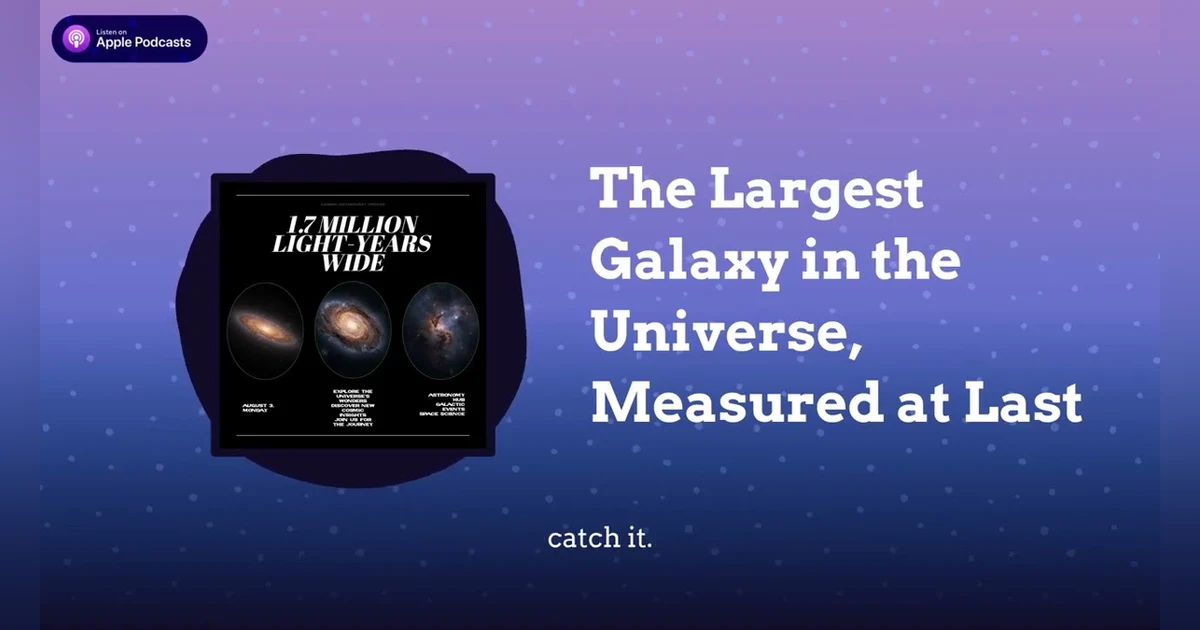


Astronomy Daily · S05E157 · “The Edge of Everything” · Monday 3 August 2026
In this episode • The largest galaxy, measured at last. Ultra-deep imaging of IC 1101 in the Abell 2029 cluster has traced its outer edge for the first time: an edge radius of ~260 kpc, a diameter near 520 kpc (~1.7 million light-years), and ~3.4 trillion solar masses in stars — about 17× the width of the Milky Way. Faint outer structures aligned with cluster X-ray disturbances show it is still accreting. Source: Marrero-de la Rosa et al., “How large can galaxies be? Ultra-deep imaging of IC 1101”, accepted A&A (arXiv:2607.15340, 16 Jul 2026); phys.org, 31 Jul 2026; The Debrief, 1 Aug 2026. • Hayabusa2's record asteroid flyby. JAXA confirmed (press conference 30 Jul) that its Hayabusa2 probe passed just 400 m from the surface of near-Earth asteroid Torifune on 5 July — 744 m from centre at 18,000 km/h — the closest asteroid flyby by any mission, plus the first-ever laser ranging of an asteroid during a flyby. Torifune proved to be a contact binary. Source: JAXA press conference, 30 Jul 2026; phys.org / Japan Today (AFP), 31 Jul 2026; autoevolution, 1 Aug 2026. • UK's first orbital launch on hold. Rocket Factory Augsburg de-stacked its RFA One at SaxaVord Spaceport (Unst, Shetland) after finding a vehicle issue during hot-fire test prep (announced 28 Jul). The certified launch window opens 10 August; a successful flight would be the first orbital launch from UK soil. Source: RFA statement (X), 28 Jul 2026; Space.com, 1 Aug 2026; Shetland Times, 28 Jul 2026. • Andromeda is winding down. A new Hubble study mapping ~200 million stars across two-thirds of Andromeda's disk finds star formation has declined over ~500 million years (from ~1 to ~0.2 solar masses/year), with the steepest drop in the last 40 million years — possibly linked to an interaction with satellite galaxy M32. Source: Williams et al., The Astrophysical Journal, 27 Jul 2026; NASA/STScI release, 27 Jul 2026. Skywatch — both hemispheres • Comet 10P/Tempel 2 — perihelion 2 Aug; closest approach to Earth tonight (3 Aug). Binoculars/small scope, dark skies. Best pre-dawn from the Southern Hemisphere; ~9:30–10:30 pm local for mid-northern latitudes before moonrise. • Moon near Saturn tonight (3 Aug) — naked-eye pairing, both hemispheres, up into dawn. • Mercury at greatest western elongation (2 Aug) — low eastern horizon ~1 hr before sunrise, toward Gemini; Mars higher. Better placed for northern observers. • Diary (2 days out): Falcon 9 upper stage (2025-010D) lunar impact near Einstein Crater, 5 Aug ~06:35 UTC — ~2:35 am EDT / 11:35 pm PDT (4 Aug); North America best-timed on the dark limb. Southern Hemisphere: ~4:35 pm AEST (daylight) — await orbiter after-images. • Looking ahead: 12 Aug total solar eclipse (Greenland/Iceland/Spain) + moonless Perseid peak + six-planet dawn alignment. View partial phases only through certified ISO 12312-2 filters. Links & follow • Website, back catalogue, news feed & newsletter: astronomydaily.io • Social: @AstroDailyPod · Part of the Bitesz.com Podcast Network
Become a supporter of this podcast: https://www.spreaker.com/podcast/astronomy-daily-latest-space-news--5648921/support (https://www.spreaker.com/podcast/astronomy-daily-latest-space-news--5648921/support?utm_source=rss&utm_medium=rss&utm_campaign=rss) .
Sponsor Details:
Ensure your online privacy by using NordVPN . To get our special listener deal and save a lot of money, visit You'll be glad you did!
Get the best secure and private email on the planet. Stop your Government, google and who knows who else spying on every email you write. Do what we did and use ProtonMail. They beleive in privacy and there are no ads in their business model...yet they still provide a free forever service. Check them out and get out special deal at www.astronomydaily.io/protonmail (https://www.astronomydaily.io/protonmail)
Become a supporter of Astronomy Daily by joining our Supporters Club. Commercial free episodes daily are only a click way... Click Here (https://www.spreaker.com/podcast/astronomy-daily-space-news-updates--5648921/support)
This episode includes AI-generated content.
Episode link: https://play.headliner.app/episode/34589076?utm_source=youtube
Kind: captions
Language: en
00:00:00.000 --> 00:00:01.590
Here's
00:00:01.600 --> 00:00:03.590
a question to start your week. [music]
00:00:03.600 --> 00:00:07.349
How big can a single thing actually get?
00:00:07.359 --> 00:00:10.230
Not a country, not [music] an ocean, one
00:00:10.240 --> 00:00:13.030
object held together as one.
00:00:13.040 --> 00:00:14.410
>> And I'm guessing you don't mean my
00:00:14.420 --> 00:00:15.910
[music] inbox.
00:00:15.920 --> 00:00:18.870
>> Bigger. Today, astronomers have finally
00:00:18.880 --> 00:00:20.950
put a tape measure around the largest
00:00:20.960 --> 00:00:23.670
[music] galaxy we know of and found its
00:00:23.680 --> 00:00:26.870
edge for the very first time. Plus, a
00:00:26.880 --> 00:00:28.710
Japanese spacecraft that just set the
00:00:28.720 --> 00:00:31.029
record for the closest asteroid flyby
00:00:31.039 --> 00:00:33.670
ever flown. A British launch put on hold
00:00:33.680 --> 00:00:35.750
at the last minute, and news that our
00:00:35.760 --> 00:00:38.389
nearest big neighbor galaxy is quietly
00:00:38.399 --> 00:00:39.830
powering down.
00:00:39.840 --> 00:00:42.549
>> It's Monday, the 3rd of August. This is
00:00:42.559 --> 00:00:45.110
Astronomy Daily. I'm Anna.
00:00:45.120 --> 00:00:47.350
>> And I'm Avery. Let's get into it.
00:00:47.360 --> 00:00:49.830
>> So, let's start with that tape measure.
00:00:49.840 --> 00:00:51.990
If I asked you to name the biggest
00:00:52.000 --> 00:00:54.389
galaxy in the universe, an astronomer
00:00:54.399 --> 00:00:58.229
would very likely say IC1101.
00:00:58.239 --> 00:01:00.470
And they've been saying it for decades.
00:01:00.480 --> 00:01:03.110
But here's the strange part. Until now,
00:01:03.120 --> 00:01:05.590
nobody could actually tell you where it
00:01:05.600 --> 00:01:06.710
ends.
00:01:06.720 --> 00:01:09.109
>> How do you not know where a galaxy ends?
00:01:09.119 --> 00:01:10.950
It's right there in the pictures.
00:01:10.960 --> 00:01:14.070
>> You'd think so. IC1101
00:01:14.080 --> 00:01:17.190
sits about 1.15 billion lighty years
00:01:17.200 --> 00:01:19.190
away at the heart of a cluster of
00:01:19.200 --> 00:01:22.710
galaxies called Abel 2029. William
00:01:22.720 --> 00:01:25.670
Herschel first logged it back in 1790,
00:01:25.680 --> 00:01:28.149
though of course he had no idea it was a
00:01:28.159 --> 00:01:31.670
galaxy. Nobody did until the 1920s. It's
00:01:31.680 --> 00:01:34.630
what we call a giant elliptical or more
00:01:34.640 --> 00:01:37.749
precisely a brightest cluster galaxy, a
00:01:37.759 --> 00:01:41.670
BCG. And BCGs are the great white sharks
00:01:41.680 --> 00:01:44.149
of the galaxy world. They sit at the
00:01:44.159 --> 00:01:46.389
center of a cluster and they grow by
00:01:46.399 --> 00:01:48.950
swallowing their neighbors one merger at
00:01:48.960 --> 00:01:51.590
a time over billions of years.
00:01:51.600 --> 00:01:53.670
>> So it's basically been eating the other
00:01:53.680 --> 00:01:55.429
galaxies in its cluster
00:01:55.439 --> 00:01:58.149
>> for most of cosmic history. Yes. And
00:01:58.159 --> 00:02:00.950
that's exactly why its edge is so hard
00:02:00.960 --> 00:02:03.510
to find. When a galaxy grows by
00:02:03.520 --> 00:02:06.149
cannibalizing others, it ends up wrapped
00:02:06.159 --> 00:02:09.190
in an enormous faint halo of stars.
00:02:09.200 --> 00:02:11.670
Stars flung out into the space between
00:02:11.680 --> 00:02:15.190
galaxies. That glow is so dim it blurs
00:02:15.200 --> 00:02:16.869
into the background of the cluster
00:02:16.879 --> 00:02:20.309
itself. So, the honest answer to how big
00:02:20.319 --> 00:02:22.790
is IC1101
00:02:22.800 --> 00:02:25.830
has for years been a shrug. You'll see
00:02:25.840 --> 00:02:28.150
figures online anywhere from about
00:02:28.160 --> 00:02:31.990
400,000 lightyear across to a wild 6
00:02:32.000 --> 00:02:34.470
million lightyear. Nobody could pin it
00:02:34.480 --> 00:02:35.270
down.
00:02:35.280 --> 00:02:37.190
>> That's not a rounding error. That's a
00:02:37.200 --> 00:02:39.990
factor of 15. So what changed?
00:02:40.000 --> 00:02:43.270
>> A team led by Carlos Morero de la Roza
00:02:43.280 --> 00:02:45.990
took the deepest images ever captured of
00:02:46.000 --> 00:02:49.270
this galaxy. Ultra deep exposures in two
00:02:49.280 --> 00:02:51.910
colors using the Isaac Newton's wide
00:02:51.920 --> 00:02:54.790
field camera. And when I say deep, I
00:02:54.800 --> 00:02:56.470
mean they were sensitive enough to
00:02:56.480 --> 00:02:59.750
detect a glow 30 magnitudes per square
00:02:59.760 --> 00:03:03.110
arcsec. Faint. In plain terms, they
00:03:03.120 --> 00:03:05.270
could pick out starlight roughly a
00:03:05.280 --> 00:03:07.589
billion times fainter than the night sky
00:03:07.599 --> 00:03:09.509
you'd see with your own eyes.
00:03:09.519 --> 00:03:11.589
>> And the trick is separating that whisper
00:03:11.599 --> 00:03:13.509
of light from everything else.
00:03:13.519 --> 00:03:16.229
>> That's the whole game. Bright foreground
00:03:16.239 --> 00:03:18.949
stars smear light across the image. The
00:03:18.959 --> 00:03:21.750
galaxy scatters its own light, too. So,
00:03:21.760 --> 00:03:24.149
they carefully modeled all that stray
00:03:24.159 --> 00:03:27.190
light and subtracted it using a detailed
00:03:27.200 --> 00:03:29.670
map of how the telescope spreads out a
00:03:29.680 --> 00:03:31.990
point of light. Only then could they
00:03:32.000 --> 00:03:34.710
trace the galaxy's true profile all the
00:03:34.720 --> 00:03:37.430
way out until it finally melts into the
00:03:37.440 --> 00:03:40.070
cluster. And here's what they found.
00:03:40.080 --> 00:03:41.990
IC1101
00:03:42.000 --> 00:03:45.430
reaches an edge about 260,000
00:03:45.440 --> 00:03:47.509
lighty years from its center which gives
00:03:47.519 --> 00:03:51.990
it a diameter of roughly 520 kiloparex.
00:03:52.000 --> 00:03:55.110
That's about 1.7 million lightyear from
00:03:55.120 --> 00:03:58.869
one side to the other holding around 3.4
00:03:58.879 --> 00:04:01.429
trillion suns worth of stars.
00:04:01.439 --> 00:04:03.589
>> Okay, I need a yard stick for that. How
00:04:03.599 --> 00:04:05.830
does it compare to us to the Milky Way?
00:04:05.840 --> 00:04:09.030
Our galaxy is about 100,000 lightyears
00:04:09.040 --> 00:04:12.070
across. So IC1101
00:04:12.080 --> 00:04:15.030
is something like 17 times wider than
00:04:15.040 --> 00:04:18.550
the Milky Way. And on mass, our entire
00:04:18.560 --> 00:04:21.189
galaxy, including all its dark matter,
00:04:21.199 --> 00:04:24.629
comes in around 1 to 1/2 trillion solar
00:04:24.639 --> 00:04:27.670
masses. IC1101
00:04:27.680 --> 00:04:30.469
has more than 3 trillion solar masses in
00:04:30.479 --> 00:04:34.150
its stars alone. It is by any measure we
00:04:34.160 --> 00:04:36.790
can now defend with data the largest
00:04:36.800 --> 00:04:38.390
galaxy known.
00:04:38.400 --> 00:04:41.270
>> You said now defend with data. That word
00:04:41.280 --> 00:04:43.350
now is doing some work.
00:04:43.360 --> 00:04:46.230
>> It is because the second finding is
00:04:46.240 --> 00:04:48.710
almost better than the first. This
00:04:48.720 --> 00:04:52.070
galaxy isn't finished. Beyond that main
00:04:52.080 --> 00:04:54.710
edge, the team spotted a scatter of
00:04:54.720 --> 00:04:58.150
faint lopsided structures. Eight of them
00:04:58.160 --> 00:05:00.310
and two line up neatly with
00:05:00.320 --> 00:05:02.710
disturbances. astronomers had already
00:05:02.720 --> 00:05:05.030
seen in the hot X-ray gas of the
00:05:05.040 --> 00:05:07.670
cluster. That's the fingerprint of
00:05:07.680 --> 00:05:11.590
ongoing feeding. IC 1101 is still
00:05:11.600 --> 00:05:15.189
pulling material in, still assembling,
00:05:15.199 --> 00:05:17.270
probably shaped by a collision with
00:05:17.280 --> 00:05:20.390
another group of galaxies 2 to 3 billion
00:05:20.400 --> 00:05:22.710
years ago that's still settling down
00:05:22.720 --> 00:05:23.590
today.
00:05:23.600 --> 00:05:25.909
>> So, it holds the record and it's still
00:05:25.919 --> 00:05:29.350
growing. That feels almost greedy. Which
00:05:29.360 --> 00:05:31.430
brings us to the real question in the
00:05:31.440 --> 00:05:34.710
paper's title. How large can galaxies
00:05:34.720 --> 00:05:39.029
actually get? Because IC 1101 now sits
00:05:39.039 --> 00:05:41.670
right at the extreme upper end of what
00:05:41.680 --> 00:05:44.550
we call the mass size relation. The
00:05:44.560 --> 00:05:47.110
biggest edge yet measured for any
00:05:47.120 --> 00:05:50.390
galaxy. It's not just a trivia record.
00:05:50.400 --> 00:05:52.550
It's a data point that tells us the
00:05:52.560 --> 00:05:55.749
ceiling for how big a galaxy can grow in
00:05:55.759 --> 00:05:59.590
the present-day universe. And IC 1101 is
00:05:59.600 --> 00:06:02.390
sitting up there brushing against it,
00:06:02.400 --> 00:06:03.990
still reaching.
00:06:04.000 --> 00:06:06.150
>> Can anyone actually see this monster for
00:06:06.160 --> 00:06:07.510
themselves?
00:06:07.520 --> 00:06:09.990
>> You'd want a good telescope. It's a
00:06:10.000 --> 00:06:11.990
faint smudge in the constellation
00:06:12.000 --> 00:06:14.550
serpents near the Virgo border.
00:06:14.560 --> 00:06:16.469
Wellplaced in the evening for both
00:06:16.479 --> 00:06:19.430
hemispheres right now. But honestly, the
00:06:19.440 --> 00:06:22.070
wonder here isn't in the eyepiece. It's
00:06:22.080 --> 00:06:24.870
the idea. Somewhere out there is an
00:06:24.880 --> 00:06:27.909
object nearly 2 million lighty years
00:06:27.919 --> 00:06:31.510
wide, three trillion stars strong, and
00:06:31.520 --> 00:06:34.309
it's still hungry. From the largest
00:06:34.319 --> 00:06:37.270
thing we know to a very small, very fast
00:06:37.280 --> 00:06:40.230
one, Japan's space agency, JAXA, held a
00:06:40.240 --> 00:06:42.150
press conference last Thursday to
00:06:42.160 --> 00:06:44.150
confirm a result that had asteroid
00:06:44.160 --> 00:06:46.870
scientists grinning. Their Hayabusa 2
00:06:46.880 --> 00:06:49.189
spacecraft has just flown the closest
00:06:49.199 --> 00:06:51.990
asteroid flyby ever attempted by any
00:06:52.000 --> 00:06:53.029
mission.
00:06:53.039 --> 00:06:55.270
>> This is the same spacecraft that brought
00:06:55.280 --> 00:06:58.150
samples of asteroid Ryugu back to Earth,
00:06:58.160 --> 00:06:59.110
isn't it?
00:06:59.120 --> 00:07:01.990
>> The very same. Hayabusa 2 launched back
00:07:02.000 --> 00:07:04.790
in 2014, dropped those precious Ryugule
00:07:04.800 --> 00:07:06.550
samples in the Australian outback in
00:07:06.560 --> 00:07:09.110
2020, and then with fuel still in the
00:07:09.120 --> 00:07:11.990
tank, kept going. It's now traveled
00:07:12.000 --> 00:07:14.230
something like 10.7
00:07:14.240 --> 00:07:17.189
billion km on an extended mission. And
00:07:17.199 --> 00:07:19.510
on the 5th of July, it threaded past a
00:07:19.520 --> 00:07:22.309
near-earth asteroid called Torifune.
00:07:22.319 --> 00:07:25.510
>> How close is closest ever?
00:07:25.520 --> 00:07:30.629
>> 400 m from the surface. 400. That's 744
00:07:30.639 --> 00:07:33.110
m from the asteroid center. And they did
00:07:33.120 --> 00:07:35.270
it while both objects were screaming
00:07:35.280 --> 00:07:38.710
along at more than 18,000 km an hour.
00:07:38.720 --> 00:07:41.510
about a 100 million km from Earth.
00:07:41.520 --> 00:07:43.749
They'd plan to pass 800 m from the
00:07:43.759 --> 00:07:45.749
center and beat their own target by
00:07:45.759 --> 00:07:48.950
clean half. At that speed and distance,
00:07:48.960 --> 00:07:51.430
that's absurdly precise.
00:07:51.440 --> 00:07:54.070
>> The operations lead, Yuya Mimasu, put it
00:07:54.080 --> 00:07:56.390
beautifully. He said the difficulty was
00:07:56.400 --> 00:07:58.950
like shooting a oneyen coin up on the
00:07:58.960 --> 00:08:01.430
northern island of Hokkaido from down in
00:08:01.440 --> 00:08:03.189
Okinawa, right at the other end of
00:08:03.199 --> 00:08:05.189
Japan. And they didn't just take
00:08:05.199 --> 00:08:07.830
pictures. Hayabusa 2 pulled off the
00:08:07.840 --> 00:08:10.230
first ever laser ranging of an asteroid
00:08:10.240 --> 00:08:13.029
during a flyby, bouncing a laser off the
00:08:13.039 --> 00:08:15.189
rock to measure the distance in real
00:08:15.199 --> 00:08:16.150
time.
00:08:16.160 --> 00:08:17.990
>> And there was a surprise waiting for
00:08:18.000 --> 00:08:19.110
them, too.
00:08:19.120 --> 00:08:21.830
>> There was toif turned out to be a
00:08:21.840 --> 00:08:24.710
contact binary. Two lumps of rocks stuck
00:08:24.720 --> 00:08:27.670
together, a bit like a cosmic snowman.
00:08:27.680 --> 00:08:31.189
Roughly 450 m of doublelobed asteroid.
00:08:31.199 --> 00:08:33.029
They hadn't expected to look like that
00:08:33.039 --> 00:08:36.949
at all. So why do this beyond the lovely
00:08:36.959 --> 00:08:38.149
images?
00:08:38.159 --> 00:08:40.709
>> Planetary defense. Learning to navigate
00:08:40.719 --> 00:08:43.509
a spacecraft that precisely that close
00:08:43.519 --> 00:08:46.230
to a moving target is exactly the skill
00:08:46.240 --> 00:08:49.430
you'd need to reach or one day nudge a
00:08:49.440 --> 00:08:52.310
genuinely hazardous asteroid. This was a
00:08:52.320 --> 00:08:54.389
rehearsal and the next act is already
00:08:54.399 --> 00:08:57.269
booked. In 2031, Hayabusa 2 will
00:08:57.279 --> 00:08:59.590
rendevous with a tiny asteroid called
00:08:59.600 --> 00:09:02.310
1998 KY26,
00:09:02.320 --> 00:09:05.350
just 11 m across. It might even try to
00:09:05.360 --> 00:09:06.150
land.
00:09:06.160 --> 00:09:08.790
>> A fridge sized probe landing on
00:09:08.800 --> 00:09:11.110
something the size of a house. I love
00:09:11.120 --> 00:09:14.230
this mission. Now to a launch that isn't
00:09:14.240 --> 00:09:16.550
happening quite yet, but when it does,
00:09:16.560 --> 00:09:19.110
it'll be a first. The German company
00:09:19.120 --> 00:09:22.710
rocket factory Oxford RFA is aiming to
00:09:22.720 --> 00:09:25.110
send the first ever rocket to orbit from
00:09:25.120 --> 00:09:28.790
UK soil flying from Saxavord Spaceport
00:09:28.800 --> 00:09:31.190
up on UNST, the most northerly of
00:09:31.200 --> 00:09:33.910
Britain's inhabited islands in Shetland,
00:09:33.920 --> 00:09:36.310
>> the first orbital launch from the UK.
00:09:36.320 --> 00:09:38.150
That's a genuine milestone.
00:09:38.160 --> 00:09:40.710
>> It really is. Britain has never launched
00:09:40.720 --> 00:09:42.630
a satellite to orbit from its own
00:09:42.640 --> 00:09:47.269
ground. RFA's rocket called RFA1 is a 30
00:09:47.279 --> 00:09:49.829
meter three-stage vehicle designed to
00:09:49.839 --> 00:09:53.829
carry up to,300 kg to a sunsynchronous
00:09:53.839 --> 00:09:56.470
orbit. But last Monday, while running a
00:09:56.480 --> 00:09:58.870
test campaign on the pad ahead of a hot
00:09:58.880 --> 00:10:01.190
fire of the engines, the company found
00:10:01.200 --> 00:10:03.750
what it called an issue with the vehicle
00:10:03.760 --> 00:10:06.550
that requires further investigation. So,
00:10:06.560 --> 00:10:09.350
they've made the call to destack, to
00:10:09.360 --> 00:10:11.829
take the fully assembled rocket apart
00:10:11.839 --> 00:10:14.389
stage by stage to get at the problem.
00:10:14.399 --> 00:10:16.069
>> And they've got a history at that pad,
00:10:16.079 --> 00:10:16.870
haven't they?
00:10:16.880 --> 00:10:20.870
>> They do. Back in August 2024, an earlier
00:10:20.880 --> 00:10:23.829
RFA1 first stage was destroyed in a
00:10:23.839 --> 00:10:26.150
fireball during a static fire test at
00:10:26.160 --> 00:10:29.110
that very site. Nobody hurt, the pad
00:10:29.120 --> 00:10:32.790
saved, but the stage lost. RFA are open
00:10:32.800 --> 00:10:34.790
about their philosophy. They develop
00:10:34.800 --> 00:10:37.350
iteratively. They test hard and they
00:10:37.360 --> 00:10:39.990
accept that things sometimes break. This
00:10:40.000 --> 00:10:42.630
latest issue sounds far less dramatic.
00:10:42.640 --> 00:10:44.790
Caught on the ground exactly where you
00:10:44.800 --> 00:10:45.829
want to catch it.
00:10:45.839 --> 00:10:48.150
>> So what does the timeline look like now?
00:10:48.160 --> 00:10:50.389
>> Air certified launch window opens on the
00:10:50.399 --> 00:10:52.710
10th of August. Whether they make that
00:10:52.720 --> 00:10:54.710
depends on what the investigation turns
00:10:54.720 --> 00:10:57.910
up. Saxavord matters here beyond just
00:10:57.920 --> 00:11:00.150
this one flight. It's the first
00:11:00.160 --> 00:11:02.389
fullylicicensed vertical orbital launch
00:11:02.399 --> 00:11:05.190
site in Western Europe and the only UK
00:11:05.200 --> 00:11:07.829
spaceport cleared for vertical launches.
00:11:07.839 --> 00:11:10.069
With satellite demand the way it is,
00:11:10.079 --> 00:11:12.630
Europe is hungry for its own independent
00:11:12.640 --> 00:11:15.030
way to orbit. Though, this is one to
00:11:15.040 --> 00:11:17.269
keep an eye on over the next week. We
00:11:17.279 --> 00:11:18.790
opened with a galaxy that's still
00:11:18.800 --> 00:11:21.190
growing. Let's close the news with one
00:11:21.200 --> 00:11:23.269
that's slowing down. And this one's
00:11:23.279 --> 00:11:25.670
practically a neighbor. New Hubble work
00:11:25.680 --> 00:11:27.590
published last Monday finds star
00:11:27.600 --> 00:11:29.750
formation across the Andromeda galaxy
00:11:29.760 --> 00:11:32.470
has been fading for the last 500 million
00:11:32.480 --> 00:11:35.350
years. Andromeda, that's the closest big
00:11:35.360 --> 00:11:36.630
spiral to us.
00:11:36.640 --> 00:11:39.190
>> The nearest large spiral about 2.5
00:11:39.200 --> 00:11:41.430
million lighty years away, roughly a
00:11:41.440 --> 00:11:44.230
trillion stars. And on a dark night, you
00:11:44.240 --> 00:11:46.470
can see it with your own eyes. A team
00:11:46.480 --> 00:11:48.710
led by Benjamin Williams pieced together
00:11:48.720 --> 00:11:51.030
two enormous Hubble surveys covering
00:11:51.040 --> 00:11:53.509
about 2/3 of Andromeda's disc and
00:11:53.519 --> 00:11:55.750
measured something like 200 million
00:11:55.760 --> 00:11:58.790
individual stars. As Williams put it,
00:11:58.800 --> 00:12:00.790
the stars are the fossil record of the
00:12:00.800 --> 00:12:03.110
galaxy's formation. Read them carefully
00:12:03.120 --> 00:12:05.350
and you can reconstruct its history.
00:12:05.360 --> 00:12:07.990
>> And that history is one of a galaxy
00:12:08.000 --> 00:12:09.509
quieting down
00:12:09.519 --> 00:12:12.069
>> steadily. Yes. Its star forming rate has
00:12:12.079 --> 00:12:13.990
dropped from about one sun's worth of
00:12:14.000 --> 00:12:16.470
new stars a year to roughly a fifth of
00:12:16.480 --> 00:12:18.790
that with the sharpest decline in just
00:12:18.800 --> 00:12:21.110
the last 40 million years. Most of
00:12:21.120 --> 00:12:23.110
what's left is concentrated in a ring
00:12:23.120 --> 00:12:25.430
about 32,000 lighty years out from the
00:12:25.440 --> 00:12:27.990
center. And there may be a culprit, a
00:12:28.000 --> 00:12:31.269
little satellite galaxy called M32.
00:12:31.279 --> 00:12:32.470
>> Pit and run,
00:12:32.480 --> 00:12:34.790
>> possibly a sideswipe. The region of
00:12:34.800 --> 00:12:37.509
Andromeda nearest M32 shows the most
00:12:37.519 --> 00:12:39.509
suppressed star formation. And the
00:12:39.519 --> 00:12:41.430
slowdown there seems to have kicked off
00:12:41.440 --> 00:12:44.069
around 60 million years ago, which could
00:12:44.079 --> 00:12:46.870
actually help pin down when M32 last
00:12:46.880 --> 00:12:49.269
barged through Andromeda's disc. It's a
00:12:49.279 --> 00:12:51.350
reminder that galaxies aren't serene
00:12:51.360 --> 00:12:54.069
islands. They jostle, they collide, and
00:12:54.079 --> 00:12:56.629
sometimes a small neighbor leaves a very
00:12:56.639 --> 00:12:57.590
large mark.
00:12:57.600 --> 00:12:59.509
>> And you can go and look at the scene of
00:12:59.519 --> 00:13:02.389
the crime tonight. You can, which is the
00:13:02.399 --> 00:13:04.550
perfect handover to the skywatch.
00:13:04.560 --> 00:13:07.269
>> Skywatch time. And a heads up before we
00:13:07.279 --> 00:13:09.670
start. We've just had the full buck
00:13:09.680 --> 00:13:12.069
moon, so the moon is a waning gibbus
00:13:12.079 --> 00:13:14.230
this week. Still bright enough early on
00:13:14.240 --> 00:13:16.870
to wash out the faintest targets. It'll
00:13:16.880 --> 00:13:18.629
get easier as the week goes, and the
00:13:18.639 --> 00:13:20.949
moon thins toward last quarter.
00:13:20.959 --> 00:13:23.350
>> First up, a comet with its moment
00:13:23.360 --> 00:13:26.550
tonight. Comet 10p/temple
00:13:26.560 --> 00:13:29.190
2 reached its closest point to the sun
00:13:29.200 --> 00:13:32.389
yesterday. And tonight, Monday the 3rd,
00:13:32.399 --> 00:13:35.430
it makes its closest approach to Earth.
00:13:35.440 --> 00:13:37.750
>> It's not a naked eye showpiece. You'll
00:13:37.760 --> 00:13:40.470
want binoculars or a small telescope and
00:13:40.480 --> 00:13:42.389
dark skies. From the southern
00:13:42.399 --> 00:13:44.629
hemisphere, it rides highest before
00:13:44.639 --> 00:13:47.350
dawn. So, Sydney, early risers have the
00:13:47.360 --> 00:13:49.910
better geometry. From North America,
00:13:49.920 --> 00:13:52.629
it's best hunted in the narrow window of
00:13:52.639 --> 00:13:55.350
true darkness after evening twilight,
00:13:55.360 --> 00:13:58.230
but before that gibbus moon climbs up.
00:13:58.240 --> 00:14:00.550
For midn northern latitudes, roughly
00:14:00.560 --> 00:14:04.389
9:30 to 10:30 p.m. local. Use averted
00:14:04.399 --> 00:14:06.790
vision and let your eyes settle.
00:14:06.800 --> 00:14:09.990
>> Next, an easy one for everyone. Tonight,
00:14:10.000 --> 00:14:12.870
the waning gibbus moon sits right beside
00:14:12.880 --> 00:14:15.990
Saturn. A lovely naked eye pairing up
00:14:16.000 --> 00:14:18.310
through most of the night and into dawn
00:14:18.320 --> 00:14:20.790
and visible from both hemispheres. If
00:14:20.800 --> 00:14:23.030
you've got a scope, swing it to Saturn
00:14:23.040 --> 00:14:25.189
while you're there for the rings. And
00:14:25.199 --> 00:14:27.590
for the early risers, Mercury reached
00:14:27.600 --> 00:14:29.750
its greatest western elongation
00:14:29.760 --> 00:14:32.230
yesterday. So, it's about as well placed
00:14:32.240 --> 00:14:34.230
in the morning sky as it gets this
00:14:34.240 --> 00:14:37.189
round. Look low to the eastern horizon
00:14:37.199 --> 00:14:39.990
roughly an hour before sunrise over
00:14:40.000 --> 00:14:42.949
toward the stars of Gemini with Mars a
00:14:42.959 --> 00:14:45.509
little higher up. Northern observers get
00:14:45.519 --> 00:14:47.990
the cleaner shot at Mercury this time,
00:14:48.000 --> 00:14:49.990
but it's worth a try from the south,
00:14:50.000 --> 00:14:52.790
too. You'll need a flat, clear horizon
00:14:52.800 --> 00:14:55.990
either way. Now, a diary note we flagged
00:14:56.000 --> 00:14:58.870
last week, and it's now just 2 days out.
00:14:58.880 --> 00:15:01.750
On the 5th of August, a spent Falcon 9
00:15:01.760 --> 00:15:04.550
upper stage is on track to impact the
00:15:04.560 --> 00:15:07.269
moon near Einstein crater on the western
00:15:07.279 --> 00:15:10.069
limb at about 0635
00:15:10.079 --> 00:15:13.350
universal time. And this one's squarely
00:15:13.360 --> 00:15:15.670
for our North American listeners. You
00:15:15.680 --> 00:15:17.910
have the best seat in the house. That
00:15:17.920 --> 00:15:21.269
impact time works out to about 2:35
00:15:21.279 --> 00:15:25.110
Eastern, 11:35 Pacific the night before
00:15:25.120 --> 00:15:27.269
with the moon up and the impact region
00:15:27.279 --> 00:15:29.509
on the dark side of the terminator.
00:15:29.519 --> 00:15:31.750
Ideal. You won't see a flash with the
00:15:31.760 --> 00:15:33.829
naked eye, but if you've got a decent
00:15:33.839 --> 00:15:35.990
telescope and a camera trained on that
00:15:36.000 --> 00:15:37.750
limb, you're in the game.
00:15:37.760 --> 00:15:39.750
>> For us in the Southern Hemisphere, the
00:15:39.760 --> 00:15:42.150
timing is unkind. That's midafter
00:15:42.160 --> 00:15:45.269
afternoon in Sydney around 4:35 p.m.
00:15:45.279 --> 00:15:48.069
with the moon not favorably placed. So,
00:15:48.079 --> 00:15:49.990
we'll be waiting on the orbiter after
00:15:50.000 --> 00:15:52.150
images of the impact site rather than
00:15:52.160 --> 00:15:54.470
catching it live. But, it's a great
00:15:54.480 --> 00:15:57.269
excuse to follow along online. And
00:15:57.279 --> 00:15:59.670
looking ahead, a quick flag for the big
00:15:59.680 --> 00:16:02.389
month coming. The 12th of August is a
00:16:02.399 --> 00:16:05.110
huge date. A total solar eclipse
00:16:05.120 --> 00:16:07.670
tracking across Greenland, Iceland, and
00:16:07.680 --> 00:16:10.790
Spain. paired for once with a moonless
00:16:10.800 --> 00:16:13.590
peak of the Percied meteor shower, plus
00:16:13.600 --> 00:16:16.870
a sixplanet lineup in the pre-dawn sky.
00:16:16.880 --> 00:16:19.030
We'll build all of that out closer to
00:16:19.040 --> 00:16:19.990
the day.
00:16:20.000 --> 00:16:22.550
>> One safety word now, though, and we'll
00:16:22.560 --> 00:16:24.949
say it every time. If you're anywhere
00:16:24.959 --> 00:16:27.189
near that eclipse path, you view the
00:16:27.199 --> 00:16:29.670
partial phases only through certified
00:16:29.680 --> 00:16:33.189
ISO12312-2
00:16:33.199 --> 00:16:35.829
eclipse glasses or a properly filtered
00:16:35.839 --> 00:16:38.949
scope. Never look at the an eclipse sun
00:16:38.959 --> 00:16:40.069
without them.
00:16:40.079 --> 00:16:42.069
>> That's your Monday briefing. If you want
00:16:42.079 --> 00:16:43.590
more, everything lives at
00:16:43.600 --> 00:16:45.749
astronomyaily.io.
00:16:45.759 --> 00:16:48.150
The fullback catalog, a news feed that
00:16:48.160 --> 00:16:50.230
updates through the day, and a spot to
00:16:50.240 --> 00:16:52.230
sign up for the daily newsletter.
00:16:52.240 --> 00:16:53.990
>> You can send us a message from the site,
00:16:54.000 --> 00:16:56.710
too. Corrections, questions, what you
00:16:56.720 --> 00:16:58.949
spotted in your own sky. We read them
00:16:58.959 --> 00:17:01.430
and we love them. We even got our first
00:17:01.440 --> 00:17:03.670
voice message today from listener Ian
00:17:03.680 --> 00:17:06.549
Sama in Uganda who said, "Hi there. I'm
00:17:06.559 --> 00:17:08.870
Ian from Uganda and I really enjoy your
00:17:08.880 --> 00:17:11.669
podcast very much. Thanks a lot. Thank
00:17:11.679 --> 00:17:13.909
you, Ian. The feedback is very much
00:17:13.919 --> 00:17:15.029
appreciated.
00:17:15.039 --> 00:17:16.949
>> Yes, thank you Ian. Very much
00:17:16.959 --> 00:17:19.189
appreciated by all of us. We'll be back
00:17:19.199 --> 00:17:21.270
tomorrow with more of today's space
00:17:21.280 --> 00:17:23.990
news. Until then, from Avery and me,
00:17:24.000 --> 00:17:25.270
keep looking up.
00:17:25.280 --> 00:17:27.346
>> Clear skies.
00:17:27.356 --> 00:17:37.669
[music and singing]
00:17:37.679 --> 00:17:40.520
Stories to tell. [music]


