Ring of Fire, Farewell Comet, and the Smell of Rotten Eggs in Space
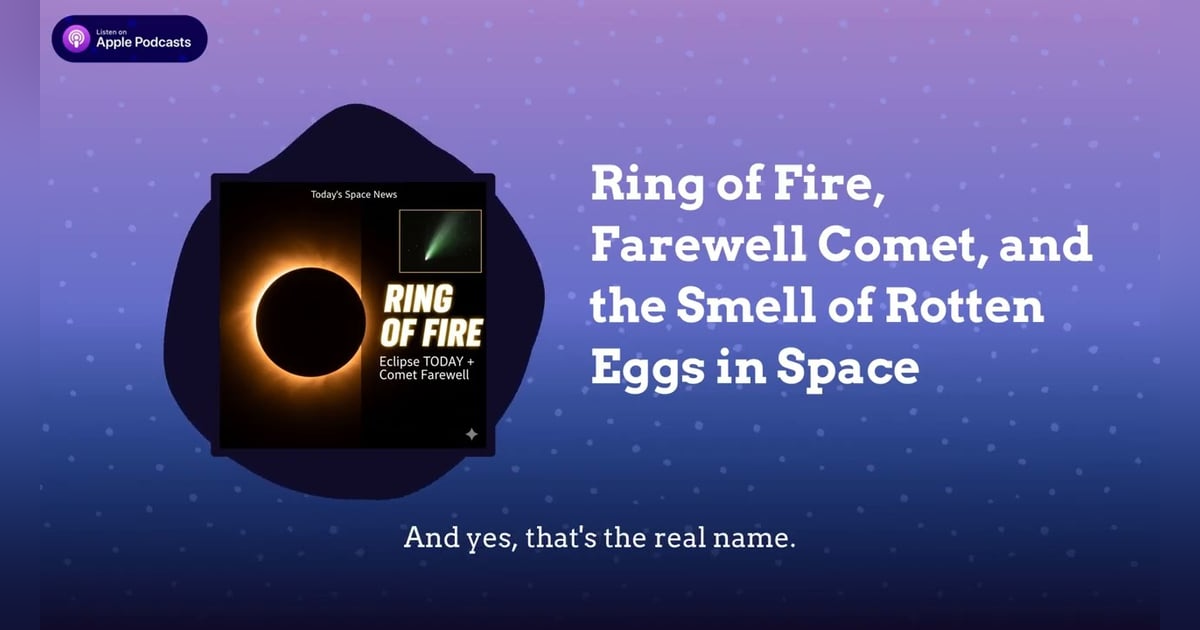


Astronomy Daily — S05E41 | Tuesday 17 February 2026 Ring of Fire, Farewell Comet, and the Smell of Rotten Eggs in Space Two celestial events happen TODAY — an annular solar eclipse transforms the Antarctic Sun into a ring of fire, and a rare hyperbolic comet makes its closest pass to Earth before leaving the solar system forever. Plus, JWST uses the smell of rotten eggs to solve a major exoplanet mystery, NASA performs a CT scan on the northern lights, a startup plans to fuel rockets with water, and we preview why 2026 is the dawn of a golden age of eclipses. In This Episode: • Ring of Fire solar eclipse over Antarctica — happening today, February 17, with up to 96% of the Sun covered and a 616km-wide path of annularity • Comet Wierzchoś (C/2024 E1) makes its closest approach to Earth today at 151 million km — a one-way trip out of the solar system, never to return • JWST detects hydrogen sulfide in giant exoplanets orbiting HR 8799, proving they formed like planets, not brown dwarfs — published in Nature Astronomy • NASA’s BADASS and GNEISS twin rocket missions launch from Alaska to “CT scan” the electrical circuitry of the aurora • General Galactic, led by ex-SpaceX engineer Halen Mattison, reveals plan to make rocket fuel from water — satellite test in October 2026 • 2026: A golden age of eclipses begins — total lunar eclipse March 3, total solar eclipse over Europe August 12, and much more ahead Hosted by: Anna & Avery Produced by: Huw at Bitesz.com Website: astronomydaily.io Social: @AstroDailyPod across all platforms Network: Bitesz.com Podcast Network
Become a supporter of this podcast: https://www.spreaker.com/podcast/astronomy-daily-space-news-updates--5648921/support (https://www.spreaker.com/podcast/astronomy-daily-space-news-updates--5648921/support?utm_source=rss&utm_medium=rss&utm_campaign=rss) .
Sponsor Details:
Ensure your online privacy by using NordVPN . To get our special listener deal and save a lot of money, visit You'll be glad you did!
Become a supporter of Astronomy Daily by joining our Supporters Club. Commercial free episodes daily are only a click way... Click Here (https://www.spreaker.com/podcast/astronomy-daily-space-news-updates--5648921/support)
This episode includes AI-generated content.
Episode link: https://play.headliner.app/episode/31717508?utm_source=youtube
Kind: captions
Language: en
00:00:00.320 --> 00:00:02.869
Good day, stargazers, and welcome to
00:00:02.879 --> 00:00:07.190
Astronomy Daily, episode 41 of season 5.
00:00:07.200 --> 00:00:08.310
I'm Anna.
00:00:08.320 --> 00:00:10.470
>> And I'm Avery. And what a day to be
00:00:10.480 --> 00:00:12.629
alive and looking up, Anna. It's
00:00:12.639 --> 00:00:16.150
Tuesday, February the 17th, 2026, and we
00:00:16.160 --> 00:00:18.870
have not one but two celestial events
00:00:18.880 --> 00:00:20.150
happening today.
00:00:20.160 --> 00:00:22.950
>> That's right. The sun is about to be
00:00:22.960 --> 00:00:25.349
turned into a ring of fire over
00:00:25.359 --> 00:00:28.390
Antarctica. And a comet that may never
00:00:28.400 --> 00:00:30.950
return is making its closest pass to
00:00:30.960 --> 00:00:35.510
Earth as we speak. Plus, we've got JWST
00:00:35.520 --> 00:00:37.750
solving an identity crisis for some
00:00:37.760 --> 00:00:41.430
massive exoplanets. NASA doing CT scans
00:00:41.440 --> 00:00:43.670
on the northern lights and a startup
00:00:43.680 --> 00:00:46.549
that wants to fuel rockets with water.
00:00:46.559 --> 00:00:50.310
And a preview of why 2026 might just be
00:00:50.320 --> 00:00:52.630
the greatest year of eclipses in a
00:00:52.640 --> 00:00:53.830
generation.
00:00:53.840 --> 00:00:55.990
>> Let's not waste a single second. Let's
00:00:56.000 --> 00:00:57.189
dive right in.
00:00:57.199 --> 00:00:59.830
>> So Avery, we've been building up to this
00:00:59.840 --> 00:01:03.349
for weeks, and today is finally the day.
00:01:03.359 --> 00:01:05.670
Right now, as many of our listeners are
00:01:05.680 --> 00:01:08.550
tuning in, an annular solar eclipse is
00:01:08.560 --> 00:01:11.429
tracing its path across Antarctica.
00:01:11.439 --> 00:01:13.270
>> And I know some of our listeners might
00:01:13.280 --> 00:01:15.109
be thinking, "Didn't we just cover
00:01:15.119 --> 00:01:17.510
this?" And yes, we've talked about it in
00:01:17.520 --> 00:01:20.070
recent episodes, but today is the day,
00:01:20.080 --> 00:01:21.910
and there's something truly special
00:01:21.920 --> 00:01:23.670
happening down at the bottom of the
00:01:23.680 --> 00:01:26.870
world. Let's recap the essentials. An
00:01:26.880 --> 00:01:29.190
annular eclipse happens when the moon
00:01:29.200 --> 00:01:31.590
passes directly between the Earth and
00:01:31.600 --> 00:01:34.149
the Sun. But because the moon is at a
00:01:34.159 --> 00:01:36.390
more distant point in its orbit, it
00:01:36.400 --> 00:01:39.270
doesn't completely cover the Sun's disc.
00:01:39.280 --> 00:01:42.149
Instead, you get this breathtaking ring
00:01:42.159 --> 00:01:44.469
of brilliant sunlight surrounding the
00:01:44.479 --> 00:01:46.469
dark silhouette of the moon,
00:01:46.479 --> 00:01:48.789
>> the Ring of Fire. And today's ring will
00:01:48.799 --> 00:01:51.270
last up to 2 minutes and 20 seconds for
00:01:51.280 --> 00:01:53.429
anyone lucky enough to be standing in
00:01:53.439 --> 00:01:55.990
the path of annularity. At the moment of
00:01:56.000 --> 00:01:58.469
greatest eclipse, which occurs at 1212
00:01:58.479 --> 00:02:01.270
UTC, the moon will cover approximately
00:02:01.280 --> 00:02:03.990
96% of the sun's surface.
00:02:04.000 --> 00:02:07.830
>> Now, 96% sounds like almost everything,
00:02:07.840 --> 00:02:10.469
but here's the important thing. It's not
00:02:10.479 --> 00:02:13.750
a total eclipse. The sky won't go dark.
00:02:13.760 --> 00:02:16.229
You absolutely must keep your solar
00:02:16.239 --> 00:02:19.270
eclipse glasses on for the entire event.
00:02:19.280 --> 00:02:21.270
There's no moment where it's safe to
00:02:21.280 --> 00:02:23.350
look at the sun with the naked eye.
00:02:23.360 --> 00:02:25.670
>> The path of annularity itself is
00:02:25.680 --> 00:02:27.430
actually quite wide for eclipse
00:02:27.440 --> 00:02:31.670
standards, about 616 km across, but it's
00:02:31.680 --> 00:02:33.270
crossing some of the most remote
00:02:33.280 --> 00:02:35.350
territory on Earth. We're talking about
00:02:35.360 --> 00:02:37.350
the Antarctic mainland and the
00:02:37.360 --> 00:02:39.350
surrounding southern ocean. So
00:02:39.360 --> 00:02:41.350
realistically, the only people seeing
00:02:41.360 --> 00:02:43.190
the full ring of fire today are
00:02:43.200 --> 00:02:45.509
researchers at a handful of Antarctic
00:02:45.519 --> 00:02:48.470
stations. However, the partial phases of
00:02:48.480 --> 00:02:50.630
the eclipse are visible from a much
00:02:50.640 --> 00:02:53.270
wider area. Observers in southern
00:02:53.280 --> 00:02:56.390
Argentina, southern Chile, southeastern
00:02:56.400 --> 00:02:59.830
Africa, Madagascar, and Maitius will all
00:02:59.840 --> 00:03:01.990
see the moon take a bite out of the sun
00:03:02.000 --> 00:03:03.509
to varying degrees.
00:03:03.519 --> 00:03:05.190
>> And here's something that I think really
00:03:05.200 --> 00:03:07.270
elevates today's event. This eclipse
00:03:07.280 --> 00:03:09.190
kicks off the first eclipse season of
00:03:09.200 --> 00:03:12.149
2026. Eclipse seasons are these brief
00:03:12.159 --> 00:03:14.550
windows, typically about 34 days long,
00:03:14.560 --> 00:03:16.949
when the geometry of the sun, Earth, and
00:03:16.959 --> 00:03:19.670
Moon align just right for eclipses to
00:03:19.680 --> 00:03:22.309
occur. And they usually come in pairs.
00:03:22.319 --> 00:03:25.270
>> Exactly. So, less than 2 weeks from now,
00:03:25.280 --> 00:03:28.149
on March the 3rd, we get a total lunar
00:03:28.159 --> 00:03:30.869
eclipse, a blood moon visible from North
00:03:30.879 --> 00:03:32.869
America. And that's just the beginning
00:03:32.879 --> 00:03:35.670
for 2026, which we'll come back to later
00:03:35.680 --> 00:03:36.470
in the show.
00:03:36.480 --> 00:03:38.149
>> For anyone wanting to follow along
00:03:38.159 --> 00:03:39.910
today, there are several live streams
00:03:39.920 --> 00:03:41.509
available, and we'll have links in our
00:03:41.519 --> 00:03:43.430
show notes. Even if you can't see it
00:03:43.440 --> 00:03:45.509
from where you are, this is a wonderful
00:03:45.519 --> 00:03:47.589
moment to appreciate the clockwork
00:03:47.599 --> 00:03:49.990
precision of our solar system. And
00:03:50.000 --> 00:03:52.309
sticking with things happening literally
00:03:52.319 --> 00:03:57.110
today, let's talk about comet C2024E1,
00:03:57.120 --> 00:03:59.830
better known as comet Wir, which is
00:03:59.840 --> 00:04:01.990
making its closest approach to Earth
00:04:02.000 --> 00:04:04.149
right now. This is one of those stories
00:04:04.159 --> 00:04:06.309
where the science and the poetry really
00:04:06.319 --> 00:04:08.550
come together beautifully. This comet
00:04:08.560 --> 00:04:11.190
was discovered back in March 2024 by
00:04:11.200 --> 00:04:14.309
Polish astronomer Casper Werto using the
00:04:14.319 --> 00:04:16.949
Mount Lemon survey in Arizona. And today
00:04:16.959 --> 00:04:20.710
it passes within about 151 million km
00:04:20.720 --> 00:04:23.110
from Earth, roughly the same distance as
00:04:23.120 --> 00:04:24.790
Earth is from the Sun.
00:04:24.800 --> 00:04:27.590
>> So it's not exactly a close shave, but
00:04:27.600 --> 00:04:29.909
it's still a significant astronomical
00:04:29.919 --> 00:04:32.469
moment. What makes this comet truly
00:04:32.479 --> 00:04:34.950
special is that it's on a hyperbolic
00:04:34.960 --> 00:04:37.110
orbit. For our listeners who aren't
00:04:37.120 --> 00:04:39.110
familiar with that term, it means the
00:04:39.120 --> 00:04:42.150
comet's trajectory isn't a closed loop.
00:04:42.160 --> 00:04:43.830
It's not coming back
00:04:43.840 --> 00:04:47.110
>> ever, or at least not for over 200,000
00:04:47.120 --> 00:04:49.590
years. And even that's optimistic.
00:04:49.600 --> 00:04:51.590
Scientists believe it originated in the
00:04:51.600 --> 00:04:54.390
Orort cloud, that vast icy shell at the
00:04:54.400 --> 00:04:56.629
outer edges of our solar system, and
00:04:56.639 --> 00:04:58.469
it's now getting a gravitational
00:04:58.479 --> 00:05:00.710
slingshot that will send it out into
00:05:00.720 --> 00:05:03.909
interstellar space. This is genuinely a
00:05:03.919 --> 00:05:06.230
once- in a civilization event.
00:05:06.240 --> 00:05:08.629
>> NASA's astronomy picture of the day
00:05:08.639 --> 00:05:11.830
featured comet Woso today with a 30inut
00:05:11.840 --> 00:05:14.469
exposure taken from Chile showing a
00:05:14.479 --> 00:05:18.469
gorgeous 5°ree long ion tail and three
00:05:18.479 --> 00:05:21.430
separate dust tails. The comet also has
00:05:21.440 --> 00:05:24.310
a vivid green coma which scientists
00:05:24.320 --> 00:05:26.390
believe is linked to carbon bearing
00:05:26.400 --> 00:05:29.350
compounds likely diatomic carbon
00:05:29.360 --> 00:05:32.230
fluoresing under ultraviolet sunlight.
00:05:32.240 --> 00:05:34.070
The James Webb telescope actually
00:05:34.080 --> 00:05:36.070
observed this comet last year when it
00:05:36.080 --> 00:05:38.070
was still far out at about seven
00:05:38.080 --> 00:05:40.629
astronomical units from the sun. They
00:05:40.639 --> 00:05:42.870
found its activity is primarily driven
00:05:42.880 --> 00:05:45.270
by carbon dioxide rather than carbon
00:05:45.280 --> 00:05:47.670
monoxide, which is interesting because
00:05:47.680 --> 00:05:50.070
it suggests the comet may have lost its
00:05:50.080 --> 00:05:53.350
near surface CO early in its evolution.
00:05:53.360 --> 00:05:56.070
Now, in terms of actually seeing it, at
00:05:56.080 --> 00:05:59.510
magnitude 7.8 to 8.2, you're going to
00:05:59.520 --> 00:06:02.310
need binoculars at minimum. Ideally, a
00:06:02.320 --> 00:06:04.390
small telescope. It's currently in the
00:06:04.400 --> 00:06:06.870
constellation sculptor, quite low in the
00:06:06.880 --> 00:06:09.510
southwestern sky after sunset. Southern
00:06:09.520 --> 00:06:11.749
Hemisphere observers have the far better
00:06:11.759 --> 00:06:12.870
view today.
00:06:12.880 --> 00:06:14.710
>> Northern Hemisphere observers don't
00:06:14.720 --> 00:06:17.110
despair. Over the coming days, the comet
00:06:17.120 --> 00:06:19.270
will climb a bit higher and by around
00:06:19.280 --> 00:06:21.510
February 23rd, it should be a more
00:06:21.520 --> 00:06:23.990
accessible target as it passes near some
00:06:24.000 --> 00:06:26.950
galaxies in Cedus. But it will be fading
00:06:26.960 --> 00:06:29.110
by then. If you can get out tonight with
00:06:29.120 --> 00:06:31.110
some optics, it's worth the effort.
00:06:31.120 --> 00:06:33.110
You're quite literally saying goodbye to
00:06:33.120 --> 00:06:35.270
something the human race will never see
00:06:35.280 --> 00:06:39.430
again. All right, let's travel 133
00:06:39.440 --> 00:06:41.749
lighty years away to the constellation
00:06:41.759 --> 00:06:44.390
Pegasus, where the James Webb telescope
00:06:44.400 --> 00:06:46.790
has just settled one of exoplanet
00:06:46.800 --> 00:06:49.670
science's most persistent mysteries.
00:06:49.680 --> 00:06:52.070
>> And the key to solving it, hydrogen
00:06:52.080 --> 00:06:54.710
sulfide, the molecule that gives rotten
00:06:54.720 --> 00:06:57.270
eggs their delightful aroma. Published
00:06:57.280 --> 00:06:59.990
in Nature Astronomy, a team from UCLA
00:07:00.000 --> 00:07:03.830
and UC San Diego use JWST to study
00:07:03.840 --> 00:07:05.749
HR8799
00:07:05.759 --> 00:07:08.550
system, which hosts four enormous gas
00:07:08.560 --> 00:07:11.589
giant planets, each between 5 and 10
00:07:11.599 --> 00:07:14.230
times the mass of Jupiter. Now, these
00:07:14.240 --> 00:07:16.790
planets have been known since 2008, and
00:07:16.800 --> 00:07:18.629
they're actually directly visible
00:07:18.639 --> 00:07:20.790
through telescopes, which is remarkable
00:07:20.800 --> 00:07:23.909
in itself. Most exoplanets are detected
00:07:23.919 --> 00:07:26.309
indirectly, but because they're so
00:07:26.319 --> 00:07:28.710
massive and because they're so far from
00:07:28.720 --> 00:07:31.909
their star, between 15 and 70 times
00:07:31.919 --> 00:07:33.749
Earth's distance from the sun,
00:07:33.759 --> 00:07:35.909
scientists have long debated if they're
00:07:35.919 --> 00:07:38.150
truly planets, or something else
00:07:38.160 --> 00:07:39.430
entirely.
00:07:39.440 --> 00:07:42.070
>> Specifically, are they planets or brown
00:07:42.080 --> 00:07:44.309
dwarfs? Brown dwarfs are sometimes
00:07:44.319 --> 00:07:47.350
called failed stars, objects that formed
00:07:47.360 --> 00:07:49.510
through gravitational collapse of a gas
00:07:49.520 --> 00:07:52.309
cloud like a star, but never got massive
00:07:52.319 --> 00:07:55.110
enough to sustain hydrogen fusion. The
00:07:55.120 --> 00:07:57.589
traditional mass boundary is around 13
00:07:57.599 --> 00:07:59.270
Jupiter masses, but that's a bit
00:07:59.280 --> 00:08:00.550
arbitrary.
00:08:00.560 --> 00:08:03.350
>> What really matters is how they formed.
00:08:03.360 --> 00:08:05.749
Did they form like planets through core
00:08:05.759 --> 00:08:08.629
accretion, building up a solid core from
00:08:08.639 --> 00:08:11.350
dust and rock that then attracted gas?
00:08:11.360 --> 00:08:13.670
or did they form like stars through the
00:08:13.680 --> 00:08:16.869
rapid collapse of a dense pocket of gas?
00:08:16.879 --> 00:08:18.550
>> And this is where the rotten eggs come
00:08:18.560 --> 00:08:21.029
in. The team detected hydrogen sulfide
00:08:21.039 --> 00:08:22.710
in the atmospheres of these three
00:08:22.720 --> 00:08:25.749
worlds, HR8799
00:08:25.759 --> 00:08:29.909
C, D, and E. Now, why is sulfur the key?
00:08:29.919 --> 00:08:31.749
Because at the vast distances these
00:08:31.759 --> 00:08:34.310
planets orbit their star, sulfur can
00:08:34.320 --> 00:08:36.469
only exist in solid form within the
00:08:36.479 --> 00:08:39.269
protolanetary disc. It cannot be in the
00:08:39.279 --> 00:08:41.829
gas phase. So if there's sulfur in these
00:08:41.839 --> 00:08:43.990
planets atmospheres, it had to have been
00:08:44.000 --> 00:08:46.310
gobbled up as solid material during the
00:08:46.320 --> 00:08:47.829
planet's formation.
00:08:47.839 --> 00:08:50.070
>> That's the smoking gun for core
00:08:50.080 --> 00:08:53.269
accretion. These worlds, massive as they
00:08:53.279 --> 00:08:56.310
are, formed the same way Jupiter did,
00:08:56.320 --> 00:08:59.350
just on a much grander scale. Previous
00:08:59.360 --> 00:09:01.829
studies looking at carbon and oxygen,
00:09:01.839 --> 00:09:03.590
couldn't distinguish between the two
00:09:03.600 --> 00:09:05.670
formation pathways because those
00:09:05.680 --> 00:09:08.150
elements can come from either gas or
00:09:08.160 --> 00:09:11.110
solids. The researchers also found that
00:09:11.120 --> 00:09:13.350
these planets are enriched in heavy
00:09:13.360 --> 00:09:15.590
elements compared to their host star by
00:09:15.600 --> 00:09:18.949
factors of roughly 2 to 9 times. They
00:09:18.959 --> 00:09:20.949
estimate the four planets together
00:09:20.959 --> 00:09:23.990
contain around 600 Earth masses of heavy
00:09:24.000 --> 00:09:26.710
material. That's an extraordinary amount
00:09:26.720 --> 00:09:28.230
of solid material.
00:09:28.240 --> 00:09:30.790
>> And this raises a really fascinating
00:09:30.800 --> 00:09:34.230
question. How big can a planet get? If
00:09:34.240 --> 00:09:37.269
objects 10 times Jupiter's mass can form
00:09:37.279 --> 00:09:39.990
through core accretion, where exactly is
00:09:40.000 --> 00:09:42.470
the line between the biggest planets and
00:09:42.480 --> 00:09:44.949
the smallest brown dwarfs? Lead
00:09:44.959 --> 00:09:47.750
researcher Jerry Swan from UCLA put it
00:09:47.760 --> 00:09:50.070
beautifully. He said the technique they
00:09:50.080 --> 00:09:51.990
used to separate the light from these
00:09:52.000 --> 00:09:55.110
incredibly faint planets, 10,000 times
00:09:55.120 --> 00:09:57.590
fainter than their star, will eventually
00:09:57.600 --> 00:09:59.590
be applicable to studying Earthlike
00:09:59.600 --> 00:10:01.829
worlds. He said, "Finding an Earth
00:10:01.839 --> 00:10:04.470
analog is the holy grail, and we might
00:10:04.480 --> 00:10:07.030
be 20 to 30 years away from getting the
00:10:07.040 --> 00:10:09.269
first spectrum of an Earthlike planet
00:10:09.279 --> 00:10:11.509
and searching for bio signatures."
00:10:11.519 --> 00:10:14.470
>> The future of exoplanet science built on
00:10:14.480 --> 00:10:17.269
the foundation of smelly gas. Who would
00:10:17.279 --> 00:10:19.590
have thought? Staying closer to home
00:10:19.600 --> 00:10:22.710
now, well, relatively speaking, NASA
00:10:22.720 --> 00:10:24.630
launched two groundbreaking sounding
00:10:24.640 --> 00:10:26.790
rocket missions from Alaska earlier this
00:10:26.800 --> 00:10:28.870
month, and the results are already
00:10:28.880 --> 00:10:30.710
exciting to science community.
00:10:30.720 --> 00:10:32.630
>> These launched from the Poker Flat
00:10:32.640 --> 00:10:34.790
Research Range near Fairbanks, and they
00:10:34.800 --> 00:10:37.269
had two of the best mission acronyms
00:10:37.279 --> 00:10:39.990
I've ever encountered. The first is
00:10:40.000 --> 00:10:43.030
badass, the black and diffuse auroral
00:10:43.040 --> 00:10:45.509
science surveyor. And yes, that's the
00:10:45.519 --> 00:10:48.710
real name. Launched February 9th, Badass
00:10:48.720 --> 00:10:52.630
reached an altitude of about 360 km and
00:10:52.640 --> 00:10:54.550
was specifically designed to study a
00:10:54.560 --> 00:10:57.350
phenomenon called black auroras. These
00:10:57.360 --> 00:10:59.430
are these strange dark structures that
00:10:59.440 --> 00:11:02.069
appear as gaps or voids drifting within
00:11:02.079 --> 00:11:04.470
the brighter diffuse aurora. Like
00:11:04.480 --> 00:11:06.550
someone has taken an eraser to parts of
00:11:06.560 --> 00:11:08.870
the northern lights. What's happening
00:11:08.880 --> 00:11:11.590
physically is that electrons, instead of
00:11:11.600 --> 00:11:13.750
streaming down into Earth's atmosphere
00:11:13.760 --> 00:11:16.310
the way they do in normal auroras, are
00:11:16.320 --> 00:11:19.269
shooting upward into space. Scientists
00:11:19.279 --> 00:11:21.910
don't fully understand why this reversal
00:11:21.920 --> 00:11:24.389
happens. And Badass was designed to
00:11:24.399 --> 00:11:27.670
gather data on exactly that. Then on
00:11:27.680 --> 00:11:31.590
February 10th, NASA launched the GNISS
00:11:31.600 --> 00:11:33.670
mission. That's the geoysical
00:11:33.680 --> 00:11:36.069
non-equilibrium ionosphere science
00:11:36.079 --> 00:11:38.630
system. This one used two rockets
00:11:38.640 --> 00:11:41.110
launched just 30 seconds apart, flying
00:11:41.120 --> 00:11:43.350
side by side through the same aurora
00:11:43.360 --> 00:11:46.069
along different slices. And here's the
00:11:46.079 --> 00:11:48.949
clever bit. Each rocket ejected four
00:11:48.959 --> 00:11:51.269
subpayloads, giving them multiple
00:11:51.279 --> 00:11:53.829
measurement points inside the aurora
00:11:53.839 --> 00:11:56.790
simultaneously. The rockets also sent
00:11:56.800 --> 00:11:58.870
radio signals through the surrounding
00:11:58.880 --> 00:12:01.590
plasma to a network of 11 ground
00:12:01.600 --> 00:12:04.150
receivers. The way the plasma altered
00:12:04.160 --> 00:12:06.870
those radio waves allowed scientists to
00:12:06.880 --> 00:12:09.750
map the plasma density, revealing where
00:12:09.760 --> 00:12:12.310
electrical currents can flow. Principal
00:12:12.320 --> 00:12:14.150
investigator Christina Lynch from
00:12:14.160 --> 00:12:16.150
Dartmouth College described it as
00:12:16.160 --> 00:12:18.230
essentially doing a CT scan of the
00:12:18.240 --> 00:12:20.629
plasma beneath the aurora. In the same
00:12:20.639 --> 00:12:23.269
way a medical CT scan uses X-rays
00:12:23.279 --> 00:12:25.110
passing through different body tissues
00:12:25.120 --> 00:12:28.310
to reconstruct the 3D image, NICE uses
00:12:28.320 --> 00:12:30.310
radio waves passing through auroral
00:12:30.320 --> 00:12:32.629
plasma to reconstruct the electrical
00:12:32.639 --> 00:12:35.190
environment in three dimensions. Both
00:12:35.200 --> 00:12:37.350
missions reported that all instruments
00:12:37.360 --> 00:12:39.590
performed as expected and returned
00:12:39.600 --> 00:12:42.550
highquality data. This is particularly
00:12:42.560 --> 00:12:44.949
satisfying for the badass team because
00:12:44.959 --> 00:12:47.350
the same mission was on the launchpad at
00:12:47.360 --> 00:12:49.670
Poker Flat last year, but the required
00:12:49.680 --> 00:12:52.150
auroral conditions never materialized
00:12:52.160 --> 00:12:54.389
before the launch window closed.
00:12:54.399 --> 00:12:56.870
Understanding how auroral currents work
00:12:56.880 --> 00:12:59.590
isn't just pure physics. Those currents
00:12:59.600 --> 00:13:01.750
shape how energy from space spreads
00:13:01.760 --> 00:13:04.069
through Earth's upper atmosphere. Where
00:13:04.079 --> 00:13:06.150
the current fans out, the atmosphere
00:13:06.160 --> 00:13:08.069
heats up, which can affect satellite
00:13:08.079 --> 00:13:10.470
drag, GPS accuracy, and radio
00:13:10.480 --> 00:13:12.629
communications. With our increasing
00:13:12.639 --> 00:13:14.870
dependence on space-based technology,
00:13:14.880 --> 00:13:16.710
this research has very practical
00:13:16.720 --> 00:13:17.990
implications.
00:13:18.000 --> 00:13:20.069
>> Now, for something that sounds like
00:13:20.079 --> 00:13:22.069
science fiction, but is heading for a
00:13:22.079 --> 00:13:24.710
realworld test later this year. A
00:13:24.720 --> 00:13:27.269
startup called General Galactic, led by
00:13:27.279 --> 00:13:30.389
former SpaceX engineer Helen Madison, is
00:13:30.399 --> 00:13:32.790
developing technology to use water as
00:13:32.800 --> 00:13:35.590
rocket fuel. And before anyone thinks
00:13:35.600 --> 00:13:36.870
we're talking about some kind of
00:13:36.880 --> 00:13:39.750
perpetual motion scam, the science here
00:13:39.760 --> 00:13:42.470
is sound. The core concept uses
00:13:42.480 --> 00:13:45.110
electrolysis, splitting water molecules
00:13:45.120 --> 00:13:47.990
into hydrogen and oxygen, and then using
00:13:48.000 --> 00:13:50.389
those gases in two different propulsion
00:13:50.399 --> 00:13:51.430
systems.
00:13:51.440 --> 00:13:53.750
>> Right? For chemical propulsion, you burn
00:13:53.760 --> 00:13:56.389
the hydrogen and oxygen together, which
00:13:56.399 --> 00:13:58.470
produces high pressure thrust, much like
00:13:58.480 --> 00:14:00.710
a conventional rocket engine. For
00:14:00.720 --> 00:14:03.030
electrical propulsion, you ionize the
00:14:03.040 --> 00:14:05.030
oxygen and accelerate it using a
00:14:05.040 --> 00:14:08.230
magnetic field, creating plasma thrust.
00:14:08.240 --> 00:14:10.629
Madison describes that second type as
00:14:10.639 --> 00:14:13.590
very, very low thrust. People jokingly
00:14:13.600 --> 00:14:16.710
like to call it a burp in space. But
00:14:16.720 --> 00:14:19.269
even a burp in space can be useful for
00:14:19.279 --> 00:14:21.750
precise maneuvers and station keeping.
00:14:21.760 --> 00:14:23.750
The real gamecher here isn't the
00:14:23.760 --> 00:14:26.069
propulsion technology itself, but the
00:14:26.079 --> 00:14:28.790
fuel source. Water is one of the most
00:14:28.800 --> 00:14:30.710
abundant resources we found on other
00:14:30.720 --> 00:14:33.189
worlds. There's water ice on the moon,
00:14:33.199 --> 00:14:36.069
on Mars, on asteroids. If you can turn
00:14:36.079 --> 00:14:38.310
that water into fuel, you've essentially
00:14:38.320 --> 00:14:40.389
created the infrastructure for cosmic
00:14:40.399 --> 00:14:41.990
refueling stations.
00:14:42.000 --> 00:14:44.389
>> That's exactly Madison's long-term
00:14:44.399 --> 00:14:46.790
vision. He's talking about building a
00:14:46.800 --> 00:14:49.189
refueling network that connects Earth,
00:14:49.199 --> 00:14:51.910
the moon, and Mars. As he puts it,
00:14:51.920 --> 00:14:54.069
everybody wants to go build a moon base
00:14:54.079 --> 00:14:56.310
or a Mars base. Who's going to pay for
00:14:56.320 --> 00:14:58.470
it? How does it actually work? His
00:14:58.480 --> 00:15:00.870
answer is to make the economics viable
00:15:00.880 --> 00:15:03.910
by using insitue resources.
00:15:03.920 --> 00:15:05.750
>> Now, there are real challenges to
00:15:05.760 --> 00:15:08.470
overcome. Water has to be purified,
00:15:08.480 --> 00:15:10.949
electrolyed, and stored efficiently. And
00:15:10.959 --> 00:15:12.790
the whole system has to be lightweight
00:15:12.800 --> 00:15:15.030
enough for space applications. There's
00:15:15.040 --> 00:15:17.269
also concerns about ionized oxygen
00:15:17.279 --> 00:15:18.790
potentially affecting satellite
00:15:18.800 --> 00:15:21.110
electronics, but the team is pushing
00:15:21.120 --> 00:15:23.829
ahead with a proof of concept. And that
00:15:23.839 --> 00:15:26.629
proof of concept is coming soon. General
00:15:26.639 --> 00:15:29.350
Galactic is planning to launch an 1100
00:15:29.360 --> 00:15:32.710
lb satellite on a SpaceX Falcon 9 rocket
00:15:32.720 --> 00:15:35.990
in October 2026. That satellite will
00:15:36.000 --> 00:15:38.389
test both the chemical and electrical
00:15:38.399 --> 00:15:41.189
propulsion systems using water as fuel
00:15:41.199 --> 00:15:44.389
in actual space conditions. If it works,
00:15:44.399 --> 00:15:46.230
it could fundamentally change the
00:15:46.240 --> 00:15:48.949
economics of space flight. MAT claims
00:15:48.959 --> 00:15:50.470
they're talking about billions of
00:15:50.480 --> 00:15:52.310
dollars in savings even with current
00:15:52.320 --> 00:15:55.189
operations and trillions in new economic
00:15:55.199 --> 00:15:57.590
growth as the infrastructure scales up.
00:15:57.600 --> 00:15:59.430
Those are bold claims, but the
00:15:59.440 --> 00:16:01.670
underlying physics is solid. We'll be
00:16:01.680 --> 00:16:03.430
watching that October launch very
00:16:03.440 --> 00:16:06.150
closely. So, we open the show with
00:16:06.160 --> 00:16:08.230
today's annular eclipse, and we
00:16:08.240 --> 00:16:10.310
mentioned that it kicks off an eclipse
00:16:10.320 --> 00:16:12.629
season, but I think it's worth zooming
00:16:12.639 --> 00:16:14.790
out and looking at the bigger picture
00:16:14.800 --> 00:16:17.509
because 2026 is shaping up to be an
00:16:17.519 --> 00:16:19.749
absolutely extraordinary year for
00:16:19.759 --> 00:16:21.110
eclipses.
00:16:21.120 --> 00:16:23.189
>> It really is. So, let's run through
00:16:23.199 --> 00:16:25.110
what's coming. First up, as we
00:16:25.120 --> 00:16:27.509
mentioned, on March the 3rd, we get a
00:16:27.519 --> 00:16:30.150
total lunar eclipse. That's a blood moon
00:16:30.160 --> 00:16:31.990
and it will be visible across North
00:16:32.000 --> 00:16:34.310
America which is fantastic news for our
00:16:34.320 --> 00:16:36.310
listeners in that part of the world.
00:16:36.320 --> 00:16:39.269
>> Then we get to August 12th. And this is
00:16:39.279 --> 00:16:42.550
the big one, a total solar eclipse, not
00:16:42.560 --> 00:16:44.949
annular but total with its path of
00:16:44.959 --> 00:16:47.829
totality crossing the Arctic, Greenland,
00:16:47.839 --> 00:16:50.550
Iceland, and Spain. And observers across
00:16:50.560 --> 00:16:53.110
much of Western Europe and North America
00:16:53.120 --> 00:16:55.189
will see a partial eclipse.
00:16:55.199 --> 00:16:57.030
>> For anyone in the UK, this is
00:16:57.040 --> 00:17:00.069
particularly exciting. The BBC Sky at
00:17:00.079 --> 00:17:02.310
Night magazine and the Royal Observatory
00:17:02.320 --> 00:17:04.549
Greenwich are both flagging this as the
00:17:04.559 --> 00:17:06.949
best solar eclipse visible from the UK
00:17:06.959 --> 00:17:08.870
since 1999.
00:17:08.880 --> 00:17:10.630
Viewers in London will see the moon
00:17:10.640 --> 00:17:13.829
touch the edge of the sun's disc at 6:17
00:17:13.839 --> 00:17:17.429
p.m. BST. And it doesn't stop there. The
00:17:17.439 --> 00:17:19.669
astronomical community is talking about
00:17:19.679 --> 00:17:22.069
a genuine golden age of eclipses
00:17:22.079 --> 00:17:25.110
beginning right now. Between 2026 and
00:17:25.120 --> 00:17:28.549
2028, we're looking at three total solar
00:17:28.559 --> 00:17:31.590
eclipses and three Ring of Fire eclipses
00:17:31.600 --> 00:17:33.750
in just three years. That's an
00:17:33.760 --> 00:17:35.430
extraordinary run.
00:17:35.440 --> 00:17:38.150
>> So, if today's Antarctic Ring of Fire
00:17:38.160 --> 00:17:39.990
has you feeling a bit left out because
00:17:40.000 --> 00:17:42.150
you couldn't see it, don't worry. There
00:17:42.160 --> 00:17:44.470
is so much more to come. Start planning
00:17:44.480 --> 00:17:46.470
now for August 12th. And make sure
00:17:46.480 --> 00:17:48.390
you're subscribed to Astronomy Daily
00:17:48.400 --> 00:17:50.310
because we'll be covering every single
00:17:50.320 --> 00:17:52.630
one of these events. This is going to be
00:17:52.640 --> 00:17:55.270
an epic year for Eclipse Tracers.
00:17:55.280 --> 00:17:57.190
>> And that brings us to the end of another
00:17:57.200 --> 00:17:59.590
packed edition of Astronomy Daily. What
00:17:59.600 --> 00:18:02.070
a day, Anna. An eclipse, a comet
00:18:02.080 --> 00:18:04.950
farewell, rotten eggs solving planetary
00:18:04.960 --> 00:18:08.310
mysteries, CT scans of auroras, water
00:18:08.320 --> 00:18:10.549
powered rockets, and a golden age of
00:18:10.559 --> 00:18:12.789
eclipses beginning right now.
00:18:12.799 --> 00:18:14.710
>> If you enjoyed today's episode, please
00:18:14.720 --> 00:18:16.390
do subscribe wherever you get your
00:18:16.400 --> 00:18:18.710
podcasts. Leave us a rating and a review
00:18:18.720 --> 00:18:20.549
and share us with anyone you know who
00:18:20.559 --> 00:18:22.789
loves looking up. You can find us at
00:18:22.799 --> 00:18:24.710
astronomydaily.io,
00:18:24.720 --> 00:18:27.029
on YouTube, and across all social media
00:18:27.039 --> 00:18:29.909
platforms at astroaily pod.
00:18:29.919 --> 00:18:31.430
>> And don't forget, we're part of the
00:18:31.440 --> 00:18:33.750
byes.com podcast network where you'll
00:18:33.760 --> 00:18:35.669
find plenty of other great shows to keep
00:18:35.679 --> 00:18:37.750
you entertained and informed.
00:18:37.760 --> 00:18:39.909
>> Until next time, keep your eyes on the
00:18:39.919 --> 00:18:40.789
skies.
00:18:40.799 --> 00:18:45.270
>> Clear skies, everyone.
00:18:45.280 --> 00:18:53.270
Stories told
00:18:53.280 --> 00:19:01.190
stories told
00:19:01.200 --> 00:19:03.919
stories


