One Sleep to Splashdown: Artemis II Heads Home + Lunar Science Bombshell
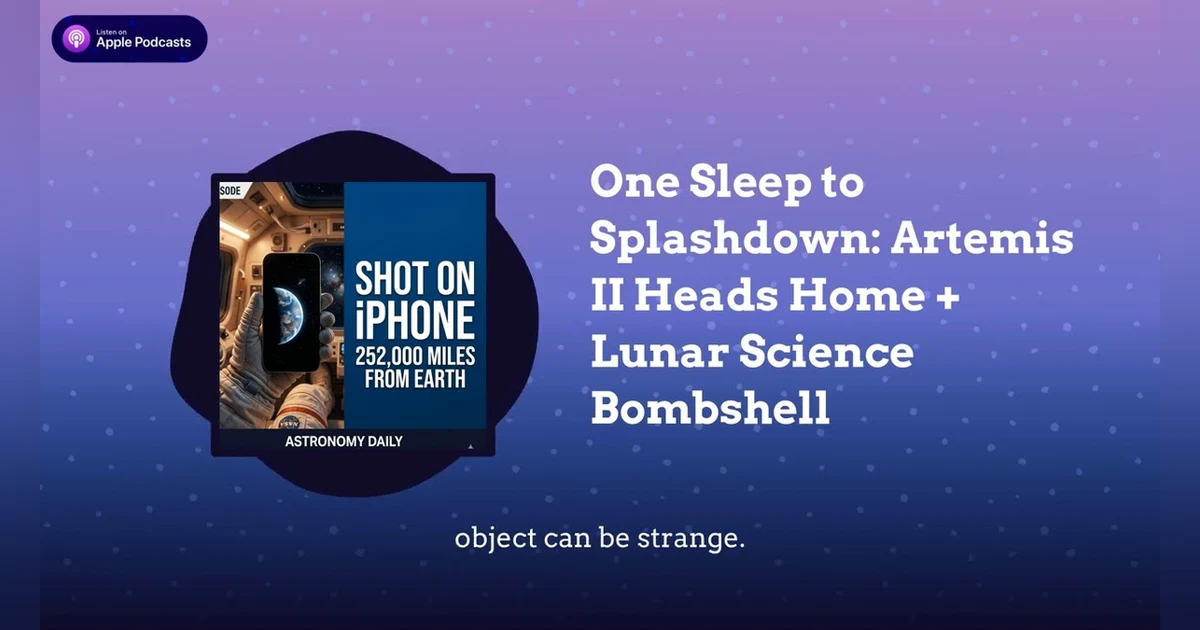


The Artemis II crew — Reid Wiseman, Victor Glover, Christina Koch and Jeremy Hansen — are on final approach to Earth after nine historic days in deep space. Splashdown is scheduled for Friday off San Diego. We have the full countdown, plus the story behind what NASA scientists called 'audible screams of delight' when the crew spotted micrometeorite impact flashes on the Moon during their lunar flyby. Also in today's episode: astronomers at ISTA in Austria have identified a brand new class of stellar remnant — two ultra-massive, X-ray emitting white dwarfs named Gandalf and Moon-Sized. Mars continues to disappoint on the habitability front. Four planets are lining up in April skies. And we close with the story of four astronauts, their iPhones, and the greatest selfies in human history. Sources & links: • Artemis II splashdown coverage: nasa.gov/artemis • Micrometeorite impacts & lunar science: space.com | sciencenews.org | spaceq.ca • Gandalf & Moon-Sized white dwarfs: ista.ac.at | universetoday.com • Mars surface habitability: universetoday.com • April planet alignment: starwalk.space • Artemis II iPhone photography: space.com | engadget.com
Become a supporter of this podcast: https://www.spreaker.com/podcast/astronomy-daily-space-news-updates--5648921/support (https://www.spreaker.com/podcast/astronomy-daily-space-news-updates--5648921/support?utm_source=rss&utm_medium=rss&utm_campaign=rss) .
Sponsor Details:
Ensure your online privacy by using NordVPN . To get our special listener deal and save a lot of money, visit You'll be glad you did!
Become a supporter of Astronomy Daily by joining our Supporters Club. Commercial free episodes daily are only a click way... Click Here (https://www.spreaker.com/podcast/astronomy-daily-space-news-updates--5648921/support)
This episode includes AI-generated content.
Episode link: https://play.headliner.app/episode/32655829?utm_source=youtube
Kind: captions
Language: en
00:00:00.320 --> 00:00:03.350
One more sleep. After 9 days in deep
00:00:03.360 --> 00:00:05.829
space, nine days that took humanity
00:00:05.839 --> 00:00:07.829
further from Earth than we have ever
00:00:07.839 --> 00:00:10.870
been, the Artemis 2 crew is coming home.
00:00:10.880 --> 00:00:13.350
Splashdown is tomorrow and we have the
00:00:13.360 --> 00:00:14.470
full countdown.
00:00:14.480 --> 00:00:16.950
>> Plus, the NASA scientists who literally
00:00:16.960 --> 00:00:18.870
screamed when the astronauts spotted
00:00:18.880 --> 00:00:20.870
something nobody expected to see on the
00:00:20.880 --> 00:00:23.189
moon. We'll tell you what it was and why
00:00:23.199 --> 00:00:25.750
it matters so much for future missions.
00:00:25.760 --> 00:00:28.070
>> A brand new class of star has been
00:00:28.080 --> 00:00:31.029
discovered. Meet Gandalf and Moonsized,
00:00:31.039 --> 00:00:33.270
two cosmic oddballs that have just
00:00:33.280 --> 00:00:35.510
rewritten the stellar rule book.
00:00:35.520 --> 00:00:38.229
>> Mars still very much not welcoming
00:00:38.239 --> 00:00:40.229
visitors. We have the science to prove
00:00:40.239 --> 00:00:42.630
it. And four planets are lining up in
00:00:42.640 --> 00:00:44.709
the April sky for a rare celestial
00:00:44.719 --> 00:00:45.590
parade.
00:00:45.600 --> 00:00:47.910
>> And we close with the most relatable
00:00:47.920 --> 00:00:50.709
space story in years. What happens when
00:00:50.719 --> 00:00:53.270
four astronauts take their iPhones a
00:00:53.280 --> 00:00:55.750
quarter of a million miles from Earth?
00:00:55.760 --> 00:00:58.869
Spoiler, the photos are extraordinary.
00:00:58.879 --> 00:01:01.510
>> Hello and welcome to Astronomy Daily,
00:01:01.520 --> 00:01:04.789
season 5, episode 85. I'm Anna
00:01:04.799 --> 00:01:07.270
>> and I'm Avery. It is Thursday, the 9th
00:01:07.280 --> 00:01:10.149
of April, 2026, and we are broadcasting
00:01:10.159 --> 00:01:12.230
from astronomyaily.io
00:01:12.240 --> 00:01:15.109
on the bites.com podcast network.
00:01:15.119 --> 00:01:17.990
>> It has been a big week in space, and it
00:01:18.000 --> 00:01:20.789
is about to get even bigger. Let's go.
00:01:20.799 --> 00:01:23.590
>> I'm ready. It is day nine of the Aremis
00:01:23.600 --> 00:01:25.830
2 mission and right now the Orion
00:01:25.840 --> 00:01:28.710
spacecraft call sign Integrity is
00:01:28.720 --> 00:01:30.550
hurtling back toward Earth at
00:01:30.560 --> 00:01:33.270
extraordinary speed. Tomorrow evening it
00:01:33.280 --> 00:01:35.350
will splash down in the Pacific Ocean
00:01:35.360 --> 00:01:37.749
off the coast of San Diego. And when it
00:01:37.759 --> 00:01:39.670
does, four astronauts will have
00:01:39.680 --> 00:01:42.149
completed the most significant human
00:01:42.159 --> 00:01:44.710
space flight since the Apollo program.
00:01:44.720 --> 00:01:46.469
>> The splashdown is scheduled for around
00:01:46.479 --> 00:01:48.630
8:00 p.m. Eastern time. That's Friday
00:01:48.640 --> 00:01:50.310
morning for us here in Australia and New
00:01:50.320 --> 00:01:52.389
Zealand. And NASA says the weather
00:01:52.399 --> 00:01:54.950
window is looking favorable. The USS
00:01:54.960 --> 00:01:57.270
John P. Murtha, the naval recovery
00:01:57.280 --> 00:01:59.109
vessel, is already on station in the
00:01:59.119 --> 00:02:01.429
Pacific with helicopters and divers
00:02:01.439 --> 00:02:02.950
ready to retrieve the crew.
00:02:02.960 --> 00:02:05.109
>> And Avery, before any of that can
00:02:05.119 --> 00:02:07.109
happen, there's a critical sequence of
00:02:07.119 --> 00:02:09.589
events. The crew module, the part that
00:02:09.599 --> 00:02:11.750
carries the astronauts, has to separate
00:02:11.760 --> 00:02:14.470
from the service module. Then it plunges
00:02:14.480 --> 00:02:17.190
into the atmosphere at around 25,000
00:02:17.200 --> 00:02:19.430
miles an hour. There will be a blackout
00:02:19.440 --> 00:02:21.510
period of several minutes when mission
00:02:21.520 --> 00:02:24.309
control loses all contact as the plasma
00:02:24.319 --> 00:02:26.390
sheath forms around the capsule.
00:02:26.400 --> 00:02:28.550
>> And then parachutes. First the drogue
00:02:28.560 --> 00:02:30.790
shoots to slow them down dramatically.
00:02:30.800 --> 00:02:33.190
Then the main parachutes and Orion drops
00:02:33.200 --> 00:02:36.229
to about 17 mph for a soft ocean
00:02:36.239 --> 00:02:39.910
landing. After 9 days and nearly 700,000
00:02:39.920 --> 00:02:41.110
m of travel.
00:02:41.120 --> 00:02:43.350
>> Now the heat shield. This is the thing
00:02:43.360 --> 00:02:45.589
that has been quietly keeping engineers
00:02:45.599 --> 00:02:47.830
awake at night. After the uncrrewed
00:02:47.840 --> 00:02:50.470
Artemis 1 mission, inspectors found that
00:02:50.480 --> 00:02:52.309
chunks of the heat shield had sheared
00:02:52.319 --> 00:02:55.350
away unevenly during re-entry. NASA and
00:02:55.360 --> 00:02:57.430
Loheed Martin spent 4 years
00:02:57.440 --> 00:02:59.910
investigating and redesigning it. Both
00:02:59.920 --> 00:03:02.070
say they are highly confident it will
00:03:02.080 --> 00:03:04.790
perform perfectly tomorrow, but it will
00:03:04.800 --> 00:03:07.270
be the realworld test. Once safely
00:03:07.280 --> 00:03:09.270
aboard the Murtha, the crew will undergo
00:03:09.280 --> 00:03:11.350
medical evaluations before flying to
00:03:11.360 --> 00:03:13.430
Johnson Space Center in Houston.
00:03:13.440 --> 00:03:15.750
Commander Reed Weisman, pilot Victor
00:03:15.760 --> 00:03:17.990
Glover, mission specialist Christina
00:03:18.000 --> 00:03:20.070
and Canadian Space Agency
00:03:20.080 --> 00:03:22.070
astronaut Jeremy Hansen.
00:03:22.080 --> 00:03:24.149
>> History makers, every single one of
00:03:24.159 --> 00:03:26.710
them. Victor Glover, the first person of
00:03:26.720 --> 00:03:29.110
color to travel to the moon. Christina
00:03:29.120 --> 00:03:31.750
the first woman. Jeremy Hansen,
00:03:31.760 --> 00:03:33.750
the first person from a country other
00:03:33.760 --> 00:03:35.830
than the United States to reach lunar
00:03:35.840 --> 00:03:36.710
distance.
00:03:36.720 --> 00:03:38.550
>> And when they get home, President Trump
00:03:38.560 --> 00:03:40.229
has apparently already promised them a
00:03:40.239 --> 00:03:41.990
White House visit. I'd say they've
00:03:42.000 --> 00:03:42.630
earned it.
00:03:42.640 --> 00:03:44.789
>> We'll of course have the full splashdown
00:03:44.799 --> 00:03:46.869
coverage in tomorrow's episode of
00:03:46.879 --> 00:03:49.990
Astronomy Daily. Set those alarms. Now,
00:03:50.000 --> 00:03:51.589
while all the drama of the homeward
00:03:51.599 --> 00:03:53.430
journey has been unfolding, the science
00:03:53.440 --> 00:03:55.350
team at Johnson Space Center has been
00:03:55.360 --> 00:03:57.509
going absolutely wild over what the crew
00:03:57.519 --> 00:03:59.350
observed during the lunar flyby on
00:03:59.360 --> 00:04:00.070
Monday.
00:04:00.080 --> 00:04:03.910
>> And I do mean wild, Avery. NASA's lunar
00:04:03.920 --> 00:04:06.869
science lead Kelsey Young described, and
00:04:06.879 --> 00:04:08.710
this is a direct quote from the press
00:04:08.720 --> 00:04:11.509
conference, audible screams of delight
00:04:11.519 --> 00:04:13.830
in the science evaluation room.
00:04:13.840 --> 00:04:16.310
>> What were they screaming about? Micro
00:04:16.320 --> 00:04:19.110
meteorite impact flashes. During the
00:04:19.120 --> 00:04:21.509
solar eclipse phase of the flyby, when
00:04:21.519 --> 00:04:23.909
the moon blocked the sun and Orion was
00:04:23.919 --> 00:04:26.390
in darkness, the crew spotted between
00:04:26.400 --> 00:04:29.270
four and six distinct flashes of light
00:04:29.280 --> 00:04:31.990
on the lunar surface. Brief colorless
00:04:32.000 --> 00:04:34.230
pin pricks of light lasting just
00:04:34.240 --> 00:04:37.670
milliseconds. Each one was a tiny rock
00:04:37.680 --> 00:04:40.390
traveling thousands of miles hour
00:04:40.400 --> 00:04:43.030
slamming into the moon. Now, scientists
00:04:43.040 --> 00:04:45.030
had hoped the crew might see one or two
00:04:45.040 --> 00:04:47.510
of these. Apollo astronauts reported a
00:04:47.520 --> 00:04:49.830
handful across all the missions, but to
00:04:49.840 --> 00:04:52.550
see multiple flashes so quickly, so
00:04:52.560 --> 00:04:54.790
clearly, they genuinely weren't
00:04:54.800 --> 00:04:55.830
expecting it.
00:04:55.840 --> 00:04:57.670
>> Commander Wiseman described it
00:04:57.680 --> 00:05:00.390
beautifully in the postflyby debrief. He
00:05:00.400 --> 00:05:02.710
said they had 5 minutes of what he
00:05:02.720 --> 00:05:05.749
called human emotional reaction, just
00:05:05.759 --> 00:05:07.990
staring at the darkened moon during the
00:05:08.000 --> 00:05:10.629
eclipse, and then the impact started
00:05:10.639 --> 00:05:12.950
showing up. And why does this matter
00:05:12.960 --> 00:05:15.110
scientifically? Because knowing the
00:05:15.120 --> 00:05:17.749
frequency and location of micrometeorite
00:05:17.759 --> 00:05:20.629
impacts is critical engineering data.
00:05:20.639 --> 00:05:22.950
When future Artemis crews are living and
00:05:22.960 --> 00:05:25.110
working on the lunar surface, building
00:05:25.120 --> 00:05:28.150
habitats, doing spacew walks, those tiny
00:05:28.160 --> 00:05:30.070
rocks are going to be falling on their
00:05:30.080 --> 00:05:32.550
heads and their equipment. Every data
00:05:32.560 --> 00:05:34.790
point about impact rates helps engineers
00:05:34.800 --> 00:05:37.270
design better protection. The Lunar
00:05:37.280 --> 00:05:39.830
Reconnaissance Orbiter team is right now
00:05:39.840 --> 00:05:41.990
using the crew's sketches and timing
00:05:42.000 --> 00:05:44.550
notes to hunt for fresh craters from
00:05:44.560 --> 00:05:46.950
those specific impacts. They may
00:05:46.960 --> 00:05:49.110
actually be able to see the new craters
00:05:49.120 --> 00:05:50.230
from orbit.
00:05:50.240 --> 00:05:51.990
>> And there's a beautiful human moment
00:05:52.000 --> 00:05:54.150
buried in all of this, too. During the
00:05:54.160 --> 00:05:56.469
flyby, the crew proposed names for two
00:05:56.479 --> 00:05:58.870
previously unnamed craters on the lunar
00:05:58.880 --> 00:06:01.830
far side. They suggested integrity after
00:06:01.840 --> 00:06:04.710
their spacecraft and Carol in honor of
00:06:04.720 --> 00:06:07.189
Commander Wiseman's late wife. Those
00:06:07.199 --> 00:06:08.629
names have been submitted to the
00:06:08.639 --> 00:06:10.950
International Astronomical Union for
00:06:10.960 --> 00:06:12.629
official consideration.
00:06:12.639 --> 00:06:15.029
>> That stopped me in my tracks when I read
00:06:15.039 --> 00:06:18.390
it. History made names written into the
00:06:18.400 --> 00:06:19.270
moon.
00:06:19.280 --> 00:06:21.029
>> Moving now to a story that has
00:06:21.039 --> 00:06:23.350
absolutely nothing to do with Artemis,
00:06:23.360 --> 00:06:25.670
but is just as extraordinary in its own
00:06:25.680 --> 00:06:28.870
way. Astronomers have just identified a
00:06:28.880 --> 00:06:31.430
brand new class of stellar objects and
00:06:31.440 --> 00:06:33.670
they've named them Gandalf and
00:06:33.680 --> 00:06:34.870
moonsized.
00:06:34.880 --> 00:06:37.189
>> I'm immediately interested.
00:06:37.199 --> 00:06:40.070
>> As you should be. So context. When a
00:06:40.080 --> 00:06:42.469
star like our sun runs out of fuel, it
00:06:42.479 --> 00:06:44.390
eventually collapses into what's called
00:06:44.400 --> 00:06:47.189
a white dwarf. An incredibly dense
00:06:47.199 --> 00:06:49.749
Earth-sized remnant. These are common.
00:06:49.759 --> 00:06:52.309
We know them well. But when two white
00:06:52.319 --> 00:06:54.790
dwarfs in a binary system collide and
00:06:54.800 --> 00:06:57.670
merge, the resulting object can be
00:06:57.680 --> 00:06:58.790
strange.
00:06:58.800 --> 00:07:01.029
>> Define strange.
00:07:01.039 --> 00:07:04.469
>> Ultra massive, highly magnetic, rapidly
00:07:04.479 --> 00:07:07.589
rotating, and this is the weird part,
00:07:07.599 --> 00:07:09.830
emitting X-rays even though they're
00:07:09.840 --> 00:07:12.870
completely alone. No companion star, no
00:07:12.880 --> 00:07:14.629
material being pulled in from somewhere
00:07:14.639 --> 00:07:18.230
else, just X-rays from a solo stellar
00:07:18.240 --> 00:07:21.270
remnant. Normally X-ray emissions from
00:07:21.280 --> 00:07:23.830
white dwarfs come from accretion. One
00:07:23.840 --> 00:07:26.550
star stealing material from another. So
00:07:26.560 --> 00:07:29.029
to see it happening in isolation is
00:07:29.039 --> 00:07:32.469
genuinely new. Exactly. And researchers
00:07:32.479 --> 00:07:34.150
at the Institute of Science and
00:07:34.160 --> 00:07:37.189
Technology Austria ISTA have now
00:07:37.199 --> 00:07:39.189
confirmed two of these objects share
00:07:39.199 --> 00:07:41.830
five distinct characteristics. Ultram
00:07:41.840 --> 00:07:44.469
massive, highly magnetic, rapidly
00:07:44.479 --> 00:07:48.070
rotating, companionless, and X-ray
00:07:48.080 --> 00:07:50.550
emmitting. Two is enough to define a
00:07:50.560 --> 00:07:53.270
class. And one of them is surrounded by
00:07:53.280 --> 00:07:56.469
a half ring of ionized gas trapped in
00:07:56.479 --> 00:07:59.110
its own asymmetrical magnetic field,
00:07:59.120 --> 00:08:01.350
hydrogen emission spectra that looked
00:08:01.360 --> 00:08:04.150
like, and I love this description, cat
00:08:04.160 --> 00:08:05.110
ears.
00:08:05.120 --> 00:08:07.670
>> Cat ears. The spectral signature kept
00:08:07.680 --> 00:08:10.070
switching between two peaks in sync with
00:08:10.080 --> 00:08:12.790
the object's 6-minute rotation period.
00:08:12.800 --> 00:08:14.469
Something no one had ever seen in a
00:08:14.479 --> 00:08:16.469
white dwarf before, which is why they
00:08:16.479 --> 00:08:18.550
named it after the Tolken character who
00:08:18.560 --> 00:08:20.629
famously speaks in riddles.
00:08:20.639 --> 00:08:23.430
>> Gandalf, who likes to speak in riddles,
00:08:23.440 --> 00:08:25.270
that is perfect.
00:08:25.280 --> 00:08:27.749
>> And moon size is its companion in this
00:08:27.759 --> 00:08:30.869
new class. A white dwarf so dense that a
00:08:30.879 --> 00:08:33.269
mass equivalent to our entire sun is
00:08:33.279 --> 00:08:35.110
compressed into something roughly the
00:08:35.120 --> 00:08:36.630
size of the moon.
00:08:36.640 --> 00:08:39.029
>> I need a moment to process that.
00:08:39.039 --> 00:08:42.070
>> Take your time. The universe will wait.
00:08:42.080 --> 00:08:44.389
>> So, what does it all mean? Are there
00:08:44.399 --> 00:08:45.990
more of these out there?
00:08:46.000 --> 00:08:48.310
>> Almost certainly. The researchers say
00:08:48.320 --> 00:08:49.910
finding two objects with five
00:08:49.920 --> 00:08:52.150
overlapping features is, and I'm
00:08:52.160 --> 00:08:54.389
paraphrasing here, more than enough to
00:08:54.399 --> 00:08:56.389
start a search. The hunt for more
00:08:56.399 --> 00:08:59.030
Gandalfs and moon sizes is on.
00:08:59.040 --> 00:09:01.590
>> Now to the red planet and a story that
00:09:01.600 --> 00:09:03.910
offers a rather sobering perspective on
00:09:03.920 --> 00:09:05.990
humanity's ambitions there.
00:09:06.000 --> 00:09:07.670
>> New research published this week
00:09:07.680 --> 00:09:09.910
suggests that Mars' surface was never
00:09:09.920 --> 00:09:12.389
really a viable candidate for life. Not
00:09:12.399 --> 00:09:14.550
just now, but potentially at any point
00:09:14.560 --> 00:09:17.110
in its history. Scientists at Universe
00:09:17.120 --> 00:09:18.870
Today have been covering a study that
00:09:18.880 --> 00:09:21.590
consolidates a growing body of evidence.
00:09:21.600 --> 00:09:23.430
radiation bombardment, toxic
00:09:23.440 --> 00:09:25.750
percllorates in the soil, and the near
00:09:25.760 --> 00:09:27.430
total absence of a protective
00:09:27.440 --> 00:09:28.550
atmosphere.
00:09:28.560 --> 00:09:30.710
>> We've known for a long time that Mars is
00:09:30.720 --> 00:09:32.949
hostile. Now, the question has always
00:09:32.959 --> 00:09:35.030
been whether there was a window billions
00:09:35.040 --> 00:09:37.269
of years ago when Mars had liquid water
00:09:37.279 --> 00:09:39.509
in a thicker atmosphere when life could
00:09:39.519 --> 00:09:41.030
have gained a foothold.
00:09:41.040 --> 00:09:42.949
>> And the emerging picture is that even
00:09:42.959 --> 00:09:45.030
then, the surface may have been too
00:09:45.040 --> 00:09:47.110
brutal. The radiation levels alone
00:09:47.120 --> 00:09:48.949
without a magnetic field to deflect
00:09:48.959 --> 00:09:50.550
solar particles would have been
00:09:50.560 --> 00:09:53.110
devastating to any surface biology.
00:09:53.120 --> 00:09:55.829
Whatever life Mars may have had, if any,
00:09:55.839 --> 00:09:57.590
would have needed to be underground
00:09:57.600 --> 00:09:59.110
almost immediately.
00:09:59.120 --> 00:10:00.949
>> Which actually makes missions like
00:10:00.959 --> 00:10:04.150
Aremis even more striking by contrast.
00:10:04.160 --> 00:10:06.710
Earth got it right. We're here. We
00:10:06.720 --> 00:10:09.750
evolved. We survived long enough to send
00:10:09.760 --> 00:10:13.430
four people around the moon on iPhones.
00:10:13.440 --> 00:10:15.509
Mars just didn't make it.
00:10:15.519 --> 00:10:17.750
>> The subsurface is still the focus of
00:10:17.760 --> 00:10:20.150
active scientific interest. There may be
00:10:20.160 --> 00:10:21.990
liquid water deep below the Martian
00:10:22.000 --> 00:10:24.310
crust. There may be microbial life
00:10:24.320 --> 00:10:26.550
sheltering from the surface hellscape.
00:10:26.560 --> 00:10:28.470
But the romantic notion of ancient
00:10:28.480 --> 00:10:30.630
surface life basking under a warm
00:10:30.640 --> 00:10:33.269
Martian sun. The science is increasingly
00:10:33.279 --> 00:10:34.470
against it.
00:10:34.480 --> 00:10:36.230
>> And it makes the search for life
00:10:36.240 --> 00:10:38.949
elsewhere feel even more precious and
00:10:38.959 --> 00:10:41.430
the protection of life here feel even
00:10:41.440 --> 00:10:44.710
more urgent. Well said. On to something
00:10:44.720 --> 00:10:46.550
a little more uplifting, at least
00:10:46.560 --> 00:10:47.670
visually.
00:10:47.680 --> 00:10:50.069
>> Skywatching time. And this month's night
00:10:50.079 --> 00:10:52.550
sky is offering up a genuinely lovely
00:10:52.560 --> 00:10:55.030
alignment. Four planets are currently
00:10:55.040 --> 00:10:57.269
visible together in April skies.
00:10:57.279 --> 00:11:00.790
Mercury, Mars, Saturn, and Neptune.
00:11:00.800 --> 00:11:03.190
>> Now, Neptune you'll need binoculars or
00:11:03.200 --> 00:11:05.590
small telescope for. It's not naked eye
00:11:05.600 --> 00:11:07.829
under any practical conditions. But
00:11:07.839 --> 00:11:09.990
Mercury, Mars, and Saturn are all
00:11:10.000 --> 00:11:12.230
available to the unaded eye. if you know
00:11:12.240 --> 00:11:14.069
where and when to look.
00:11:14.079 --> 00:11:16.230
>> For our southern hemisphere listeners in
00:11:16.240 --> 00:11:18.310
Australia and New Zealand, the best
00:11:18.320 --> 00:11:20.550
viewing window is the eastern sky in the
00:11:20.560 --> 00:11:22.949
hours before dawn. Mercury is the
00:11:22.959 --> 00:11:25.269
trickiest. It's always close to the sun,
00:11:25.279 --> 00:11:27.110
but right now it's at a reasonable
00:11:27.120 --> 00:11:29.910
elongation and worth hunting for. Mars
00:11:29.920 --> 00:11:31.590
has been a reliable presence in our
00:11:31.600 --> 00:11:34.150
skies for months now. And Saturn is that
00:11:34.160 --> 00:11:36.150
beautiful, steady, golden glow that
00:11:36.160 --> 00:11:38.790
never twinkles the way stars do. If you
00:11:38.800 --> 00:11:40.710
grab even a modest pair of binoculars
00:11:40.720 --> 00:11:42.710
and point them at Saturn, you can make
00:11:42.720 --> 00:11:45.750
out the ring system. It never gets old.
00:11:45.760 --> 00:11:47.829
>> This is a great time to get kids outside
00:11:47.839 --> 00:11:50.710
and look up. Four planets at once.
00:11:50.720 --> 00:11:53.269
Artemis 2 coming home tomorrow. The
00:11:53.279 --> 00:11:55.190
timing couldn't be better for a bit of
00:11:55.200 --> 00:11:56.710
genuine wonder.
00:11:56.720 --> 00:11:58.389
>> Clear skies permitting. Check the
00:11:58.399 --> 00:12:00.470
Starwalk app or your local astronomy
00:12:00.480 --> 00:12:02.470
society for specific viewing times from
00:12:02.480 --> 00:12:04.630
your location. Links as always in our
00:12:04.640 --> 00:12:07.110
show notes. And we close today with
00:12:07.120 --> 00:12:09.509
perhaps the most delightfully human
00:12:09.519 --> 00:12:12.470
story of the entire Aremis 2 mission.
00:12:12.480 --> 00:12:14.389
>> You know, amongst all the orbital
00:12:14.399 --> 00:12:15.910
mechanics and the heat shield
00:12:15.920 --> 00:12:17.509
engineering and the science about
00:12:17.519 --> 00:12:19.990
micromedorite impacts, there's this
00:12:20.000 --> 00:12:22.230
other story quietly running alongside it
00:12:22.240 --> 00:12:24.949
all. The four Artemis 2 astronauts
00:12:24.959 --> 00:12:27.350
brought their iPhones. not to make
00:12:27.360 --> 00:12:31.030
calls. There's no signal 252,000
00:12:31.040 --> 00:12:33.910
miles from Earth. But NASA administrator
00:12:33.920 --> 00:12:36.150
Jared Isaacman made a deliberate
00:12:36.160 --> 00:12:38.150
decision to allow the crew to bring
00:12:38.160 --> 00:12:41.910
iPhone 17 Pro Maxes on board as personal
00:12:41.920 --> 00:12:44.710
cameras. The idea was simple. Give the
00:12:44.720 --> 00:12:47.269
crew the tools to capture their own
00:12:47.279 --> 00:12:48.230
story.
00:12:48.240 --> 00:12:50.629
>> And they have. Christina Coach and
00:12:50.639 --> 00:12:52.629
Commander Weissman use the iPhone's
00:12:52.639 --> 00:12:55.030
front camera, the selfie camera, to take
00:12:55.040 --> 00:12:57.430
what are being described as genuinely
00:12:57.440 --> 00:13:00.230
the greatest selfies in human history.
00:13:00.240 --> 00:13:02.629
Their faces softly lit from inside the
00:13:02.639 --> 00:13:05.430
cabin and behind them, suspended in the
00:13:05.440 --> 00:13:08.629
black of space, our entire planet, a
00:13:08.639 --> 00:13:11.350
pale blue crescent from a quarter of a
00:13:11.360 --> 00:13:14.470
million miles away. The EXIF data from
00:13:14.480 --> 00:13:16.949
the images shows they kept the camera on
00:13:16.959 --> 00:13:20.150
default settings. No special filters, no
00:13:20.160 --> 00:13:22.710
complicated exposures. Just point the
00:13:22.720 --> 00:13:24.949
phone at the window, press the button.
00:13:24.959 --> 00:13:26.710
And then there's Reed Whitesman during
00:13:26.720 --> 00:13:28.870
the lunar flyby turning off all the
00:13:28.880 --> 00:13:30.710
cabin lights so there's no reflection on
00:13:30.720 --> 00:13:34.550
the windows, zooming his iPhone 17 to 8x
00:13:34.560 --> 00:13:37.030
and photographing Chbashef crater on the
00:13:37.040 --> 00:13:39.509
far side of the moon. A place that had
00:13:39.519 --> 00:13:41.350
never been photographed by a human
00:13:41.360 --> 00:13:43.910
holding a camera in their hands before.
00:13:43.920 --> 00:13:46.550
>> You could argue Apple should just retire
00:13:46.560 --> 00:13:49.670
the shot on iPhone ad campaign. Now it
00:13:49.680 --> 00:13:52.629
has been definitively won. The crew has
00:13:52.639 --> 00:13:54.550
reportedly shot more images on their
00:13:54.560 --> 00:13:56.230
phones than through the professional
00:13:56.240 --> 00:13:59.030
Nikon cameras, and NASA says everything
00:13:59.040 --> 00:14:01.189
captured will be made publicly available
00:14:01.199 --> 00:14:03.750
within 6 months. So, there's a lot more
00:14:03.760 --> 00:14:04.710
to come.
00:14:04.720 --> 00:14:07.430
>> There's something quietly extraordinary
00:14:07.440 --> 00:14:09.990
about this story. We're in an era of
00:14:10.000 --> 00:14:12.710
such technological sophistication,
00:14:12.720 --> 00:14:15.189
orbital mechanics, deep space
00:14:15.199 --> 00:14:18.629
navigation, radiation shielding, and yet
00:14:18.639 --> 00:14:20.949
one of the most resonant moments of the
00:14:20.959 --> 00:14:24.150
entire mission is four humans far from
00:14:24.160 --> 00:14:26.550
home pulling out their phones to take
00:14:26.560 --> 00:14:28.069
pictures of each other.
00:14:28.079 --> 00:14:30.150
>> Because that's what people do. That's
00:14:30.160 --> 00:14:32.550
what we've always done. We go somewhere
00:14:32.560 --> 00:14:35.110
extraordinary. We look at each other. We
00:14:35.120 --> 00:14:37.910
press the button. That's humanity right
00:14:37.920 --> 00:14:38.710
there.
00:14:38.720 --> 00:14:40.550
>> And that is Astronomy Daily for
00:14:40.560 --> 00:14:43.509
Thursday, the 9th of April, 2026. We'll
00:14:43.519 --> 00:14:45.269
be back tomorrow with everything you
00:14:45.279 --> 00:14:47.910
need for Artemis 2 splashdown day. Set
00:14:47.920 --> 00:14:49.189
your alarms.
00:14:49.199 --> 00:14:51.590
>> You can find us on all major podcast
00:14:51.600 --> 00:14:54.230
platforms. Search astronomy Daily or
00:14:54.240 --> 00:14:56.949
head to astronomyaily.io.
00:14:56.959 --> 00:15:00.150
We are on X and Instagram as Astro Daily
00:15:00.160 --> 00:15:03.430
Pod on Tik Tok, YouTube, and Tumblr. If
00:15:03.440 --> 00:15:05.030
today's episode gave you something to
00:15:05.040 --> 00:15:07.030
think about, or if the Gandalf story
00:15:07.040 --> 00:15:08.790
made you look up at the sky a little
00:15:08.800 --> 00:15:10.629
differently, share it with someone.
00:15:10.639 --> 00:15:11.829
That's how we grow.
00:15:11.839 --> 00:15:12.949
>> From all of us at the
00:15:12.959 --> 00:15:16.069
>> byes.com podcast network, clear skies
00:15:16.079 --> 00:15:17.829
and we'll see you tomorrow.
00:15:17.839 --> 00:15:21.829
>> Goodbye. Astronomy day.
00:15:21.839 --> 00:15:29.829
Stories be told.
00:15:29.839 --> 00:15:33.560
Stories to tell.


