’Hey, Let’s Go to the Moon’ — Artemis II Launch Day
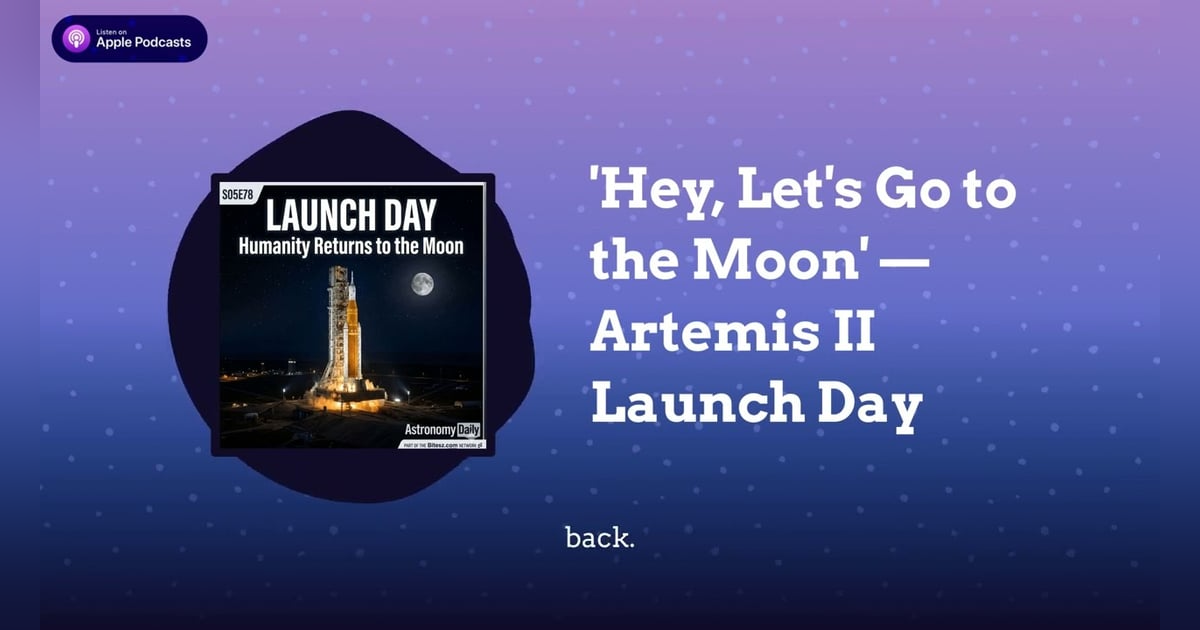


Launch day has arrived. In this episode of Astronomy Daily, Anna and Avery countdown to tonight's historic Artemis II launch — humanity's first crewed lunar mission since 1972 — and explore the dramatic stories unfolding alongside it: a sungrazing comet faces its moment of truth just three days from perihelion; astronomers raise urgent alarms over plans for one million new satellites; the interstellar comet 3I/ATLAS leaves its open-data legacy; and fascinating new science unpacks the hellish reality of Venus and a creative low-tech solution for mapping the Moon's interior. Story References Story 1: Artemis II Launch • NASA Artemis II Mission Hub: nasa.gov/mission/artemis-ii • NASA Live Coverage (NASA+, YouTube, Amazon Prime) — begins 7:45 AM EDT April 1 • Launch window: 6:24–8:24 PM EDT Wednesday April 1 (09:24–11:24 AEDT Thursday April 2) • Crew: Reid Wiseman (Commander), Victor Glover (Pilot), Christina Koch, Jeremy Hansen (CSA) • Mission duration: 10 days, splashdown April 10 off San Diego Story 2: Comet MAPS • C/2026 A1 (MAPS) perihelion: April 4, 2026 at ~14:23 UTC • Perihelion distance: ~160,000 km above Sun's surface (solar corona passage) • Kreutz sungrazer family — related to Great Comet of 1106 • Nucleus estimated ~400m diameter (JWST MIRI observation, Feb 7 2026) • Best-case post-perihelion brightness: magnitude -5 to -10 • Source: Sky & Telescope, EarthSky, Universe Today, Wikipedia Story 3: Satellite Megaconstellations • SpaceX proposal: 1,000,000 satellites (AI orbital data centres) — FCC filing Jan 30, 2026 • Reflect Orbital proposal: 50,000 mirror satellites — FCC filing July 31, 2025 • IAU, RAS, and ESO have all filed formal FCC objections • Nature study (Dec 2025): 96%+ of future space telescope exposures affected if constellations completed • Hubble: up to 1/3 of images contaminated • Source: Universe Today, Astronomy Magazine, Nature Story 4: 3I/ATLAS Open Data • NASA open data archive now available: science.nasa.gov/solar-system/comets/3i-atlas • Key finding: 3I/ATLAS unusually rich in methanol vs hydrogen cyanide • Observed by 12+ NASA missions including Hubble, JWST, TESS, SPHEREx, MAVEN, Perseverance • Jupiter flyby: March 16, 2026 at 0.358 AU • Source: NASA Science, Space.com, NRAO Story 5: Venus • Surface temperature: 464°C average • Atmospheric pressure: 92× Earth (equivalent to ~1km ocean depth) • Longest spacecraft survival: ~2 hours (Soviet Venera probes) • Source: Universe Today, April 1 2026 Story 6: Lunar Optical Fibre • Two new journal papers propose telecom-grade optical fibre for lunar seismic mapping • Could map deep interior and identify lava tube locations • Lava tubes: potential natural shelters for future astronauts • Source: Universe Today, April 1 2026
Become a supporter of this podcast: https://www.spreaker.com/podcast/astronomy-daily-space-news-updates--5648921/support (https://www.spreaker.com/podcast/astronomy-daily-space-news-updates--5648921/support?utm_source=rss&utm_medium=rss&utm_campaign=rss) .
Sponsor Details:
Ensure your online privacy by using NordVPN . To get our special listener deal and save a lot of money, visit You'll be glad you did!
Become a supporter of Astronomy Daily by joining our Supporters Club. Commercial free episodes daily are only a click way... Click Here (https://www.spreaker.com/podcast/astronomy-daily-space-news-updates--5648921/support)
This episode includes AI-generated content.
Episode link: https://play.headliner.app/episode/32515294?utm_source=youtube


