Artemis Delays, Blue Origin’s Lunar Pivot, and Life’s Building Blocks in Space
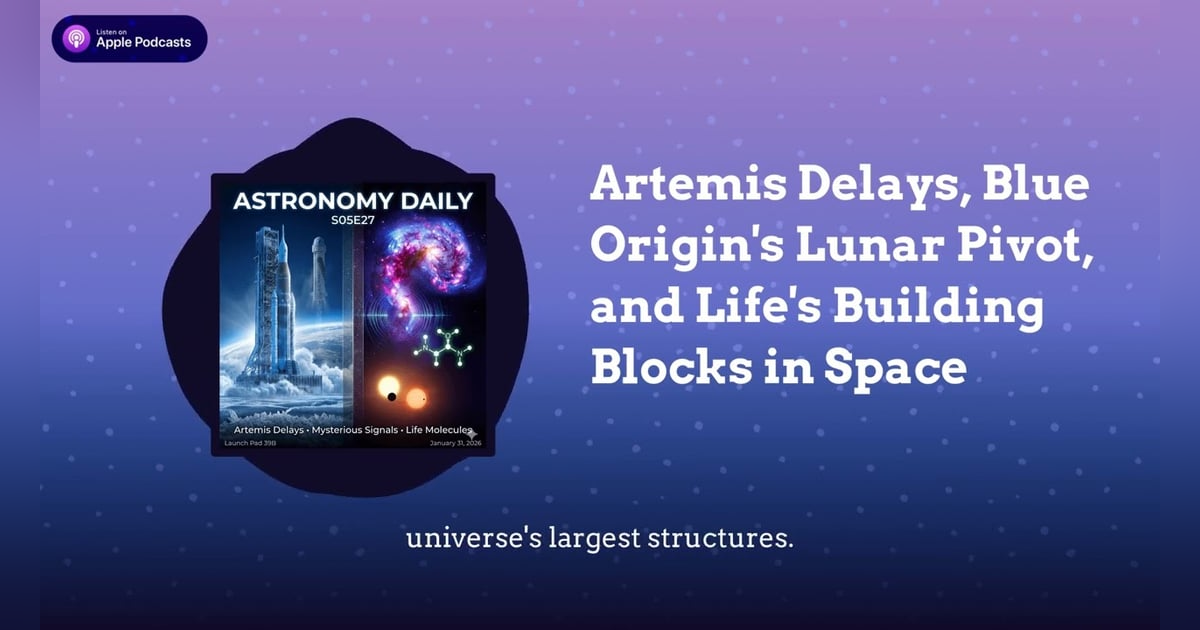


Join hosts Anna and Avery for Saturday's cosmic roundup! NASA's Artemis 2 wet dress rehearsal faces weather delays, pushing the historic lunar mission to April 2026. Blue Origin announces a major strategic shift, pausing space tourism for two years to focus on their Blue Moon lunar lander program. We explore million-mile-per-hour cosmic winds racing through a "magnetic superhighway" in colliding galaxies, investigate a mysterious object sending unexplained signals across the galaxy, discover why Tatooine-style planets might be more common than expected, and celebrate a groundbreaking first - the detection of ethanolamine, a molecule critical to cell membranes, in interstellar space.
**Episode Keywords:** Artemis 2, NASA, Blue Origin, New Shepard, space tourism, lunar lander, cosmic winds, galaxy merger, IC 1623, mysterious signals, radio astronomy, circumbinary planets, binary stars, ethanolamine, astrobiology, interstellar molecules, space exploration, Kennedy Space Center
**Detailed Chapter Markers:**
- [00:00] Introduction & Episode Overview
- [02:15] NASA Artemis 2 Wet Dress Rehearsal Delay
- [06:45] Blue Origin Pauses Space Tourism for Lunar Ambitions
- [11:20] Million-MPH Cosmic Winds in Magnetic Superhighway
- [16:30] Mysterious Object Sending Unexplained Galactic Signals
- [21:15] Tatooine Planets More Common Than Expected
- [26:00] Life-Critical Molecule Detected in Interstellar Space
- [30:45] Episode Wrap-Up & Closing
Become a supporter of this podcast: https://www.spreaker.com/podcast/astronomy-daily-space-news-updates--5648921/support (https://www.spreaker.com/podcast/astronomy-daily-space-news-updates--5648921/support?utm_source=rss&utm_medium=rss&utm_campaign=rss) .
Sponsor Details:
Ensure your online privacy by using NordVPN . To get our special listener deal and save a lot of money, visit You'll be glad you did!
Become a supporter of Astronomy Daily by joining our Supporters Club. Commercial free episodes daily are only a click way... Click Here (https://www.spreaker.com/podcast/astronomy-daily-space-news-updates--5648921/support)
This episode includes AI-generated content.
Episode link: https://play.headliner.app/episode/31430985?utm_source=youtube
00:00 - Introduction & Episode Overview
02:15 - NASA Artemis 2 Wet Dress Rehearsal Delay
06:45 - Blue Origin Pauses Space Tourism for Lunar Ambitions
11:20 - Million-MPH Cosmic Winds in Magnetic Superhighway
16:30 - Mysterious Object Sending Unexplained Galactic Signals
21:15 - Tatooine Planets More Common Than Expected
26:00 - Life-Critical Molecule Detected in Interstellar Space
Kind: captions
Language: en
00:00:00.240 --> 00:00:02.790
Welcome to [music] Astronomy Daily, your
00:00:02.800 --> 00:00:04.309
source for the latest space and
00:00:04.319 --> 00:00:06.470
astronomy news. [music] I'm Anna.
00:00:06.480 --> 00:00:08.470
>> And I'm Avery. Thanks for joining us on
00:00:08.480 --> 00:00:12.070
this Saturday, January 31st, 2026.
00:00:12.080 --> 00:00:13.910
>> We've got [music] a fascinating lineup
00:00:13.920 --> 00:00:16.070
today covering everything from NASA's
00:00:16.080 --> 00:00:18.550
Aremis program updates to groundbreaking
00:00:18.560 --> 00:00:19.990
discoveries [music] in the search for
00:00:20.000 --> 00:00:22.790
life beyond Earth. Avery, what's on the
00:00:22.800 --> 00:00:23.429
agenda?
00:00:23.439 --> 00:00:25.029
>> Well, Anna, we're kicking things off
00:00:25.039 --> 00:00:26.470
with some news from NASA's [music]
00:00:26.480 --> 00:00:28.870
Aremis 2 mission. There's been a delay
00:00:28.880 --> 00:00:30.550
in critical testing due to some
00:00:30.560 --> 00:00:32.630
unexpected [music] weather challenges.
00:00:32.640 --> 00:00:34.310
Then we'll dive into Blue Origin's
00:00:34.320 --> 00:00:36.069
strategic shift as [music] they pause
00:00:36.079 --> 00:00:38.310
their space tourism program for at least
00:00:38.320 --> 00:00:40.310
2 years. After that, [music] we're
00:00:40.320 --> 00:00:42.470
looking up at some truly cosmic
00:00:42.480 --> 00:00:45.830
phenomena. Million mileph winds racing
00:00:45.840 --> 00:00:47.910
through [music] colliding galaxies and a
00:00:47.920 --> 00:00:50.069
mysterious object sending powerful
00:00:50.079 --> 00:00:51.830
signals across space that has [music]
00:00:51.840 --> 00:00:53.910
astronomers scratching their heads.
00:00:53.920 --> 00:00:55.670
We'll also explore some surprising
00:00:55.680 --> 00:00:58.150
findings about Tatooine style planets
00:00:58.160 --> 00:01:00.950
orbiting binary stars and wrap up with
00:01:00.960 --> 00:01:02.630
an exciting [music] discovery.
00:01:02.640 --> 00:01:04.789
Scientists have detected a molecule
00:01:04.799 --> 00:01:06.789
critical to life in interstellar [music]
00:01:06.799 --> 00:01:09.350
space for the very first time.
00:01:09.360 --> 00:01:11.350
>> Quite the journey today. Let's get
00:01:11.360 --> 00:01:12.070
started.
00:01:12.080 --> 00:01:13.350
>> Ready when you are.
00:01:13.360 --> 00:01:15.109
>> All right, Avery. Let's start with
00:01:15.119 --> 00:01:17.990
NASA's Aremis program. I understand old
00:01:18.000 --> 00:01:19.749
man Winter has thrown a wrench into
00:01:19.759 --> 00:01:21.190
their testing schedule.
00:01:21.200 --> 00:01:23.749
>> He certainly has, Anna. NASA has been
00:01:23.759 --> 00:01:25.830
forced to delay a critical fueling test
00:01:25.840 --> 00:01:28.070
for the Aremis 2 mission due to below
00:01:28.080 --> 00:01:29.990
freezing temperatures at Kennedy Space
00:01:30.000 --> 00:01:31.990
Center in Florida. The wet dress
00:01:32.000 --> 00:01:33.990
rehearsal was originally scheduled for
00:01:34.000 --> 00:01:37.030
January 27th, but those unexpected cold
00:01:37.040 --> 00:01:39.749
temperatures put it on ice, so to speak.
00:01:39.759 --> 00:01:42.469
>> I see what you did there. But seriously,
00:01:42.479 --> 00:01:44.310
what exactly is this wet dress
00:01:44.320 --> 00:01:47.109
rehearsal? And why is it so important?
00:01:47.119 --> 00:01:49.270
>> Great question. The wet dress rehearsal
00:01:49.280 --> 00:01:51.510
is essentially a full practice run of
00:01:51.520 --> 00:01:53.910
launch day procedures minus the actual
00:01:53.920 --> 00:01:56.630
launch. The team loads the massive space
00:01:56.640 --> 00:01:59.590
launch system rocket with over 700,000
00:01:59.600 --> 00:02:02.069
gallons of super cold liquid hydrogen
00:02:02.079 --> 00:02:04.630
and liquid oxygen propellants, runs
00:02:04.640 --> 00:02:06.550
through all the countdown procedures,
00:02:06.560 --> 00:02:08.790
and then drains everything back out.
00:02:08.800 --> 00:02:10.790
It's the ultimate dress rehearsal before
00:02:10.800 --> 00:02:13.190
the real show. So, they're basically
00:02:13.200 --> 00:02:15.190
making sure all the plumbing works and
00:02:15.200 --> 00:02:16.710
everyone knows their roles when the
00:02:16.720 --> 00:02:18.550
clock is ticking down. What happened
00:02:18.560 --> 00:02:20.630
with the weather that caused the delay?
00:02:20.640 --> 00:02:22.869
>> Well, Florida experienced some unusually
00:02:22.879 --> 00:02:24.710
cold conditions. We're talking about
00:02:24.720 --> 00:02:26.630
freezing temperatures that persisted for
00:02:26.640 --> 00:02:28.630
several days. The problem is that
00:02:28.640 --> 00:02:30.790
loading these cryogenic propellants in
00:02:30.800 --> 00:02:32.790
freezing conditions creates additional
00:02:32.800 --> 00:02:34.790
safety risks and potential technical
00:02:34.800 --> 00:02:37.589
issues. NASA's priority is always safety
00:02:37.599 --> 00:02:39.030
first, so they made the call to
00:02:39.040 --> 00:02:39.910
postpone.
00:02:39.920 --> 00:02:41.910
>> Smart move. When are they planning to
00:02:41.920 --> 00:02:42.790
try again?
00:02:42.800 --> 00:02:44.869
>> The space launch system is now set to
00:02:44.879 --> 00:02:47.830
roll out to launchpad 39B on February
00:02:47.840 --> 00:02:49.990
5th with the wet dress rehearsal
00:02:50.000 --> 00:02:52.550
rescheduled for February 8th. This means
00:02:52.560 --> 00:02:54.949
the Aremis 2 launch is now no earlier
00:02:54.959 --> 00:02:57.830
than April 2026, which is a shift from
00:02:57.840 --> 00:02:59.589
the previous March target.
00:02:59.599 --> 00:03:01.350
>> For our listeners who might not be
00:03:01.360 --> 00:03:03.589
following every detail of Artemis,
00:03:03.599 --> 00:03:05.910
remind us what makes Artemis 2 so
00:03:05.920 --> 00:03:06.949
significant.
00:03:06.959 --> 00:03:09.509
>> Hannah, Artemis 2 is absolutely
00:03:09.519 --> 00:03:11.830
historic. This will be the first crude
00:03:11.840 --> 00:03:14.309
mission beyond low Earth orbit in over
00:03:14.319 --> 00:03:17.030
50 years, basically since the Apollo
00:03:17.040 --> 00:03:19.430
program ended. Four astronauts will fly
00:03:19.440 --> 00:03:21.589
around the moon, testing all the systems
00:03:21.599 --> 00:03:23.270
and procedures that will eventually
00:03:23.280 --> 00:03:25.430
support landing astronauts back on the
00:03:25.440 --> 00:03:28.390
lunar surface during Artemis 3.
00:03:28.400 --> 00:03:30.390
>> It's wild to think we haven't sent
00:03:30.400 --> 00:03:33.509
humans beyond Earth orbit in 5 decades.
00:03:33.519 --> 00:03:35.589
Who's on the crew? The crew includes
00:03:35.599 --> 00:03:37.910
NASA astronauts Reed Weisman, Victor
00:03:37.920 --> 00:03:40.470
Glover, and Christina Ko along with
00:03:40.480 --> 00:03:42.630
Canadian Space Agency astronaut Jeremy
00:03:42.640 --> 00:03:45.270
Hansen. Victor Glover will make history
00:03:45.280 --> 00:03:47.430
as the first person of color to travel
00:03:47.440 --> 00:03:50.309
beyond low Earth orbit. And Christina Ko
00:03:50.319 --> 00:03:52.789
will become the first woman to do so.
00:03:52.799 --> 00:03:55.509
>> That's incredible. Even with this delay,
00:03:55.519 --> 00:03:58.229
April 2026 is right around the corner.
00:03:58.239 --> 00:04:00.070
The wait is almost over.
00:04:00.080 --> 00:04:02.710
>> Absolutely. And honestly, a few weeks
00:04:02.720 --> 00:04:05.030
delay to ensure everything is perfect is
00:04:05.040 --> 00:04:06.949
well worth it when you're pioneering the
00:04:06.959 --> 00:04:09.830
return of human deep space exploration.
00:04:09.840 --> 00:04:11.910
>> Speaking of human space flight, let's
00:04:11.920 --> 00:04:14.229
shift gears to Blue Origin. They're
00:04:14.239 --> 00:04:16.150
making some significant changes to their
00:04:16.160 --> 00:04:17.749
program, aren't they, Avery?
00:04:17.759 --> 00:04:20.069
>> They sure are, Anna. Blue Origin has
00:04:20.079 --> 00:04:21.590
announced they're hitting pause on their
00:04:21.600 --> 00:04:23.590
New Shepard space tourism flights for at
00:04:23.600 --> 00:04:26.629
least 2 years. This is a major strategic
00:04:26.639 --> 00:04:29.030
shift as they refocus their resources on
00:04:29.040 --> 00:04:30.870
NASA's Aremis program and the
00:04:30.880 --> 00:04:33.110
development of their lunar lander.
00:04:33.120 --> 00:04:36.230
>> 2 years is a substantial pause. What's
00:04:36.240 --> 00:04:37.670
driving this decision?
00:04:37.680 --> 00:04:39.350
>> It all comes down to their Blue Moon
00:04:39.360 --> 00:04:42.070
lunar lander program. Blue Origin won a
00:04:42.080 --> 00:04:44.150
contract from NASA worth potentially up
00:04:44.160 --> 00:04:47.189
to $3.6 billion to develop a human
00:04:47.199 --> 00:04:49.430
landing system for the Aremis missions.
00:04:49.440 --> 00:04:50.870
They're planning an uncrrewed
00:04:50.880 --> 00:04:52.870
demonstration mission to the moon in
00:04:52.880 --> 00:04:55.830
2028. And that's requiring a massive
00:04:55.840 --> 00:04:57.350
concentration of their engineering
00:04:57.360 --> 00:04:59.189
talent and resources.
00:04:59.199 --> 00:05:01.270
>> So they're essentially choosing moon
00:05:01.280 --> 00:05:03.510
landings over suborbital tourism
00:05:03.520 --> 00:05:05.590
flights. That seems like a pretty clear
00:05:05.600 --> 00:05:07.270
indication of where they see the bigger
00:05:07.280 --> 00:05:08.629
opportunity.
00:05:08.639 --> 00:05:10.710
>> Exactly. And it's worth noting that Blue
00:05:10.720 --> 00:05:12.710
Origin has already conducted eight
00:05:12.720 --> 00:05:14.870
successful New Shepard tourism flights
00:05:14.880 --> 00:05:18.550
since July 2021, carrying 43 people past
00:05:18.560 --> 00:05:20.790
the Carmen line, the internationally
00:05:20.800 --> 00:05:23.590
recognized boundary of space at 100 km
00:05:23.600 --> 00:05:25.990
altitude. So they've proven the concept
00:05:26.000 --> 00:05:27.430
and the technology.
00:05:27.440 --> 00:05:29.270
>> I remember the excitement around those
00:05:29.280 --> 00:05:31.270
early flights. What exactly will
00:05:31.280 --> 00:05:33.510
passengers experience on a New Shepard
00:05:33.520 --> 00:05:36.070
flight? It's a roughly 11-minute journey
00:05:36.080 --> 00:05:38.150
where passengers experience about 3
00:05:38.160 --> 00:05:39.830
minutes of weightlessness at the top of
00:05:39.840 --> 00:05:41.990
the ark. The capsule has massive
00:05:42.000 --> 00:05:44.070
windows, the largest ever flown in
00:05:44.080 --> 00:05:46.469
space, giving spectacular views of
00:05:46.479 --> 00:05:48.469
Earth's curvature and the blackness of
00:05:48.479 --> 00:05:50.870
space. It's suborbital, meaning you go
00:05:50.880 --> 00:05:53.110
up and come right back down, but you
00:05:53.120 --> 00:05:55.270
definitely cross into space.
00:05:55.280 --> 00:05:57.510
>> And this pause is specifically for the
00:05:57.520 --> 00:05:59.670
tourism program. What about other New
00:05:59.680 --> 00:06:00.950
Shepard missions?
00:06:00.960 --> 00:06:03.270
>> Good distinction, Anna. New Shepard will
00:06:03.280 --> 00:06:05.029
continue flying cargo and research
00:06:05.039 --> 00:06:07.029
missions. Blue Origin has committed to
00:06:07.039 --> 00:06:08.950
conducting at least two cargo flights
00:06:08.960 --> 00:06:11.189
each year during this tourism pause.
00:06:11.199 --> 00:06:12.950
These missions carry scientific
00:06:12.960 --> 00:06:14.870
experiments and payloads for various
00:06:14.880 --> 00:06:16.870
customers, including NASA.
00:06:16.880 --> 00:06:19.350
>> What about their ticket sales? I imagine
00:06:19.360 --> 00:06:21.029
people have already paid for future
00:06:21.039 --> 00:06:21.990
flights.
00:06:22.000 --> 00:06:24.070
>> Yes, and Blue Origin says they'll be
00:06:24.080 --> 00:06:25.749
contacting customers who've already
00:06:25.759 --> 00:06:27.270
purchased tickets to discuss their
00:06:27.280 --> 00:06:29.670
options. They haven't specified how many
00:06:29.680 --> 00:06:31.110
people are affected, but they've
00:06:31.120 --> 00:06:33.510
emphasized this is a temporary pause,
00:06:33.520 --> 00:06:35.350
not an end to the program.
00:06:35.360 --> 00:06:37.590
>> It's interesting timing, isn't it? Just
00:06:37.600 --> 00:06:39.350
as several companies are getting into
00:06:39.360 --> 00:06:41.749
the space tourism business, Blue Origin
00:06:41.759 --> 00:06:44.550
is stepping back, at least temporarily.
00:06:44.560 --> 00:06:46.390
>> It really shows you the scale of the
00:06:46.400 --> 00:06:48.390
lunar lander challenge. Building a
00:06:48.400 --> 00:06:50.390
spacecraft that can safely land humans
00:06:50.400 --> 00:06:52.230
on the moon and return them to lunar
00:06:52.240 --> 00:06:54.390
orbit is orders of magnitude more
00:06:54.400 --> 00:06:57.189
complex than a suborbital tourism op.
00:06:57.199 --> 00:06:59.189
Blue Origin is betting their future on
00:06:59.199 --> 00:07:01.110
being a key player in the new era of
00:07:01.120 --> 00:07:02.550
space exploration.
00:07:02.560 --> 00:07:04.870
>> And with that NASA contract potentially
00:07:04.880 --> 00:07:08.550
worth $3.6 billion, it's not hard to see
00:07:08.560 --> 00:07:10.469
why they're prioritizing it.
00:07:10.479 --> 00:07:12.950
>> Exactly. This is Blue Origin's moonshot,
00:07:12.960 --> 00:07:15.670
both literally and figuratively. If they
00:07:15.680 --> 00:07:17.670
can deliver a successful lunar lander,
00:07:17.680 --> 00:07:19.749
it positions them as a major player in
00:07:19.759 --> 00:07:22.469
the new era of space exploration. From
00:07:22.479 --> 00:07:25.110
human space exploration to cosmic
00:07:25.120 --> 00:07:27.350
phenomena, let's talk about something
00:07:27.360 --> 00:07:29.510
happening on a scale that's almost
00:07:29.520 --> 00:07:32.469
impossible to comprehend. Avery, tell us
00:07:32.479 --> 00:07:35.589
about these million mileph winds racing
00:07:35.599 --> 00:07:36.790
through space.
00:07:36.800 --> 00:07:39.510
>> Anna, this is absolutely mindblowing.
00:07:39.520 --> 00:07:41.830
Astronomers have discovered cosmic winds
00:07:41.840 --> 00:07:45.430
traveling at over 1.1 million mph.
00:07:45.440 --> 00:07:47.510
That's roughly 500 kilometers per
00:07:47.520 --> 00:07:49.270
second, racing through what they're
00:07:49.280 --> 00:07:51.589
calling a magnetic superighway between
00:07:51.599 --> 00:07:53.589
two colliding galaxies.
00:07:53.599 --> 00:07:57.270
>> A magnetic superhighway in space. That
00:07:57.280 --> 00:07:58.710
sounds like something out of science
00:07:58.720 --> 00:08:01.510
fiction. Where is this happening? This
00:08:01.520 --> 00:08:04.070
incredible phenomenon is occurring in a
00:08:04.080 --> 00:08:07.430
system called IC1623
00:08:07.440 --> 00:08:09.830
which is actually two galaxies in the
00:08:09.840 --> 00:08:12.390
process of merging together located
00:08:12.400 --> 00:08:14.629
about 275
00:08:14.639 --> 00:08:16.869
million light years from Earth in the
00:08:16.879 --> 00:08:19.990
constellation Cedus. These galaxies are
00:08:20.000 --> 00:08:23.029
in the late stages of a cosmic collision
00:08:23.039 --> 00:08:25.430
and it's creating some extraordinary
00:08:25.440 --> 00:08:26.309
physics.
00:08:26.319 --> 00:08:27.909
>> Walk us through what's actually
00:08:27.919 --> 00:08:29.909
happening here. How do galaxies
00:08:29.919 --> 00:08:33.430
colliding create these super fast winds?
00:08:33.440 --> 00:08:35.909
>> When galaxies merge, their gravitational
00:08:35.919 --> 00:08:38.149
interactions trigger massive bursts of
00:08:38.159 --> 00:08:40.709
star formation. We're talking thousands
00:08:40.719 --> 00:08:43.670
of stars being born. These newborn stars
00:08:43.680 --> 00:08:46.310
live fast and die young, creating
00:08:46.320 --> 00:08:48.630
powerful stellar winds and supernova
00:08:48.640 --> 00:08:50.790
explosions. All of this activity
00:08:50.800 --> 00:08:53.110
generates enormous amounts of energy
00:08:53.120 --> 00:08:55.190
that drives material outward at
00:08:55.200 --> 00:08:58.150
incredible speeds. and the magnetic
00:08:58.160 --> 00:09:01.430
superhighway. What role does that play?
00:09:01.440 --> 00:09:03.829
>> Here's where it gets really fascinating.
00:09:03.839 --> 00:09:05.430
The team from the University of
00:09:05.440 --> 00:09:07.670
Hershshire discovered that magnetic
00:09:07.680 --> 00:09:09.750
fields are actually channeling these
00:09:09.760 --> 00:09:11.990
winds, creating what they call a
00:09:12.000 --> 00:09:13.910
superighway that connects the two
00:09:13.920 --> 00:09:16.389
galactic cores. Think of it like a
00:09:16.399 --> 00:09:18.870
cosmic interstate highway system, but
00:09:18.880 --> 00:09:21.269
instead of cars, you've got superheated
00:09:21.279 --> 00:09:23.670
gas screaming along at speeds that make
00:09:23.680 --> 00:09:25.750
Earth's fastest spacecraft look like
00:09:25.760 --> 00:09:27.430
they're standing still.
00:09:27.440 --> 00:09:30.150
>> That's an amazing image. How did they
00:09:30.160 --> 00:09:32.150
detect something like this?
00:09:32.160 --> 00:09:35.030
>> They used the Arakama Large Millm Array,
00:09:35.040 --> 00:09:37.430
ALMA, in Chile, which is specifically
00:09:37.440 --> 00:09:39.829
designed to observe cold gas and dust in
00:09:39.839 --> 00:09:41.829
the universe. What they found was
00:09:41.839 --> 00:09:44.630
unexpected. The magnetic field structure
00:09:44.640 --> 00:09:46.870
doesn't just randomly radiate outward
00:09:46.880 --> 00:09:49.750
like many galactic winds do. Instead,
00:09:49.760 --> 00:09:52.310
it's highly organized, creating this
00:09:52.320 --> 00:09:54.550
directed pathway between the galactic
00:09:54.560 --> 00:09:55.590
centers.
00:09:55.600 --> 00:09:58.310
>> Why is this discovery so significant?
00:09:58.320 --> 00:09:59.990
What does it tell us about galaxy
00:10:00.000 --> 00:10:01.509
evolution?
00:10:01.519 --> 00:10:03.750
>> This is crucial for understanding how
00:10:03.760 --> 00:10:06.630
galaxies grow and evolve. These powerful
00:10:06.640 --> 00:10:08.710
outflows, what astronomers call
00:10:08.720 --> 00:10:11.350
feedback, can actually regulate star
00:10:11.360 --> 00:10:13.829
formation by expelling the gas and dust
00:10:13.839 --> 00:10:16.069
that would otherwise collapse to form
00:10:16.079 --> 00:10:18.470
new stars. It's like a pressure release
00:10:18.480 --> 00:10:20.630
valve for galaxies. Too much star
00:10:20.640 --> 00:10:22.630
formation can blow away the material
00:10:22.640 --> 00:10:24.949
needed to make more stars, which can
00:10:24.959 --> 00:10:27.430
eventually slow down or even halt a
00:10:27.440 --> 00:10:28.790
galaxy's growth.
00:10:28.800 --> 00:10:31.430
>> So, galaxies regulate their own growth
00:10:31.440 --> 00:10:33.590
through these winds. That's a pretty
00:10:33.600 --> 00:10:36.230
elegant self-limiting system.
00:10:36.240 --> 00:10:40.069
>> It really is. And what makes IC1623
00:10:40.079 --> 00:10:42.069
particularly interesting is that we're
00:10:42.079 --> 00:10:44.389
seeing this process in action during a
00:10:44.399 --> 00:10:47.910
galaxy merger. When galaxies collide, we
00:10:47.920 --> 00:10:50.069
see the most extreme versions of these
00:10:50.079 --> 00:10:52.230
processes. The most intense star
00:10:52.240 --> 00:10:55.110
formation, the most powerful winds, the
00:10:55.120 --> 00:10:57.509
strongest magnetic fields. It's like
00:10:57.519 --> 00:10:59.430
watching galaxy evolution. and fast
00:10:59.440 --> 00:11:00.230
forward.
00:11:00.240 --> 00:11:04.069
>> What do we think the fate of IC1623
00:11:04.079 --> 00:11:04.790
will be?
00:11:04.800 --> 00:11:06.790
>> Eventually, these two galaxies will
00:11:06.800 --> 00:11:09.269
completely merge into a single larger
00:11:09.279 --> 00:11:11.509
galaxy. The current burst of star
00:11:11.519 --> 00:11:13.750
formation will eventually exhaust much
00:11:13.760 --> 00:11:15.910
of the available gas. And what we're
00:11:15.920 --> 00:11:18.389
looking at now, this spectacular phase
00:11:18.399 --> 00:11:20.949
of cosmic winds and magnetic highways
00:11:20.959 --> 00:11:23.670
will fade. But the combined galaxy will
00:11:23.680 --> 00:11:25.829
carry the imprint of this violent event
00:11:25.839 --> 00:11:28.150
in its structure and stellar populations
00:11:28.160 --> 00:11:30.310
for billions of years to come.
00:11:30.320 --> 00:11:31.829
>> It's humbling to think that we're
00:11:31.839 --> 00:11:33.829
witnessing something that takes millions
00:11:33.839 --> 00:11:36.550
of years to play out, just captured in a
00:11:36.560 --> 00:11:37.910
snapshot.
00:11:37.920 --> 00:11:40.310
>> Absolutely. And every time we point our
00:11:40.320 --> 00:11:42.870
telescopes at merging galaxies, we learn
00:11:42.880 --> 00:11:44.710
something new about the forces shaping
00:11:44.720 --> 00:11:47.350
the universe's largest structures.
00:11:47.360 --> 00:11:49.350
Speaking of pointing our telescopes at
00:11:49.360 --> 00:11:51.269
the universe and finding surprises,
00:11:51.279 --> 00:11:53.269
Avery, we need to talk about this
00:11:53.279 --> 00:11:55.350
mysterious object that's been sending
00:11:55.360 --> 00:11:57.829
powerful signals across the galaxy. The
00:11:57.839 --> 00:12:00.389
headline says it's unlike anything we
00:12:00.399 --> 00:12:01.750
have seen before.
00:12:01.760 --> 00:12:04.310
>> That's not just hype, Anna. Astronomers
00:12:04.320 --> 00:12:06.150
have discovered something truly
00:12:06.160 --> 00:12:08.870
puzzling. A cosmic object that's
00:12:08.880 --> 00:12:11.509
periodically sending out intense radio
00:12:11.519 --> 00:12:14.150
signals. And it doesn't fit into any
00:12:14.160 --> 00:12:16.069
category of known astronomical
00:12:16.079 --> 00:12:18.230
phenomena. It's one of those discoveries
00:12:18.240 --> 00:12:19.990
that makes you rethink what you thought
00:12:20.000 --> 00:12:20.790
you knew.
00:12:20.800 --> 00:12:23.750
>> Okay, you've got my attention. What
00:12:23.760 --> 00:12:25.590
exactly are we dealing with here?
00:12:25.600 --> 00:12:28.230
>> The object sends out extremely bright
00:12:28.240 --> 00:12:31.829
radio pulses that last about 30 to 300
00:12:31.839 --> 00:12:34.069
seconds. That's up to 5 minutes per
00:12:34.079 --> 00:12:36.710
pulse. And these pulses occur roughly
00:12:36.720 --> 00:12:39.509
every 2.9 hours with remarkable
00:12:39.519 --> 00:12:42.310
regularity. What makes this so unusual
00:12:42.320 --> 00:12:44.870
is the combination of that long period
00:12:44.880 --> 00:12:46.550
and the duration of the pulses
00:12:46.560 --> 00:12:47.509
themselves.
00:12:47.519 --> 00:12:49.509
>> When you say it doesn't fit known
00:12:49.519 --> 00:12:51.910
categories, what are the usual suspects
00:12:51.920 --> 00:12:53.750
for objects that send out regular
00:12:53.760 --> 00:12:55.110
signals like this?
00:12:55.120 --> 00:12:57.590
>> Great question. The two most common
00:12:57.600 --> 00:13:00.069
sources of periodic radio signals are
00:13:00.079 --> 00:13:03.350
pulsars and magnetars. Pulsars are
00:13:03.360 --> 00:13:05.430
rapidly spinning neutron stars that
00:13:05.440 --> 00:13:07.750
sweep beams of radiation across space
00:13:07.760 --> 00:13:10.150
like a cosmic lighthouse. But they
00:13:10.160 --> 00:13:11.829
typically pulse on the order of
00:13:11.839 --> 00:13:15.110
milliseconds to seconds, not hours. And
00:13:15.120 --> 00:13:17.190
their individual pulses are brief,
00:13:17.200 --> 00:13:19.750
usually milliseconds, not minutes.
00:13:19.760 --> 00:13:22.470
>> So this object is pulsing way too slowly
00:13:22.480 --> 00:13:24.150
to be a normal pulsar.
00:13:24.160 --> 00:13:26.870
>> Exactly. And the pulses last far too
00:13:26.880 --> 00:13:29.910
long. Magnetars, which are neutron stars
00:13:29.920 --> 00:13:31.910
with incredibly powerful magnetic
00:13:31.920 --> 00:13:34.310
fields, can sometimes produce longer
00:13:34.320 --> 00:13:36.870
period signals than regular pulsars, but
00:13:36.880 --> 00:13:39.030
even they don't typically operate on a
00:13:39.040 --> 00:13:41.509
3-hour cycle with multi-minute pulse
00:13:41.519 --> 00:13:42.310
durations.
00:13:42.320 --> 00:13:44.310
>> Have astronomers proposed any theories
00:13:44.320 --> 00:13:45.670
about what this could be?
00:13:45.680 --> 00:13:47.350
>> There are a few possibilities being
00:13:47.360 --> 00:13:49.750
investigated. One idea is that it could
00:13:49.760 --> 00:13:51.990
be a white dwarf in a binary system,
00:13:52.000 --> 00:13:53.829
which is two stars orbiting each other
00:13:53.839 --> 00:13:56.389
where one is a white dwarf remnant. The
00:13:56.399 --> 00:13:58.470
interaction between the two stars can
00:13:58.480 --> 00:14:00.629
potentially generate these periodic
00:14:00.639 --> 00:14:03.110
radio emissions. Another possibility is
00:14:03.120 --> 00:14:05.590
that we're seeing some kind of unusual
00:14:05.600 --> 00:14:08.069
magnetar or pulsar that operates
00:14:08.079 --> 00:14:09.670
differently than the ones we studied
00:14:09.680 --> 00:14:10.389
before.
00:14:10.399 --> 00:14:13.189
>> When was this object discovered and how?
00:14:13.199 --> 00:14:15.189
>> The discovery was made using radio
00:14:15.199 --> 00:14:17.509
telescope observations. And what's
00:14:17.519 --> 00:14:19.350
particularly intriguing is that the
00:14:19.360 --> 00:14:21.110
signals are powerful enough to be
00:14:21.120 --> 00:14:23.990
detected across vast distances. The
00:14:24.000 --> 00:14:25.990
exact distance to this object is still
00:14:26.000 --> 00:14:27.990
being determined, but the fact that we
00:14:28.000 --> 00:14:31.030
can detect such clear periodic signals
00:14:31.040 --> 00:14:33.509
suggests it's either relatively close in
00:14:33.519 --> 00:14:35.750
cosmic terms or it's putting out
00:14:35.760 --> 00:14:37.590
tremendous amounts of energy.
00:14:37.600 --> 00:14:39.910
>> This reminds me of those fast radio
00:14:39.920 --> 00:14:42.470
bursts we've heard about, brief, intense
00:14:42.480 --> 00:14:44.870
radio signals from across the universe.
00:14:44.880 --> 00:14:46.230
Is this related?
00:14:46.240 --> 00:14:48.629
>> That's a natural comparison, Anna. But
00:14:48.639 --> 00:14:51.750
fast radio bursts, FRBs, are different.
00:14:51.760 --> 00:14:53.910
They're much briefer. typically lasting
00:14:53.920 --> 00:14:56.790
milliseconds, though some do repeat.
00:14:56.800 --> 00:14:59.030
This object's behavior is more periodic
00:14:59.040 --> 00:15:01.509
and predictable with much longer pulse
00:15:01.519 --> 00:15:03.910
durations. It's almost like comparing a
00:15:03.920 --> 00:15:06.470
strobe light to a slowly rotating search
00:15:06.480 --> 00:15:07.110
light.
00:15:07.120 --> 00:15:09.110
>> What's the next step for studying this
00:15:09.120 --> 00:15:10.629
mysterious object?
00:15:10.639 --> 00:15:12.790
>> Astronomers will be conducting follow-up
00:15:12.800 --> 00:15:14.550
observations across multiple
00:15:14.560 --> 00:15:16.710
wavelengths, not just radio, but also
00:15:16.720 --> 00:15:19.750
optical, X-ray, and potentially others.
00:15:19.760 --> 00:15:21.910
They want to determine exactly where it
00:15:21.920 --> 00:15:24.629
is, measure its properties in detail,
00:15:24.639 --> 00:15:26.629
and hopefully identify what type of
00:15:26.639 --> 00:15:28.790
object it is. Sometimes you need
00:15:28.800 --> 00:15:30.710
multiple types of observations to build
00:15:30.720 --> 00:15:31.910
a complete picture.
00:15:31.920 --> 00:15:34.230
>> Do discoveries like this happen often
00:15:34.240 --> 00:15:35.910
where we find something that just
00:15:35.920 --> 00:15:38.230
doesn't fit our existing models.
00:15:38.240 --> 00:15:39.670
>> More often than you might think,
00:15:39.680 --> 00:15:42.150
actually, the universe keeps surprising
00:15:42.160 --> 00:15:44.389
us. Every major improvement in our
00:15:44.399 --> 00:15:46.310
observing technology reveals new
00:15:46.320 --> 00:15:48.389
phenomena we didn't predict.
00:15:48.399 --> 00:15:50.949
Radioastronomy in particular has a
00:15:50.959 --> 00:15:53.189
history of unexpected discoveries.
00:15:53.199 --> 00:15:55.350
Pulsars themselves were a complete
00:15:55.360 --> 00:15:57.030
surprise when they were first detected
00:15:57.040 --> 00:15:58.710
in 1967.
00:15:58.720 --> 00:16:00.790
>> Could this turn out to be a whole new
00:16:00.800 --> 00:16:03.430
class of astronomical objects?
00:16:03.440 --> 00:16:05.910
>> That's definitely possible. If follow-up
00:16:05.920 --> 00:16:08.310
observations confirmed that this truly
00:16:08.320 --> 00:16:11.030
doesn't fit into any existing category,
00:16:11.040 --> 00:16:13.269
it could indeed represent something new.
00:16:13.279 --> 00:16:15.350
Of course, it might also turn out to be
00:16:15.360 --> 00:16:17.590
an extreme example of a known type of
00:16:17.600 --> 00:16:20.310
object, just operating in a regime we
00:16:20.320 --> 00:16:22.389
haven't observed before. Either way,
00:16:22.399 --> 00:16:24.069
it's expanding our understanding of
00:16:24.079 --> 00:16:26.069
what's possible in the universe.
00:16:26.079 --> 00:16:27.829
>> I love that we're still finding things
00:16:27.839 --> 00:16:29.990
that make astronomers say we've never
00:16:30.000 --> 00:16:31.749
seen anything like this before.
00:16:31.759 --> 00:16:34.230
>> Me, too, Anna. It reminds us how much we
00:16:34.240 --> 00:16:36.470
still have to learn about the cosmos.
00:16:36.480 --> 00:16:38.790
Sticking with unexpected discoveries,
00:16:38.800 --> 00:16:40.949
let's talk about planets that orbit two
00:16:40.959 --> 00:16:44.069
suns. Tatooine style worlds. Avery, I
00:16:44.079 --> 00:16:45.509
understand these aren't as rare as
00:16:45.519 --> 00:16:47.910
scientists once thought. That's right,
00:16:47.920 --> 00:16:50.230
Anna. New research is challenging our
00:16:50.240 --> 00:16:53.030
assumptions about circumbinary planets.
00:16:53.040 --> 00:16:54.790
That's the technical term for planets
00:16:54.800 --> 00:16:57.030
that orbit both stars in a binary
00:16:57.040 --> 00:16:59.749
system. It turns out these Star Wars
00:16:59.759 --> 00:17:01.829
style worlds might be more common than
00:17:01.839 --> 00:17:03.910
we previously believed, especially
00:17:03.920 --> 00:17:06.949
around certain types of binary stars.
00:17:06.959 --> 00:17:09.189
>> Before we dive into the findings, let's
00:17:09.199 --> 00:17:11.429
set the stage. How common are binary
00:17:11.439 --> 00:17:13.429
star systems in the first place?
00:17:13.439 --> 00:17:15.669
>> Binary systems are actually incredibly
00:17:15.679 --> 00:17:18.230
common, Anna. Roughly half of all
00:17:18.240 --> 00:17:20.870
sunlike stars exist in binary or
00:17:20.880 --> 00:17:23.110
multiple star systems. So, we're not
00:17:23.120 --> 00:17:25.429
talking about a rare cosmic curiosity
00:17:25.439 --> 00:17:27.750
here. Binaries are a fundamental
00:17:27.760 --> 00:17:29.590
component of the galaxy's stellar
00:17:29.600 --> 00:17:30.789
population
00:17:30.799 --> 00:17:32.630
>> and we have discovered actual
00:17:32.640 --> 00:17:35.029
circumbinary planets already, right?
00:17:35.039 --> 00:17:36.870
This isn't just theoretical.
00:17:36.880 --> 00:17:39.190
>> Absolutely. NASA's Kepler Space
00:17:39.200 --> 00:17:41.669
Telescope discovered the first confirmed
00:17:41.679 --> 00:17:44.710
circumbinary planets back in 2011, and
00:17:44.720 --> 00:17:46.870
we've found several more since then.
00:17:46.880 --> 00:17:49.750
These are real worlds orbiting two suns,
00:17:49.760 --> 00:17:52.070
just like Luke Skywalker's home planet.
00:17:52.080 --> 00:17:54.150
But the question has always been, how
00:17:54.160 --> 00:17:56.390
common are they? So, what does this new
00:17:56.400 --> 00:17:57.830
research tell us?
00:17:57.840 --> 00:17:59.909
>> The study found that circumbinary
00:17:59.919 --> 00:18:02.310
planets appear to be particularly common
00:18:02.320 --> 00:18:04.310
around what are called equal mass
00:18:04.320 --> 00:18:06.870
binaries. Systems where both stars are
00:18:06.880 --> 00:18:09.510
roughly the same size and mass. In these
00:18:09.520 --> 00:18:11.830
systems, the stable orbital zone where
00:18:11.840 --> 00:18:14.230
planets can form and survive might
00:18:14.240 --> 00:18:15.750
actually be more favorable than
00:18:15.760 --> 00:18:18.150
astronomers previously calculated.
00:18:18.160 --> 00:18:20.470
>> Why would having two equal mass stars
00:18:20.480 --> 00:18:22.870
make it easier for planets to form? It
00:18:22.880 --> 00:18:25.110
has to do with gravitational stability.
00:18:25.120 --> 00:18:27.750
When you have two stars of similar mass,
00:18:27.760 --> 00:18:29.510
their gravitational influence on the
00:18:29.520 --> 00:18:31.270
surrounding disc of planet forming
00:18:31.280 --> 00:18:33.029
material is more balanced and
00:18:33.039 --> 00:18:35.110
predictable. There's less chaotic
00:18:35.120 --> 00:18:37.350
variation in the gravitational forces
00:18:37.360 --> 00:18:39.510
acting on the disc, which means there
00:18:39.520 --> 00:18:41.430
are stable regions where material can
00:18:41.440 --> 00:18:43.750
accumulate and grow into planets.
00:18:43.760 --> 00:18:46.230
>> What about unequal binary systems? One
00:18:46.240 --> 00:18:48.630
big star and one small one. Those
00:18:48.640 --> 00:18:50.710
systems can still host circumbinary
00:18:50.720 --> 00:18:52.710
planets, but the dynamics are more
00:18:52.720 --> 00:18:55.190
complex. The larger star dominates
00:18:55.200 --> 00:18:57.590
gravitationally, and the smaller star
00:18:57.600 --> 00:18:59.669
creates additional pertabbations that
00:18:59.679 --> 00:19:01.430
can make certain orbital regions
00:19:01.440 --> 00:19:03.990
unstable. It doesn't mean planets can't
00:19:04.000 --> 00:19:06.230
form, but the stable zones might be more
00:19:06.240 --> 00:19:08.070
limited or located at different
00:19:08.080 --> 00:19:09.190
distances.
00:19:09.200 --> 00:19:11.110
>> This has implications for the search for
00:19:11.120 --> 00:19:13.270
habitable worlds, doesn't it?
00:19:13.280 --> 00:19:15.909
>> Very much so. If circumbinary planets
00:19:15.919 --> 00:19:17.750
are more common than we thought,
00:19:17.760 --> 00:19:20.390
especially in equal mass binaries, that
00:19:20.400 --> 00:19:22.070
increases the overall number of
00:19:22.080 --> 00:19:24.230
potential planetary environments in the
00:19:24.240 --> 00:19:26.390
galaxy. Some of these could potentially
00:19:26.400 --> 00:19:28.390
be in the habitable zone, the region
00:19:28.400 --> 00:19:30.390
where liquid water could exist on a
00:19:30.400 --> 00:19:31.669
planet surface,
00:19:31.679 --> 00:19:33.990
>> although I imagine having two suns would
00:19:34.000 --> 00:19:35.669
complicate the climate situation
00:19:35.679 --> 00:19:36.950
significantly.
00:19:36.960 --> 00:19:39.110
>> You're absolutely right. The climate on
00:19:39.120 --> 00:19:40.950
a circumbinary planet would be
00:19:40.960 --> 00:19:43.270
fascinatingly complex. You'd have
00:19:43.280 --> 00:19:45.270
variations in heating depending on the
00:19:45.280 --> 00:19:47.750
orbital positions of both stars relative
00:19:47.760 --> 00:19:50.070
to the planet. Sometimes of the year,
00:19:50.080 --> 00:19:51.990
both suns might be on the same side of
00:19:52.000 --> 00:19:54.310
the sky, providing intense combined
00:19:54.320 --> 00:19:56.390
heating. Other times, they'd be on
00:19:56.400 --> 00:19:58.789
opposite sides, creating more balanced
00:19:58.799 --> 00:19:59.830
illumination.
00:19:59.840 --> 00:20:01.510
>> How did researchers arrive at these
00:20:01.520 --> 00:20:03.750
conclusions about circumbinary planet
00:20:03.760 --> 00:20:06.470
frequency? They combined observational
00:20:06.480 --> 00:20:08.470
data from telescope surveys with
00:20:08.480 --> 00:20:10.710
sophisticated computer modeling of how
00:20:10.720 --> 00:20:13.669
planets form in binary star systems. By
00:20:13.679 --> 00:20:15.430
simulating thousands of different
00:20:15.440 --> 00:20:17.510
scenarios with various binary
00:20:17.520 --> 00:20:19.750
configurations, they could identify
00:20:19.760 --> 00:20:22.150
patterns about which systems are most
00:20:22.160 --> 00:20:24.150
likely to host planets.
00:20:24.160 --> 00:20:25.909
>> Are there any specific systems
00:20:25.919 --> 00:20:27.669
astronomers are now targeting for
00:20:27.679 --> 00:20:29.590
follow-up observations based on these
00:20:29.600 --> 00:20:32.230
findings? The research definitely points
00:20:32.240 --> 00:20:35.029
to equal mass binaries as high priority
00:20:35.039 --> 00:20:37.430
targets for planet hunting campaigns.
00:20:37.440 --> 00:20:39.590
Missions like NASA's upcoming Nancy
00:20:39.600 --> 00:20:42.070
Grace Roman telescope and continuing
00:20:42.080 --> 00:20:44.310
observations from groundbased facilities
00:20:44.320 --> 00:20:46.230
will be keeping a close eye on these
00:20:46.240 --> 00:20:49.029
systems. Every new circumbinary planet
00:20:49.039 --> 00:20:51.909
we discover helps refine our models.
00:20:51.919 --> 00:20:54.549
>> It's exciting to think those iconic twin
00:20:54.559 --> 00:20:56.630
sunset scenes from Star Wars might be
00:20:56.640 --> 00:20:58.230
more common in the universe than we
00:20:58.240 --> 00:21:00.870
realized. It really is, Anna. The
00:21:00.880 --> 00:21:03.029
universe keeps proving that the reality
00:21:03.039 --> 00:21:05.110
can be just as spectacular as science
00:21:05.120 --> 00:21:07.750
fiction. Sometimes even more so.
00:21:07.760 --> 00:21:10.070
>> And for our final story today, Avery,
00:21:10.080 --> 00:21:11.669
we're talking about a discovery that
00:21:11.679 --> 00:21:14.070
touches on one of astronomy's biggest
00:21:14.080 --> 00:21:16.310
questions, the search for life beyond
00:21:16.320 --> 00:21:18.630
Earth. Scientists have detected a
00:21:18.640 --> 00:21:20.549
molecule critical to life in
00:21:20.559 --> 00:21:22.950
interstellar space. For the first time,
00:21:22.960 --> 00:21:24.789
tell us about this breakthrough.
00:21:24.799 --> 00:21:27.270
>> This is genuinely exciting, Anna. For
00:21:27.280 --> 00:21:29.750
the first time ever, astronomers have
00:21:29.760 --> 00:21:32.710
detected ethylenamine, a molecule that
00:21:32.720 --> 00:21:34.950
plays a crucial role in forming cell
00:21:34.960 --> 00:21:37.750
membranes floating in the vast spaces
00:21:37.760 --> 00:21:40.149
between stars. This discovery has
00:21:40.159 --> 00:21:41.990
profound implications for how we think
00:21:42.000 --> 00:21:43.909
about the building blocks of life in the
00:21:43.919 --> 00:21:44.870
universe.
00:21:44.880 --> 00:21:46.549
>> Let's start with the basics. What
00:21:46.559 --> 00:21:49.590
exactly is ethylamine and why is it so
00:21:49.600 --> 00:21:52.390
important to life? Ethylamine is an
00:21:52.400 --> 00:21:54.630
organic molecule that's a key component
00:21:54.640 --> 00:21:57.190
of phospholipids which are the primary
00:21:57.200 --> 00:21:59.669
building blocks of cell membranes. Think
00:21:59.679 --> 00:22:02.230
of cell membranes as the walls and gates
00:22:02.240 --> 00:22:04.549
of cells. They define the boundary
00:22:04.559 --> 00:22:06.870
between the inside and outside of a cell
00:22:06.880 --> 00:22:09.190
and control what goes in and out.
00:22:09.200 --> 00:22:11.590
Without molecules like ethyleneamine,
00:22:11.600 --> 00:22:13.430
you can't build functional cell
00:22:13.440 --> 00:22:15.909
membranes. And without cell membranes,
00:22:15.919 --> 00:22:18.470
you can't have cells as we know them.
00:22:18.480 --> 00:22:20.630
Though this is truly fundamental to
00:22:20.640 --> 00:22:23.350
life, at least life as we understand it.
00:22:23.360 --> 00:22:25.510
Where was this molecule detected?
00:22:25.520 --> 00:22:27.510
>> The discovery was made in a molecular
00:22:27.520 --> 00:22:30.149
cloud, one of these vast, cold regions
00:22:30.159 --> 00:22:33.110
of space where gas and dust accumulate
00:22:33.120 --> 00:22:35.110
and where new stars and planetary
00:22:35.120 --> 00:22:37.830
systems eventually form. These clouds
00:22:37.840 --> 00:22:40.390
are essentially stellar nurseries. and
00:22:40.400 --> 00:22:42.549
finding lifebuilding molecules there
00:22:42.559 --> 00:22:44.470
suggests that the ingredients for life
00:22:44.480 --> 00:22:46.230
might be getting incorporated into
00:22:46.240 --> 00:22:48.950
planetary systems right from the start.
00:22:48.960 --> 00:22:51.190
>> How do scientists actually detect
00:22:51.200 --> 00:22:53.190
specific molecules in interstellar
00:22:53.200 --> 00:22:55.830
space? I imagine you can't exactly
00:22:55.840 --> 00:22:57.430
collect a sample.
00:22:57.440 --> 00:22:59.510
>> Great question. They use radio
00:22:59.520 --> 00:23:02.070
spectroscopy. Every molecule has a
00:23:02.080 --> 00:23:04.390
unique spectroscopic signature. Think of
00:23:04.400 --> 00:23:06.789
it like a molecular fingerprint.
00:23:06.799 --> 00:23:09.029
Different molecules absorb and emit
00:23:09.039 --> 00:23:11.510
light at specific wavelengths. Radio
00:23:11.520 --> 00:23:13.510
telescopes can detect these signatures,
00:23:13.520 --> 00:23:15.750
allowing astronomers to identify what
00:23:15.760 --> 00:23:18.310
molecules are present in distant clouds,
00:23:18.320 --> 00:23:20.230
even though those clouds are trillions
00:23:20.240 --> 00:23:21.590
of miles away.
00:23:21.600 --> 00:23:23.750
>> We've found other organic molecules in
00:23:23.760 --> 00:23:26.070
space before, haven't we? What makes
00:23:26.080 --> 00:23:27.990
this discovery special?
00:23:28.000 --> 00:23:29.750
>> You're absolutely right, Hannah.
00:23:29.760 --> 00:23:32.390
Astronomers have detected more than 200
00:23:32.400 --> 00:23:34.070
different molecules in interstellar
00:23:34.080 --> 00:23:37.270
space, including amino acids and sugars.
00:23:37.280 --> 00:23:39.430
But ethylanamine is special because of
00:23:39.440 --> 00:23:41.750
its direct connection to cell membrane
00:23:41.760 --> 00:23:44.230
formation. It's one thing to find amino
00:23:44.240 --> 00:23:46.950
acids, the building blocks of proteins.
00:23:46.960 --> 00:23:48.950
But finding a molecule that's essential
00:23:48.960 --> 00:23:51.190
for creating the actual structure of
00:23:51.200 --> 00:23:54.070
cells, takes us another step closer to
00:23:54.080 --> 00:23:55.990
understanding how life's fundamental
00:23:56.000 --> 00:23:58.549
architecture might arise. Does this
00:23:58.559 --> 00:24:00.310
discovery change our thinking about
00:24:00.320 --> 00:24:02.149
where the building blocks of life come
00:24:02.159 --> 00:24:02.950
from?
00:24:02.960 --> 00:24:05.190
>> It definitely supports the hypothesis
00:24:05.200 --> 00:24:07.830
that many of life's essential molecular
00:24:07.840 --> 00:24:10.070
ingredients aren't created on planets
00:24:10.080 --> 00:24:12.950
after they form, but rather arrive from
00:24:12.960 --> 00:24:15.830
space. We already know that meteorites
00:24:15.840 --> 00:24:18.390
deliver organic compounds to planets. We
00:24:18.400 --> 00:24:20.390
found amino acids and meteorites that
00:24:20.400 --> 00:24:23.029
have fallen to Earth. This discovery
00:24:23.039 --> 00:24:25.510
suggests that even more complex life
00:24:25.520 --> 00:24:27.430
related molecules could be delivered
00:24:27.440 --> 00:24:28.710
from space.
00:24:28.720 --> 00:24:31.350
>> Though in a sense the raw materials for
00:24:31.360 --> 00:24:33.350
life might be common throughout the
00:24:33.360 --> 00:24:34.390
galaxy.
00:24:34.400 --> 00:24:36.789
>> That's the tantalizing possibility this
00:24:36.799 --> 00:24:39.590
raises. If molecules like ethanolamine
00:24:39.600 --> 00:24:41.590
can form in the harsh conditions of
00:24:41.600 --> 00:24:44.230
interstellar space, then these building
00:24:44.240 --> 00:24:46.149
blocks might be present in molecular
00:24:46.159 --> 00:24:48.789
clouds throughout the galaxy. Every time
00:24:48.799 --> 00:24:51.350
a new planetary system forms, it could
00:24:51.360 --> 00:24:53.590
be inheriting these pre-made components
00:24:53.600 --> 00:24:54.789
of life.
00:24:54.799 --> 00:24:56.950
>> This doesn't mean life is automatically
00:24:56.960 --> 00:24:58.950
everywhere, though, right? Having the
00:24:58.960 --> 00:25:00.549
ingredients doesn't guarantee you'll
00:25:00.559 --> 00:25:01.830
bake the cake.
00:25:01.840 --> 00:25:04.549
>> Exactly. This is about potential and
00:25:04.559 --> 00:25:06.789
possibility. Having the molecular
00:25:06.799 --> 00:25:09.190
building blocks is necessary for life,
00:25:09.200 --> 00:25:11.669
but it's not sufficient. You still need
00:25:11.679 --> 00:25:13.750
the right conditions for those molecules
00:25:13.760 --> 00:25:16.230
to assemble into functioning biological
00:25:16.240 --> 00:25:18.470
systems. The right temperature,
00:25:18.480 --> 00:25:21.590
pressure, energy sources, solvents like
00:25:21.600 --> 00:25:24.070
liquid water, and probably a host of
00:25:24.080 --> 00:25:26.789
factors we don't fully understand yet.
00:25:26.799 --> 00:25:28.470
>> What are the next steps for this kind of
00:25:28.480 --> 00:25:29.430
research?
00:25:29.440 --> 00:25:30.950
>> Astronomers will be looking for
00:25:30.960 --> 00:25:33.350
ethanolamine and similar molecules in
00:25:33.360 --> 00:25:35.190
other molecular clouds to see how
00:25:35.200 --> 00:25:37.350
widespread they are. They'll also be
00:25:37.360 --> 00:25:39.590
searching for even more complex organic
00:25:39.600 --> 00:25:41.909
molecules that might be precursors to
00:25:41.919 --> 00:25:45.029
biological chemistry. Every molecule we
00:25:45.039 --> 00:25:47.110
find helps us piece together the story
00:25:47.120 --> 00:25:49.830
of how inanimate chemistry transitions
00:25:49.840 --> 00:25:51.990
to the chemistry of life.
00:25:52.000 --> 00:25:53.590
>> It's remarkable to think that the
00:25:53.600 --> 00:25:55.669
membrane surrounding every cell in our
00:25:55.679 --> 00:25:57.669
bodies might have had their chemical
00:25:57.679 --> 00:25:59.830
ancestors floating between the stars
00:25:59.840 --> 00:26:01.510
billions of years ago.
00:26:01.520 --> 00:26:03.590
>> It really is, Anna. It connects us to
00:26:03.600 --> 00:26:06.710
the cosmos in a very tangible way. We're
00:26:06.720 --> 00:26:09.190
not just made of stardust in an abstract
00:26:09.200 --> 00:26:12.390
sense. The actual molecular machinery of
00:26:12.400 --> 00:26:14.950
life may have origins that predate Earth
00:26:14.960 --> 00:26:16.149
itself.
00:26:16.159 --> 00:26:18.070
>> What a perfect note to end today's
00:26:18.080 --> 00:26:20.070
episode on. A reminder that we're part
00:26:20.080 --> 00:26:22.390
of a universewide chemistry experiment
00:26:22.400 --> 00:26:24.149
that's been running for billions of
00:26:24.159 --> 00:26:25.110
years.
00:26:25.120 --> 00:26:27.110
>> Well, that wraps up another day of space
00:26:27.120 --> 00:26:29.909
and astronomy news. From NASA's Aremis
00:26:29.919 --> 00:26:32.070
preparations to the discovery of life's
00:26:32.080 --> 00:26:33.909
building blocks floating between the
00:26:33.919 --> 00:26:36.950
stars, the universe continues to amaze
00:26:36.960 --> 00:26:38.310
and inspire.
00:26:38.320 --> 00:26:40.310
>> It really does. Thanks so much for
00:26:40.320 --> 00:26:42.149
joining us today, everyone. Remember,
00:26:42.159 --> 00:26:44.789
you can find us at astronomyaily.io
00:26:44.799 --> 00:26:46.630
for full episode transcripts and
00:26:46.640 --> 00:26:47.590
additional content.
00:26:47.600 --> 00:26:49.510
>> And don't forget to follow us on social
00:26:49.520 --> 00:26:52.950
media at astroaily pod for daily updates
00:26:52.960 --> 00:26:55.029
and space news throughout the week.
00:26:55.039 --> 00:26:58.470
>> Until next time, keep looking up. Clear
00:26:58.480 --> 00:27:03.029
skies everyone. Astronomy [music] day.
00:27:03.039 --> 00:27:10.950
Stories be told.
00:27:10.960 --> 00:27:19.473
Stories [music] told.
00:27:19.483 --> 00:27:21.503
[music]


