




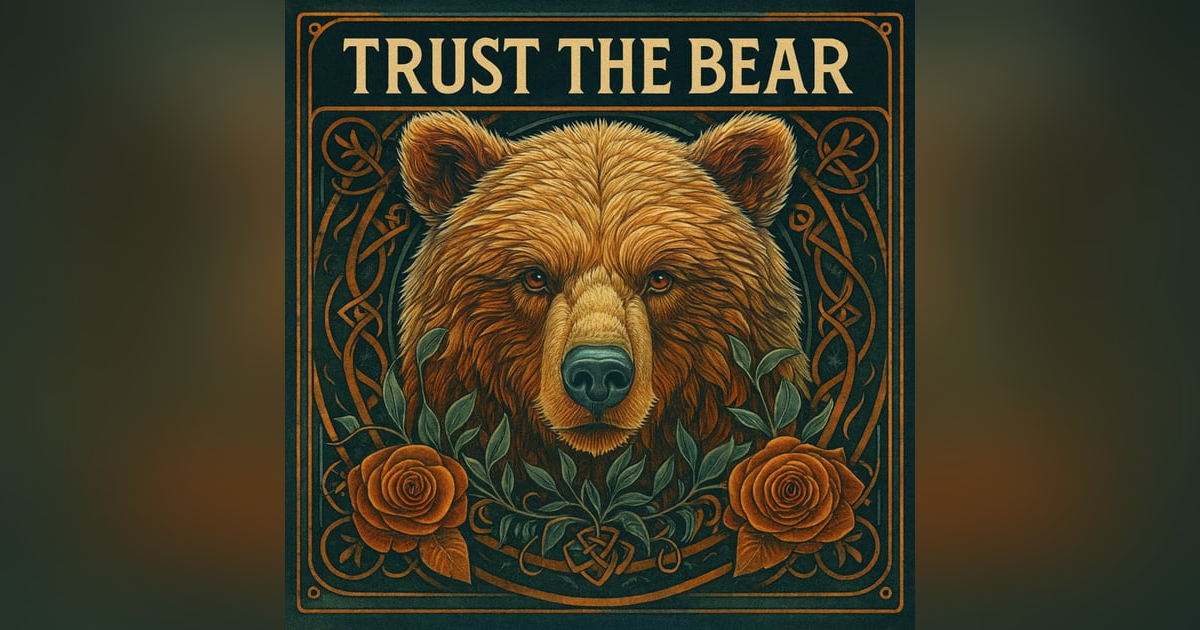
Trust the Bear
Folklore, Fear, and the Viral “Man vs. Bear” Debate
What do fairy tales, survival instincts, and a viral social media debate have in common? In this episode of Lexicons Unbound, we unpack the question that took over timelines: Would you rather be alone in the woods with a man or a bear?
We explore the bear as a powerful symbol in folklore—protector, predator, and primal force—and examine how it connects to modern conversations about women’s safety, autonomy, and survival instincts. From Goldilocks and Winnie the Pooh to viral memes, we trace how stories shape our perceptions of danger and trust.
Along the way, we discuss:
Why the bear (and other large predators) looms large in folklore and cultural imagination
How gender dynamics and survival strategies have evolved
How women today reclaim storytelling to challenge old tropes
This isn’t just about bears—it’s about the enduring stories we tell to navigate fear, find power, and rewrite the narratives handed down to us.
Whether you’re a folklore enthusiast, a meme scholar, or just curious why the internet keeps asking about bears, this episode is for you.





Melanie (00:05.799)
Molly, what are we going to talk about today? We're going to talk about the man versus bear debate and how that controversy is actually tied to a lot deeper roots. You know, I think I was almost shocked when I started seeing this go all over social media because it really seems to me about educating men because I don't know that they would have ever thought
about this choice and I'm pretty sure they wouldn't be so surprised that women would, for the majority, choose the bear. I find that interesting too because I remember reading it as it started to kind of proliferate and I thought, well, duh, like of course I would choose the bear. And then my second thought was, well wait, who's the man? Like if it were my partner, that's a different choice, right? But then you're thinking about this stranger and wondering.
I'm so curious about the women who would choose the man. Like what has your life been like that those were safe interactions? I think we should let the listeners know that the way that we're going to do this podcast is that Molly and I choose a topic, sort of piece together an outline and then don't talk about it with each other. And we go out and do our own little rabbit holeing down the internet and
because we are who we are, the academics that we are. I'm sure there's going to be some journal articles pop up in here. And then we have just pressed the record button and go. And I love that you brought this up because it goes right into one of the blogs that I read. Author professor, her name is Kelly Jarvis. She asked exactly that question. She's like, I need more context. Is it my daughter that's alone in the woods? Is it me alone in the woods? Is it?
You know, it doesn't just have to be a woman alone in the woods. It's just someone alone in the woods that encounters a man or a bear and the safety around it. And she said something that I really resonated with in that I have been very privileged all my life to be around safe men. And so I'm like you, is it my partner? Is it somebody I know? Is it somebody connected to somebody I know? Like where is the
Melanie (02:27.844)
Where is the forest that I'm in? Am I on my grandparents' land where there might be some hunters that have leased that land and then I run into that person? And my assumption, I think, unless there is outward physical signs from that man, I will be wary, but I am not panicked because that's not been my lived experience. But there so many women not like that. And so most every person that they encounter
if they are alone or vulnerable would elicit a fight or flight kind of thing. I found an article and this is coming from The Night Errant, which is, it looks like a school publication, a student publication of a school in St. Louis Park, Minnesota. And the author, or it's an editor, but the, who also wrote it named Melinda Areola. And it says, man versus bear, a cultural analysis of the heated debate.
And there's a picture of a white appearing woman in the woods with a bear on one side and a man on the other. And it says man or bear. One has a statistically high chance of violence and can result in a lifetime of fear and trauma. The other is a bear. And that's, think that has so quickly summarized for many women or many people who would choose the bear exactly what this debate really is about. Right. Well, and statistically,
I mean, there's just not that many bear attacks because, you know, unless it's a mother bear with a cub, they're not going to come towards someone. They're going to run away. A man, the statistics are not that good about for anybody, not just women, but particularly for women. It's an eye-opening debate. All right. I've got a question for you. The title of the episode for today is Trust the Bear, a folklore informed approach. Molly, tell me.
Why is folklore important? First of all, that we're storytelling beings, right? That so much of our lives and our histories are shared through stories. And we only understand ourselves in relationship to other people, in relationship to those stories that we tell and that we learn about ourselves through. And one of things I always think about is we started as oral history cultures, oral cultures. All of those stories and those traditions are passed down through
Melanie (04:52.643)
the telling of these stories. And sometimes, if any, you've ever, you know, talked to somebody who does fishing, those stories get a little embellished or they, dramatic elements sometimes get a little more dramatic. And so I think folklore is a way to, or was a way to teach younger generations about the world and about themselves and the area they lived and all of that. Then it was also for entertainment.
And so I think folklore is important because I think there is a lot of history and a lot of generational connection, right? That we can trace this back to various elders in how we arrive at where we are in the present moment is partially from the folklore that we come from. Yeah. You've heard the theory literature as mirror or as window. It's Dr. Rudine Sims Bishop. She's the one that first came up with this and it's really about literature, but
I think it just translates immediately over to storytelling. And it's a way to either see a reflection of ourselves or to look at others, right, in some way. And I think one of the things that we really talked about when we first started coming up with the idea of this podcast is that these new storytelling memes or debates that go on is just a reflection of the ones that we've had in the past and then connect them to those folklore traditions that
we've had because really there's only so many stories, right? We just adapt them to There's nothing new under the sun. Which kind of makes me sad. Yes, I agree. I hate that we are still continuing to fight the same battles. As we first kind of thought about this idea, one of the things that stuck out to me, especially with Wicked Part 1 being so popular and
Of course, that building from The Wizard of Oz, thinking about lions, tigers, and bears, my. That was one of the first things I wrote down as we started to talk about this was the way that we use that phrase and that cadence of that phrase with various other things. But the idea is that this is meant to be scary and large and predatory. And so as they are traveling the yellow brick road, this is terrifying. It's meant to be.
Melanie (07:07.727)
you got to find your courage to walk on through. The choice of bear. if I'm going to think of the bears that I immediately identify with, it's a teddy bear. I grew up with teddy bears, right? It's Winnie the Pooh. There could not be a less terrifying bear in the world than Winnie. Well, I think of the three bears. Exactly. Yeah.
And they weren't predatory, they were a family. That's right, absolutely. And then there's Paddington. That's kind of a craze these days. We've got, I don't know, what is there? Three now, three of the Paddington movies. That scene's about right. Yeah. And then we go down the Disney path and there's Brave, where the mother gets changed into a bear. And then we have our National Park Service, where Smokey the bear is now sort of becoming a political icon. Absolutely.
So there's so many folklore connections to this symbol. I want to go back to this article that I had found by this woman, this editor, Ariella. And she says, the bear is acting out of instinct, but any harm caused by another human is conscious. Yes. So in some ways, we're able to, or we're willing to, forgive a bear for attacking us, especially if it's out of instinct, if it's a mother protecting cubs.
or if we're going to think about a bear who, whatever reason they may attack, for food even, Scarce resources that we in some ways will forgive that because that's instinct. But if a human attacks, there is something conscious underneath that. You have to make the choice to attack another person. Yeah, especially if that other person is not considered a threat.
Yes, because even that, defending yourself is a very different understanding of violence than just to attack someone, especially someone who is not a threat or is not seen as a threat. And it's so, well, was going to use the word interesting, but I'm not sure that that's the right word. Depressing is probably the better word. There is so much violence towards women. And that's what I think has pushed this debate.
Melanie (09:31.727)
We need to allow the shade to be lifted on this and really understand that this is happening so much that it's sort of a no-brainer for women to immediately, they would rather choose the bear. think some of this is going to go back to like the Me Too movement and the number of men who often, and then different people with different identity markers, but men in this particular case who would say, not all men, hashtag not all men.
I don't think that women are saying all men. And I think that there are men who recognize why women would choose the bear. And yes, you know, we're seeing, think men who are parents say, well, yeah, I would, I would rather my daughter, I would rather my partner, I would rather my mother be in the forest with a bear than with another man. And so I think that there are men who recognize that there is that threat. And it doesn't have to mean I am the problem.
but that people like me might be. That's the thing. It's the recognition that I think we've been missing. At least a certain segment of the population has been missing. And to me, it's interesting that these conversations are now so much easier to have on social media because we bring in so many different voices, hopefully, potentially. You're not just within a particular friend group.
So there's the potential for a wider conversation on this, which I think is helpful. Absolutely. Well, and then the way things get shared, right? So I first saw it because somebody had taken it from X or Twitter because it's still Twitter in my brain. Exactly. Always will be. Yes, to take it from something like that or maybe it was a Tumblr post. I'm not 100 % sure. But then to have that screenshot and then I saw it on Facebook for the first time, that was my first interaction with it. So I was thinking about it.
that even as we try to figure out like where did this start, there's this moment where somebody says the thing and then that thing is what goes viral, but sometimes tracing it back to its origins can be so much more difficult. And so I find that really interesting now, of course, how it has even become a meme that you can just say man or bear. I had shared with you that at a local marathon near where we are that there was a person holding a sign that said run like you chose the man.
Melanie (11:56.087)
not the bear. And I that so interesting that now it has become enough of a meme, that shortened argument that stands in for the whole, that we don't even have to explain the entire debate around this. People can just go, I know exactly what that means. Exactly. Well, and when we were first talking about topics that we might want to do, and I brought this up, I said, well, you know what? That really started a couple of years ago. Maybe it's not still current.
And then we started looking into things and it's everywhere. It's still very current. And I find that interesting too, since we are academics, because of course, one of the things I went to do was to try to find what journal articles have been published. I started scouring popular culture journals even, and I can't find anything. Now, of course, some of that speaks to how long it takes to get something published in academia. you're not bitter. You're not bitter. No, no, no, no, there's no.
There are no thoughts about that. But it also said something to me about people maybe still trying to figure out what to do. Where is the argument? What do I want to say about it? Especially because I think to some degree, yeah, what's the argument? If most women already get this, there hasn't been anything published yet because it's part of the same old song. Song and dance. We already know, yep, this makes sense that trying to figure out how you would write a 30 page paper about it.
might be a little harder at this point. Yeah, same sound, different verse. Yep, exactly. And then if we think pop culture-wise too, then we have the doctor in Idaho who was forcibly removed from a town hall for asking questions of her elected officials. And that as she left and they said, you know, this would just be easier if you would cooperate. And she said, that's what rapists say.
And so looking at some of the comments on that and people be like, this is why we chose the bear. This is why we chose the bear. Yeah. Removed forcibly and handcuffs. Yes. No woman to my knowledge is saying, I want to be in a forest with a strange bear. What they are saying is my chances with a bear are safer. And especially some of those that we saw that were at least if the bear attacked me, people would believe me. At least the worst thing a bear could do to me is kill me.
Melanie (14:21.315)
Those were haunting stories, right? There is so much trauma related to this meme that I think it is important that we think about. We don't see the bears as inherently violent. We see them as inherently instinctual. But if we want to dig in a little bit to the folklore side of things. Yeah. One of the things I found that I thought was so interesting is that human culture has lived around bears for so long.
that bears have come to symbolize a bunch of different things in various cultures, but that some of that translates across cultures. So very broadly, bears symbolize healing, courage, and strength. And I also think that if women are choosing the bear and they're choosing healing, courage, and strength, there is also something for me at least about this idea of not needing a man to be whole or to be complete.
to be able to live a life that you are happy with. And so there's some beautiful, I don't know, poetic justice in there too. Well, sure. mean, there is nothing, there's not a bigger compliment that I could have from my students or the young people around me to call me a mama bear. That's right. I love that you went to the symbolism too, because I have something pulled up right here. Of course, because that's how we work.
This is from Triple Moon Psychotherapy and the article is, symbolism across cultures from protection and restoration to unbridled power and instinct. Just like you said, strength, intelligence, protection. Here's the neat one, traversing between realms. No, those things also make me think of this Tumblr post I had shared with you that made me think about Disney's Beauty and the Beast a little differently too.
And so it was a set of Tumblr ideas. And one of the people was arguing that Gaston really is the most terrifying Disney villain because he could be anyone in the world. Gaston is terrifying as a villain because the entire town is on his side. They see the beast as a beast. He is vicious and terrifying and to be feared and to be pushed out. And that it doesn't take Gaston much.
Melanie (16:41.229)
to convince the town to go after him. And one of the things I love about that too is because the first time I showed my oldest child, Beauty and the Beast, as a kid, she called the Beast a bear. He was a bear to her. That's how she read that that beast was as a bear. So thinking about that traversing between realms, like that's what the Beast, you know, becoming the prince at the end, that renewal, I think that's such an interesting
high end to this idea that there may be more symbolism to a Disney-fied story than we often give it credit for. Absolutely. Disney has taken those traditional stories from folklore and then put it into 3D for us. I know those artists are looking to expand it and deepen it, but
you know, the original material is there for them to work with, right? The symbolism is there for those who want to see it. The danger about Gaston is he's the one sitting next to you in the pub. Yes, because the critique I always often hear, I should say, of Beauty and the Beast is, it's just Stockholm syndrome. Like, cool. But this one, the point that these people are making is it's not even about the princess story. It's not about Belle in this moment. It's about the fact that who we see as the villain is villainizing someone else.
And the whole town lies into that. This whole mob mentality of they're ready to go kill the beast because they think that he deserved it. Right. That the beast is the danger. That the beast is the danger when the danger is leading them there. Exactly. I'm going to get off topic here for just a second. You know, Disney is often vilified, I guess is the right word, for the gender mechanics of a princess and being saved and those kinds of things. But think if we're willing to
watch these things critically and analytically with the young girls in our life that there's so many other stories that can come from these things, so many other lessons. And tying into how are we going to view these things in the 21st century? It can mean different things now. Yeah. And I'm happy for that because I love those stories. I'm a Disney girl. I to be able to watch those.
Melanie (19:05.335)
some things and not feel bad and go, that doesn't apply anymore. Okay, maybe it just applies in a different way. think, you know, wanting to make the argument too, that it doesn't mean you have to watch it uncritically either. Exactly. doesn't mean you can't watch it and recognize the places it's problematic and the stories that it might uphold or reify the structures and systems it keeps in place, but that you might also imagine what are the stories it tells about the importance of being yourself? What are the stories it tells about
what, you thinking you mentioned brave earlier, what does it mean to be brave looks like a bunch of different things. Exactly. Something else I found that traversed some cultures and I've got, I've got my receipts, my academic journals that we can add. There are articles. this is Northeast Asia is one place that they're looking at it.
And this person was specifically looking in American, Canadian, and Native American literature or Native literature. There's so much within Native American. But about this idea of bear myth and the bear as a creation story, that it was bears who sort of evolved into humans. And I think that is so interesting. And one of those articles, they kind of talk about
the fact that we so often think of bears as being bipedal, even though they often walk on four feet, but we see them in a similar format to ourselves. And I think that is such an interesting way, because that was certainly not a creation story I heard growing up. Like an idea that we might have, that a bear might have evolved in that sort of folkloric tale or those creation stories are that those trends.
late across cultures or resonate with a variety of cultures is also really fascinating. know. I didn't go down that rabbit hole as far, but in many native cultures, both in the Americas and in Russia, the bear is very prominent in that. Well, don't we tie bears and Russia together? Well, yes. I mean, it's their symbol, right? Right. Right. Absolutely.
Melanie (21:24.623)
another place that I went with this and you touched on it a little bit, I think. But there's this helpful animals in folklore and I think this goes to Christopher Robin and Winnie the Pooh because he trusts in Winnie the Pooh and tells him secrets and then I think about Calvin and Hobbes. know, it's not a bear, but it's a tiger. Again, another ferocious
wild animal that becomes companion. But my question is, why are we looking to animals for companionship and trust as opposed to other humans? You know, I immediately thought of Jasmine and her sidekick is a giant tiger. Yes, yes. But it makes me think, especially in that story, because the humans around her weren't trustworthy.
Right. Animal isn't going to hide or can't in the same ways, I guess, or that we as humans can currently understand. Perceive, right? That they can hide motivations or that they can lie to us or manipulate us in the same way. It's right. If my dog wants to manipulate me, it's to give me the puppy eyes to get the dog treat. Right. It's not a super sophisticated manipulation. Over time. Exactly.
kick me out of my home and rule the roost or whatever it is. What you see is what you get. Yes, in a much different way. Lions and tigers and bears. my! We've got to the tigers. We'll get to the lions here in a minute. was thinking about, see my favorite Disney tiger is Sher Khan in Jungle Book, but he's mean. He's terrifying. But I think I like him because he's smart. Yes. Well, then you think of Baloo, right? He is a bear.
He is bear. He's just a big goofball.
Melanie (23:24.671)
And and who and who Mowgli immediately trusts and confides in and who's a mentor and a teacher and... But Baloo also walks on two feet and it has more human-like qualities. Exactly. Okay, lions. I hadn't even gone down the lions, tigers and bears oh my thing. if we're going to stay in Disney, it's going to obviously go to Lion King, which is an incredible story. lions are
so powerful. It makes me cry every time. It's very emotional. Well, I think maybe it's because we have all these stories growing up that connect us emotionally to the animal kingdom. We look for those qualities in other humans, don't we? Yeah, absolutely. Nobody's looking for Scar. We all want Mufasa as our dad. That's right. So when I had said the lion's tigers are
Tigers and Bears earlier made me think of, we have a children's book here and I'm pretty sure it's called Lionheart. And it's the idea of this little boy who, you know, happens to be named Richard and he has a little stuffed lion and there's something he is scared of that is tied to like when he's sleeping. So bad dreams is my guess, but it just sort of is talked about as like the shadow, a shadow.
and the lion in his dream comes to life and protects him and teaches him how to be lionhearted, right? To be brave. And so I think about that too of the, that's what I think of because on the cover, it's sort of the little boy and the lion is standing kind of above and over him to where it is literally protection from this big scary thing until you can sort of stand on your own to do that. I love that. Yeah, it's a beautiful book.
Well, and I think that is why folklore will always be part of it. I mean, we may remix it, we may reimagine it, but there are such concepts that are ingrained in us from these stories and that's their purpose. Well, frankly, Disney is as popular as it is because it has figured out how to capitalize on these stories that mattered to us as kids. Exactly. builds on folklore, builds on
Melanie (25:44.765)
the Grimm Brothers and it builds on Hans Christian Anderson and native stories and all of these things. Especially thinking about Moana 2 just coming out and you have Maui as this trickster character, but he can shapeshift into animals. That's an important piece of the story and so it's this little bit of, I don't know, magical realism that we all want to hope that our lives are imbued with as well. And Disney has figured out how to capitalize on it because these stories resonate.
They over generations, probably some sort of collective imagination, it resonates over and over again. Well, and the universality of it too. Yes. Right? Absolutely. Even cross-culturally, we can understand those basic conflicts, man versus man, man versus self, man versus man, you know, those kinds of things. Okay. I love that you brought up Moana because now I want to talk about reclaiming the narrative women as storytellers.
Yes. I don't know about your timeline on your social media platforms and we can we can talk about the reasoning for this but my algorithm predominantly brings me good women storytellers. Hmm. Whether it's just about something that happened in their day or something that happened in their life or their their sharing information that they think other women need to know.
I mean, that's just how I've trained my platforms to tell me. Now, maybe it's because the majority of people online are women. I don't know. I haven't looked at those statistics. What's your timeline look like as far as women storytellers? I was thinking of the videos I go through and I, you know, assuming that the algorithm is working partially on what do you stop on and for how long. So I see comedians and that kind of thing. And there's some comedians whose humor I like and there are a few
men who oftentimes it's things like their parents or their partners and that's part of their content is the kind of joking aspects there. But I also I'm thinking of specifically this woman who has been coming across my feed a lot more lately and that is her content. It's her and a camera and she's telling stories of her life, whether it is her work life and some are funny and some are incredible.
Melanie (28:04.927)
incredibly emotional, but watching the engagement she has, the number of people who want to comment back, want to add on, want to ask questions or, hey, you mentioned this a while back. How is that? I am fascinated at the way that those stories allow people to engage with her. Yes. In what feels like an ongoing way, right? They become invested in the story instead of just the one-off video here and there.
They're invested in how this goes. It feels like to me that now I get a much bigger choice on the stories that I consume. We've continued to expand that with streaming and all of the channels that we're able to get nowadays, but that doesn't negate the fact that those stories in our large scale media, right? And our broadcast media, they have to be chosen to be produced. Yes. And the majority of the
producers is still in a male dominated way. And there are some women that are starting to have their own production companies and produce their own stories. But if we get out of that huge multimedia capitalistic kind of production and then come to these smaller platforms, it's these everyday women that I'm interested in because their stories are more like mine than
90 % of the things that I see on TV. We have access to stories in such an unprecedented way. So to think about how one person can share a story that gets multiplied or plus one, right? yes, I agree. So I share and I agree. So I share and these stories sort of make the rounds. I've experienced so I share. Yes, exactly. And, you know, I think a big thing we're seeing right now
politically is that this idea of another sort of meme that has happened, right? So an original creation that we've drawn upon that I thought about as I was thinking about doing this podcast was the idea of like the face-eating leopard, like, the leopards ate my face, right? So I voted for the leopard and I didn't realize the leopards would eat my face. Yeah, yeah. And I think that is such an interesting turn of phrase.
Melanie (30:32.861)
that, you know, there's one particular woman I follow and she shares stories and it's like hashtag leopards ate my face and over and over. And so there is also this moment of like the viciousness or the violence of the leopards eating your face. But there is just the expectation. Well, that's just what leopards do. Why would you expect anything different? And I find that really interesting, kind of juxtaposed against this man and bear debate too.
That's just what men do. And it's also, I don't know what provokes the man. The bear, I can to some degree reasonably assume that if I haven't surprised it, I'm not trying to actively attack it. It's not hungry, right? Or these particular things. But that if I were to meet a strange man, it might be only the fact that I am a woman. That could be enough of a provocation. Right.
I want to encourage our listeners to share your own interpretation of this particular debate. In our show notes, you'll have a website that you can go to. We would love to hear what you think about this. We want you to look at folklore as this sort of evolving tool for processing our collective thoughts, fears, and desires.
fun little meme this morning that I think is a great, great thing for us to end on. Tell our listeners what it says. So, the phrase that I found this morning that I sent was, I love the phrase, bear with me, because it either means be patient or the zoo heist was a success.
It was just such perfect timing to come across my feed this morning. Absolutely. Well, we want to thank you all for joining us today, and we look forward for you to come back on our next episode. And to engage with us and let us know how this has affected or impacted your own algorithms. Absolutely. And not only that, what would you like to hear us talk about? What kind of folklore is showing up in your life?
Melanie (32:50.801)
showing up on your algorithms now in the 21st century. what can we do a deep dive on and connect some dots? Thanks again for listening to us.