What IS Folklore?
 Suyash Dwivedi (CC License via Wikimedia)
It’s the end of another long day, and you’re scrolling (doomscrolling?) through social media when you come across another viral post, a life hack, or a story making the rounds. Is the story true, or have you come across folklore in digital form? Maybe you’re like us and, at first, the idea of folklore feels archaic and distant. It feels like long-forgotten stories from your childhood rather than something that is alive and evolving. But folklore isn’t just fairy tales or stories told around the campfire; we see it in memes, viral trends, urban legends, and shared rules online. When you think of folklore, we hope you’ll learn to see it as a contemporary facet of our lives. In this post, we will help you learn to spot digital folklore and understand why it so often becomes viral.
It can be difficult to parse out what folklore means, what counts as folklore. For us, folklore is the informal stories and/or practices shared person-to-person that evolve in each retelling. Think of it like a game of telephone, where it’s less about the minute differences that change (e.g., was it really a glass slipper Cinderella wore?) and more about the overall meaning of the story. Folklore could be used to teach a lesson or share hard-learned wisdom. It could be part hyperbolic myth and part recounting of an experience. Folklore is intricately tied to both communication (people expressing themselves) and art (people expressing themselves artistically). Perhaps the most important point to remember is that folklore is old and contemporary; it is still evolving, created, and shared.
In the digital sphere, we see this in a variety of ways. Perhaps it’s the warning post (e.g., “Don’t answer the phone if it rings three times”), the superstition (e.g., “If you spill salt, be sure to throw some over your left shoulder to ward off bad luck”), the survival or gender dynamics debate (e.g., Man vs. Bear), the urban legend (e.g., Bigfoot), or the seemingly “fact”-based myths (e.g., “It takes seven years to digest swallowed gum”). Regardless of the kind of folklore you come across, these kinds of posts share some key traits: There is typically no single author. They are stories shared and reshared to oblivion. They evolve over time. They are often a mix of humor, warning, and/or “insider” knowledge. Even when you don’t immediately clock a post as folklore, you may find yourself hesitating or thinking, “Hm, that might be important information to remember.”
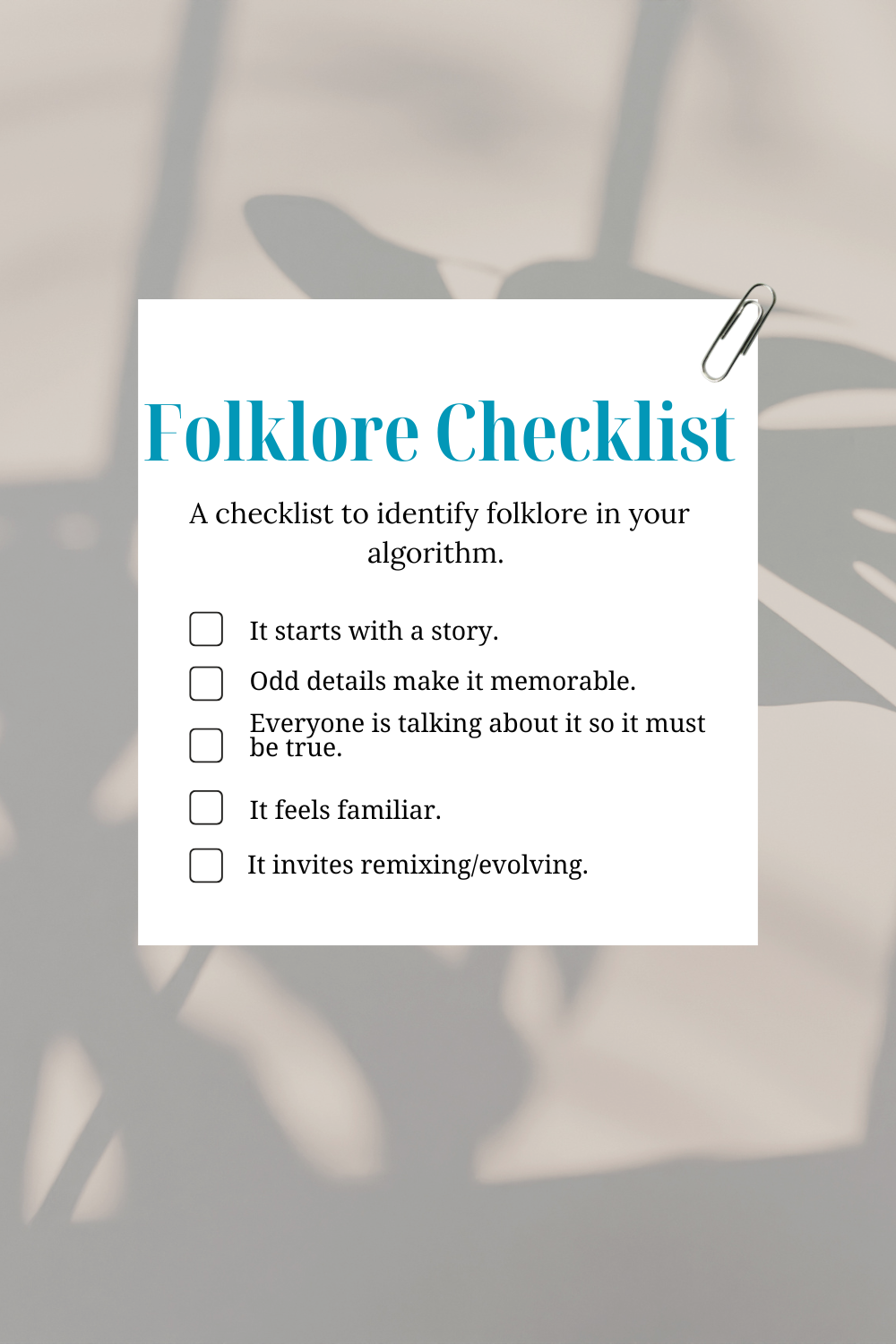
So, how do you begin to recognize folklore in your feed? Here are some practical tips--a Folklore Checklist--to keep in mind:
- Folklore is narrative-driven; it starts with a story. (“A friend of a friend told me…”)
- Odd details make it memorable. (Exact times or weirdly specific instructions)
- The virality of the post becomes a type of proof (“Everyone’s talking about it, so it must have some truth”)
- It feels familiar. (taps into familiar archetypes like warnings, transformations, or heroes/villains)
- It invites remixing/evolving. (Memes, stitches, reshares all evolve the story)
 Gage Skidmore (CC License via Wikimedia)
Now that you have some ideas about how to spot folklore in your feed, let’s talk about why it matters. Folklore is community-centered. As our communities continue to spread and/or become disparate, we seek more of that community online. In digital spaces, folklore still serves a communicative function, allowing people to reduce uncertainty about facets of life, to make sense of their experiences, to build community, especially through the use of inside jokes in particular groups, and to continue to share knowledge (whether that knowledge is real or imagined). Folklore is powerful in this way, reflecting culture, fear, and humor within a society or cultural group. And this is why we love to analyze it, to figure out what insights digital folklore gives us about contemporary life.
The next time you’re scrolling through social media, and you come across a (viral) post that strikes you as noteworthy, especially if it strikes at fear or safety, stop and ask yourself the Folklore Checklist questions. If you’re able to answer them each with a yes, you’ve come across a modern piece of folklore!
What’s the strangest bit of digital folklore you’ve come across lately? Drop it in the comments or tag us, and we may feature it in a future mini episode! And, if you haven’t already, please subscribe to Lexicons Unbound and check out our first full-length episode, “Trust the Bear” which explores the viral man vs. bear debate.
Folklore Sparks Curiosity: The Tale of the Kensington Runestone