
 Apple Podcasts

 Spotify

 Amazon Music
 RSS Feed
The Science of the Human-Animal Bond: How Pets Support Your Brain Health & How You Support Theirs with Dr. Etana Berger, Ph.D.

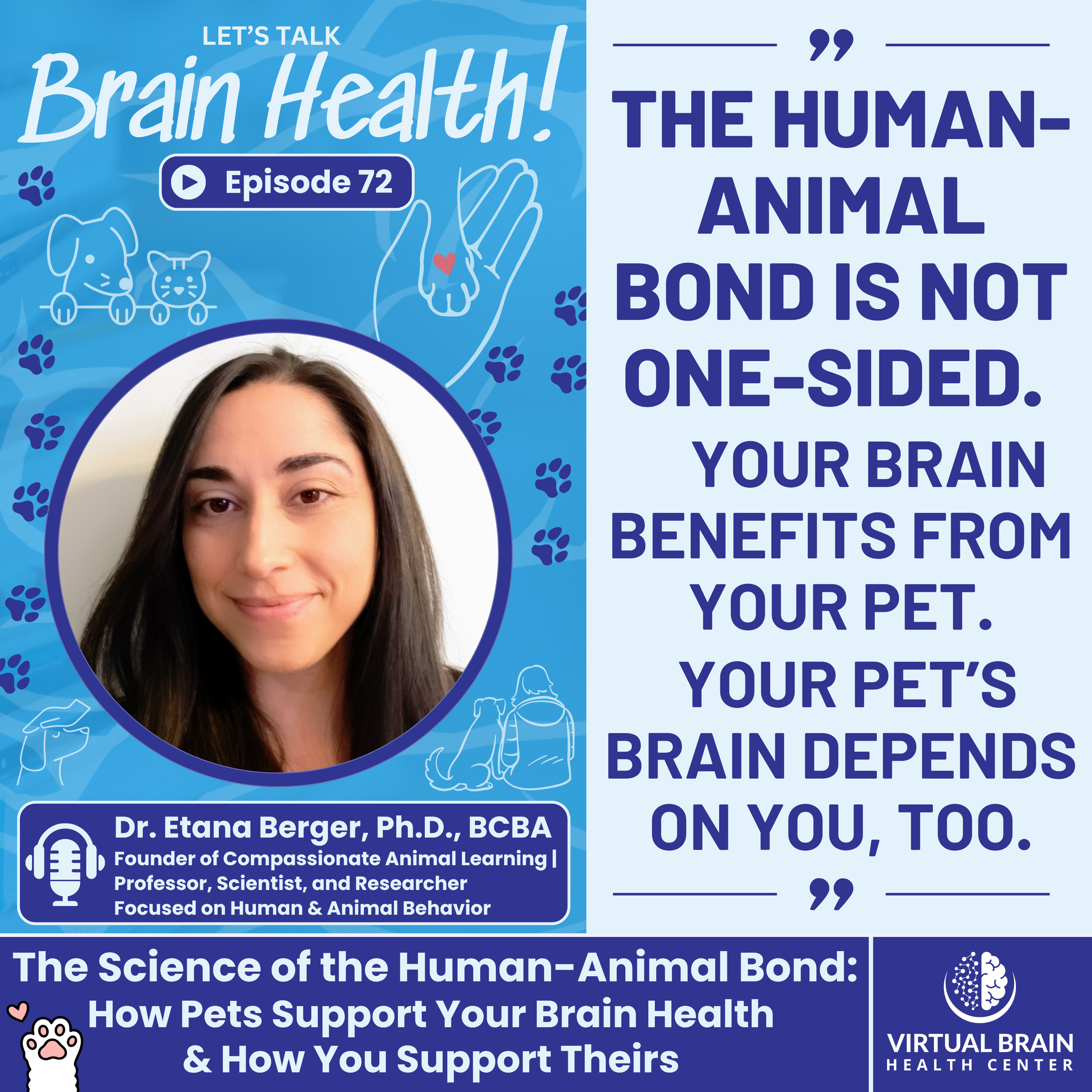
Pets are part of millions of households. For many people, they are companions, family members, and daily sources of connection. Research shows these relationships also influence physical health, mental health, social well-being, and brain health.
In this episode of the Let’s Talk Brain Health Podcast, Dr. Krystal Culler, DBH, MA, sits down with Dr. Etana Berger, Ph.D., behavior scientist and applied behavior analyst, to explore the science behind the human-animal bond. This conversation explores how pets support human brain health and why it is equally important to understand how we support the cognitive and emotional well-being of our animals.
This episode brings a behavioral science lens to the conversation and highlights how intentional interactions, enrichment, and environment shape wellbeing for both people and pets.
What You Will Learn in This Episode
- How pets support emotional health, stress reduction, and social connection
- The brain health benefits of the human-animal bond
- Why routines and shared activities benefit both humans and animals
- How behavioral science helps us better understand pet needs
- Ways to support your pet’s cognitive health through enrichment
- The importance of environment, stimulation, and engagement for pets
- How caring for a pet can strengthen purpose and daily structure
Key Takeaways
The relationship between people and pets is a two-way health connection.
Positive interactions with pets can support stress regulation, emotional well-being, and social health.
Animals also benefit from cognitive enrichment, predictable routines, and supportive environments.
Behavior science helps us better understand how to create healthier environments for both humans and animals.
Small daily actions can strengthen brain health for both you and your pet.
Who Should Listen
Pet owners interested in brain health
Professionals in health, animal behavior, or aging services
Anyone interested in the science of human connection and wellbeing
About the Guest
Dr. Etana Berger, Ph.D., is a behavior scientist, professor, and Board Certified Behavior Analyst (BCBA) with over a decade of experience supporting meaningful behavior change across the lifespan. Her work explores how behavioral science principles apply across both human and animal behavior and how environments shape outcomes.
Resources
You can connect directly with Dr. Berger on LinkedIn or at Compassionate Animal Learning, her company’s website.
Be sure to check out her new program offering for “Separation Related Behavior Workshop and Social Meet Up Series” starting on May 11, 2026 via this form.
You can learn more about The Susie Project, rescuing animals from the Caribbean.
The resources from this podcast conversation are available in this presentation.
Earn FREE CEs
The podcast qualifies for the following credit types: AMA PRA CATEGORY 1, ANCC, AAPA, APA, ASWB, and IPCE. Join the Learn at Pinnacle app to earn FREE CE Credit for listening to this episode!
Support the Podcast
If you found this episode valuable:
Share it with a fellow pet owner
Subscribe for more brain health conversations
Leave a review to help others find the show
Contact
Have a topic you would like covered on the podcast? Email: podcast@virtualbrainhealthcenter.com
Thank you for investing in your brain health and the well-being of those pets who depend on you.
**Disclaimer**
Pet ownership is a meaningful, long-term commitment that requires time, resources, and consistent care. This conversation focuses on the science of how human–animal relationships connect to the brain and overall health. It is not intended to encourage adopting or acquiring a pet. We encourage you to reflect on your current circumstances, capacity for care, and long-term readiness before making any decisions related to pet ownership.
0:02 Welcome to the Let's Talk Brain Health podcast, a public health educational initiative of the virtual Brain Health Center. I'm your host, Doctor Crystal Color, and I'm so glad you're here. On this podcast, I sit down with incredible guests to explore all things brain health and Wellness. Together, we'll talk about how to care for your total brain health, mind, body, and spirit while sharing the latest brain Health Science practical tips and strategies you can use everyday. By prioritizing your brain health, you're taking an important step towards living a happier, healthier life. So let's dive in and welcome today's guest. Pets are part of millions of households.
0:44 Many people see them as companions or even members of the family. Science shows these relationships also connect to our physical health, mental health, social well-being, and even brain health. Today we are exploring what research says about the health benefits of pets and an important part of the conversation, many people overlook our responsibility to support their brain health too. Today I'm joined by Doctor Tanya Berger, PHDA, behavior scientist, researcher, and professor with a deep passion for understanding behavior across both humans and animals. Doctor Berger holds a PhD in Applied Behavior Analysis and has spent over a decade as a Board Certified Behavior Analyst provider helping children and adults make meaningful behavior changes across many areas of life. Through her applied work, teaching, and research, she developed a strong interest in how behavioral science applies beyond humans.
1:41 After years of working with her own dogs and recognizing how much we can learn from them, she expanded her work to support animal behavior and training. She completed her training through the Victoria Stilwell Academy as a positive Reinforcement dog trainer and also became a fear free certified professional supporting humane evidence based approaches to animal care. Today, her work reflects A lifelong passion for animals and behavior science with a focus on helping people better understand their pets while also improving the well-being of their animals in their care. Doctor Berger, welcome to the Let's Talk Great Health podcast. Is there any additional information you'd like to share with our guests today before we get started?
2:25 I actually would love to start by first acknowledging that today would have been Jane Goodall's 92nd birthday, and her organization, the Jane Goodall Institute, is having their first annual Jane Goodall Day today. It seems only fitting to pay homage to a pioneer in this field who believed so deeply in our connection to nature and animals that she dedicated her life to it. And interesting fact that some folks might know, some might not is that Goodall actually did prefer dogs to her chimps, even though she's famous for that. And she speaks very highly of her dog that she had when she was younger. Yeah. What better day than today to talk about our connection with our pets. I'd encourage everyone today to think about how they might want to honor her legacy.
3:12 I am wearing my Jane Goodall Institute shirt, and it has a picture of her on it. And it says girls just want to do science. So really promoting women and girls in the STEM field. So that's my way of honoring her today in addition to getting outside. And I encourage you to think about that too. Learn something new every day in the ways that we can include brain health and so many different ways. And I'm so excited to dive in what you even proposed to me for the topic of not only how pets are good for our brain health, but the thing we can do to support the brain health of our pets. Have to ask though, what first brought you into understanding the connection between pets and human health? It's the same story we hear for a lot of people that are in animal fields or have an animal at home. I felt such a deep connection with animals, of course, specifically my dogs and my turtle, My family in general, we've always gravitated toward animals. My sister is an emergency veterinarian. We've always had animals in the home. And I think really my spark came from my first dog that I had with my husband.
4:22 And his name was Boomer. And he was a pity, a pit bull, and he passed away probably about three years ago. But he was just the sweetest, kindest soul and our bond was indescribable. And I heard all the stigma around pit bulls and I just, I wouldn't look at him every day and be like, oh, if only they could meet you and maybe it would change some minds. And when he passed, I had this aha moment that I just needed to move into animal behavior. Over the years in this field, my interests have just grown from animal behavior to understanding how pain plays a role in the behavior we see and how human behavior impacts our pets and ultimately how our bonds impact each other.
5:03 I think for many people who have ever been a pet owner and as you shared, you've owned a wide variety of animals over their time, they talk about that special pet known as your heart animal. And there's something unique about that bond. And sometimes you may get lucky in your lifetime and own more than one animal where you have that unique experience. And today we're going to focus in on the broad benefits pets for health and well-being. And I'd like to do a caveat before we dive in is we could likely do an entire series of podcast conversations with you where we would dive into the benefits of pets for brain health on physical, mental, social, emotional well-being. But we're going to do a first introduction on these multiple domains of Wellness. So I appreciate you accepting my brain challenge to give us these initial highlights.
5:52 And so I think the best way we could start this conversation is give an introduction to the research of how pets influence our health and walk through what do we know in these different areas. And so maybe we begin with the one people might have the most level of awareness. What does the research tell us about physiological health and how owning pets may influence that health and well-being? The really cool thing is that this is so broad. There has been so much research done and it's really head to toe like on how they benefit us. So across the span of our system, we see benefits. So we can start with things like blood pressure, for example, and we found many studies that have supported the benefits of pet caregiving pet ownership in relation to diastolic and systolic blood pressures, noting that the numbers for those two types, systems of blood pressure are often lower for pet owners when accounting for other variables that might influence those numbers.
6:55 If we look at how our pets impact us physically, we often see that those with dogs are more likely to engage in movement. They're more likely to get up and get out and walk those dogs. And so we're more likely to even get activity levels that are closer to those benchmarks or those recommendations that our health professionals want us to get to. So those 150 minutes a week of exercise that we need to get upward toward 300, of course, when we move into lipid levels, limited research, small pools of research on this, but some suggest that because we're walking our dogs and engaging in that movement, we might see improvements in our lipid levels, cardiovascular benefits.
7:36 So there's research on patients with cardiac risk factors greater than or equal to 1 and looking at these patients in relation to their pet ownership. And we're seeing things like greater parasympathetic activities and lower sympathetic activities. So just a reminder that parasympathetic system is associated with that rest and digest, right functions of lower heart rate and constricted pupils and promotion of digestive functions, whereas the sympathetic system is fight or flight. So increased heart rate, dilated pupils, decreased digestive of activity. So overall, in any research we review, I would say be a cautious consumer of information, right? Always read the information thoroughly and make sure you're getting it from the right sources. And realize that there are some studies that suggest different benefits or have opposite findings. But overall, it's really exciting to see these details, our entire physiological system, and see these correlations start to develop.
8:33 And of course, I've walked through a bunch of different types of information here, and this comes from a variety of different studies. All of the studies are cited and referenced in my information. So just to make sure, we give those wonderful researchers their credit. Yes, and we'll include a link in our show notes where people can find all of the resources that you're referencing in your talk today. What you highlighted for us are all these big bucket areas that we see in brain health when we talk blood pressure, additional movement and walking, lipid levels, cardiac system, stress and digestion, that these are big areas and we've heard many experts talk about and more in depth these areas in previous episodes on our podcast.
9:17 And if you read The Lancet Commission report, these are those key areas that we target for dimension risk and prevention when it comes online in the conversation for brain health and interacting to see how pets influence some of these risk factors that we also target from studying in the aging field. I always used to hear the running joke was what's the best way to get moving in terms of exercise? And they would say get a dog or get a pet because the idea was we would feel more obligated to walk that dog most of the time than we would to actually move ourselves or our own bodies. And there was a large body of research that would support that, with the caveat that pets work for everyone. But a lot of the research would show that there are additional benefits that came with getting up in walking that dog, social connection, emotional benefits that came from connecting with others and walking group.
10:15 But pets were one option to consider and it didn't collect the dust that a treadmill would. We have a lot more growing research now behind that. You're touching upon something there, right? We have all these systems and ways to get that movement in, but what better system than an animal that we have companionship, relationship with, that we can go out and enjoy nature with and not only promote physical activity but promote social interaction. And that leads us to the next area of health and well-being that has a pretty big depth in breadth of research. Behind it is the psychological benefits of pet ownership.
10:57 Can you give us some of the highlights of that for us now? It is such a huge topic, but let's start with the changes we experienced even when we're presented with a stressor. So some research has suggested that pet ownership not only impacts our blood pressure in a general sense, but also seems to be diminished when we're faced with a mental stressor after like a six months of pet ownership and caregiving. Beyond this, we also find that that we generally see pet caregivers, pet owners have lower cortisol levels, which just as a reminder that's that stress hormone and higher levels of oxytocin. And just a reminder for that too. Oxytocin we more affectionately refer to as our like love hormone often associated with emotions like trust or feelings of attraction or bonding.
11:51 And we see those higher levels when we've got pets in our lives and we might even see higher levels of self esteem, for example. So there was a great article that this that a lot of this comes from the friend who keeps you young from it's 2023 and I think it's Sir Johns Hopkins and they talk about a lot of these benefits. But this goes beyond just general mental well-being, right? We can also see pets impacting symptoms, severity of mental health diagnosis. We can't touch on all of the diagnosis today, of course, that's like a whole list of it. But we can focus on something like PTSD, for example. And in this same article, we found that when we read what these authors wrote, 84% of PTSD patients who are paired with a service dog report significant reduction in symptoms, and then 40% of those patients are able to additionally decrease medication.
12:40 These are huge percentages. This is demonstrating that impact that not only do our dogs have all these amazing physiological impacts on us, but we're also seeing psychological benefits as well. And this seems to be for individuals where pets are an option in a fit for them, which is a subset of a population of people where we say this conversation isn't for everyone, it's for people where pets ownership resonates with them. If we broaden the right lens a little bit wider, what might be the overall brain health benefits associated with having a pet? We see some really incredible benefits in particular with dog ownership, too, when we're looking at brain health.
13:22 There's just so many studies about. McDonough in 2022 took data from the Alabama Brain Study, and they found greater cognition and larger brain structures from those with pets. And then they took this a little further and they found that their pet ownership was really associated with other things like better processing speeds, orienting attention, episodic memory related to storytelling, and more impacts on your dorsal and limbic areas and or systems. And beyond this, in the same study, they noted that pet ownership can reduce brain age by 15 years, so really serving as a protective factor to the aging that happens as we get older. Are there any insights from the research that you reviewed that pet aging is offering some of those benefits for the aging brain?
14:12 Of course, we've got those physiological benefits like we're getting out, we're getting exercise, we're playing with our dogs in our yards and on walks. And physical benefits impact our brain health like you've spoken about before. So I think that's part of it. But I think also when we're engaging in all these things, like when we're storytelling, those funny stories that you tell about your pet who ate the pizza off your plate when you walked away or the funny things that they do, you're engaging all these areas of the right. You're engaging that episodic memory, right? When we have to be aware of their cues that they give us so that we know how to respond appropriately, so we know that they're stressed out or we're sure that we're engaging the environment in a way that promotes their safety.
14:58 Like we got to make sure that door stays closed so we have to be quick about it. All of these things that are promoting memory and processing and motor movement and orienting and attention, this is all brain related concepts. These are all things that your brain has to process and do related to your pet. You're thinking and processing pretty hard when we're engaging with our pets to meet their needs. And we know too, in building on all the complex tasks that your brain is asked to do as part of pet ownership, social health plays a key component of overall brain health. And it's very hard to ever go anywhere with a pet and not engage in additional social interaction. So can you tell us a bit more about the psychosocial benefits connected to having a pet?
15:52 Yeah, And I will put a caveat in there that make sure that if you see a dog on a walk, you always ask first to pet or approach. I know that they're so hard to resist, but when we look at psychosocial areas, Zhao in 2025 looked at this correlation and specific to social capital. And what they found was pet ownership was correlated to higher social capital. And just to give a little bit of an idea of what were we meaning by social capital? How was this being measured? Some of the scale items where things like generally my neighbors can be trusted or my neighbors and I help each other or I feel like I'm part of this neighborhood. So overall, we see this suggestion that pet ownership was potentially fostering not only your health, but this like social well-being and this specifically psychosocial benefits with social capital. Interesting to see how pets bring people together. I think it's been this long standing saying there's something unique about pets and babies that have people connect. Strangers out in public will connect even from very far social distances in the way of non verbal communication as well as verbal communication and it brings the very physical distance that people have.
17:12 A part will narrow between that, that there's just something uniquely innate about that happened between human connection and bonding between animals and babies among people of all ages and something to always just watch if you're ever out people watching. It happens and it unfolds all the time. I don't remember the exact words of that saying, but it's always just been passed down and different iterations through theology, psychology, and just innate human wisdom. And I hear a social experiment on the horizon here from you like. Mental health tends to be top of mind for a lot of people and there seems to be this broad emotional component that comes online for pets and well-being. Is there anything that we may be missed about when we've covered these domains of health that you want to highlight through any of the research or any of the research limitations or where the research is going that you want us to know about for pets and our health?
18:15 Of course, like I said, anything mental health related or social related could be its own podcast, right? You look at factors of loneliness and stress and emotional well-being. All of those in and of themselves are also factors that have been influenced in positive ways. In general, when I look at this research, I think what we can say is that these findings are exciting and we're going to be cautious consumers of research. We want to see replication. We want to see more studies demonstrating these correlations, and we want to dive into those correlations further. We want to know more, why do these things exist? Why are we seeing what we're seeing? So I think there's more work needs to be done, but I think that we can be excited by them and that's fair.
18:56 That's a fair thing. Like it's fair to see these correlations and think, wow, how amazing this relationship that we have with our pets and the benefits that we see. Appreciate you sharing that years ago when I first got into this research I came at it as one being interested in psychology. But also for years I've started as a volunteer puppy raiser for a non profit that raises service dogs and gives them away to people with disabilities. And through those experiences got into wanting to know how pets benefit people's health. And of course they're interacting with the public. And my own lens of learning the social sciences was a helping to educate others and volunteers experiences and having that science lens of what do we critique? And after you dig in the sciences, it always brought me back because there's only one thing that can happen is we can't ever look at the human pet connection without the human involved.
19:51 Because if the human's not involved, then it's not a pet. It becomes just the animal, and that was always the main thing that drew the line for the research. And after I read that and kept that in my cap, if the human wasn't involved, then it's not a pet, it's an animal. It's an animal outside in nature, in its own environment. So there's always that human element of us being involved in some way, and it's very hard to control in real world and experiments. Is this not a perfect? Science all the time like we want ideally and through scientific research. And so it's what is the best we can do and how do we make sense of that in the research and how do we make meaning of it for ourselves in our lives.
20:37 You have insights from everything you've been reading because you are way more in depth in this field than I am. No, I think we have to be cautious consumers, right? I think we're headed in the right direction. We have so many research labs out there that are looking at so many different topics. They're looking at these physiological logical topics, they're looking at brain health topics, they're looking at canine cognition and what they know and how canines understand us. And there's just so many really interesting, amazing labs doing incredible work out there. And there are a lot of human animal interaction labs now looking at these bonds and looking at what it means to have a pet and to have a relationship with this animal and how do we make it better, How do we make our relationships better so that they're benefiting both of us?
21:26 They're benefiting the human and the pet. I always say be a cautious consumer, but it's OK to be excited in science. It's OK to see these correlations and say wow this is amazing and I can't wait to find out more. We're on that point of we're finding out a lot more about what we do know and I'm excited for this next half of the conversation because we are going to talk a bit about this canine connection. What do we know about how dogs are experiencing us as humans and what we can do to support our pets brain health and Wellness? First, what does the science of canine cognition teach us about how dogs understand or experience us as humans? Yeah, I think that's a great question. This is one of the areas of science that we are just diving deeper and deeper.
22:16 And I love these cognition labs out there. If you work for a dog cognition lab and you want to do research, let's do it. But these dogs are incredibly intelligent and they're perceptive. When we look at how they perceive us, we actually see them engaging in what we call left gaze bias. And this is specific to reading human facial expressions, that they do this with us, but not necessarily each other. Left gaze bias is actually something that we as humans also participate in when we're analyzing each other's facial expressions. So it's our tendency to look to the left side of the viewy's face and spend more time there analyzing it. And they're incredibly accurate in reading our facial expressions and what our body language means. Doctor Hare has also spoken about this pretty frequently and how they also engage in things like social referencing. When we point and look, they follow it. They look in those directions, right? Ultimately, our dogs are working very hard to understand us and to decode what we are looking for from them. And they're using strategies that we as humans use to decode facial expressions and behavior.
23:25 It's pretty incredible to see their cognition in action. Thank you so much for telling us about what we do know and how the Canine Cognition Labs are starting to better understand the dog human interaction from their perspective, looking at us, understand what we are trying to ask of them. And what a lot of people might not know is that dogs can experience a cognitive trajectory, human similar to human, which may follow an aging care continuum. And that can include cognitive decline that may happen later in their canine years. And some of this can be similar to dementia that we talked about at the later years of life for aging adults. Can you tell us a bit about what this called this decline can look like in our canine?
24:14 And what are some of those early warning signs that pet owners might want to be aware of or look out for? Ultimately, this is something you should screen with your veterinarian. It's super important to always share your observations and ask questions in those exam rooms, really to ensure your medical team knows what's going on because you're seeing this animal everyday, their norms of behavior. So your observations are really important. We want to ensure that your vet knows about those things. We want to ensure your concerns are addressed. So before I dive into this, I want to be super clear about something. Do not hesitate to ask questions to your medical professionals.
24:56 Those observations and those questions can be vital in ensuring that your pets going to get what they need and your vets have an accurate picture of what's going on at home. So don't hesitate to ask those questions and to bring in those observations. When we talk about what we call CCDS or canine cognitive dysfunction syndrome, there are a lot of different potential symptoms. So this is a jumping off list that you can talk to your veterinarian about. But you might see things like confusion, disorientation, increased irritability, maybe some slowing and responding to cues, changes in the sleep wake cycle, decreased interaction with people. You might even see that they have some difficulty performing cues that you know that they've learned before, some cues that you've taught them behaviorally. You might even see changes in house training or interest to food.
25:46 You might see changes in attention, activity levels, awareness of their surroundings. You might see the development of compulsive behaviors or circling or tremors. Again, those sleeping patterns may change inappropriate vocalizations of physically, you might see stiffness or weakness. Horowitz 2001 did a great speech about this and she had all of these wonderful descriptors in there. Again, none of this replaces you going to see your veterinary team, but this is information you can use to start that conversation. If you have concerns, bring it to your vet, talk about it. Do not be afraid to ask those questions. They're extremely important to ask. So much like for ourselves, we should start the brain health conversation with our healthcare provider or our pets and bring in any observation that we may notice. Is there a time frame for our aging pets that we may want to be aware of these symptoms or when to start the conversation? Because I know for humans, we say we should at least check this in about once a year in the elderly year. So I would say this would pair really well with your annual vet visit that you would take your pet to. But as the annual behavior specialist, do you have any other recommendations or kind of rule of thumb to put in the minds of our listeners today?
27:01 I think you're spot on. Anytime you're having an annual visit, bring your observations. As a behavior analyst, I tend to tell folks, keep a little notebook somewhere in your house or take notes on your phone, but keep a little running list. And if you see something that sparks that curiosity, oh, I wonder why my dog did this, write it down and then you can bring that list with you to your annual vet appointments. Certainly as our dogs become seniors and our dogs age differently depending on their size, as we get older in years, when you start getting closer to those senior years, you definitely want to talk to you about senior health, just like us. And there's a shift in how often we should check certain things and how often we should make certain observations or making sure that we're writing down specific behaviors and bringing it to their attention.
27:54 It means different things at different stages of development in different stages of life. I encourage you to become really aware and observant of what your pets are doing, what's normal for them, what looks normal to them, and what seems off. And then have an open discussion. Bring those questions, bring those observations, and don't be afraid to do that. It's an open conversation. Now I can share someone that has supported a dog through their dementia journey to the end of life. And as someone that has to start this conversation with my own vet for my senior dog, what we have noticed is her back paws, she's getting tripped up on them and it's not physical decline if you're observing your own pet, it's when her paws, they flip over. So when your pads would typically rest on the bottom, hers are getting turned over and she's not able to flip them back.
28:47 So she's not able to get back onto her own pads of her feet. We have to start that conversation with our provider because we know it's neurological and it's bilateral, both sides, not just one. So those are the observations. That's the call we've had into our vets. And so that's a little bit earlier of a checkup she's going to go in for. And so that's just insights people can have to watch for their dogs. I've been down this path before and I know I have a little more working knowledge than most around the brain health but so hard to see in your own pets but there in their later years. Yeah, and it's hard to see, but I think the great thing too is that if you're bringing those observations ahead of time, like we can talk a little bit about how to make quality of life better for your pets as they age.
29:34 What can we do for that dog that's having difficulty with those back paws, right? How can we make the house safer? Can we add those anti slip mats in the house so that maybe if your dog's having a little bit more difficulty with walking, we're promoting safety, safety in the house and we're preventing further injury, right? We're preventing other things from going wrong. So I think that's why those observations are so important, because you might see this and say, I guess they're just aging, but there might be things that we can do to help that quality of life as they age. There's many times we talk about how our pets benefit us, and you hope to focus the responsibility that we have to support our brain health of our pets.
30:17 As a pet owner, what should we understand about keeping our animals mentally healthy as they age? Our relationships with our pets is exactly what that is. It's a relationship, right? In that way, we have a responsibility to them to support their health as they age, and that includes their brain health. We've seen research supporting enrichment as something that might even slow the progression of canine cognitive dysfunction, the symptoms that they have. That was a study in 2021 by O'Brien and her team, which is incredible to see, right? We don't have to necessarily just succumb to this. We can maybe improve the quality of life. We can maybe slow the progression of some of this.
31:00 And really we want to look at how do we do that? And enrichment is one of those ways that we can stimulate our pets cognitively and get our dogs problem solving and get our dogs engaging in innate behaviors too. I think that's a really important piece as well for their brain. We might set up some food based puzzles and promote them engaging and sniffing and finding the food right. So they're problem solving, but we should be ensuring that they have access to safe enrichment. Thank you for encouraging us to support the brain health of our pets and that there are the actionable things that we can do. If you how quickly our conversations can go with our expert guests, I'd like to make sure we can give people action steps that they can take from today's conversation. Yeah, if we wanted to make one small change this week that could benefit both our brain health and our pet, what would you recommend we do?
31:57 I would say enrichment, enrichment, enrichment. An enrichment includes training that includes positive reinforcement training. So just a few minutes of training really helps us cognitively. And I think the fun thing there is that when you're engaging in training, you are also being challenged cognitively, right? You're focusing on how do I set up these cues? How do I shape this behavior while your dog is problem solving? And they're saying like, what do I need to do to get access to the street? Or what does that mean that this human is doing right? It's cognitively stimulating for both of you. So I think it's a great jumping off point for both of us in terms of cognitive health, positive reinforcement training.
32:41 And it can be something super fun. It could be a functional cue, having your dog touch their nose to your hand. Or it could be just something super fun, like having your dog weave between legs, right. It doesn't have to be anything terribly serious, just fun. Positive reinforcement based training builds rapport, builds trust, gets you cognitively thinking, gets your dog cognitively thinking. It's just a great starting point for that cognitive health. It helps you bond, Yes. What a win win around for both of you. Now it's something you said. You've given us lots of great ideas, has really resonated with our listeners. Where can they learn more about you and follow your work? Yeah, So I am on LinkedIn under Etona Berger or Doctor Etona Berger. I'm often posting about a variety of behavioral topics, so feel free to send me a connection request and follow me on there.
33:30 My company is Compassionate Animal Learning. We offer a variety of services now, training classes, grant writing, research review, academic writing, speakers and conference engagements. And we just launched our first ever separation related behavior workshop and virtual meet Up series to support owners with pets diagnosed with separation anxiety. It's launching May 11th, so feel free to reach out and find out more. Our website is IGB, as in boyhw.com. You can fill out a contact form today and look for posts on LinkedIn. I'm also involved deeply with my sister's nonprofit work rescuing animals from the Caribbean to get them medical care and adoption.
34:15 And you can find out more about that work at the Susie Project Coconut Freedom fund@susiecff.com. And our listeners can grab links to all that below in our show notes. And I want to make sure you have the final word today. What is the message that you want people to take away from today's conversation? Our pets do so much for us. They impact our health, they benefit our mental health. They are incredible companions and they bring us so many moments of happiness and joy. But this is a two way St. It is important that we also think about what we can do for them. Be patient with them as they learn.
34:56 Use positive reinforcement techniques in your training. Let them engage in innate behaviors like sniffing and maybe even some barking like you heard today. Moderate your expectations. When you're gone all day at work and you come home, understand they're going to want to play, they're going to want to engage with you. So maybe change that expectation a little bit. We don't want to just expect that they'll sit quietly when you get home so you can relax on the sofa, even though that's understandable. Enjoy your relationships with your pets because they're just full of incredible moments of joy and ultimately, it goes fast. Pets give us unconditional love, companionship, routine, movement, and connection. This conversation reminds us that relationship goes both ways.
35:43 If animals support our health, we also share the responsibility to support theirs. If you have a pet, think about one small step that you can take this week to support both your brain health and your pet's well-being. A short walk, a new enrichment activity, More intentional time together. Small daily actions add up. If you enjoyed this conversation, share this episode with someone who loves their pet. You are helping more people learn how to build better brain health. Doctor Tanya Berger, thank you so much for letting me pick your brilliant brain on the Let's Talk Brain Health Podcast. Thank you for investing your time and energy into your personal brain care by listening to today's episode of the Let's Talk Brain Health Podcast.
36:28 I hope our conversation gave you fresh insights, a bit of inspiration, or practical steps that you can take on your own personal brain care journey. If you enjoyed today's conversation, I'd like to ask you to please share this episode with someone who could benefit from it or consider leaving us a review. If you have questions or a topic in brain health you'd like me to explore, please e-mail me anytime at podcast at virtualbrightonhealthcenter.com. I'd love to hear from you. We have so many Any more exciting topics ahead? And I can't wait to continue this lifelong journey of better brain health together with you and our growing virtual community. Until next time, remember to give your brain the care it deserves and make your brain health a priority.