
 Apple Podcasts

 Spotify

 Amazon Music
 RSS Feed
Supplement Science and Brain Health: Separating Fact from Hype with Dr. Jordan Glenn, Ph.D.

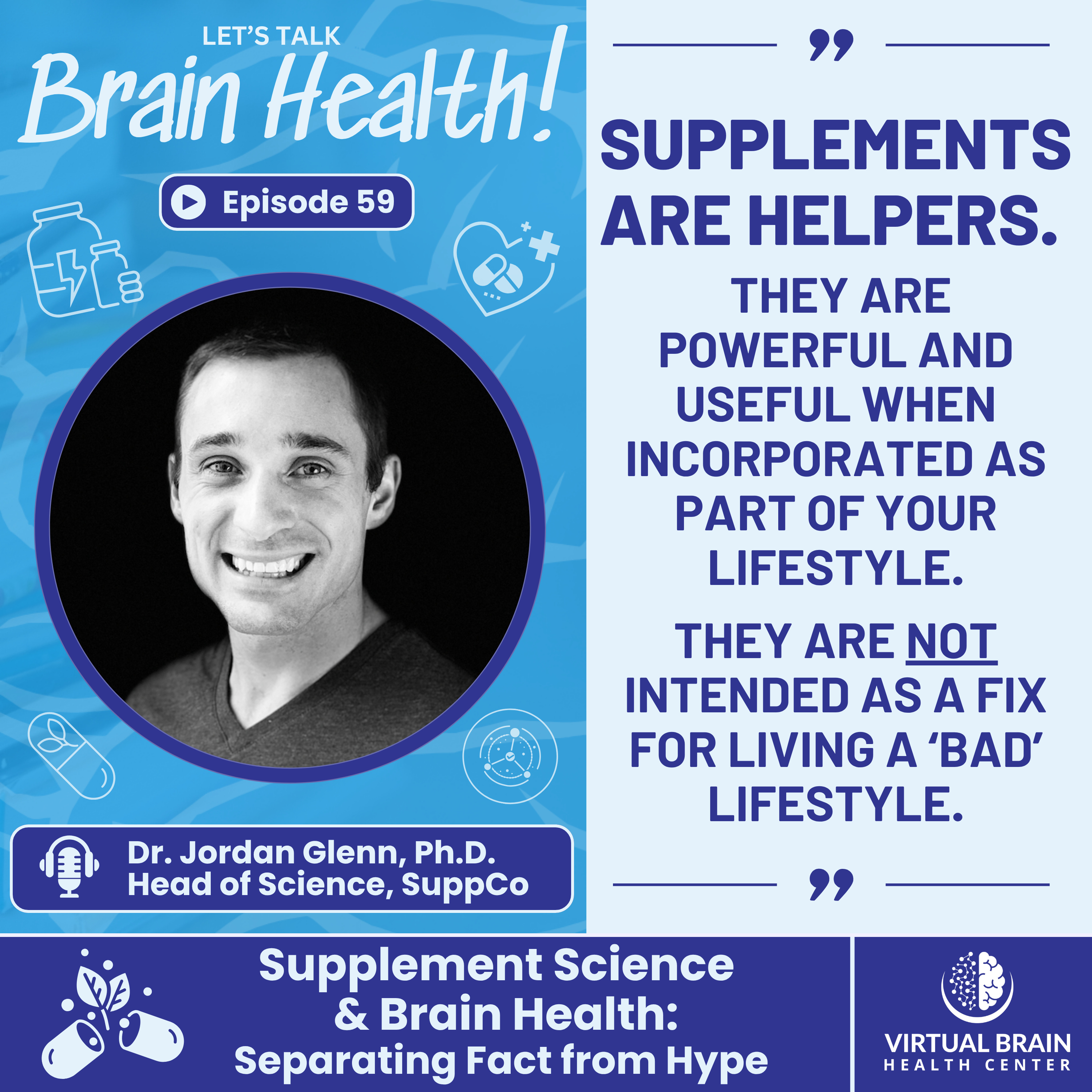
Dive into the world of supplement science for brain health with Dr. Jordan Glenn, PhD. In this episode, we explore the efficacy of various supplements, debunk common myths, and discuss how to make informed, personalized choices for your brain health.
Dr. Glenn shares insights from his extensive research in exercise physiology, nutrition, and aging, highlighting key supplements like creatine, omega-3s, and curcumin.
Learn about the importance of evidence-based decisions, the role of rigorous supplement testing, and how SuppCo’s trust score can guide you in choosing the right products. Tune in to understand the science, safety, and benefits of brain health supplements.
00:00 Introduction to Supplement Science
00:22 Meet Dr. Jordan Glenn, Ph.D.
01:09 Journey into Supplement Science
03:37 The 2014 Study on Supplement Habits
06:06 Personalized Supplementation Explained
09:14 Spotting Credible Science vs. Hype
14:03 Effective Supplements for Brain Health
24:18 The Importance of Third-Party Testing
29:06 SuppCo's Role in Supplement Evaluation
32:42 Final Thoughts and Takeaways
Resources:
- Read more about the research study that Dr. Glenn dubbed “the most important supplement study you’ve never heard of” on his Substack post.
- Connect with Dr. Jordan Glenn, Ph.D. on LinkedIn or follow his writing on Substack.
- Learn more about SuppCo on their website.
- Explore a recent summary of a brain health supplement study that explored marketing labels titled, “What 4,400 People Just Proved About Supplement Labels (and Why It Matters for You)” or access the full research article on “Label Statements and Perceived Health Benefits of Dietary Supplements”
0:02 Welcome to the Let's Talk Brain Health podcast, a public health educational initiative of the virtual Brain Health Center. I'm your host, Doctor Crystal Color, and I'm so glad you're here. On this podcast, I sit down with incredible guests to explore all things brain health and Wellness. Together, we'll talk about how to care for your total brain health, mind, body, and spirit while sharing the latest brain Health Science practical tips and strategies you can use every day. By prioritizing your brain health, you're taking an important step towards living a happier, healthier life. So let's dive in and welcome today's guest. Today, we're exploring supplement science.
0:44 What really works? What's height and how to make safe, informed choices for your brain health? Before we begin, I want to remind our listeners that this podcast is for educational purposes only. It is not a substitute for medical advice. Please consult your healthcare provider before starting or changing any supplement routine. I'm thrilled to be joined by Doctor Jordan Glenn, PHDA, scientist and strategist working at the intersection of personalized health, longevity, and supplement science. As Head of Science at SOPCO, he leads the brand's rigorous supplement testing and evaluation efforts, helping consumers make smarter, evidence based decisions about their health routines. Jordan holds a PhD in exercise Physiology with specializations in nutrition, aging, and behavioral health.
1:30 Over his career, he has authored more than 100 scientific papers, raised over 40 million in external funding and capital, and LED clinical strategy at several health tech companies. He is a strong advocate for personalized supplementation, ensuring the right ingredient is used at the right time for the right goal. Welcome to the podcast today, Jordan. I'm so glad that you're here. Now that we've had a chance to hear your bio, how did you find your way to the field of supplement science? Thank you, Crystal for having me. I'm looking forward to this conversation today. It's really interesting how I ended up in supplements. My doctoral work is all in exercise Physiology. I did a lot of work during my time and research with aging, working with specifically aging athletes, people who are dealing with this paradox of wanting to be bigger, faster, stronger, all while like fighting those natural effects of aging.
2:19 And supplements came up all the time when I was working with these athletes. They're like, I take this and this, this is making me faster, etcetera. I found supplements to be this really interesting intersection at that moment for that group of individuals as like a way to maybe add a little bit of counteraction to some of the aging effects they might be feeling while they're dealing with their training. So I got really involved in it, working with master athletes, and we were doing a lot of work in beta alanine, creatine, citrulline, malate, looking specifically at performance. But that was kind of my gateway into supplements. And then I just got really interested in the nutritional component of it. And then how would it starts to affect things like chronic diseases. I went on to work at a company called Amata Health for a little while where we worked on diabetes and heart disease. I ended up at Neurotrack.
3:01 I was the chief science officer there for a little while where we were working on early detection for cognitive decline. So I got really invested in supplements for brain health and then it just all expanded and I just became very interested in the space all together. But it all really stemmed from working with the Senior Olympian, high level aging athletes who are in their 50s, sixties, 70s and just really looking to get bigger, faster, stronger and and any way possible, which is a really fascinating construct. I appreciate you sharing that because it's always interesting to see how past unfold and people find the way to the work that they're doing. And I think people could hear through your words the passion of what brings you into this space and why you're here as our expert today to cover one of the hottest topics in brain health with his brain health supplements. Because it's all around us, whether you're seeing it in the media, whether you're getting it in newsletters that you're receiving through your e-mail, as well as the ads that you're seeing or the nice shiny sparkly brains on the shelves when you're shopping any mainstream market. So it is around us everywhere.
4:03 So I know we're going to dive into a lot of those topics today. But you recently published something on social media and some of your writing that you do, which I happen to be a fan and follow along, and you called a 2014 study one of the most important things about supplement science that you thought just didn't get enough attention. So I want to ask if you could tell us about that study, what it found and why does it still matter in today's context for us? I posted about this with Subco. I also wrote a sub stack on it as well. In 2014, there was an article that came out that essentially showed that people who took supplements were more likely to engage in other healthy habits.
4:44 And on the surface that seems like either a no brainer or a very simple concept. But to me, it is incredibly powerful because supplements are one of the easiest quote UN quote like health things to do. If I'm looking at going to go run a 5K or take a multivitamin in the morning, it's so much easier to do that to take a multivitamin. And I've always looked at supplements as a gateway drug to health. And there's many papers published in this concept. Or if I wake up in the morning and engage in one healthy habit, I am much more likely to engage IN2345 healthy habits as the day goes on. And the reverse is also true. My day starts with brunch and I'm having a a heavy breakfast and mimosas. Very unlikely I'm going for a run later that afternoon.
5:25 That paper that came out was the first to show real data that people who take supplements actively engage in other healthy habits. And I love that concept because for people that are engaging in the supplement world are looking at supplements as a way to help get healthy, I think that's a very simple way to start. Maybe you take your creatine gummy first thing in the morning. Maybe you take a multivitamin to get yourself started. But you're much more likely then to say, oh, my lunch is going to be a salad versus this heavy burrito, or I'm going to not skip my afternoon walk or whatever it may be simply because you made that initial moment. And that's why I really love that paper. It's very digestible, it's very simple, and it does a really good job, I think, of showing the power that supplements going to have when used in the right way with the right perspectives.
6:11 And for our listeners, we'll include a link to that paper and the article you wrote for Subco in the show links below. But I also think that really trends well with a lot of the latest research we see in brain health now where it's multifactorial. Lifestyle interventions are what works. And a lot of them do tend to have a supplement arm as part of the protocols, which I know we're getting to later on these brain health supplements. So I'm going to make sure we keep the conversation going and pivot now to what's the science, safety and evidence around supplements. So let's start for someone that might be new to this topic of supplement science and you've used the term personalized supplementation.
6:53 What does that mean and why is that important? Personalized supplementation. It's very simple. It means tailoring supplements to your unique needs instead of following A1 size. All fits approach and so a good example on Sup code. We have general protocols all of our users have access to. Could be a heart health protocol, a brain health protocol, exercise recovery protocol, and we'll have a list of supplements that you can take with how much to meet that goal. And that's great. But if we know everything about you, if we know your specific goals, your lifestyle, maybe your biomarkers, where do you live, You have a family with just all these different factors, it gives us the ability to create a much more nuanced supplement program for you. Our pro users have access to a personalized supplement prescription program on Supco where they can actively input all of their data and get this personalized approach back. And they can be similar among people, but doses might change or specific nutrients might change based on if you're in the sun all day long, we don't need to recommend vitamin D to you. But if you're like me who lives in Boston and the winter months come and you don't go outside as much, that's absolutely something that you need to do.
8:01 And so these little things to know about each individual really help maximize the supplements we can give them, but also we can make sure they're not taking too many, we're not overlapping them if we can, why take 15 if we can take 5 and achieve the same results? That is why personalized prescriptions become so important as they become much more nuanced. I think about Supco, the right supplement, the right time for the right person and the right amount. And if we can do that, it becomes a much more effective solution. Everything you just explained pretty much mirrors what we're trying to do with getting personalized medicine. And really what we talked about with brain health is it's personalized risk. We all have one unique brain. It's different for all of us, but we all have our unique risk profile for potential brain decline later in life.
8:49 And that looks at individual risk, our health and it has our own nutritional needs which can include that supplementation arm. And So what a nice way that there is a tool available that people can look at to pull together that health picture and the nutrient piece and make that personalized for you and take into account that it can change. And I always joke that I'm also in Northeast Ohio. And that's the standard recommendation, right, Is vitamin D for many of us where that's just what you're getting when you go to see your primary care provider. But it's good to know because that's one of the top vitamin deficiencies that is noted with brain health. So one to know definitely that plays an environmental role for where you may live. And always great to have those conversations with your providers.
9:33 For many people, especially when they come to our events at the virtual Brain Health Center where we're doing education, or even if we're out in communities in person, there's a lot of marketing noise around brain health or brain health supplements. How can people spot what's credible science versus height? What recommendations or information would you like our listeners to know? The simple answer is go to Sup Co and we'll do it for you. However, to be not so tongue in cheek, I actually have a kind of a controversial opinion on this. And when it comes to brain health supplements, I firmly believe in this. All supplements in general, I believe that brands and products should be publishing and doing clinical research on their products. It sounds like a big lift, and it is, but it's the only way to really differentiate.
10:25 Does something work versus does it not work? You could go to any supplement aisle and see these brain health blends and it'll have 15 different things in it. That's going to change your cognition overnight. But how do you know? There's no way to know. And there's no way to know if the right amount is in there for what you need to change what you're doing. They need to be tested. They need to be evaluated. They need to be published. And where I say it's controversial is because you see a lot of brands that will put numbers up on their website or white papers, or we did this study and here's everything we found, but you don't see the methodology. You don't see the details that went into that. You don't really see how it was done to the quality of the research. If it's published, you can do that.
11:06 We don't necessarily need or expect consumers to go and have to read through those papers, but if they do have a published paper, it gives you a better sense of the credibility of that product. One of the things that we incorporate at Subco is we have a trust score where we essentially score all products based on 29 key attributes. And one of those things that we do is we score clinical studies. If a brand or a product has clinical studies on them, my team, we all we review it, if it's valid, we give credit for that and the score goes up. We take that guesswork of understanding clinical studies out of the user's hands. And really I do that work for them. But in the absence of doing that, I think just looking for seeing does a brand, have they published a paper showing that their thing works? I think that is a good simple line in the sand for anyone to do to when when purchasing a product off the shelves. Yeah, I'm glad you shared that guideline because one I have tended to do and I always disclose to people, this is one of my soapbox issues when I do public engagement is to go to the fine print and read what they're saying. Because historically when you're looking in the broader brain health supplement space, people did not get fined or have the companies that have to pay large monetary fines because of their product.
12:20 They were fined because of the marketing claims they made which were misleading to the consumers. And for them, even though it looked like a large sum of money, it was nothing in the grand scheme of the revenue they made off of those products. So to just be mindful of that and for many of the things is they're the same supplements that have sat on the shelf for years. They just made a new label, they put a brain on them and a lot of them are sparkly pink brains or they're silver and they're glitter. It was just a marketing rebrand for the same supplement, just like vitamin D. And they've pulled out the brain benefits now and it's been rebranded, so to speak, under this brain health arm.
13:02 And there's a lot of other vitamins out there that have done the same thing. Just to be mindful of that is it's not all of a sudden all these things are brain healthy. They've been rebranded or repurposed in some way under this lens because now this brain health arm in branding and there's a lot of statistics around this have really taken off. So I always like to just point out of the ones that had hit the media for the fines was not the product itself not being a product that had value. It was the deceitful marketing and the claims that they made that could show cognitive games like improvement in memory or decision making and processing speed. And just like you said, there was no science, there was no studies to back that up and that was why they were fine.
13:46 So to pay attention to those. So I liked your guidelines and I like that my work a little bit different where I could at least summarize for them of it sounded like a lot of money that hit the companies, but it was really nothing to their bottom line. And they're like, hey, we'll pay that and we'll just keep doing of what we're doing because they're still making the profits. And unfortunately, that's where consumers get taken advantage of now, because you're the expert here who has done the research. You've spent a lot of time in the aging space on the performance side. You've done the brain health and cognitive health and early detection side. Now you're really digging into the science. How do we get credible information out to consumers? Where does the science sit in terms of supplements and science in supporting brain health for people? This is super important.
14:34 So there are supplements that have been shown to work well for brain health. One caveat I will put on this entire conversation is that these are supplements and I would call them as preventative supplements or early intervention supplements, especially when I was back at Neurotrack when we were living in brain health, day-to-day questions come up all the time. My, my mother, my father, my grandmother has Alzheimer's disease. What can they take to to make it better? And unfortunately, the answer a lot of times is there's just nothing. When the disease state of cognitive decline is further down the line, there's not a lot that can be done, at least today. So when we talk about supplements in the data behind them, we're talking about preventive products, we're talking about things that are happening maybe early stage when maybe we're starting to notice some declines that we can make some inroads in. But all of these, I would say, start early versus waiting too long.
15:23 And I think that's just a very important caveat to put over all of this because it's a question that comes up all the time in my line of work. When it comes to supplements specifically, I think let's start with creatine. Creatine is all over the place. It's getting so much excitement right now. I've been in the supplement space for a decade loosely, whether immediately or adjacent, and creatine has gone from a dude bro supplement that may or may not be healthy that you take in massive amounts in a gym to being something everyone should be taking. And in the recent years we're seeing a lot of new data coming out on the cognitive side. There's multiple trials showing cognitive benefits, maybe under even things like sleep deprivation or mental fatigue, but we're also seeing it act as a way to help with people who maybe have memory issues.
16:05 It's neuroprotective. We're seeing some things for Parkinson's, depression, some of these other mental health conditions that are directly related to cognitive health. We're seeing studies show improvements in memory and reasoning. That line of research, while new, is only going to continue to expand. Because creatine has such a massive safety profile, we know we can take it in high amounts and still have it be safe. And I think we're going to continue to see a lot of positive results from creatine in the neurocognitive space or the cognitive health space in the next 5 to 10 years to come. I want to start there just because there's so much hype in creatine. There's so much excitement around it, but there is actual data supporting creatine's use as a brain health supplement. There was a recent small pilot study that came out of the University of Kansas Medical Center that examined creatine use among individuals with Alzheimer's disease and found cognition improvement for those that took 20 grams of creatine daily for about 8 weeks.
17:04 This was a small single arm study with no control group. I'll put a link in the show notes below for people to snag that, but study continues, so we will see where those results go as well. It's always exciting with brain Health Science, we learn new things and then we continue to see how it has broader applications. Another important supplement for people to focus on and look at it in the realm of creatine where it kind of has a lot of other benefits besides just cognitive itself, and the cognitive is really starting to come out is Omega threes, omega-3 of fatty acids, the EPA, the DHA. We know DHA, it's a structural fat in the brain. It supports synapses, anti-inflammatory signaling.
17:44 It probably right now today has the strongest human data of the entire group of brain health supplements. It's linked to mood regulation, to memory, to slower overall cognitive decline. And these are robust meta analysis that are actually showing these effects. It's a must have brain nutrient. It's today, it's got the deepest human data scientific foundation behind it. And when we combine that with the effects on blood pressure, on cholesterol and triglycerides and the other kind of overall health benefits that Omega threes tend to provide, I think Omega threes are a really powerful one to combine, especially if you're taking creatine as well when we think about overall preventative brain health. And that's one that's even linked to the diets that we see that have benefits for brain health.
18:27 That's a key nutritional element that is important. Are there any other ones that you want to share with us today? Yeah, I'll burn through a few more. So curcumin is a big one. Curcumin I love a lot. I personally take curcumin as an antioxidant, anti-inflammatory. It can counteract neuroinflammation. There are some data showing it might help with amyloid buildup. Human studies show modest improvements. I wouldn't say you're going to make leaps and bounds and changes in your cognition, but we are seeing improvements in mood and memory. The big issue with curcumin is bioavailability. Usually you'll see it combined with something like piperine to help with absorption. Maybe you'll see it in liposomal delivery form to help actually the body use it. Curcumin is something that if you take it without, let's call it a helper, you're just going to excrete it. You're not going to be able to use it very well. So you do need to be cognizant of what you're taking it. How I think Bacopa monieri is another interesting one. It comes from Ayurvedic medicine, and I like it because it has this ancient allure behind it as an adaptogen, but it's one of the few that actually have a significant amount of scientific evidence behind it. The issue that comes with Bacopa a lot is that while the results are probably the most reliable of the group, they're small. Most everyone who takes Bacopa has shown modest or mild improvements in their cognitive health, things like processing speed, tension, memory, but again, not these massive steps. You're going to see minor improvements. But I think why I love to
19:59 include Bacopa Moni areas because it's consistent. Big trials have been done, big reviews, meta analysis, etcetera, showing really significant consistency. And it enhances symnaptic communication. It can help protect neurons. It can be very powerful. It's just not going to be that Big Bang that people are looking for that quick fix, especially now in the world of GLP ones where look how look at these amazing effects we're seeing. The Copa's not going to do that, but it is going to be very consistent in its outcomes. I think the last one I'll talk about might be Ficetin. So ficetin I think is I call it a wild card, it's a flavonoid, it's got antioxidant anti-inflammatory properties and really importantly is it has potential synalytic properties, meaning that it has anti cell aging properties associated with it.
20:46 The counter is that we've seen most of these data in animal trials so far. So in the animal trials we've seen facettin improving cognition, we've seen actual biomarkers change with reduce, with reduction in brain aging. And I think over time we're gonna start this, maybe the next two to five years, we're gonna start to see some more trials around facet and come out in human data. It seems safe. The safety profile is looking really good with regard to how humans can use it. But we don't really see a lot of human data showing efficacy yet. You see a lot of functional medicine doctors talking about it. It's actually getting popular. The hype is starting to outpace the science. But I do think the science will catch up with time. I like that as my wild card supplement.
21:26 It's something that I reserve for like the biohackers who are like, I'm willing to try things. I'm willing to do my end of one trial and experiment with some stuff because it does seem safe. But it doesn't necessarily mean today it will work in humans, But I think time will filter that out pretty well. I think that's probably my short list of ones that if you're really getting into brain health supplements, there's some consistent ones there that you know will work. Creatine seems to be effective, Omega seems to be effective. The pacopa seems to work really well. But then you also have the turmeric and the curcumins and then the up and coming facetin, which I think kind of get round out a nice stack for someone that hits all the different things that somebody might want from a brain health supplement profile. I am grateful that you shared not only the science, where the state of the science is now, what are some of the limitations or things to be mindful of and also where the science may be going.
22:13 And I'm going to make sure that the link is below in the show notes because if anyone's like me, as you were talking, I wanted to be taking notes so they can read that and it can be in front of them. And if they know you from your talking, there's also links. So if they want to see the studies, they can go and read some of that additional information for themselves. So now we've heard the state of science on brain health supplements, I want to ask you what might people get wrong when they're trying to support their memory or their focus or their long term brain health supplements that you may want to caution them about? There's a couple of factors and I think it's not just brain supplements, but supplements in general.
22:55 Brain health specifically is waiting too late. Waiting too late is what probably went with all preventative medicine. Obviously waiting too late is a big issue. And so if you're waiting until a disease state extends too far, it's going to be really hard to have a supplement. Do you know that that legwork, but also making sure that you're taking the right dosage of something. So a lot of times you'll find, and we see this in pre workout supplements a lot too and you'll see blends of things that will have a little bit of a lot of things in it, but maybe none of those things are enough of a dose to matter. And while it looks impressive to see 17 different ingredients in a blend, you may only need three of those and you may need them in 10X the amount that's actually listed on that label. So it's really important to understand your dosing sub code is a good job of this.
23:39 We have an entire dosing breakdown to show you how much you should be taking of a certain ingredient based on what the science says, a minimum, a maximum, do not exceed, etcetera, to help people really understand what their dosing profile should be. And the other thing is making sure you're getting real supplements. There's no matter what you take, if the ingredients are not in the bottle, you're not going to get anywhere. And we are Subco Tested series has shown a lot of this where there's a lot of products in the shelves today that are failing third party testing, meaning that they may only contain 10530 percent of the actual active ingredient. So I think being able to understand and know the quality of the brand are how likely is that supplement to be actually, quote UN quote, real or actually to contain the active ingredient that you would expect to see in there?
24:24 It's a bigger issue than it should be, and it's one that really needs to be accounted for when buying supplements today. Yes. And I think that can lead to some of the work that you guys are doing at Supco and putting out these third party testing reports. Can you tell us why this is such a game changer when it comes to supplement safety You. Know what's interesting is I think safety might be the wrong word there. I think it's just supplement efficacy because what we see more often than not is that these supplements just have nothing in them. They're just placebo powder. That may not hurt you, but it's definitely not going to help you and that's why we started this up Co tested program. We've tested creatine, we've tested NAD plus our Urolithin a testing program comes out next week and then we have a number of others down the line that we're looking at as well.
25:09 And we are seeing on average about 50% of the supplements we test have less than 5% of the active ingredient listed in that bottle. And that becomes so, so important because you cannot get effects of something if you're not actually taking what you think you're taking. And so that's why we started this program. And we saw in creatine, 4 out of the six gummies we tested failed. And so powders pass the flying colour. So powder seems to be a much more reliable form factor these days than the gummies is That state becomes really is is working through some issues. We saw with NAD testing that if a brand promoted really high amounts of NAD for really cheap, it was correlated much more likely to fail our testing than ones that were maybe a little bit higher price for a more reasonable amount.
25:56 And those when our Eurolefin A testing comes out next week, it's even more exaggerated. We're seeing incredibly low prices for incredibly high amounts, which is just not reasonable for Eurolefin A, which is a very expensive product to manufacture right now. I always say with supplements, there's a bit of a sniff test if something looks too good to be true. If I can get 2000 milligrams or something for 10 bucks, you might want to think twice about it. Let something feel real and pass that sniff test before you go out and buy it and hope for the best. And I think this is where Supco comes in. We have the trust score, We have scores for everything. We rate brands based on 29 different attributes. And so we can do a lot of that legwork for people. But if not, then I think that sniff test is a really good way for people to just judge the products they're buying.
26:40 In doing this research, were there any results that surprised you? I mentioned the creatine gummies that was far and away really interesting that most of them had 0 creatine in them. They were literally candy with no creatine being sold as creatine products. But what we did see was people posting our results on reviews of some of these products, calling them out for what they were doing. We saw one brand actually reformulate and put creatine in and then have their reviews go down because it didn't taste as good, because it was chalky or gritty, which is what you'd expect from a creatine gummy. And then the other thing I thought was really interesting is the gummies that didn't have the creatine in them had much higher ratings on Amazon than the ones that did because they tasted better. These kind of things, they're just things I didn't expect and we are going to this testing program. I just think it's really interesting to see how the consumer reaction to products in the wild can be very different than what the actual quality of that product is. Yeah.
27:41 And just in hearing what you said, it's almost very interesting of what happens when consumers get the information about a product that they thought they were consuming. And then the action steps that they take where it almost just seems like once they get empowered with this science information, the ripples effects of change that they can have and pushing back on companies for having accountability in that market. And then shifting this title way of some change where you think as the consumer you're just like the passive person because you're choosing to spend your money here and yet they're making some changes in the industry by doing that. Absolutely. And we're seeing it not only in just like we've tons of people writing into US saying I've changed my stack, I've switched my product. We have a list on SEPCO of all the failed products that have gone through Sepco testing, so people can review them and see them before they go with make a go to make a purchase. And people saying that they're glad that we're doing this. And then people think, can you test this? Can you test this?
28:40 Can you test this? We don't take recommendations. We don't take reach outs from brands or consumers. We test our products solely based on their ranking on the Subco platform, but it is really interesting to see users change their habits and their products they're taking based on it. But also in the wild, people posting screenshots of the results of the reports in reviews on Amazon calling brands out. We've seen a brand actually reformulate because of it. So we are seeing changes happen in the space as a result of it and we're just excited to continue to do it and grow it and make it more impactful. We have covered so much ground in our time together and I want to be mindful that we get to dive into but Sup Co and the work that you're doing in your sub Co score.
29:21 But can you tell us a little bit more about that and how people can use that as a tool to evaluate their own supplement stacks for brain health? The goal of Subcode, the right supplement at the right time for the right reason, for the right person. We are goals to be the source of truth and supplements. So I feel very lucky and that I get to be the head of science at a supplement company that doesn't sell supplements. That's on purpose because I get to be completely unbiased in a very convoluted and confusing space. And so Subcode's goal is just that, to help people understand what they should be taking for what reason, for what goal. And we have a trust score of all the brands and all the products on our platform. It's a one to 10 score based on 29 key attributes.
30:03 So it could be manufacturing standards, clinical studies, different ingredients that are used, etcetera. And we simplify supplements for our users. So you come in, oh, this supplement has a score of 9.1. I can see all of the reasons why they got that score or what they where they lost points. And as a consumer, I can make a very intellectual decision on what I want to buy and why. I actually take supplements that might have a slightly lower score because there are certain indicators that don't matter as much to me personally that I don't mind buying this particular supplement. It just gives users such an unbelievable insight into each brand that they might want to take or be taking and empower them with the information to make these decisions to pick the right things.
30:50 And if they want, we can do all that for them. We can pick the supplements for them. They just tell us their goals and we will do the work for them. But we have a lot of people who feel confident in being able to pick their supplements. So they know the goals, they know what they want to take, and they're just looking to understand how do I find the right brand? How do I find the right products? That's really what's up Code does is help simplify and lower the barrier to entry for supplements. How people find the right brands at the right time, the quality products that are out there, and sift through a lot of the mess that exists in the supplement world today. Yes, and I know I'm only an end of one but I can share my user experience as it's free. People can snag the link below in the show notes. But I went in and entered my supplements and I happened to buy one in a pinch when I was short at the local store and I got in and I said I'm definitely not going to buy that brand again after I saw I was like, that was not a good investment of my money. So it definitely can inform consumers and looked at my stack and some of my other brands and realized it is helping me reach my goals.
31:48 You can learn all types of different insights. What you can do as an informed consumer with just your little stack Only took about 5 minutes of my time. It's a very user friendly app, but you can get lots of new insights there. So I hope our users can be sure and our listeners can check that out and grab that in the show notes below. Crystal, it's changed my own stack habits as well. Even as a scientist who knows this space well, it is almost impossible for anyone to understand all of the details behind all the specific brands that exist in the market. It's so detailed and there's just so much out there, even for me knows the space so well. My stack has changed completely since I started working at Supco and being at Supco and looking at and evaluating these products. I think for people who think they have it all figured out, they might be surprised.
32:33 For people who are looking to get into it, I think it's a really good entry point as well. And I want to make sure to ask you this because this is such a hot topic. What is 1 myth about supplements that you want to set straight today for our listeners? Oh that's a good one. I'll keep it simple. I think we view supplements as a lot of times a catch all a fix. Supplements are supplements and I think if we are streaming Netflix till 2:00 in the morning, no amount of magnesium glycinate is going to fix our sleep. If we are eating trans fats and pumping our bodies full of sugar day after day, no amount of berberine is going to help with the insulin and the triglyceride and the cholesterol levels that we are doing to our body.
33:17 That is something that I always encourage people to remember is that supplements are helpers. That's why they're called supplements because they are supplemental to everything else we do in our life. We do tend to overcorrect a little bit. Supplements, I think can be very powerful and I think they can be very useful, but they cannot be the thing that fixes all the other things that we are doing in our lives. And I think if there's one myth and myth, I think that's a good word for it because of how a lot of times we view supplements that that's the one thing that I would want people to remember. It would be just that. Incorporate it as part of the rest of your lifestyle. Don't use it as a fix for living a bad lifestyle. Appreciate your explanation of that because the line I always tend to have is you can't supplement away a bad diet.
34:00 And the way I look at diet is it's all of the things you consume. It's not just your nutritional pattern, it's all of your consumption pattern throughout your day-to-day to keep that in mind. And now it's my favorite part of my time with my guest is the rapid fire questions for you, Jordan, as we wind down today, brain love, novelty and surprise. So let's see what we can get out of you before we close. As an expert in supplement science, what is your one non negotiable for your own brain care? My non negotiable today probably Omega threes and I take them for brain health but I also take them for many other reasons as well. That's probably the one that will live and die on today. How can our listeners learn more about you and follow your work? One, I'd write for Supco all the time. I put out a weekly science corner where we're always busting different myths or introducing new supplements. At Supco, I write a sub stack where we're always just introducing new supplements and science and different areas of the space that I think is interesting, whether it be breaking down studies or different ingredients. And then on LinkedIn, I talk about all the stuff on LinkedIn all the time.
35:06 So there's a number of different channels where I'm always just talking about supplements. That's perfect. Our listeners can grab all those links below in the show notes. And if our listeners can take away one final message from our conversation today, what would you want it to be? Go open up your supplement cabinet, look at the five to 10 to 15 supplements you're taking, and if you don't know the exact reason why you're taking each of those supplements, stop using them. If there's one thing to take away, it's know what you're taking and why. There's so many people I talked to that are taking all these things and just don't know what they're doing. And that is, to me, a big gap in the supplement space is if you are taking something, know why. And if you know why and you're comfortable with it, that's fantastic.
35:50 But make sure that answer is not, I don't know. I think that's the one take away I would want for anyone listening to remember about supplements. Today's conversation gave us a clear science based look at supplements, what works, what doesn't, and why testing and personalization matter. Jordan reminded us that supplements can be valuable tools, but they work best alongside healthy habits and informed choices. Subcos Sub score is one way to help evaluate stacks with confidence. Doctor Jordan Glenn, thank you so much for letting me pick your brilliant brain on the Let's Talk Brain Health podcast. And to our listeners, a quick reminder, this podcast is for educational purposes only and not a substitute for medical advice.
36:34 Always consult your healthcare providers before starting or changing supplements and be sure to tell your doctors and pharmacists about everything you take to avoid any interactions. Supporting your brain health means supporting full health, so stay informed and supplement smart. Thank you for investing your time and energy into your personal brain care by listening to today's episode of the Let's Talk Brain Health Podcast. I hope our conversation gave you fresh insights, a bit of infiration, or practical steps that you can take on your own personal brain care journey. If you enjoyed today's conversation, I'd like to ask you to please share this episode with someone who could benefit from it or consider leaving us a review.
37:17 If you have questions or a topic in brain health you'd like me to explore, please e-mail me anytime at podcast at virtualbrainhealthcenter.com. I'd love to hear from you. We have so many more exciting topics ahead, and I can't wait to continue this lifelong journey of better brain health together with you and our growing virtual community. Until next time, remember to give your brain the care it deserves and make your brain health a priority.

Head of Science
Dr. Jordan Glenn, Ph.D. is a scientist and strategist working at the intersection of personalized health, longevity, and supplement science. As Head of Science at SuppCo, he leads the brand’s rigorous supplement testing and evaluation efforts, helping consumers make smarter, evidence-based decisions about their health routines. Jordan holds a Ph.D. in Exercise Physiology with specializations in nutrition, aging, and behavioral health. Over his career, he has authored more than 100 scientific papers, raised over $40 million in external funding and capital, and led clinical strategy at several health tech companies. He is a strong advocate for personalized supplementation, ensuring the right ingredient is used at the right time for the right goal.