
 Apple Podcasts
 Spotify
 Amazon Music
  RSS Feed
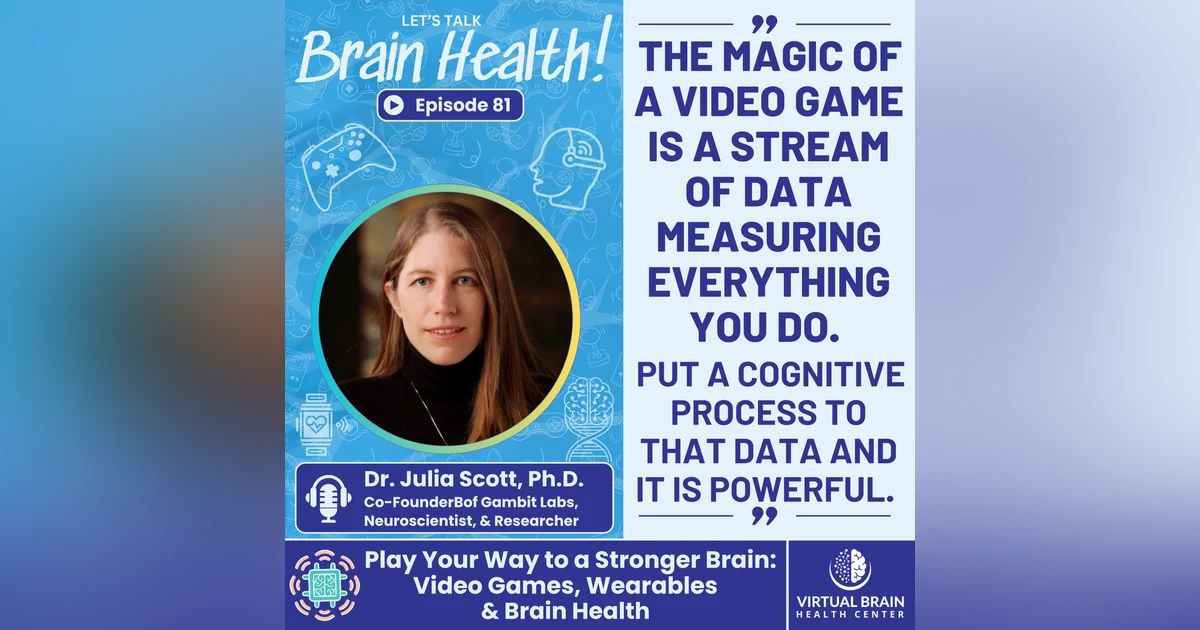
 Play Your Way to a Stronger Brain: Video Games, Wearables & Brain Health with Dr. Julia Scott, Ph.D.
For a long time, video games and brain health existed in completely separate conversations. Games were entertainment — a guilty pleasure at best, a concern at worst. That is changing. And the science behind that change is more compelling than most people realize.
In this episode Dr. Krystal Culler and co-host Dr. Jonathan Artz, MD sit down with Dr. Julia Scott, Ph.D. — neuroscientist, researcher, and co-founder of Gambit Labs — to explore video games and wearable sensors as genuine tools for brain health. Not as a replacement for the fundamentals, but as a powerful and increasingly accessible addition to our brain care toolkit — one that can reveal things about our brains we have never been able to see before.
What You'll Learn in This Episode
🧠 What types of video games Dr. Scott's work focuses on — and how they differ from passive gaming experiences
🧠 What is actually happening in the brain when we play the right kind of game — and why games accelerate learning in ways traditional training cannot
🧠 Why every game is quietly generating a portrait of your brain through patterns of behavior
🧠 The difference between games designed for cognitive assessment versus intervention — and why that distinction matters
🧠 What dark mechanics are — and how some games deliberately hijack dopamine systems to override good judgment
🧠 What happens when wearable sensor data is integrated into gameplay in real time — and what that unlocks about self-awareness and self-regulation
🧠 Why agency is the central value driving the work at Gambit Labs
🧠 What Gambit Labs is building for neurodivergent youth — biofeedback-enhanced games focused on executive function and self-regulation
🧠 Where the field is heading
Key Takeaways
✔ Not all games are created equal — the games that matter for brain health are built with intention and clinical science
✔ Every game generates a portrait of your brain through patterns of behavior — strategy, reaction time, reward processing, and more
✔ Wearable sensors become 10x more powerful when paired with strategically designed games — giving you the relationship between brain state and behavior in real time
✔ Agency over your brain health begins with knowledge — when you can see what is happening inside, you can do something about it
✔ The FDA has now cleared a second game-based ADHD intervention — the proof of principle that this approach works is no longer in question
✔ Games are not just play — they are play with purpose
Earn FREE CEs
This podcast qualifies for continuing education credit for the following healthcare professionals: Physicians (AMA PRA Category 1 Credit™), Nurses (ANCC), Pharmacists (ACPE), Physician Associates (AAPA), Dentists (ADA CERP), Dietitians (CDR), Social Workers (ASWB), Psychologists (APA), Athletic Trainers (BOC), and Interprofessional Continuing Education (IPCE).
Each eligible episode offers 0.5 hours of FREE CE credit. Not seeing your profession listed? You will receive a Certificate of Participation to submit to your licensing board for possible credit approval.
Join the Learn at Pinnacle app to earn FREE CE credit for listening to this episode — available on the Apple App Store and Google Play.
Support the Podcast
If you enjoyed this episode, please help us grow the conversation around better brain health:
- Follow or subscribe to the Let's Talk Brain Health! Podcast
- Leave a rating or review
- Share this episode with a friend, colleague, or fellow brain health advocate
Thank you for investing your time and energy into your brain health. A special thank you to Dr. Julia Scott for reminding us that games are not just play — they are play with purpose. 🧠🎮
Resources
-
Discover Dr. Julia Scott's work at the Brain and Memory Care Lab at Santa Clara University
-
Learn more about Gambit Labs
-
Read more about XRSI for technology privacy and safety
-
Explore Rachel Kowert's Gaming Guide for Parents online here

Co-Founder of Gambit Labs | Neuroscientist | Researcher
Dr. Julia A. Scott, Ph.D. is the Co-Founder and Chief Scientific Officer of Gambit Labs, a digital health company building biofeedback-enhanced games to develop executive function in adolescents. Holding a PhD in Neuroscience from UC Davis and with more than 20 years of experience, she has spent her career translating brain science into practical tools — from early-detection imaging biomarkers for Alzheimer's disease to virtual reality applications for mental health and dementia care. Most recently, she directed the Brain and Memory Care Lab at Santa Clara University, where she led research teams and industry partnerships advancing neurotechnology and immersive technology solutions for a range of brain conditions. Julia also leads MedXRSI, an international body establishing safety and ethical standards for extended reality technologies in healthcare, and sits on the boards of Content for Good and the Virtual World Society. Her work lives at the crossroads of neuroscience and technology, driven by a mission to make brain health innovation accessible and responsibly built.