
 Apple Podcasts

 Spotify

 Amazon Music
 RSS Feed
How Brain Energy Shapes Health: Computational Neuroscience in Action with Dr. Jin Hyung Lee, Ph.D.

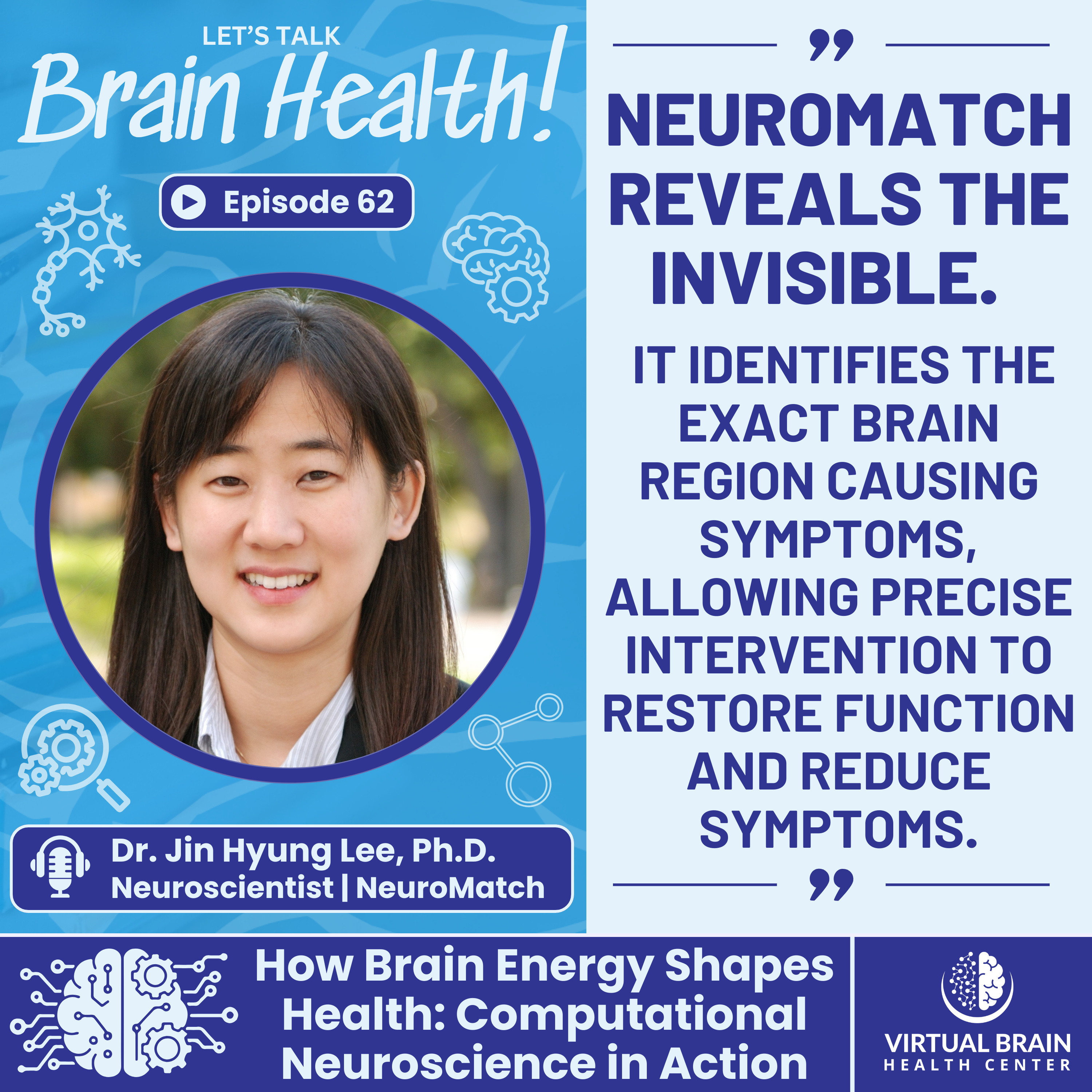
In this episode of the Let's Talk Brain Health Podcast, we are joined by Dr. Jin Hyung Lee, Ph.D., a pioneering neuroscientist, Stanford professor, and founder of LVIS Corporation.
Dr. Lee introduces NeuroMatch, a groundbreaking technology that creates live digital twins of brain function to revolutionize brain healthcare.
She shares her personal journey from electrical engineering to neuroscience, inspired by her grandmother's stroke, and discusses the intersection of technology and brain health.
Discover how NeuroMatch can diagnose and treat conditions like epilepsy, autism, and Alzheimer's, potentially transforming the way we understand and manage brain health.
Learn about the importance of sleep, preventative care, and how AI could make brain health accessible to all.
Tune in to explore the future of neuroscience, AI, and personalized brain healthcare.
00:00 Introduction to Dr. Jen Lee and NeuroMatch
00:42 Dr. Lee's Personal Journey into Neuroscience
01:25 The Intersection of Electrical Engineering and Brain Health
02:49 Developing NeuroMatch: From Lab to Clinic
03:52 The Future of Brain Health Monitoring
05:05 How NeuroMatch Works
07:33 Collaborations and Inspirations
09:56 Patient Advocacy and Real-World Impact
12:25 Artificial Intelligence and Energy Efficiency
17:53 Future of Neuro Match in Healthcare
24:41 Rapid Fire Questions and Final Thoughts
Resources:
- Explore more about Dr. Lee and her work on her lab’s website
- Learn from Dr. Lee in one of her TedX talks from her website
- See the Invisible: Innovating How Neurological Diseases Are Examined with NeuroMatch and LVIS on their websites.
0:02 Welcome to the Let's Talk Brain Health podcast, a public health educational initiative of the virtual Brain Health Center. I'm your host, Doctor Crystal Color, and I'm so glad you're here. On this podcast, I sit down with incredible guests to explore all things brain health and Wellness. Together, we'll talk about how to care for your total brain health, mind, body, and spirit while sharing the latest brain Health Science practical tips and strategies you can use every day. By prioritizing your brain health, you're taking an important step towards living a happier, healthier life. So let's dive in and welcome today's guest. We'd like to welcome Doctor Jin Lee, a visionary neuroscientist, Stanford professor, and founder of Elvis Corporation.
0:50 That's LVIS. Doctor Lee's groundbreaking technology, Neuro Match, is revolutionizing brain healthcare by creating a digital twin of brain function, a live interactive model that reveals how brain circuits communicate in real time. This is not only a technological breakthrough, but it's critical step towards addressing the rising prevalence of neurologic disorders like epilepsy, autism, and Alzheimer's. Jen, is there anything else you would like to comment about your background or share with our audience? Yeah, that's a really nice summary. But one thing I would like to share is that I didn't start off as a neuroscientist. I was trained as an electrical engineer all the way through my PhD, but I decided to jump into neuroscience when my grandmother had a stroke. Jen, welcome to the podcast and thank you so much for sharing your personal connection to the broader brain health base. So that was my initial question after watching some of your Ted Talks.
1:50 And I hope our guests will check out our show notes below where they can see some of the tops from your labs page. Because you posed the question, can we fix the brain like we fix electronic circuits? And that got me thinking, how does electrical engineering intersect with brain health? Would you mind telling us a little bit about that and your work and what inspired you to create Neuro Match in your research today? Yeah, I'd be very happy to. When I first learned about brain disorders was when my grandmother had a stroke and one day she had a stroke and she was just paralyzed on the right side of her body and she remained bed bound for about 12 years. And as she was going through all the rehabilitation therapy, I was wondering why there's nothing we can do to directly fix the brain.
2:44 Where what I started to learn is that the brain is actually an electronic circuit in a way because it uses electrical signal to communicate, it forms a circuit. That's a well known fact. Once I learned that, my thought next went to why can't we just directly analyze the circuit, see how it should operate normally, and when there is a disorder that's disrupting its normal function, why can't we simply restore it based on that simple idea? I started going around asking questions and there was no tool available to be able to do that. I decided, you know what, maybe this is something I can do as an electrical engineer. So I decided to take on that journey.
3:26 So in my lab for the past 15 years, we've been doing research on trying to model the brain function. And once we had the ability to quantitatively model the brain function, we then moved on to translating that solution to a form that's deliverable in a clinic. That is what the origin of neural matches. Jen probably didn't know that I am an adult neurologist, so I've been doing that in that especially for 26 years. And I did neurophysiology training way back many years ago. But the reason I'm even mentioning this because electrical engineering is definitely a key about how well I actually got into neurology.
4:08 Given that there are a lot of diseases, a lot of the neurodegenerative diseases that are just going to increase over the next 20 years because of the aging population, and that includes Parkinson's and Alzheimer's disease. How might technologies like Neuromatch help reduce personal and societal costs? Yeah. So I'm thinking about it in multiple different angles. For one, if you have the ability to understand which part of the neural circuit is damaged when you have neurological disorders, there are ways to directly reverse that. And on top of that, once you have that ability to look at things, the circuitry and their functions, you can then also do preventative care where we can start to monitor the brain health. If it starts to deteriorate, you can tune it. Fixing the circuit damage once it reaches beyond a certain stage is much more difficult compared to being able to tune it at an earlier stage.
5:09 What I'm envisioning is that everybody will really start to monitor their own brain health and take charge of taking care of your brain health. And if you happen to discover it in a much later stage, having the ability to understand what exactly needs to be reversed also gives you a direct answer to what therapeutic should be designed. Can you go into a little detail about what neuro match actually is? Actually how it works, how it functions. Yeah. So Neural Match, we designed it around providing a tool that can be used in a clinical setting to visualize the brain network function. Right now, there's very little you can do in the clinical setting.
5:52 We utilized in particular EEG, because that's a very deployable technology. It's been around for many years. But interpreting EEG is very difficult because it comes from a very complex signal. There's a lot of noise and it's also unclear what the signal means. In my lab we have developed over the years ways to understand the signal by directly doing cell type specific neuromodulations, mapping them, where we now have a good understanding of how single cell spikes interact with the overall brain network. Using that information, we started to try to interpret how human brain function that's measured from very noisy signal can be interpreted. And now what we have is a solution where we can start to map different symptoms in the patients to be directly visualized.
6:42 And sometimes I look at the data when they have certain anxiety attacks or even have epileptic seizure or having some depression symptoms or autistic symptoms, we can start to parse out those symptoms. And then when we see which part of the circuitry is having malfunction that you can start to treat them, that is the basic idea. And we're starting to see great success in that direction. So is there an electrical signature of a person having a panic attack or a depressive episode or as other type of mood related issue? Yeah, we're starting to see that where we've done research on it, but I wasn't sure if we're gonna really be able to decipher it from an EEG signal, but we're starting to see that those are possible.
7:31 We're gonna start to be able to tell in specific individuals whether you're having this attack. Is this a direct result of your brain function circuit changes? Can we modify these circuit changes so that you no longer have attacks? That would be the way that you would imagine how neuromatch will change the way we deal with brain disorders. How do you see this playing into some of the bigger initiatives and the broader landscape of what we're seeing in the shift of better understanding the brain, neuroscience and its inner working, so to speak, where we hear efforts like the US Brain Initiative, the Human Brain Research Project. Does this support and or help accelerate your work? My work has been directly inspired by both projects you mentioned.
8:19 Because the US Brain Initiative funded a lot of my research in the lab. We have directly benefited from such programs. The Human Brain project was a European project, so we were not directly involved in it. But the goal of the project of what I intended to do with my research and what they set out to do, model brain function, was an identical goal. And inspired that by that project, we also made separate efforts on how we think the brain should be modeled and it has resulted in fairly successful outcome, which is what we translated into a neuro match. From the work that you have been doing, what do you see about the power of collaboration and this intersection of science, engineering and medicine and pushing brain research forward, as well as the supplied science piece and supporting patients and healthcare providers in that day-to-day life? Talking about my own personal journey, I was a straight up electrical engineer all the way through my PhD and then I jumped head on into neuroscience research, very basic science in my lab as I became a professor.
9:32 And then afterwards, once we had enough clues about it, we went into developing clinical solutions that is suited for a clinical setting. It was a very long journey, jumping through lots of different cultural differences, but along the way we've collaborated with all the different experts in these fields, which is what made it possible. And to solve a problem like brain disorders, there's no other way than being able to work with a lot of different experts. So I'm very grateful for all the people that provided amazing collaboration and we intend to move forward in the same direction. I have a question about this. From doing some patient advocacy work as well and just seeing this broad stroke of when we talk about brain health, it's really become much more expansive to people living with brain based conditions, whether it's neurodegenerative or living with a mental health condition as well.
10:29 I think the latest stats from the Dana Foundation say 8 out of 10 people are impacted directly by a brain health condition, whether they're diagnosed or someone in their immediate network. How do you work with involving patients and kind of some of your design or how they may be influencing what's next, whether it's for them or their own loved ones? That's a great question. As I was going through this journey of jumping into neuroscience for the past 15 years, one of the things that was I wish everything was faster where I want to help this person who has this parent who has Alzheimer's as a kid with autism, it was very difficult to say, well, this research will take another decade before you can benefit.
11:16 But fortunately now we're seeing results. We have FDA approved solutions that can be immediately deployed into clinical use. And now that we have that and we directly see patient data, the discovery process is actually accelerated in a way, seeing people in need directly. You're right, 8 out of 10. I'm surprised it's not ten out of 10 because if I go ask anybody, ask if they have a family member or friend who's impacted, is it impacting you? It's almost everyone when I meet them. And then I have a chance to look at their brain network and then start to analyze it. Then the discoveries accelerated also through the personal connections.
11:57 I feel really motivated to do do this faster. So it has been a really positive experience where instead of taking an approach of, oh, this is how we should do it systematically, this is the plan. It's more, Oh my God, we need to address this right now. Let's just get on it. It's both been hectic, but also exciting and motivating to be able to help people in an accelerated manner. Not where I have to tell them, I'll come back in 10 years, let's see what I can do for you. Let's try this right now. So it's been exciting. Yes, Jim, everybody's talking about artificial intelligence in the last several years, especially this year. And it sounds like just what I know basically about Neuromatch and they're using a lot of data sets, a lot of energy.
12:46 And I was just curious how that plays into this being more democratic product that's used in many clinics and just the amount of power that has to be used to analyze people's information. Have you thought about that or? That's a great question. Thank you so much for asking that question. There are two main aspects related to energy and availability. One is the brain signal as it stands in the current clinical setting, as you are very well aware, is there only a few number of physicians who can even read it. Access to brain health assessment is very limited.
13:27 That's not something that can be widely deployed. There are care deserts, so to speak, even in the United States, where there's more healthcare than other places, one would argue. And these deserts can be taken care of because we basically use AI to solve human intelligence problems. A lot of things are automated. It's very easily deployable in a very energy efficient manner. So it could be deployed in very limited settings in a very scalable manner. That's one thing. Another aspect regarding energy is that we started this journey because we wanted to solve brain disorders, But in the process, what we are doing is understanding how brain circuit algorithms work and it does computation in a very different manner compared to regular electronics, which is what we use for AI nowadays. And the problem with that AI is that it is AI working for AI, not really AI working for humans. Because for one, look at all the data center and the energy that it's taking up, we often find ourselves where it's like a matrix.
14:35 We're giving all the energy to the AI to do it's AI thing while we have to conserve energy to where we don't have enough electricity to power air conditioning, for example. But having an energy efficient AI is a very important way to make sure that AI serves humans instead of us working to give energy to AI and the human brain. One of the key features is that it is highly energy efficient. And as we are looking at the algorithms of how the brain computes, we're starting to understand that this is very different from the way that the regular von Neumann architecture computer computes things. And as we learn this to cure brain disorders, we're also learning that this can be utilized to design energy efficient computational systems.
15:25 And that's another way where we're using AI to solve human brain problems, but we're using human brain insights to solve AI problems. I was just curious, has any data center company come up to you given your research saying, hey, this energy usage in the brain could be modeled to improve energy efficiencies for other purposes or any other AI product that is being created actually right now? Yeah. The AI work in terms of creating new computational approaches, it's more in the earlier stages than the brain science part is, but we're starting to make good progress there and we're doing active research projects on it.
16:08 I'm constantly in contact with a lot of data center people and energy efficiency. Getting good cheap source of energy is one of the biggest concerns there and we are envisioning collaborating very soon in order to bring some of these knowledge to exponentially improve energy efficiency. And reflecting back on what you've just shared, I almost feel like after our conversation, I have to go ask AI to almost generate a poem of all the things we know about the energy and the ways we use strategies to take care of our brain because we've been so overwhelmed by our environment that we've lost touch of those basics. And while we have to scramble to put those all back in, which is a very long journey for John and I.
16:53 And our podcast is having experts on to give us back that brain science and to stretch the importance of the lifestyle. And it seems like what you're talking was saying too, is we're going to have this balance where the technology is informing the brain and then we're using the brain to inform. And I feel like our brain could write a poem to a yes, we're. Going to make that happen. Of being energy efficient, but just the things that it's learned and how the demands it is and just your work of the intersection of the engineering and the problems you're trying to solve. But I think better understand that and the conversations that we're probably going to have towards the end of today of what are we doing to keep our brains energy center to doing the best it can. And just like you talked there with the old when we start to reach there, how do we make sure we don't go past it or at least had to dial it back to reach our day-to-day lives. Been excited to ask you this question now about what's the role that you see neuromax playing in improving this area of diagnosis and treatment for some of the conditions you mentioned earlier like dementia, autism or epilepsy and your current work?
18:09 A couple of different things. For one, we live in a day and age where there's so many things coming at us, where a lot of us are in either mental health or neurological disorder kicking our ass, where a lot of us also have sleep problems. That's another problem with your brain, all of that. I think we can now enter a new era. There's all these machines coming at us with all the stimulus we need to more actively take care of our brain. Once we have these tools like Neuromatch where we can assess your brain health, you can start to tune your brain periodically to make sure let's go and drifting off in the wrong direction. Let's just put it back in the right place either through behavioral changes like sleeping and eating better. But if it goes a little bit beyond that, we could perhaps do modulation kind of your brain function do use Wellness products to bring it back to a more normal range. And I think the future is more where you actively manage your brain health.
19:10 But also when you have a problem now, it's more like the diagnosis is you talk to the doctor, you take some MRI's, there's no obvious problem. I don't know what to do. There's a lot of just guessing going around where you go to multiple hospitals and you don't even know exactly what your problem is. But Neuromatch now is able to give you an exact pinpoint it. The whole point is, see the invisible just show you where the problem is. And once we can show you the problem is right there, it's no longer wondering what's happening. You know that the problem is in this part of your brain where things are overactive, let's say. And if that's clearly visualized and pinpointed to a specific region, then all you have to do is reverse that change, which will remove your symptoms. That will be one way of diagnosing and then also pairing that with treatment because accurate diagnosis is the same as treatment.
20:07 When I explain about how we map the brain and figure out the accurate diagnosis, a lot of people ask me, diagnosis is great, but what about treatment? But when you know exactly what the problem is, the treatment is the same as the diagnosis. If your car stops, let's say, and you don't know why it stopped, it's a stopping disease. But if you know that your car stopped because your engine oil was depleted, that. Hypnosis is the same as the treatment because you have to refill the engine oil. Being able to pinpoint the problem with the brain function will open up a new Ave. for understanding exactly what your problem is and then treating it. And the approach is similar in all the different brain disorders. It will have details that are varying, but the whole point is that we want to normalize brain function and that will be the beginning where we will see a lot of patients that go through neural match exams and then we will try to reverse the disease related changes. But at the same time more into the future. What I see is that all of us who feel still healthy, we should start to monitor our brain health, try to make sure it doesn't go outside the range of normal function where you continue to tune to make sure things stay within the range. And if it goes off, you start to clip those changes, put it back into the normal range so that you never become sick. And is there one story or example that you might be able to share that might put this all together for us now that shows this real world impact in real
21:38 time for an individual? Yeah. I mean, there has been multiple cases where a lot of my friends who had family members with severe neurological or psychiatric conditions where they went to multiple hospitals, all the tests came back normal and they didn't know what exactly the problem was. But once we did the test with neuromatch, we could figure out pinpoint the problems in the brain that exactly matches the symptoms. The next treatment is very clear. However, those treatments are not yet available in many of the hospital settings. So what we have now decided to do is open a new clinic. The clinic is called New Vera Brain Health and we are going to open that clinic early next year, January, February timeline.
22:26 And that's where we're going to bring back all the people we were able to exactly diagnose what their problem is, matching their symptoms to also work with them to have treatments. And I'm very excited about that. Thank you so much for sharing that. We'll be sure to include some additional information from you that people can grab in the show notes below. Thank you. It's getting close to closing time and we have a special way that we close up our sessions and Crystal will be asking you some questions very shortly. But I do have one more question about you alluded to the future of the neuromatch system. So say a decade from now, 20 years from now, what is your belief that will this be used in primary care, neurologic care, psychiatric care? Where do you see neuromats being used in the healthcare system? I think it should be utilized in every stage of care. We have ways of providing more detailed information. Let's say if you're a neurosurgeon or somebody who needs to do a very precise procedure. But the basic level of monitoring should be done all the way from primary care to actual surgical units. I envision that all of the above should be adopting this technology that allows you to monitor brain health. And in the future, what I hope is that by doing that kind of preventative care, nobody really
23:56 will have neurological or psychiatric disorders. More that we're always treating ourselves to make sure we never become sick. That's my hopes and dreams. I think we're all hoping for the future where we can talk more openly about brain health, what that looks like in the ways that we can take care of our brains together. Which leads me to the rapid fire question part for our guests. Just some quick questions so we can give our listeners some actual steps from your brilliant brain as an expert in your own area of expertise but has entered into the brain health and Wellness space. What your one non negotiable for taking care of your own brain? If I had to pick one, it's sleeping. I think everybody would agree that sleeping is really important for your brain health.
24:47 I can actually feel it. We also see it in our various patient data. Not sleeping is perhaps the worst thing you can do to your brain. So if I had to pick one, it'll definitely be sleeping. Yes, I think that's one that was underrated for many years and we realized we really missed the public health messaging over the past decade or so and we are course directing in that one. How do the listeners find out more about you and or follow your work? I have many websites for Stanford. I have my lab website, Lee Lab Neuromatch is also introduced in elviscorp.com and also new Vera Health Institute is explained in new vera.org.
25:34 But also we're starting a new website to bring a lot of knowledge to the general public, a new website calledginbrain.com and that will was it Com I don't remember. It's a website where we're going to put a lot of knowledge that the general public can engage and learn about brain health. That's great. We'll be sure to snag all those websites and they'll be below in the show notes for our listeners to grab. And when I'm sure you have the final word though, today, what message do you want our listeners to take away about the power of understanding their brains, either for human health or for innovation today? I think knowledge of the brain, even though it may not have been directly to understand the brain, we always as we grow up and learn more about everything over time.
26:24 The one thing that you should learn the most about is yourself and knowing the brain beyond just knowing yourself and your character really will open up a lot of possibilities for everyone. I think you can look forward to the day and age of knowing your brain. What an inspiring conversation we've had today with the notion, in the words that I at least clung on to was the idea that we can see the invisible with the data that we can get from our own brains. Your work reminds us that the future of brain health isn't only about smarter technology, it's about using innovation to better understand ourselves. Neuromax shows what's possible when neuroscience, technology, and imagination come together for better brain health.
27:09 Doctor Jin Lee, thank you so much for letting us pick your brilliant brain on the Let's Talk Brain Health Podcast. Thank you for investing your time and energy into your personal brain care by listening to today's episode of the Let's Talk Brain Health Podcast. I hope our conversation gave you fresh insights, a bit of infiration, or practical steps that you can take on your own personal brain care journey. If you enjoyed today's conversation, I'd like to ask you to please share this episode with someone who could benefit from it or consider leaving us a review. If you have questions or a topic in brain health you'd like me to explore, please e-mail me anytime at podcast at virtualbrightonhealthcenter.com. I'd love to hear from you.
27:54 We have so many more exciting topics ahead, and I can't wait to continue this lifelong journey of better brain health together with you and our growing virtual community. Until next time, remember to give your brain the care it deserves and make your brain health a priority.
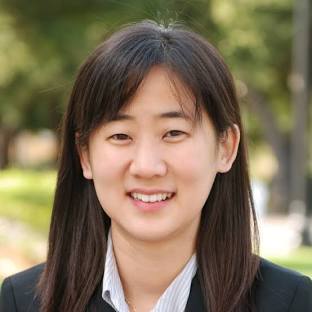
Dr.
Dr. Jin Hyung Lee, a visionary neuroscientist, Stanford professor, and founder of LVIS Corporation. Dr. Lee's groundbreaking technology, NeuroMatch, is revolutionizing brain healthcare by creating a “digital twin” of brain function—a live, interactive model that reveals how brain circuits communicate in real-time. This is not only a technological breakthrough but a critical step toward addressing the rising prevalence of neurological disorders like epilepsy, autism, and Alzheimer’s.