A Cat Named Hope: Community Cats, Japanese Pet Culture & My Heart 地域猫ホープ:日本のペット文化と私の想い
Hello, dear listeners. I'm Sally, your Japanese language teacher — and today, I'm setting aside our planned lesson on keigo (honorific language) for something a little different. I hope you'll bear with me, because right now, there's something weighing on my heart that I simply have to share.
This episode is a chat from the heart — and along the way, you'll pick up some beautiful, real Japanese vocabulary that you won't find in any textbook.
1. What Is a Chiiki Neko? — Community Cats in Japan
If you've ever visited Japan, you may have noticed something that surprises many travelers from overseas: cats everywhere — round, well-fed, and seemingly very content. Many of these are chiiki neko (地域猫), or "community cats."
Chiiki (地域) means neighborhood or local area, and neko (猫) means cat. So a chiiki neko is a cat that lives in the neighborhood and is watched over by the people who live there. In the past, these cats were called nora neko (野良猫) — stray cats — but the newer term chiiki neko reflects a warmer, more caring relationship between the cats and the community.
People in the neighborhood may leave food out for them. In more rural areas, cats sometimes wander inside homes. But most community cats sleep and shelter wherever they can find a safe spot — and with Japan's growing number of akiya (空き家), or empty abandoned houses, there are more sheltered spaces than ever. As Japan's population ages and elderly residents pass away or move into care facilities, these empty homes have quietly become refuges for cats seeking warmth and shelter.
This is a very real part of Japanese society today — and something you'd rarely learn from a standard Japanese language learning course.
2. TNR and Sakura Neko — Japanese Words for Cat Care
Community cats are not simply left to multiply on their own. Many neighborhoods in Japan now practice TNR — Trap, Neuter, Return (捕獲・不妊手術・返還). Volunteers use special cage traps baited with food. When a cat walks inside, the door snaps shut. The cat is then taken to a veterinary clinic to be spayed or neutered, and afterward returned to its neighborhood.
To prevent a cat from being accidentally trapped and operated on twice, the tip of one ear is carefully snipped after surgery. This is called a sakura neko (桜猫) — a "cherry blossom cat" — because the notched ear resembles a cherry blossom petal. The right ear indicates a male cat, and the left ear a female.
TNR is an important part of Japanese pet culture and is now practiced in many communities across the country, including my own neighborhood. I even visited the clinic where the surgeries are performed. It starts late in some areas — including mine — but every effort counts.
3. My Story — Ten Months of Feeding, and One Very Sick Cat
Now, here is what has been keeping me up at night.
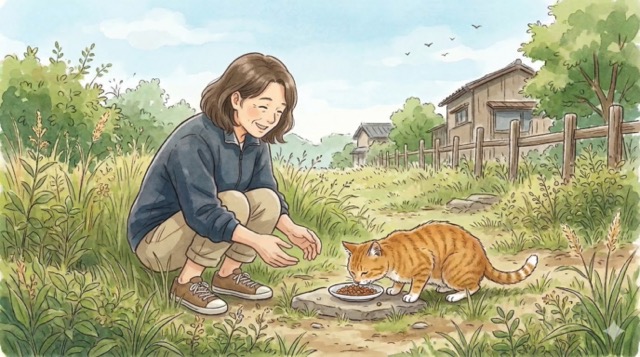
There is a young male cat near my home — about two years old — that I have been feeding for nearly ten months. I gave him a name. I talked to him gently, day after day. I had planned to have him included in our neighborhood's TNR program.
But before that could happen, he got sick.
At first it seemed like a simple neko kaze (猫風邪) — a cat cold. Usually, a cat cold is nothing serious; rest and time are enough. But this time, a viral infection took hold. He can barely breathe. His nose is completely blocked. His eyes are weeping with discharge. He looks truly miserable.
I described his symptoms to an AI tool, and the answer was clear: his condition is too serious to recover from alone. He needs veterinary care as soon as possible.
For the past three days, I have been trying everything I can think of to catch him. Yesterday, an experienced volunteer came with a large catching net — much bigger than the little butterfly nets children use for tonbo (dragonflies) or semi (cicadas) in summer. But unfortunately, the attempt failed.
When a cat has a frightening experience in a place, it learns that the place is dangerous. It becomes wary — and may stop coming back. But because I have been feeding this cat and speaking to him gently for so long, he still returned, even after yesterday's scare. Not to his usual feeding spot, but nearby. That small thing gave me hope.
Right now, I have placed a trap cage outside with food inside, and I am waiting. All I can do is hope he finds the courage to walk in.
4. Japanese Words for Life, Loss, and Nature
This episode has touched on some important Japanese vocabulary — the kind that comes from real life, not a textbook. For those of you doing Japanese listening practice, here are a few key words to remember.
Jakuiku kyōshoku (弱肉強食) — "the weak are meat; the strong eat." This is the Japanese expression for survival of the fittest, where stronger creatures prey on weaker ones. Lions eat herbivores. Bigger fish eat smaller fish. Even among cats, dominant males compete fiercely for territory and mates — and the cat I care for is a male who has clearly been in his share of fights. Just before he fell ill, his face was covered in scratches.
Shizen tōta (自然淘汰) — natural selection. A vivid example: a single fish can lay tens of thousands of eggs, but only a tiny fraction survive to adulthood. The smallest are eaten by slightly larger fish, who are eaten by even larger ones, until eventually humans or seabirds take the rest. Jakuiku kyōshoku and shizen tōta — two ways of describing the same hard truth about the natural world.
Outdoor cats, including community cats and strays, have an average lifespan of only about five years. Indoor cats, by contrast, typically live 15 to 20 years. The difference is enormous. The cat I have been caring for is only two years old. He still has so much life ahead of him — and I am not ready to accept that the world has no room for him in it.
5. Why I'm Sharing This Today
I know this episode has nothing to do with a formal Japanese language lesson. But this is real life — and real life is one of the very best ways to learn Japanese.
While I work on this podcast for Japanese learners around the world, I am also out here in my neighborhood, leaving food out, watching from my balcony, and waiting for a small, sick cat to trust me just enough to walk into a cage.
Many visitors from overseas comment on how happy and well-fed the cats in Japan appear — and it's true, many community cats here are genuinely well cared for. But even so, some cats fall ill and cannot recover on their own. That is the reality, too.
I had planned to talk about keigo today. But I needed to share this first. We will return to keigo next week — it is a big topic and we have a lot of ground to cover together. I hope you'll look forward to it.
Until next time — dewa mata (ではまた).
Key Takeaways
Chiiki neko (地域猫) are community cats in Japan, watched over and cared for by local residents — a reflection of Japanese pet culture at its most human.
TNR (Trap, Neuter, Return) programs help manage cat populations responsibly. After surgery, cats receive an ear notch and are known as sakura neko (桜猫) — the right ear for males, the left for females.
Akiya (空き家), Japan's growing number of empty abandoned homes, often serve as shelters for community cats.
Neko kaze (猫風邪) means cat cold, but viral infections can turn serious quickly and require veterinary care.
Jakuiku kyōshoku (弱肉強食) and shizen tōta (自然淘汰) are two essential Japanese phrases for understanding nature and survival — and life.
Outdoor cats in Japan live an average of five years. Indoor cats live 15 to 20. The love and care of a community makes all the difference.

📚️Reading:Level N4:The Secret of April 1st "Lies" 4月1日の「ウソ」のひみつ

 Apple Podcasts
 Spotify
 YouTube
 Amazon Music