What I Look for When Hiring Team Members
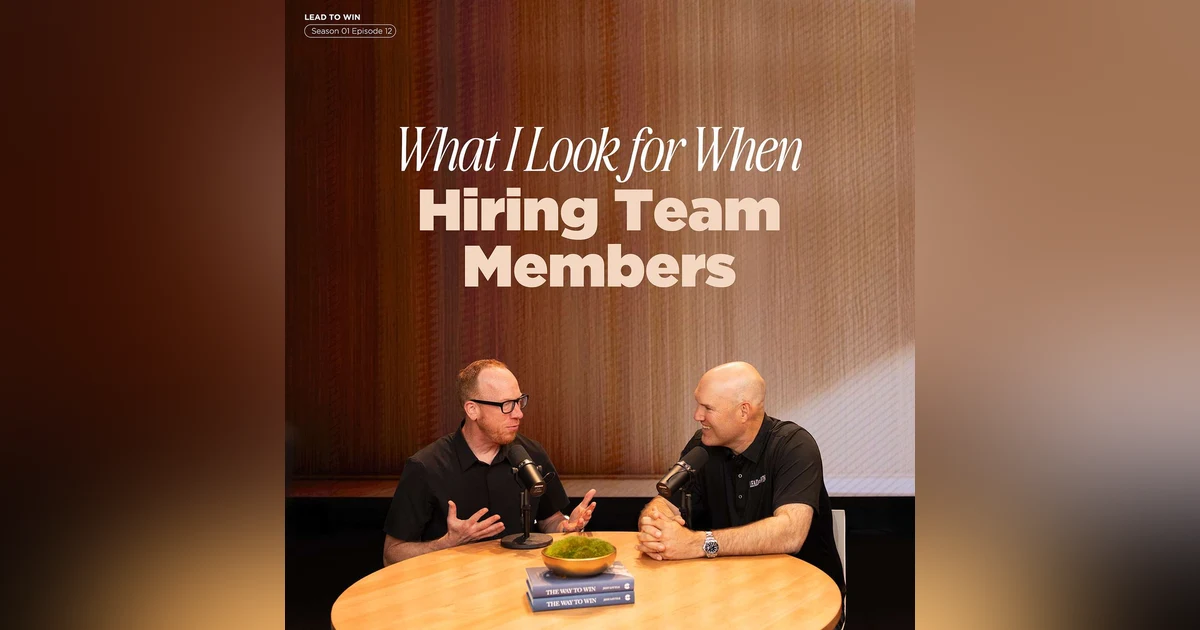


When it comes to building a team, the people you choose determine more than just productivity—they shape the culture, carry the vision, and impact everyone around them. In this episode, Pastor Jeff and Pastor Jed talk about the kind of teammates they value most: people who are humble, trustworthy, aligned with the mission, and committed to growing. You’ll hear real insights on what makes someone not just a good hire, but the kind of person you’d want in your corner through every season. Whether you’re building a new team or reevaluating your current one, this conversation will help you clarify what really matters.
TIMESTAMPS
5:38 - Team Building vs. Being a Superstar
10:45 - Teaching Team Principles Early
17:15 - Character: The Foundation of Great Teams
22:10 - Competency: What can You Actually Do?
25:32 - Curiosity: The Drive to Keep Growing
31:06 - Chemistry: Why Team Flow Matters
ADDITIONAL RESOURCES
More resources: https://leadtowin.com/
Win With People: https://leadtowin.com/pages/win-with-people
Register for Leaders Gathering: https://leadersgathering.leadtowin.com/
Information on Milestone Church: https://milestonechurch.com/
FIND US AT: https://leadtowin.com
GET IN TOUCH: Contact us at info@leadtowin.com
FOLLOW US ON SOCIAL
Instagram: https://www.instagram.com/jefflittle/
Facebook: https://www.facebook.com/pastorjefflittle
0:00 You want to hire people who have a curiosity, they're pushing you to go. How did you tell me about what? Oh, curiosity is this intangible trait that makes great team members and leaders. Once again, I want to welcome you to the Lead to Win podcast, where we help you win in the areas of life that matter most. I'm your host, jed Walker, and joined, as always, with Pastor Jeff Little. So glad to have you here with us. We're talking about the concept of teams. Our last episode we were talking about the challenges with hired hands. We're talking about some of the concepts. We talked about this metaphor of a shepherd and how a shepherd oversees environments and how that applies to ministry.
0:45 It's all in this great book that you have here Win With People. But I want to talk this time now because it's one of the things that people comment. When we have guests, when we have people in our growth track, one of the things that they comment is how's their commitment? So long you guys have been together, you have this incredible longevity. You're a growing organization. New people are being added, but you have this long-term buy-in, this developmental process in our environment. How do you end up with an environment like that? Well, first of all, I always say I work with the best. I mean my team is really, I believe, the best. I mean I love the people that I work with and I believe, again, it comes out of when I talk about win, with people trying to champion this heart that I believe is the heart of God, that's predominant in the Bible and I believe it cross applies to business leaders, marketplace leaders, school principals, people that work with people and serve people, and that's a big part of what I mean.
1:47 That's what leadership is is about helping people, and so I always just love offering people help. It's why we do this podcast. I wasn't looking to do a podcast you guys begged me for five years and I just want to offer something to that person out there who feels stuck and doesn't know exactly how to go forward. And I would say, if you would put a greater amount of energy into building a great team, if you would become a better team builder yourself. Now, this is going to require growth and these are painful steps. So, along the way, being someone who decided I'm going to build, I'm not going to be a superstar, I'm going to be a super pastor, a super coach, a super team builder.
2:30 That's required me to grow. I mean, I have to do a lot of self. I can remember lots of meetings, especially in seasons where you're really pushing, where I had to do self-evaluation Did I handle that right? Reflecting a lot of times, thinking did I handle that right? Was I too harsh here, making decisions about hires? And I want to spend some time talking about that because, again, what you're talking about I'll do like a growth track. Our first step membership, and I'll bring our team in and introduce them and I have the person who oversees our business and finances. We're one of the first four students that became part of our church and I'll introduce these people and smart people.
3:15 They're not just looking at you. They expect you to say whatever the party line is and do it persuasively, but they're looking at the people around you and the people around you are the carriers of what your culture really is. So I want to encourage somebody today, no matter what their assignment currently is, even a younger leader that's developing. I preached this weekend. I said it to our congregation if you want your kids to really excel in life, I mean, help them learn how to be better at relationships and team building and being on a team and deferring and preferring and growing, and teach them some of those principles.
3:55 Again, I'm for doing well academically, I'm for hitting a ball. Quite honestly, even team sports, team sports are not about the fact that most kids are going to become professional baseball players. Or get college scholarships, or get college scholarships or whatever Some will. But a lot of it is about life. It's about having a coach. It's about preferring your teammate. It's about celebrating them. It's about when you get put in the batting order in this position. Then you're there to serve the team, right. It's when what if you have to give a sacrifice, bunt and you don't get to swing for the fence? You see that as a win, right. What if you're the best rebounder but you're not the night's highest scorer?
4:37 Right? These are principles. It's so good and I know we have people marketplace like If you became better at building your team, then your department or your area is going to grow. But ministry leaders specifically, this is a heightened, it is a central focus team sport, I mean we are a group of shepherds, building a team of shepherds that have a culture and a farm of sheep. A church is a farm of sheep that you're wanting to grow and multiply and have babies and develop, and the babies do well and mom and dad do well and you are tending and taking care of people.
5:23 So I want to focus in on the last episode. We talked about what not. You don't want to build on hired hands. You want to go listen to that episode. It's true, I'm also focused on this too and I just want to say it directly. Any team leader needs to come to what we call our leaders gathering here at Milestone Church. You can go to leadtowincom and that is a two-day period where we just give everything we have to help churches, businesses leaders help their teams get better and, specifically, ministry leaders, we show you all our plays, we let you sit with our youth teams and worship teams, and it's just where we feel a responsibility and a stewardship to give back.
6:09 And we don't believe we have it figured out and we're not the only church, but we do believe we've gotten to a point where it's a responsibility because Jesus loves his church and so we just love teams. I tell people you should bring them here. There's not just information, there'll also be an impartation that will help them love people better, help them serve people better, and so we just love to help, and I know you. you leverage your relationships. You leverage your time, your energy, not necessarily for you or building what comes back to you, but to build other people. In fact, honestly, one of the things about this environment, really about this podcast there's so much in the personal development space and a lot of it, if you're not careful, can become really, really singular to you as a person.
6:55 Right, what I love about what you're saying and what I love about our environment. Having been here now 18 years, I can tell you we think about development always through the lens of how is you getting better or getting bigger, going to benefit someone else? Exactly, the end is never you. The end is what can you take and then give to someone else. I think that's a radically different way to think about development and it's also why we want to encourage you to get the resources to watch the podcast, to come to the Leaders Gathering, because it's going gonna benefit not just you but everyone you're leading. We're gonna have John Gordon here, which I think has a lot of. He's actually coming out with a new book on teams, so he's gonna help us with team building. I'm bringing I have my pastors who have been my pastors for 25 years Steve Robinson, jim Laffoon, coach Tom, who's a spiritual father.
7:43 We're going to have some more dialogue sessions, not just a preach-off, and so this is a learning laboratory that we want you to leave with tools and be equipped. But I talked about what not to build on. Jesus said if you build on the hired hand, better context would be day laborer. You just kind of pick somebody up, pay them money and let them watch your sheep Right when the wolf comes, not if yes, when the pressure comes, when the problem comes. Most of the time churches don't know what they're building on until there's a challenge or a problem. And now, doing this 30 years, they're going to come.
8:26 It's not a question. So fast doesn't last, it just doesn't. And what we live in the world today that celebrates speed, right. How fast it's growing fastest, growing Well. Cancer is the fastest growing, okay, so I'm not against the fact that God can't do something to grow you Again. I'm for churches growing and impacting. Of course, I'm trying to give another piece to the puzzle that you've got to spend. I am the chief team builder. Right, I'm not just the chief communicator, the chief vision caster. One of my biggest responsibilities is the health of the team, it's true, because the team is going to be what the people interact with and the people can't be healthy.
9:13 We know that the easiest way anybody, any great, capable leader, makes a mistake when they're moving too fast. When you're moving too fast, you could miss something that you wouldn't have missed if your attention was fully engaged Exactly. So I would say, even the book, when With People, I have a guide with it. It's just to take your team through it, and it's really simple. Why would I take my team through that? I would want to get them together and help us. We study, we have conversation, and here's the real truth If they get better, if they get better, then whatever it is that you're trying to accomplish is going to be more fruitful, because the people are served better and helped.
9:55 So, if you would like your team to take better care of the people and feel more equipped to do it, that's the whole point of Win With People. I want to hone in on this episode, though, and I feel like we talked about what not to build on. I'd like to talk about what do you build on? Because I would say, in the evolution even of our church, in the organizational dynamic, empowering people, because you get to a point where one I've had to grow in this, but then you also have to empower people to hire people, yes, right. So if your company is growing or your department, so eventually you're not just delegating task, right, you're delegating authority, right.
10:42 So there are people now in our organization have responsibility for millions of dollars of budget, lots of people, and then, when they begin to hire people, what I have found that is not an intuitive, natural skill for a lot of people. They have to be coached. They have to be coached on what are you looking for Now? This is a simple grid, very simple, but these are some thoughts. Right, first of all, character. Right, so character is who you really are, and that really is the hard part. Right? So character is who you really are, and that really is the hard part. Right, because now we're better at dressing up our resumes and we've been coached on how to respond in an interview, and so myself, sometimes, I'll find myself prodding people like, actually sort of trying to get them out of their rote rhetoric, and then what'll happen is, when you do that, you'll hear them say, and then they'll be like oh, I didn't mean that.
11:41 Well, you didn't mean for everybody to hear it, but that's what. So the hardest part is finding out who this person really is, and some of that is not possible just interviewing or casually. That's one of the greatest people that I've ever hired. They chose me as their pastor before they chose me as their boss, and so I've seen them live in the environment. That's not always possible. Let me qualify that, and we have hired people. But the best people are the people you know how they've responded. But the best people are the people you know how they've responded. See, character is when you might respond in a way that could look not beneficial to you, but it's the right thing to do.
12:23 You're going to do the right thing, even if it is perceived to be putting you at a disadvantage Because you said and this is true they're not going to disclose that on their resume, they're not going to disclose that in an interview. Does this need to kind of see their character revealed? Does that impact how fast you hire someone, the hiring process? I've heard you say this before. You want to put a little weight on somebody to see how they respond. What practically does this look like for us to get a better picture of what their character's like? We've built an entire department that we call our pipeline, and so some people say you shouldn't call it a pipeline because it's more of like a pool. But I mean the bottom line is people with character in today's world stand out.
13:04 So if you create a pool of people, people with character are going to start to stand out. And character's not just I don't drink, smoke, cuss or chew or date any girls that do the old youth group line, the old youth group line. Obviously, in ministry there's character qualifications. In other words, there's stuff you can't do and be in ministry. But character still is more than just moral, behavioral things in those realms. Character is also how you treat people, how you treat people when no one's looking, how you treat the waitress, how you steward your time and talent. If you're a good teammate, meaning my character says to me that I don't want to be on a team where I'm not sufficiently doing my part to serve my teammate.
13:56 That's a character decision. Whether my boss knows or not, whether it's on an evaluation form or not, I'm going to do the because the right thing to do if I've signed up on the team. It's bad character to be on a team that you don't want to wear the jersey or be on a team where you're not fulfilling your role and you're putting your teammates in a deficient position, like my work habits is a character decision. So I'm going back to something you said a moment ago that I want to make sure everybody listening caught this, because I think it's so important. You were saying being their pastor gives you a window, and I know you enough to know when you say being your pastor doesn't mean they like listening to you preach and they go.
14:38 That message was so good. What you mean is they listened to you preach, they got inspired to take a step. Now they're using their gifts, they're going through the growth track, they're serving, they're engaged, they're participating. So what happens now is someone who cares about the vision of the church or the organization that's going to organically. They're already going to be in a different bucket because they've taken steps to demonstrate they're willing to commit to the vision and not just to you personally, because in a growing environment it's easy for people to slip through who are like I see the momentum, I see the gift, I want to get close to it, not so that I can help it, but I can siphon some of that off to myself. That's a character issue. The old saying is that the greatest people you ever hire are the people that you just start paying for what they're already doing.
15:22 In other words, so that's back to this pool of young leaders that we have. So go run rec at summer camp, right? If you complain, you hate it at summer camp. Right, if you complain, you hate it, you can't get anybody excited about it. Then you might think you're called to this, but you're not exhibiting the character attributes of someone who is called to it. Right? Because, again, we have internships. We have 89 students with us in the summer serving, so we provide these atmospheres for them, because when it's hot, when you're tired, when you feel like no one's seeing this, this is not going to make a highlight reel, no one's going to give me a bonus.
16:05 And you're serving people and you're loving it, and then people are attracted to that momentum and you're helping your teammates and you're growing. That's going to stand out. And if you have character deficiencies, it's like when you press on a toothpaste tube Diet Coke doesn't come out. That's true, right, and so people go. Well, I didn't know that was in there, what was in there. You just never got under enough pressure for your character to be revealed. So the hard part in ministry is it is a pressure-filled endeavor, I mean it requires, and so what we do a lot of times is we only look at talent but we don't look at heart, character, substance and usually in ministry, it's platform talent.
16:46 Platform. Yeah, I mean, I say that a lot of people. The people allow them to stay on the platform because they're actually way better on the platform. When they get off, they don't like the person that they're talking to. That's a problem. So you want to be people who, the closer someone gets to you, the more substance is there and the more character they see revealed. So you're looking for character. How do you find that character in your hiring? It's not always possible. I will say, though, if you hire someone with bad character, it's going to be revealed. Right, it's going to happen, and there's going to be a cost. There's going to be a cost. Yeah, like we said last episode. Yeah, the next thing is, though, competency right. So I mean and I would say this in the ministry world again, it's like I love people and I kind of love ministry and I pray and I know a lot of Bible verses and all that, but it's like what do you know how to do?
17:42 Do you know how to do anything? I found that's not just in ministry. Like. I was working with a guy the other day. Talking to him, he's like well, I'm in marketing. I'm like, but what do you do? So you get paid money to just talk about ideas that you never have the responsibility to execute? I mean, so there are these people embedded in organizations who fulfill a box on an org chart and they haven't had a challenge enough financially to do cutbacks. They're somebody's friend or they really love the company or whatever, or just got lost in the matrix of all the activity. But at the end of the day, what can you attribute to the fact there's very few roles on a team, that you can just be the hype man?
18:31 Now some people have ascended to the point where they can just be someone who talks and offers advice. I meet a lot of young people. What are you going to do? I'm going to be a consultant. What if you? built. How do you know how to consult something? You're a consultant. What are you consulting? You've never built anything. They're 25 and they said I've paid my dues, I'm ready to consult. The most respected leader is always the person who can point to what they built, and I would say that too in ministry. The best thing you do with young leaders is not give them a position where they can ride momentum, but make them build momentum. Department heads that are player coaches. They coach not because they can't play, and every once in a while they'll get in the game, they'll put the uniform on and everybody will be like, wow, that guy can play.
19:14 That person always has way more buy-in and way more high performers on their team. Yeah, so you want to put. There's a difference in impetus. Impetus is that you are good at your skill. I mean, the scripture talks about that. You show me somebody good and competent. They will not stand before obscure people. They'll stand before kings. They'll stand before kings. So there's a skill component that gets lost today in the hype of and ministry. It's so dangerous too, because it's like I like them and they're nice and people like them and it's like but what? Do you know how to? do you have that built into your hiring process, right?
19:57 You're asking the department heads. Okay, let's be clear, you like them, but what are they good at, what can they do? I have a teaching. I haven't taught it a lot, but there's a difference in visionaries and dreamers. I meet a lot of people today because we live in a world that's easy to do a lot of talk but not have a lot of substance, and so we're better at messaging. And so people who dream are people who have a lot of great, grandiose ideas that don't know how to execute. True visionaries know how to deliver and execute. You can't just give some grandiose thing. We're going to build this big building, we're going to raise people to do this.
20:37 Where you build the most influence is when you deliver on it. It's like, hey, we want to see this high school impacted for Christ. Well, what that's going to involve is one you got to build a team. You got to actually know how to communicate the vision. You got to then mobilize the team. Then you got to execute and then you got to do a morning donut breakfast. So then you got to figure out where do we get the card table? Who's getting the donuts? How do we get the orange juice? You got to talk to the teachers. The teacher says we gave you this room. You end up at the wrong room. How do you make it happen? When are the kids showing up? How will they see the donuts? So you actually have to be able to execute high school to where you meet a kid who God touches, he gets saved, he's an influencer.
21:23 Then next thing you know they're coming to your youth service, which you have to plan, and then you have to da-da-da-da-da and you're doing this and then you take them to camp. Oh, you talk about execution, right, and so good leaders are not just talkers. They know how to do stuff. There's a lot of hard work in what you just described. Yeah, they know what they ought to do something. So if you begin to hone in on what is my competency Because everybody has competencies they have competencies they developed, they have intrinsic competencies in the way God has made them. And when you begin to see that contribution, hone it, grow it, offer it, you become a valuable team member.
22:07 So practical, and I think in some ways it leads us to the next one. What's the next character? The next one is curious, and so I know some of you may have heard these Cs. They kind of floated around character competency. The next one, chemistry. But I've added this idea of curious, right, because we have a college, so we're trying to train future ministry leaders, we have a residency, so we take applications from students that come from all over and say, hey, I want to come Because ministry is an apprenticeship model, right, and not every church is a teaching hospital is an apprenticeship model, right, and not every church is a teaching hospital, but we like the apprenticeship and we like to bring them in and, hey, come with us and do this and learn it, because you learn ministry by doing it right. And so I've found, though, that we have, so we have classes, and then we have a non-accredited track that we're offering to where it's like how do you help people?
22:58 That? Because nowadays we need people that do sound and we have podcasts and microphones and lights and people here helping do, and there's these other competencies that you need and what I've found. I'm not saying you don't need to think about the curriculum of the college or the programmatic elements of. We are going to get a soundboard and we'll tell you this is this button and this is this button or we're going to. But here's what I've learned. Okay, there's program, there's class, but the good ones are so curious, they outpace the program because they're curious to learn.
23:42 That's so important. You don't learn to be a great video person by taking a video class. It's so good you go shoot video. You edit video. I want to say that again because I think it's so easy to miss. What do you mean when you say you're talking about someone who's curious? Do they wake up in the morning and have a desire to? I want to figure out how this works. I'm getting better today. If they only do the requirements this is what you mean by the class If they only meet the standards and go, hey, I got an A in the class, it's like an A is not what we're after. What we're after is you're coming back on your own accord and through your own initiative, telling us about all these things that you're finding out in the field that you're working because you're passionate about it. And so I do lead to win, to be a blessing to people in the body.
24:28 But make no mistake, you know me because you work with me every day. I'm a local church pastor of Milestone Church. I do a little bit of external stuff, but our people know my passion. I wake up every day. How do we better? You know, right now we're eight months ahead on we're going to do this, we're going to offer that. We're going to meet today. How are we going to do this better? Are we connecting? How do we get people connected to the grow track and grow? And what are we going to do with small groups? So what I'm saying is do I have a doctorate? Yes, do I have degrees? I'm not against those Basically, those just give you credibility with people. Right that you know how to do the work.
25:09 But at the end of the day, I'm a learner. In my car, I'm not listening to music. I have podcasts there listening, learning, ideas, thoughts. So what I would say is you want to hire people who have a curiosity. They're pushing you to go. How did you Tell me about what? Oh, curiosity is this intangible trait that makes great team members and leaders. It's one of my favorite things about you. We've been friends for almost 30 years. We've worked together, coming up on 20 years, 18 years in the church, 12, 14 years full-time. Whatever it is, we lose track of it, but I've never once wondered did Pastor Jeff wake up this morning thinking about how do we make Milestone Church greater?
25:56 How do we accomplish Jesus' mission better? How do we serve and love these? And so what that does is that inspires the culture of everyone around to think about what would it look like? We say the ceiling always becomes the floor. Whatever we do, we're always thinking we can get better, we can grow more, because it's just part of our culture. I love it. I love it about our environment. So I will take somebody with great character, someone growing in their competency. But if I'm here's a big test. If you're a manager, you're a pastor, you're a leader, and if I have more passion for what you do than you do, that's gonna be a problem. And I have a lot of passion you do, Okay.
26:38 So if I become more passionate about what you're doing, why do I need you? Well, people who are curious I believe this is true about them. You haven't seen their best yet, so you want to bet on someone who's You're hiring a version that's not nearly as good as it's going to be. You don't want to be the one hiring someone where their best days are already behind them no, no, no, no, no, no, no, no, Coasting is not going to. So yeah, so it's like this ethos of curiosity and I just love team members who are like well, I saw this worked here. Another thought here on curiosity is in today's world we like novel or genius or someone who says they are a revolutionary pioneer.
27:25 That's a very small minority of people and a lot of those people are not great team members, to be honest. No, they're hard to be around Really. The next layer is early adopters people that are looking at working practical things early in their stages, incorporating those and making them better. I'll be honest, I am not a genius. A lot of what I've done is just find people that do it great. Ask them to help me learn, be curious. How's that Okay, how did that work? And then bringing it and molding it, shaping it, making it a little better than how I found it, and that's what you.
28:08 They're curious, just bottom line. I don't want people around me who don't. It's really this simple. Do you care? If you don't care, that's a problem. Seems like a low bar. Seems like a low bar, but it's a big deal. I need to know you care, it's true. The final one is chemistry, and this is the challenging thing, because I like to help people with dating and marriage. So I had a group of young adults at my house last night. They were all sitting, we had dinner and they're sitting, they're asking me about dating and they're asking about this and they're talking about these different things and really there's some similar things here, right, and I'm like, well, I would talk to you as a dad.
28:50 I want to know the guy's character, right, and that gets pretty cemented here, around 20, 25 years old, like who they are. So I want to know same as hiring, I want to know what choices have you made that were character-based, that are character and value-based, because if you're going to marry and attach yourself to that person, then you're going to be connected to their integrity and character, right, it's probably not a phase. If we're seeing all the signs of it over and over, it's probably established, and so they're like well, he came to church and got inspired. I'm like, well, let's see him walk it out a little bit. You know what I mean.
29:30 Six months, yeah, but so there's similarities, character, this, and so then I believe you should get counsel and you should have people involved and there's these character and the matching of destinies and these traits you're looking for, but there's also this element that's outside of your parent or your pastor or whatever. That there's chemistry, right, and that's the same way with a team, right, like you can line up well, I'm passionate about these things and I have a great competency and you have skills. But did you know? It could still not work if there's just no flow, right, like I know very talented people who have high character, they're competent, they're curious.
30:14 They just don't flow with me, right. So it's like I'm going to be your friend but I'm not building with you. I know people who have all the top traits. I wouldn't build a tool shed with them because we don't have chemistry, we don't have the same grid, we don't have the same value structures, we don't see things through the same perspective, because there's different ways to do stuff and there's different cultures that prioritize different things. I talk a lot about aspirational values versus actual values. I think if you want to track good team members, you need to get down to the root of what are my actual values and how do you communicate those well enough for someone to say, hey, I want to build that, I want to value that, I have chemistry, I have confirmation.
31:01 A tuning fork is an object that, when struck, produces, based on the vibrations, a sound, a note, the resonance. There's a resonant, right, so it creates a note, so that note is given off and it's used to where you could tune a piano based on that note. Now, it doesn't change, right? It's not flexible in terms of it's going to give and it's accurate, right. The problem is you have to be able to hear the note, and so if you can hear the note, then you can also create the sound. And I think this is a challenge in where I would encourage every leader here, your department, your business, your company, your church man, especially church staff, you need to make sure you're playing a.
31:49 You are playing a note, by the way. Yes, you are playing a note. You're playing a note that. Hey, it doesn't matter, we can all do whatever you can have. The big deal in church today. Can you have side hustles? Can you have whatever I mean? Again, I'm not trying to say a lot of. There are pastors, maybe listeners, that are bivocational. I'm not talking about side jobs. I'm talking about divided passion or divided attention. Divided attention, energy or really really more? than anything. Divided culture. That's it, right. How can two walk together lest they be joined? Psalm 133, where there's unity, god commands blessing, and I'm not saying you can't have unity in that model at some, I don't know, there's lots of models.
32:30 Okay, for me, we're all in. It's one for all, all for one. It's team. That's our culture, right. So we're all together. All I'm saying is, when you're hiring somebody, if you have a strong culture, right, if you have a strong culture and most of the time, things that are moving forward, have strong cultures, and those cultures can be representative of several different sounds, right. What is the sound? By the way, if I come to your house, it has a sound, it's true. Forward. have strong cultures and those cultures can be representative of several different sounds. What is the sound? By the way, if I come to your house, it has a sound. Your company has a sound. When your team gets together, there's a sound.
33:11 Our team gets together, there's a sound that is familial, fun, laughing, not taking ourself too serious, but absolutely intent on winning the game. When we get together, we're like we're going to get to play and we're going to try to beat the other. We're not competing against other churches, we're competing against our own potential, exactly right. And somebody else doesn't have to lose for us to win, right? We're trying to advance this kingdom, right? So we're serious too. So it's kind of fun, serious, fun, serious. But what I found is there's not a lot of middle ground and usually within the first year you can tell if there's a chemistry fit. So I think it's important to talk about chemistry, have the conversation.
33:51 I can't tell you how many times in 30 years I've had the conversation. You love being part of the church. I would rather be your pastor and us have good chemistry with me being your pastor than you come on the team and there's not chemistry as teammates, Because there's people you can have this relationship with that you can't have that relationship with and that's intangible but it's pretty easy to recognize. If you go to the meeting and you don't want that person at theible, but it's pretty easy to recognize. If you go to the meeting and you don't want that person at the meeting, there's a chemistry problem. It may be impacted by some of these other things and I've found either love it or hate it, but, man, when there's chemistry it's like I love me, the people I work with, I love working with those people.
34:37 Do we ever have disagreements? I think good teams have healthy conflict. Do we ever disagree? Of course, this is not some robotic, these are leaders. But even in disagreement or we could do it different. Or one of my teammates the other day said I disagree, I strongly disagree, I vehemently. So I was like so you disagree? Try to find new ways to say it again. Yeah. And I mean the people I work with are passionate. In fact, that's one of our biggest challenges. We love each other, but we're also passionate. We have to keep building consensus With strong opinions Because of strong opinions. Right, those are all good things, but if you don't have chemistry, you're gonna be miserable, Right, it's true.
35:21 And so I just tell people life's too short to be miserable. Why would you, by the way, do ministry? when you're miserable. There's a lot more lucrative ways to be miserable. Why would you do this? So I think it's our job as people hiring people and building teammates to look for. Also, do we flow? And when you flow and you have character and you're getting better and you're good and you're curious, that's dynamite, yeah. Then the team gets better, Exactly Well. Thank you so much. So many practical insights and thoughts. I hope you guys felt like you got better. I hope you feel more confidence to help your teams win, to find the right kind of team members that are going to help you in your organization.
36:07 Thank you so much for joining us. We'll see you next time.