The Team You Build Determines the Culture You Carry
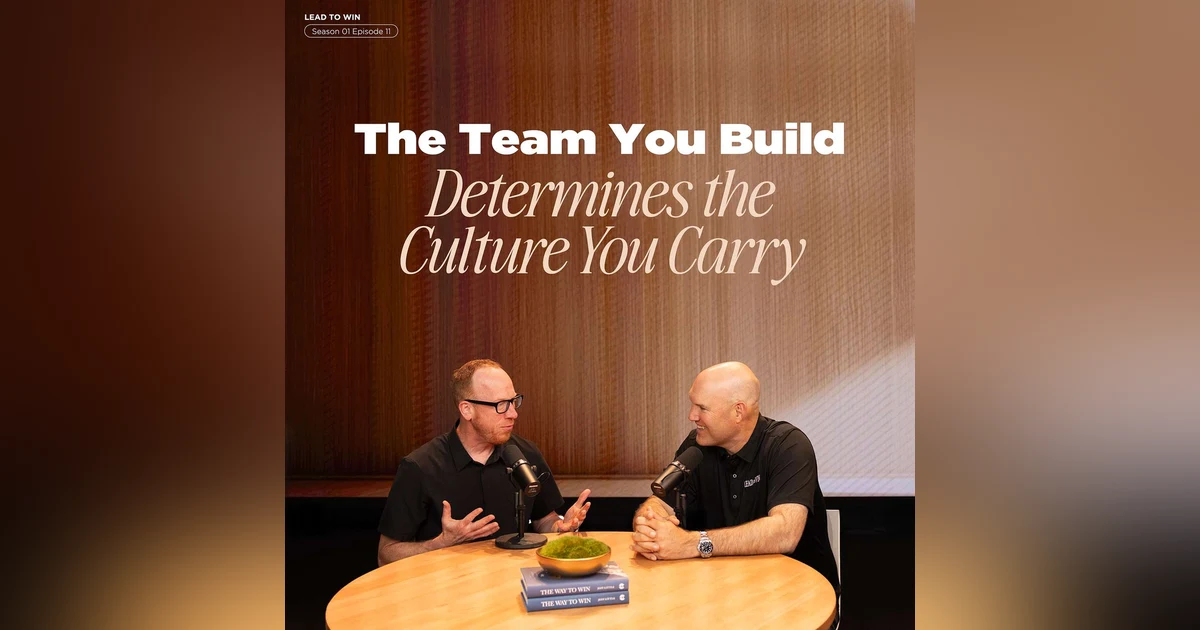


Every leader wants a thriving, healthy culture—but too often, we forget that culture isn’t something you create once and walk away from. It’s something your team carries every single day. In this episode, Jeff and Jed talk about how the wrong team members can quietly undermine your values, and how the right ones can bring them to life. You’ll learn what to look for when hiring or promoting, why smart leaders prioritize team fit over short-term fixes, and how to build a culture that actually reflects your heart and vision.
TIMESTAMPS
1:15 - Shepherds: Biblical Leaders Who Care
3:56 - The Value of Sheep in Biblical Context
6:10 - Jesus as the Good Shepherd
9:54 - Building Teams That Last
16:00 - Hired Hands: Leaders Who Don't Stay
24:23 - Building Culture, Not Just Results
29:50 - The Dangers of Self-Promotion
33:16 - Respect Comes From Dealing With Problems
ADDITIONAL RESOURCES
More resources: https://leadtowin.com/
Win With People: https://leadtowin.com/pages/win-with-people
Register for Leaders Gathering: https://leadersgathering.leadtowin.com/
Information on Milestone Church: https://milestonechurch.com/
FIND US AT: https://leadtowin.com
GET IN TOUCH: Contact us at info@leadtowin.com
FOLLOW US ON SOCIAL
Instagram: https://www.instagram.com/jefflittle/
Facebook: https://www.facebook.com/pastorjefflittle
00:00 - Valuing Honest Feedback
01:15 - Shepherds: Biblical Leaders Who Care
03:56 - The Value of Sheep in Biblical Context
06:10 - Jesus as the Good Shepherd
09:54 - Building Teams That Last
16:00 - Hired Hands: Leaders Who Don't Stay
24:23 - Building Culture, Not Just Results
29:50 - The Dangers of Self-Promotion
33:16 - Respect Comes from Dealing with Problems
0:01 People that are working with you. What do they say at their dinner table? Wow, Right. So I've always been a person where I want to know that, right, I want to know, I would rather know. Hey, it feels like this is all about you. I would rather know because you're going to find that out Eventually. Eventually, you're going to find that out. Well, I want to welcome you again to the Lead to Win podcast, where we help you win in the areas that matter most. I'm your host, jed Walker, joined again as always by my teammate and friend, pastor Jeff Little. Thank you again, as always, for joining us, excited this week to talk about this concept that you touch in your book Win With People, this concept of being a shepherd.
0:46 Now, a lot of times, shepherd that feels like an ancient thing, that feels like the other side of the world. But you say in the book and it's so true, the Bible is filled with shepherds. The Bible is a shepherd book written to people who understood this. And the reality is shepherds are all over the world. God uses that metaphor because it's something that's meaningful, that, whether you have sheep or not, it affects your life, because we're going to talk about some today, about relationships, about the workplace, about church life, and all of that really comes back to this idea of sheep and shepherd. God knew what he was talking about and he gave us that metaphor for a reason. Yeah, it's interesting. We don't really want be called sheep. No, no one likes that. But when you really study the characteristics of sheep, they don't do well alone.
1:33 They have these characteristics that are. Don't be rough with them. They don't like change, they like the routine. Don't be rough. Don't handle them rough. Don't yell at them. A lot of leaders yelling at their team wondering why no one's responding. So there's these pictures that we see in scripture, right, there's all these metaphors bones and breath and wineskin and wine and bread and all of that, but one of the predominant themes, and actually not just a metaphor but real life, right, because of the agricultural, the farming culture of that. We've been to Israel and you still see today, you still see it Like in a fairly developed city of some sort.
2:18 You'll go right outside of town and there's the shepherd and the sheep, so it's a picture we lose. I think also when you see the stories of the Bible, the sheep are also by us seen, as in most of our suburban or urban context. If you had one, maybe it's just a pet right. This was like. When Jesus in Luke 15 talks about the lost sheep, he's talking about something of great value. Yes, their livelihood, the center of the economy really built around that. I mean there's clothing, there's food, so the value when a sheep was lost that's more like us losing a car or maybe losing a segment of our business or something.
3:03 So I think we have to get ourself in the space that, when the Bible's talking about this, that sheep are valuable to God. It's important, right? Because it's also why, when God says make an offering, he wasn't like saying offer your pet. He was saying offer this piece that you look to for your sustenance and your wellbeing. I think that's fascinating. If you had a company and you were distributing a certain product, it would be like, hey, take half your warehouse and go give it as an offering, which? That's the context, right? So first we have to understand value, or we can't get the understanding of why it's so important. But, at the end of the day, the role of a ministry leader and I wanna make sure that I cross-apply this as well I know a lot of people that listen to this podcast are ministry leaders, but there's also, I know I just talked to a guy the other day who said he got a lot out of the podcast because, really, the principles are still true.
4:00 Right, the principles are true If you see yourself as not just a boss of the people that you're managing or even a manager, but you see yourself as someone who's tending to their livelihood and knowing that their health impacts their ability to produce what they're. You're just gonna be. That's just very rarely seen in the marketplace. My boss actually cares about me. Right, it's a rare thing. I love that you and I both were encouraged by the fact we got great feedback from a principal who's been listening to the podcast and enjoying it and said this has been so helpful. Thank you so much for giving. She's using it in the school and with their teams and teachers.
4:40 Okay, let's talk about this idea of a shepherd. The shepherd sometimes not typically the metaphor that a leader who's trying to win they don't necessarily gravitate towards shepherd. Shepherd was often in the ancient world. He gave it to the youngest kid. It was the. You know, david gets forgotten when he's the shepherd. It's kind of the thing that people were trying to get out of. But it's fascinating now that of all the metaphors Jesus could have picked, it's not the only one, but one of the ones he chose was I am the good shepherd. So what is it about this role, sometimes overlooked, sometimes not necessarily chosen? What makes a shepherd so valuable as a metaphor, other than the fact that Jesus said he's that? What makes this such a valuable way to think about it?
5:20 Early on I really realized that I'm like I don't know really if I have the skill set to be a superstar or a super influencer. Not that that was even a thing 30 years ago when I started. But I would consistently hear God say just make sure they know how much I love them, right? So I actually sort of just stumbled into hey, I think I could be a super pastor. Yes, I preach, yes, I lead, yes, I sit in business meetings. But the ethos and culture I could be a super pastor. And now, now I'm sharing on this podcast after years of pastoring and loving and building people, pastoring and loving and building people, and now there's actually a little bit of attentiveness to it that I believe the root reason.
6:10 I mean it's very clear in 1 Peter, chapter 5, where Peter later in life, leaning on what Jesus told him when he stumbled like feed my sheep. Peter. Later in the latter part of the Bible, he makes it real clear shepherd, the flock of God, do it willingly, and I think sometimes we forget Peter early on wanted to be first, wanted to be the one who was recognized, wanted to be the greatest. He was ambitious, he was very self-focused right, this is not the guy who was over there just naturally gravitating toward the wounded bird. He was the one always trying to put himself first. So it's important to see he grew over time to grow into that. I mean, he's the guy that brings out the sword and cuts a guy's ear off where Jesus was trying to teach him about serving and the towel and he has this problem with that.
7:00 Why would you, my rabbi, my authority, the son of man, serve me that way? But it's interesting, peter's perspective now lots of persecution. He'd had his own failures and problems. So he's giving us a wisdom from a very powerful reflective point Through pain and experience right Pain, walking with Jesus in person seeing. Later he was able to reflect on how Jesus related. So good. And we gotta remember Jesus didn't mind being called the Lamb of God, right? Yeah, it's true. So he didn't mind being called the chief shepherd, that's right. He chose that. So when you see it so predominant right, david, you see Moses, you see all of these key figures my question is how have we lost it in our culture?
7:47 Because I believe I'm not making a blanket statement, because I've actually found that there's a lot of pastoral, motivated, relational. I wanna love people, I wanna take care of people and really they've abandoned really a real gift they have, because in today's world it's not celebrated or it's like I can't get to there doing that, and so I'm trying to help people put the pieces together that you could actually excel in your corporate job by being someone who takes care of the people. Does that not mean that you don't need these other skills? No, I'm not saying you don't, but it's really more culture than anything.
8:34 It's really about culture. That makes sense, I think. sometimes leaders think of the shepherd as the guy with a few little injured sheep over here and he's like, no, no, I want to be in charge. I want to be out there making an impact. I want to leverage my gifts for maximum growth and potential. I know you, we've been friends a long time and you are very pastoral, but you also have this side. That's strategic, that's leadership forward. You're thinking in efficiencies, big organizational. You're a strategic leader. Why do you think people are nervous to embrace this shepherding Because of? Do they think it's limiting in some way? I think so, and I mean we do know that 85 to 90% of churches like out of the several hundred thousand churches, in America at least, are less than 200 people.
9:18 They're smaller. Is it a good thing that churches are having a bigger reach? I mean, actually, if you're listening to this podcast, you're probably a learner and you want your youth group to grow, your team to grow, your company to grow. So God actually shows us that growth for the church is a desire of His. In fact, ephesians tells us, when the parts are connected properly, when we're under the headship of Jesus Christ, then it builds itself up and it grows and there's more love, according to Ephesians 4. So this is not an anti-grow message. I'm talking about the growing through health and having a better long-term view of what that growth looks like.
10:02 Right, because you can have all kinds of growth and people think, well, okay, well, that means it's going to be less. Actually, it may actually be more sustainable, it may be more transferable, it may actually outpace quick, self-centered growth. Right, so it's actually, as is all things in the kingdom of God, they're counterintuitive, but actually better, right, and it's better than you thought and God's smarter than you think, and so I believe in church growth, teaching right to help pastors understand that you have to delegate and you have to build a team that's equipping and taking care of people, and our life is also about equipping people to take care of people as well.
10:52 I say it this way I'm not responsible to personally take care of every person, but I am responsible as the steward of the chief shepherd to see to it, to the best of my ability, that those needs can be met. That's so good. That's really my target. I thought one of the things in the book. You cite a proverb that I think really speaks to what you're talking about and the proverb says know well the condition of your flock. Now that can be In the Hebrew. You get into that. It's looking into their eyes, looking into that sheep and really knowing where it's at. But what you're saying is it doesn't necessarily mean that in order to know well the condition of your flock, you do that for every single sheep. It could be that you're over a team of shepherds and you look at the team who's responsible for those sheep and you know because they're telling you and they're with the sheep every day.
11:40 Exactly, you say in the book shepherds smell like sheep. So let's talk a little bit about. I'm fascinated by this idea that a shepherd is. They have to be good at a bunch of different things. They have to know terrain, weather, they have to be able to manage the sheep, they have to be forward thinking, but they also have to have this relational insight. They have to have this EQ to be able to look at their teams, their sheep, and know how are they doing, what's going on with them. And I think a lot of times, leaders can be in such a hurry to accomplish outcomes and tasks and goals, which are all valuable, that they lose sight of how the sheep are actually doing. Can you speak to that? Yeah, I think we all lean toward a lack of self-awareness. I know, even myself, as a young pastor, I can see seasons where I was pushing a certain initiatives and I really got a little blinded to being tasked over people.
12:29 From time to time. We all can lean toward a lack of self awareness, right, and so I think one of the things we should all whether you are a principal or a children's leader or whatever role you have we all should seek to avoid this happening. People that are working with you, what do they say at their dinner table? Wow, right. So I've always been a person where I want to know that, right, I want to know. I would rather know. Hey, it feels like this is all about you. I would rather know, because you're going to find that out Eventually, yes, eventually, you're going to find that out.
13:10 We feel like you're disconnected and you don't care about the sheep or whatever that might be. Hey, you're really harsh because you're trying to strive for something that provides something for you but it's not being received as this is for the betterment of all of us. And everyone's had that boss, everyone's had that pastor, everyone's had that person where you're like this is about them. And anytime you bring feedback, they're defensive. They turn it back around on you. They won't listen If you have to be overly authoritative all the time if you have to tell everybody you're in charge, if you are constantly. I meet so many pastors and leaders they're constantly talking about today.
13:54 People don't care and young people don't want to work and our church isn't generous and they're just frustrated with the ministry life, and a lot of that is because it's at this very core. Are you trying to build something big? Are you trying to build big people? Do you care about the people? Does winning for you look like you crossing a finish line with a big celebration, or is it actually people being with you? Is your team developing and growing? Are they sharing in the blessing and we say it this way, it's kind of cliche, but it's true Do you want more for them or is this really about what you want for you?
14:35 And so that really is the shepherd's whole life is measured by what is the condition of the flock. It's good, and I believe we live in a day. I'm gonna say it, and there's so much. Again. Two things can be true at one time right, is it better that we're more effective at our communication styles or ways to reach people and seeking to be missiologically relevant? I think relevant can be dangerous because we're not primarily called to be relevant, we're called to be biblical. But the biblical model, the Bible tells us I became all things to all men, paul said, in order to win some.
15:17 That doesn't mean compromising the Bible, but that's missiology, the study of reaching people who am I trying to reach? Who am I talking to, who am I trying to reach? And so if we have antiquated methods and we're not serving the people, all of that's good. But what happens is you tend to sway over to better at messaging, better at marketing, better at speaking, communicating, creating cool environments, but you have a dysfunctional team. And if the team's dysfunctional, the church will be dysfunctional. If the team of leaders is dysfunctional, the company. It starts right there, with the people closest to you as the team leader. That's so good. And you're back to John 10, right, we were talking earlier about this idea that sheep, just shepherds, taking care of just a few sheep.
16:04 Jesus, in John 10, john 10, 12, he actually gives us insight because he's talking about the shepherd, but he's talking about needing more help to take care of the sheep, and he introduces this contrast between a shepherd and a hired hand. Let's talk a little bit about this idea because he starts to delve into Now, if you're not familiar, hired hand would be a day labor. It would be be somebody that there was not. It wasn't a family member, it wasn't a long-term. It was like maybe you're bringing the sheep in, maybe it's time to shear them. Seasonal help this is very true in ministry. Right, like I need some help. Where am I gonna find some people to get through Christmas season or Easter or busy season? So you make some quick hires.
16:48 These hired hands are essentially people who are like I see myself in it for a short term. There's contractual, it's transactional. Talk to me a little bit about why was Jesus pressing this so hard and what does it look like to have a hired hand in our leadership context? today. So in years of working with pastors, I've found that a lot of times, especially at the senior pastor level, they're dealing with space issues like how do I get a space to take care of the sheep? And that's valid right. The sheep need a barn, the sheep need a pasture, the sheep need water. So a lot of times they want to talk about that. They really believe if I had a better barn I would have better sheep. Maybe there's some things related to that, but I want to talk about the thing we can have the most direct influence on and I think if I were to offer I think we're going to kind of give a couple of these podcasts here to talk about.
17:35 So many leaders are saying where do I get good people? Yes, that's a big issue. So I would say Across the board, not just in ministry. And I'm not setting us as the standard. But when people come to our environment, like for me, I say up front I'm not the best preacher, I'm not the best, but I'm really good at getting high capacity, even people that were not necessarily high capacity to start, but grow, to become developed leaders, and so we've been most my team. We have longevity. People want to ask about that. How do you have longevity with the team? Now we have this next generation of leaders that are coming up.
18:16 Smart people look at the leader and the leader's job is to sell the vision of where they're going, and so they listen to the sales pitch. But smart people look at the leader and say who's around the leader? Because the reflection of the leader is really seen. So it's going to happen. Depending on what level of leader or pastor or manager you are, intuitively new team members or people from the outside are going to go to the number two, the lieutenant, the CFO, the other manager, the volunteers. Some people lead a volunteer team and so people want to know who's on the invite list before they go to something.
18:57 So, people, who's building this with you? Right? So therein lies the challenge, especially in church, I mean it's coming For us. We have Saturday night service every six days. It comes with amazing regularity. There's a lot going on services, people to take care of, so I find that a skill that a lot of ministry leaders especially but it cross-applies is team building. In fact, we're building our leadership gathering in January and in the description we'll put the dates and I would say even to a senior pastor, you would be blessed by coming, but even always tell them send some of your team, let them get around our youth teams or these different, get in that kind of team culture, and so I find that actually team building.
19:43 And so I find that actually team building. And now we have these subsidiary companies or things, headhunters trying to find staff, everybody's scrambling. Where do you find good people? And I want to hit on this because there's so much we can talk about in this area. But I want to talk about the attributes of what we a lot of times build on, which is a day worker, a hired hand. A still thing that baffles me is why would you be a day worker in ministry? I'm gonna go work in a different area. There's a lot more lucrative ways to be miserable, it's true.
20:25 But you'd be amazed. There are a lot of people in ministry who fit the characteristics of what you're about to describe as day workers. They're out there. Right. And so I would say to the person if you're building your youth team, you're building your children's team, you're the pastor, you're the associate pastor, the executive pastor and even within the business office or the graphics department or whatever, if you build on these things, it comes with a lot of challenge, emotional energy, and the hardest part about building on a day worker is they see their commitment level to the check they get at the end of the day, not to the people. And if you build on that, you might think you're gaining ground, but it's temporary and you not only lose the ground you gained, you actually back up, because every time you make a bad hire, those people are connected to a group of people within the church or in the department and so you think you're moving forward quicker by hiring the day worker, but actually you have to deal with the emotion of processing all of that and then you actually lose sheep.
21:28 Yes, you actually lose what you're building. And people get hurt. And the other thing is, because we've been studying this for a long time and trying to find help wherever we can Remember we read that Netflix book. We were fascinated in Netflix. They said they were trying to answer the question what's the best thing that you can give a high-performing team member were trying to answer the question what's the best thing that you can give a high-performing team member? And we thought it's Netflix. It's like unlimited budget. We thought maybe like nap pods or sushi bars or extra vacation. What we found in that book. I think you remember this the greatest thing that you can give a high-performing team member Another high-performing team member, exactly so when a high performer sees day workers coming in and out. you say it this way a lot of times You're voted off the team not by your direct report, but by the rest of the team who has to work with you every day.
22:10 You're promoted by your team. Everybody thinks it's just your boss, but actually there's a table of people that are actually promoting you and you're promoted by your team because when there's layoffs or cuts, the team members are like we're not losing them. I'll give them some of my salary before we lose them. Nick Saban. He says that the great players don't want to be around the mediocre players. They don't mix well together. We think, well, let's just get enough people on the team and by the sheer amount of players we'll win the game. But he's saying no, no, you got to really be careful who you let into that environment. And really it's back to to culture and again, peter Drucker, culture, each strategy for breakfast. You actually have to decide what culture am I going to build in my team?
22:55 Because the people are the carriers of the culture. I listed out a few things in the book Win With People because I think again a lot of times people think of a shepherd as an isolated, lone individual taking care of a few herding sheep. But the Bible doesn't show organized shepherds. But it does show us there was this familial nature to the business. David was in the field, jesus when he was born. There were shepherds. Abraham had a large flock, lots of herds, and so he was over tons of servants. Who, many of those servants were shepherds. So there were teams in the Bible. So it takes for a church or a ministry department or a company or a team to be productive and to grow, there has to be a team of shepherds.
23:41 Here are the qualities of a hired hand that Jesus says when the pressure comes, when the enemy comes and it's not if it's going to come, it's coming. It's when it comes, when COVID comes, when challenge comes, when it's a matter of time. You're working with people. These people don't have the spirit to endure. First off, they're outcomes and results oriented, and shepherds are process and journey oriented. In other words, they see the joy of the life, with the sheep getting healthier, developing, and so a lot of times you can say it this way Hired hands are tasked over people.
24:29 Now again, there are people that say, hey, I just want to be with people and I just love people. But ministry life? The Bible says we're called to equip the saints for work of ministry. I think that's one of the biggest misperceptions that I've seen from people, especially if they've been in the marketplace or somewhere else and they want to come into ministry. They think, oh, this is a place where we all sit and pray all the time and I have my own personal pastors and my friends who are all serving God, and that's even about you, right? No, shepherds take care of sheep and shepherds' flocks that are healthy, multiply they do. So it's really about you. Don't get paid in ministry to do ministry, right?
25:12 You get paid to equip people to do ministry, yes, and so you have to be a good team builder and there are tasks to be accomplished, definitely Like the people that don't ever get anything done. You have to know how to do stuff. I've worked with a lot of people and still today, I see this all the time. I'm like what do you actually do? Do you do anything? So, yes, I love people, I'm building people, equipping people, but I have to write a message, I have to balance a budget, I have to do some stuff, but it can't be. People feel it. This is so big In the ethos of a church or a team or a company. People can tell if your motivation is for them.
25:58 I tell a lot of pastors. Tell more stories of the people. Celebrate the people. You're the champion, it's you. Everything I do is to help you flourish. And when people sense that their buy-in level is huge because it's so rare, it's so good. And maybe the best way to see this is a dad right Like a dad who's busy, who has work, who has responsibilities, who has financial pressures, if he's constantly telling the kids I have no time for you, I have no time for you. The kids feel that they do, but in spite of all the responsibilities he's carrying, if he stops, looks them in the eye, smiles, celebrates with them, laughs with them, he's communicating to them that I'm here for you and whatever the tasks may be, they don't come before you.
26:42 And really we see that connection between pastoring and parenting. Paul multiple times connects the two. So it's really that Sometimes it's not even that complicated. On the way to this podcast today, I pass by and there's a whole group of people, Of course, when I drove on the property. We're about to have Vacation, Bible School and there's all these blow up things for kids and all this and I'm thinking, wow, this is pretty amazing. I mean, all we got was like a popsicle stick. A flanagraph? Yeah. But anyways, it looks like it's going to be a pretty amazing thing. But I see this group of people and I know, okay, those are the people about to stay up late, take care of scared moms' problems with their kids kid throwing up this problem this kid got stung by a bee can't control this one.
27:24 They're about to put out a lot of emotional energy. So I just stopped and said, hey guys, thank you for serving families this week, said a prayer over them. Just a touch. Just that touch. That's just a little thing. It's a small thing that goes a long way. Manage by walking around, walk slowly down the hall, right, say hi to people. Don't look so intent on what you're trying to do, right so, outcomes and results. The next one is they're looking for better opportunities, right so Paul says of Jesus he did not consider equality with God something to be grasped. So you can always see strivers, graspers, and it's about them. They're trying to take as much as they can because they have a scarcity mentality.
28:05 Exactly. So the shepherd is A owning their own stewardship of who they are, but they don't see the win as what comes to them. But it's how healthy are the sheep? It's really good. Hired hands are all about their own opportunity. What's in it for me? Okay, three self-significance, self-promotion. We live in a world today where it's never been easier to promote yourself, right? So are you driven toward self-promotion or are you living your life to see the promotion and the development of the people that you're stewarding?
28:48 Is that your goal? Now, again, in a healthy team, if you're serving the team I always say this because I think a lot of pastors don't know how to sort that out what does that look like In a healthy team? They actually kind of push you up. They're pushing you up hey, take a little time. Or look, we want to make sure everybody knows who you are. We're going to tell them who you are because they're proud of who you are. But that's helping the team. So I'm not saying there's never a time to say, hey, I'm the pastor, or I'm the leader, or I'm the manager, or here's some of my qualifications or whatever. But we've all seen it where the person on the team it's like seventh grade, but there's no I in team.
29:30 It's kind of like you're not a team person, you're all about you, right, right. So it doesn't have to be either or right. It's not like who gets all the glory. There's more than enough. There's more than enough credit and encouragement to go around. Nowadays there's. The other thing of a hired hand or day worker is they're building their own brand instead of building the house, and so in church we talk about it's actually scriptural. I'm putting these living stones together to build them into a spiritual house to which God dwells. In that house it's not a structure of stones, it's a structure of people that he Actually. It's not bricks. Stones have to be hewn, which means there is an individual nature.
30:14 They're not uniform, they're not all the same shape and size, yeah, so at the end of the day, we're not talking about uniformity, Right becoming a clone or a robot Becoming a clone, you have to dress like me, act like me, fit everything. That's not it. Every clothes you wear has to say the brand of the house or whatever. We're not talking about being weird here. You can have different interests. You can have different personality. I work with people who are very different than me in terms of likes or hobbies or even opinions. We want that and we invite that. But the spirit of it is we're building the team, we're building the people, we're building the house, and if you're building your own brand, that's going to be a problem. Yes, it's so true. Most people listening probably didn't watch Sesame Street.
30:55 But Sesame Street I always think about the two guys that would be old school kids before we had streaming cartoons. My grandson he's got a plethora of stuff of streaming cartoons. We'd watch Sesame Street and there would be this analogy because you're teaching kids how to recognize the difference and two have a tennis racket and one's bouncing a basketball and the song would be which of these kids is doing his own thing and you as a kid would recognize wait a minute, they're trying to play tennis and he's got a basketball. If you're a manager, a pastor, a ministry leader, you can generally detect that very quick. Wait a minute. We're trying to play tennis and you're bouncing a basketball and I will say this if you build on that, it's going to be a problem.
31:42 Yeah. That Philippians 2 passage where you got the grasper concept. It also says do nothing out of selfish ambition, hired hands highly motivated by selfish ambition. Actually, it's encouraging considering others more valuable. So I think we live in a day-to-day where you can build your own personal expression and you don't have to build a team. If you're good at that, you don't necessarily have to. But I think the next thing is individual expression, all right, instead of alignment in unity, and so you can always see that individual expression and kind of just moving it right down to the last one that I listed is they have their own agenda.
32:27 Basically, they don't have the agenda of the team vision, and so what I would say is I want to unpack what is a valuable team member in the next episode, but in this episode I want to say it looks like you're getting there faster when you build on hired hands, but you actually are hurting your better performers too right, your good performers who are trying to serve the vision. See you compromising with day workers and you lose respect when you don't deal with day workers. You lose respect of the true shepherds and, second of all, you're hurting the culture of an environment.
33:10 Your company, your department, your children's ministry, youth ministry, your church is primarily influenced not just by you but by the team around you and the spirit and culture with which they carry the passion and heart of that environment. So good, and so I would rather have average people that have a heart and a passion and a care for the people than I would to have talented people who are self-absorbed and narcissistic and all about themselves, because if you're listening to this in your ministry, it's a team sport. It is. It's a team sport bottom line. Not an option. There's not an option, right?
33:51 So I think building teams sometimes means being able to recognize what not to build on, and I want to say I've done it. Yeah, I've done it. I have too. Yeah, we all have, I'm not saying human nature. And I would say to a parent or anybody in your gut, and I would say to a parent or anybody in your gut when you're like man, I think you know generally you're right, like if you see an attitude or a perspective or you're like, I think you're generally right. So if you have people close to you who are exhibiting these characteristics, it's not going away. It's not going away. You have to be willing. The phrase, john Maxwell, if you need them, you can't lead them.
34:43 The proportionate level at your perspective of needing people will cause you to not build on this, because if you need them, it's very hard to lead them. And I think sometimes the people who are the most susceptible are the people who are good team members, who do get coached well, because they think if I just coach them, if I say the right thing, I can unlock something in them and I'll be able to turn them. And it's like people have their own wills and it's the old leadership adage when somebody tells you who they are, believe them. And. I think sometimes because in ministry you love people, you wanna give them a chance you see their redemptive potential. But some people you're just not gonna be able to win. This goes back to shepherds. There's this heart of compassion, there's this love, there's this service.
35:24 But shepherds also know how to deal with hired hands. They also know how to deal with wolves. That's a misperception that the shepherd is only in this box. True Right, they also know how to protect the sheep Such a good thing. One of the greatest things you do to protect the sheep is make sure you don't employ day workers to take care of them. Thank you so much. There's so much here and I really appreciate this idea of let's be wise we're not saying that we don't have to add people to our team but let's use wisdom. As we're thinking about it, jesus, and your wisdom here, giving us some caution, but I'm excited for you to join us next time. We're going to talk about what makes a great team member and how do you know who you actually are looking for. Thank you so much for joining us on the Lead to Win podcast.
36:06 We'll see you next time.