Returning to the Heart of a Shepherd
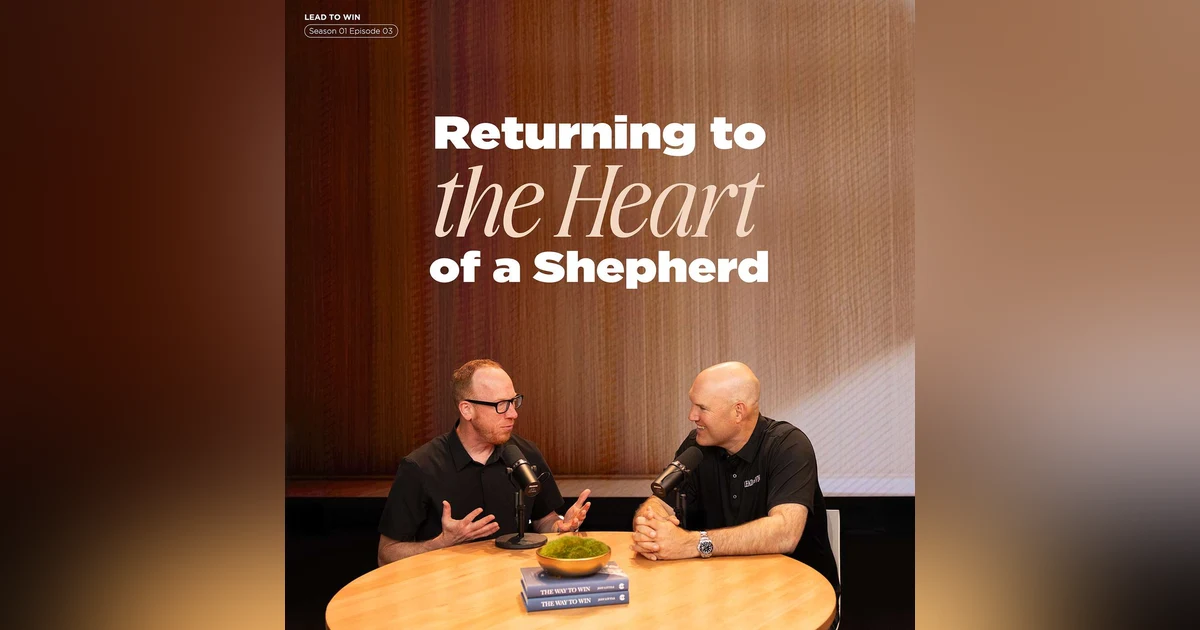


Shepherds take care of sheep. Pastors take care of people. Our first job is to create the culture that people experience when they come into our environments. Good shepherds facilitate growth and health. Discover why the culture you carry matters more than the platform you build. Pastor Jeff shares how a healthy team and a heart for people will always outlast trends, hype, or systems.
Win with People Book: https://leadtowin.com/pages/win-with-people
More resources: https://leadtowin.com/
Register for Leaders Gathering: https://leadersgathering.leadtowin.com/
Information on Milestone Church: https://milestonechurch.com/
Social Media:
Instagram @jefflittle
Facebook @jefflittle
0:01 Quit worrying about what they're saying on social media or Facebook. Worry about the hearts of the people closest to you. A shepherd wants more for you and is not afraid to say hey, you may not like this, but you don't need to do that, don't do this. This is going to kill you, and a lot of people today don't have that interest. They're just trying to get from people whatever they can. If your staff or your team did better taking care of the people, the environment's going to grow. I want to welcome you to the Lead to Win podcast. I'm excited about this week's episode, pastor Jeff, because you've just released your new book Win With People here at a big ministry event and it was an opportunity for you to preach a powerful message, and I want to just take some time today to talk about this book because I know it's really something that's come out of your heart and there's a lot in there that I know they're going to benefit a lot of people.
0:53 Well, I think you know, a book can be a topic, it can be a teaching, it can be something that you just want to share with the larger body of Christ, or sometimes a book, and it doesn't always work this way, but it's. It's. It's your life, right, right, it's my life calling it's this. This book is really the very essence of how I see the world. It's the very essence of what I believe to be a lot of what my impartation to others and inspiration is, and uh, and so the the Genesis of all this is that when I started in ministry, first of all, I have a heart for young people in ministry Um, any, any person out there.
1:40 I love helping people with the investigation of ministry and helping them find their call. It's a big deal. But when I started out, I was like, look, I don't think I'm going to out-preach everybody. I don't think I'm going to necessarily out-strategize, definitely not going to be the coolest person on the planet. I'm not going to win with fashion trends and media marketing. I mean, we have social media and I believe in marketing and all that, but I don't see the lens through like what's the slickest thing I can put out? It's a tool, but it's not your primary thing that you're counting on. It's not my primary passion. My passion is people being who God's called them to be.
2:22 And so I would hear God say early days, the first church I pastored, I would be struggling with my message. And I would always hear God say Jeff, just make sure they know how much I love them. Right, I'd be like that sounds so obvious. But I learned over time. You know I've I tell our church I still do it. I'm proud of you. Yeah, I love you. I I'm proud of you. Yeah, I love you. You're generous. Yeah, One time I was taking up the offering and I had a guest pastor and I sat down and he said to me is that real? Like you said, they're generous, Are they really generous? And I told him well, I'm just going to keep telling them that, Right, I'm going to keep saying that to them, because people tend to rise to the level of the way you see them and the expectations you have for them.
3:08 And now you look at our church. It's one of the most generous churches in the country because we just keep saying you're generous, I'm proud of you, I love you. And sometimes a lot of those people live in environments or grew up in homes where they didn't hear that a lot, and so for me, it all started as a young, 21 year old pastor who I was telling them that I loved them, but they were not telling me that they loved me, and it's like it's where. It's where I developed the understanding that the reason a lot of shepherds aren't close to the sheep is the sheep can bite. There's some that bite, they bit the fool out of me, and it was quite a challenging experience, right. I mean I didn't commit any financial impropriety, I didn't have any moral failures.
3:54 I probably was a little abrupt in my leadership style at 21, but actually the church grew but really, at the end of the day, ended up resigning from that church because it was just impossible. Yeah, the disunity. Yeah, the reason I have such a passion for churches and teams to be unified was I know what it's like to try to accomplish something in a disunified environment, and so that was my first experience. By the way, I resigned. My wife didn't even know I was going to and they gave me a standing ovation. That's not great for your confidence. That doesn't do a lot for your self-esteem. That doesn't feel like a win. No, no, it doesn't. And so I ended up moving in my new wife.
4:36 I move in all my belongings in with my in-laws. She's an only child, so they were glad to have her back. But I was like I've kind of failed here. It's out of a false start. She cried every single day. She was working as a substitute teacher. Now I'm a Baylor graduate. I'm the rising star in my denomination. I end up at my first assignment and the whole thing is a failure it blows up. Yeah, and she's at her parents' house crying every day. Man and I interviewed at seven churches around the country and, quite honestly, like we talk about, the local church is the hope of the world.
5:18 At 21, 22, I was like I don't know if it has any hope. Yeah, it was a different era. It was a different era. There wasn't as much help for pastors, right? So where did I develop this passion to help pastors? As I remember what I felt like in that place and I'll be honest, I would go to pastors and they were like well, just be miserable, like us, like that's what you signed up for I'm like man, and of course they were paying me, you know, $50 a week. And they said I was in it for the money. You know, I was like I. This is where I developed another thought, and that is there's a lot more lucrative ways to be miserable right. Like you, you have to, you have to have a, a reason and a and a meaning behind living.
5:58 The call to a shepherd. So I started out saying I want to be a great shepherd, I want to be a, I want to be a. I don't want to be a superstar, I want to be a super pastor. And so I began to build that lens. I'm a disciple maker, a coach, a developer, helping people, want more for people than you want from people, building this ethos Right. And so that's what that was the Genesis. And then I ended up finding these pastors who began to pour into me and help me, and I've always just felt like, when I serve other leaders and pastors and people that have a call, I just feel like that God smiles. It's amazing, and God's blessed you in that area so much.
6:41 I mean when we first met. I mean this isn't theory to me. We go back almost 30 years and I remember the first time I met you. You were going through some of these challenges, but you were excited about what you were doing. You were excited about Jesus, you were excited about his church and you were excited about the future and just being around somebody. I think you can take that for granted, that there are people in ministry who are excited about all those things, and that kind of excitement is contagious. I remember the first time we met I was like man, there's a guy and I had no idea that we would ever work together. I had a feeling we were going to be friends. I didn't know we'd ever work together. But that aspect of man I can't believe. We get to do this and this is a holy calling. That God's. Yes, it's challenging, but, god, and this was after you faced all those challenges, that you faced and so I think that general posture God's blessed you as a result of that and there's really an audience of people who need to hear that, because it's not a thing.
7:34 You know, going and being faithful and serving in the group of people that God's entrusted to you is not always the thing that's celebrated, but I think it's what God celebrates. Yeah, I remember having to pass the test there, right, I remember the passage of scripture that's very clear Either you forgive or you live in torment, like I mean I remember reading that and going I got a choice here and somehow I mean we know how, but like still practically speaking, I mean it's only with Jesus, centering your life on him that you can do that. Because there's my wife hurting, crying, my new wife, it's like. But I remember saying, okay, I'm not going to live in torment.
8:16 I'm not going to let this define my whole future, and I believe there's a lot of people out there. If I were to pick one of the number one things that stops people from continuing to shepherd others, this isn't just primarily the book, when with people is about returning to the call of a shepherd, and it deals primarily with the biblical ethos that Jesus, you know his, I, one of his main I am statements I am the great shepherd. It deals with that. But this applies as well to to teams and homes, and, and, and, and. I think we get hurt and we, we build up hardness and defense and we're just like I'm never letting anybody else in.
8:57 I'm just not going to do it. You know, and that that passing of that test, not long after that meeting you, it's like I know if, if God hadn't helped me, like I would have been a different person, you know. And so so then what happens is you? You know, you rock along and I'm sure, um, we'll tell more of the story of milestone. I mean, I have I pastored three other churches, had great experiences and challenges in those processes, but began to really be, you know, focused on how to build this culture and this ethos where people are taken care of, planted Milestone. I think a lot of people miss that.
9:37 They see where. Milestone is I was 28, but only by the sovereign hand of God had I already pastored three other churches. So I had a few other farms and I was like, hey, I want to. My leading thought was I want to build a church that I want to go to. I want to build a church I want to bring my friends to. I want people to be considerate and loving. That's a big deal, because I think that step right there gets skipped a lot of times. You talk about it in the book, right, it's not just to be a great shepherd, it starts with being a great sheep. Yeah, and every shepherd is under the great shepherd. Jesus. And so it's not just hey, be a leader, hey, be out in front. You say it in the book. It's like if you were a better Christian, you'd be a better pastor.
10:18 Right. And so learning how to under that, because I think everybody's in a hurry to skip to their own definition of what it looks like to arrive or to be successful, or to win. It's easier to skip steps today, because of just the world we live in. So start Milestone Church at 28. I'm now 51 years old and so along the way in the process, I began to realize, hey, like this impartation of, of having a culture and an environment that truly cares about the people, celebrates the people, builds the people you know is is is rare because you only know what you know, right, and so I didn't really preach at a lot of conferences.
11:00 I mean, honestly, none like I preached for my friends and honestly I mean honestly, none Like I preach for my friends and honestly, most of the time I'd be preaching for some church plan or some church I was helping yes, because I ended up helping a lot of guys get started and so I would preach at their churches. But at 49 years old, I was invited to speak at this large national conference and then, as a result of that, I preached on 1 Peter 5, right, like this call like shepherd, the flock of God. Yeah, and it like broke the internet, right. I remember when that happened. We were laughing because you're like wow, be a shepherd. People are like that's an amazing message.
11:41 Where'd you get that? You're kind of like it's the Bible. It's been there the whole time. So an amazing message. Where'd you get that? You're kind of like it's the Bible. It's been there the whole time. So there was this response, right. So then I started talking about it, and I started talking to staffs and teams about it, and then I started understanding oh okay, this is important to the culture of the Bible, it's important to the culture of churches, and there's a reason why it's been lost, and there's also a lot of misperceptions. So that's where the book came in, and the book really is designed. Quite honestly, if, if your staff or your team did better taking care of the people, the environment's going to grow. That's true, right, and so do you have a farm where these sheep are growing and developing?
12:26 Here in Texas we have feedlots. Yeah, we don't really care about their long-term success because they're about to kill these guys and make T-bone steaks out of them. Term success because we're about. They're about to kill these guys make T-bone steaks out of them. So a feedlot is just get them what they need to sustain them to get into the slaughter. All efficiency, all efficiency. Just push them through it. But a farm is about growing them and then they're going to have young ones and the young ones are going to grow up and we've got them at different ages. So I began to understand the importance of that. Then I started putting it on paper, which really put a whole other level of research into it to understand it. So first of all you mentioned it we don't like to be called sheep.
13:06 We don't, it's almost demeaning, it's a demeaning thing, right, but the Bible has no problem using that metaphor. God, over and over, says I'm the shepherd, you're my sheep, jesus didn't mind being called he did when he recognized behold the Lamb of God. John the Baptist saw him he was like behold the Lamb of God, don't call me a sheep. Don't call me a sheep. I'm powerful, I'm the son of God, yeah. He embraced it. So there is, in this biblical picture, some very important things about it, right Well? Psalm 23,. You go into it in detail, One of the most well-known passages in the whole Bible very much from the perspective. The Lord's my shepherd, I'm his sheep. Yep. Well, and most of the notable characters in the Bible were shepherds.
13:49 They were Abraham, moses, david. David the Psalm 23,. Right, so David, not out of theory, he actually was out in those fields and that was actually a preparation for him to move into being in the golden era of God's kingdom. They're the king and all of that right and that's back to skipping steps right, like a lot of people wanted to fight, defeat or take down a giant. Right. But he didn't start with a giant. He took down lions and bears and God got him ready in kind of the abstract hide, hidden place, so that when the moment came he would be ready. There's a lesson in that for a lot of young leaders right, be faithful in the little pieces, so at the right time, at the right moment, you'll be ready for those bigger battles. I began to ask myself when I, when I shared the message to this group of pastors which I built on and I actually unpack a little bit more in the book I'm like it's so clear in the Bible shepherd sheep, psalm 23, moses, david, jesus, john 10, Jesus.
14:47 I'm the good shepherd, right. I'm the, I'm the door, the gate, which means he lays down right in front of the, the, he becomes the gate as the entranceway to fire first line of defense for the sheep Peter. When he fails, jesus goes and finds him when he went back fishing, do you love me? He doesn't rehash all his mistakes he says do you love me? Yes, of course I do. Then feed my sheep feed my lambs, love me feed my sheep blah blah, love me, feed my sheep. Very clear, very clear, right. What is he saying to him? Get back to what I actually have called you to do, and that is to take care of people. It's really good, not just fish, right? So so then Peter later in life, first Peter five.
15:36 So this is a very clear biblical picture for what the call is. There is no. Jesus did not say I am the great influencer, I am even the great orator, Right. Not even that he didn't say you know, peter did not say you know, he was very clear shepherd the flock of God. It's true. You know, I like the message paraphrase. Yeah, I like the emotion of it. I understand the paraphrase, but it's like I have this concern for you leaders, because I am one that's really good that you miss this or you lose this. In other words, there's this sort of fatherly tone of I'm concerned that you might leave this out and it's so critical, and so I see it from a scripture standpoint but, I started asking myself how did we get off, right?
16:16 How do we get to a point where someone stands up and says be a pastor, and everybody feels like it's a novel idea? Yes, that's like, how did that happen? Well, here's what happened. I mean, it was not that long ago that there was no such thing as church growth, right, and I want to be very clear. The Bible talks about the body being joined together, supplied together, and it talks about when it's joined in a healthy way to the head, christ, it builds itself up, it builds itself up, it grows, and Ephesians actually says 4, says it grows and it builds itself up actually and shows that there's more love, right?
16:57 So when people start celebrating something dying, it's kind of like whoa dude, wait a minute. No, no, growing more love yes, that's a good thing. Who wouldn't want that? That's a good thing, right? Yeah, we all want that, and it's all relative right, yes, right, so a house church in China may look different than a church in historic England Right, which could look different than a Brazilian church or an Asian church or here in America. They're all different. But the point of the matter is that church growth. So I'm for growth over decline, right over decline, right.
17:39 We're actually in a rare time in church and history in America where there's like for the first time I'm hearing statistics that we're on this upswing, where there's this, there's this, this, this cultural desire to know about Christ. I'm thinking, man, I spent my whole ministry doing when we were in a negative. It's like what could happen if we got positive. Here we go, yeah Right so all that's great, but what I I? So I want to be very clear. Okay, I'm not against someone having influence if they steward it properly. We all have a measure of influence. I'm not against using marketing, I'm not against any of these things, so don't hear what I'm not saying. And I'm for church growth, of course. I mean, I love everything about church.
18:20 I'll talk about the money. We'll talk about how to balance, have a good budget. We'll talk about facilities. We'll talk about the babies. We'll talk about the best animal crackers. I mean whatever you want to talk about I'm into it, you get into it, I'm into it big time. But on the other hand, what I learned was there began to be this pocket Fuller Seminary, lyle Schaller, mcgavern, lyle Schaller's book, the Very Large Church. There began to be these cohorts and some teaching out on the West Coast. That were church growth teachings and in these teachings there began to be An important concept. But one thing you learn in theology or methodology two things can be true at the same time.
19:05 And so what happened was is they began to say that shepherds have small churches. So still to this day, better than 85 to 90 percent of churches are less than 200 people. Why? Because it's about what one shepherd can facilitate. But shepherds have small churches, ranchers have big churches. Now there's a principle there that I talk about in the book that's surprising to me where I talk about teams of shepherds and actually the skill of a shepherd. That is a lot different than people's idea, right so? But here's the problem with that. We begin now to have a generation that can skip steps through technology, who want to be ranchers.
19:52 Wow yeah. But they don't know anything about sheep. That's a problem. They don't know anything any different because they're sheep Right. The problem is, you can't just one day wake up and say I'm a rancher if you've never been a shepherd, Right Like a rancher, is recognized as a rancher because all the shepherds go. This guy knows a lot about sheep. Rancher because all the shepherds go. This guy knows a lot about sheep. He's not doing this to get away from taking care of sheep, but to serve the organization. He's moving up so that he can coach other shepherds. He didn't just go. Hey guys, I'm a rancher. Everybody recognized me as one Exactly. I thought that was so helpful, the way that you explained that Exactly.
20:33 Yeah, and so so I did some just simple studies of sheep right when. I first started preaching on it. We just looked up. You know they're just like don't, don't yell loud. You know I'm thinking, man. These people have been yelling at their sheep for years. You know they don't like loud noises. Don't have rough, you know, don't be rough with them. Don't handle them rough, you know like, the better you develop your systems and your processes, the more that they will actually follow that. Like so does it, don't, don't be? They like predictability? Yes, you follow me? Yes, they're averse to change, they're better together, Don't let them get alone. You know all these things. And when you when you know, when you begin to see the behavior, there's a reason that Jesus kept using that metaphor Right, and so I think I think my goal with the book, one of the goals I have every time I talk to pastors, if you really, really bullet down is this idea of can you which I believe you can, and I think that's part of where my message is connecting you can have a church that's impacting your community and it still have an ethos of pastor, family, shepherd.
21:43 It's not either or. It's not either or. Because you say in the book you just mentioned in a second ago you're like I like all aspects of church. Well, you say in the book shepherds and this is what a lot of people miss they're multidimensional. They have to know a lot of things about a lot of things. They're not just over there with a cluster of four or five sheep. I four or five sheep, I think most you know, today, leader is the prevailing word and I'm not. I'm not against understanding how to lead better which? really means to serve others, but at the end of the day, that's, that's predominant right and so, but but then most people would think of a shepherd as this pretty insignificant person. And there's a whole other teaching on that that I've been thinking about. That I didn't include in the book, but there is. You know, there was some persecution of shepherds and there was some perspective of shepherds that could be challenging, right, but the average person when they think shepherd like when I was growing up my mom had those little precious moments.
22:35 And you buy like a Bible bookstore. It's this real subtle calm soft lamb With one or two lambs, yeah. What I begin to bring out in here is, you know they had to have navigational abilities, organizational abilities. They worked as teams Like I believe that you can be a shepherd. I think being a shepherd makes you a better team builder, right, and so I think there's so much from a skill standpoint, that so equates to, I would even say, you know business and managers, and even the home, right. I mean, we want to be pastors and shepherds of our families. Right, and then back to what you said about Jesus being the gate.
23:16 Another thing that the shepherd has to do is defend the sheep from attacks, because sheep have no natural defenses. Biggest aha moment, when David was encountering the predator. The scripture actually says he grabbed it by the hair. He was close enough. He was close enough. So shepherds know how to deal with threats. Yes, right, they know how to tell hey, this is not good. And that's the difference in the world we live in today that wants something from you, a shepherd wants more for you and is not afraid to say hey, you may not like this, but you don't need to do that, don't do this, this is going to kill you. And a lot of people today don't have that interest. They're just trying to get from people whatever they can. It reminds me, as you're saying, that in the book you talk about in Jesus, in John 10, he's talking about the difference between a shepherd and he contrasts this other category hired hands, yes, and he says you can find out the difference between a shepherd and a hired hands when the wolves come, because when the wolves come, the hired hand, the day worker, the guy who's only in it for himself, leaves.
24:15 Talk to me for a moment, because I know you're passionate about this what happens in a church when a church builds on? hired hands instead of people who really have that shepherd's heart, who bear that culture of the house. That'd be one of my greatest desires for anybody listening, and this is like if you're building a youth team or you're. You're studying for ministry, like I want to. I want this. I've had some people approach me about this becoming even a curriculum for young ministry leaders to be trained in it. I had one of my good friends who pastors one of the largest churches in the country, bought one for everyone on staff. Because I also have a training deal with it, a leader's guide that you could do of people everywhere would sit and we'd all just get re uh, emboldened and passionate about being a great shepherd to people and pastoring and taking care of people.
25:08 But let's, the biggest impartation is that, at the end of the day, ministry is is people work right? It's sheep work it is, and and and you need people. And then we also have services, and now you have stuff that you didn't have when I started. It's true, there were no screens and lights and podcasts. You almost have to be a TV production, right Digital media person. We didn't have that? We didn't even have that. Like sound people and stuff. It's like piano. I mean, it's a different world today. Totally different. And you need people, right. So, and so what happens is, john Maxwell said years ago, if you need them, you can't lead them.
25:48 It's true, and we, you do need some people that can do something, and you hope they can do it. Well, right, and what happens is because the, the, the, the goal of today is fast, not necessarily for something to last. So what happens is you try to get there quicker. You get a hired hand who only cares about their temporarily wage, their title and the easiest way to get it done, and they don't care about the sheep. Wow, and then you get some pressure. I mean, there were people had their entire, some of their entire creative and other different departments during COVID. Leave their entire church, you get a COVID, you get a pressure. It ain't a matter of if the wind blows. It's when it blows, when that crisis comes, yeah, and then the other thing that I've learned is because I've done it, I've hired a hard hand It'll be like, well, let's just get a day worker.
26:36 It's so much harder to do what you do every day with those people too, because the attitude, the cultural impact, and so you're just always regretting it. So I would say to somebody out there, if you're thinking, oh, it'll just get better or it'll just go away, probably not, it's just going to get worse. But I think the call to a shepherd, the book, win with people If I said one number one place team building, building a better team. Teams win championships, and this is not an individual sport and helping you get more everything in leadership teaching today, eq, self-awareness build your team help others.
27:18 Shepherds are good with sheep, so true. And you say it in the book. I love this thought. How the shepherds, how the pastoral staff takes care of the team is how the team ends up treating the church. Everybody wants to know like how do you get this great culture? How do you make it feel warm? How do you make it feel like people are celebrated? Well, it's got to be the culture. And that starts with how do you treat the people and how do the people how do you treat the team? And then how does the team team treat the people? I hope people will get the book, the study guide, take some people through it, but if I had one, thought that I would leave them with when I talk about this, this ethos, this culture, this dynamic.
27:58 We've talked a lot about the Bible. It's obviously predominant in the Bible. But if you're not happy with your youth ministry, your kids ministry, if you've had a division, a schism, whatever, if you're not happy with that environment, then first you have to look at yourself. Do I care about them? But also you have to look at the people closest to you, them, but also you have to look at the people closest to you, and I think that can sound so obvious, but if the people closest to you don't have that heart, then it's not going to be present throughout the other, the other parts of the organization, the team or whatever it is. And so we? We tend to tolerate behaviors that we know are not producing the right kind of fruit.
28:45 It's always close Every time a church goes through. It's not about COVID or something on the outside Right. I mean, even you have a challenge, like somebody out there going. Well, I got to manage this challenge. Well, you got to get the shepherds in the right place. It's true, Because if all the shepherds are calm and unified, guess what the sheep are going to? do they're going to calm down? Yeah, they're going to be calm. Now, if you got hired hands watching the sheep, there's going to be wolves and predators and problems all the time. So quit worrying about what they're saying on social media or Facebook and worry about the hearts of the people closest to you. Wow. That's so good. Well, this, this resource, is incredible.
29:26 I hope you'll get it, but, as we've been talking about it, a resource like this is more than just content and putting some information in your hands. It really facilitates conversations. That, I think, is going to make your team better, your culture better, your environment better, whether you're a church, whether you're a business, even in your home. Thank you so much for this. I also will put a link in the description that if they want to watch me preaching about the subject to about 3,000 pastors, then you could go and watch that as well. Well, Pastor Jeff, thank you so much for joining us. Thank you for joining us for this episode of the Lead to Win podcast. We hope you'll join us next time.