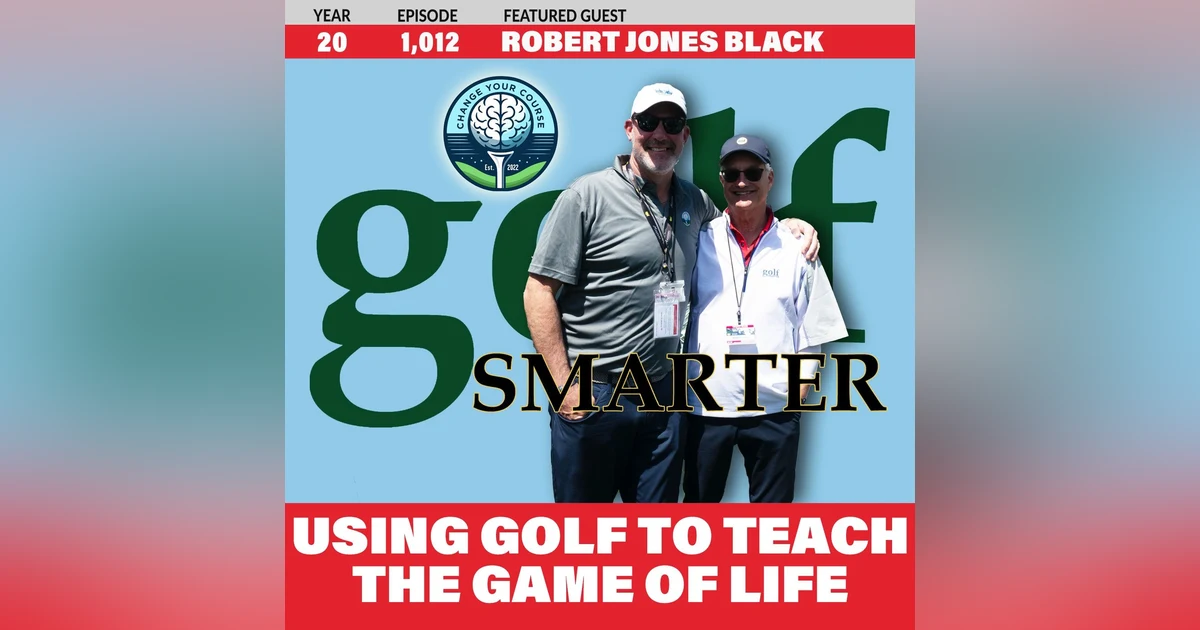
Using Golf To Teach The Game of Life with Bobby Jones' Great Grandson, Robert Jones Black


 RSS Feed
Please check out this article about Fred's golf and podcast journey called "A Lifetime On The Air" that was published in the NCGA Magazine (Northern California Golf Association) recently!
Get more when your visit the refreshed golfsmarter.com!
- Introduce an Upcoming Episode: Receive free gifts for recording a show opening by clicking on "Record Your Show Open Here!" tab on the right side of golfsmarter.com.
- Watch Daily Video Highlights from Our Interviews: Follow @golfsmarter on Instagram, X, Facebook, TikTok, YouTube daily to see our highlights and helpful insights from our interviews on the podcast.
- Post a Review: you'll receive three free gifts when you post an honest review about Golf Smarter the podcast.
- Fill Out a Listener Survey: It only takes a few minutes to fill out our survey, which helps us to better serve your interests in the podcast. You'll receive a free link to Tony Manzoni's video and Justin Tang’s summary of Tony’s Lost Fundamental on pdf!
This episode is brought to you by BreakfastBalls.Golf. Visit BreakfastBalls.Golf for the best quality and pricing on premium used golf balls. Find your favorite brand at half the price of new balls! Use GOLFSMARTER at checkout for 20% off your order!
This episode is brought to you by 5Hour Energy. 5-hour ENERGY Transfusion flavor is available online or in stores. Head to 5hourENERGY.com and order yours today!
Check out "Invested in the Game", a new original podcast from Charles Schwab. This podcast is their way of sharing the incredible stories behind the game. Listen now at schwab.com/TheGame or wherever you get your podcasts.
This episode is sponsored by Indeed. Please visit indeed.com/GOLFSMARTER and get a $75 SPONSORED JOB CREDIT. Terms and conditions apply.
This episode is sponsored by HIMS. Start your free online visit today HIMS.com/golfsmarter and received personalized ED treatment options.
This episode is brought to you by RULA.
0:03 Hi. I'm Joel from Springfield, Missouri and I play at Rivercut Golf Course. Welcome to Golf Smarter. Hi. This is Mike Leggetts from New Concord, Ohio, and I play at JC Public Golf Course. This is the Golf Smarter Proadcast Number one thy and twelve or Episode one twelve. The one everybody knows is the game of golf is like the game of life. You get bad breaks from good shots, you get good breaks from bad shots, but you have to play the ball as it lies. But there's another one that he talks about in the game of golf, I suppose also in the game of life, one must do one's own reasoned and resolute best, whether the prospect be bleak or rosie. As long as you do your best, as long as you have prepared, as long as you have put your time in, as long as your expectations are in right alignment, then whether the outcome is not what you want it or beyond what you want it, you have to be disciplined on how you're taking that approach. And that word reason to me, Fred was the part that everything that we've done in youth golf since I've started this are coming across, and that is coaches, parents, friends, results giving them unrealistic expectation.
1:23 I cannot go out to the golf course tomorrow with an absolute expectation of shooting seventy two if I've never broken eighty. Using golf to teach the game of life with Bobby Jones' great grandson, Robert Jones Black. This is Golf Smurder, sharing stories, tips and insights from great golf minds to help you lower your score and raise your golf IQ. Here's your host, Fred Green. Welcome to Golf Smurterer Podcast. Robert, welcome over.
2:04 Yeah right, exactly, exactly, all right. Take two, Yeah, there you go. Welcome to the Golf Smarter Podcast. Robert. You doing Fred, I'm doing great. It's so great to talk to you. A brief history of how we met, and then why your name is Robert and not Bob or Bobby. So I've told this story. The audience is aware that I went to the Masters here this year twenty twenty five for my first time, and we had these members badges because we were the guests of Charlie Yates Junior. And at one point I'm there with Mac Barnheart, agent for Lucas Glover.
2:47 We're chatting. Boy, my dropping names fast. So we're chatting away but not and Max says, hey, can you get a table? Says to one of the people works there, and they said. Okay, we got to this table. We sit down at the table is already three people at the table, soon. To be four. And we get into a conversation, Hey, how you doing. What's going on? And so the older gentleman, probably in his late seventies, maybe his eighties, and you can confirm this in a minute, he says, Yeah, I've been coming to the Masters since i was fourteen. I was sixteen fourteen. I'm like, wow, how is that? Yeah, I've been coming every year. How this family?
3:28 And I just look at him and give him the hands like, come on, there's more of this than that. Tell me, goes, Oh, Bobby Jones was my grandfather. Wait a minute, your cousin first cousins with doctor Bob. Yes, I am. And so then sitting next to him is one of his sons and his son's wife, and then joining us a few minutes later is another one of his sons, Robert Jones Black. Welcome to the Golf Smarter Podcast. Robert good recount and you and I guess you've got to see where my hike came from, too, didn't you not? Your dad came from? Your brother is My mom is five three and my dad is five eight. I went to six foot five.
4:12 My older brother he capped out at six foot two, but somehow somewhere the height came in. And uh, yeah, I remember we were taking the picture. I was like, don't you see where this came from? So yeah, I shared with a couple of people the picture that I took with the three of you, and they're like, somebody wrote. Back, who those giant people? I don't recognize those people? We were trying to start a basketball team in the seventies, I think. But yeah. One of the things I love about the Masters, I'm on twenty five years. My first one was Ola Fable, and one of the things I like about that particular area is that you kind of have this kind of community sitting and so you never know who you're going to sit down with, and most everybody always is very open to just having conversation. Uh you picked up on, uh, probably a kind of a life trait that my dad has himself and instilled in us, especially in our early stages of young adulthood and everything, and that was we're humble about you know who were related to, and just a nice subtle message. Throughout life of Bobby created or accomplished some really great things, but we did not, So Pete, appreciate it, respect it, and
5:44 and but be humble about it. And that's a you know, it's a tough area to navigate through, especially as you know now I'm approaching fifty. I'm going to turn fifty this year, and then you talked about Bob Jones for uh, you know, you have to talk about it, and you have to represent the story and the legacy and the brand and the brand. That's what I've talked to doctor Bob about a lot. It's like representing the brand. Yeah, I mean, it's it's and I think it's interesting when you historically, when you talk about generation transfer, that second generation the third generation of any company that's a family owned and operated company, that second to third generation is where it starts getting really tricky because one, especially in Bobby's case, that audience that got to see the living and breathing Bobby Jones is moving on. The second generation was able to carry that legacy in the story and get us involved with some really great things. Now my generation and then my son's generation, you're getting away from that tangible attachment. So it's this really tricky way of saying how do you stay relevant and not just become public domain but not also trying to capitalize on what Bobby Jones accomplished. And I think the family has always done a great job of that, and I think it's interesting that that is part of me and the
7:18 cousins that are all in my age group, which I think there's twelve of us. That's the task that we have for the next you know, thirty forty years, is how do you tell this story? Now, we are very fortunate in the fact that every April he has talked about a lot, and then now every August with east Lake hosting the Tour Championship, we've kind of bookended the golf season with these moments of talking about Bobby Bobby Jones, So it helps us a lot to happen. Yeah, yeah, still there, but there's still just that obligation responsibility to figure out how do you keep that relevance And it gets more challenging passes.
8:01 Right, but in your humility aside. There are photos of him behind you. So how did it get to be your Robert Jones Black? Where? How did how did that last name come in to play? Where? How did that move forward? So my my grandmother's my dad's mother was Bobby Jones first born, and that was one of his two daughters. So she she was Clara Jones Uh And she ended up marrying local and actually somebody she knew for a large part of her life because they were in the same neighborhood area of Atlanta. And she was ended up marrying William Black, who went by Bill or Billy. And he incredibly fascinating personality in himself. He had his own story.
8:54 He was very involved with golf. He was very involved with the Greater Greensboro Open for the years that's the title that now the windhom Championship here in Greensboro, North Carolina. He was a big part of that. Great golfer lived his life every single day that it wasn't pouring down rain he was on the golf course. But he had gotten into the car business. In nineteen fifty five, he went to General Motors and asked about franchise opportunities and they gave him the Cadillac franchise in Greensboro, North Carolina. That's what moved him from Atlanta to Greensboro. So, and then they had three kids at my dad and then two sisters, Claire and then Mary and Mary. Unfortunately we lost in twenty twenty. I'm yeah, but that's where we get the black last name attachment to it. And actually it was doctor Bob and I in twenty fourteen or fifteen somewhere around there where I started wanting to become involved with the family business on the Jones side, uh, where he was just kind of like, you know, you really should embrace the full name that you've been given and just go with Robert Jones Black. And I've actually it's it's been again. I'd like to stay humble to everything, but I think it's kind of fun and it's a name that people remember. So yeah, and.
10:23 When you're introduced to someone, you know, I'm Robert Jones Black, it doesn't register that it's, you know, direct ascendant of Bobby Jones. Yes, and so with the family history as it is, and thank you for that explanation. At what point are you is the word indoctrinated as to what the history is and what it means to the world at large beyond just the family. Natural indoctrination to a degree, never a point which again I really like this about out the family as a whole, Never a point of like, you know, any sort of sit down or anything that happened. I think natural. I say natural because as I was entering adulthood post college, just coincidentally, we had the centennial one hundred year birth anniversary of Bobby Jones, and then immediately two years later we had the release of Bobby Jones' Stroke of Genius, which had you know, you know, Fox Theater Atlanta where we did the full red carpet show and all of that, and meeting Jim Cavisio and one of the or the writer and creator of that is still associated with one of our foundations, Bobby Jones CSF Kim Dawson. So I think just in that timeframe was when I really started
11:54 registering obviously being a sport fan growing up and understanding what he had accomplished, understanding the magnitude, I guess, and it wasn't until that mid twenties for me to really start getting that what he did was special, but more importantly, the legacy that needs to be maintained around character, integrity, honesty. All of this was so much more than a record that was made in golf in terms of majors one in the Grand Slam. There was something bigger there and that's ultimately what I attached to. And I guess anybody that would see my golf swing would understand that if I can't attach to the golf game, then try to attach to what he was off the golf course, maybe a little bit more relatable.
12:50 When you were growing up. What kind of stories did your dad share and did he have memories of his grandfather? Did he share them, did some you know, again, he was somewhat quiet about it. I think that Bob Jones, my dad, in that generation, when you're the grandchild, I think you're naturally going to get added pressure and expectations from people because it's still just such a connect. I think my dad was twenty three twenty four when Bobby Jones passed away, so he, you know, certainly went all through childhood. I think they did a lot of like summers visiting in Atlanta, staying at the house and things like that, and you know, just some of the things that my dad would chat casually through was how much of a fan Bobby was with golf and golf, you know, in the sixties, just starting to become a broadcast sport and all of that that when it was aired on TV.
13:59 Bobby not moving from the TV. But my dad, Lissie was born in forty seven and it was right around that time period that Bobby was diagnosed with syringa maelia. So every grandchild, uh, you know, kind of depending on age of when they came in and my dad was the first grandchild. They know him as not Bobby Jones the golfer, but Bobby Jones the syringa maelia. You know, I don't want to say patient, but uh, my dad watched him go from cain to crutches, to wheelchair to complete completely being immobile. He's got a really good master story I love to tell and that will be the nugget that I can provide.
14:54 And let me let me also, since you talked about when your dad was born, let me apologize for saying maybe he's in a I was right. He was. He's in his late seventies, late seventies. Yeah, but yeah, I think absolutely right, and I think that was a good guess. So I don't think he'll be mad at that. I appreciate, Okay, no, no, no problem. My favorite this is And what's funny about this is he told this story. I think it was the first Masters we went to after COVID, so maybe twenty two, so this is a new story for me. But he had a friend there and we were sitting across the tenth tee and we were facing towards the cottages, so away from eighteen Green and everything, and that cottage, one of the first ones by ten t is the Jones Cottage.
15:43 And so he's talking to his friend. I'm like, I've gone to this tournament for twenty two years at this point. My dad and he said, he said, you know, there's a funny story about that cottage. He said, that front room right there. When I came to the Masters, that's where I stayed, and I would stay in the front room. And he said, so one year and he was trying to recall his age, and I'm gonna think it was fourteen or so, based on the timeliness of this story. He said, I'm sitting and I've woken up, and I'm just kind of sitting in my room in Bobby Jones, which they call Bob. I'm sure Bob Jones has talked about that. Bob was sitting in the living room and my dad looks out the window and he sees Jack Nicholas and Jack's dad walking out of the clubhouse walking past ten t approaches the cottage, knock on the door, and in comes Jack Nicholas and his dad. So my dad's like, you know, I got to hang out in my room, can't go out there. And they visit for I don't know, a handful of minutes or whatever it was, and you know, just here's conversation happening or whatever, and then you know, you hear the pleasantries of an exit.
16:56 Door shuts, looks out the window and Jack and his dad walked back to the clubhouse, and it was Jack Nicholas telling Bobby Jones that he was going pro And my dad was sitting in his bedroom sitting there watching or hearing this take place. And I was like, how in the world have we come over twenty two years the first time that you're going to share that story. But I think it just shows that my dad, traditionally he's just a keeps to himself type individual, very smart business guy. He's had an amazingly successful career. He continued the car dealership piece. We're still doing that now, my sister and brother in that business, and then other ventures that he took on along the way. But he just I think, likes to keep some things very personal and to himself. So it didn't surprise me. He had never shared the story, but I found it. I was like, that was such a monumental moment in golf history because Bobby did not want Jack to go pro yet. Really, yeah, because Bob was an amateur.
18:06 He was really promoting the idea and loved the idea and as soon as the whole concept of and I'm just from what I know talking to doctor Bob, is that. He didn't, you know, he didn't want to go pro. He retires at twenty seven and becomes an attorney. That pro was not that era, but Jack Nicholas kind of changed things. It did he did, and that was see it. You're right because his early sixties I think it was sixty one sixty two where Jack went pro I think, And yes, the purses and the sponsorships and all of this stuff that we see didn't exist then, So you could see what Bobby Jones, you know, kind of argument would be there, and I think Jack needed one more US amateur to tie Bobby Jones. Might need to check that for me, but it was something along as one one more with ty Bobby Jones, and he wanted that, so he did not like seeing Jack go you know, pro on it.
19:10 So but anyways, it was to me a fascinating story and I think, uh, my dad's experiences growing up and everything. Again, when when Bobby Jones is for the most part not able to move and not able to you know, go outside and hit golf balls with his grandkids and all that, you would imagine that being the story. But unfortunately, because of Serena Maelia, it just wasn't very stationary. So it was a lot of conversation. Yeah, they all say Bob and my dad. They also talk about how incredibly smart Bobby Jones was. It's no mistake about the accomplishments he made in education. He was a smart guy.
19:50 Yeah, yeah, he figured it out. And is there conversation, you know, beyond the foundation. I'm not sure how many cousins you have in your generation. Doctor Bob and your dad are the same generation, but your generation may have even more and is there every conversation about the maintenance of the legacy and the promotion of the brand. Well, the short answers yes, and thankfully we still have you know, a fair amount of youth in that that second generation, you know, ranging from maybe early early sixties as the youngest to to my dad being the eldest at at seventy seven. So, you know, I think what we look at and again it goes back to every conversation of every family business you talk about generation transfer, but in trauma. Yeah, but yeah, I mean it's like right now, most of the activity that's being done and the work being done, they're still able to manage. And so what I felt like was a really nice gesture, if that's a fair way to put it, was I expressed interest in twenty fourteen to get involved with the commercial side and did that for a number of years, and it was nice to just kind of see what
21:21 the decision making process was, how we look at it. But what I really got out of that is the protection that the family provides to the legacy itself. It is incredibly tough to match in like a licensed commercial sense. So you know, if it were a product that came out of the you know, the next great golf gadget or whatever. That they made sure that any partnership we had was really reflective of the standards that the family wanted to maintain around the name. And that was such a neat to see that it was it wasn't just taught that. There was constantly things being presented that immediately the family goes just that's not the fit, that's not the opportunity, that's not where we want to see the name.
22:14 And then I think probably the hardest thing to fill next generation is especially Bob Jones' ability to tell the stories. He knows it inside out, and he's a very good orator. I mean, he's just so good at speaking. Oh yes, so tough to fill that. It's like, you know, that's you know, how does that with the next generations. But we're a small family. I mean it's still, like I said, I think it's twelve that are in the third generation, so it's it's still a very manageable size, so that if and when we transition to a new generation being part of the company, it won't be inundated with thirty forty fifth he cousins. It's still going to be a very manageable name.
23:08 I need I need to apologize. I feel kind of weird. You know, I talk about the brand and here's Bobby Jones, who is such a strict promoter of amateur golf and you we are talking about a brand. He probably wouldn't be too happy about the way that's being discussed. My sense from you know where he came from and what he stood for. Well, and I think again that's not inaccurate. And the first opportunity, I don't know how many people know this was actually Eli Cowaway, uh oh and this is this is uh. In stories for you on that one.
23:49 Go ahead, Yeah, but yeah, Eli, he had come across a signature of Bobby Jones that was written as Bobby, which was incredibly rare because Bobby always signed his name as Robert. But he presented it to the family and I think at the time it was my grandmother and said, hey, there's I have an idea to create a golf line and I want this signature to be the mark. And but nobody this was like eighty eight eighty nine, I think when the first meeting took place family, nobody really knew what licensing was at that time, so it was not very well accepted. But to your point, the biggest hurdle from the family and from my grandmother especially was I don't think Bobby Jones. I don't know if he would be supportive of this or whatever, but I think one of the best things that the family did was to be able to recognize that the most important thing we can do is keep his name relevant, and what a better way to do it than put it onto a golf club. And so they did end up doing the deal, But that was actually our early education of name image and likeness as everybody knows it today because thank college sports, but name image likeness and how that is how that is done. I tend to want to
25:20 think that Bobby was also very innovative, you know, from the work that he did with spauling to go from the hickory shaft and to steal and things of that nature, to me was showing and even the development of Augusta National that he wanted to continue the growth of the sport and popularity of the game and make the game easier to play. So I feel like that there's if he looks at today's world and sees the mass amount of name recognition and licensing that takes place that he would be accepting of that fact. So but again, I think as long as we're doing things associated with foundation work, community works, scholarships with Emery uh and and all of those things that we are involved in, it's a nice balance.
26:16 And everybody wants to celebrate Bobby Jones. So yeah, So what happened did Callaway? I mean, because there were the Bobby Jones line of clothes and clubs and everything, But did Callaway? Is that the old hickory stick stuff. It was a little bit of that that he was doing initially, Ultimately it was big Bertha. Oh okay, big Bertha took off. Look at this. You're not going to believe this. I'm holding up a putter right now that has Callaway on the on the handle, and we've actually talked about this a couple of weeks ago on the podcast. This is this putter is called the Purest Steelcore Hickory Stick USA, and on it is a signature that I'm not sure if you can read it, but it says Tony Manzoni, Honey, yeah, do you know if Tony Manzoni, So, Tony Manzoni talk about full circle, Tony Manzoni and Richard Parente, who grew up together playing golf, came up with this idea for this golf club and they needed an investor, and they contacted Ellie Callaway. And we've heard this story recently, mainly because Jeane Parente, who's still in the golf industry.
27:48 It was his dad. And Tony Manzoni was an amazing coach down in the Palm Springs area and was on the Golf Smarter podcast at least a times and every and he was such a great coach that his team that he coached at College of the Desert Community College won twenty nine regional championships in a row, won national champions and whatnot. So anyway, Tony Manzoni, it's like the only place you can find anything about him is on Golfsmarter dot com. But the point is is that handmade steel core hickory stick by Richard Parente. Tony and Richard they called Ellie Calloway and said, we have this golf club we want to start and we need an investor. And he looked at it, Calloway looking at no.
28:38 No, thanks, that's fine. And then weeks go by they couldn't find any money, and once again they call him, give it one more try. Let's give it one more try. Manzoni does, and Callowy said, I'm so glad you called because I'm interested. So let me talk about calloways starting full circle And here we're back here with it. The book coming out of about Callaway's story. All right, So that's Nicholas Calloway, his son. I was introduced to him soon after the PGA show this year. And it's actually next week and I'm sorry, I don't have the title in front of me, but we're recording.
29:19 We're recording this in May, I mean in late April, so next week. That means the book is probably already out. The book. Yeah, the book is out, and if if it has not been found, I am really anxious to read this because what Nicholas did was he actually was able to find memoirs written by his dad and he just kind of transcribed what those were saying into this incredible career story. And he had an absolute, amazing fascination and relationship with Bobby Jones. Now it's factually, but I don't know to what degree that they are distant cousins, so they are related in some way, shape or form.
30:11 Wow. But when Bobby Jones won the Grand Slam, Ellie was a child and his mom kind of looked at him and said, Hey, that's a that's a distant relative of yours. And he forever followed Bobby Jones. And the book ends Nicholas shared with me, like the closing paragraph and it's all about Bobby Jones and what Bobby Jones taunt Ellie Calloway in terms of how to be a career person and work with you know, character and all this stuff. It's it's really fascinating. But one more thing on this that I'll share. Uh, they invested in AI technology. So if you get the audio version of the book, it is Ellie Calloway's voice narrating the book.
31:03 So but I did not know for voiceover announcers. No, what are we getting into? What are we getting into a whole other conversation. But I was like, that's pretty fascinating to have his dad's voice read on and generated to read this book that ultimately most of the words are at least words amazing. Yeah, that really is remarkable, And yes to the Gulf Smarter community, that book. I will track it down and we will talk to Nicholas. Nicholas wrote the. Book, right, yeah, so's yeah, yeah. Okay, We've got to get him on the show and talk about this.
31:44 I'll get you guys. Family History Week here on Smarter. Definitely suck. I'm curious to know. The I guess to put it this way, the ball's in your court, your son and the next generation. How is it that you are going to. Impart the legacy of your family and what it means to not just your family but the greater community at large, and how you are supposed to carry yourself. Yeah, I'm curious is how.
32:29 You deal with that? Now? Well I think you said your son is Bobby. Yeah, yeah, so Bobby is my son and ten years old. And uh still a little young, but. Yeah, he's getting it and he's been. He that was his third Masters this year, so he's got a head start on me. I don't know if that'll That's why I keep trying to say to my I don't know if that's going to be an annual thing. But because of being a junior and everything, and and not to jump off track, but I think it's very important and be fun for listeners to know the way the Masters handles young kids that are out there is unbelievable. They I'll tell this quick story his first time on the property.
33:19 We had not been on the property for two minutes and we're walking by the putting green and it was Scotti Scheffler, Max Homer, and an Amner at the twenty three Masters. And so I said to Bobby, was like, hey, come up and get on this little rope line because they're about to walk from the putting green to the first tee. And so Bobby gets right up on the front line and one of the stewards, you know, yellow hat guys ye looks at Bobby and he goes, hey, you want a closer look at this? And Bobby kind of looks up at me like am I allowed to do this? I was like, go, yeah, not knowing who the kid is, not knowing who he is none, what's just random child at the time, eight year old kids sitting there. Took him under the ropes, took him not to the first tea, put him on the first tea.
34:10 You know they have that umbrella that sits back there. Put him right by the umbrella and let him sit on that first tee to watch Scotti Scheffler, Max Hooma and the amateur t Off, they will if they see kids at that tournament, they make sure they get to the front. It's absolutely unbelievable. So I had to share that first, and then now to answer your question, I think that it is tough, and I think the unknown piece of the future is what does the relevance, what does the name have in terms of muscle and strength when we get to like twenty forty and twenty fifty, which just wild that those years even are coming out of my mouth right now, goly, But I think one of the benefits that we have is that history is allowing us to really kind of ride some momentum that hasn't been there for a number of years because we're hitting these centennial moments. So he started his majors wins in nineteen twenty three, so you have from nineteen twenty three or twenty twenty three to twenty thirty. You've got a natural ability to talk about the success that Bobby Jones had on the golf course, and so I think that gives us a very nice runway. And of course twenty thirty that's the centennial of the Grand Slam, So
35:41 no mistake that Marion will be hosting the US Open in twenty thirty and Bobby Jones completed the Grand Slam on the eleventh hole of Marion. So I think, you know, from my standpoint, I have the nonprofit that I started that has a dual purpose, and part of that purpose is to provide some modernization or value to tomorrow's story of Bobby Jones. That's a tough thing to do, but I feel like that's was probably the fairest and safest thing for me to do at this point. Again, the generation that's our leadership right now, the cousins that are all involved with the day to day decision making, hopefully they get, you know, a nice long run of that.
36:33 And then I certainly am now with the amount of time I'm spending in the golf industry, very aware that I am much more upfront representation than I was three or four years ago, which is flattering and honorable and all that, but it also, you know, gives you a little bit of heartburn that you're just kind of like, I want to make make sure that I'm able to maintain the standard that my dad's generation is being able to maintain. So I think on the short term like the ten year run, be asked or do what I'm asked to do, continue the build of what I've created that certainly honors what Bobby Jones did. And then I think once we get into that twenty thirties and twenty forties, we'll just kind of see. But we've got I think we'll say I'm almost fifty and the youngest maybe twenty three now out of our generation. So we have a nice, you know, nice expansion of age that can always be representing the story. We just got to make sure that there is value to it beyond what the Masters delivers and Tour Championship at East Late delivers. But those two, again, they're forever instilled. As long as those tournaments are taking
38:04 place in hosts at those areas and those properties, we're going to be able to talk about Bobby Jones every year. Well, thank you for opening the door, because the reason that you're on the episode today is when you sat down at that table, you know, inside the Ropes under the umbrella. I don't know what it was, but I overheard, you know, you were sitting to my left with Mac in between us, and you said something about I want to be on golf Smarter, Like, wait, you just said, how do you know about golf smarter? What's going on here? And we got into the conversation and you were telling me about your nonprofit that you've started, and that's why you were invited. So thank you so much for the first half hour of conversation being about your grandfather. I'm so fascinated by it, and I just love the family connection and I really appreciate you sharing as much as you have. But let's talk about your organization because I did find did it fascinating and wanted to help to promote it with you.
39:04 Thank you, Like should we talk about that or should we talk about Mac? Because he stole the show that day anyway, Like we all got home, we're like, did you hear all those isms? That? But Mac is Mac was working hard, man, he was He was amazing and it was just and it's like I got to hang out with Mac for a couple hours just watching him do his thing and it was amazing. Yeah that's uh, that was my first time meeting him. But uh, but and he has a Again, I thought the conversation that we were having with Mac around the subject area the nonprofit, I found it to be a very refreshing and kind of different perspective in point of view. But yeah, So in twenty twenty one, I started a nonprofit called the Generation Next Project. It was a very reactive decision, you know. The twenty twenty for me across the board was incredibly difficult. I was in production, live event and licensing business. Beyond Bobby Jones, I was working with a couple other athletes, and so when twenty twenty did its number in terms of shutdowns and the just absolute annihilation of anything live event or production, my business, unfortunately, was massively impacted by that. And what made it worse unfortunately,
40:37 was I have a wonderful business partner. He is one of my seed investors with my sports marketing group. And April seventeenth, during the peak shutdown, this was when it was hardly you could even not even really go to the grocery store. His twelve year old son, four day shy of his thirteenth birthday, took his own life, and it was shocking, jarring everything about it. And I will saying I don't say this a lot in interviews, but I think one of the things that was looking back on it, it was really interesting was my business partner's name is Brad Hunstable. It was Brad's response, I think that really started kind of putting some of the early roots about the nonprofit that we'll talk about in a second.
41:31 Brad's a West Point grad Ohio State, NBA, built a technology company that was really one of the early impactors of increasing bandwidth so that you and I could do what we're doing right now online. And he actually originally created his technology for military use because Brad was the last west Point graduating class pre nine to eleven whoa so he did not have to go to duty. Every class following Brad out of West Point, these guys were going and having to do tours in Afghanistan and Iraq both.
42:13 So he started technology that increased bandwidth so that families could have satellite conversation, and that ended up migrating into sports. He ended up getting Fox Sports, he got Masters, I mean, he got some great contracts or contracts, and sold the company in twenty sixteen to IBM. So he's just this just a very smart, successful, driven guy, and he suffers this tragedy of unimaginable pain, and two weeks or so after he buried his son, he's on the phone with me saying, how do we do this where this doesn't happen to anybody else? And I was like, I'll say, I don't know. What do you want? He was like, I want to get out, I want to voice, I want to get big, I want to go fund me, I want a foundation. So I initially challenged it and said, don't you think right now is the time for you to just be with family and mourn, And he was like, not what I want to do. We raised through go fundme a pretty substantial amount of money. He created a documentary from it very quickly. He actually had a video that he created on Facebook Live that to this day and this is no joke. It's been I think it's over one hundred and seventy million views. And he ended up getting He was one of the early early voices when we were fighting over not fighting, but all the
43:47 discussion about the vaccine. So that was taking media coverage late twenty twenty into twenty twenty one. What we knew and what the experts in child psychology knew was this pandemic just threw gasoline on an already burning fire with youth mental health. And he was one of the first to be able to break into the news cycle and get some interviews. And what was shocking, and I've never talked about this in this way, Fred, what was shocking to us at the time was we were sitting there. We had a PR guy out of DC that was doing outreach, and he was hitting all the big networks and Washington posted everybody. Nobody wanted the story. It was all about the vaccine, and it was all about the election.
44:39 Nobody wanted the story. As soon as that vaccine came out, and as soon as it started getting mass distribution in twenty one, all of a sudden, the story started coming out. These schools being shut down, what's the impact, look at the suicide rate, look at therapist's office getting inundated with parents saying, my kids are not who they were six months ago. So in all of that, and I hope I didn't go long on that. I am processing myself, and it was I think it was like winter, like late twenty twenty, and I was looking through I was actually kind of paging through down the Fairway that Bobby Jones wrote nineteen twenty seven. And I don't do this.
45:25 I don't pick up my great granddad's books and just read them. It was just an impulse maybe passing time, and I kind of started seeing some of the things that he was referencing in the book. And then I went back into the numerous quotes that I've acquired over time and that you can find on just by googling Bobby Jones quotes, and I started seeing like this pattern in this message. And what I saw was that Bobby Jones, with that intelligence that he had, really understood how much golf was teaching us about life and even vice versa. And he did not have a mentally easy time with his fame. And I do think, and I think Bob Jones for would agree, part of the contributing decision making of nineteen thirty retiring was exhaustion of trying to live up to the sports world's expectation that he never wanted to have anyway, he just loved the game. But I'm looking at the quotes and I have this idea that hits my mind, and I'm like, all right, I need to talk to a sports psychologist about this. And I got introduced to a sports psychologist out of Chicago who was at the time and maybe still the sports psychologist for the White SOX and he took my call and
46:58 I said, you know, kind of explain to them the whole situation. I said, I'm looking at this idea and I have just a couple questions to ask you. He said, fire away. I said, all right. Question one, are there specific mental and emotional responses that take place on the golf course turn around the golf yes? I said, okay. Question two, Are those exact same mental and emotional responses also found in the course of real life? And he kind of giggled and said yes. And I said, all right, Question three. If I were to take a young golfer and show them those specific mental and emotional responses on the golf course and teach them how technique and discipline how to work through those, could they take that exact same technique and discipline and apply it to the real life situation that's creating the same mental and emotional spots.
48:01 And he's just kind of laughed and he said one hundred percent. He said, that's called experiential learning. So that took me to a six month process of creating a five oh one C three, launching the concept, starting to build a team. I was later that year introduced to Carla Steingraber out of also out of Chicago, and we have now created a program called Change your Course and this is what we're doing. We're literally going to golf clubs, organizations, tournaments, whatever, college teams, anything, because the age group is twelve to twenty two years old, and we're identifying these situations that these kids or young adults are going through on the golf course. We're using that as the communication tool to say, where do you feel like this in real life? And how are you addressing it in real life? And if I can, if I've just showed you out to work through first t jitters, can you take that same practice and use it when you have your class presentation next week or when you have your job interview.
49:16 This is all falling into place for you. It's beautiful. I'm really fascinated. What was the quote that jumped out of your grandfather's book, great grandfather's book that made you see the parallel and an opportunity. It was a series of quotes and my favorite, favorite favorite, and I wish I had it in front of me. It's not now. The one everybody knows is the game of golf is like the game of life. You get bad breaks from good shots, you get good breaks from bad shots, but you have to play the ball as it lies. And that is by far that's the universal one.
49:58 But there's another one that he talks about, and I'm trying to in the game of golf, I suppose also in the game of life. I'm trying to think how it goes, but it essentially it says one must do one's own reasoned and resolute best, whether the prospect be bleak or rosie. That one shook me or just got me where it's in his intellectual way of saying something with the word selection he used, but doing one's own reason and resolute best, whether the prospect be bleak or rosie, as long as you do your best, as long as you have prepared, as long as you have put your time in, as long as your expectations are in right alignment.
50:56 Then whether the prospect the outcome is not what you wanted or beyond what you wanted, you have to be disciplined on how you're taking that approach. I found that one to be so monumental, and I'm sorry that I didn't put it all together, but it's that's the core. Once he introduces it is that is that message reasoned and resolute best, And that word reason to me, fred was the part that everything that we've done in youth golf since I've started this, this is the biggest thing that student athletes are coming across, and that is coaches, parents, friends, results giving them unrealistic expectation. So that word reasoned and resolute best I translate that as you you as long as you're being realistic with yourself. So I cannot go out to the golf course tomorrow with an absolute expectation of shooting seventy two if I've never broken eighty. But you have this of all the things that were addressing through the program, and parents are a big part of it, what we're having to really unfold and uncover and dissect is this kid has a completely disconnected expectation and he's
52:27 not or she's not going to be able to accept the bleak outcome. They're only going to be able to accept the rosy outcome. And I think that one, to me was where seeing how we've developed the program and learning. I mean, I went into psychology one oh one when I decided to do this, but this was the one where I was like, this is so treatable because all this is is creating anxiety and depression and letdowns and all of these emotions based off of someone's expectation being aligned with their ability to do their reason and resolute best. Do that makes sense? Yeah? Powerful? Yeah, very powerful. What age kids are you working with?
53:11 So we really right now we're focusing on twelve to twenty two, mainly because a lot of these issues that tend to be compared from the golf course to the real life situation our adolescent and young adult issues. It's also where the numbers are staggering. But we also know that the best way that you could get really into this is start the education process at eight to ten years old, So I think that'll be like a phase two for us. However, our solution right now on that is, let's start talking to the parents of the eight year old, nine year old, ten year old golfer. Don't worry about educating the golfer yet. They're not mentally developed enough to really understand how dis ruptive their mind can be on their trajectory towards adulthood. But adulthood, but their parents are.
54:08 And it's a lot of times we're not intending to misalign or misdirect our child. God, we get so in the moment, and we're so even ourselves. We care so much about what other people think, much more so than twenty or thirty years ago. So little Johnny at eight years old has to start winning these golf tournaments. That's where you start seeing the problem. So if we can get to the parents at that age and then let the kids take on the program when they hit twelve years old, that would be our win. Amazing. And so the change your course curriculum. What kind of training does your educators have to go through on that?
54:54 And are you using PGA professionals to do this or are you using teachers or psychologist? And what's your recruiting process. I'm sorry for three questions in a row, but I. Think it's okay. And that's the beauty about this year is last year in twenty twenty three, we ran programs and predominantly that was me and Carlo stein Graber, the psychologist, and then we would have a PGA professional. In a couple of situations, we tried it without golf presence because I got to one point where I was like, they're getting so consumed with the golf result, I didn't feel like we were getting the life message. So I said, let's remove a golf instructor from the program to see how it does. And it did well. But to the question last year became how do we take this from hitting one hundred and twenty kids a year to getting this into the thousands, which is the question behind that is how do you scale? And what we have created it is a certification program that someone can train themselves into a club, can just hire us in for a day long program, let their instructor participate. If the instructor likes how the program works and what they want to do, they can get certified, pay a license to the nonprofit and they go and run the program we have. I'm
56:26 so excited. On the talent side, I'm so glad you asked it. So the first moment that I went this is this is actually true? This is coming true was last September a fundraiser that we did up in Chicago, and we were fortunate to have one of the participants as a member of Madina, and we asked that participant if they could possibly get someone out of the golf group to come and just hear the story. And see the message, see the program. And that was Eva Rogers. And Eva is an instructor at Madina. She's a top fifty golf digest. I mean, her accolades are just unbelievable.
57:11 She actually taught Onnica's kids how to play golf because she was down at Lake Nona before Madinah. Once I saw Eva engage and then you know, kind of going through the fall of last year, going I hope we don't lose her, but the opposite happened. She started providing us incredibly value, a valuable input. She's created some of the drills and exercises, which is a tough thing to do, Fred if you think about it, coming up with a drill or an exercise to practice chipping, practice, putting high chips, pitches or whatever. That's one thing when you're trying to work on the mental game, you have to find a way to simulate that emotion. So my example of that would be, first tea jitters, which is nerves, that's heart rate, that's out of breath, that's sweat. I'll give everybody this one for free. Do calisthenics on the driving range. Get your heart rate up, run up and down, get anything going walk up to that ball and hit the drive.
58:16 And if you do that repetition, repetition, repetition, do three drives every time you're on the driving range. In that situation and having your body get comfortable swinging that golf club, you're going to be so much more effective addressing those jitters on the first t of a Tournament's amazing. It was things like that that Eva brought in. And then we've also got we've got a golf committee and another really well represented PGA certified professional, Nick Bova out of Hamilton Farm and Nick. Curious, does your program as you change your course program, does it compete or come lament First T.
59:03 Uh. This is a really it does not compete. Definitely a compliment. But what's really neat that I learned through communication with First T and then the First T chapter here in Greensboro, North Carolina. First T Central Central Carolina's the CEO, Ryan Wilson, was actually down at First T Corporate. Before he came up. He introduced me or notified me that they have a part of their program called Bridge to Life. So they'll end a lesson and they'll ask the kids, now, with what you've learned today, how would you apply it to life? And he said, and then that's kind of it. You get them to recognize that, you know, they're learning manners and they're learning, you know, take your hat off in the building and things of that nature. He was like, you're picking up right there.
59:51 He was like, it's just natural. We're not here, and I don't mean to be so blunt with it. Our objective is not to put the golf club in someone's hand. Our objective is, if the golf club is in someone's hand, and I don't care if they're a twenty five handicap or a plus four, is how can you use this sport you love to better off the golf course. So what we say is we are delivering a program on the mental game through the game of golf for the game of life. I love that your golf game is going to get better, but what I care about is how are you performing and how are you changing how you're living your life off the golf course. That's what we want to see.
1:00:36 The result on incredible. How do people find you online and social media stories? Where do we find more? Generationnextproject dot org is the official website we're most active. We use Instagram the most that I'm aging myself on our TikTok lack of TikTok present, but I'm sure we'll add into that as well. But our Instagram handle is Generation Underscore Next Underscore Project, so we'd love to have some followers there. But the official website is the best place we have all the information. There you can learn more about the actual content and what a one day program looks like, what a two day program looks like, et cetera.
1:01:25 And the website is Generationnext dot. Com, Generationnext Project, dot org. Yeah remember yeah dot org. Okay, Robert, thank you so much for doing that work, first of all, and for and I wish you all the success that you can reaching the people that you need to reach and the children that you need to reach and the parents hopefully they'll understand it too. But I also really. Touched and really moved by your family story and. How you're carrying the legacy along. Thank you so much. Well, you're welcome, And let me just say to you also, congratulations on the amazing work you've done. I know you are surpassing a thousand episodes, which I can't imagine what that means to you. I think that when I was introduced to you, and I already knew about the Golf Smarter brand. It's such a natural thing to talk about.
1:02:26 Golf is such a challenge and the parting Bobby Jones quote the most important distance is the five and a half inches between your ears, and you have a whole podcast about it. So good job and congrats on surpassing on thousand