When Staff Thrive, Communities Thrive: A Nonprofit Wage Revolution
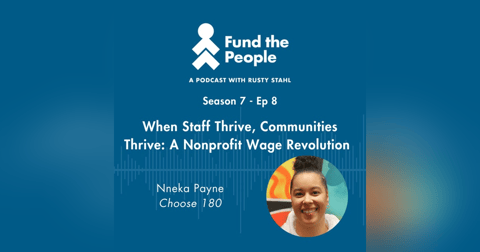
In this episode of the Fund the People podcast, host Rusty Stahl interviews Nneka Payne, Executive Director of Choose 180, a Seattle-area nonprofit that transforms oppressive systems and supports young people's healing and development. Payne shares her personal journey from experiencing the juvenile legal system firsthand to leading an organization that provides alternatives to prosecution and incarceration for youth. Choose 180 has grown from one program to eight, expanding from court-based diversion to include mental health services, gun violence prevention, and other support services.
The conversation focuses on Choose 180's groundbreaking decision to establish a minimum salary floor of $70,000 (now $73,000) for all employees, up from previous wages that hovered around $45,000-$50,000. This transformation occurred rapidly - within 4-6 weeks - during the pandemic, driven by staff advocacy and leadership's commitment to addressing financial stress among employees. The organization worked with compensation consultants and engaged their board to make this significant change, despite the uncertainties of nonprofit funding.
The results of this wage increase have been transformative for both staff and program participants. The organization has actually grown its staff from about 20 to 32 people, while maintaining strong program outcomes. Choose 180 has also expanded its employee benefits to include wellness stipends, homeownership education, and other resources. Nneka emphasizes that when staff aren't burdened by financial stress, they can focus more fully on serving participants, leading to better outcomes and stronger community impact.
Bio: Nneka Payne
Nneka is a relationship-focused and mission-driven leader who holds a dynamic background spanning a decade across community-based organizations, human services, and the legal system. Rooted in her firsthand experiences with the King County juvenile legal system, the mission of CHOOSE 180 is deeply personal for her. She has witnessed how the strain between systems, processes, and people create significant gaps and limit opportunities for young people and is committed to eliminating those strains and identifying possibilities.
Links to Resources:
Contact CHOOSE 180 (206) 457-8940
FTP Podcast episode Talent Matters Remix, Part III: Culture of Care - with Michele Booth Cole
FTP Podcast episode Compensation Philosophy for Your Nonprofit - with Mala Nagarajan, Vega Mala Consulting
FTP Podcast episode Getting Retirement Right – Tips for Nonprofit Employers - with Chitra Aiyar, Just Futures
Go to our website for a transcript of this episode and links to the resources discussed in the episode. You can find all the episodes of this podcast plus our blog, toolkit and other resources on our website, fundthepeople.org. And we invite you to learn from all the amazing past guests of Fund the People - A Podcast with Rusty Stahl at fundthepeople.org/ftp_podcast.
00:00:04:08
INTRO
Welcome to the Fund The People podcast. I'm your host, Rusty Stahl. I'm president and CEO of Fund The People where our mission is to maximize investment in America's nonprofit workforce. We give funders and nonprofits cutting edge ideas, research and tools to help drive equity effectiveness and endurance in the social sector. So let's start the show.
00:0:33:07
RUSTY
Welcome to the show, everyone! On this episode, you'll learn from one community based nonprofit that has set a floor on wages for all employees to ensure sustainable jobs and better working conditions. You'll hear why they did it, how they did it, and how it's going. Our guest is Nneka Payne. A relationship focused and mission driven leader who has a background in community based organizations, human services and the legal system.
Nneka serves as executive director of CHOOSE 180. CHOOSE 180 is a Seattle area nonprofit that transforms oppressive systems that have caused harm and assists young people as they heal from hurt to wholeness. As a diverse team with lived experience, the CHOOSE 180 team is uniquely positioned to serve young people from a place of understanding and trauma based care.The organization views young people not as problems to be solved, but as possibilities to be developed. Nneka Payne, thank you so much for making time to speak with me and welcome to the Fund The People Podcast.
00:01:44:18
NNEKA
Thanks Rusty. Thanks for having me. I'm excited to meet with you and have a great conversation today.
00:01:50:01
RUSTY
Well, I appreciate it. It's fantastic to have you here on the show and I've been trying to learn about your organization from afar. I first heard about it through, I think, some press coverage about what you all had done around wages and was excited to see the story a little bit. And I really wanted to learn more and share the story with our listeners, the nonprofits, the funders, and the intermediaries who listen to this show.
So, before we dive into the story of CHOOSE 180 and how you're investing in your staff team. It would be awesome to start with you! Tell us a little bit about what motivated your nonprofit career, are there particular moments or experiences that sort of started you in this direction and what got you into your current role as executive director of CHOOSE 180?
00:02:45:23
NNEKA
Yeah, you know, it's interesting, Rusty, whenever I get this question, sometimes I'm like, who am I? Where did I come from? So, I love the question at the same time my mind goes blank. But, you know, I began my career as a paralegal, really working with individuals who have been, you know, historically oppressed and harmed, to really work with them, to navigate the legal system and overcome the many social factors, that in a lot of ways our young people also experience, that have been contributing to really pushing them further in a rut.
I mean, honestly, this is where I really came to realize just how strained the relationship between processes, people and systems really were. And they're all independent, but they all need to work together and they have a hard time working together. It is the thing that I consistently came back to. And so, you know, I would say it was during that time, being a paralegal that I realized it should not have to be this hard for folks to just establish a safety net or even to survive, you know, whatever survival looks like to folks and not even survive, thrive, you know, that even at the most basic level.
And so from there, it was really clear I needed to dedicate my life to, you know, my professional journey and my life to dismantle that, to disrupt that. I often say I love making good trouble, and this is exactly what I knew I wanted to do for the rest of my life. So I've had the honor of working for, you know, various organizations in the nonprofit sector and also in the government sector, and really to focus on the pathways for individuals who specifically look like me, you know, who are navigating complexities of very rigid processes and unjust systems, you know, both internally and within the scope of direct service, and what does that look like to achieve success. And so I knew early on that my purpose was in service to my community, to my people. And I knew early on that that's how I was going to dedicate my life, period.
But what got me here specifically at CHOOSE 180, you know, it's really on a personal note, if I can be honest, I've been a fan of CHOOSE 180 for a while , but what drew me to the role and the capacity of the executive director, like I said, was on a personal note, you know, I've encountered the juvenile legal system twice in my life, once at 11 and then again at 16. So I was pushed through the system, it lacked resources, it was quite the process for myself and for my family. And ultimately it left me with an image of who I was as a young person. And what that image was, was telling people, I'm a bad kid, don't invest in me. And so this really created, I would say, this kind of chip on my shoulder that has become my biggest asset in my life, period. And it allows me to zealously, I think, advocate for our young folks and be the type of servant leader that I believe I am for our community.
And so it was at that time, though, where I knew that I wanted to, again, jump into this role and start to be committed to transforming these systems from a different perspective, from a youth perspective. And so when the opportunity to come along and offer what I can bring to the table for this phenomenal organization, I was both humbled and hungry for it. And so there was no CHOOSE 180 when I was younger. And for me, I want to play a hand in just really ensuring that that's not something that anyone else ever has to say.
00:06:07:03
RUSTY
That's incredible. Yeah, when you have those experiences and you see what other people are going through, that's the same thing and you see the difference between no support system available and then an organization like this available, that makes a lot of sense. Well, thank you. Thank you for sharing that personal journey, I appreciate it. And I'm sure people are now excited to hear about what CHOOSE 180 does. So tell us a little bit about the mission and goals of CHOOSE 180.
00:06:37:02
NNEKA
Absolutely. This is my favorite part of my job, to be completely honest with you, is talking about the work we do, so CHOOSE 180 sees young people as possibilities to, you know, to be developed and not problems to be solved. And we really believe when we can all come together, we can change the narratives around young people, intentionally advocate for system change -lasting system change- that's key there, and create a future where resources are invested into the communities and young people have the opportunity to thrive, not just survive, right?
And so our goals and like our mission and our purpose really are boiled down into three critical areas of our work at the individual, community and the system level. And basically, when we take a look at that, starting with individual, it's about meeting our young people where they are, you know, whether that's in the jails, whether that's in school, whether that's in their community, whether that's at a Panera. We're going to meet you where you are, how you are showing up. And then equally important, we're going to support their growth by identifying and providing the necessary resources that they need to allow them to grow and step into the pillars of a safety net that they can create and really start to see them for the person they are and not the action that they did.
And the next thing that we do is at that community level. And so becoming more unified as a community and building relationships between communities and system partners and neighboring counties, you know, we will have the power to sustain that support for our young people. And it's an investment back into our community. I often say investment in our young people is an investment back into us. And so it's a no brainer.
And last but certainly not least, you know, part of how CHOOSE 180 is able to do this work is from a systems perspective. We, you know, the systems aren't broken, Rusty. A lot of times folks are like “The system is broken, the system is broken.” It was created like this. They are simply made that way. They are punitive, they are harmful in many ways, they're racist in some ways and so we have to strive for system transformation that is humanizing, that's restorative, that's anti-racist and led by the communities that we serve. And so, when we do this work, we lean into those pockets of work, that individual, that community, that system level. And, you know, essentially, you know, we work to dismantle those systems and uplift our young people. And switch that narrative of the thing they did to who they can become.
RUSTY
That's really powerful. So Nneka tell us more specifically about some of the programs and activities that CHOOSE 180 offers.
00:09:18:03
NNEKA
Yeah. So we currently have eight programs that are really rooted in prevention, intervention and diversion based work that all run with the restorative based curriculum that our team has actually developed. And so more specifically, though, we have gun and gang violence prevention program, where we work with youth and young adults impacted by gun and gang violence or just overall violence who are at risk of or currently impacted by it.
We also have a mental health and counseling program, really offering at no cost art therapy and counseling sessions for youth and young adults. And another one of our programs is our school and court based diversion programs really designed to disrupt that school to prison pipeline and really lean in to creating the alternatives to jail, rather than prosecution. So those are just a few of our programs, but those are probably our most notable ones and the ones that a lot of folks reach out and do referrals into.
RUSTY
And you told me earlier that you started with one program and now you have eight. What was the first one?
NNEKA
Yeah. So our first program was our court based diversion. And so essentially and we still have it, it's, it's actually one of our most successful programs. We have a 93% success rate and so basically what that translates to is 93% of the young people who go through that program do not recidivate, so they do not touch or go back into the jailing system. And that partnership is with the prosecuting attorney's office. And so essentially what happens is a young person will be alleged of a crime, and say it could be graffiti tagging of some sorts as an example, and instead of pleading out to that charge, they're able to come into our court based diversion program, complete the curriculum, and upon a successful completion, their charges are diverted. In other words, they go away, nothing's on their file, they're good. And then we work with them to create those pillars of success.
00:11:16:00
RUSTY
Wow, that's fantastic. Thank you for sharing about your mission and these important programs that are such a resource to young people. And I was thinking about the name of the organization so, people might enjoy learning about what's behind the name. And I would love it if you could give us a brief sense of the story of how the organization came to be founded too.
00:11:42:06
NNEKA
You know CHOOSE 180 didn't begin as CHOOSE 180. We began as the Community Roundtable Leaders which is quite a mouthful to be honest with you. It began in 2011 and essentially it was a community centered effort in partnership with the King County prosecuting attorney's office to really impact racial disparities, keep youth out of the juvenile criminal legal system and really focus on disrupting the school to prison pipeline. And so when we talk about the origin of CHOOSE 180, you know, it started with recognizing that the criminal legal system was not the most effective tool in addressing complex social issues for young people, period.
So we started first as a court based diversion with one program really focusing on diverting charges into something else, anything other than jail. And so from there, Doug Wheeler Jr convened a group of community leaders, hence the Community Leaders Roundtable, to create a program called the 180 Program. How can we change this around? How can we start here and make that pivot and then that later became CHOOSE 180.
RUSTY
I was curious to hear how has the staff team grown and changed since that founding and how many staff do you have now and what's that look like?
NNEKA
Okay, so we've evolved quite a bit from that origin story to now and everything in between. And so we currently have 32 staff members and 10 board members. So in 2017, just to put some perspective on that, we had one staff, maybe two, and so we've grown quite a bit over the last couple of years, which in nonprofit I think is pretty scary. When we started, it was in 2011 originally the origin stories in 2011, and then we officially kind of became a 501c3 in 2017. And so now to fast forward to 32 employees, 10 board members, I think it really speaks to the needs of our community and what our young people need.
00:13:52:22
RUSTY
That's a very fast growth. But as you said, there was probably a lot of need out there that wasn't being addressed. And you all have stepped into that gap. Okay. Let's get into how CHOOSE 180 has evolved as an employer, as you've grown dramatically in what is that at 13 years, 14 years, something like that? Before you all set this new floor on wages that we're going to talk about, before that happened, what was the situation? What did salaries look like? How big was the staff at that point, like right before this process began?
NNEKA
Great question. I think, you know, before we made that intentional shift toward elevating salaries to a livable wage, our salary ranges, I think reflected what you typically see in a nonprofit for a by and for nonprofit on top of that. And at that time, I believe we had about 20, maybe 19, 18 staff members. But looking back at the wages, they hovered in that $45 to $50,000 range, which, you know, that's low, but, you know, also pretty consistent with what you see in nonprofits during that time. But, you know, it was inconsistent and often didn't align with the scope of work that our staff were doing and caring, which again, not to normalize this, but it's something that is not very, you know, uncommon across nonprofit organizations. The salary rarely matches the work.
And at the end of the day, you know, the then leadership knew, we got to make a pivot point, period blank. This isn't working, our staff shouldn't have to choose between, you know, a career of service or paying their bills. And so that's where the conversations really started to kind of happen. And we started to make those shifts knowing that, you know, come hell or high water, we got to make this work.
00:15:44:07
RUSTY
Wow. Another choice, staff shouldn't have to choose between career and life of service and paying the bills. Yeah. So tell us the story of what happened. I know when I heard your predecessor as executive director speak once, he was very clear that he did not initiate the change, that the staff really advocated for it and he had to choose how to respond. So I'm curious to hear the story of sort of why and how the organization chose to do this intervention, this change of creating a new floor of wages. And what did that look like?
NNEKA
Yeah, well, you know, it's simple. It needed to be done. And I think that I definitely commend the leadership that was in place during that time because they did an outstanding job understanding the current state of wages, the current state of our staff. But simply put, it was an informed leap. And so it really began after having conversations with the team, you know, watching the team, seeing the team really have that anxiety around coming to work, but then needing to, you know, think about this, and so, you know, the effort really began by having conversations with the team and it was clear that our current salary landscape was long overdue to make a pivot, to prioritize and support our staff.
And it was also clear that CHOOSE 180 wasn't providing the same resources that we were providing to our program participants, to our own staff. And so when I say that, I mean things like access to mental health resources beyond employment, you know, resources as well, housing resources, for example, you know, many folks on the team were living in the similar conditions as youth and young adults that were on their caseload. We had to make that pivot. And so as a result, in an effort to take that step towards economic justice and compensate our staff as the experts they are and relieve some of that financial stress and burden that does show up in the work, the decision was a no-brainer to increase salaries across the board at a minimum of 70,000 a year at that time.
And you know, that process didn't happen overnight, but it was a rather quick process. I do believe it took maybe 4 to 6 weeks from the beginning of the conversations to implementation, as in staff saw the changes reflected on their paychecks within a month and a half. And when I think about commitment and follow through, that's exactly like, put your money where your mouth is, period. So we said we're going to prioritize staff and this is what we're going to do, then let's do it, let's show up. And so, you know, it's a quick turnaround, like I said, but it was one that was an informed leap.
And so that conversation, it was conversations, it was a wage analysis. It was serving our staff.
It was really assessing King County, where are we at with the cost of living in King County and maybe Pierce County for, you know, some comparisons. And, you know, really taking a look at all of that, coupled with, of course, the budget. All of this is good in theory, but at the end of the day, what does our budget look like? You know, it's hard to cash a check you don't have, period. And so there was a lot of work to go into to review our past revenue and what are we anticipating, which again, is almost impossible when it comes to the nonprofit world. It's really hard to have guaranteed money as we all know. However, you know, that's where that leap of faith really goes in. The last step was really making sure our board was ready and willing to make that jump with us because again, it was a huge jump. And once everything was laid out, the clearer it got that we can't go back. We cannot go back. This is the new thing for us going forward.
00:19:38:05
RUSTY
That is a lot. And so what you're telling me is from the time people started saying, hey, this is a problem, I can't do this anymore, or whatever they said, to actually shifting salaries and getting that pay coming into paychecks was 4 to 6 weeks.
00:19:57:20
NNEKA
4 to 6 weeks. Let me tell you, Rusty, when money is on the line, a team will move a lot quicker and figure things out. That's for sure. No, but real talk, we had a very dedicated finance team and board that was very committed to figuring this out. And so from 4 to 6 weeks, we brought in folks to help do that analysis. And so, you know, we brought in some compensation experts that allowed us to move through and collect this information. But as soon as we figured out we can make this happen, it will require us to definitely lean on our community, lean on our funders to come along with us. Like I said, it was, let's go.
RUSTY
Wow. Amazing. So, I am curious if you can say who some of those experts were who came in to help in that process and what their role was.
00:20:46:16
NNEKA
Yeah, I would need to grab their consultant name. So first let me say that. But they were a small compensation based consulting firm. They were black and brown identifying women. That makes a tremendous difference in the work that we do, considering 75% of our staff identify as black and or person of color, not nonwhite identifying. And so to work with experts that understand that generational wealth, that poverty, that, you know, wages have historically looked very different for black and brown folks across the board.
And that was really important. And so they came in and really worked with our team, our leadership team and our board to set down what questions are we trying to solve here, what and what are some tangible things that we actually can do. But I would be happy to send you those names here.
RUSTY
We can definitely link to them. I'd appreciate that. So you went from wages of about 45 to $50,000 a year. I'm sure some people were higher, some people were lower, right? And so you decide, the organization decided to create a floor of $70,000 a year per person. So no matter what job you do, that's the baseline. Do I have that right?
NNEKA
You absolutely have that right. And so that's what it was then and now because cost of living will never just go away and inflation must always haunt us, now I believe that that floor is $73,000 and like some change but yes, to your point, every single person who works here, they’re starting out at that base minimum of, at this point, $73,000.
RUSTY
And did anything else change like, you know, were there other things, like did you have HR people in-house or externally or other kinds of staff support that you didn't have before and then through this process got added or later have been added, can you talk about that a little bit, are there other things you'd want to mention?
00:22:43:13
NNEKA
I think during that process it was clear that we have to prioritize our staff just as much as we’re prioritizing, you know, our participants and these outcomes that are outlined by contractual obligations. And so since that time, we've really leaned into ensuring that our staff have the support they need to show up fully for this work. Because, I mean, let's face it, Rusty, we know this work is hard. Our staff bring their whole selves to this work every single day, which is a common approach for folks in the nonprofit world, especially in justice based work. And so over the years, we've added intentional benefits to prioritize not just the salary component, but wellness and care for our staff.
And so, for example, we offer a monthly wellness stipend that staff can spend however it feels best for them, whether that's yoga, boxing, a cooking class, whatever the case is, that helps them take care of themselves. We've also leaned into, like I mentioned, resources, like the employment assistant programs, you know, provided through our benefits package, which, you know, might I say is an underutilized benefit for many nonprofits. I highly encourage folks to tap into that because these programs offer access to things like housing assistance, therapy sessions or legal advice, all at no cost to our staff. And so it's another way that we've kind of normalized, you know, tapping into these resources because every day, right, like our focus is our participants, wow can we get them housed, how can we get them the things that they need?
And so, you know, one of the things that we are focusing on is building generational wealth and long term resources for our staff. Like I mentioned earlier, with over 75% of our staff identifying as black and or person of color or nonwhite identifying, we know how important it is to create pathways for long term financial stability. It's just not a luxury.
And one of the things that we've done to kind of offer that additional support is we brought in folks to educate our team on home ownership, for example, from understanding what is down payment assistance, to balancing like closing cost, for example, and everything in between. As a result of that, we had a handful of our staff actually purchase homes for the first time, which is a huge step, and them building towards that generational wealth and something that maybe not would have been able to happen had we not made that leap to increase the wages, you know, and we're not even done. We still are working out things to make sure that our staff know we got you while you were out here, you know, protecting our youth, while you are out here supporting our youth and investing in our youth, we got you at the home front.
And so literally right now we are looking at ways to introduce 401k plans and retirement accounts because again, it's not just about what staff do in their role, it's also about prioritizing their well-being, I mean, every aspect of their lives, because believe it or not, most of these folks will not retire at CHOOSE 180. So what part do we play, right? What part do we play in ensuring that their next journey, their next chapter, they don't have to try to figure it all out from scratch. I think we have a responsibility to do that here at CHOOSE 180 and so, we're just adding layers and layers so our staff can feel and know there's a culture of care here.
00:26:08:00
RUSTY
That's fantastic. We actually had another executive director on this show a number of years ago who had written an article called Culture of Care, about how do we build cultures of care for our staff inside nonprofits? So I'll put the link to it in the show notes for that episode.
NNEKA
I would love to read that, actually. I'll give you my compensation experts. You give me that article because I would love to dive into that. Absolutely.
RUSTY
Yeah. I'll get you that article, it was in the Stanford Social Innovation Review. And the executive director is in DC Safe Shores, the DC Children's Advocacy Center. Okay. So thank you for sharing all of that. And we actually had two episodes of this show about retirement savings accounts for nonprofits with Chitra Aiyar from Just Futures. So we'll put that in the show notes as well if people are interested and thinking about that. And the other thing you just said, I feel like you laid it out like your philosophy as an employer, like what does it mean to help your staff take care of themselves as they work for the organization? So, we did have an episode about what does it mean for a nonprofit to have an employer philosophy? So we'll put that in the show notes as well, because I think that seems relevant.
So yeah, I'm curious to talk a little bit more about like this whole process has paralleled the pandemic, it sounds like. And from what I've seen, you know, the pandemic and the sort of political turmoil and crises we've been in have changed things for so many nonprofit workplaces during this time, right? We have a lot of internal conflict, we've had union organizing, we've had people being accused of being racist or white supremacist culture, including people of color being accused of those things in leadership roles. We've had all kinds of tumult, right? We've had things like going from working together in a workplace to working virtually or hybrid and all the implications that that has had for some people being isolated and some people being home with their children and not being able to get any quiet and not meeting even their coworkers when new people get hired. Some people just never meet each other. So there's just been so much change for us and also the needs in some ways of the people and communities we serve has grown during that period.
So all that to say. I was curious to hear if you wanted to and obviously it's sensitive, but are there things you would share about how some of that context has changed or impacted your team? You know, whether it's in terms of burnout or turnover, and how do you think creating this floor, raising people's wages, it wasn't just creating a floor because you also took people up by $20,000 from get go. So that's worth noting. So I'm curious, like, do you think that with those two, the crises happening at the same time as giving people this increase in wages and increasing your support for them, I'm curious to hear how you think those two things have impacted the team.
00:29:31:02
NNEKA
You know, I definitely believe there were some silver linings in those things 100%. But at the end of the day, during this time and even now, and what's coming up again when we're a by and for a community, the landscape hits a little bit different. It's very different because we still have to kind of suit up, put our armor on, and then go out and participate, navigate for these young folks where right now nonprofit work, you know, there's holes being poked at it left and right. And so I think that our team has done an outstanding job of keeping our mission and what are we here for and most importantly, our young people at the focal point through this all.
And I think that my observation has been, even prior to stepping into this role, when I was just championing, you know, CHOOSE 180 work, and even now, as I'm sitting in this role, that's how we've been able to move along, you know, despite the environmental uncertainty, despite the things that are constantly changing our community, our purpose hasn't changed. And so we have been able to really anchor to that. And when you anchor to that, you can't be swindled or moved. And I think our staff has done a phenomenal job.
We felt the pain points and the pressures and a few ways, you know, in the context of our programming for example, we went from having a pretty much 100% in-person things all the time, so in-person workshops in the facilities in that, to moving things to 100% virtual in the pandemic and even post-pandemic in a lot of ways and it's been working? Well, yes. And though we know because we are experts in this work, we know that our young people thrive the most when they have that in-person engagement. And so moving back to that, it's been a challenge, has been a challenge in the sense of like change is hard and this is one way to put it, you know, and young people, I love young people so much, but do they love convenience of Zoom? Absolutely, they do. And I don't blame them, I get it, I get it. But from a staff perspective, we have definitely shifted. Like I said, our team has done a phenomenal job keeping our purpose at the forefront. And so we have been able to pivot as a team pretty gracefully, I think in some ways. One of those ways being, you know, making our way back into in-person meetings such as staff meetings, for example, you know, but the nature of our work still calls for us to be in all the places at once and so we're slowly kind of doing this dance of, you know, what can we leave those years ago and what can we take with us? But again, because we are so committed to our work, our staff are phenomenal with the work, it's kind of like, what are we got to do? We're going to do it.
00:32:17:01
RUSTY
Let me ask you a blunt question, because I get this from funders, because I'm out there trying to convince funders to help them understand, I should say educate them about why it's important to invest in the staff of grantee orgs and other groups. And they'll say, well, can you show me how, so I can show my board or my boss, how investing in the staff leads to better program outcomes. And can you show me, you know, causality versus contribution, blah, blah, blah. Is there any evidence you can share? Like, do you think turnover has gone down? Do you think staff morale has maintained, are constituent services better or at least, you know, the quality of what young people are getting from CHOOSE 180 has stayed the same or gone up through all this craziness in some way because of maybe the wages plus all these other resources you've been developing and the attitude of the organization toward its staff?
00:33:17:21
NNEKA
Absolutely. You know, Rusty, one of the conversations I truly look forward to most when I'm talking to funders is this one right here, is the show me the math, convince me. And I'm like, say less, let's do this. Thank you, challenge accepted. The decision to increase wages was a huge morale boost for our staff. And honestly, it was a huge morale boost for our community as well. When our organization was able to make staff a priority and actually follow through on said priority and the commitment, it shifted everything , it strengthened our culture and ultimately it had a ripple effect on the work we do with our participants in all the lovely ways. When staff can come to work without the weight of wondering how they'll pay for gas, how they'll cover this bill, or have to stretch their paycheck or counting down like when do I get paid, they are able to pour into their participants, into their work a whole hell of a lot more. And their case management, their coaching, it's all elevated.
And don't get me wrong, staff have always shown up for their participants. That has never been an issue. But sheesh, at the end of the day they're real people, they're navigating real challenges and financial stress is an absolute heavy load, and so reducing that burden has made a tremendous impact not just on their work but their overall wellness. It's truly transformative. It is truly transformative for our staff to be able to walk through that process and be on the other side, being able to take a breath.
Young people are beautiful creatures in the way that they will match your energy. And so if we have our staff wheeling and dealing about financial burden, how can they possibly show up and be the best version of themselves to the participant? And again, our staff has done a phenomenal job of putting on that armor, but it doesn't mean in the back of their head they are not stressed out from this financial instability. And so if we're able to offer just a little bit of reduction in that, it's a no brainer every single time for any funder, period.
RUSTY
Amazing, yeah. So just again, another blunt question. So this change in six months and then sustained since then, how the heck did the organization find the money to raise people's salaries by 10 to $20,000 each? Where did the money appear from? How did the org talk to your funders, etc.? Give me some sense, because that's what my nonprofit folks listening are like: How? Where did the money come from? What do you do? What's the magic?
00:35:53:23
NNEKA
Before I can even say that, I mean, I have to give credit where credit is due. Our previous executive director, Sean Goode, stewarded in this decision. And so I am truly honored to take over, and fully committed and not just sustaining, but enhancing what we are doing with our wages. And in my opinion, you know, it's a constant conversation because it's going to be a constant shift. If I'm being real, I've seen two sorts of gears play out, right? When it comes to making sure that this stays a priority, how do we get the money? And I think the biggest thing is normalizing the conversation around staff salaries and benefits and wages.
And so that was a new thing, to be honest, that happened then and it's a new thing, it continues to be new. And so at the end of the day, what happened when we kind of took that leap of faith and a lot of it was betting on people to show up. And that probably does not make other EDs very, very comfortable with that answer but hear me out here. So, when articles came out about our compensation adjustments, the community showed up for us, period. We had the opportunity to really, like I said, declare where our priority is without compromising what our mission is. We had an outpouring of support from many community members, when we jumped, they jumped with us and it was incredible to see that and to continue to see that.
When it comes to funders, it took a little bit more, you know, rightfully so. You know, we're talking about funders and city money and government money and things like that, they want to see the work, the math, make the math math, right? And so I think our funders, especially our contractual related work, it remains a top priority in our budget conversation, being clear where our priorities are, and I think our funders, then and now, have done truly an amazing job to work with us to ensure our salary commitments are valued just as much as our contract outcomes. And both need to be true, both must be done and we have to do both well.
I think that what tended to happen is our reporting went through the roof, we started serving more folks, we started having better outcomes, all of these things. And again, that's not to say our outcomes weren't already great, we have a very high success rate in our programs and all of that. But you felt the shift, you know. It also put us in the position to hire more staff and so our work started to expand and we really could say, no, we're meeting this need and that the need, where are we at, let's go.
And so for us, I think that we've been able to really balance the priority and especially now, like right now, when we fast forward from that time youth involved crime, we're seeing an increase and understandably that increase can pull our focus. But like I said, we're balancing both priorities, ensuring that we stay focused on reducing youth involved crime and supporting young people while not losing sight on how essential it is to prioritize our staff.
00:38:54:13
RUSTY
No, that's amazing, it's counterintuitive. You raised wages, you increased the amount you owe everyone, and yet it enabled you to hire more people.
NNEKA
Yes, who would have thought?
RUSTY
Who would have thought, right? So it sounds like you have a mix of kinds of funders. Do you feel like there's a difference between your government contract kind of support and your philanthropic support in terms of how responsive they've been to this?
00:39:20:10
NNEKA
I mean, that's a great question. I would say yes and I say that because our philanthropic funders, our foundation based grants, things like that, they tend to lean on the side of wherever you need this, put this, we got you. And that is traditionally what we see in those kinds of avenues, whereas government, federal, local dollars are tied up in heavy deliverables and outcomes. And so one of the things that we've been really good at is when we put out this is what we want in our budget, and we get a kickback of like we can give you 25%, we've said no to funding, we have said no to funding. We've said we cannot compromise on this. You're asking us to give you the moon and the stars on a nickel.
And so, you know, we've normalized passing opportunities and I think that maybe every executive director might be cringing right now with that. But I think that allows us to stand in our values and what we will continue to prioritize. And at the end of the day, I mean, thankfully we haven't had to pass on many and those folks come right back around because our work speaks for itself. And so it's like if you want CHOOSE 180, you got to get the whole package of CHOOSE 180. And I think a lot of times funders realize, especially from the more restricted dollars, we not only have tremendous outcomes, but we have community rapport. When we walk out on these streets, Rusty, they know who we are, and in a way where that’s CHOOSE 180, like in this mentorship and this big brother way and this big sister way, our schools know us, our juvenile facilities know us, and that in itself is priceless. And I do believe our funders, specifically with their more restricted dollars, know that. And it's invaluable. And so, you know, we've definitely have had to put up a little bit more of a convincing, but we've normalized also passing on opportunities and prioritize what we need and we've been okay. We've been just fine.
RUSTY
This should be reassuring executive directors out there that they can take a values based leap and make it work. So I'm curious to hear, Sean Goode was the executive director and you succeeded him directly, I believe. So, is there anything you could share about what is meant for you to sort of inherit and sustain the floor and wages as you've stepped into this role and continued to build upon that?
NNEKA
Yeah, you know, it's truly been an honor. At first I thought, Oh, heavy is the head that wears that responsibility to be honest, you know. And though as I stepped in and I and again I've championed this work well before stepping into this role and so being able to be immersed in the culture, immersed with our staff, our participants, again, I commend Sean and other folks who are a part of that decision because it was probably the best thing that could have happened to nonprofits, period. And I am honored to continue that. And like I had mentioned earlier, not just continue to build upon it and set a new kind of evolution of what that looks like now.
And I say that because I truly think that you know, that it puts nonprofits on the map. It also holds our community accountable. And it goes back to what I shared with you earlier, Rusty, I love making good trouble and so how I do that is I'm going to hold our community accountable. I'm going to hold our funders accountable. And if you are after thriving communities and young people being supported, then there's no other conversation we have to have. But an investment into our staff is an investment right back into our community.
And so I'm really honored to continue this work and really build upon it. Right now we're building out our five year plan and this is one of those things that is one of the top priorities in that five year plan is staff priority wages, wellness, benefits.
00:43:03:18
RUSTY
Yeah, that's one thing I've seen elsewhere when nonprofits make these kinds of commitments, it's got to be at that level of strategic plan or whatever the organization calls it, that it's a pillar of how they're going to operate. Do you have any honest advice for other nonprofit EDs who would want to up wages or improve working conditions in some other way?
NNEKA
Oh, my honest advice would be to prioritize your core, which for me, when I say core, I mean that is your staff. Be bold for them. Take the informed leap, whether it's wages, working conditions, internal structure, whatever it is. If your core, as in if your staff is supported, it will always be reflected in the work, period. It will always be reflected in the work and it opens so many more doors than to not be bold. I'd also say be clear about what you need. I think nonprofits in general hesitate to be bold, naming their needs. But the truth is our communities are ready to show up for us. They are ready to invest. They are just waiting for us to tell them how and what and be honest about your gaps and they will fill them. Your community is ready, your funders are ready. They are ready to jump in with you.
RUSTY
Wonderful! And what message would you share for funders about supporting grantee organizations to invest in their staff for living wages or other staff support?
00:44:34:18
NNEKA
Yeah, I would say to our funders, any funder at all, if you want to see if you are seeking lasting impact transformation in communities that are thriving, you have, you must invest in the people doing the work. There is no other way that that is going to happen. And so supporting organizations like CHOOSE 180 or other organizations to provide a living wage and meaningful benefits, it's really not just about putting more money in pockets, it's about sustainability without fear. And when staff are supported, they show up stronger, they show up more focused, they are better equipped to serve communities and the outcomes, man the outcomes take care of themselves. But I encourage you to take a leap of faith for your community and the rest will fall in place. So, invest in the people doing the work, it's the only way the work gets done.
RUSTY
You're talking my language. Okay, so, how can our listeners connect with you and CHOOSE 180? Give us the website address, nice and clear, and any social media and anything else you want to share.
00:45:47:17
NNEKA
Absolutely. Well, to learn more, get connected with us, you can visit our website, it's at choose180.org and you can also follow us on our social media, which is the @Ichoose180 all one word or come down to Burien, Washington. We'd love to have you, you know, we'd love to have you and show you around, we have an amazing space, we'd love to welcome you to our community. So, however that works for you, we'd love to talk more. Show you what our programming is all about.
RUSTY
That, I'm sure will be an incredible privilege and quite an opportunity for whoever takes you up on that, which I hope they do. Well, Nneka Payne, thank you so, so much for your servant leadership and thanks for making time to be with us and bring your energy and bring your message to the field here on the Fund the People podcast.
NNEKA
Thank you for having me. It was a blast and I look forward to future conversations with you and the folks that are listening. You know, we're in this together. It will take the collective.
RUSTY
Fantastic, I look forward to those conversations as well, and appreciate you're making time to do this and I hope people will hear your message loud and clear. You deserve as many microphones, as many stages and as many platforms as you can get. And so, for those listening, bring Nneka and her colleagues to your communities, whether it's virtually or your conference or other ways so that she can share the important work and they can share the important work that's being done at CHOOSE 180. That's my message today.
NNEKA
Thanks, Rusty.
RUSTY
Allright, thank you.
OUTRO
Thanks for listening to the Fund the People podcast, visit fundthepeople.org and click on podcast to find a transcript for this and other episodes and all the links discussed in the episode. If you enjoyed this episode, we really appreciate a five star rating and a quick review if possible, on Apple Podcasts. It helps more people to find the show. Thank you for driving change in our communities. Remember to keep your tank full, take care of yourself and take care of one another.