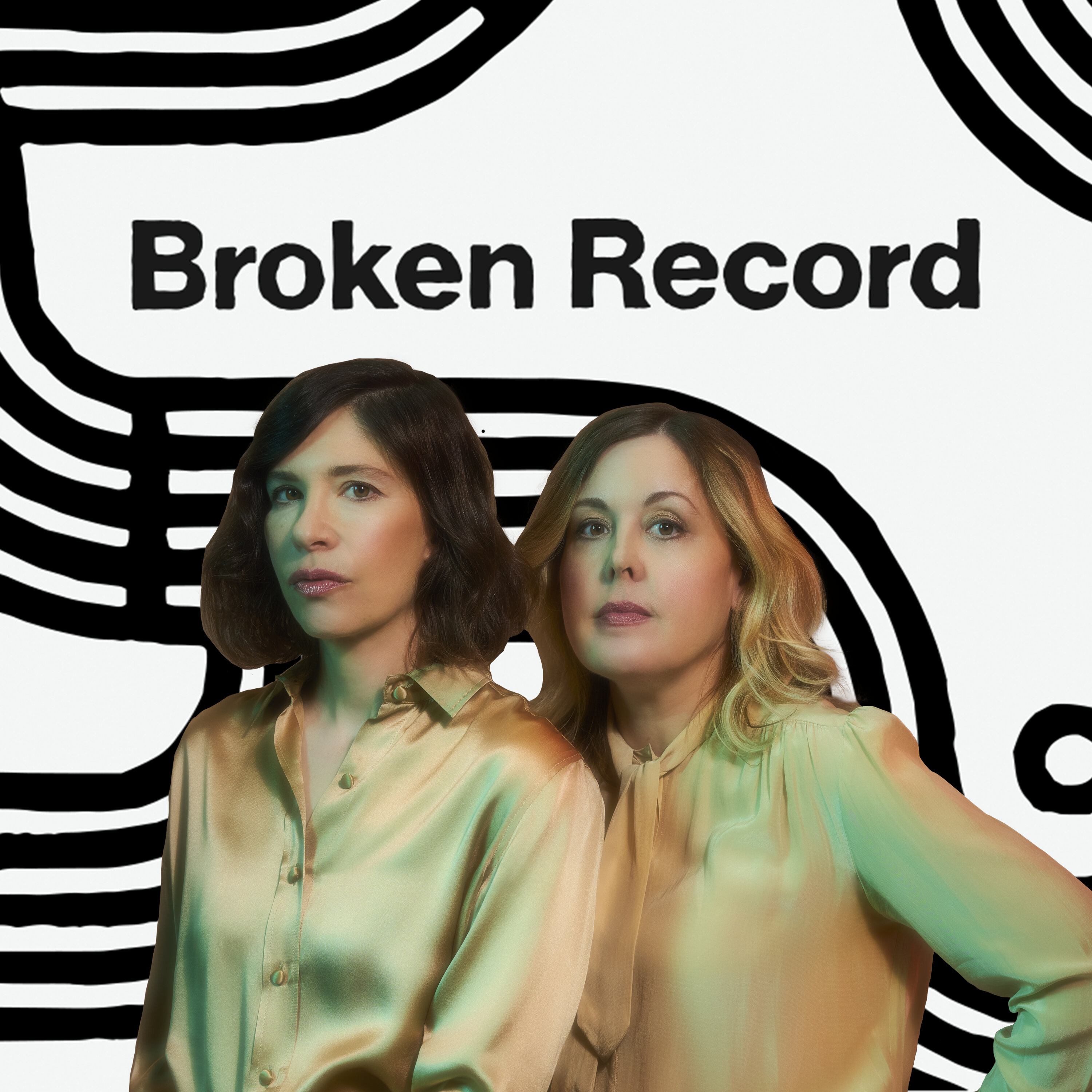
00:00:15Speaker 1: Pushkin Slater Kinney has long been a safe space for band members Kerrie Brownstein and Koryn Tucker. What started as a group born out of the feminist punk riot girl scene in Olympia, Washington in the early nineties, has grown into a life affirming artistic endeavor. In late twenty twenty two, tragedy struck when Carrie's mother and stepfather were killed in a car accident overseas. In the months after, Carrie found respite from her men's grief by playing the guitar for hours on end and writing new music. Slater Kenney's latest album, Little Rope, is in part a meditation on Carrie's grief, but it's also proven to be a triumph for the band. Koryn Tucker, who handles the bulk of the singing for the new album, has been racking up rave reviews, including one from The New Yorker, who noted that Koran's performance is the most dynamic inflexible of her career. On today's episode, Bruce HEADLM talks to Carry Brownstein and Koran Tucker about their intimate recording relationship and how there's sometimes opposing approaches to creative work. Compliment one another. They also talk about the matriarchal nature of the early Olympia music scene and why they wanted their new album to sometimes sound gross and obnoxious. This is broken record liner notes for the digital age. I'm justin Mitchman. Here's Bruce Headlm's conversation with Slater Kenny. I think for some acts, and I think you might be one of them, critics almost get in the way. I think this is the first time I've been able to listen to one of your new records without reading sort of manifesto about what it meant from somebody, or you know, hearing all the kind of is it wired? Girl? Is it? This? Is this? It was just pure pleasure listening to it. Just a great album, and it also is it's incredibly lively. Like We've done a lot of interviews with people who've sort of been coming out of pandemic, and a lot of this stuff feels tentative. This feels like it was a shot out of a cannon. I want to know from you how this album started and the kind of world you were trying to create with this album to invite people in. What was it? I think because we did make a Pandemic album before this one, perhaps we got that insular, isolating sound out of the way this one, I think we were recommitting to the band, which to me is almost an act you have to do with each album is recommit to the need, recommit to the making and doing of music and find necessity in it and intention and purpose so that it's not random or something you take for granted, and then you get to the task of making it. But I do think because of that, and perhaps feeling slightly underestimated, that you know when you're on your eleventh album, that people wonder what you have to say. I think as we were writing, we knew we had something to say. I think there was an urgency to it. There was a deliberate, I guess nature in terms of songwriting and the craft of it and approaching things in new ways, but also returning to some of the methods that we have used for almost thirty years, which is the two of us in a room together with guitar and singing. So yeah, I think interest in terms of when you start writing a record and it's your eleventh album, you have to know that you want this still, because otherwise there's just a flattening of the whole experience in the sonic nature of it as well, which we didn't want. Was there something different you did sonically here? It's a great sounding record. There's a couple tracks particularly I thought just had a great sort of background sound. I think Hunt You Down was one of them that really just had a great sort of atmosphere. I think that, you know, we really approached it with wanting to have, you know, an album that was really bold, and we were fortunate enough to work with John Congleton as a producer on this album, and so we worked really hard on finding sounds that were cutting edge, kind of extra, that were loud and sometimes gross was a word that we used a lot, and we wanted it to be a little bit obnoxious at times. Yeah, But I think, like with something that Hunt You Down, we wanted to set moods. But I don't like music that is just vibe. But I do like things that are immersive that bring you into a world. And I think we we thought with each song about the rhythm and what tones work with the song, and about arrangement a lot. We also do a lot of editing. You know, when you start out as a band, a lot of it is first idea, best idea, or it's a culmination of everything you've been thinking about, everything that's been percolating and building up for your entire life. And then the first three records are kind of an extension of I don't know, that sort of back catalog of ideas. But then after that there is a searching and a seeking and so we don't always trust first idea, best idea. We sit with something for a while, hunt you down. As a song that we wrote three or four choruses for that we really made have elements come in in, you know, guitar parts that come in just once to just punctuate and accentuate a certain lyric. We really thought about that song as a journey, I think, and we did that with a lot of these songs, really sat with them and wrestled with them over and over again until we had sort of the perfect version of them. And then, of course you try to throw that out when you're recording and accentuate things that are imperfect or things that are messy, or things that kind of teeter on the edge. Can you tell me a little more what that writing is like. You mentioned that you guys have always just sat in rooms with guitars, I assume facing each other and writing. Is that what's it like for you? What's the room like, what are you playing? How does that work? For this album? I was actually using a friend's apartment. He has an apartment downtown and that was kind of nice because Corn and I, when we do write together, it is often in our own homes or you know, small rooms, whether it's been a basement, that's very often a basement or an office or some kind of den. But we were in a space that was more like aloft in downtown, and neither of us live downtown. A lot of people in Portland live on the east side of town, so you're not kind of immersed in the city of Portland. So we were on this sort of upper floor able to kind of look out at the river and see the skyline and you know, see the sort of the mountains, you know, Mountain Hood in the in the distance and Mount Tabor, and that was kind of nice to build, to have this particular space that we didn't necessarily know we're going to have that. We only wrote music there. It wasn't anywhere that we did any other living. We just went there and wrote and worked, and I think that kind of insolarity can be good. You know. Sometimes I like when you're writing and you're sort of it's ambient and you're kind of eating and breathing music and you can walk from your you know, where your amplifier is, to the kitchen. But I also just like getting in my car or walking and being in the space where I know what I'm there to do is write and work. And we had that with this album, which we have not always had. I think that we we give ourselves multiple avenues to arrive upon a song, whether it's jamming on something or working on a particular part of a song, trying to crack a certain chorus of a song, you know. I think that we allow ourselves to experiment with different ways of writing in different places, different setups, so that we can approach things from different angles. We also sometimes send ideas back and forth, you know, using software, you know, where we can really flush out an entire demo of something, and then the other person gets it and sits with it for a while and maybe reharmonizes the chords underneath it, or works on a top line melody. Can you walk me through? I mean, lots of standouts on this record, but Untidy Creature, which is the last track, so I'm starting with the end, but I thought it was such an outstanding song. How did that start? How did that go back and forth between you? The funny thing about that song is it actually was the first song we wrote for the album, and we wrote it in was it twenty twenty one, beginning of that year, and I think Carrie had this great riff idea for a song, and I think we just started jamming on that one and coming up with an idea for the song. And I think it came together fairly quickly in terms of the music of the song, but the lyrics really changed over the year. You know, I think that I wanted it to be a really personal story, but it also definitely reflects what happened in the past couple of years in terms of women's rights in this country and in terms of feeling autonomous and feeling respected. I think that, you know, it's meant to reflect that experience and rebel against it. Of that opening riff, it actually reminds me, it's like a minor version to me of the Waterloo Sunset riff, kind of the way that little figure just descends when you work out the music for that, and did you work out the music really solidly before the lyrical ideas came yes, When do you guys kind of lock in your guitar plank? Because I can't think of another band that has an interaction between guitar players the way you guys do. You don't have a bass player, but there's something amazing about how you fill up the space with your two guitars. How do you work that out? That is a very ineffable thing, and it's a sonic vernacular that we came to very early in this band, and it is very instinctive in some ways in terms of how we fill things out sonically. You know, neither of us are trained musicians, so we are often approaching things a little bit differently, probably not always doing what is expected in terms of chord progression, no progression, kind of hybridizing scales and sliding into notes that might not be, you know, the most comfortable for the listener, and I think that then affects how Korn sings. We also dtuned to C sharp, which always creates something that feels I think a little bit scary and certainly a little bit sour. Sometimes the tuning is slippery in C sharp. No matter how many people intonate these guitars, it definitely creates some dissonance there that we like, you know, we like creating a sonic landscape that isn't just something that you can sort of relax into it, because then when it does, when all the notes align, it's very satisfying. But there's a lot of times where the notes are misaligning, you know, when it's it's just right on the edge of not being right. So I think we're aware of that as we are putting the guitar parts together and we utilize that discord, we seek it out a little bit and we toy with it. And then we can also contrast that really well with something pretty like Untidy Creature starts out with that big riff and then it breaks down into a very beautiful, catchy verse, has much more classic like chord, you know, structures. And then the other interesting thing about that song is that because we didn't record it, Korin misremembered the chord she played under my riff, so she ended up writing two different chord progressions. And when I remembered that she had written two different ones, I thought, well, let's use both. So at the end of the song it switches. She just her guitar switches. I'm still playing that riff and her part switches. And I think we are conscious of the ways that that can really change something. It can make something go from minor to major, or even something a little more subtle than that. And it's very satisfying. We are such a guitar bassed band. That is such a tool for us in terms of how we express, you know, the emotion in our song. And so, yeah, we are we are very particular about it, but mostly it's instinctive. But we also, I think have gotten better at utilizing it effectively. Just so I understand, are you using standard tuning and then tuning everything down three se It's not a it's not an alteration that would be even more insane. Yes, And in fact, sometimes when we've had people come into the studio or join us live and we say, see sharp, they're imagining some real jazzy, crazy tuning and really no, it's just basically standard but dropped you know, a step and a half there. And was this just something you started doing early or it was such an accident? Great corn, Yeah, it really was an accident and was I think when we first started playing together, I had detuned my guitar for my former band, I was the only player. I was the only instrument player, and I liked singing with a slightly dropped tuning because it made my voice. It just gave like a drama to my voice that I liked. And so when Kary and I started playing together, when we finally tuned our guitars to each other, it happened to be C sharp, and we're like, great, that's what it is. Yes, it could have been D at that, you know, I mean, it could have been it could have been E flat, could have been d Literally the moment we decided to codify it, it was C sharp, and for some reason, we still only tune to that. It is the language of this band. It's like you step into the land of Slater Kenny and everybody speaks C sharp. That's just it's one of the only rules. After a quick break, we'll be back with more from Slater Kenny. We're back with more from Bruce Hedlam and Slater Kenny. So did the lyrical idea? Does it grow naturally out of the music or you're just hearing it and you think, well, no, I have this, I have a lyrical idea I can apply it to this or are you listening to it saying it's got to be this, this is where it's leading me. I think it depends on the song. I think for a tidy creature, that one had some lyrics that came very naturally while I was singing, but I really wanted to develop a story in that song that you know, was about one particular experience that was about being inside of a world instead of a moment inside of a feeling. And so that involved a lot of writing and rewriting and rewriting and rewriting those lyrics, but it was the music had come first in that particular song. Yeah, I feel like both of us. But I definitely write things down all the time, either in my notes app or on an actual you know, in an actual notebook lyric ideas, but I can't always be certain that they will fit with the song. You know, a song like Needlessly Wild or the verses of Hunt You Down. It's like the music compels me to sing a certain way or to sing certain words, and often we will have placeholders and it's almost like a feeling like the word has to sound a certain way in your mouth. You can't shoehorn some new set of consonants in there, or you know, or it has to be this way syllabically, like it does inform things. You want it to be singable and not, you know, sort of clumsy. So sometimes the melody a little bit dictates the lyrics, not every obviously, you know you hear certain when I listen to a band like The National, I think there's no way that you know, Matt beren Journey must be almost telling a short story here. But for us, I think, and especially Korin with her capabilities as a singer, she can convey a lot with very few words, but they still have to be the right words. But I do think the music can kind of inform what we end up singing about, because it's a feeling, and if you put the wrong lyrics over there over it, you can really tell, you know. Sometimes those are the songs that don't end up on the album because they just don't feel connected in that way. The relationship is muddy between music and lyrics. You mentioned the singing on this song, and I would say the whole album, it's fantastic. I'm not sure you've sounded better. In fact, Kryn, are there things you can do with your voice now you feel you that you couldn't do before? Yeah? Weirdly, yes, Over the years, I have started taking better care of my voice, and I did start working with a voice coach in Portland who helped me work on and maintaining my voice on tour, and I think he taught me a bunch about singing. He taught me how to work through different parts of my voice and control them a bit better. And so I think kind of unconsciously that came out on this album because it was it was a very emotional album, but it also has a complexity to it that I think sort of really speaks to where we are in our lives right now, and I wanted to be able to convey that with the singing as well. Carrie, did you find her singing on this album different? Yeah? I think it is some of Korin's best singing. I go back and listen to something like dig Me Out or The Woods, which are two albums that Sleader Kinney are sort of known for, and Korn's voice is incredible on both of those albums. But the control role on this album, the nuance, the diversity of sounds and voicings. A song like Small Finds, there are three distinct vocal styles on that song. You know. The verse has kind of a tossed off ensutionient, almost Kim Gordon feel, and then the chorus is this big rock voice, and then the coda, which takes you out of the song, has this whole other, almost Jim Morrison doors vibe. It's sounding to me, you know. And then of course there's something like the choruses of Hell, which, yes, you can maybe imagine that on dig Me Out, but not with that control, and not with the verses being so pretty and melodic. So yeah, I'm very impressed. And I really needed quarant to sing more on this record because I had just gone through loss in my life and was grieving and didn't really think that my strength was going to be in singing on this album, and so Koran really stepped up, and it's probably the most singing she's done since very very early Slater Kinney. So, Koran was your voice your first instrument growing up? My dad is he was like a hobby musician. He played folk music in the sixties. He opened for Pete Seeger once yeah, And he was always playing music when I was little. I remember being two or three years old and singing folk songs with him, and he would play guitar and be like, sing this one, you know, And I just thought that was what kids did growing up, was learning folk songs. I was wanted to sing. I think I got really anxious as a teenager. I didn't feel comfortable pursuing it because I I was just I didn't have the self confidence. But when I arrived in Olympia and I connected with the music scene there, it was so supportive and so wide open in terms of what a band could be, what a singer could be, that I wanted to start my own band. I was so inspired by other women in bands that I wanted to do it myself. And so I started a band right away and started singing in it and performing with no real training and no real idea what I was doing. Was there a particular song, a moment that made you feel that you wanted to do this. I think there was a moment. It was February fourteenth, nineteen ninety one, and it was a Valentine's Stay show with Bikini Kell and Bratmobile two bands that I was extremely inspired by, and I think Feels Blind by Bikini Kel was probably one of the most inspirational songs. It hit me so hard at that age. I was eighteen and I saw what they did as a band. It was so impactful. It wasn't professional, it wasn't polished, but it just really dared people to do something different with our lives. And I felt like it was a calling for me as well to start singing and do my own band. Carrie, what was it for you? Gosh, A single moment. I think for me, it was definitely in high school when I started actually going to shows. You know, I had grown up listening to a lot of pop music in the eighties and watching MTV. I could never decode how or what people were playing. There was a lot of spectacle surrounding that music. You couldn't really permeate the artifice of it. But I started going to shows in high school and I remember seeing hammer Box. They were a band from Seattle, The Fastbacks Beat Happening, and I would just watch these people play, like Kim Warnick or Kurk Block from the Fastbacks, and I could actually see what they were doing I could see what the pedals, the guitar effects pedals look like. I saw that there was a quarter inch cable going from an amp to a pedal to maybe a tuner if we were lucky, And I could see how their fingers moved across the fretboard. I could see that there were monitors like that. Whole machinery was demystified for me, and music was something that was made. It wasn't just packaged or produced. There was sweat and effort, and I really just needed to kind of press myself to the front of those stages and watch and decode. And so I think more than a single moment, but just being in rooms every weekend and understanding that this was something that wasn't happening in New York or la or London, but happening in the suburbs of Seattle and in Seattle and in all these places that I inhabited with people that were just a little bit older than me, and that I had access to it, that I could if I got a guitar, that I could play this. It wasn't foreign. You know, I've asked that question of so many people, and you're the first two have mentioned live music, not recorded music. For so many people, it's you know, under the covers with my radio hearing love Me Do for the first time or whatever it is. It's amazing, that's what you reacted to so strongly. Yeah, I think, of course we both have all those moments of recorded music, but you know, we came up with such community, and I think that idea of conveying something live and being able to do that, to me, it was not just an oral experience. There was something more than just listening involved. It was ritual. Your experience in Olympia is really interesting. People know the Seattle scene from that era. Tell me how it was different, or maybe it wasn't different. I think it was different in terms of the diversity of bands in Olympia and the kind of support there was immediately for young women playing music. And you know, I think that there was a space there for hearing about women's stories and women's experiences. That was super important. You know, there was a radio station from the College at Evergreen that Diana Aaron's and other friends DJ'ed at that would have our bands play on them. There was multiple recording opportunities. I think for bands it didn't cost any money. I mean my first recording was Molly Newman renting a task tape recorder and we made our first single off of recording. You know, that was free, and so having those kinds of resources and those opportunities available, I think, you know, it just kind of eliminated of those barriers to have really interesting already and female fronted bands happen. Yeah, it was almost matriarchal compared to Seattle, and it had an avant garde element. It had a real art slant to it. In Olympia, there were bands were minimal. There were a lot of two pieces, you know, like sort of White Stripes were the first band that got big as a two piece, but Olympia had twenty two piece bands. A lot of bands didn't have bass. Just convention was really done away with, and you could form a band on a Monday and play a show on a Friday. This notion of professionalism was very much deconstructed, almost frowned upon, you know, which of course was endemic to punk in general. And punk was you know, sort of turning its nose up at a lot of those conventions, but particularly in a scene like Olympia, you know, there was a real i don't know, just sort of celebrating of the amateur, and then of course eventually you want to get better, and bands did, and they watched each other and tried to best their last thing. But in the spirit of it was definitely something that felt kind of anti commercial, anti professional, and very much pro art, pro weird. I've always wondered if there's a flip side to that kind of experience, which is it seems like a very intense place and people are very intense about their art, and sometimes intense fans can be punishing ones. There are not a lot of casual fans of your band. There are super fans, and their people say I've never really listened to them, and super fans kind of scare me a little bit. You know. I'm thinking of someone I really admired, Liz Fair, who put out one record that people didn't like and it was like a war crime or something. Maybe it's worse for women, like you know, Lou Reid can do a whole album of guitar feedback, and then Joni Mitchell does Mingus and people are like furious with her when you're making records. Are you kind of conscious of that core fan? Are you worried, well, are they going to feel betrayed by this if we do this? What's your relationship to those kinds of fans. I think that we try and first and foremost make a record for us, for ourselves that we're enjoying, that we feel like we're doing something new when we write music. I wouldn't say that we're totally unconscious of our fans and what people enjoy about the band. I think that would be dishonest. I think we do think about what people might enjoy, but I think that you try and put that on the back burner, and the front burner is stretching and doing something interesting, because otherwise I think it's so easy to feel stale in a band. All right, one last quick break and then we'll be back with the rest of Bruce Hedlam's conversation with Slater Kenny. We're back with the rest of our conversation with Slater Kenny. What do you do to make sure you don't go stale? I mean, when you're younger, you're still learning to play, you're still feeling your way out. You guys are very experienced. Now, are there barriers you put up for yourself or the things you feel now we got to get over this. Is there a way of making it hard, making it more rewarding, I mean, that's the goal. I think it doesn't always come easy to make it hard, if that makes sense, But we try to avoid the facile or something that's repetitive of Well, that's an avenue we've explored before. This is you know, it's very easy for Korin and I to have kind of these sort of angular terst guitar parts intertwining and a certain kind of vocal. But we allow ourselves now to kind of work through that process. We will take every idea and sort of run with it and exhaust it, because I think that's part of the process. I think for a while, when we would land upon an idea that felt too familiar, we would discard it immediately. I think one methodology we've learned is or one thing we've incorporated in our writing is patients to sort of see something through until we know that it's not working or that having faith that it will transform into something that is working. But those parameters I think are good, and there are ways that you can have parameters. One is just setting time limits. You know, those very few records are great when someone spends five years recording them in the lap of luxury in paradise, that's not like the best way to make great music. But if you say, you know, we recorded Call the Doctor in five days, and we recorded Dig Me Out in ten, and we recorded The Woods in three weeks, so you know we recorded this album in probably fifteen to seventeen days, right, Quorna, You know that is a parameter. That is a limitation. Now we'd already done the writing on it. But I think having something some where it feels like you're pushing against something that is you can't really manufacture that, but I think you can trick yourself a little bit into into having something to push against. And that's important because then you have to justify. You have to, Okay, can I justify this part or this length, like what you know, test me on, like someone's sort of testing you, someone's pushing back, and you say, like, no, I'm going to affirm this thing. That that is helpful. But each album kind of has its own world to it, and sometimes the worlds of a Slater tiny record have really high stakes, and this one did. And it's not an experience we would I would ever want to live through again. I'm talking about the death of two people in my family that occurred when we were making this record. You know, I would I never want to live through that again. But it certainly raised the stakes and it created an absolute, like ontological like shift in this band, and that that doesn't always happen. And short of that, you have to create a way for there to be stakes and necessity and parameters. Life doesn't always bring you that, and I wouldn't wish those parameters brought onto any now. For a lot of people, that would be a reason to stop making the record. Did you consider that, No. I needed music more after the death of my mom and stepfather. I needed the choreography of playing guitar. I needed to feel something almost prayerful. And that's what music is for me. It's a version of that. It's a version of placing myself in a room communing with something bigger than me, putting my fingers on the neck of the guitar. I played and wrote over and over again for eight hours a day, sometimes, which I hadn't really done since I was in high school or in the early years of Slater Kindney. It was it became an absolute need for me, and I think we just we just kept going. I also needed the songs to be what I couldn't be. You know, I felt incoherent, I felt weak, I felt despondent, and I needed the songs to be the opposite of those things. I needed the songs to be coherent and vibrant and strong and make noise in a way where I felt mute. So we just channeled all all of that into into the into the songs, and even the songs we had already written and we had recorded a handful of them, were sort of dragged into this new reality. Your book, which is excellent, you write about being a kid, and by virtue of your parents' relationship, you were very early dragged into the adult world of complications and complex feelings. You know, one thing I really love about this album, or all your albums, but this one is seeing people try and figure out those complexities almost on the run. In the relationship songs like say It Like You Mean It Certainly and Dress Yourself Untidy Creature. Actually probably the whole album. It's this sort of collision of polemical and personal ideas. I'm wondering if that's a pretty common experience for artists that as kids they're pulled into that kind of adult world and they spend a lot of time trying to figure that stuff out. Do you think that relates to your writing. I mean it's true for me, but I don't know if it's true for everyone. I mean, obviously you hear that a lot when you listen to someone talk about what compelled them to create art, to drive them towards something, to be driven to have grit, to yearn for something that's helps them make sense of a situation that they might not be able to do with words, with language that they don't have. They channel that into something that is artistic or physical, or involves a knowing without knowing, you know, that kind of just an awareness with it before you have the language. I think that was true for me. I do think that our band, even though obviously we are adults now and can express ourselves mostly eloquently, I think there is a lot of Slater Kidney that operates in that dual space of the conscious and unconscious, where you have something that's concrete but also intangible. I think we aim for that in our songs. You know that there's something sort of ineffable and hard to grasp, but also something very grounded. And that's kind of the sweet spot with our band lyrically or musically, that it feels very tethered to experience, tethered to honesty and integrity, but also reaching for something that might transcend those things or get you away from those concrete ideas, gives you an allowance to escape from some of the hard truths. I think you mentioned that you really needed the band at that point, and does that explain in part why there's so much short of energy in this record. You always have energetic records, but you're kind of at the stages in your career where a lot of songwriters and people I love. The first thing that goes is the fast song. I don't know if you've ever noticed that. You know, they kind of they can do the mid tempo song. They can do even better slow songs, but they kind of lose something off fastball, and nobody wants to admit it, but it's kind of there, not you, guys, because this album just it just has such velocity. I guess I would call it rhythm's great beats. It's all kinds of things, but it just has such energy all the way through it. We were conscious of that and that we worked on having fast songs. I think at one point we went through the tempos of the different songs and we're like, that's too slow. That's too slow. We need to at least have one song that's I don't know, one forty tempo or above. Really well, yeah, I think it was helpful to record a batch of the songs in August and to get a sense of the album as a whole, like what did those songs represent? Did they have enough variety in terms of rhythm and tempo. We did intentionally write some fast songs, but we also I think there was just a propulsion at that point, like sometimes when you feel out of control or things feel chaotic, you need something to match that, And so we were able very naturally, very organically to come up with fast songs. It wasn't I think there's something honest when people write their mid and slow tempo songs. It's because if they write the fast song, it feels like they're quote writing the fast song, which I feel also wary of, like, don't forget we can still do a fast one, which is not what you want. You'd rather have someone do a great mid tempo song if they're not feeling the fast ones, but we I think we're just there was a real sense of like tumult and yeah, that we were able to last of those faster ones and have them feel innate and that they belonged on this record, and so we definitely ended up with a handful of them. I think a song like Small Finds, though, was it was kind of a question mark going into the studio with that one. I think John was really puzzled by that song. And I loved that because I loved that we were trying things that were a little bit of a stretch and still a little bit avant garde, and that I was trying this vocal thing with it, which John was like, this is bizarre, and I was like, just wait, just wait, just give me, give me five more minutes, let me try this one thing, you know. And and I think that we just in the end, like it kind of stipped together at the last minute, you know, it kind of came together as this interesting flavor for the album that was unlike any of the other songs. And I think that's that's the joy of having the patience and having that language with each other to say like, just give me five more minutes, let me try this one other thing with it. And sometimes that's what you need in order to make something that's unique for the album. I also want to ask you. I would like to ask you about all the songs, but I'll tick one more, which is say it like you mean it. Can tell me about that one. So that one I had this idea for. I had the chorus for it, and I had this weird guitar line for the verse. And I had a really hard time finding a verse for that song. And Carrie was like, this is great. You should keep working on it, you should finish it, and you know, she helped kind of work on the music for the verses, and I came up with, you know, an idea. I started singing it and I did a first take of it, and John said, no, that's that's not really interesting enough. And it was very frustrating, and I was like, okay, right, and I kind of sat down on the couch, just like boiling inside. I was like, just give me, just give me a minute, give me some time with us one then, and I went home that night and I went to bed and I woke up in the middle of the night, and I had this other idea for the vocal melody, and I sang it to my phone and I came back the next day and I rewrote the whole vocal melody for the song. And when I started singing it, John was like, Okay, yeah, yes, start there and then we can go to this place in the chorus. And he knew he knew where to go with that song when I started it in a different place that was more vulnerable, and then he pushed really hard on the chorus to make it sort of have a range of feelings of not just sad, but also you know, there's a bed of anger on it and regret, and you know, I think it was another song that evolved kind of at the very last minute. You know, I'm so glad that we had the patience to keep working on it. I've noticed in other interviews that you Koran, sometimes the relationship seems to be You're sometimes a little worried about going too far with the song, and then Carrie is like, no, I want you to go too far with this song. Do I have that right? Is that the dynamic between you? Yes, I think it is. I mean, that's kind of our dynamic in general, like I'm like a speedboat and Korn's like an oil tinker, and I'm like doing a million like turns, and then Korin will slowly turn and then when she's turned, it's like, oh my god, Whoop's okay? Now this is It's like she's there and it is like no going back with Koran, and I love that. I love that we temper each other because Korn's like, would you just slow down? This is like this is so garrulous, this is just too many ideas, too many melodies, and Koran is very, very steady and very commanding. Well, you know, there's that old line that perfection is the right combination of opposites. Are you opposites in other ways as well? I think we're more similar than we are different. I think that, you know, we both really are disciplined about art and think it's really important. Carrie's brain operates on like a different level though for sure, like She's, she has just a very high capability for composing and working on things. And I would definitely say that I'm a much more subconscious writer and that sometimes I have to not think about something to find the answer for it. I have to walk away, or I have to do something else and it will need to hit me emotionally for it to be the right answer. Has that relationship changed over the years. Do you think have you taken on some of your each other's characteristics? Probably no, Corn saying no. Now, Corn's too stubborn for that. Corn is so stubborn. Korn's way more stubborn than I am. I'm impulsive and Corn is stubborn. I would have said yes, but Corn saying no, and then I just default and say, Korn's right, Well, she is the oil. So there's yeah, you just you don't mess with that. You'd a great You used a phrase a couple of times in your book, but the one I remember was I described boldness. She was bold. Yes, that is very much us. Like I am such a meta person. I feel like I'm always dancing around it, circumlocutionary. Korn's just right there, She's right at the center of it. I think. Also in my book, an example is when we were coming up with titles for The Wood and I had a list of like fifteen and Korn just said, let's just call the Woods. And I was like, yeah, right, okay, that's of course. Why are we trying to do something other than that. It's just that's the right answer, and it's the final answer. Final answer. Yep. Well, the right combination of opposite is perfection. I think this album is the right combination of opposites. I think it's just fabulous. So thank you so much for taking all this time, Thanks for having us on. Thanks to Carry Brownstein and Coreyn Tucker of Slater Kenny, their new album Little Rope, along with all of our other favorite Slater Kenny songs, are streaming on a playlist be made at broken record podcast dot com. Subscribe to our YouTube channel at YouTube dot com slash Broken Record Podcast, where you can find all of our new episodes. You can follow us on Twitter at broken Record. Broken Record is produced and edited by Leah Rose, with marketing health from Eric Sandler and Jordan McMillan. Our engineer is Ben Holliday. Broken Record is a production of Pushkin Industries. If you love this show and others from Pushkin, consider subscribing to Pushkin Plus. Pushkin Plus is a podcast subscription that offers bonus content and ad free listening for four ninety nine a month. Look for Pushkin Plus on Apple Podcast subscriptions, and if you like this show, please remember to share, rate, and review us on your podcast app Our theme music's by Kenny Beats. I'm justin Richmond.