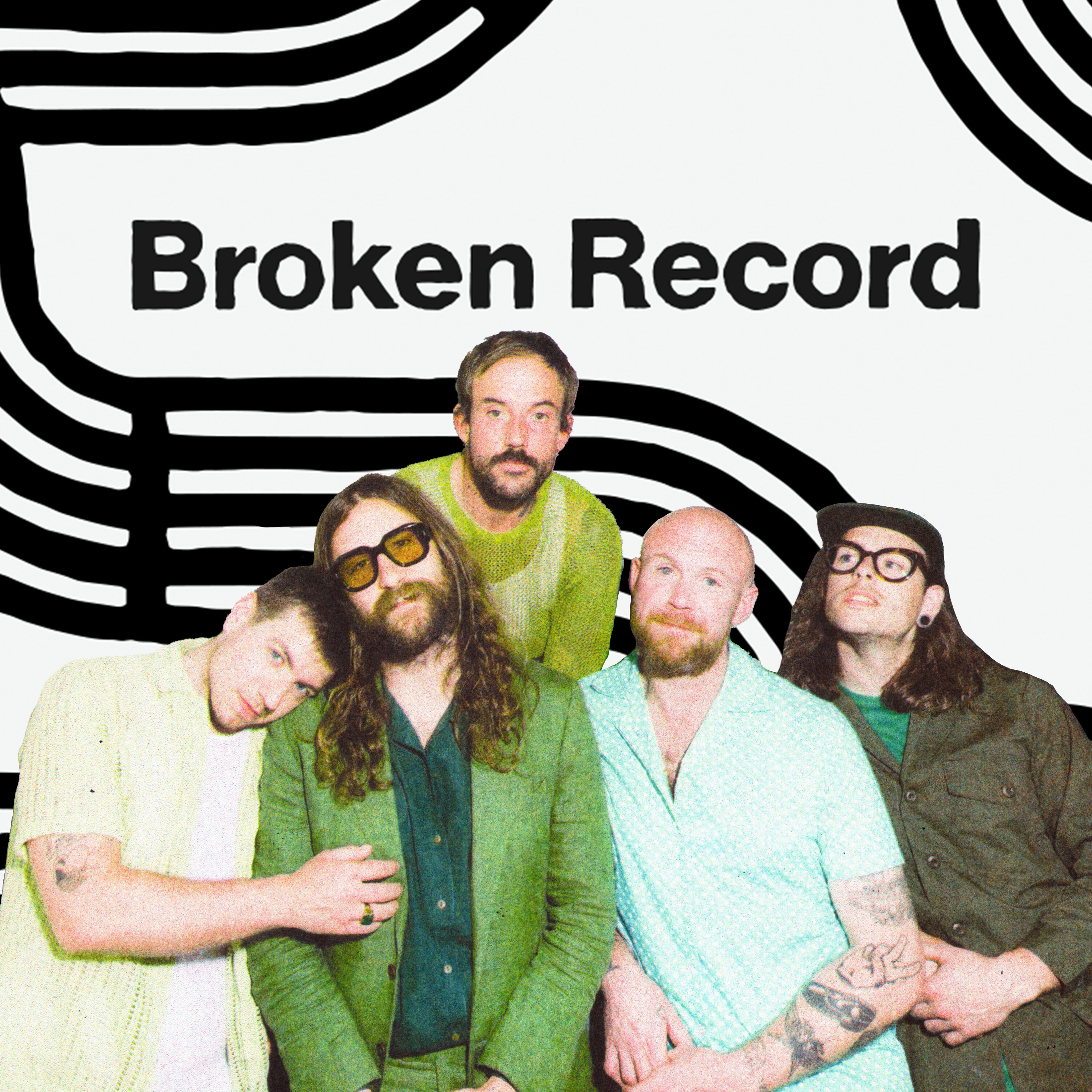
00:00:15Speaker 1: Pushkin.00:00:20Speaker 2: The British band Idols has released five albums in only seven years, starting with their critically acclaimed debut album Brutalism in twenty seventeen. The band's been growing steadily ever since, with their bombastic sound that brilliantly balances joy, chaos and an often critical take on the powers that be. The five piece band's lead singer, Joe Talbot, has always channeled his personal pain as well as his dissatisfaction with Britain's ruling class, into his songwriting. Mark Bowen, idols guitarist and producer, serves as Joe's primary musical partner in the band. They both bring a love of hip hop and old school soul and arm beat the mix, along with UK techno and house music. All of these influences can be heard on their latest album, Tank, a project produced by Mark Bowen, our friend Kenny Beats, and radiohead Nigel Godrich. On today's episode, I talked to Joe Talbot and Mark Bowen from the green room of The Tonight Show with Jimmy Fallon about their tumultuous creative partnership. They also explain how Mark helps temper Joe's sometimes passionate rage, and Joe breaks down why he'll forever despise England's monarchy. This is broken record liner notes for the digital Age.00:01:34Speaker 3: I'm justin Mitchman.00:01:36Speaker 2: Here's my conversation with Joe Talbot and Mark Bowen of Idols.00:01:41Speaker 3: Thank you for doing.00:01:42Speaker 1: This, Thank youth for having us.00:01:44Speaker 3: No man, I mean, you.00:01:45Speaker 2: Guys are backstage at Jimmy Fallon right now. I don't know how you guys keep it together. I can hardly do one thing in a day. You guys must be doing you know, a million things.00:01:54Speaker 1: It's crazy.00:01:55Speaker 4: I mean it comes to a sense of gratitude like we've been fucking fifteen years ago, Like Crappy sound Engine is. We give us shit form turning up early.00:02:06Speaker 1: Do you know what I mean?00:02:07Speaker 4: When we're working fifty sixty weeks and then we turn up, get paid fifty bucks for a show and some warm beers and then drive for four hours home to play to ten people. But we knew the value of that, we knew the experience, and we knew how special the learning curve was. So when we're here and we're given opportunities, we take them because that's fucking gift. When you have a platform, whether you're lucky or not. And there's a lot of entitled people in our industry. But when your gifted a platform, that is a beautiful opportunity to challenge yourself and give the audience back the energy they've given you by being present and fucking vital and full of life because you only get one and it's magic.00:02:59Speaker 2: Is it weird to see the audience get bigger and bigger and more like fans And.00:03:05Speaker 3: I mean, I don't know, it's got to be insane, but you get.00:03:06Speaker 1: What you build.00:03:07Speaker 4: Man, Like we a dialogue with our music that was a continual growth. You know, there's no surprises. We know what's happening, and we know what we've made, and we know what our audience is building. They've helped us from the start, so we've been carrying each other from twenty eleven and like, there's no surprises. You get what you work for.00:03:31Speaker 2: I love how self assured that answer is. You know what I mean that you guys kind of know what you put out there, and it really listening to the new record. You know, as the records have come out, it seems like you guys are pretty self contained. Like from the jump, you guys knew what you wanted to say, which you wanted to do, how you wanted to present it, even though I've seen the changes, Like every album sounds and feels very different. Every album is a really strong statement.00:03:53Speaker 1: Yeah, I mean that's.00:03:55Speaker 5: Definitely our biggest kind of moo as creators is the we're very much driven by our intent and our intentions you know, in the music, and then they kind of create with Joe's design and stuff like that. It's all very much there from the outset. It's not you know, about jamming and you know, exploring things in that way. It's about how do we represent what we're intending here. It's not you know, stumbling upon something. So yeah, it's a it's a big thing in this bland.00:04:28Speaker 1: You know.00:04:28Speaker 5: The title always comes first, the artwork of follow soon after, and then it's like conversations around that, and it's about kind of like Choo expressing what he meant when he gave that title, and then we talk all about that and talk kind of about maybe sometimes like what the song is going to be about or what the kind of music's going to be about.00:04:50Speaker 3: But you don't really have lyrics or music at that.00:04:52Speaker 5: We don't have distract. We don't have anything, it's all. It's all dealing in abstraction. And I think that I think that dealing in.00:04:57Speaker 6: The abstract is why we write the music first always because it's it's easy to translate the abstract into something abstract, and then it's about too translating that into into word.00:05:08Speaker 4: Yeah, I mean, the whole purpose of every album is, you know, life is abstract. There's there's no there's no actual rules. The whole point in philosophy, if you look at Plato's Republic, that's just creating structures that are imagined in order to understand the socio political like narrative that goes on and how people are dying to find purpose and meaning to move forward. And that's what art is. Art is the breach of existence. It allows you a sense of purpose and where you're at right there, and the more you understand your momentary purpose, the more you can move forward with vigor and understanding and more purpose. So every album is about the human condition and either how I'm affected by socioeconomic situations or relationships or whatever it is. I put that in, I document it, but that always comes from the present thing that's most of mind. I already know what the next album is going to be about and what it's called and with each one, and Bowen then takes my very small thing because I don't want to like overwhelm him his ship with my ego, because it's not just about my ego. It's about it's about some sort of landscape that we can make brilliant music.00:06:29Speaker 1: So I just go, well, this is the kind of thing I'm going to be talking about.00:06:33Speaker 4: But I don't have any lyrics and I won't force anything, but this is what I'm interested in thematically, and then he goes okay, and then he puts color to that, and he puts you know, some terror firma down.00:06:46Speaker 3: Some strong terror firm.00:06:47Speaker 4: Yeah, I believe, and then like and once it's all done, then then I sing on top. But it has to be done.00:06:54Speaker 2: Does the color that Mark comes up with in the rest of the band, does that help you sort of hone you in on what you want to talk about?00:07:02Speaker 4: Well, it's Bowing and I that writes some music. So it's kind of like just pushing, pulling together. Because he's a very philosophically and just emotional practice, very different to me. So between us we have this like really beautiful pushing pool creatively. That allows me a new perspective, like, you know, just saying I just wanted to smash the room up and I had to talk to Buying. I'd be like, what do I punch? And he's like, well, how about.00:07:29Speaker 1: You do this?00:07:29Speaker 4: And I'm like, oh, yeah, yeah, yeah, of course. You know he's my guy and like this because he's the opposite to me. So we understand that to create parameters within an album, it has to be outur boundaries. Create the boundaries, work within them, and you'll flourish.00:07:48Speaker 1: I mean, it's like it's also a strict if.00:07:50Speaker 4: I'm like, uh no, that's not joy as an act of resistance enough, no, no, no, no, no, it's not like that.00:07:57Speaker 1: So this is where I'm at, and that's a conversation.00:07:59Speaker 4: And I think that's why our music very much sounds like an insular entity is because we allow each other to breathe, all five of us, obviously the boys right shit as well. It's not just me and him, but it's mostly us. We allow all five of us to breathe within a parameter, but we have to have those parameters. That's the best way of creating something. I think creative thinking comes from problem solving and like it's good to have that, Like do whatever you want, but you can only use the color blue, and you're like, oh that's sick. Okay, where so do whatever you want. You're like, uh, okay.00:08:35Speaker 3: It's a little intimidating.00:08:36Speaker 4: Yeah, yeah, h it's just a little flat, Like what's the challenge in there? You like doing anything? That's how life works. Life doesn't go yeah, go ahead. We know how privilege we are, and we use to have privilege that there are people like the most brilliant and the most beautiful art comes from those voices that have a sense of tumultuous fire. They have to fight against something, whether it's oppression, depression, love, fucking civil wars, genocide, whatever it is. There's things under the like that's when the voices are most resent. I just think, Yeah, you set yourself the boundaries, and you set yourself the parameters to flourish. Obviously, like two different degrees. I'm not comparing myself to fucking Billie Holidays, you know what I mean. But I've been through some horrible shit and I'm allowing my traumas in in order to make a more brilliant picture.00:09:33Speaker 3: Mark, what's your sense of your guys's relationship? Is it similar?00:09:36Speaker 5: Yeah, I mean it's it's tumultuous, but that's good. That's that's where we get, you know, out of the rumble. You know, we start to move the earth around us, the water starts to flow, and I think that's it. It's like we're just so different creatively as well, and it's useful.00:09:57Speaker 1: And part as well.00:10:00Speaker 5: You know, you like, for two people that are so as individuals, so strong in their feelings about their creativity and about their about but it would it would almost suit us better to be auteurs and to be on our own, you know, just having people that are like yes around us, they all that happened, but it wouldn't.00:10:20Speaker 1: Have the same impact. It wouldn't work.00:10:22Speaker 5: It would be too self self serving and self immilating as well, because it's like, you know, Joe's approach needs my touch and my and my approach needs Joe's touch to become full, become complete, to become become resonant in that intention as well. I think that you know, you can have two down the line or to abstract to like you know, flourishy or or kind of a coming from a very different perspective. So I think I think it requires that for idols to be a thing.00:10:59Speaker 3: But probably more generally too.00:11:00Speaker 2: I mean, I think that's the in you know, the year twenty twenty four, it's like partnerships groups bands are rarer and rarer, but you kind of you look back over all of the best music came from on some level of partnership, you know, off the walls of solo record, but that's a partnership with him in Quincy, and yeah, there's always got to be something to sort of rein you in or something to play off of, you know.00:11:25Speaker 1: I think it's the playoff of.00:11:27Speaker 5: But I think it's also because like when you're creating art, you're creating something from your perspective to be observed from from a different perspective. So I guess it's useful at that at that point of creation for the art to them be informed by something from a different perspective, because it allies the best of a singularity. Because there is no singularity, there's no there's no truth.00:11:49Speaker 1: Yeah, I'm all for like that.00:11:51Speaker 4: There are there are things that are created like Nick Drake pink Man, that's just him on his I entirely. I mean maybe there's an engineer and a producer that, but I think you can get magic from anywhere. Some people are completely introverted. I think Baron and Aya, I'm definitely half half introvert extrovert, like I need time on my own to process, but we process very different. I think we just learned democratically, and you know, people forget democracies and the leaders. So like, you know, we're just we's taking it's a few albums, but now we're at a point.00:12:27Speaker 1: Where it's like, this is your two man, I'm just going to sing you crack on. I'm like, I'm fucking ready. This is beautiful, and that that's.00:12:33Speaker 5: A real thing as well that we've kind of learned as we've gone along as the idea of service. You know, we've learned more about kind of serving the song as we write, but also service to each other. You know, there's there's times where, especially when you're dealing with Joe's lyrics and his vocal approach, you know, sometimes it's not what I've been expecting or would have wanted, but you can see that there's something that you needed to get out, and it's like, actually, yeah, you're right, this doesn't need my two cents right now.00:13:03Speaker 4: And that happened with me with Gospel. It ended up getting cut and nothing to do with me piano. There was parts it was just short. I was unsure about the landscape because it's very you.00:13:15Speaker 1: It was you.00:13:15Speaker 2: Yeah, there was a different version of a Gospel the song on the new record.00:13:21Speaker 1: Well, I mean it's all there. It's all there.00:13:23Speaker 4: It's just like restructured a bit, as if there was something taken out.00:13:27Speaker 1: So it just happens once, but like that's it. It's not crazy.00:13:31Speaker 4: But I was just like, I felt how important it was to bow and how amazing it was. So I was just like, even though you know it got cut after your discussion with Nigel, right, it wasn't like my input, but I felt that.00:13:45Speaker 1: I was like, but I knew there's his. Also.00:13:50Speaker 5: The other thing was that whenever I showed it to you, you were like, oh, that's the verse and it's not.00:13:57Speaker 1: I didn't know what it was.00:13:58Speaker 5: The more big was the chorus in my head and whatever you said it was, I was like, that's not it, but then it has to be.00:14:06Speaker 1: It doesn't matter.00:14:07Speaker 5: It was the thing about Gospel I don't know if alright, it's just one big yeah.00:14:12Speaker 2: I'm glad you guys are sometimes confused by your song structures too, because I was about to bring that up about one of the new songs. I'm often I don't care, but if I listen back and trying to think, well, what's the verse, what's the chorus, what's the pre chorus, It's.00:14:23Speaker 3: Like, I don't actually, I don't know, like I have noub Yeah, I think.00:14:26Speaker 5: I think it's especially on this one, it was about, like, you know what, one of one of the biggest drivers that we've not actually spoken about that much actually and impress on this was like when we started out of this album, the things that we were listening to. Most of the things we were leaning on most was fifties and sexonties pop music and cool and that's really informant that you know, Roy is called Roy because I was trying to hep Roy Orbison song at the.00:14:50Speaker 3: Time, beautiful song Jesus Christ.00:14:53Speaker 4: I mean that was something that song is probably a perfect example of us too, like not compromising, what's the way colliding? So I had this chorus, it was like a Lee Moses chorus that I wanted to write for like two to three years.00:15:07Speaker 1: It's not the one. It's not the one.00:15:09Speaker 4: And Buying had this like the verse and the bridge, and the bridge was the chorus, and I was writing it with my friend like trying to write at home. It's the only thing I tried to write home, and I was like, everything I'm writing isn't the.00:15:23Speaker 1: Chorus, but it works and it's sick, and that's what's on the album.00:15:27Speaker 4: And then we were in the studio and we were packing down, the drugs were packed away. It was only me, Bowing and John in the studio with Nigel and Miko and like in London, and I was like, fuck, it's the Limoses chorus. And then I wrote the drum beat in what about a minute. I was like dagda and John was like, oh shit, okay okay. And then like I wrote all the films, got it down in like probably five minutes recorded.00:15:57Speaker 1: But I was like buying it, would you reckon? And we both were like for.00:16:01Speaker 4: Organ, I was like organ line four chords and then we both be almost exactly the same.00:16:07Speaker 1: I sang the same notes progressive and we.00:16:09Speaker 4: Were like that's it, that's the fucking one, and like you know, that it wrote itself in a minute, like it just and that's how fifties pop should be.00:16:20Speaker 1: That like soul, like sixties soul.00:16:23Speaker 4: It's like that ship was natural and like so it's called soul music because it's the most humane fucking element of music. It's like, well, of course that's it. It sounds easy to write because it's so fucking innate in the human condition to listen to what it's reading or Nina Simono fucking even like the Flamingos and shit like that.00:16:46Speaker 1: It just feels.00:16:48Speaker 4: It feels like you're being spoken to and you're heard, and when you feel heard, it just it feels like you're limb. And like that's what that's what I want from pop music. That's what I want from soul music.00:17:01Speaker 1: That's why you know you get all these I'll play my dad Frank Cosch.00:17:05Speaker 4: And Ivy and he's like, all right, I get it, I get you know you would.00:17:10Speaker 1: No one could be like, what's this ship?00:17:11Speaker 4: Yeah, and like you hear the soul, you know, it's so you feel the soul fuck everyone else, and like we were trying to connect that that's what we wanted when I said I want to make people dance.00:17:23Speaker 1: It's about the magic of music that you get when you allow it in.00:17:27Speaker 4: But you can only allow it in if the message is portrayed in a way that allows you to feel open, you know, And that's you know, the favor of the sun and the moon. If you just shine, you open that person up. If you blow hard and you get aggressive and you're trying to come on and just join us to say, it doesn't allow the sense of dialogue. So like it was all these things that we were practicing in that fifties pop thing was the first thing that really melded us together with purpose. And then next thing I know is writing fucking all sorts of shit.00:18:01Speaker 2: We're taking a break and then coming back with more of a conversation with Joe Talbott and Mark Bowen of Idols. We're back with Joan Mark of Idols. So Roy became like the kind of like the leadoff in a sense. That was the thing that kind of made it all come together.00:18:19Speaker 1: That was it.00:18:20Speaker 4: That was the only thing that we connected on all of us. Gotcha completing something that we're all like, that's it. Everything else was parts. We came to the studio in France with seventeen parts with like two or maybe three instruments song but like a verse and that's it.00:18:34Speaker 1: So we had we had we had an album too, right, we had nothing? Yeah, that was it.00:18:38Speaker 5: And that was when the idea of the fifty pop thing became slightly more abstract. It was more just about tone and that sense that the untenable thing that you can't really put a name too. And then it was about being playful with structure and playful with but I felt with like choosing your moments, like I think you know. Another big moment on the on the album was the instrumental end section of pop pop pop.00:19:04Speaker 3: I have that highlighted to ask you, like, what is the hook?00:19:07Speaker 2: It's like the sunbeams, some beams and the gold sugar part and then goes back to something what's going on here?00:19:14Speaker 3: Yeah?00:19:14Speaker 5: I mean it happens twice in really quick succession, then one time at the end, and then it's like that song was really kind of like very much for us.00:19:23Speaker 1: It was like it was so abstract the whole way through.00:19:27Speaker 4: I think, I mean it was it came from my idea I had. I had to beat in mind for quite a while again, and like it came from like UK garage and Mika Levi Mika Chew in the Shapes, which is like real grimy pot act that kind of crossed the line between sometimes grime, sometimes pot, sometimes indie, sometimes punk. Like they did whatever the fuck and it always sounded infectious, danceable, and I was like that. And there then MySpace what you call it, like the description genre description was pop pop pop oh sack because it was kind of like wre I came from. Yeah, yes, Like basically there was this reper the same garage at the time, which you know, everyone had the gun things. I didn't obviously think I'm talking about like that, like in the garage scene in Manchester, in London and Birmingham, you know, there was it was a real heavy gun crime in those areas and it was a very beautiful community of people that made something great out of serious deprivation at the time. There was also a lot of bullshit, you know, as it always with the racist media attaching gun crime to garage.00:20:34Speaker 1: It was like, but the gunfinger thing was a real thing.00:20:37Speaker 4: So I always thought it was kind of a reference to that because some of that ship the beats that used were kind of grime beats, anyway, fast forward, and I had this beat that kind of felt like because with the nature of sick beats, you change it from one twenty to one forty to one sixty to one eighty. You've just gone through techno, garage, house drum and bass, you know, and all those things. You put that beat on no matter what the speed was on that fucking dancel, and I wanted a beat that you can do that with. I mean, I'm guessing it's probably one fifteen or something one two three, one two three, okay, so yeah, it's technical beat, but it's got that kind of pushing Paul swing. So it's like this was in our head, wasn't it. And then like I started playing the thing, and then bon took over because I was playing this bass line on that an open bodied bass, she started feeding back like fuck on this pokea. So I was like, play that bassline with like this, and obviously I don't use feedback and ship that's busting. So he just finessed it. It sounded sick.00:21:45Speaker 1: It was that thing. It basically he was he was.00:21:47Speaker 5: He was playing it and you heard the the original note and then the feedback was creating the harmonic.00:21:54Speaker 1: But because it was a because there was a hollow body.00:21:56Speaker 5: You still had the original note in there as well, so it made this chord and I was like, oh, can you did you change the feedback home?00:22:04Speaker 4: And was like I could keep hitting this single now for so I read him and then we're like walking around.00:22:12Speaker 1: I was trying to find it. Was like, where's the next note in the secrets? Where? And where is? Where does it? We find it? And I was like, ah, ship, we got it, and we got the we got the sequence.00:22:20Speaker 4: In order, and then that was it and like we we fucking it didn't sound like but Bowen added the chords later on on the on the on the Prophet, which.00:22:30Speaker 1: For me finess.00:22:32Speaker 4: But like in between that and that, Kenny and I are in the studio next door to these guys.00:22:38Speaker 1: In Frank Kenny beats. Yeah. Boy.00:22:40Speaker 2: I texted him yesterday that this is my ship. I was like, yo, Roy, it's crazy, glad.00:22:45Speaker 1: You like it.00:22:46Speaker 3: I don't know if he worked on that one or not, but.00:22:48Speaker 4: Work everything, yeah, he said with us the whole son. So I was in there and I was like, I was like started going in hard. Kenny was like, nah, they say't that what are you doing I was like okay, and then he You know, Kenny's got this amazing way of just like he's very intuitive and he understands the person as a musician. So what I mean by that is any person can sing, but a musician understands how to create a dialect of you outwardly. So you have an internalized group of masks that are all you. They're all true, but they come in cadence, they come in intonation, they come in a timber, whatever it is tone.00:23:36Speaker 1: You can use that to.00:23:38Speaker 4: Truly portray your person who you really are, and like that comes from somewhere within that you lack. You have to have that openness with yourself and try new shit to you Like that is that's it. That was me when I was twelve, and that's how I want to sing on this tune. I listen, this song reminds me of the Cordetts and that was a time of innocence. I'm going to sing with that innocent twelve year old voice because that's what this song is and that's who I am on this song. But you Need One is incredible as Kenny pets, he puts you in there, he goes think about where you are right now.00:24:16Speaker 1: Think about who you are.00:24:17Speaker 4: Remember when you told me that thing six months ago about your mother that day and you said that thing that's you right now go and you'd be like, that's it brings out that thing and that's the voice, but that's the dimerstudy musician, and a karaoke thing is that you can easily.00:24:34Speaker 1: I was doing it the.00:24:35Speaker 4: Other day we covered the Warpman and I was I just basically was trying. It sounded like I was trying to sit like Hamilton Lighthouse. Obviously that guy's much better voice than me, and I reined in. But I know Kenny in my head like what you do it? And I was like, okay, what will Kenny do? You know, you have to find why you want to sing that song and then you portray that with your skill set.00:24:58Speaker 3: Right, that's great, I mean, that's beautiful.00:25:00Speaker 2: I mean back to the fifties and sixties point, it's like, how many times did artists do I mean they weren't covers, but like versions of things, and they weren't covers because they didn't just like ape whatever the I mean, sometimes they did, but a lot of the great you know, Aretha's respect per version versus Otises. It's like they're both beautiful, but Aretha clearly had a vision of herself for that song. You know, there wasn't just let's do what Otis did you know?00:25:25Speaker 4: It's also like if you go back to the early first UK and US top tens, there would be three versions of the same song in the top ten. Yeah that's fucking well, but that's it. Like good example, I thought that a Change Is Gonna Come was by Otis reading. I didn't realize it was Sam Cooked until like muchs later, and like I was like, does that mean in my head that Otis owns it? Because it's the one that I believe, But like the context of Sam Cook and the reason why I wrote it and the bravery it took for him to do.00:25:58Speaker 1: That, it's insane.00:26:00Speaker 4: Yeah, like if you put that in context of the pop machine then and how racist it was, the bravery is untouchable. But that I'm like this Besides, the point is virgin is the one because it's it's what I learned it to be, And like I think it's like if that's a sense of ownership, like if I own the Walkman's song and make it mine, because I mean it, it's not my writing, but if I mean it, then it's it's as beautiful.00:26:33Speaker 5: You know.00:26:34Speaker 1: I agree.00:26:34Speaker 2: I wish that way of thinking was a little more prevalent in music because it's like there, I mean, why not pull from other things, you know, like make a song yours like that kind of adding that kind of variety back in the music would help make it, in my view, more interesting.00:26:49Speaker 4: There's issues there, like if you like, I mean, how many writers did Harry Stele sound on that album? And you get credit on all of it? I don't know how much he wrote. I'm not criticizing the guy obviously, Like I'm not gonna lie. I like Harry Starles's music, but like obviously had lots of writers on that, and I don't know whether I want to know that or I don't think if I thought that Harry Steals wrote it all, I'd enjoy even more. Yeah, not all of it. I just like his singles. Some of them are really good pop songs. I think like knowing that an artist has. But like I think Frank Hoschsin is a great example. How many producers does does he work with? And it's still incredible to me? So I guess it's I don't know, it's a cut us as well. I think I just the less I know the better when it.00:27:35Speaker 1: Comes to that stuff. I think, you know, that's it.00:27:37Speaker 4: If you ignore all the bullshit and the noise around the song, it's a good song. Because one of the things I fucking hate that he's gatekeeping pricks in music to think that you're not allowed to like something because it's like in the pop machine or you know what I mean, Like, you know, I got no time for that ship. I think a good song is a good song. The less I know the better because I'm a judgmental prick.00:28:04Speaker 2: It's good to know about It's a good thing to know about yourself, you know, as you move through the world.00:28:09Speaker 1: I appreciate you three therapy man.00:28:11Speaker 5: But I mean, but that's it. The mystery is key, I think, especially since becoming musicians full time and as a producer, and you kind of look behind the wizard's curtain and it does dissolve away some of the mystery, and it's kind of really, I'm not as enthusiastic about other people's music anymore as I once was because I've lost some of the sense of mystery.00:28:37Speaker 2: Yeah, has it made making your music less fun in a way too, or no, no.00:28:42Speaker 1: No, not at all. That's the thing.00:28:44Speaker 5: It's not added to that experience because I've got more control to the chaos to happen. You know, we're not sat behind the producer who's in front of us and they're in charge of all this stuff and they're gatekeeping some of the information and some of the way we could go about stuff. No, I'm stood up there and I'm going now, or you know, let's do this like that was that was a big thing move on this album was about what we've done before in the past, and this isn't the negative things. Is just what happens with bands, especially when they don't know a lot of that about production is you bring the music, it guides the production, but it's you're never able to completely one hundred percent get what you were trying to guide because there's a confluence through the producer that go through. And what I wanted on this one was I wanted the production to inform the writing so that it was all unified. So that's why, you know, like on pop Up Up, we were just talking about one of the reasons that song is so successful in that achievement around the UK garage kind of like aspect of it is because it's on a tape loop, and because the tape loop, because you're only hearing four snares, ever those snares on repeat, it becomes a drum machine. It becomes that that thing that you can patch on to you know, what's coming up next to you, that repeated rhythm thing. But even further down the line, I mean it's like, yes, no, I can hear when that's happening in other people's music and you're like, you know, it's kind of like why is that so cool?00:30:18Speaker 1: And I know why it's so cool.00:30:20Speaker 5: That kind of removes some of the mystery, but it also kind of adds another.00:30:24Speaker 1: Tool to the expression.00:30:26Speaker 5: Yeah, whereas before we were like we got so close with that, but it's not it. Now we're like, we got it, we got it, We've got the thing we're set.00:30:34Speaker 1: At night to do.00:30:35Speaker 2: I imagine working with Nigel god Rich too, is like a big aid in that way, right, like in terms of creating a more organic process between the writing and the production and all that. Kenny, having Kenny, both Kenny and Nigel involved.00:30:48Speaker 1: Yeah, very much too.00:30:49Speaker 5: I'm like absolutely The cool thing about working with Nigel is that it's again coming back to that fifties and sixties pop stuff. There is nothing that Nigel god Pritz does. I mean, he likes to keep the mystery alive. He doesn't like talking about his process too much. But there is nothing that Nigel Godrich does that people weren't doing in the sixties.00:31:09Speaker 1: It's just a taste things tape.00:31:11Speaker 5: It's all these old crappy eyeboard stuff that's broken. It's all working around the restrictions of what you have to hand. That's what I love, and I think that that's very rare these days because we've all got access to everything. Yeah, you know, you've got splice, You've got like all your loop banks, you've got any kind of like process that you want to hand. You can just you know, download the vst you and a where you go. You've you've got any kind of processing that you want. And you're losing the restriction that creates creativity, and you're losing the restriction that allows you to relinquish some of the control because you're like, oh, this is the way that its signs going through this great you know, like and once once you get into certain places and you find that little patch, the little thing, you know, like a weaverb or something like that, that just that will inform the sign to the rest of the album. As long as there's a drum going there, something else in the background, the vocals splashing the rhyme, it'll feel like the album.00:32:14Speaker 1: So that was that was really cool. He challenged us all in the right way.00:32:20Speaker 4: I found it very difficult to start, but he was very patient and insightful. He was intent on making us as accomplished and brilliant as possible, and that meant being uncomfortable and challenged. And he is forthright in making the best of a song and an album as Kenny is, and he worked us and he worked as brilliantly, and I'm very fucking grateful that he allowed us the opportunity to make something great, because you know, it's like it's a steep learning curve keeping up with Nudge, Godrich and Kenny beats. Yeah, it's not that fucking around time. It's about learning, and I'm very grateful that they were all so willing to learn. I hope we can continue for at least one more album. If you're listening to Nodule I'm fucking coming for you, boy.00:33:20Speaker 2: I'm sure he loves to hear that. We're gonna pause for one last quick break and then come back with the rest of my conversation with Idols. We're back with the rest of my conversation with Joe Tarbott and Mark Bowen of Idols.00:33:40Speaker 3: Were you fucking around it? You really know? The next album is the name.00:33:43Speaker 4: I'm never fucking around No, I mean I am, but not like not with that stuff like that. Now I've got it, it's on.00:33:51Speaker 1: It's on lock Yeah, Okay, this is the latest he's done this.00:33:55Speaker 5: By the way, he's normally doing it when we're in the studio working on the album, and then it becomes all he talks about. It's normally when he's done his vocals, he's like, so, guys, ive got the book on your.00:34:06Speaker 1: Still drums recording on this song? You know?00:34:08Speaker 4: It's like yeah, but I mean and me and both talked about it two days ago over coffee in the morning, and I was like, I've got it.00:34:18Speaker 1: I've got a new title. I've got it, and sometimes it's not right now. The first the first one, like a Tomorrow, is going.00:34:28Speaker 4: To be called Meditations wasn't it, because that was about stoicism, and I realized I'm not patient enough to be a stoic raga punk something.00:34:38Speaker 1: So yeah, the King.00:34:41Speaker 4: It's a rough time to be saying fuck the King. Man, I don't no, no, no no, it's not no no, no, no no. There's a there's a separation, you see. You need to understand. And it's a good opportunity on the podcast, so you was to do that. There is a difference as a citizen of our country between the human being that is Charles who has cancer. There's nothing fucking brave or funny about celebrating someone else's demids with cancer. It's pathetic and stupid. But I will for despise the monarchy until it's abolished. There are people starving in our country and the poor have been blamed for shit that our government and the aristocracy have implemented, and our country is falling apart because of that, because of the greally one percent and the fucking horrid shit that they're getting away with on a daily basis, one of which is the monarchy.00:35:34Speaker 1: It needs to stop.00:35:35Speaker 4: And until that happens, I will say fuck the King with my eyes wide open. I know what I'm saying, and I fucking mean it. Fuck the king and everyone that reigns after it.00:35:45Speaker 3: It's not my place to speak on that. I just going to say I love the conviction.00:35:48Speaker 1: Yeah, as a human being, I want for better all.00:35:52Speaker 3: Ultimately, you seem consumed and driven by passion. You see a better way forward, a vision for something to be better, to be fair and just. It's not and I like that.00:36:04Speaker 4: You know there's a fine line in this while I'm exploring different tones and the produties to my message, because I understand I've come across as a sanctimonious prick, and the last thing I do is judge someone who I feel is making a loveless choice in a voting ballad, or a loveless choice when they're crossing a rod, or a loveless choice when they say something to someone online like I may judge their action, but I understand the person behind that bullshit is scared, frustrated, hungry, fucking exhausted, overworked all these things. And you know it's up to ask, as a purveyors of messages within the populace, to try and cut through the lines in order to create a sense of empathy and love in order to move forward with grace and power. That is, the people connecting on a human level.00:36:55Speaker 2: Were you a reader growing up? You have such a really beautiful way with words. You know, whether it's lyrics, whether it's speaking extemporaneously. You know how to wield the power of words.00:37:04Speaker 7: Man, you know, I think I'm got tired of breaking my knuckles. You needed another way to exp like that, And you really almost punched the wall in the other room.00:37:15Speaker 3: That that was me.00:37:16Speaker 4: I would never punch a wall. Yeah, I think my friend said it brilliantly once when I was younger. He was just like, there's nothing more stupid than losing a fight to an object. Yeah, it's like, yeah, you're never going away either.00:37:32Speaker 1: Now.00:37:32Speaker 4: What I meant was, I was very I was very frustrated, and when my frustrations come out outwardly, I understand that comes across quite aggressive. So I needed to cool off and then just process it with Bone because Bones very level headed and pragmatic when it comes to ship like that, and he's who I trust, So I go to him that I'm not punching anything, not anymore.00:37:56Speaker 5: It's often that kind of like that aggressive kind of angry approaches from a place of afters because you expect better.00:38:04Speaker 1: You hope, yeah, for more from the world.00:38:06Speaker 5: Do you hope for kindness, empathy and understand thing and people to be as passionate, as driven them as as wanting the best as you do, and then you get disappointed by that.00:38:18Speaker 4: But yeah, I mean the other thing is that I'm just like, you know, you've got to do it yourself. It doesn't get done right. That's that's what me and Marco will manage to slime.00:38:28Speaker 1: That's we're unnet stoicism as well.00:38:31Speaker 5: Yeah, you're slowly coming round to the basically Marcus school really is you are not Marcus really.00:38:37Speaker 2: Is making picture Joe as a as a stoic. I mean, maybe you know, borrow some tenants. It just doesn't really seem like you can wear that.00:38:43Speaker 5: Yeah, speaking as Marcus really is tattooed on his ribs, you are on the journey too.00:38:51Speaker 1: But I'm more, I'm more I'm Biggie Smalls. I got tired.00:38:57Speaker 3: If you see more two PACs recorded me than.00:39:01Speaker 1: That's true.00:39:01Speaker 4: That yeah, I'd say artistically, but I never got I never got on the two packs of music.00:39:06Speaker 1: To be fair, I appreciate it. Obviously I'm not fucking stupid, but I just I just love the flow.00:39:14Speaker 3: The flow a bit off all day, all day.00:39:17Speaker 1: Anyway, So fucking.00:39:18Speaker 3: Fire hose like Park Man, like you just.00:39:22Speaker 2: It's like you watch park and abusing me like this motherfucker twenty two was like, it's like this guy was a fucking genius.00:39:28Speaker 3: It's kind of I'm not. I don't want to call you a genius to your face.00:39:31Speaker 1: Nor bad. I'm not fucking genius. But here's the thing, And I'll tell you what if you listen to his.00:39:40Speaker 4: Stunning, glorious, fucking parents and what they stood for, and and you know I came from that, I am. I am half my mother and half my father, and I owe a lot of that today, the moral stance. My father's an artist, my mom was a fucking powerhouse, and they were full of love and empathy and courage in different ways.00:40:03Speaker 1: And I'm a product of that.00:40:05Speaker 4: My dad was a socialist, is a socialist, and and my mom was a fucking beautiful dancer.00:40:14Speaker 1: And that that's where I come from.00:40:16Speaker 4: And I you know, you can see that to the beautiful things that he stood up for, you know, And the same as bot I see his parents in him. If you know how beautiful and wonderful his parents. His mother is a power, his father as the powers in different ways, and as a parent. Now I realized it's so fucking magic and important.00:40:36Speaker 1: That is.00:40:37Speaker 3: Yeah, you have a kid. We do, yeah, both of us, not together. You guys would make great parents. Are you kidding me? Like you guys like the perfect co parent insituation?00:40:48Speaker 5: No, no, no, no, no, it's like it's the thing about the difference between now. So it's okay whenever. It's like, you're creative, baby, but because we can cross each other's lines, but I think on parents and it's real tough when you cross each other's lines.00:41:02Speaker 3: Yeah, yeah, I do want to ask Joe the repetition.00:41:06Speaker 1: Yeah, in lyrics, it's really cool.00:41:09Speaker 2: I don't know if something you do consciously, if it's a float thing because you're in the biggie, if it's something to do with the meaning of the words, but like it comes up that Yeah.00:41:20Speaker 4: I like wordplay, poetry and obviously rap music, so I kind of grow up on airprop And is that thing about a vocal hook, you know, like a soundple hook or a vocal hook, you know, I just see certain things like a sledgehammer, if you want to force something home and make someone uncomfortable, or make something iconic, iconic meaning that if you see, if you squint, you see something blurred from a mile away, you know what it is because you've seen it before, you've heard it before. And I think, like, it's not necessarily my self as part of the song, but if you use repetition in a way like The Fall did it, there's a lot of postport that did it as well, and like, I just think it's word play and I think there's many ways you can you can be beautiful, and I think hip hop's the best example for that obviously.00:42:16Speaker 1: Like for me, repetition is one. It's like a tropro of us, like it's part of the Bibles is language, and on.00:42:23Speaker 5: This album, the more so I think in in its purest form of garden like samples. I think, like both of us, you know, your background is kind of hip hop and your influences, and I come like I listened to the loops of techno and hard Heus and stuff like that as a kid, and so it's all like you know, samples and actual repetition of sign and.00:42:43Speaker 1: I think on the on this album. We've always tried to do that.00:42:47Speaker 5: You know, We've done it very in a very post punk way, that kind of crowd rock way where you know, you've got that motoric B and the bass line and it's loop and rind and there's you know, pocket and feel kind of comes out of that.00:43:01Speaker 1: But like on on Tank, for the first time, we.00:43:05Speaker 5: Literally are using samples of our Yeah yeah, yeah, it's not all the played it's like, you know, the signed on Pop Up Pop. You know, we only got those frequencies once. We didn't run through the whole song.00:43:16Speaker 4: I'd say, you what, So when we're in the studio of Pop Pop Pop when I was in m Kenny, Yeah, we were trying to figure out chorus and I was like, I thought about a hip hop sample hook and I was like, this is our hip hop sample. I was like, I'll just sing it far away from the mic and distort it and it would just sound like an old sample. And he was like, fuck yeah, So I just did that some beams because it's based on a Roll Dark quote where he says that like basically shitty people and their ugly thoughts come out in their face and they look mean and they look like fucking horrible, not necessarily ugly people about and what he's saying is so like if you're a nasty prick, you can see it in your face. But he said that good people and people that have beautiful thoughts, it shines out of their flace like somebeams.00:43:59Speaker 1: And I just love I love that quote. And knowing what he was like, you thought he was a real cynic.00:44:05Speaker 4: He wrote, he's really kind of like Uncanny Chill, these books that are kind of a bit sinister for sick and empowering for children in like a wicked way. So I wanted to do that quote, so I chucked it in a sort of song spots for my kid. I wanted it to be like a steparate thing that's a sample and not to this song. It doesn't lyrically fit with what I was singing in the verses, but it fits in the theme of the song as a sample.00:44:31Speaker 3: That's cool. And that's what I love about too.00:44:32Speaker 2: It's like there's a lot of repetition, but there's also a lot of chaos in your songs, and so it's never like there's repetition so I know what's next, or there's repetition. So I've heard this before, and I think that's what makes you guys' music so listenable, you know, like just makes people want to go back and listen more and again. And you know, listening to Brutalism again recently, it was like there's new things I'm hearing in that, you know that I haven't listened to that in a couple of years, And I can't believe you guys have five albums in seven years.00:45:00Speaker 1: Yeah.00:45:00Speaker 4: Well, yeah, I mean we're very you know, we're privileged. Man, We're lucky. We've got we've got time and space and money to make beautiful ships. So we'll keep making it.00:45:11Speaker 1: Until we're hunger for it as well.00:45:13Speaker 4: Yeah, I mean obviously, Yeah, that's that's part of our that's part of our privilege. Yeah, it's not just about our circumstance and what we've been allowed. It's the fact that we get up in the morning and we've got shipped to do.00:45:25Speaker 5: Yeah, that's fucking a gift to me that if I got canceled like next week, I'd be like, well, let's get the studio.00:45:33Speaker 1: It's getting the studio.00:45:36Speaker 8: Yeah, this is what else is going to do, Like not not ship I mean Kenny's like that though as well, like like more so he's insane, Like it's worked like insane crazy, You'll be you'll be like working with stuff and his hest and chilling, and then like these other people will just turn up. It's like, yeah, just like my brillin has just like dumped everything it has, can you possibly have sparce.00:46:04Speaker 1: To do more? And he's just he just is, He's you know, he's gonna bring out the best in that person exactly. Yeah, yeah, yeah, yeah sick.00:46:13Speaker 2: I mean, I guess that's the thing about great producers, like how it split. Like I couldn't thought about like a father. I couldn't imagine splitting my time between like eight different families of kids.00:46:21Speaker 3: It's like, what the fuck? How do you? But people like Kenny have this beautiful.00:46:25Speaker 2: Gift of showing up being themselves in all these different ways with all these different people.00:46:30Speaker 5: And he shows up he's himself, but he's also like I've never know, I've never seen him not change your rip if he comes in the room, and he'll just like he does something profine to people. It's an energy, it's it's class.00:46:46Speaker 2: I appreciate talking to y'all and good luck on the performance. Tonight should be fun.00:46:51Speaker 1: Yeah fuck yeah, all right, much up later, guys.00:46:57Speaker 2: Thanks to Joe Talbot and Mark Bowen of Idols. They're talking about their creative push and pull and the recording of their latest album Tank. You can hear it along with our other favorite Idol songs on the playlist at broken Record podcast dot on. Subscribe to our YouTube channel at YouTube dot com slash broken record Podcast, where you can find all of our new episodes. You can follow us on Twitter at broken Record. Broken Record is produced and edited by Leah Rose, with marketing help from Eric Sandler and Jordan McMillan. Our engineer is Ben Tolliday. Broken Record is a production of Pushkin Industries. If you love this show and others from Pushkin, consider subscribing to Pushkin Plus. Pushkin Plus is a podcast subscription that offers bonus content and ad free listening for four ninety nine a month. Look for Pushkin Plus on Apple podcast subscriptions. And if you like this show, please remember to share, rate, and review us on your podcast app. Our theme music's by Kenny Beats. I'm justin Richmond,