
Season 2- Episode 11 - Claim the Child Tax Credit While On Child Support Payments - Form 8332
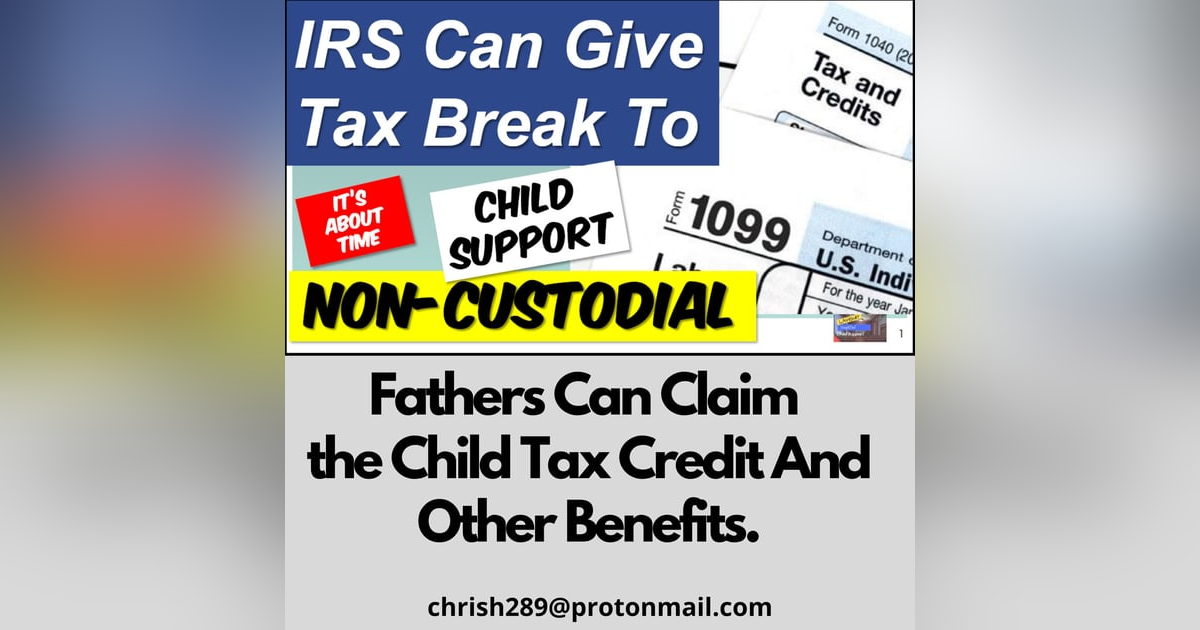






Claim the Child Tax Credit While On Child Support Payments - Form 8332
If you are a non-custodial parent ( which is usually a father), it is possible for you to claim child tax credit. You claim the child as a dependent on your tax return who is under the age of 17.
If you were recently divorced or separated during the last six months of th year, you may still be able to claim the credit in some cases. The child tax credit is about $1,000 tax credit for each qualifying child that you can claim.
You must also have earned income. Earned income includes any earned income you get from working, and any income that is not investment income (dividends, interest, capital gains, etc.).
comprehensive overview of the child tax credit, child care credit, earned income tax credit, and additional child tax credit is available from the IRS.gov website.
📖 To Schedule Discussion and Conversation:
👥 Calendar: https://bit.ly/Calendar-ChildSupport
📢 Email: Chrish289@protonmail.com
📝 Let's Connect On Social Media:
👍 Facebook: https://bit.ly/FB-ChildSupportMadeSmple
🐦Twitter: https://twitter.com/chrish289
📸 Instagram: https://www.instagram.com/chrish289/
✅ Youtube Video Link: https://www.youtube.com/watch?v=fLgQrjWOVVg
❤️ Please Support This Channel:
PayPal
💎 $25 Donation OR any amount: https://bit.ly/ChildSupportMadeSimple
[Accept All Payments- MasterCard, Visa, , Etc]
Cash.app
💎 Any amount: https://cash.app/$chrish289
Claim the Child Tax /Credit Refund Even With Child Support Payments - Form 8332
@chrish289
(c)copyright 2021 - 2130
Introduction:
Chris H 0:03
Welcome.
Chris H 0:06
In today's session, we have a special video. As a result of being the first part of the year, which is tax season, we've decided to put together a video on whether or not the non custodial parent can claim the child's on their tax return or children. And we've received many questions on is this possible? And so we put together this special video in order to answer some of those questions. This is a question that comes up often this time of year. And both for folks that are on the Child Support Program, which is non custodial, as well as those who are not on a child support program. So this is for an audience of either the non custodial with or without a child support order in place. Let's get started.
Chris H 0:57
Here on the screen is the form the IRS Form called the 8332. This is the form that you use that the custodial parent would use to allow the non custodial parent to claim the child for that specific tax tax here. And so this is what our video our special video is about.
Chris H 1:22
Hello, my name is Chris. And in this session, and on this channel, we always compare how the Child Support Program comes into conflict with
Chris H 1:34
your your rights, whether federal or state. But in this session, we're going to discuss how you have the opportunity as a non custodial parent to take advantage, or at least be allowed to claim the child that you are not in custody.
Chris H 1:51
Let's get started.
Chris H 1:54
As always, we have our non lawyer Maxim, which is we teach you the case laws reviews for your specific case. And in this special video, we will talk about the folks that are on the child support which are a man on child support, as well as though they're not on a child support order, but they are considered a non custodial parent.
Chris H 2:20
We also have this disclaimer, this session special session is about tax advisor. And so we have a disclaimer that says we will cover the general provisions of this particular tax strategy. But in no way are we providing accounting, or guidance we recommend and we strongly suggest that you review what we've covered in this video with your accounting advisor or your tax advisor for more specific details that fits your situation.
Chris H 2:52
So in this session, what we're going to discuss is five things we're going to start off with will describe the 8332 form, also known as the release or revocation of the child exemption for noncustodial. Parents. We'll look at and review the case law surrounding this process, which is an IRS process. And the most recent decision is damar versus commission of IRS which is 2019. Next, we'll look at the benefits. What do you need to know? Well initially, if you do have a child, the non custodial parent can claim up to $2,000. in child support, and a little bit more, we will cover the recent development regarding jurisdiction for the child support. And finally, we'll look at how to introduce this process into your court case. If you have a court case, if you don't have a child support court case, then this part of this it be good to hear what happens.
Chris H 3:56
We have a section called call to action, where at the end of this presentation to special video, we will walk you through if you have a court case, how you can introduce this to help resolve some of the financial issues with regarding taxes.
Chris H 4:17
So we start off with that child support is a business it is a private business as part of the Social Security Administration. It is a $28.5 billion business in 2018. And according to their own work, they said they paid out $27.4 billion
Chris H 4:39
as part of their child support collection process and of course 28 point 5 billion minus 27 point 4 billion is about a billion dollar difference there that goes to the to the Child Support Agency
Chris H 4:55
45 CFR 264 point three zero
Chris H 5:00
We've said on this channel that all men are enrolled in the Child Support Program, except many do not have an active case. And that is this that is this section of the statute, it says the state agency must refer all appropriate individuals in the family for whom paternity has not been established, or for whom paternity has been established and a support orders in place.
Chris H 5:31
Here, we're asking for those of you're viewing this video for the first time or those who have reviewed other videos in our channel, we are asking that, please subscribe, and hit the notification bell. Yes, this is a shameless plug. But it doesn't cost anything to subscribe. As well, as we have future videos we'd like to release, we want you to be notified immediately.
Chris H 5:57
So let's start off with the case law surrounding the 8332 form in tax. So this is a recent case law from the United States Tax Court. And it's damar versus the Internal Revenue Service. And here, the courts decided in 2019, what are the guidelines to allow a noncustodial parent to claim the child on their tax return?
Chris H 6:27
Let's look at the form itself 28332 form, it's called the release and revocation of the claim for the child from the custodial parent. So on the screen, I have the upper part, there's three parts to the program, where you complete the information. So to start off with, you include the Father's name, most of the time, the fathers are the non custodial parent.
Chris H 6:56
So that's why they go into non custodial parent, then you put the social security number there in the top right,
Chris H 7:04
then Part two is where the one who has custody, usually the mom, and here on the screen, I put Jane mom doe.
Chris H 7:15
And here in the section, she agrees not to claim the exemption for the child. So I'll repeat, this is a section where she claims she not have the exemption for that job. And she's allowing the noncustodial parent in which to claim the child. So we complete the name, Mom, then you put the tax year in which that this form is being completed. As well as the custodial mom signs the document, her security number goes on there as well as the date in which to form
Chris H 7:53
basically was signed and created. So this is where the exemption where, again, Mom, or custodial agrees not to claim the extension, which is part one.
Chris H 8:08
Here we are in part two, where this is where
Chris H 8:14
I agree not to claim the extension again, Mom, but now we're going to specify the years in which that the custodial parent will not claim to son or daughter No, and I put here you know daughter DOS and sunbow. So for the tax years, you could put multiple years you could put
Chris H 8:35
here on the screen, I have 2022 2023 as well as 2027. Could you gap the years Yes, you can have a gap in the years you can select. So this is where you specify the years. So it does not have to be chronological. It could be every other year. Again, it's the agreement between the custodial parent in the non custodial parent. And of course, we finished this off with the signature of the custodial mom and her social security number, as well as the date in which the agreement was signed. And again, here is where we're specifying the years of which you're allowing the exemption to the non custodial parent.
Chris H 9:24
We're now at part three, which is what is called the revocation of the released. Now this section is if the if the custodial parent allow the non custodial, non custodial parent to have let's say certain years, the mom or custodial
Chris H 9:45
can revoke one of those years or many of those years are all those years. So in essence, then the custodial parent can release the years in which that the dad can claim as well as revoke. So this is
Chris H 10:00
One form that has both the release and the revocation. On the bottom or the back of the form, there's an entire section on what should the non custodial parent do with this form once they have received it. There's other information here. And this is where we said, you sit down with your tax advisor and go over the rules for this program. Again, we're not providing the financial advice or tax advice on this, please review that with your professional.
Chris H 10:33
So this brings us to what are the benefits are what do you need to know about form 8332? Well, to start off with, it gives tax benefit what is called a child tax credit up to about $2,000. There is also the additional tax tax credit, which for those who qualify gives a little bit more again credit towards paying down your taxes.
Chris H 10:59
Also included as credit for other dependents. What that means is that if the non custodial parent has another family, and you've included that parent, which you don't have that child which you don't have custody in that you can take advantage of the credits for the dependent care.
Chris H 11:18
The form also allows for what's called optional, it may or may not apply. And again, this is where your tax advisor will help you with this. There's all the earned income credit which are available to custodial parent. There's also the child dependent care credit, as well as the head of household filing status. Again, review this section with your tax professional to see whether or not you qualify for that. What that gives you is additional funds towards reducing or even attacks tax refund for the non custodial parent.
Chris H 11:59
In the past, all of this used to be handled under a divorce decree or a Separation Agreement. And it could be used that in support agreements and a Separation Agreement could be used as a substitute perform a 332. But this is no longer permitted. As we looked at the case before, at the beginning of the video, the final ruling was made that you must use this form if the non custodial parent wants to claim the child.
Chris H 12:31
Here we are now what is called delegation of authority. This is now the IRS rules. And this is a matter of jurisdiction. There are several areas in which child support has nothing to do with the IRS because the IRS did not delegate their authority to any other agency. And so let's compare what happens in this case. Again, this video is a special visa covers both men who are on the Child Support Program. And those are not on the Child Support Program.
Chris H 13:10
26 USC which has Internal Revenue Code regulations 1.1524 where the Tax Court did not want to get involved in what is called custody fight within the states, as you know IRS laws or federal law, and that child support and custody issues are state control. And so the IRS didn't want did not want to get involved in that. So they created this section of the law, including other session law, where regardless of who has custody of the child, based on state law, or based on their divorce decree or settlement, the IRS will allow the non custodial parent with this form to claim the child. There's other provisions in the law that allow this. So this is a separate rule that the IRS has created under this provision. We have a video called defend your rights. We ask that you review that video in terms of how to defend your rights within this IRAs provision.
Chris H 14:18
Another area in which the IRS has their Dell near delegation of authority and no one else has that is the 1099 workers program. That is a federal federal government designation. And if you're in child support, it does not cover this category. In other words, if you are an independent contractor or a 1099 worker, you are not within the jurisdiction of child support. However, you can take advantage of this a three three form. Again, it's both for folks that are in the Child Support Program and those that are not included or are not ready
Chris H 15:00
required to be in a child support program. We have a few videos on the 10 nine nine program, we asked you to review those video for more details.
Chris H 15:10
So why is this possible? Why is the IRS able to create rules that either circumvent or just not involved with the transport program. As you know, our government works on what is called the supremacy clause, which established that the federal government rules and laws supersedes that of state law and state law cannot interfere with federal law. And that is a supremacy clause, which is article six, paragraph two of the Constitution United States.
What that means is that the IRS can set their own rules, despite what the state wants under the Child Support Program, if you're not on the Child Support Program, and this doesn't matter, but I wanted to take the opportunity to explain why this a three three form is allowed, and why it does not matter what the state's say about custody, and all the issues surrounding custody, and non custodial parent.
Chris H 16:12
So here we are at what is called my opinion, okay, this is all about the child tax credit for non custodial parent. The advantage of this a three three form is that if you have young kids below the age of 16, that there's a good chance that you qualify for a child tax credit. And it's up to $2,000, it could be even more. And what this credit does, it reduces your income tax responsibility, in some cases give you other benefit. So this is an excellent program in which if you're on child support, male you should look into to help reduce that tax burden. As well as if you're not on child support. This gives you an opportunity again to reduce your tax responsibility and your tax requirement.
Chris H 17:02
So here we come to what is called a blessing versus Freestone is a famous case about child support. So now we're going to talk about the child support issue. And a three three form for the non custodial parent.
Chris H 17:18
The title for the program was never
Chris H 17:21
installed to benefit what is called the mother. It says here that title 4d was never intended to benefit individual children, or the custodial parent. And it was only in place just to assist the federal government in reimbursing the state's.
Chris H 17:41
Next, if you've already filed your tax return, and you need to amend the tax return, and you decide that you want to give the non custodial parent what is called the claim that child talk with your tax professional. But we believe in based on the ruling of the Internal Revenue Service, that you could actually go back a few years and allow the non custodial parent in which to claim that child.
Now this is a great opportunity that if you missed out missed that, say a year ago or two years ago, there's a possibility that you can go back and this form on the screen is called a 10 40x for amended return. Again, the details of this, please consult with your tax advisor. But we believe there's an opportunity for you to recapture the past years of cleaning the child on your taxes.
Chris H 18:44
So here we are at our call to action screen. This is where you now introduce this 833 form strategy into your court case, either by a petition or emotion in the courts. And it doesn't matter whether you're divorced or unmarried, whether you're on child support, or you're not on child support, you can start this process now.
Chris H 19:13
Again, this special video covers both. So knowing that this does not benefit the mother or the child and you want to introduce this to capture that
Chris H 19:26
the child tax credit. You can sit down with your Professional Tax Advisor accountant work out the scenario to see if there is a benefit or not. And then you can bring this evidence into your court case. So where does that leave mom since the mom or the custodial parent has to give permission or you can present this knowing that title four D does not benefit the mother or the child. You can introduce this without involving Mom, you do
Chris H 20:00
Have to get the courts to agree that it's okay for mom to go ahead and sign the form. Obviously, if mom objects, that that's a contention for the court, but at least you have an opportunity to take advantage of this, knowing that mom in of itself is not a party to the top to the title for D program. And the idea for introducing this special video is to reduce the financial burden on the family. That's the purpose of this section. It's not so much whether mom is right, or the dad is right, is that let's find out what's in the best interest of the child in terms of the financial burden on both parties.
Chris H 20:47
So here we are, at the end of this special video, again, want to thank you for taking the time to review this. And this specific program that allows a noncustodial parent to claim specific years for the child that they don't have custody for, again, the custody questions are for state matters, the IRS will allow the deductions regardless of whether you're the you know, custodial and noncustodial. We also ask for you to subscribe to this channel. We will bring more videos we'll do more research. Now while we're doing research, and that takes time we're asking for a small donation, a small gift in the amount of $25 to aid us in that research.
Chris H 21:36
So we're at the end, and on the screen. We have videos will we ask you to to review. Again, this special video was How can a noncustodial parent claimed the child on the tax return for better financial security. And again, thanks Have a great day.



