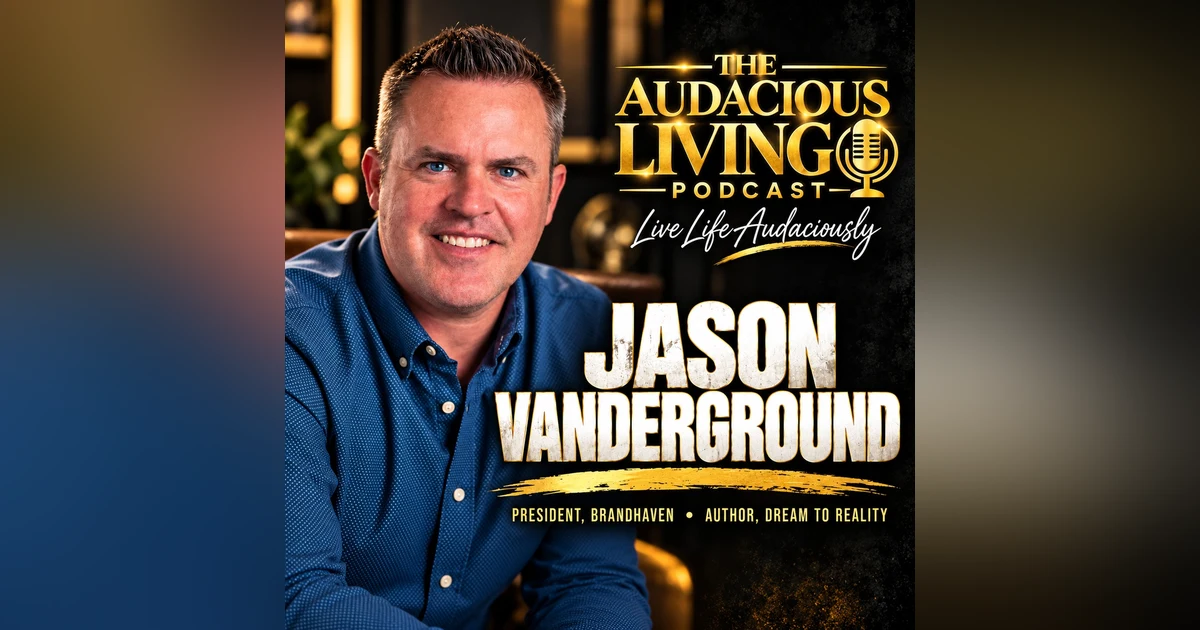
Audacity Without a System Is Just Hope with Jason Vanderground


What if your dream is not stalling for lack of passion, but for lack of a plan?
Signature Quote
"Audacity without a system is probably just hope. And hope's great, but it's not a strategy and it's not a plan."
That line landed like a bell in the middle of this conversation, because it names the gap most of us live in. We have the vision. We have the wanting. What we do not have is the next most important action written down anywhere.
Jason Vanderground has spent thirty years closing that gap for brands and movements, including the He Gets Us campaign that reached the Super Bowl. In this conversation he walks through his DREAM framework, Define, Research, Experience, Apply, Measure, the same system he has refined across three decades, and shows why it works just as well on a personal dream as on a national campaign. He also gets honest about the detours: losing his corporate job at forty, missing a live radio interview for his own book launch, and the two words, "only forward," that pulled him out of the spiral.
This is a conversation about giving your boldest vision some scaffolding, and about the quiet kind of audacity that does not need a spotlight.
This episode is for you if...
- You have a dream you have rehearsed more than you have built
- You want a practical system for turning vision into measurable progress
- You are navigating a detour and need the pivot from "why" to "what's next"
- You believe audacity is quiet courage, not loud performance
Jason Vanderground is the president of Brand Haven, a Grand Rapids, Michigan agency, where he has spent thirty years using the principles of marketing and branding to build things that matter. His team was part of the work behind He Gets Us, the faith-based campaign that became a Super Bowl advertiser. His first book, DREAM to Reality, was published this September and lays out the framework he has refined across three decades of practice.
What sets Jason apart is where he points all of that expertise. His name means healer, and he describes his life's work as healing and reconciliation, finding where things are broken and helping make them whole. He is a self-described introvert and a father of three boys who still feels the same spark he felt in his first college marketing class.
He joined the podcast to share the system behind the dream, and to make the case that audacity without one is probably just hope.
DREAM to Reality is available on Amazon.
[ADD GUEST WEBSITE LINK]
Listen on Major Platforms
🎧 Spotify → https://open.spotify.com/show/2jVR6V7X2kRiCCDXE0FTyl?si=IR3TsfEWR3WA6BzfBRnVXQ
🍎 Apple Podcasts → https://podcasts.apple.com/ca/podcast/the-audacious-living-podcast/id1547447345
📦 Amazon Music → https://music.amazon.ca/podcasts/9f7902bb-dec8-4bd9-918d-d1fef21b7c67/the-audacious-living-podcast?ref=dm_sh_pGv57yQvAmAQVp2IIaXoDwtFt
Enjoying the show?
Share this episode with someone who needs to hear this.
⭐ Leave a review:
👉 https://ratethispodcast.com/audacious
I'll do a three-to-one countdown because every professional podcast, you gotta do three-to-one countdown, right? And like, you know. Here we go. Maybe it's just an opportunity to show off my counting skills. I don't know, but here we go. ⁓ Three, ⁓ two, ⁓ and one. ⁓ Hey Jason, thank you for joining me here today ⁓ on the Audacious Living Podcast. ⁓ glad you could be here. We were joking, we probably could have pressed record 10 minutes ago, and we probably should have, but it doesn't matter. We're here now. ⁓
Jason Vanderground (00:04)
Have to.
Jason Vanderground (00:26)
Thank you, thanks Audley. It's great to meet you and I'm really looking forward to the conversation.
Audley (00:31)
Yeah, I I am as well, cause and and and you so ⁓ correctly put it. I think the work ⁓ that we do ⁓ are are very much in line and in sync with one another. Obviously the audacity work and the framework and and the and the and the encouragement of living your best audacious life ⁓ is something that we probably always and often hear and and your and your work around I guess the principle of dreaming, the concept of dreaming is ⁓ I I I think the two work hand in hand. In fact
Audley (00:59)
It's one of those so th th there there there's there's a handful of words that when I think about at their core of their existence, it I automatically smile. And and dreaming is definitely one of them. And so, ⁓ perhaps as as as a starting point, Jason, ⁓ I can get you to ⁓ introduce yourself to our audience and sort of talk about the work that you've done and what and what's got you to the point that you're at now.
Jason Vanderground (01:21)
Yeah, thanks. So Jason Vanderground, ⁓ based in Grand Rapids, Michigan. I grew up in northeast Ohio, so not not too far from
Jason Vanderground (01:31)
Our neighbors to the north, just on the other side of Lake Erie. ⁓ And yeah, I'm president at a ⁓ firm called Brand Haven. ⁓ most people know us from the work that we did with He Gets Us, but really our my life's work has been how do you use the principles of marketing and advertising and branding ⁓ to ⁓ to build things that matter, but to all but to spark movement, social change. How do we get people to think
Jason Vanderground (02:00)
and act differently, especially when it comes to things that are that just make for a full and healthy life. And ⁓ so that that's what I am I'm all about.
Audley (02:10)
What ⁓ what what sorta got you to the w with w with all getting deep in your whole your whole resume and it's not even about the resume, I'm more curious interested as to why you got to where you got to.
Jason Vanderground (02:22)
So I was ⁓ in school, I was not particularly good at math or science. So I knew that my future was not there. ⁓ And I thought maybe, you know, maybe I'll be an FBI agent. We we were just talking about this the other day. We're like, if you weren't doing what you're doing now, you know, what would you be? What would be so I would probably either I'd like to be an FBI agent or a professional sailboat racer would probably be my two things. But in ⁓ college, ⁓ I took a marketing class ⁓ and ⁓
Audley (02:45)
Okay. Okay.
Jason Vanderground (02:51)
I s for the first time sa. ⁓
Jason Vanderground (02:54)
How how are people's attitudes shaped? How do those shape their behaviors? What changes their mind? What does and I and I was like, that's the part I'm interested in. So the the psychology, the sociology that is behind marketing and branding, that's what caught my attention. Almost like I could feel it going through my veins. And I was like, ⁓ that's what I was made to do. And so yeah, I wrote thank you, Les Kramer. he taught my first marketing class in undergrad, and ⁓ I've just been in love with
Audley (03:28)
And so like y you've been in this this this field for like thirty years. It's a long time.
Jason Vanderground (03:34)
I know, it goes by fa I just had my birthday, so I just had to last week. So yeah, fifty-two years old. So it ⁓ yeah, I started working in the field when I was still in college. I think it was my junior year I was working full time at an ad agency. So it's been a minute. It goes it goes by fast, but ⁓ yeah.
Audley (03:35)
Wow.
Audley (03:41)
For you.
Audley (03:53)
And so th that same spark is it still do you still feel it today? Like, you know, you talked about feeling it, you know, back then in your veins. Do you still feel it now, that excitement and and love for what you do?
Jason Vanderground (04:02)
Ever every day. I d just there's there's so much you know, at ⁓ I have a friend and he was like, Jay, just ⁓
Jason Vanderground (04:10)
Over the next 10 to 15 years, everything is going to change. You know, what's happening with technology, ⁓ how society and culture is changing, artificial intelligence, basically everything that you see and experience today, at some point in the next 10 to 15 years, will be radically overhauled. And I think it's really important that we overhaul these things for the good. ⁓ And so, ⁓
Jason Vanderground (04:35)
You know, we ⁓ my name actually Jason means healing, healer. And so I'm very much interested in ⁓ healing and reconciliation. And how is it that where we have brokenness or fragmentation, ⁓ how are how do things get made whole again? And of course we can't we're never gonna do that in our lifetime, but we get to be a small part of that. ⁓ And that's what I wake up every day doing is how do we how do we help people see maybe I'm not that different than my neighbor? ⁓
Audley (04:40)
Okay.
Jason Vanderground (05:05)
⁓ Or, you know what, maybe we have more in common than we thought. Or, you know, maybe I should maybe I should check that assumption. ⁓ I thought I got here on a rational basis, but it was kind of emotional. So ⁓ and also I, you know, I I I love the idea in advertising of, you know, that you don't have you don't have to feel bad about ⁓
Jason Vanderground (05:25)
people desiring less Spartan lives. And so there are good things that we can, you know, as long as they're not taking over. ⁓ But ⁓ a home, clothes, ⁓ good entertainment, the you know, these are ⁓ these are good things too. They can be good things. And so ⁓ you ⁓ know, we get to work on all sorts of things ⁓ in our in our line of work. ⁓
Audley (05:47)
Got you. Gotcha. Well it it's it's it's great to hear that it still sparks you ⁓ th thirty years later, which is which is awesome. That in itself ⁓ is a whole conversation around finding do you know the things that you love and finding ways to be around them. ⁓ 'cause a lot I'll tell you, Jason, a lot of people don't have what you just described. I wanna make that clear. A lot of people don't, and so the fact that you do is a big deal.
Jason Vanderground (06:08)
I have this I have a so we're talking about our books coming out and your your book is coming out in December. Mine ⁓ just came out in September and I've had a couple people reach ⁓ yeah yeah. Yeah, so the the the book is ⁓ yeah, I have it I have it here. It's on my bookshow. Yeah, so dream to reality.
Audley (06:17)
I I was I was actually waiting for you to say mention your book. I was gonna say, Jace, you ever told me about your book, right? That's you gotta get used to talking about your book.
Audley (06:27)
Sorry boy. Yeah. Yeah.
Jason Vanderground (06:28)
It's still so new that sometimes I have to read the subtitle just so I make sure I get it correctly. I don't know if you have that at all, but ⁓ it's a yeah, it's the framework that builds brands, sparks movements and drives real change. And but I had a couple of college buddies reach out and go, Hey, I'm kinda stuck. I don't like where my career is at. ⁓
Audley (06:33)
Ha ha. ⁓
Jason Vanderground (06:47)
you know, what would you say to me? Like what does it mean to turn my dream into reality? And I didn't know if my friend was like just putting me on and and like be ⁓ because he was hilarious in college. He was always facetious, always joking about something. And I was like, Steve, I can't tell if you're just like putting me on right now or if and he goes, No, I'm really serious. So, ⁓ I think, you know, I I ⁓
Audley (06:55)
Mm.
Audley (07:00)
Right.
Jason Vanderground (07:11)
I love the idea of audacity though, and I do think it fits with dreaming. ⁓ And I think it's all about ⁓ imagining imagining things being different than they are right now. But the audacity part I love is because a lot of times we're afraid.
Audley (07:16)
Very much so.
Audley (07:23)
Yes, yes.
Jason Vanderground (07:27)
⁓ and I'm I have this every day. A lot of times we're afraid to either say this thing out loud, start a conversation, ask a certain question ⁓ that would be the thing that would break through for you. But it's the ⁓ getting comfortable in the uncomfortableness and knowing that that's probably where I'm growing. But I love being comfortable. I would just, I would love to just why does it have to be this hard? So ⁓ but that's that's where.
Audley (07:28)
Yes.
Audley (07:34)
Yes. Yes.
Audley (07:43)
Yes.
Audley (07:46)
Yes, yes, yes.
Audley (07:51)
Right, right, right, right, right, right.
Jason Vanderground (07:55)
That's where growth for us as as human beings comes from.
Audley (07:57)
Yes. Yes. Well the the the idea of deep even daring to dream that is an an a dacious act in itself. And ⁓ you're absolutely correct. That that you know that that that comfort zone, that space that just feels nice and I don't have to worry about anything. I know it. It's familiar to me, all these things. It's and it's but but you're right, there's no growth that happens in there. The the the other thing that ⁓ I it's really interesting is I find the more I talk about audacity, I oftentimes have to talk about what it isn't.
Audley (08:27)
Because there are some misconceptions. So for example, there's actually three ⁓ myths I identified. ⁓ the first one is that people seem to think that if you're not the the the the loudest person in the room, if you're not skydiving out of planes, or you're not wrestling alligators in in the swamp and you're not being audacious, right? Because those are big things. Whereas what you just described, even you know, f you know, fighting through your comfort zone, that's a small act that requires that quiet courageousness.
Audley (08:56)
But it still is a audacious act in itself. And ⁓ I and I think that's a huge one. The concept of even dreaming is audacious. Daring to dream is audacious. They're not big. They don't no no one can probably know no others they're not visible to others, but they're still there. ⁓ and that's that's really what my my my I go to, I think about when I thought when I when I think about dreaming and how important that is to us.
Jason Vanderground (09:20)
Yeah, I think to me, ⁓ and I'm an extroversion is not my natural way. I I'm I'm
Jason Vanderground (09:25)
Definitely more introvert, but it's like in the line of work, you're like, well, you gotta you gotta kinda talk to people. ⁓ but I yeah, I would agree. I don't see audaciousness as having to be larger than like I think ⁓ you know, I'm speaking from recent personal experience here, but ⁓ having somebody in your life who has just experienced the death of a very close family member, ⁓ reaching out when you're ⁓ uncertain and you don't know the right thing to say and you feel like ⁓ but just going, Hey, I sit with you.
Audley (09:30)
Yeah, that's right. That's right.
Jason Vanderground (09:55)
You in your grief or whatever pain that's audacious. That takes tremendous courage again to move outside your comfort zone, to engage with another human being, ⁓ to put yourself out there, to take a ⁓ real risk relationally when ⁓ it would be way easier to just avoid that conversation. So I agree with you. I don't think you have to have this like larger-than-life personality to be living audaciously. Yeah. ⁓
Audley (09:59)
Mm-hmm.
Audley (10:02)
Yes.
Audley (10:21)
No, no, no, no. There's a there's another one that that actually when I was reviewing stu looking at some of material, ⁓ it resonated with me because you talk a lot about having systems. So if you've got a vision, it's not just gonna happen because you've you know, you you you there's motivate you like you're motivated to do it and you really, really want it. There are systems that need to be in place in order to get you where you want to get to. And it's interesting because another sort of myth I work through with individuals is that there seems to be a belief that ⁓ audacity is reckless.
Audley (10:51)
And so we all got that image where someone walks in one day to their boss says, I quit, and they pack up all this stuff and they put in a cardboard box and they're out the door, right? Is that an audacious act? It absolutely is. There's no question about it. But at the same time, that same individual who, you know, who comes into work, who's not feeling fulfilled, not feeling satisfied, they start doing some planning, they start developing some systems, they find where their in their next leap is, and then they quit, right? That's still an audacious act in itself, but it's very, very different than the outward.
Audley (11:20)
being reckless. And so that's something that ⁓ so I guess where I'm going with this is I'd love for you to sort of let's let's get into this this conversation about systems, shall we?
Jason Vanderground (11:29)
Yeah, let's do it.
Audley (11:32)
The the the so I guess what's the s what's the what's the starting point of having a good system? Like I mean how y y I mean you can develop systems but how do you know you got a good one? Is it do you wait to the end to reach your dream or like ⁓
Jason Vanderground (11:42)
Yeah, I know.
Jason Vanderground (11:45)
Well, I y ⁓ so that's the whole premise of the book, you know, i is and when you look at the cover of the book, the word dream is very
Jason Vanderground (11:52)
It's kind of foggy. It's out of focus. You know, a lot of times you you don't understand the whole thing at the beginning. You you have ideas, you have inklings, you have ⁓ a premonition, you have a scrap of paper that's like ⁓ something, something that has maybe been gnawing at you or you keep seeing or keeps coming to mind. ⁓ And then the reality, like, okay, maybe weeks or months or a lifetime later, it's like, okay, now I look back and I see it in ⁓ and how it happened.
Audley (11:54)
Mm. ⁓
Audley (12:09)
Yes.
Jason Vanderground (12:22)
And so ⁓ that's ⁓ the challenge that I was seeing a lot of ⁓ brands and social movements were happening is ⁓ great inspiration, you know, maybe audacious at the beginning. So, you know, they they envision things being very different than they were right now. And then where do you go with that?
Audley (12:34)
Yes, yes.
Jason Vanderground (12:41)
And so ⁓ a lot of people kept asking me about he gets us, like you know, and that started with the the dream there was was kind of, you know, how did the world's greatest love story become known as a hate group? Like, how did we go from Jesus saying, People are gonna know that you're following my way by the way that you love and treat your neighbor, even the neighbors that are totally different than you, especially the neighbors that are different than you, ⁓ to Christians feeling comfortable saying, No, God
Audley (12:41)
Right. Right.
Jason Vanderground (13:08)
loves me and God hates you over our difference. And ⁓ so ⁓ how did that happen and could we use media to to change that? You know, fast forward two years later, ⁓ you know, he gets us is a Super Bowl advertiser when ⁓ there hadn't been anything face-based in the Super Bowl in in over a decade. ⁓ And so that process of ⁓ you know the the acronym really that I use of ⁓ it has it starts with defining the difference that you want to make. ⁓ And a lot of times you'll have
Audley (13:37)
Okay. Huge.
Jason Vanderground (13:38)
This idea, but it's like ⁓ and I I have three young sons, or as I talk to other young adults, it's like, what is the difference that you really want to make in the world? What do you feel like you're called to do? Like, what do you want to change? What do you think needs to be different? ⁓ And we all have something like that. ⁓ And then ⁓ so that's that's great. Once you're like, okay, I think this is what it is, ⁓ then then you have to start doing a lot, yeah. Yeah.
Audley (13:56)
Yes, yes.
Audley (14:03)
And and why and why that's a good question, sorry, why that's a great question, 'cause it helps give you some focus, right? Because in that dream stage, you know, things are like all way all up here and you wanna kinda bring it down to earth a little bit where you can actually look at it as opposed to you know, it's up in the sky, so to speak.
Jason Vanderground (14:09)
Yes. ⁓
Jason Vanderground (14:19)
Yeah, and it can it can start with something very loose, but you've you've got to wrestle with it for a while. And I think I think you really gotta spend some time and make sure you're not just kind of ruminating on these things, not just kind of spinning your tires in the mud. ⁓ But there's a way to go about okay, what I can out of your dream. ⁓
Audley (14:24)
Yes, yes.
Audley (14:34)
Yes.
Jason Vanderground (14:40)
What is it that I really want to change? And it can be something, it can be your life, it could be your career, it could be something that you want to see different in your community, something in your your local school. ⁓ Like ⁓ most people have this kind of thing, ⁓ but it may just stay in the, ⁓ I wish I would. ⁓ And I've thought about, but not you haven't really defined the difference. What is the change that that you ⁓
Audley (15:01)
Yes. Yes.
Audley (15:05)
Yes.
Jason Vanderground (15:08)
want to to make yourself. ⁓ And I think then once you know that, you gotta do a lot of research. Because a lot of times I'll come up with a dream. I was, you know, it's like
Jason Vanderground (15:17)
And then you realize, yeah, that already exists. That's covered pretty well. Like we got that, you know, or you start learning things about it as you research. And the research can be as simple as just sharing it with other people, starting to get feedback, having ⁓ conversation about it. And ⁓ that starts to give the dream shape. And then I really went to ⁓ you have to you have to turn it into an experience ⁓ and something that people can do that is ⁓ emotional, something that they can interact with.
Audley (15:30)
Yes, yes.
Jason Vanderground (15:47)
With. ⁓ And then seeing things, I'm I really like to see things as like integrated systems. How do all these pieces work together? ⁓ And so how do you then apply what you've come up with in a way that
Jason Vanderground (16:02)
⁓ it gets through to in every single touch point that a brand or a movement has ⁓ with an audience and then ⁓ really figuring out how do you measure what matters and that you've got to measure ⁓ you know the typical things that we think about like hey finances and revenue and but also ⁓ am I making the difference that I said I I wanted to set out to do and ⁓ and how do you do that? Because sometimes the more noble the dream, ⁓ the less accountable sometimes we can think we need
Audley (16:23)
Right. Mm-hmm.
Jason Vanderground (16:32)
be to is it making a difference? ⁓ But it's important to bring that kind of business ⁓ rigor to the dream because that's what keeps us accountable to it ⁓ over the long haul.
Audley (16:43)
Yep. Yep. I guess it's on the on the measuring piece, I oftentimes you you you you when you think it through, some of the things that we wanted where we say, you know, make it go so hey, I want to make a difference to the world, it's it's so difficult to t to measure. And and so what I oftentimes talk about, start within your world, right? Start within your sphere of influence and and and work outwards because i it it is it is big. So we're talking about the whole world, it is big, but I think starting in your personal space is is a good starting point.
Audley (17:12)
Is is are there any other thoughts and other ways to measure the stuff that are more difficult to measure? Any any ways of do good ways of doing that?
Jason Vanderground (17:19)
I think one of the things that we would measure is, well, ⁓ when I worked in healthcare, one of the things we would say is you there's no there's no mission without the margin. ⁓ So if if things aren't if the numbers aren't good, why it's gonna be really hard to fulfill our mission of say making the community healthier. ⁓ we need those two things, you know, working working hand in hand. And so ⁓ I make that point ⁓ in the book that I th one of the other things I would say is ⁓
Jason Vanderground (17:49)
Especially with social change initiatives, ⁓ we measure things like ⁓ is the audience kind of more aligned with the point of view that you're and so with he gets us, it was ⁓ we would measure ⁓ do do people ⁓ think that Jesus loves them for who they are? Are they more interested in reading about him, reading more stories from his life? ⁓ And so it wasn't just are people visiting the website they were, are people engaging on some
Jason Vanderground (18:19)
social clicks, likes, all that. You know that th those are great things. ⁓ But
Jason Vanderground (18:24)
Things that measure am I actually are we making the difference that we set out to make? And I think I I call that strategic alignment. It does the group that you're serving go, you know what, the point that you've been making around Jesus and ⁓ being making peace between kind of factions that were at odds with each other, being a bridge builder, ⁓ going against all of kind of the social norms to reach out and love on other people? ⁓ Is that is that getting across in what we're trying to communicate more so than just
Jason Vanderground (18:54)
⁓ are a lot of people on our website and engaging with our social content.
Audley (19:00)
I'm wondering, Jason, ⁓ what made you finally decide to take your system and put it into words and put it in a book? I mean, you I'd imagine that you've worked with a ton of leaders and a ton of brands, helping them to solidify their vision or bring their vision to to reality. What was the tipping point for you to say, you know what, let me let me put this in a book?
Jason Vanderground (19:22)
Yeah. So you have all this material. I'm sure you probably have this too. You you're like, I've I got some here and I got some here and I got these papers and I have this episode and there was something about ⁓ seeing the big story and and knitting it together and then
Jason Vanderground (19:39)
Just saying, hey, here are some principles that I've used. Here's some helpful things that people have shared with me over the years. And getting it in one piece of material. And I remember even when I got my manuscript, I'm like, boy, if this thing never gets published, my manuscript is invaluable just to me. Like to have all this stuff documented and go, Yep, those were the stories, those are the approaches, those are the examples. That's really what stands out over the thirty years of doing this work. So
Audley (19:58)
Yes.
Jason Vanderground (20:09)
⁓ it's great because I can even I can load my own book into Claude and ask ask it my own questions. Because a lot of times I forget. I remember ⁓ Stephen Covey said something like, only 60% of the time would he actually abide by his ⁓ seven habits of highly effective people. And I was like, so just because ⁓ you spend a lot of time doing it.
Audley (20:28)
Really? Okay.
Jason Vanderground (20:34)
doesn't mean that you are consistently living up to it. And so ⁓ now that it's written down, ⁓ you you have it in something that's defined and I can always go back to it. And then it makes it a lot easier for me to share ⁓ these principles, this approach with the world. And it and it, you know, it gives me opportunities to to meet and talk with somebody like you.
Audley (20:41)
Yes.
Audley (20:50)
Sure. Yes.
Audley (20:55)
Yeah, no, it's awesome. No, I think it I'm well thank you for doing that because it does. It gives it i it it almost it brings clarity to thought. That's kind of how I view it as I like because you're right. You're you're over here, you're over here, you're over here. And then the other thing that at least in in my space, what happens is, ⁓ you know, ⁓ I mean, I've been doing this podcast for six years. I've got like seven hundred plus episodes. And I and I will tell you, Jason, and I say this all the time, every guest that leaves this podcast, they leave a piece of themselves behind.
Jason Vanderground (21:03)
Yeah.
Audley (21:25)
Right. And I'll and I'll go, you know, Jason said that on and I'm how can I apply that here? And so I've got all these pieces, ⁓ right? So when I talk about you know, my book is three it's it's it's it's built on three pillars. One of them is pieces of all these guests, all these seven hundred plus guests and their p and what they've left behind. ⁓ another pillar is kinda like personal lessons and stories that I had in my own life. And then the last one is sort of frameworks I developed as a result of the first two pillars, right? ⁓ And so, ⁓
Audley (21:53)
It really helped the idea of putting it all down, brought clarity of thought. And then what it also did, it opened up new learnings and new things that new connections I never made. And so one of the connections that that came to mind very, very clear ⁓ is ⁓ this thing that I call audacity. It was it it was always present in my life the entire time. I was always exhibiting it in some way, but just didn't know it, nor did I have the language.
Audley (22:20)
say, Hey, I'm being audacious. Like I d I was I I didn't know, I was ⁓ acting and so ⁓ yeah, I think there's great power in in in in putting things together.
Jason Vanderground (22:30)
In your writing, have you been able to trace back to kind of the very first time in your life when you think that you recognize audacity? Yeah. What was
Audley (22:38)
Absolutely. ⁓ Absolutely. There's there's a story to that one. There's actually two key points. I was, I was, I and I literally remember I was I was a participant ⁓ in ⁓ a communications workshop literally in the 90s. ⁓ And a gentleman and I with the we were in a w ⁓ icebreaker extra warm-up exercise, ⁓ and ⁓ we were partnered off and we were told to come up with a word that best describes ourselves.
Audley (23:05)
That starts with the letter of our name, the first letter of our name. And so I was with the gentleman and I said, the first that came to mind was audio. I'm just thinking my voice loud. I'm audio. And he looked at me and said, Nah, you're audacious. And literally I was like, Huh? Like woo and and and and and I could remember my my just kind of what's that mean? And what's going on? And and it sat, it sat in my memory banks for like in my subconscious for the longest time. And then in ⁓
Audley (23:35)
There's a whole story to this, Jason. So you you asked a really good question. So then in in 2020, we had this thing called the pandemic, which we all know. ⁓ And ⁓ it was at that time I had decided, and at the time, so going into pandemic, I would I happen to be, I was blessed enough to be a commissioner of a of a Canadian basketball league. Huge thrill, love the job, all that kind of stuff. But as you know, rug gets pulled out, we're all like, no, we can't do that no more. And I remember literally going through this period of depression.
Audley (24:02)
Which is very foreign to me because I'm an upbeat guy and you say you're depressed. Like, what are you talking about? And ⁓ I literally was in a f a conversation with a friend of mine and I remember saying, Ever since I lost basketball, and the moment I said that, I was like, That's it. I thought about basketball. Let me re so what can I do? What can so now you know the problem is, you can do something about it. And so I I said, Okay, well, let me replace it. What can I do? Well, I've been podcasting in two thousand eight, it was the first time I did podcast, I can just get back into that again.
Audley (24:31)
And then it became what do you want to talk about? I don't I want something that resonated, something that was powerful for me, meant something to me that I could share with others. And I literally lit literally did a a a snapshot of my life, and I looked at every major accomplishment, every milestone, every victory, and I saw this red thread of audacity. It's every time I did something, it was on the strength of me taking a chance, me not knowing, but doing anyways, stepping into this place called uncertainty.
Audley (25:00)
And it didn't always work out in my favor, but a lot of times it did. And and that's kind of what this this work does. There's no guarantees of how things will spill out. And it was at that point I recognized that audacity was always there the entire time. And then when I started to write, I started to recognize the audacity that are that that exists within my parents. So so then when I look at them individually as my mother and my father, ⁓ I make total sense because those two individually on themselves.
Audley (25:29)
Audacity on a whole other level. So yeah, that's that's kind of been my journey in understanding it. And then of course I go back to that workshop with that, you know, I remember that word sting in my subconscious, waiting for me to bring it out, and it came out like, ⁓ and then the heavens and earth just open up from then after that. ⁓
Jason Vanderground (25:45)
I and to me that's how ⁓ that's there's so many pieces in that. It was somebody else noticing in you and just naming it, saying it out loud, and seeing something that ⁓ you know you hadn't been able to put your finger on. And then when it's said, you go, wow, what if that's it? But you it's interesting in your story.
Jason Vanderground (26:04)
you you don't get it all at once. You don't get the clarity. You don't get the answer. You get you get pieces and you start putting this puzzle together. ⁓ But you keep you keep working at it and ⁓ and then you look back and you go, it's been with me the whole time. And that's I think that's a big part of what writing a book is helpful for is you go, yeah, I've ⁓ I've had these ⁓ ideas. I've had this kind of characteristic about me. ⁓ And ⁓
Audley (26:07)
That's right. That's right. That's right. That's right. That's right. That's right.
Audley (26:20)
That's right.
Audley (26:26)
Yes.
Jason Vanderground (26:34)
didn't just come from me. ⁓ it was imbued within me. And then all these people that I've been able to share it with and something that that carries you forward now. So ⁓ I think for all of those reasons, just getting these core ideas down on paper that define us, sharing them with others and going, ⁓ you know, keep keep living like this, keep doing this. And ⁓ I think especially now with ⁓
Audley (26:35)
Right.
Audley (26:48)
Yes, yes.
Audley (26:55)
Mm-hmm.
Jason Vanderground (26:58)
How separated we get from each other, how easy it is for technology to lead to despair and hopelessness. I would we we desperately need audacious living, people who are ⁓ making their dreams real, going after it, producing ideas, creating better solutions. ⁓ We're ⁓ not there by a ⁓ long shot. We're not where we need to be. And we need people living this way in order to create the solutions that are gonna guide us over the next 10 to 15 years.
Audley (27:04)
Mm-hmm.
Audley (27:26)
And and and that is why the subtitle of my book is is how unleashing your inner greatness can change the world for everything that you just said. Like that's how we change the world by stepping to ourselves, unleashing our integrates. Cause here's the thing like if I use my gifts and I truly ex use my gifts or what they're intended, I'm not the beneficiary. Others around me are. Like the gifts aren't for me. They're for others to be to be benefiting others. So now imagine a space we're all just using our gifts.
Audley (27:55)
We're all putting it out there. We're all benefiting others. That's how you change the world. And so yeah, thank you for making that point. Cause that I I wholeheartedly believe that myself.
Jason Vanderground (28:04)
Yeah, I couldn't agree more.
Audley (28:07)
⁓ I I wanna go back to the this point around you know, inspiration you know not being enough. ⁓ that you know, again, systems and all these other elements added to it can help you, you know, fulfill your dreams. Is that something you've always believed or something that you had to kinda land on yourself and identify?
Jason Vanderground (28:24)
You know, I I have I've always had these dreams, you know, as as a kid and even in like elementary school, you know, a lot of times when you like, you know, you kinda
Jason Vanderground (28:32)
Not really paying attention to what's going on. You're looking out the window. You're it looks like you're not there, but you're you're really deep in thought. And I would have a lot of these experiences. And I think a lot of times as people were told, don't do that. You know, pay attention, stay focused, like the here and now, be present. And those things are important. But I think the act of of dreaming, whether it's a ⁓
Audley (28:40)
Yes.
Jason Vanderground (28:56)
a dream that you're having while you're asleep that a lot of times people will go, that I remember a little bit of that one or you share it with your spouse. You go, This is what I was in ⁓ maybe there's some meaning, you know, in there. ⁓
Audley (29:01)
Yes.
Jason Vanderground (29:08)
And then and then of course when we're awake, it's it's that dreaming and imagining and thinking of things being very different than they are right now. So ⁓ I was just trying to say that that that part is valuable. And I put the dream, the vision, kind of the bold aspiration, ⁓ even above a lot of times, you know, people want to start with, well, what is the problem? ⁓ Here's what's wrong. Here's let's get a problem statement. Or you know, sometimes the people are defining problems.
Jason Vanderground (29:38)
Problems out of the ⁓ pain and brokenness that they see in the world. And that is all good. That that's actually a helpful piece to the puzzle. But I think something that that comes even before that is what is the difference ⁓ that I want to make? What is it in light of that pain or brokenness? And so ⁓ the problem is always there. You we need to be solving real problems. ⁓ But
Jason Vanderground (30:03)
I find the thing that ⁓ usually is what animates ⁓ and propels somebody is is the pursuit of the dream. And then ⁓ the the reality part is just really understand what is the next most important action for me to take in pursuit of that dream. ⁓ And ⁓ you know, sometimes it's ⁓
Audley (30:22)
Right.
Jason Vanderground (30:27)
Not getting too overextended, either financially or in terms of margin, ⁓ personal margin, ⁓ but making sure that your work, what is the next most important thing that I could do to ⁓ pursue this dream and change my reality, my brand, my product, my social movement, my community initiative, whatever that is. ⁓ And to always be asking ourselves about that: what's the next most important thing that I can be doing? And ⁓ those things.
Jason Vanderground (30:57)
Steps that you're taking then every day, they need to work within a larger system. Otherwise, we're just working against ourselves. We, you know, it's one step forward, two steps back. And so ⁓ having a bit of a system, and I put all of the templates that I use in my work in the book. I think there's a dozen templates ⁓ and like 20 real-world examples. I just wanted I wanted people to have the tools that we use ⁓ to figure out, you know, how do you go from a question like, how did the world's greatest love story turn, you become known?
Audley (31:13)
Right.
Audley (31:18)
Sure. Yep.
Jason Vanderground (31:26)
As a hate group, into how are you two years later that there's a real brand? It's called He Gets Us. It's in the Super Bowl, and you have Jesus, you know, and ⁓ and this message of Jesus ⁓ in front of 115 million people. And so that's the that's really the process that I've tried to share with people, but it works on a lot of levels. It works on a personal, on a community level, but also on the biggest stages that we have in culture.
Audley (31:36)
Center, yeah.
Audley (31:45)
Yep. Mm-hmm.
Audley (31:53)
Does it ever get challenging working with dreamers who don't want the systems, they want to keep dreaming? Like, you know, it's it's it' you sometimes you'll have people who are just they're so committed to it, right? Like, I wanted to do this as a little boy and now you're telling me to do what? No, and feeling that maybe that adding systems is pulling them away from their dream.
Jason Vanderground (32:12)
It happens all the time. ⁓ And but without ⁓ yeah. I think especially for dreamers, ⁓ sometimes they can be having like an individual experience and it's like, you know, some maybe you're you're best to dream as just one, ⁓ but if you're going to have like you mentioned, you know
Audley (32:14)
Really?
Jason Vanderground (32:32)
a a professional basketball league, a team, a group there's so much structure and communication that's required. ⁓ you know, when you look at the team effectiveness model, do we do we know what the vision is? Okay, that's the first step. But then, you know, what's my role? What are the val how are how is this all gonna work together? And that's ⁓ I really enjoy that part. How do we see this as an interrelated system? And ⁓ you know for he gets this we had 200 people across
Audley (32:40)
Yes.
Jason Vanderground (33:02)
Seven different agencies all working on it, a client, funders. ⁓ keeping all of those things finely tuned and in working order, it takes a it takes a lot of attention to detail. ⁓ and so yeah, we it it ⁓ if if the only person who can keep track of your dream is you, ⁓ it's probably gonna be really hard to
Audley (33:23)
Ha ha ⁓
Jason Vanderground (33:26)
make it happen in the real world. Like, ⁓ and maybe that's all you need. Maybe, you know ⁓ it made sense to him. Yeah.
Audley (33:29)
When when you ⁓ when you frame it that way, when you f when you frame it that way, it makes total sense.
Jason Vanderground (33:37)
Yeah. But usually even like you, you know, your story is ⁓ I was talking to somebody else and they said this and then I went to this person. Now I have seven hundred, you know, episodes and I've had all these and so there's something about the dream and sharing it with others and allowing them to speak into it and you know, finding a discipline to hold yourself yeah, yeah.
Audley (33:44)
Yes. Yeah.
Audley (33:49)
Yeah.
Audley (33:53)
Yes.
Audley (33:57)
Or or provide clarity, right? Like Yeah, but they can provide clarity and and I ⁓ I'm and I'm I'm o I've always been a fan of the outside opinion. You gotta be and I and I say that with a slight caveat because you don't wanna be ⁓ living to the opinion of others, right? You just wanna be the fine line and be careful of that. But outside like I like I remember once I went ⁓ I was in a home depot. It was a couple of years ago, and I was you know buying whatever, I got in the conversation with the cashier, and the cashier said out of the blue, she said, you what?
Audley (34:27)
bet you'd make a great podcaster. ⁓ I said, right, thanks. Like I think I had like episode five hundred by that point, right? ⁓ But but the point but the point I'm making is that because
Jason Vanderground (34:33)
Yeah. Yeah. ⁓ You didn't you didn't tell them? You didn't you didn't be ⁓ actually yeah, that's what I do. That's yeah. Yeah. You picked up another follower that day, then
Audley (34:40)
Well, I d absolutely I did. yeah, by the way, you can check me out here and subscribe and all that losing the opportunity. ⁓ I probably did. But the but the the the the point though is that ⁓ outside opinions have a perspective of you that you may or may not be able to see fully, right? ⁓ And ⁓ and so you it's and I and I I've always said when someone says, ⁓ you should think about doing this, listen. There's something there. There's something that they can see that you can't yourself, and so yeah.
Audley (35:09)
I think the outside that clarity is really important too and part of the dreaming process.
Jason Vanderground (35:12)
Yeah. I yeah, because we are we tep we think from the inside out and we can live up, you know, in our own mind quite a bit of time. ⁓ And but there's something about the outside in, not that you're ⁓ doing it for that reason, but it's just
Audley (35:18)
Yes.
Audley (35:21)
We said Yes we can.
Jason Vanderground (35:29)
Just to have the perspective, the f the inverse of the perspective that you naturally carry forward. ⁓ And there's some and especially in marketing and communications, ⁓ it has to resonate with an audience. People have to go, I know what you're talking about. You know, ⁓ if you kept using the word audacious and people were like
Audley (35:44)
Right.
Jason Vanderground (35:48)
I don't know what he's saying. Like it, you know, I don't know that word doesn't mean anything to me. ⁓ and so communication, it's all about, you know, is is the receiver of the communication going, yeah, that makes sense. That connects with me, that's emotional, that resonates. I wanna, I want to learn more about that. So ⁓ we need that outside in perspective. And a lot of times that comes from, you know, sharing our dream, sharing our vision with somebody who's close to us that can give us even more pieces than than what we've already gotten.
Audley (35:48)
Yeah, yeah, sorry.
Audley (36:17)
Yes. Yeah. Yeah. ⁓ so now now Dream it you you it's a it's an actual framework, D E R E A It's a framework that you use. ⁓ I know d D is defined, but I kinda feel like we've been talking about different elements of this the entire conversation. ⁓ am I am I am I way off there? Are we how close are we are to
Jason Vanderground (36:37)
We we have. We have. I I try to like not like hammer home the ⁓ acronym all the time because I feel like sometimes you can be like, ⁓ boy, here we go. Another but ⁓ it ac it helps me remember it. Otherwise I can't keep track of it. So yeah, the the D, you know, to find the difference you wanna make. We it's really for me. Yeah. And I I keep staring at the book just so I can like actually, you know, remember what I what I wrote down. It's still new. But yeah, and then this this
Audley (36:49)
Hmm.
Audley (36:52)
So it's for yours it's it's for yourself then. It's for yourself. ⁓
Audley (37:00)
Yeah. ⁓
Jason Vanderground (37:06)
The R is researching with precision. And sometimes that's a you know, a national survey, or sometimes it's just a one-on-one conversation with somebody. But ⁓ somehow we have to go on this quest to learn about this area, what's happening, what's already done, what resonates with people, what doesn't. ⁓ the getting the feedback part, like you said, is so important. And then a lot of times in my line of work, people would say, then you need to make ⁓ some piece of communication after that, maybe.
Jason Vanderground (37:36)
An ad or a podcast or a video series, or and I was like, I don't want to go there. I so thankfully it was E, and I was like, you know what? It today I think it's very experiential. ⁓ And so it's it's a lot about doing first and then ⁓ saying after that. Nike has this framework of be, do, and say. You gotta be about it. Then you need to be actively doing it. And kind of the last step is, yeah, then you can.
Jason Vanderground (38:05)
Kind of earn the right to maybe put it in some words and share that with somebody else. So the experiential part ⁓ is huge for for brands and and for individuals. And then ⁓ then I kind of stepped back and said, well, now we got to make sure once once we know the core experience that we want to create ⁓ for people, then how do we apply that consistently? Not with ⁓ sameness and kind of rigidity. ⁓ it's not like we're
Jason Vanderground (38:33)
we're brand police or we've got to like, you know, make sure that p but there has to be somehow this has to all work together. So you mention brand like Home Depot. It's like
Audley (38:36)
Right.
Jason Vanderground (38:43)
The website, the advertising, the couponing, the merchandising, like ⁓ somehow it all has to come together for that shopper, whether you're in-store, online, consuming media. ⁓ So seeing it as a system and then having a measurement framework. And ⁓ I'm really interested there in in ⁓ the the financial things are obvious. I think we have a lot of those down. But measuring what really matters, like what, even if it's a for-profit business, you know, measuring things that
Jason Vanderground (39:13)
Go back to the difference that you want to make in the world. ⁓ And I think every company should have this. And that's a lot of times, you know, it's it's tucked away in the mission, vision, values area. ⁓ But it needs to be it needs to be front and center. And because I think that's that's what either a consumer or a citizen is responding to: is you go, ⁓ I like the way you do things, I like the way you think, I like what you stand for, therefore. ⁓
Audley (39:23)
Right. Yeah. Mm-hmm. ⁓
Audley (39:33)
That's right.
Jason Vanderground (39:38)
I want to do business with you or I want to sign up for whatever you're offering or I'd like to donate to your cause. ⁓ so that's the framework in a nutshell and the in the book kind of the half of the book explains that ⁓ and then half the book is well how do you actually do that? And ⁓ I I kind of gave it all away. So it's it's all there.
Audley (39:40)
Gotcha.
Audley (39:53)
Gotcha.
Audley (39:58)
What I what I what I do like and I ⁓ it goes without saying is that ⁓ this is something you can apply for your personal life too. As much as we're talking about the business world and and brands, like you can you can literally plot this framework into how you manage your personal life.
Jason Vanderground (40:14)
Yeah. Yeah, I think you can think about it. ⁓
Jason Vanderground (40:17)
In your profession. I think you can think about it in your relationships. ⁓ how can I be ⁓ more intentional? How can I how can I hold myself accountable to ⁓ where I want my relationships to be ⁓ professionally, where I'd like to go if I'm stuck? ⁓ You know, what's the next most important action for me to be taking towards the realization of ⁓ my dream? So ⁓ yeah, I I've realized that more so from the questions people have asked me ⁓ because I originally
Jason Vanderground (40:47)
I originally intended it for branding, marketing, advertising, communications, ⁓ social movements. And then they started asking me, well, what about this here? And I was like, you know, I it applies there too. So that's it's been cool to see people say, I ⁓ we could use this framework in anything that we're doing. And ⁓ I think a lot like what what you're talking about, audacity is something that can show up in ⁓ every part of your life. So ⁓ that's I think that's when you know you're onto something.
Audley (40:50)
Yes.
Jason Vanderground (41:16)
That is going to resonate with people, because you're starting to connect just at a human level, ⁓ not just through a discipline or a vocation or a but it it starts to become, it transcends all aspects of life, which I really like. It wasn't until ⁓ it wasn't until I got ⁓ after college and into my that I saw your life needs to be integrated. The more you compartmentalize things, you know, this is my Monday, that's my Saturday, this is.
Audley (41:38)
Yes, yes, yes, yes. We're the same person.
Jason Vanderground (41:43)
Yeah, yeah. It's it it all has to fit together. And but I really struggled with that growing up, especially growing up in a in a faith community where I had that part of me and then I had what I considered to be the real world, which seemed very different then. ⁓ And trying to put those two things together never worked ⁓ until I started seeing it all as ⁓ one and to be treated as one. And so I I I feel that in your work as well, that audacity isn't something that you do when you're
Jason Vanderground (42:13)
In front of the mic, ⁓ you need to do that at the dinner table or in on the car ride. And ⁓ you know, constantly leaning into difficult, risky, not reckless, but leaning into the harder things ⁓ in life. And we're I think we're called to do that all the time.
Audley (42:27)
No. Well, yep.
Audley (42:30)
That's right. That's right.
Audley (42:34)
Well, and now Jason, I've dug a hole for myself. There's no way I can't do that way 'cause I'm the audacity guy now, right? So it's I can't I can't go, Well, I'm a I'm afraid I can't I'm too afraid I can't do this. Like I can't say that, right? Like 'cause it ca
Jason Vanderground (42:38)
You better. Yeah. They're gonna who yeah. You're gonna be held accountable at home now. Yeah.
Jason Vanderground (42:48)
But you know what? I'm I'm tempted to do the opposite of my framework almost every day and to go, Yeah, don't d just let it go, don't lean it you know, like and because it's ⁓ it's so much easier to do it that way. ⁓ but we can't. We gotta ⁓ I know.
Audley (42:52)
Ha ha ha ⁓
Audley (43:00)
⁓
Audley (43:05)
Sure it is. It's comfortable. We talked about it earlier. It's comfortable. ⁓
Jason Vanderground (43:09)
I know. Just sit there and watch a football or basketball or hockey game and just ⁓ enjoy with your friend you know, that's good. That you know, but that the refreshing is price so that you can go back and and ⁓ and pursue ⁓ you know, pursue the things w that are gonna make you grow and that are gonna make the world ⁓ around you that much better.
Audley (43:13)
⁓ Yeah, and chill out.
Audley (43:32)
Jason, I I I I I love stories. I'm wondering if you have one ⁓ if you can share maybe a c a campaign maybe that didn't work out, or maybe it fell o fell apart before it actually worked.
Jason Vanderground (43:43)
Yeah, I talk about them as as dream detours. ⁓ so I was like, you you know, you have oddly an audacity, and I was like, okay, what's another? ⁓ And ⁓ sometimes you think you're on this path and then you and then you run in smack dab into a detour and you go, I guess I guess this wasn't it. The dream's over, or ⁓ this dream is ruined. And ⁓ I had that my my ⁓ my last corporate job was at Steelcase, great company, and I talk about in the book that ⁓ I had really enjoyed.
Audley (43:47)
Okay. I like that.
Jason Vanderground (44:13)
I enjoyed my time working there. I liked what the company did, but I had I ⁓ I had been working with a group that for me had been a little bit more difficult, and I kind of let it get to me. And I knew that it affected my attitude, and ⁓ that was just coming through. And ⁓ I end up my my position ends up being eliminated. And I ⁓ I think I was I was probably 40 the first time that I had essentially lost a job. And I I remember being asked in, I knew it was coming. ⁓
Jason Vanderground (44:43)
Going home, telling my wife, you know, hey, you know, well, I have a bit of severance, but ⁓ you know, I'm essentially out of a job. I don't know what comes next. ⁓ And go on, man, and ⁓ it's really easy at that point to go, why? Like, why is this happening? Why, what and but ⁓ I remember I had a pastor tell me, ⁓ he said, the sooner you can go from why to what's next, ⁓ the better. And ⁓ it's
Audley (45:07)
Hmm.
Audley (45:11)
Well well that was my experience, right? That was my experience. Like I I said, my gosh, what's happening? ⁓ I don't have basketball. Now what's next? So it's yeah.
Jason Vanderground (45:13)
Yeah.
Jason Vanderground (45:18)
Yeah. Yeah. I mean your basketball th that got shut down hard and quickly. I mean it just ⁓ all of a sudden we went from like full arenas and stadiums to ⁓ you know, we ⁓ nothing was happening.
Audley (45:33)
And ⁓ and then the piece that that that I d we directly had to manage. So remember, you know, we're we we've got we've got ten teams here in in in in Canada, ⁓ sort of across sort of the Ontario, going out out east, ⁓ the central Ontario. ⁓ And we we had a number of players that were from the US. So it wasn't like, hey guys, just go home and close. It's like we gotta arrange, make sure that everyone literally gets home.
Audley (46:00)
And we're worried about will people get on planes and get their flights. Like that's kind of you know, all all managing all that as well. And that was just a tough time.
Jason Vanderground (46:08)
Yeah, shutting down is not a neat, tidy process. It's ⁓ yeah, it's can we get back across the board? No. No. And ⁓ it was hard for for all of us. I was I I was working at a manufacturer at the time that did ⁓ seating for arenas and stadiums and theaters and probably put some of the seats in the arenas that you had basketball teams in. ⁓ And I remember like I was like, We're shutting down the factory? What like how long is this gonna last? You know? And ⁓ but
Audley (46:13)
It's not just turning the sign over like closed. ⁓
Audley (46:19)
Sure.
Jason Vanderground (46:38)
Something new came out of that. ⁓ And ⁓ every detour seems to lead us closer to ⁓ what the dream actually was. I wouldn't have chosen the detour, but I'm glad it happened. ⁓ And, you know, you wouldn't be behind a mic today, probably, ⁓ if you hadn't hit a roadblock. ⁓ And but here we are. That's that's part of our story, and ⁓
Jason Vanderground (47:04)
⁓ it's easier to see like you were talking about, kind of looking back. You know, once you get this idea of, okay, here's I think what my life's work is. Now I can see it in reverse. But when we're in the middle of it, man, it it stinks. ⁓ but you show up for people differently, having gone through it. ⁓ And so I find a lot of people who are kind of in transition. ⁓
Audley (47:08)
Yeah. That's right.
Audley (47:16)
Yeah. No. No.
Audley (47:22)
Course, of course.
Jason Vanderground (47:26)
professionally will reach out and go, Hey, guess what? Like ⁓ that thing that you had happen to you, that just happened to me. And I go, Okay, let's talk, man. Let's have coffee. Let's ⁓ and ⁓
Audley (47:33)
Yep, that's right. And and and and I think I so so to your point I want to add to that because it's important that you you you you take from the lesson. So I can go through something really, really terrible. ⁓ And if I walk out of that bitter and still angry, I'm not helping nobody. Like I'm I'm still in my own feelings, in my own in the valley, in the muck, trying to figure it out. If I'm able to succeed to to to walk away and get that perspective and understand what it did not only to me but for me.
Audley (48:03)
Then I can make that call and say, I got you, Jason, here's what you do. This is what happened last week, right? So it's I I would just add that caveat because there are those that are still stuck and muddled in what happened and haven't moved to that next stage.
Jason Vanderground (48:13)
Yeah. Yeah. I had, you know, what the book just came out. My first media interview was a live radio interview with our local ⁓ NPR affiliate. ⁓ And I end up ⁓ they had moved their studio. It was a different building on the campus of our local university. I I thought it was in this old location. ⁓ I can't find it. My time that I'm supposed to be there passes. The time that I was supposed to be on air passes and I was like, I'm not gonna make it.
Jason Vanderground (48:41)
And ⁓ I I don't know where it is. I can't find it. And I just remember how disconcerting that feeling was of being late to a live interview. Like you're not supposed to do that. That should not happen ever. ⁓ And ⁓ I got on the phone with the the program host and she explained quickly what was going on at her end, I explained quickly, and I was like, I'm and I we started going through the explanations and ⁓
Audley (48:50)
Yes, yes, yes, yes, yes, yes, yes.
Jason Vanderground (49:06)
Bless her Shelley or she said only forward, Jason, only forward. And it was like instantly I set down the frustration, the emotion, the and we just said, okay, how do we? ⁓
Jason Vanderground (49:19)
We have to go forward. ⁓ And it was so nice for her to say that. She was ⁓ very experienced person. So it wasn't saying it out of like ⁓ just let's move forward. She was like, ⁓ I know it all, I I know what you're saying, ⁓ we gotta move forward. And we sat down and taped a piece that ended up running a couple days later, and it was it was a great conversation. So, ⁓ but letting go of that stuff in the moment, man, that's tough. ⁓ because yeah.
Audley (49:22)
Beautiful.
Audley (49:45)
Yeah, yeah, yeah, yeah. taps no, no, I didn't know you're right. No, you're out you're absolutely right. And it's it's not an easy thing. And I think we we've we got so much invested into this. So you could have been like, my gosh, my gosh, my gosh, I'm late, I'm late, I'm late, I'm late. Okay, it happened. It happened. You know, and I'm look ⁓ I've had tons of times happen on this podcast, right? Where where someone will have missed or I have missed, ⁓ and although we're here right now and we're here to do the thing that we wanted to do.
Jason Vanderground (50:01)
Yeah.
Jason Vanderground (50:06)
Yeah.
Audley (50:14)
We're still talking about what happened before. That's great. But we're here now. ⁓
Jason Vanderground (50:19)
Yeah. ⁓ I think giving giving ourselves and others permission to go, okay, we what's next? It has to move forward. It's we're not saying we shouldn't be present or we shouldn't learn from the lessons of the past, but ⁓ at some point you gotta say, I gotta keep moving forward. And I think that's a really important message ⁓ for us today. I need to be reminded of that. Only only forward.
Audley (50:29)
Right. Yeah.
Audley (50:43)
you well i i i have been ⁓ so appreciative of of this conversation jason i i think it's been phenomenal i've appreciated the insights ⁓ the perspective I mean I love perspective so that's always great to hear ⁓ I'd be be remiss if I didn't congratulate you as first time author ⁓ I don't know if that how high that was on your bucket list but if it if it was you achieved it so you give yourself a a star and a check mark because that is a big deal so congratulations.
Audley (51:12)
And for listeners that wanted to connect with you directly, learn more about your work or snag a copy of your book, where can we send them?
Jason Vanderground (51:18)
Yeah, so the book is is on Amazon. It's Dream to Reality. ⁓ and ⁓ my last name is very unique. So when you're like, okay, Jason Vanderground, I'm I'm pretty easy to find. so the book is out there ⁓ and then you know my agency is is called Brand Haven. ⁓ And so the book is on the ⁓ the agency website as well. And you have your you're just you know, two months coming and you you'll be in the same spot. So ⁓
Jason Vanderground (51:46)
Take the you know, take all the congratulations that your friends and family and colleagues bestow on you and then, ⁓ you know, keep putting the ideas out, keep living out what you know, you know, your dream is, what you're called to do and keep being bold.
Audley (52:02)
it that's it well well the other thing about this too jason and and you very well know this ⁓ is is you know the the release date isn't the end of the journey right that that's just that's just picking it up man we're just getting going right ⁓ so yeah ⁓ so you're you're that's where you're at now so no well congratulations ⁓ what one last question I'm so curious about we talk about audacity oftentimes on here and ⁓ if if you were to finish this sentence for me I I'd love for you to
Jason Vanderground (52:11)
No.
Jason Vanderground (52:14)
You just you just get into the starting line. Yeah. Yeah. So yeah.
Audley (52:32)
So it's so it is Audacity without ⁓ a system is what?
Jason Vanderground (52:41)
It's it's probably just hope. ⁓ And ⁓ hope's not hope's great, ⁓ but it's not a strategy and it's not a plan. ⁓ And ⁓ you gotta be able to put those two things together. It's the combination of that, the spark, the attitude, the thing that you're holding on to, and some discipline, some rigor, some process. ⁓
Jason Vanderground (53:06)
You know, I remember I was taking golf lessons and I asked my golf coach, like, I stink, I'm terrible. What does it take? I want to golf like that. She said 10,000 hours. And I was like, you're doing the 10,000 hour principal thing. I was like, isn't there some shortcut? Or couldn't I learn better? Or is there and it was like, no. So ⁓ finding that thing that you the difference you want to make and then working really hard at it over a long period of time. You've done that with your platform. ⁓ showing up every day.
Audley (53:18)
Thanks, Malcolm Gladwell. Yeah. ⁓
Jason Vanderground (53:36)
and working hard at it. That's what I want to keep doing. That's that's what I that's what I talk about with my boys, ⁓ the y the young men that I ⁓ serve now. ⁓ and my wife and I. So ⁓ yeah, every day showing up in service to that vision that you've been given and living it out.
Audley (53:54)
I love it. I love it. Jason, like I said, this has been awesome. I appreciate the time. I appreciate the insights. Thank you for being a guest on the Audacious Living Podcast.
Jason Vanderground (54:06)
You're welcome. We'll have to trade books. I'll ⁓ you gotta send me one of your books. I'm gonna get one of your books and I want you to sign it. ⁓ And maybe we'll we'll be like basketball players. Like you can have my jersey, I'll I'll take yours. Let's sign them. ⁓ but yeah, congratulations to you two. All right, thanks, Audley.
Audley (54:19)
Let's do it. ⁓ Thank you, my friend. Thank you.