4. The Escape Committee
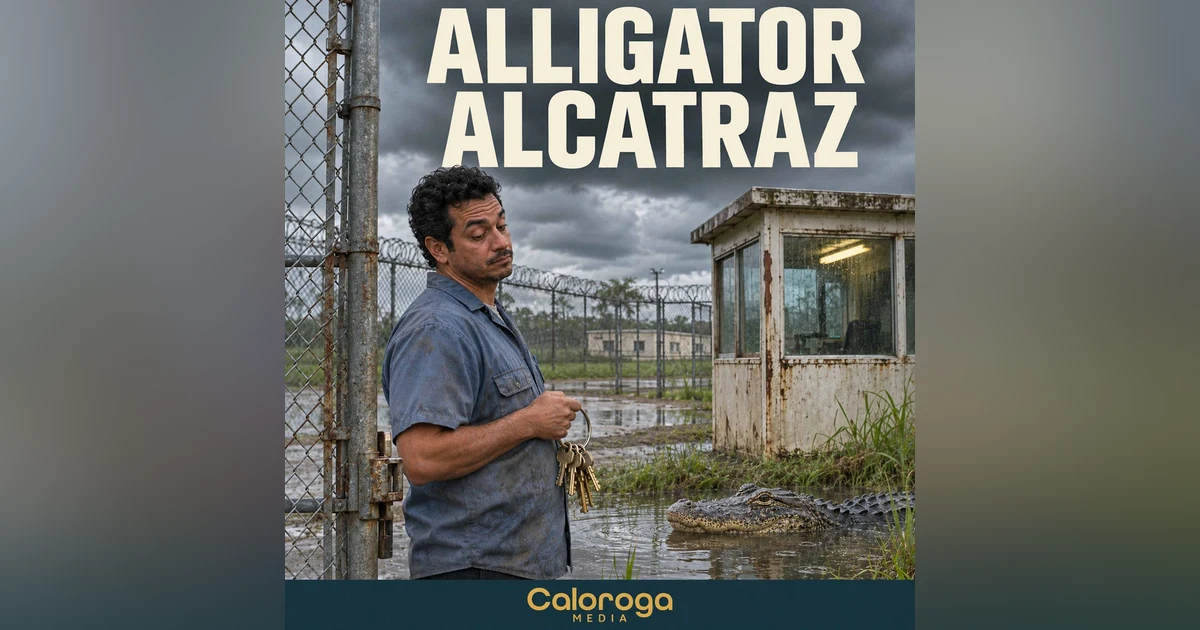



Gator Tales - Episode 4: "The Escape Committee" Week Three begins with chaos as Alligator Alcatraz faces closure and systematic transfers that threaten to separate recently reunited families. When Carlos Mendoza plans a desperate escape attempt to avoid being sent away from his wife and daughters, Tommy must convince him to trust Elena's plan for "bureaucratic jujitsu"—using transfer paperwork errors to route people toward their families.
Meanwhile, three other detainees attempt a dangerous boat escape through the Everglades, forcing Tommy's network to orchestrate a rescue operation that makes the incompetent administration look heroic while demonstrating the community's true leadership. As transfer buses arrive and people face scattering across the country, Tommy transforms Alligator Alcatraz's final days into a training ground for immigration rights organizing—preparing everyone to carry their hard-won knowledge to new battles.
To become a premium subscriber (no ads and no feed drops) visit caloroga.com/plus. For Apple users, hit the banner on your Apple podcasts app which seays UNINTERRUPTED LISTENING. For Spotify or other players, visit caloroga.com/plus. You also get 25+ other shows on the network ad-free! Go to Caloroga.com for all our shows!
0:03 Calarugu Shark Media. Week three at Alligator Alcatraz started with what the administration called operational transition planning and what everyone else understood as controlled panic. See when a federal facility gets shut down because of a corruption scandal, it don't just close like a restaurant that can't pay the rent. There's procedures to follow, investigations to coordinate, and about a thousand ways for bureaucrats to turn a simple closure into a bureaucratic disaster. The official word from Washington was that all detainees would be systematically relocated to appropriate facilities over the next seven days, which sounded orderly and professional until you realize that nobody in charge had any idea where eight hundred people were supposed to go, or how to get them there, or what to do about the families that Tommy and Elena had just finished reuniting. But the real crisis wasn't the bureaucratic confusion. The real crisis was what happened when desperate people realized they had one last chance to take control of their own situations. Monday morning of week three, I watched a man named Carlos Mendoza stand at the fence looking out at the swamp, calculating whether he could make it to dry land before the
1:35 water moccasins noticed he was there. Carlos had been separated from his wife and two daughters for six weeks. Tommy's network had located them in a facility in Arizona, but now that Alligator Alcatraz was closing, there was no guarantee Carlos would be transferred anywhere near them. For all he knew, this was his last chance to avoid being scattered to some other corner of the detention system. Carlos was planning to escape, and if Tommy couldn't stop him, that escape was going to destroy everything they'd built. This is episode four the Escape Committee. Now you might think that one man trying to escape wouldn't be much of a problem in a place that was already falling apart, But Carlos Mendoza wasn't just any detainee. He was one of the people Tommy's network had been helping with family reunification. If Carlos got caught trying to escape, the investigation would focus on how he'd gotten the information about his family's location.
2:50 That investigation would lead to Tommy's underground telegraph and that would expose Elena, whose whistleblowing had just brought down a congressman but left her vulnerable to retaliation if anyone discovered she was still operating inside the system. Tommy had about twelve hours to convince Carlos not to throw his life away on a desperate escape attempt that would destroy the network that was helping hundreds of other families. The conversation happened Tuesday morning behind the maintenance shed where Tommy had been conducting his quiet business for three weeks. Carlos, Tommy said, I know you're scared about the transfers. We all are, but running ain't going to get you closer to your family.
3:41 Carlos was a small man with calloused hands and the kind of quiet desperation that comes from watching your children disappear into a system. You don't understand. They're going to send me to Louisiana, he said. Elena found out my wife and girls are in Arizona. How am I supposed to get to them from Louisiana? Same way we got David back to his mother, Tommy said, same way we found your family in the first place. We use the system. The system Carlos laughed, but it wasn't a happy sound.
4:22 The system separated us. The system put me here. The system is about to scatter us again. Why should I trust the system to help me? Tommy understood Carlos's frustration, but he also understood something Carlos didn't. Sometimes, the best way to beat the system is to let it think it's winning while you work around it. Because Tommy said, Elena's got a plan. Elena's plan was typically brilliant and completely insane. Since the facility closure was creating chaos in the transfer system, she was going to use that chaos to engineer administrative errors that would route people toward their families instead of away from them. See, when you're moving eight hundred people to different facilities across the country, there's a lot of paperwork involved, transfer orders, transportation schedules, facility capacity reports, medical clearances, and when that paperwork has to be processed quickly by a bureaucracy that's already in crisis mode, mistakes are inevitable. Elena knew exactly what kinds of mistakes were most likely to happen, and more importantly, how to make sure those mistakes happened in the right direction. She'd
5:52 spent three weeks quietly observing the facilities, administrative procedures, mapping out who had access to which systems, and identifying the bottlenecks where a small change could have big consequences. Now she was going to put that knowledge to work. The key, Elena explained to Tommy, is that we're not trying to break the system. We're trying to help it fail in ways that benefit people instead of hurting them. Carlos would be transferred to Louisiana, just like his paperwork said, but through a series of clerical errors and rooting adjustments, his final destination would be a facility outside Phoenix, less than fifty miles from where his wife and daughters were being held.
6:41 It was an escape. It was what Elena called assisted navigation through bureaucratic inefficiency. But first they had to make sure Carlos didn't do anything stupid that would draw attention to their operation. Convincing Carlos to trust the system that had betrayed him was like convincing someone to walk back into a burning building. But Tommy had something that bureaucrats never understood. He had credibility with people who had no reason to trust authority. Look, Tommy said, three weeks ago, Maria was standing at that fence every morning looking for her son. You remember that, Carlos nodded David's with her. Now, not because the system worked the way it was supposed to, but because we made it work different. Elena and Luis and Pete and Maria and a dozen other folks. We figured out how to make things happen without waiting for permission.
7:48 Tommy pointed toward the housing units where families were gathering for the evening meal that had become a community ritual over the past three weeks. You see that that's not what they planned when they built this place. They plan to break people down, separate families, make everyone so desperate they'd sign whatever papers were put in front of them. But we built something different. We built a community. Carlos was quiet for a long moment, watching the families who'd been reunited through Tommy's network. But what happens when they transfer us all? He asked, what happens to the community.
8:29 Then Tommy smiled, that's the beautiful part, he said. They can transfer us, but they can't transfer what we learned. Every person who goes to a new facility carries this with them, the knowledge, the connections, the understanding that people don't have to be helpless just because they're in detention. That's when Carlos understood what Tommy was really building, not just a network for solving problems at Alligator Alcatraz, but a model that could work anywhere. People were being processed by systems that didn't care about their humanity. But Carlos wasn't the only person thinking about escape. Tuesday afternoon, Tommy discovered that three other men were planning their own break for freedom, and their plan was a lot more dangerous than anything Carlos had been considering. Miguel Restrepo, Jose Vargas, and Antonio Silva were planning to steal one of the guard boats during the evening shift change and try to navigate through the everglades to reach the main highway. These weren't men who'd been helped by Tommy's network. They were newer arrivals who'd been processed during the chaos of the facility closure and hadn't been integrated into the community that Tommy had built. They didn't trust the underground telegraph. They didn't believe in Elena's bureaucratic jiu jitsu, and they sure
10:01 didn't want to wait around to see where the transfer system would send them. They were going to make their own escape, regardless of the consequences for everyone else. The problem was that their escape plan was guaranteed to fail in the most spectacular way possible. None of them knew how to operate a boat, none of them understood the Everglades Waterway system, and none of them had any idea how to navigate through a swamp that had been confusing people for centuries. If they tried their escape, they'd either drown, get eaten by alligators, or get caught within hours and bring down a security crackdown that would destroy everything Tommy's network had accomplished. Tommy had to stop them without exposing his own operation or getting anyone in trouble with the authorities.
10:55 He needed what Old Pete called creative intervention. Pete Tran had been watching the three potential escapees for two days, and he'd come to the same conclusion as Tommy. Their plan was suicide with extra steps. They're going to take Boat three, Pete said, pointing toward the smallest of the guard boats that was moored near the administrative building. That's the one with the engine that stalls if you don't know how to work the choke. They'll get about half a mile before they're stranded. And then, Tommy asked, then they'll try to swim, and then they'll discover that the water between here and the highway is about ten miles of the most dangerous swamp in Florida, full of gaiters, snakes, sinkholes, and patches of water that look solid until you step on them. I'd spent forty years working these waters, and he knew every current, every hazard, every trick that the Everglades used to kill people who thought they were smarter than the swamp. Best case scenario, Pete continued, they get lost and the coast guard finds them before they die of exposure. Worst case, we're reading about them in the newspaper as an example of why detention security needs to
12:26 be increased. Tommy realized that the solution wasn't to stop the escape, it was to make sure it failed in a way that didn't hurt anyone. Pete, he said, how would you sabotage a boat so it looked like mechanical failure instead of sabotage Pete smiled, son, I've been making boats fail to start for longer than you've been alive. Question is, what do we do with three grown men when they're stranded in the middle of a swamp. That's when Tommy outlined what he called Operation Rescue Mission, a plan that would turn a dangerous escape attempt into an opportunity to demonstrate the competence of Tommy's network while making the administration look like heroes. The escape attempt happened Wednesday night, exactly as Pete had predicted. Miguel, Jose and Antonio slipped away during the evening shift change, made their way to the boat dock and attempted to start the engine on Boat three. The engine turned over a few times, sputtered, and died. They tried again, same result. What they didn't
13:57 know was that Pete had spent the afternoon making subtle adjustments to the fuel system that would allow the boat to start but not run for more than ten minutes at a time. After about twenty minutes of trying to get the engine running properly, the three men managed to get the boat started and headed out into the canal system that surrounded Alligator Alcatraz. Tommy was watching from the housing unit windows, along with about fifty other people who'd been quietly informed that something interesting was about to happen. The boat made it about half a mile before the engine died completely, leaving three men stranded in a small boat in the middle of a dark swamp with no paddles, no navigation equipment, and no idea how to get back to shore. That's when phase two of Tommy's plan began.
14:50 Luis appeared at the guard station to report that he'd seen men in the water and was concerned for their safety. Maria mentioned to one of the kitchen staff that she'd heard shouting from the direction of the canal, and Elena, using her knowledge of bureaucratic procedures, suggested to Deputy Warden mackenzie that the facility should conduct an immediate safety check of all detainees to ensure that everyone was accounted for. Within an hour, the guard staff had discovered that three men were missing and that there was an unauthorized boat somewhere in the waterway system around the facility. What followed was what Deputy Warden Chet mackenzie later described as a textbook example of crisis response coordination and what everyone else recognized as a comedy of errors that somehow resulted in a successful rescue operation. McKenzie immediately activated what he called Emergency Protocol seven, a plan that involved alerting the Coast Guard, notifying state and federal law enforcement, and coordinating a multi agency search and rescue operation. The problem was that none of the agencies involved had any experience with a specific waterway system around Alligator Alcatraz, which had been created by the facility's own drainage disasters over the previous three weeks.
16:22 The Coast Guard dispatched boats that were too large to navigate the shallow canals, the state police sent helicopters that couldn't see anything through the swamp canopy, and the Federal marshals arrived with equipment designed for urban fugitive recovery, not swamp navigation. Meanwhile, Pete had quietly launched one of the other facility boats with Tommy Luis and two other men who actually knew how to operate in the Everglades. Pete navigated directly to the spot where he knew the escape peas would be stranded, a small island of solid ground at two miles from the facility, where the current would have pushed their disabled boat. They found Miguel, Jose and Antonio exactly where Pete had predicted, wet, scared, covered in mosquito bites, and extremely grateful to see anyone who looked like they might be able to get them back to civilization.
17:22 You boys looked like you might need some help, Pete said, as they pulled the three men into their boat. How did you find us, Miguel asked, well, Pete said, I've been working these waters since before you were born, and when you know the water, the water tells you where everything is. The rescue operation that followed was a masterpiece of bureaucratic theater. Pete navigated back to the facility with the three escape detainees, but instead of returning directly to the dock, he radioed ahead to let the authorities know that he'd located the missing men and was bringing them back safely. This allowed Deputy Warden mackenzie to coordinate the official rescue with the Coast Guard, state Police, and federal marshals, making it look like the multi agency response had been successful.
18:26 The three escapees were returned to the facility wet, tired, and completely cured of any desire to try navigating the Everglades on their own. They'd learned firsthand why the swamp was considered more effective than razor wire for keeping people from wandering off. But more importantly, they'd learned something about the community that Tommy had built. See. Instead of turning them in or letting them face the consequences of their escape attempt alone, Tommy's network had quietly orchestra their rescue in a way that protected them from serious punishment while demonstrating to the administration that the detainee population could be trusted to help with crisis management. Mackenzie issued a statement praising the cooperative attitude of the detainee population and their valuable assistance in the successful rescue operation. He recommended that similar community engagement protocols be implemented at other facilities as examples of innovative detention management. The Coast Guard commended the facility's effective emergency response procedures, the State Police noted the excellent interagency coordination, and the Federal Marshals included the incident in their report as an example of successful fugitive recovery operations.
19:53 Everyone took credit for a rescue that had been engineered by people they were planning to deport. But the most important result of the escape attempt was what it did for community morale. During the final week of the facilities operation, Miguel, Jose and Antonio went from being outsiders who didn't trust anyone to being part of the network that had saved them from their own bad decisions. They started helping with the work that needed to be done, sharing information about transfer schedules, and looking out for other people who might be tempted to try desperate measures. More importantly, their rescue demonstrated to everyone at the facility that Tommy's Network didn't just help people when things were going well. It was there for people when they made mistakes, when they were scared, when they were desperate enough to make dangerous choices. Word got around, as word always does in places where people have nothing to do but talk to each other. Tommy's people had engineered the whole thing not to embarrass the three men who tried to escape, but to make sure they didn't get hurt and to prove that the community could take care of its own. By Thursday morning, Tommy's Network had gone from being a group of people who helped with practical problems to being the unofficial leadership of the entire facility. People came to them with questions about
21:24 transfer procedures, concerns about where they were being sent, problems with paperwork, and requests for help contacting family members. Elena was running what amounted to a legal aid clinic out of the library, Luis was teaching survival skills to people who were going to be transferred to facilities in unfamiliar climates, and Pete was sharing knowledge about how to read bureaucratic systems and navigate institutional procedures. Tommy had created something that was more than a network or community. He'd created a school for surviving the immigration detention system, and with only three days left before the facility closed, he was running out of time to make sure that education would continue after everyone was scattered across the country. Thursday evening, Tommy called what he described as a planning meeting, but what everyone understood was a graduation ceremony for the community they'd built over the past three weeks. About two hundred people gathered in the recreation area behind housing unit see families sitting together in the humid Florida evening, listening to Tommy explain what was going to happen over the next few days.
22:51 Tomorrow they start the transfers, Tommy said, some folks are going to facilities in Texas, some to Louisiana, some to Arizona and California. Some of y'all are going to be released to await your hearings from outside detention. He paused, looking out at faces he'd come to know over three weeks of shared work and shared hope. But here's what I want everyone to understand. What we built here don't depend on this place. It depends on people, and everywhere y'all go, you're carrying this with you. Tommy pointed to Maria and David, sitting together with their arms around each other.
23:36 Maria knows how to organize food service and coordinate with kitchen staff. David learned how to navigate bureaucratic procedures and help people fill out paperwork. He gestured toward Louise. Louise can teach people about foraging, about reading the environment, about making any place more livable, and he knows how to build trust with people who've never worked together before. Tommy nodded toward Elena, who'd been sitting quietly at the edge of the group. Elena understands how government systems actually work, how to find the pressure points where small changes can have big effects, and she knows how to turn bureaucratic chaos into opportunities for people instead of disasters. Every one of you, Tommy continued, learn something here that you can use wherever you end up. Not just practical skills, but something more important. You learn that you don't have to be helpless just because you're in a system that treats you like you don't matter what. Tommy described that Evening was a network that would continue operating even after Alligator Alcatraz was closed and everyone was scattered to different facilities.
24:57 Elena would maintain contact with people through the leadlegal aid organizations that were monitoring the corruption cases. Luis would connect with agricultural and environmental groups that could provide resources and support. Maria would work with family reunification services and immigrant rights organizations, and Pete Old Pete, who'd been teaching people to read the currents and navigate dangerous waters. Pete would coordinate with a network of commercial fishermen and boat operators along the Gulf coast who'd been quietly helping people for years. What we're creating, Tommy explained, is bigger than anyone facility or anyone situation. We're creating a system that helps people survive bureaucratic cruelty with their dignity intact, no matter where they end up. It was an escape from the immigration detention system.
25:54 It was transformation of it, one person at a time, one facility at a time, one family at a time. Elina stood up and addressed the group in both English and Spanish, explaining how the corruption investigation was going to create opportunities for people to challenge their cases, to demand proper legal representation, to insist on their rights to family reunification. What happened here, she said, proves that even the most powerful people can be brought down by the truth. And the truth is that families belong together, that people deserve to be treated with dignity, and that ordinary people working together can accomplish extraordinary things. As the meeting ended and people started returning to their housing units for what might be their last night together, Tommy realized that he'd accomplished something he'd never intended when he first arrived at Alligator Alcatraz.
26:55 He'd turned a detention center into a training ground for immigration rights organizeds. Friday morning came with transfer buses lined up outside the gate, like school buses at the end of the academic year, ready to take people to new facilities across the South and Southwest. But it also came with something else, a delegation of lawyers, immigrant rights advocates, and family reunification specialists who'd derived to monitor the transfer process and provide legal assistance to people whose cases had been affected by the corruption scandal. Elena had been busy during her final week at Alligator Alcatraz. Using her contacts in Washington and her knowledge of the legal aid network, she'd arranged for the facility closure to be monitored by every immigrant rights organization in Florida. The transfers weren't happening in the shadows. They were happening under the watchful eyes of people who would follow up on each case and make sure that no one disappeared into the system. More importantly, Elena had used her insider knowledge to identify people whose detention was legally questionable, whose paperwork had been manipulated, whose cases deserved immediate review. About sixty people were being released directly from Alligator Alcatraz instead of being transferred to other facilities.
28:26 Among them was Carlos Mendoza, who would be reunited with his wife and daughters in Phoenix within the week. Tommy watched the buses load with a mixture of sadness and satisfaction. Sadness because he was saying goodbye to people who'd become family over three intensive weeks. Satisfaction because he knew that the network they'd built was going to continue working long after Alligator Alcatraz was nothing but a memory. As the last bus pulled away, carrying Luis and Pete and Marie and dozens of others to new challenges in new places, Tommy realized that his own transfer paperwork was still being processed.
29:10 Unlike the others, Tommy wasn't being sent to another detention facility. His case had been expedited for release, partly because of the facility closure and partly because of Elena's behind the scenes legal work. By Sunday, Tommy Esperanza would be free to go wherever he wanted. The question was whether he was ready to leave behind the work he'd started. Saturday evening, with the facility nearly empty and the administrative staff packing up their offices. Tommy and Elena sat by the canal where it all started, watching the alligator's cruise through water that was finally running clear. You did something remarkable here, Elena said. You turned a place designed to break people into a place that built them up. Tommy was quiet for a moment, listening to the sounds of the everglades settling into another night. We all did it, he said, Finally, you, Me, Louis, Pete, Maria, everyone, We just proved that people don't have to accept cruelty just because it comes with official authorization. Elena smiled. So what happens now? You're free to go. You could disappear, start over somewhere new, put all this behind you. Tommy looked out at the empty buildings that would be demolished within the month, at the canals that would be filled in,
30:40 at the land that would be returned to the wilderness It had been before politicians decided to build their monument to bureaucratic efficiency in the middle of a swamp. I've been thinking about that, he said, and I realized something. What we built here wasn't about this place. It was about proving what's possible when people work together instead of against each other. He turned to Elena, You're going to keep fighting this system from the outside, using everything you learned here to help other people write. Elena nodded. I've got enough evidence to keep prosecutors busy for years, and I know how to make sure that evidence gets to people who can use it to help families instead of just punish politicians. Then I reckon. My job ain't finished, either, Tommy said. As week four of Alligator Alcatraz dawned, Tommy faced the choice that would define everything that came after, whether to take his freedom and disappear, or to use what he'd learned to keep fighting for people who were still trapped in systems designed to destroy their hope. It wasn't really a choice at all.