When Rape Culture Goes Viral: What Happens When Power, Platforms and Pain Go Viral
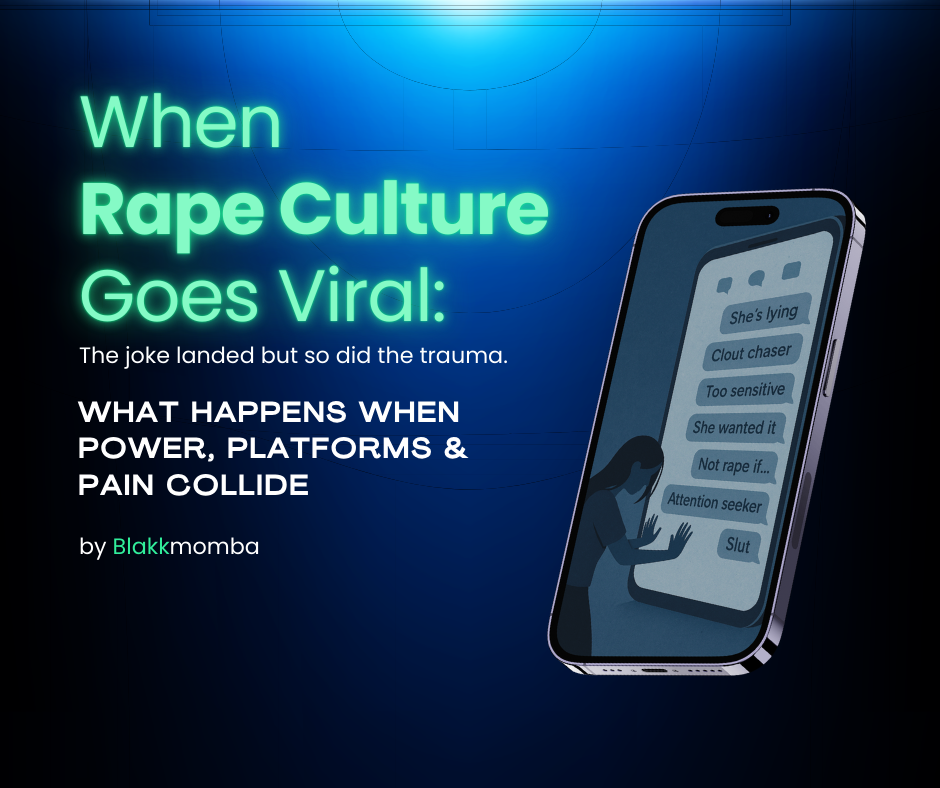
A single “joke” about assault exposes how the internet turns trauma into trending content—and why calling it out is vital for every survivor watching in silence.
By Blakk momba | Host of Momba Raw and Unfiltered
The "Joke" That Wasn't a Joke
I woke up to the kind of post that makes your chest tighten.
A screenshot of a legal document.
A graphic.
A joke.
The latest punchline in a case about rape.
It was about his size. A “tootsie roll” comparison.
50 Cent posted it with a laugh track playing in the background of social media.
And everybody jumped in line to ha-ha like it was just petty gossip and not somebody’s real-life trauma.
But let’s slow down for a second.
Let’s name it for what it is.
This is rape.
And rape isn’t funny.
It’s not a meme.
It’s not viral content.
It’s not something you remix with a song and laugh about on your morning scroll.
It’s violation.
It’s control.
It’s pain.
It’s survival.
This Was Never About Sex
Let’s be real—rape has never been about sex.
It’s about power. Domination. Humiliation.
The ability to take something from someone and dare them to say a word about it.
According to the CDC, nearly 1 in 4 women in the U.S. have experienced rape or attempted rape.
For Black women, it’s even more devastating—over 20% have been raped in their lifetime.
One in four Black girls will be sexually abused before they turn 18.
But we’re making jokes about penis size?
The Line That Broke Me
Let me tell you what broke me about that post.
It was the part where the survivor, Jane Doe, said she felt “relieved” when she saw his penis—because she thought it wouldn’t hurt as much.
Let that sit for a second.
She had to find a silver lining in her own rape.
Had to convince herself it might be less traumatic because the man violating her wasn’t well-endowed.
That’s not a joke.
That’s psychology.
That’s survival.
That’s what it looks like when women are forced to minimize their own pain just to mentally survive something they never consented to.
And y’all laughed.
If You Wanna Talk About Size…
Let’s really talk about it.
Men have been taught that their manhood is measured in inches.
That their power is tied to their ability to dominate—financially, emotionally, sexually.
That their status depends on how many people they can conquer, control, humiliate, or impress.
When that illusion cracks?
When a man with money, access, and influence still feels small?
He starts to take from others to fill what he lacks inside.
Not just physically—but emotionally, psychologically, spiritually.
This ain’t about the size of a man’s penis.
This is about the size of his ego.
And what happens when that ego is bruised and broken and left to fester inside a system
that teaches men that someone else’s body is theirs to fix it with.
You don’t have to be a psychologist to see it.
You just have to be a woman who’s survived one.
This Case Is a Mirror
This case isn’t just about one man.
It’s not about one woman.
It’s not even about celebrity.
It’s a mirror.
It shows us what we really care about.
What we’re willing to defend.
What kind of pain we’re willing to make viral—and what kind we ignore.
Because when a survivor comes forward about someone powerful, the public doesn’t ask “What happened to her?”
They ask:
“Why did she stay?”
“Why now?”
“What does she want?”
And that tells me everything.
It tells me we’re still a culture that would rather protect rapists than believe women.
It tells me we’re still more comfortable dissecting her silence than his violence.
And it makes me sick.
Why Women Don’t Speak Up
You want to know why women don’t speak up?
Because when we do, we get memed.
We get mocked.
We get minimized.
We get made into punchlines and punchbags at the same time.
Then people say, “It’s just the internet. Y’all take it too seriously.”
No. This IS serious.
The internet is where our girls are growing up.
It’s where they’re learning what they’re worth.
What they should look like.
How they should act.
What they should tolerate.
And when we flood this space with rape jokes and memes about women’s trauma,
we’re teaching them to laugh at their own pain before anyone else can.
We’re teaching them to be silent.
To stay pretty.
To stay liked.
We’re teaching them that if they ever speak up, this is the price.
For My Girls
And I reject that.
I reject that for my daughters.
I reject that for every girl who’s still carrying what happened to her in silence.
I reject that for the woman who’s scrolling today and seeing her entire story turned into a comment thread.
We tell girls to speak up, then tear apart the women who do.
We say we care about Black women, but don’t believe them.
Don’t protect them.
Don’t amplify them unless they’re singing, performing, or dying.
And that is why I speak.
Not because it’s popular.
Not because it’s safe.
But because somebody has to interrupt this cycle.
We are failing women.
We are failing girls.
And we are failing the future.
Because while y’all are making memes, these girls are trying to figure out how to love themselves
in a world that won’t even believe them.
I thank God every day that what I’ve been through didn’t break me—
because now I can be loud about what others still have to whisper.
I may do what I do for the world.
But I do what I do for them.
For my girls.
So they know that their bodies are not bargaining chips.
Their silence is not expected.
And their survival is sacred.
So no, I’m not laughing.
The joke?
It was never funny.
And if you can laugh at rape, the problem isn’t the size of his penis.
It’s the size of your soul.
— Blakkmomba
Resources for Survivors
If you or someone you love has experienced sexual violence, you’re not alone.
You are worthy of safety, healing, and being heard.
Visit RAINN.org or call 1-800-656-HOPE.
📌 Resources & Citations
Community Spotlight: Building Bridges With Words